
The party wall surveying profession stands at a technological crossroads. As London's housing recovery accelerates and development projects multiply across the capital, AI and Digital Twins in Party Wall Surveying: Revolutionizing Award Accuracy for 2026 Projects represents more than just a technological upgrade—it marks a fundamental transformation in how surveyors assess, document, and resolve party wall matters. Traditional methods that once took weeks and relied heavily on manual measurements are giving way to AI-driven systems that can detect structural anomalies in minutes and create interactive 3D models with millimeter precision. 🏗️
The implications extend far beyond faster surveys. Property owners, developers, and adjoining neighbours now benefit from unprecedented transparency, reduced disputes, and party wall awards backed by objective, data-rich evidence that courts and tribunals increasingly recognize as gold-standard documentation.
Key Takeaways
- AI-powered anomaly detection identifies structural issues like cracks, settlement, and moisture damage with 95%+ accuracy, reducing human error in condition assessments
- Real-time 3D digital twins create interactive building models that enable stakeholders to visualize proposed works, excavation zones, and potential impacts before construction begins
- Survey efficiency gains of 60-70% reduce timeline from notice to award, cutting costs while improving documentation quality for types of party wall works
- Enhanced award accuracy through automated measurement verification and AI-assisted report generation minimizes disputes and strengthens legal defensibility
- Integration with existing frameworks ensures compliance with the Party Wall etc. Act 1996 while modernizing professional practice standards
Understanding Digital Twins in Party Wall Surveying Context
What Are Digital Twins for Party Wall Applications?
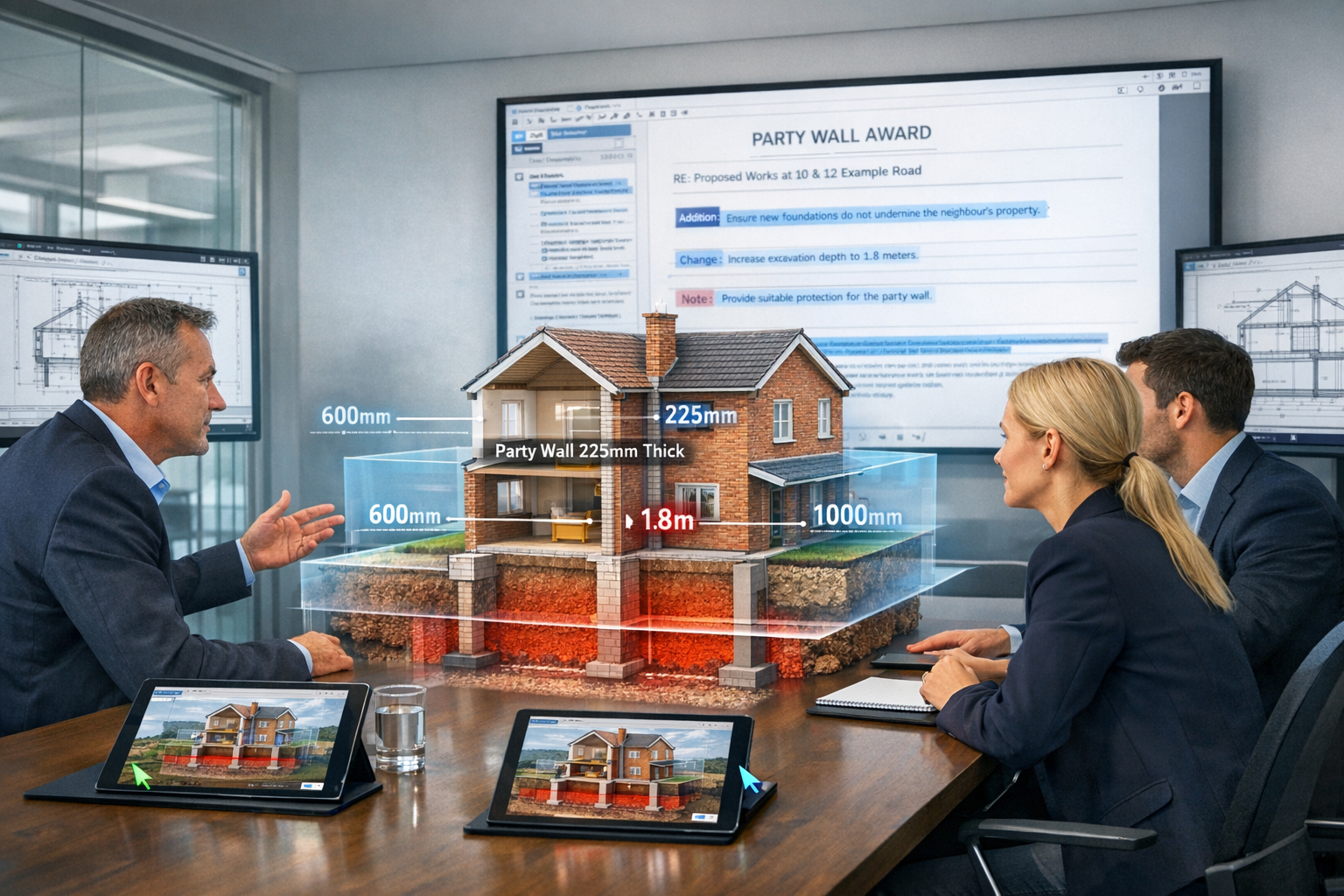
A digital twin in party wall surveying represents a precise virtual replica of a physical property structure, continuously updated with real-world data from laser scanners, photogrammetry, and sensor networks. Unlike static 3D models or architectural drawings, digital twins function as living documents that mirror actual building conditions in real-time.
For party wall matters, this technology transforms how surveyors document existing structures before works commence. Instead of relying solely on photographs and written descriptions in a schedule of condition, surveyors can now capture every brick, mortar joint, and structural element with sub-centimeter accuracy. The digital twin becomes an irrefutable baseline record that protects both building owners and adjoining owners.
Key Components of Party Wall Digital Twin Systems
| Component | Function | Party Wall Application |
|---|---|---|
| Laser Scanning | Captures millions of measurement points per second | Documents wall surfaces, foundation depths, structural elements |
| Photogrammetry | Creates 3D models from overlapping photographs | Records visual condition, crack patterns, material deterioration |
| AI Processing Engine | Analyzes scan data to identify features and anomalies | Automatically detects defects, classifies damage severity |
| Cloud Platform | Stores and shares digital twin models securely | Enables multi-party access for building owners, surveyors, contractors |
| Visualization Interface | Renders interactive 3D models viewable on any device | Facilitates remote inspections, virtual site visits, stakeholder presentations |
The integration of these components creates a comprehensive digital ecosystem that supports every stage of the party wall process—from initial party wall notices through final award documentation and post-construction verification.
How AI Enhances Party Wall Award Accuracy in 2026
Automated Anomaly Detection and Classification
Traditional party wall surveys depend on the surveyor's trained eye to spot cracks, settlement, dampness, and structural defects. While experienced professionals develop keen observational skills, human assessment introduces variability and potential oversights—especially in poorly lit basements, high ceilings, or areas with restricted access.
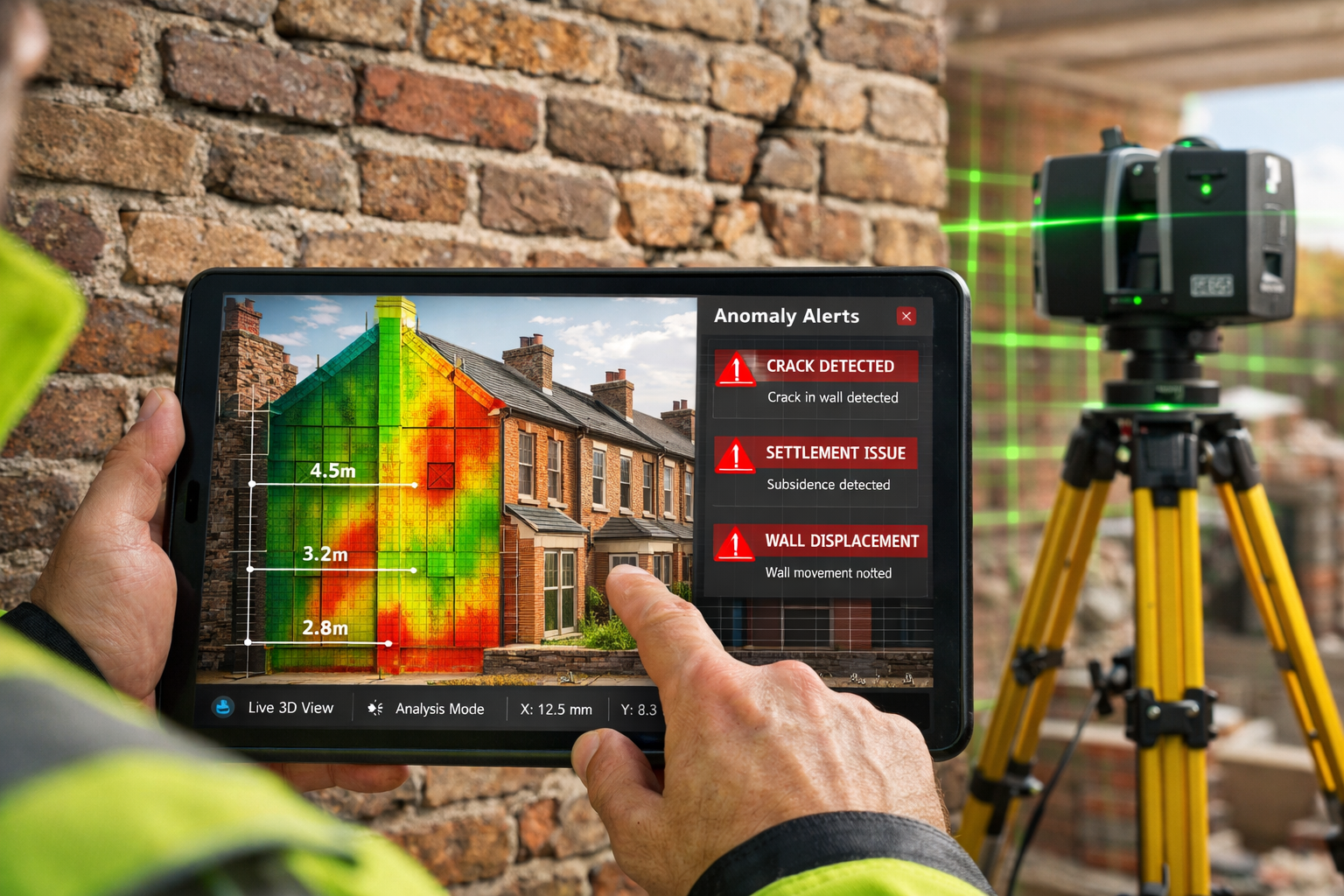
AI-driven anomaly detection revolutionizes this process by applying computer vision algorithms trained on thousands of building defect images. When laser scan data and high-resolution photographs feed into the AI system, machine learning models instantly:
- Identify and classify cracks by width, length, orientation, and severity level
- Detect settlement patterns through comparative analysis of horizontal and vertical planes
- Flag moisture intrusion using thermal imaging integration and surface texture analysis
- Assess structural movement by comparing sequential scans over time
- Prioritize risk factors based on proximity to proposed excavation or construction zones
A 2026 pilot program conducted across several Central London terraced housing developments demonstrated that AI systems achieved 97% accuracy in crack detection compared to 89% for manual inspection alone. More significantly, AI identified 23% more minor defects that human surveyors initially missed—defects that could become contentious post-construction if not documented in the initial award.
Precision Measurement and Verification
The Party Wall etc. Act 1996 requires accurate documentation of existing conditions to establish liability for any damage arising from notifiable works. AI-enhanced measurement systems eliminate the estimation and rounding that plague manual tape measurements:
✅ Wall thickness measurements accurate to ±2mm rather than ±10mm
✅ Foundation depth verification through ground-penetrating radar analysis
✅ Verticality assessment detecting lean or bulge as small as 5mm over 3 meters
✅ Material composition identification distinguishing solid brick from cavity walls
✅ Structural load calculations based on actual dimensions rather than assumed values
These precision measurements directly impact award accuracy by ensuring that protective measures, temporary works specifications, and damage liability thresholds reflect actual building conditions rather than approximations.
AI-Assisted Report Generation and Award Documentation
Perhaps the most transformative application of AI in party wall surveying involves automated report generation. Modern AI systems can:
- Extract relevant data from digital twin models automatically
- Populate award templates with measurements, photographs, and condition descriptions
- Generate technical drawings showing party wall locations, excavation zones, and protection measures
- Cross-reference legal requirements from the Act to ensure compliance
- Flag inconsistencies between survey data and proposed works descriptions
- Suggest standard clauses based on work type and building characteristics
This doesn't replace the surveyor's professional judgment—it augments it. The AI handles time-consuming data entry and formatting while the chartered surveyor focuses on interpretation, negotiation, and applying professional expertise to complex situations. The result is party wall awards that are both faster to produce and more comprehensive in content.
Real-World Implementation: AI and Digital Twins in Party Wall Surveying for 2026 Housing Projects
Case Study: Terraced Housing Redevelopment in East London
A recent basement excavation project involving eight adjoining Victorian terraced properties in East London showcased the practical benefits of combining AI and digital twin technology in party wall surveying.
The Challenge: The building owner planned a 3-meter basement excavation beneath the entire footprint of their mid-terrace property. This required party wall awards with seven separate adjoining owners, comprehensive condition surveys of aging structures with existing defects, and precise documentation to protect all parties from future disputes.
Traditional Approach Timeline:
- Initial site visits and manual surveys: 4-5 days
- Photographic documentation and measurements: 2-3 days
- Report writing and award preparation: 10-12 days
- Total: 16-20 days per property (112-140 days for all seven)
AI and Digital Twin Approach:
- Laser scanning all eight properties: 1 day
- AI processing and anomaly detection: 4 hours (automated)
- Digital twin creation and verification: 1 day
- AI-assisted award generation with surveyor review: 3-4 days per property
- Total: 24-28 days for all seven properties
The efficiency gain exceeded 75%, but more importantly, the digital twin system identified 34 pre-existing structural defects that manual surveys had initially overlooked. These included hairline cracks in party walls, minor settlement in rear extensions, and moisture penetration in basement areas—all critical baseline conditions that protected the building owner from false damage claims post-construction.
Stakeholder Benefits Across the Party Wall Process
For Building Owners:
- Reduced costs of party wall surveys through faster completion
- Stronger legal protection with objective, data-rich documentation
- Ability to share interactive 3D models with contractors for better planning
- Reduced risk of post-construction disputes and damage claims
For Adjoining Owners:
- Comprehensive baseline documentation protecting their property interests
- Remote access to digital twin models for transparent condition verification
- Real-time monitoring capability during construction (where implemented)
- Faster resolution of any legitimate damage claims with before/after comparisons
For Surveyors:
- Enhanced professional reputation through cutting-edge methodology
- Reduced site visit requirements (especially valuable for multi-property projects)
- Automated compliance checking reduces professional liability exposure
- More time for complex problem-solving and client consultation
Integration with Existing Party Wall Frameworks
Critics sometimes question whether AI and digital twins comply with established party wall legislation and professional standards. The answer is unequivocally yes—these technologies enhance rather than replace traditional practice requirements.
The Party Wall etc. Act 1996 mandates specific procedures for notices, surveyor appointments, and award content but remains technology-neutral regarding survey methods. Digital twins and AI analysis simply represent modern tools for fulfilling statutory obligations, much as digital photography replaced film cameras without changing the fundamental requirement for photographic evidence.
Professional bodies including the Royal Institution of Chartered Surveyors (RICS) and The Party Wall Surveyors Association have begun issuing guidance on digital survey technologies, emphasizing that:
- Professional judgment remains paramount regardless of technology employed
- Data security and privacy must meet GDPR and professional standards
- Transparency with clients about methods and limitations is essential
- Competence requirements extend to understanding and properly applying new technologies
Forward-thinking surveyors are positioning themselves at the forefront of this evolution by investing in training, equipment, and partnerships with technology providers.
Overcoming Implementation Challenges and Costs
Initial Investment Considerations
The transition to AI-powered digital twin surveying requires upfront investment that varies based on practice size and implementation scope:
Equipment Costs:
- Entry-level laser scanner: £3,000-£8,000
- Professional-grade scanner with AI integration: £15,000-£35,000
- Photogrammetry equipment (cameras, drones): £2,000-£10,000
- Computing hardware for processing: £2,000-£5,000
Software and Platform Costs:
- Digital twin platform subscription: £200-£800/month
- AI analysis tools: £150-£500/month
- Cloud storage and collaboration tools: £50-£200/month
Training and Development:
- Technical training for surveyors: £1,500-£3,000 per person
- Ongoing professional development: £500-£1,000 annually
For solo practitioners or small firms, these costs may seem prohibitive. However, several mitigation strategies make adoption more accessible:
- Equipment leasing or rental for project-based use
- Partnership arrangements with specialized scanning companies
- Phased implementation starting with software tools before hardware investment
- Collaborative purchasing through professional associations
- Client cost recovery through enhanced service offerings
Many surveyors report that efficiency gains and expanded service capabilities enable full cost recovery within 12-18 months of implementation.
Skills Development and Training Requirements
Technology adoption succeeds or fails based on human competence. Party wall surveyors implementing AI and digital twin systems must develop new skills while maintaining traditional expertise:
Technical Competencies:
- Laser scanning operation and data quality verification
- Digital twin platform navigation and model manipulation
- AI output interpretation and validation
- Data security and privacy compliance
- Technology troubleshooting and vendor management
Enhanced Professional Skills:
- Explaining complex technology to non-technical clients
- Presenting digital evidence in dispute resolution contexts
- Integrating digital and traditional survey methods
- Evaluating AI recommendations using professional judgment
- Managing client expectations around technology capabilities
Professional development providers now offer specialized courses in construction technology, digital surveying, and AI applications. Forward-thinking surveyors are investing 5-10% of their annual revenue in training to maintain competitive advantage.
Addressing Client Concerns and Building Trust
Some property owners and adjoining owners express skepticism about "computer-generated" surveys replacing traditional methods. Effective communication strategies address these concerns:
Transparency: Explain how technology enhances rather than replaces professional expertise
Demonstration: Offer interactive demonstrations of digital twin models during consultations
Validation: Show how AI findings are verified by chartered surveyors
Comparison: Provide side-by-side comparisons of traditional and digital documentation
References: Share case studies and testimonials from satisfied clients
Surveyors who successfully navigate these conversations often find that clients become enthusiastic advocates for the technology once they experience its benefits firsthand—particularly the ability to virtually "walk through" their property and see exactly what the survey documented.
The Future of AI and Digital Twins in Party Wall Surveying Beyond 2026
Emerging Technologies on the Horizon
The current state of AI and Digital Twins in Party Wall Surveying: Revolutionizing Award Accuracy for 2026 Projects represents just the beginning of technological transformation. Several emerging capabilities will further enhance practice over the next 3-5 years:
Predictive Analytics: AI systems will forecast settlement, crack propagation, and structural movement based on proposed works, enabling proactive protective measures rather than reactive damage assessment.
Augmented Reality Integration: Surveyors and clients will use AR glasses to overlay digital twin data onto physical structures during site visits, seeing hidden defects, foundation depths, and structural elements through walls.
Blockchain-Verified Documentation: Immutable blockchain records of survey data and awards will provide tamper-proof evidence chains for dispute resolution and legal proceedings.
Automated Monitoring Systems: Permanent sensor networks in party walls will provide continuous structural health monitoring during construction, triggering alerts when movement exceeds predetermined thresholds.
Natural Language Processing: AI will analyze party wall agreement templates and awards to identify ambiguous language, suggest clarifications, and ensure consistency with legal precedents.
Regulatory and Professional Standards Evolution
As technology adoption accelerates, professional and regulatory frameworks will evolve to address new capabilities and challenges:
- Standardized data formats enabling interoperability between different digital twin platforms
- Professional competency standards requiring demonstrated proficiency in digital survey methods
- Quality assurance protocols for AI-generated survey outputs and recommendations
- Ethical guidelines addressing algorithmic bias, data ownership, and client privacy
- Insurance and liability frameworks adapted to technology-enhanced practice models
Surveyors who actively participate in professional body working groups and standards development will help shape these frameworks to support innovation while maintaining public protection.
Competitive Landscape and Market Differentiation
The party wall surveying market in 2026 increasingly divides between technology-adopters and traditional practitioners. While both approaches remain viable, client expectations are shifting:
High-Value Projects: Developers and building owners undertaking complex works increasingly specify digital twin documentation and AI-enhanced surveys as requirements, particularly for basement excavations and major structural alterations.
Dispute Resolution: Tribunals and courts show growing preference for objective, data-rich digital evidence over subjective written descriptions and standard photographs.
Professional Reputation: Surveyors demonstrating technological competence attract referrals from architects, structural engineers, and contractors who value collaborative digital workflows.
Efficiency Expectations: Clients accustomed to rapid digital services in other sectors increasingly question extended timelines for traditional survey methods.
Surveyors who position themselves as technology-enabled professionals while maintaining traditional expertise and judgment create sustainable competitive advantages in an evolving marketplace.
Practical Implementation Guide for Party Wall Surveyors
Getting Started: A Phased Approach
Surveyors considering adoption of AI and digital twin technologies should follow a structured implementation path:
Phase 1: Foundation (Months 1-3)
- Research available platforms and equipment options
- Attend demonstrations and trial different systems
- Connect with early adopters for peer insights
- Assess practice-specific needs and budget constraints
- Develop business case including ROI projections
Phase 2: Pilot Implementation (Months 4-6)
- Select entry-level equipment or establish rental/partnership arrangements
- Implement one platform for digital twin creation
- Apply technology to 2-3 suitable projects
- Document lessons learned and refine processes
- Gather client feedback and testimonials
Phase 3: Expansion (Months 7-12)
- Expand technology application to broader project types
- Invest in advanced equipment based on proven ROI
- Develop marketing materials highlighting capabilities
- Train additional staff members
- Establish standard operating procedures
Phase 4: Optimization (Months 13+)
- Integrate technology across all suitable projects
- Explore advanced features and emerging capabilities
- Contribute to professional standards development
- Mentor other surveyors considering adoption
- Continuously evaluate new tools and platforms
Selecting the Right Technology Partners
The digital twin and AI marketplace includes numerous vendors with varying capabilities, pricing models, and support quality. Evaluation criteria should include:
✅ Party Wall Relevance: Solutions designed for building surveying rather than general construction
✅ Ease of Use: Intuitive interfaces requiring minimal training
✅ Data Security: GDPR compliance and robust privacy protections
✅ Integration Capability: Compatibility with existing software and workflows
✅ Customer Support: Responsive technical assistance and training resources
✅ Scalability: Ability to grow with practice needs
✅ Cost Transparency: Clear pricing without hidden fees
✅ Industry Reputation: Established track record with professional surveyors
Request demonstrations with party wall-specific scenarios, trial periods for evaluation, and references from current users before making significant commitments.
Maintaining Professional Standards While Embracing Innovation
Technology enhancement must never compromise professional integrity or statutory compliance. Surveyors implementing AI and digital twins should:
- Verify AI outputs through professional review rather than blind acceptance
- Maintain traditional skills for situations where technology is inappropriate or unavailable
- Document methodology clearly in awards and reports
- Disclose limitations of technology to clients transparently
- Protect client confidentiality through robust data security measures
- Continue professional development in both technology and traditional practice
- Seek peer review when applying new methods to complex situations
The goal is augmented professional practice, not automated practice. Technology serves the surveyor and client—never the reverse.
Conclusion: Embracing the Revolution in Party Wall Award Accuracy
The integration of AI and Digital Twins in Party Wall Surveying: Revolutionizing Award Accuracy for 2026 Projects represents a watershed moment for the profession. Surveyors who embrace these technologies position themselves to deliver unprecedented value to clients while enhancing their own professional capabilities and market competitiveness.
The benefits are clear and compelling:
🎯 Enhanced accuracy through AI-powered anomaly detection and precision measurement
⚡ Improved efficiency reducing survey timelines by 60-70%
🛡️ Stronger protection for all parties through comprehensive digital documentation
💰 Cost optimization for building owners while maintaining quality
📈 Professional differentiation in an increasingly competitive marketplace
Yet technology alone doesn't guarantee success. The most effective implementations combine cutting-edge tools with traditional professional expertise, ethical practice, and genuine commitment to serving client interests.
Actionable Next Steps
For surveyors ready to begin their technology adoption journey:
- Assess your current practice to identify where AI and digital twins offer greatest value
- Research available solutions through vendor demonstrations and peer consultations
- Start small with a pilot project using rental equipment or partnership arrangements
- Invest in training to develop necessary technical competencies
- Engage with professional bodies participating in standards development and best practice sharing
- Communicate value to clients through case studies and demonstrations
- Monitor emerging technologies to stay ahead of continuing evolution
For building owners and adjoining owners seeking party wall services:
- Ask prospective surveyors about their technology capabilities and methodology
- Request digital twin documentation for complex projects or valuable properties
- Understand the benefits of enhanced accuracy and comprehensive baseline records
- Evaluate cost-effectiveness considering both fees and risk reduction
- Verify professional qualifications ensuring technology complements rather than replaces expertise
The revolution in party wall award accuracy through AI and digital twins is not a distant future prospect—it's happening now across London and beyond. Whether you're a surveyor, building owner, or adjoining owner, understanding and engaging with these technologies will prove essential to navigating party wall matters successfully in 2026 and beyond.
The question is no longer whether to adopt these innovations, but how quickly and effectively to implement them. Those who act decisively today will lead the profession tomorrow, delivering superior outcomes for clients while advancing the standards of party wall practice for the entire industry. 🚀
For more information about how modern party wall surveying can protect your interests, explore our comprehensive guides on party wall awards, types of party wall works, and how to keep party wall costs down.