

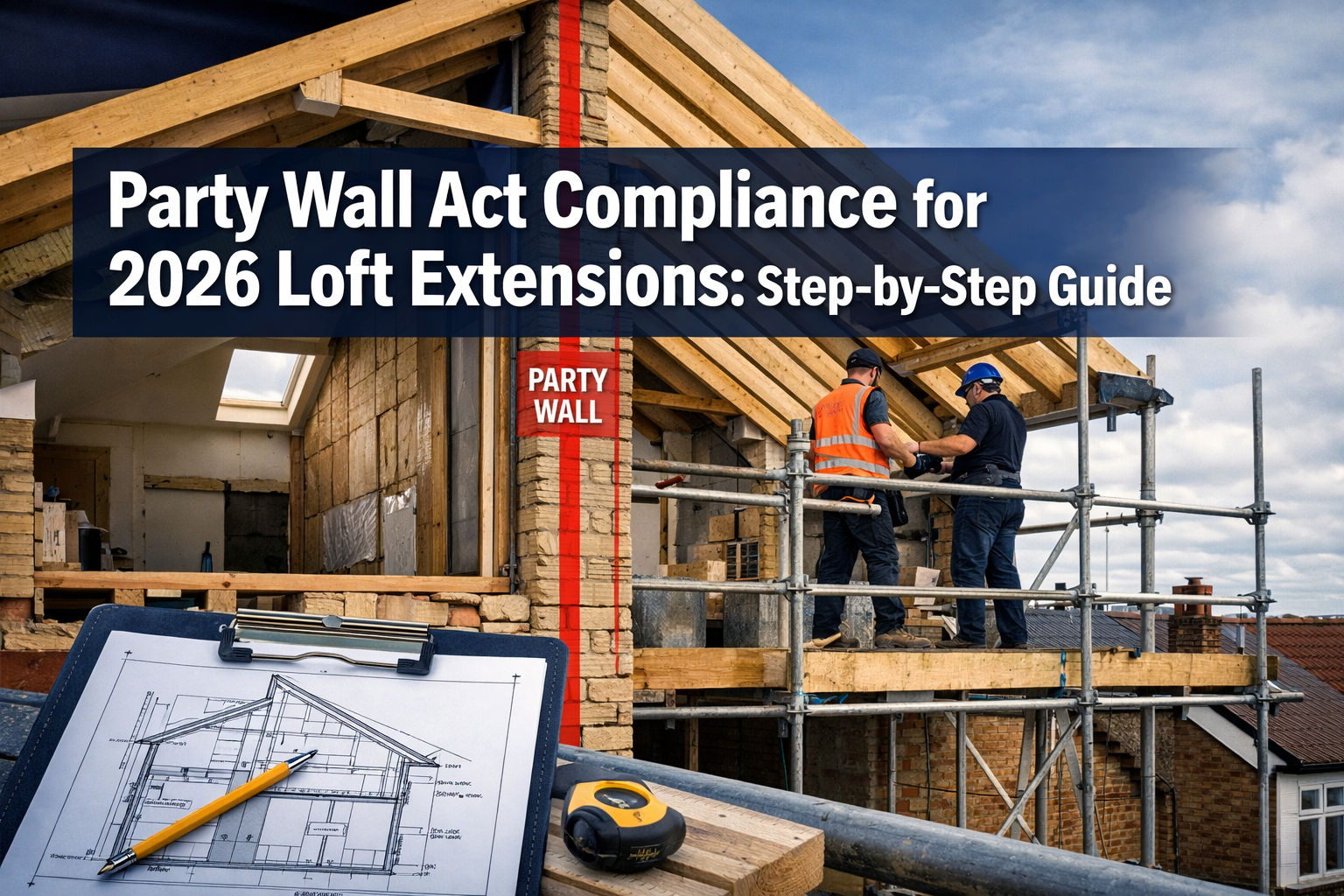
Planning a loft conversion in 2026? If you live in a terraced or semi-detached property in England or Wales, you're likely facing one of the most misunderstood aspects of home improvement: Party Wall Act compliance. With housing demand surging and loft conversions becoming the go-to solution for adding space without moving, understanding Party Wall Act Compliance for 2026 Loft Extensions: Step-by-Step Guide to Notices and Awards has never been more critical. This comprehensive guide walks through every stage of the notice and award process, helping homeowners avoid costly delays, legal disputes, and enforcement action.
Key Takeaways
✅ Two-month notice period required: Party Wall Notices must be served at least two months before structural loft work begins (one month for excavation)[1]
✅ Written agreement or formal award mandatory: Work cannot commence until neighbours consent in writing or a Party Wall Award is issued[1]
✅ Schedule of condition protects all parties: Pre-work documentation of adjoining properties prevents future disputes and establishes baseline condition[1]
✅ Mid-terrace properties need dual agreements: Homeowners typically require party wall agreements with neighbours on both sides[4]
✅ Non-compliance carries serious penalties: Failure to follow the Act can result in unlimited fines, forced demolition, and difficulties selling your property[2]
Understanding the Party Wall Act for Loft Conversions in 2026
The Party Wall etc. Act 1996 applies exclusively to England and Wales, governing building work that affects shared walls, structures, or boundaries between adjoining properties[1]. For loft conversions, this legislation becomes relevant when structural work impacts the party wall—the shared wall between terraced or semi-detached homes.
When Does the Party Wall Act Apply to Loft Extensions?
The Act applies to loft conversions when work involves:
🏗️ Structural alterations to party walls, including inserting steel beams or cutting into the wall structure
🏗️ Building up to or astride the boundary line between properties
🏗️ Excavation within 3-6 metres of neighbouring structures (depending on depth)
🏗️ Raising party walls to accommodate increased roof height
However, the Act does not apply to minor, non-structural work such as plastering, electrical installations, or attaching kitchen units to walls[1]. Understanding this distinction prevents unnecessary delays and costs.
The 2026 Loft Conversion Surge and Compliance Challenges
The year 2026 has witnessed a significant surge in party wall surveying demand for loft conversions, driven by increased housing activity and homeowners seeking to maximize existing property value rather than relocate[3]. This heightened demand has created longer lead times for surveyor appointments and emphasizes the importance of early planning.
Mid-terrace properties present unique challenges, as homeowners typically need to secure party wall agreements with neighbours on both sides[4]. This doubles the complexity and potential for disagreement, making proper notice procedures absolutely essential.
Step-by-Step Guide to Party Wall Notices for Loft Extensions
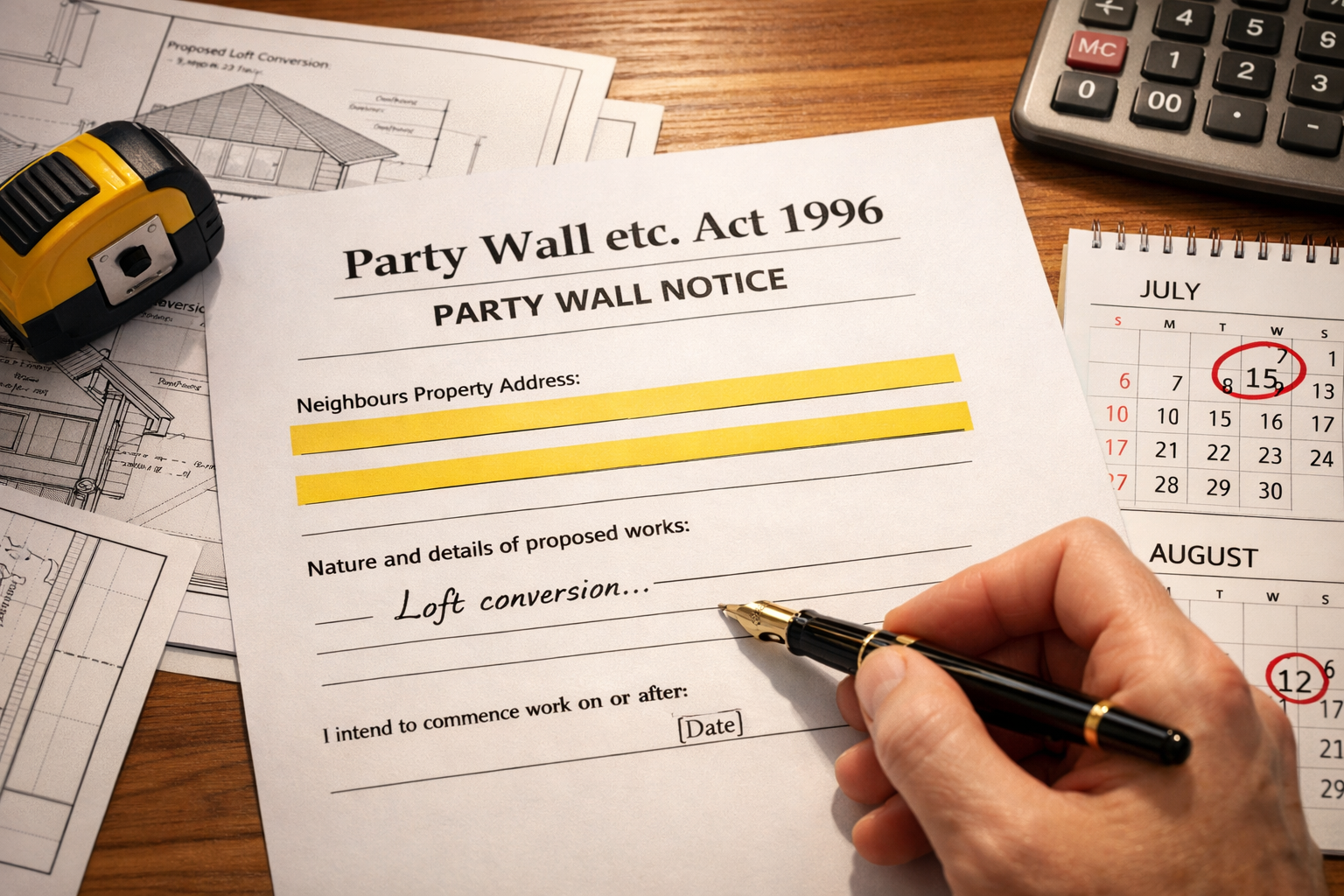
Serving proper Party Wall Notices forms the foundation of legal compliance. This section breaks down the exact process for 2026 loft conversions.
Step 1: Determine Which Notice Type You Need
The Party Wall Act specifies three types of notices, but loft conversions typically require:
| Notice Type | When Required | Notice Period |
|---|---|---|
| Party Structure Notice | Work directly affects the party wall structure (cutting, inserting beams, raising height) | 2 months |
| Line of Junction Notice | Building a new wall up to or astride the boundary line | 1 month |
| 3/6 Metre Notice | Excavation within 3 metres and below neighbouring foundations, or within 6 metres at specific depths | 1 month |
For most loft conversions affecting party walls, a Party Structure Notice is required[1]. Learn more about what Party Structure Notices are and how to serve them.
Step 2: Prepare Your Party Wall Notice
Your notice must be in writing and include specific information[1]:
- Your details: Full name and address as the building owner
- Neighbour's details: Full name and address of all adjoining owners
- Description of works: Detailed explanation of the loft conversion and how it affects the party wall
- Commencement date: When you plan to start work (must be at least 2 months from notice date)
- Drawings and plans: Architectural drawings showing the scope of work
💡 Pro Tip: While templates exist, having a party wall surveyor prepare your notice ensures all legal requirements are met and reduces the likelihood of disputes. Check out guidance on Party Wall Act notices and how to respond.
Step 3: Serve the Notice Correctly
Timing is critical: The two-month notice period is mandatory for structural party wall work[1]. Serving notice too late will delay your entire project, potentially causing contractor scheduling issues and additional costs.
Delivery methods include:
✉️ Hand delivery to the property
✉️ Registered post with proof of delivery
✉️ Recorded delivery to ensure receipt confirmation
Multiple neighbours: If you live in a mid-terrace property, you must serve separate notices to neighbours on both sides[4]. Each neighbour responds independently, potentially resulting in different outcomes.
Step 4: Await Your Neighbour's Response
Once served, your neighbour has 14 days to respond in one of three ways:
Option 1: Written Consent ✅
The neighbour agrees to the work in writing. No party wall award is needed, and you can proceed after the notice period expires[1]. This is the simplest and most cost-effective outcome.
Option 2: Dissent or No Response ⚠️
If your neighbour objects or fails to respond within 14 days, a "dispute" is deemed to exist under the Act. This triggers the need for a Party Wall Award[1].
Option 3: Conditional Consent 📋
The neighbour may consent but request specific conditions, such as particular working hours or additional protective measures.
Step 5: Handle Disputes Through the Award Process
When consent isn't given, the Act provides a structured dispute resolution mechanism that doesn't require court involvement. Understanding types of party wall works helps clarify when awards are necessary.
The Party Wall Award Process: Complete Walkthrough
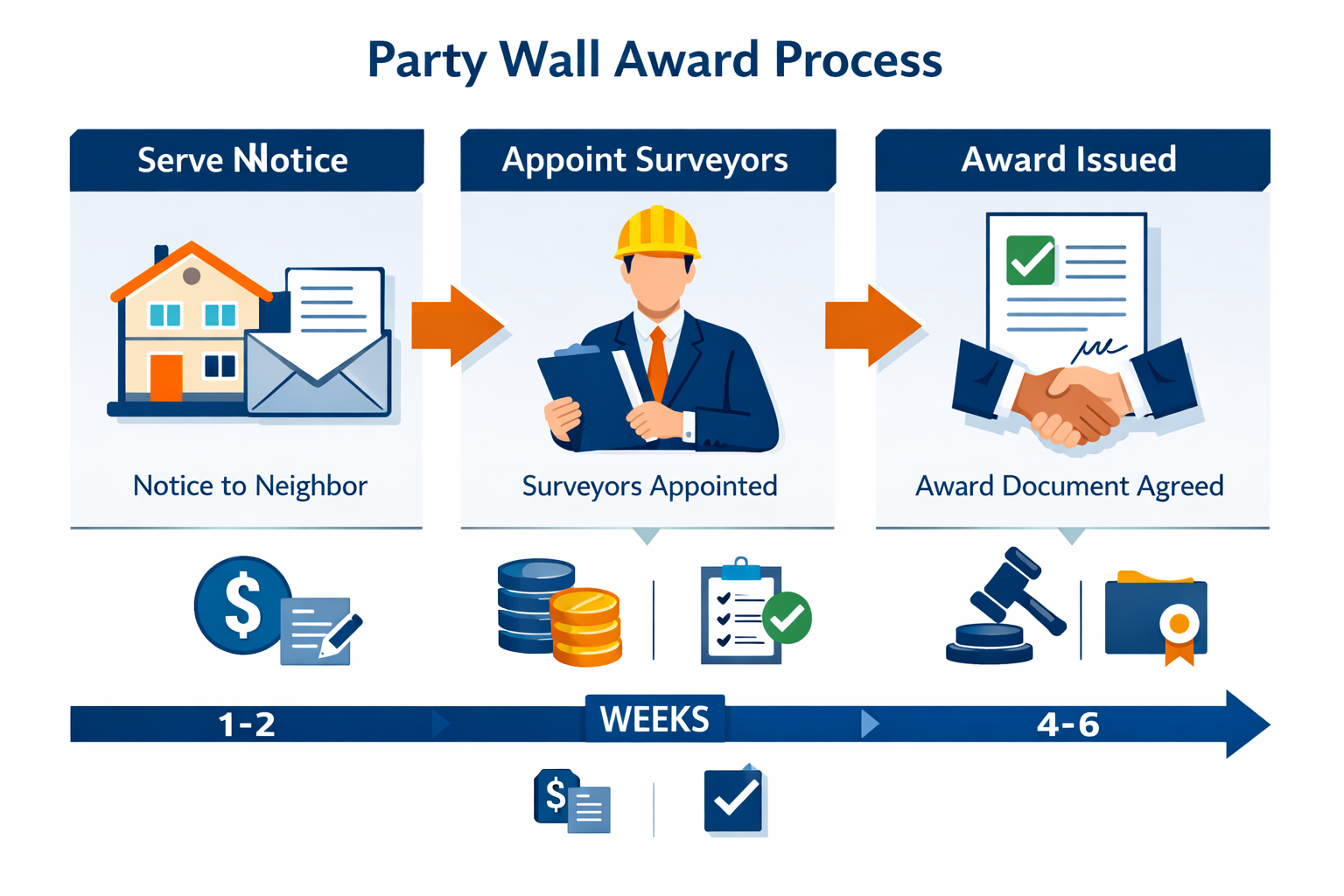
The Party Wall Award is a legally binding document that permits work to proceed despite neighbour objections. This section provides an in-depth look at obtaining awards for 2026 loft extensions.
Understanding Party Wall Awards
A Party Wall Award is a formal document prepared by appointed surveyors that:
🔹 Grants permission for the proposed work to proceed
🔹 Specifies conditions and protective measures
🔹 Documents the pre-work condition of adjoining properties
🔹 Allocates costs between parties
🔹 Establishes dispute resolution procedures
Awards are legally enforceable and provide protection for both building owners and adjoining owners[1].
Appointing Party Wall Surveyors
When a dispute arises, you have two surveyor appointment options:
Option A: Agreed Surveyor
Both parties jointly appoint a single surveyor who acts impartially. This approach typically reduces costs and speeds up the process. Learn about party wall contract templates and awards.
Option B: Two Surveyors
Each party appoints their own surveyor. The two surveyors then work together to prepare the award. If they disagree on any matter, they appoint a third surveyor to make the final decision.
Cost allocation: As the building owner initiating the work, you typically pay for both your surveyor and your neighbour's surveyor fees[1]. Understanding party wall costs helps with budgeting, and there are strategies for keeping party wall costs down.
What's Included in a Party Wall Award?
A comprehensive Party Wall Award for a loft conversion includes:
📄 Detailed work description: Specific details of the loft conversion affecting party walls
📄 Schedule of condition: Photographic and written record of the adjoining property's current state
📄 Protective measures: Requirements for scaffolding, temporary supports, working hours, and dust control
📄 Access rights: Provisions for surveyors and workers to access neighbouring property for inspections
📄 Dispute resolution: Procedures if disagreements arise during construction
📄 Cost allocation: Clear statement of who pays for what
The Schedule of Condition: Your Protection Against Claims
The schedule of condition represents one of the most important elements of party wall compliance[1]. This document:
✔️ Establishes a baseline record of the adjoining property before work begins
✔️ Includes detailed photographs of walls, ceilings, decorative finishes, and structural elements
✔️ Documents existing cracks, settlement, or damage
✔️ Protects building owners from false damage claims
✔️ Provides evidence for legitimate damage claims by adjoining owners
Without a proper schedule of condition, disputes about damage become difficult to resolve, potentially leading to costly litigation.
Timeline for Party Wall Awards
Understanding the award timeline helps with project planning:
| Stage | Typical Duration |
|---|---|
| Initial notice period | 2 months |
| Neighbour response period | 14 days |
| Surveyor appointment | 1-2 weeks |
| Schedule of condition preparation | 1-2 weeks |
| Award drafting and agreement | 2-4 weeks |
| Total minimum timeline | 3-4 months |
In 2026's high-demand environment, surveyor availability may extend these timelines[3]. Starting the process early—ideally before finalizing architect plans—prevents project delays.
Common Pitfalls and How to Avoid Them
Pitfall 1: Starting Work Without Proper Consent
The mistake: Beginning loft conversion work before the notice period expires or before obtaining written consent/award.
The consequence: Neighbours can obtain injunctions forcing work stoppage, and you may face unlimited fines[2]. Courts can order demolition of non-compliant work.
The solution: Never commence work until you have either written consent from all affected neighbours or a Party Wall Award in place[1]. Consider working with building owners' surveyors who understand compliance requirements.
Pitfall 2: Inadequate Notice Content
The mistake: Serving vague or incomplete notices that don't fully describe the work or its impact on party structures.
The consequence: Neighbours may legitimately reject the notice, requiring you to start the process again with proper documentation.
The solution: Include detailed architectural drawings, structural engineer reports, and clear descriptions of how party walls will be affected. Professional surveyor preparation ensures completeness.
Pitfall 3: Ignoring Building Regulations Alongside Party Wall Requirements
The mistake: Focusing solely on Party Wall Act compliance while overlooking building regulations.
The reality: All loft conversions require building regulations approval regardless of size[2]. Requirements include:
🏠 Minimum head height of 2.2 metres
🏠 Fire resistance for 30 minutes (12.5mm plasterboard or fire-proof coating)
🏠 Insulation thickness of 270mm
🏠 Smoke alarms within 7.5 metres of habitable space
🏠 Proper staircase design meeting Part K regulations
The consequence: Non-compliance with building regulations results in unlimited fines, inability to obtain home insurance, and serious difficulties selling your property[2]. Local authorities have four years to take enforcement action.
The solution: Run party wall and building regulations processes in parallel, ensuring both compliance requirements are met before work begins.
Pitfall 4: Poor Neighbour Communication
The mistake: Serving formal notices without any prior informal discussion with neighbours.
The consequence: Neighbours feel blindsided and are more likely to dissent, triggering the award process and increasing costs.
The solution: Before serving formal notices, have friendly conversations with neighbours about your plans. Show them drawings, explain the work schedule, and address concerns proactively. Good relationships often lead to written consent, avoiding the award process entirely.
Pitfall 5: Underestimating Costs and Timelines
The mistake: Failing to budget for party wall surveyor fees and not accounting for the minimum 2-3 month compliance timeline.
The consequence: Project delays, contractor rescheduling fees, and budget overruns.
The solution: Budget £700-£1,500+ for party wall costs (more for complex cases or multiple neighbours). Start the party wall process at least 3-4 months before your planned construction start date[3].
Party Wall Act Compliance for Different Loft Conversion Types
Dormer Loft Conversions
Dormer extensions typically require Party Structure Notices when:
- Steel beams are inserted into party walls for support
- The dormer structure ties into or affects the party wall
- Roof height increases affect the shared wall structure
For mid-terrace properties, dormers on both sides of the roof may affect both neighbours[4].
Hip-to-Gable Conversions
These conversions often involve raising the party wall height to create a vertical gable end. This always requires a Party Structure Notice as it directly alters the party wall structure[1].
Height restrictions apply: maximum 4 metres at the highest point and 2.5 metres at eaves within 2 metres of the boundary[4].
Mansard Loft Conversions
Mansard conversions involve significant structural changes to party walls, including:
- Raising party wall height substantially
- Creating flat or near-flat roof sections
- Inserting major steel beam structures
These comprehensive alterations require detailed Party Structure Notices and often result in more complex Party Wall Awards.
Velux/Rooflight Conversions
Simple Velux window installations that don't affect party wall structure typically do not require Party Wall Act compliance[1]. However, if the conversion involves structural beams inserted into party walls to support the new space, notices become necessary.
Regional Considerations for London Loft Conversions
London's dense terraced housing creates unique party wall challenges. Regional surveyor services include:
- Party Wall Surveyor North London
- Party Wall Surveyor South London
- Party Wall Surveyor East London
- Party Wall Surveyor Central London
- Party Wall Surveyor West London
London's property density means most loft conversions affect neighbours, making party wall compliance virtually mandatory for terraced and semi-detached properties.
Award Enforcement and Post-Construction Compliance
During Construction
Once your Party Wall Award is in place, compliance doesn't end:
🔧 Follow award conditions: Adhere strictly to working hours, access provisions, and protective measures specified in the award
🔧 Allow surveyor inspections: Surveyors have rights to inspect work progress and ensure compliance with the award
🔧 Document everything: Keep photographic records of work stages, particularly where party walls are affected
🔧 Address damage promptly: If damage occurs to adjoining property, notify surveyors immediately and arrange repairs as specified in the award
Post-Construction Inspections
After completion:
✅ Surveyors conduct final inspections comparing current condition to the schedule of condition
✅ Any damage caused by your work must be repaired at your expense
✅ Final sign-off confirms work was completed in accordance with the award
✅ Documentation is provided for future property sales
Dispute Resolution During and After Work
If disputes arise during construction, the Party Wall Award provides resolution mechanisms:
- Surveyor mediation: The appointed surveyor(s) interpret award terms and resolve disagreements
- Third surveyor involvement: If two surveyors disagree, the third surveyor makes binding decisions
- Award amendments: Surveyors can issue supplemental awards if circumstances change
- Court enforcement: As a last resort, awards are enforceable through county courts
Practical Tips for Smooth Party Wall Act Compliance in 2026
Start Early
Begin the party wall process 4-6 months before your planned construction start date, accounting for 2026's high surveyor demand[3].
Choose Experienced Professionals
Work with party wall surveyors who specialize in loft conversions and understand current 2026 compliance challenges.
Communicate Proactively
Maintain open dialogue with neighbours throughout the process, addressing concerns before they become formal objections.
Budget Realistically
Account for surveyor fees, potential delays, and contingency funds for unexpected compliance requirements.
Document Everything
Keep copies of all notices, correspondence, drawings, and agreements. Proper documentation protects your interests if disputes arise.
Coordinate with Other Approvals
Run party wall compliance alongside planning permission (if required) and building regulations approval to avoid sequential delays.
Consider Professional Project Management
For complex loft conversions affecting multiple neighbours, professional project managers can coordinate party wall compliance with construction scheduling.
Conclusion
Party Wall Act Compliance for 2026 Loft Extensions: Step-by-Step Guide to Notices and Awards provides the roadmap for navigating one of the most legally complex aspects of home improvement. With loft conversion demand surging in 2026 and party wall surveying services experiencing high demand[3], understanding the notice and award process has never been more valuable.
The key to successful compliance lies in early planning, proper notice service, thorough documentation, and professional surveyor support. Whether you're a building owner planning works or an adjoining owner responding to neighbour's plans, understanding your rights and obligations under the Party Wall Act protects your property interests and maintains good neighbour relations.
Your Next Steps
- Assess your project: Determine if your loft conversion affects party walls and which notices are required
- Engage professionals early: Appoint a qualified party wall surveyor to prepare notices and manage the process
- Serve notices promptly: Allow the full 2-month notice period plus additional time for award preparation
- Maintain documentation: Keep comprehensive records of all party wall compliance activities
- Coordinate approvals: Ensure building regulations and party wall compliance run in parallel
Remember: no work can legally commence until you have either written consent from all affected neighbours or a properly executed Party Wall Award[1]. Taking shortcuts risks unlimited fines, forced demolition, and serious difficulties when selling your property[2].
For professional guidance on your 2026 loft conversion party wall compliance, consider consulting with experienced surveyors who understand current demand pressures and can expedite the process while ensuring full legal compliance.
References
[1] Party Wall Agreement – https://hoa.org.uk/advice/guides-for-homeowners/i-am-improving/party-wall-agreement/
[2] Rules Regulations – https://www.greenmatch.co.uk/loft-conversion/rules-regulations
[3] Party Wall Surveying Surge In 2026 Loft Conversions Navigating High Demand Compliance During Housing Uptick – https://nottinghillsurveyors.com/blog/party-wall-surveying-surge-in-2026-loft-conversions-navigating-high-demand-compliance-during-housing-uptick
[4] Terraced House Extension Data 2026 – https://www.mayfairstudio.co.uk/blog/terraced-house-extension-data-2026