


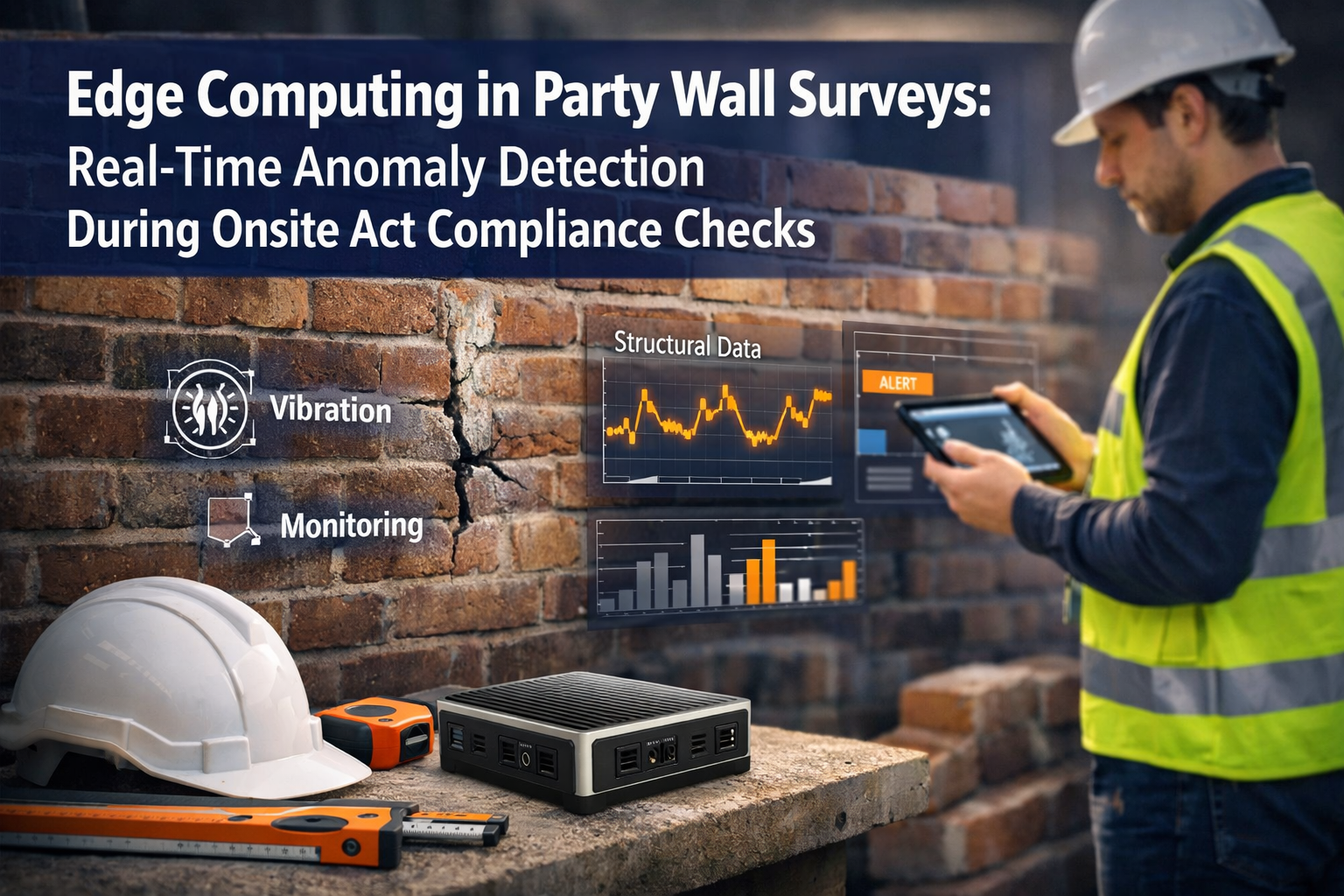
When a foundation crack appears during excavation work next to a party wall, every minute counts. Traditional surveying methods require surveyors to collect data, return to the office, analyze findings, and then report back—a process that can take hours or even days. By that time, minor structural movement can escalate into costly disputes between neighbors. Edge computing in party wall surveys changes this equation entirely, enabling instant data processing right at the construction site and flagging foundation risks before they become legal battles.
In 2026, edge computing technology has matured to the point where surveyors can deploy compact, ruggedized devices that process sensor data in real-time during Party Wall Act compliance checks. This practical guide explores how edge computing enables real-time anomaly detection during onsite Act compliance checks, with specific hardware recommendations and integration strategies for field efficiency.
Key Takeaways
- Instant Detection: Edge computing devices process structural monitoring data on-site within milliseconds, identifying anomalies like excessive vibration or foundation movement before they escalate into disputes
- Hardware Accessibility: Ruggedized edge computing solutions suitable for construction sites now cost between £800-£3,500, making the technology accessible to surveying practices of all sizes
- Compliance Enhancement: Real-time anomaly detection strengthens compliance with the Party Wall Act by providing documented evidence of structural changes during notifiable works
- Integration Simplicity: Modern edge devices connect seamlessly with existing IoT sensors, tablets, and cloud platforms without requiring extensive technical expertise
- Dispute Prevention: Immediate alerts enable surveyors to halt potentially damaging work and adjust construction methods before structural damage occurs
What Is Edge Computing and Why Does It Matter for Party Wall Surveys?
Edge computing refers to processing data close to where it's generated—at the "edge" of the network—rather than sending everything to distant cloud servers. For party wall surveys, this means analyzing sensor readings from structural monitoring equipment right at the construction site using portable computing devices.
The Traditional Survey Challenge
Standard party wall survey procedures involve multiple site visits to document conditions, monitor ongoing works, and assess any damage. Surveyors traditionally:
- Take manual measurements and photographs
- Record observations in notebooks or tablets
- Return to the office to analyze data
- Generate reports days or weeks later
- Respond to neighbor complaints after damage has occurred
This reactive approach creates significant problems when construction work affects adjacent properties. By the time a surveyor identifies structural movement or excessive vibration, the damage may already be done.
How Edge Computing Transforms the Process
Edge computing enables proactive monitoring during Party Wall Act compliance checks. The technology processes sensor data instantly, allowing surveyors to:
✅ Detect anomalies in real-time as they happen
✅ Receive immediate alerts when thresholds are exceeded
✅ Make instant decisions to halt or modify work
✅ Document compliance continuously with timestamped data
✅ Prevent disputes before structural damage occurs
According to industry analysis, edge computing deployments have accelerated significantly in 2026, with applications expanding beyond traditional tech sectors into construction and infrastructure monitoring [1]. The technology's ability to process data locally—without relying on internet connectivity—makes it particularly valuable for construction sites where network access may be unreliable.
Real-World Application Scenario
Consider a typical basement excavation project in London requiring a party structure notice. The building owner plans to dig 3 meters below the adjacent property's foundation level. Without edge computing:
Traditional approach: Surveyor visits weekly, takes manual readings, neighbor complains about cracks three weeks into the project, dispute escalates, work stops, costs spiral.
Edge computing approach: IoT sensors monitor foundation movement and vibration continuously. Edge device processes data every second. When excavation causes 2mm of movement (approaching the 3mm threshold), the surveyor receives an instant alert on their mobile device. Work pauses immediately. Construction method adjusts. No damage occurs. Neighbor relationship preserved.
Edge Computing in Party Wall Surveys: Real-Time Anomaly Detection Systems Explained
Real-time anomaly detection represents the core value proposition of edge computing for party wall compliance. Understanding how these systems work helps surveyors select appropriate technology and implement effective monitoring strategies.
Components of an Edge-Based Anomaly Detection System
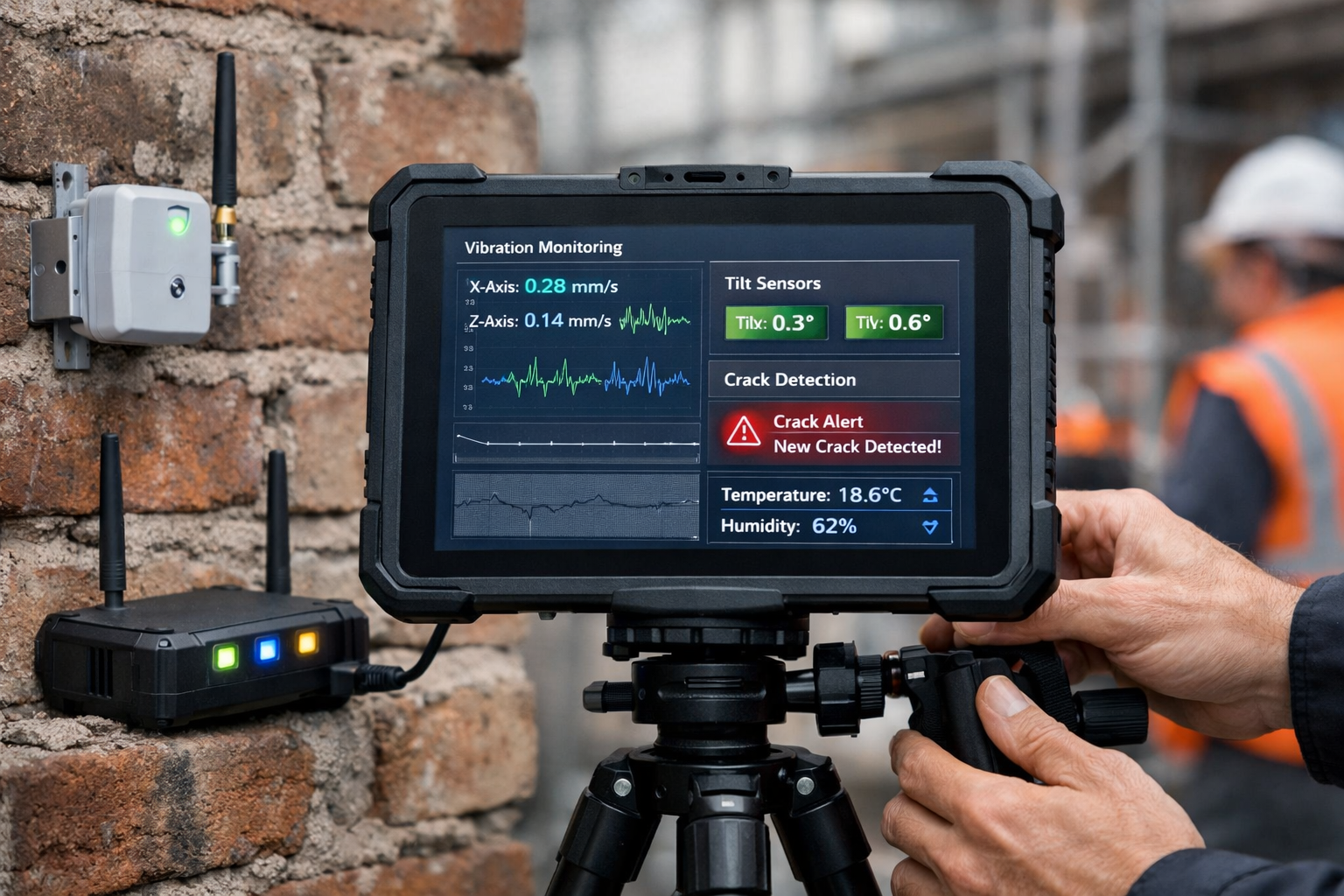
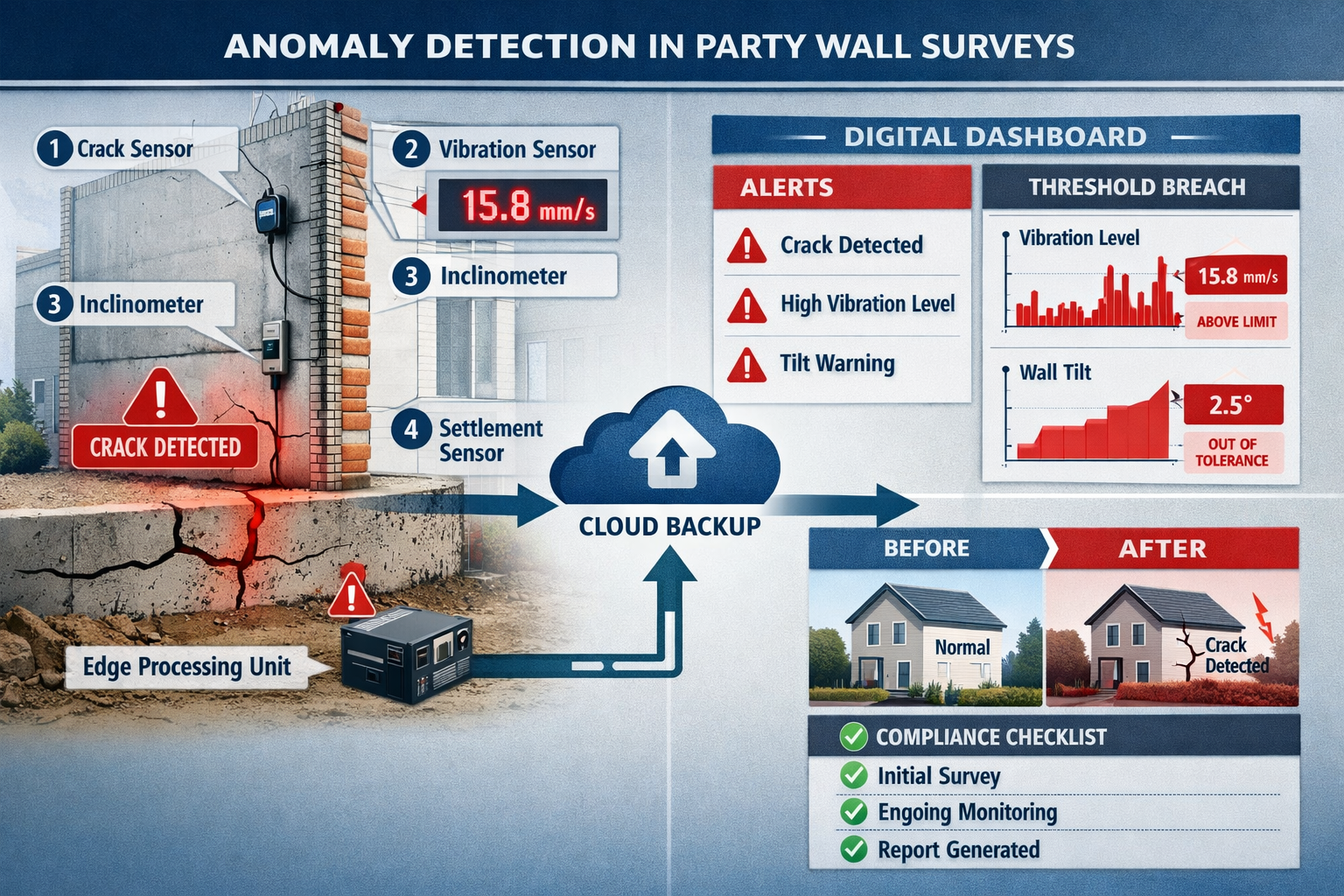
A complete edge computing system for party wall surveys consists of four integrated components:
| Component | Function | Typical Hardware | Cost Range (2026) |
|---|---|---|---|
| IoT Sensors | Measure structural parameters (vibration, tilt, crack width, temperature) | Wireless accelerometers, tilt meters, crack monitors | £150-£400 per sensor |
| Edge Gateway | Processes sensor data locally, runs anomaly detection algorithms | Ruggedized industrial computer or specialized edge device | £800-£2,500 |
| Mobile Interface | Displays real-time data and alerts to surveyors on-site | Tablet or smartphone with dedicated app | £300-£800 (if new) |
| Cloud Backup | Stores historical data, enables remote access, generates reports | Subscription-based cloud platform | £30-£100/month |
How Anomaly Detection Algorithms Work
Edge computing devices run specialized algorithms that continuously analyze sensor data to identify patterns that deviate from normal conditions. The most common approaches include:
1. Threshold-Based Detection
The simplest method sets predefined limits for each parameter. When a sensor reading exceeds the threshold, the system triggers an alert. For example:
- Foundation movement > 3mm
- Vibration velocity > 15mm/s
- Crack width increase > 1mm in 24 hours
2. Statistical Anomaly Detection
More sophisticated algorithms establish a "baseline" of normal readings during initial monitoring, then flag any measurements that fall outside expected statistical ranges. This approach adapts to each site's unique characteristics.
3. Machine Learning Models
Advanced edge devices can run lightweight AI models trained to recognize patterns associated with structural problems. These models improve over time as they process more data from various party wall projects [5].
Processing Speed: Why Edge Beats Cloud
The critical advantage of edge computing lies in processing speed. When sensor data travels to cloud servers for analysis, several delays occur:
- Network latency: 50-200 milliseconds to send data to cloud
- Processing queue: Additional wait if servers are busy
- Return transmission: Another 50-200 milliseconds for results
- Total delay: 200-500 milliseconds minimum, often several seconds
Edge computing eliminates these delays by processing data locally within 10-50 milliseconds. This speed difference proves crucial during dynamic construction activities like:
- Pile driving operations
- Excavation near foundations
- Demolition work affecting party walls
- Heavy machinery operation
A surveyor monitoring excavation work receives alerts about excessive vibration instantly with edge computing, enabling immediate intervention. Cloud-based systems might deliver the same alert several seconds later—potentially after damage has already occurred.
Integration with Party Wall Documentation
Edge computing systems enhance compliance by automatically generating detailed records of structural conditions throughout construction projects. The technology integrates with traditional party wall awards and schedules of condition by:
📊 Timestamping all measurements with precise date and time
📊 Creating visual dashboards showing structural parameters over time
📊 Generating automated reports for inclusion in party wall documentation
📊 Providing evidence of due diligence if disputes arise
📊 Supporting compliance with notification and monitoring requirements
This documented evidence proves invaluable if disagreements emerge between building owners and adjoining owners about whether notifiable works caused damage.
Practical Implementation: Hardware Recommendations and Integration for 2026 Field Efficiency
Deploying edge computing for party wall surveys requires selecting appropriate hardware, configuring monitoring systems, and training staff. This section provides practical guidance for implementation in 2026.
Recommended Edge Computing Hardware for Party Wall Applications
Based on current market offerings and construction site requirements, these hardware options provide reliable performance for party wall monitoring:
Entry-Level Solution (£2,000-£4,000 total)
- Edge Device: Raspberry Pi 4 in ruggedized case with industrial power supply
- Sensors: 4-6 wireless vibration and tilt sensors
- Interface: Standard tablet with custom monitoring app
- Best for: Small practices, single-property monitoring, occasional use
Mid-Range Solution (£5,000-£8,000 total)
- Edge Device: Dell Edge Gateway 3200 or similar industrial computer
- Sensors: 8-12 multi-parameter sensors (vibration, tilt, crack width, temperature)
- Interface: Ruggedized tablet with dedicated monitoring software
- Best for: Regular party wall work, multiple simultaneous projects
Professional Solution (£10,000-£15,000 total)
- Edge Device: Advantech UNO-2484G or HPE Edgeline EL4000
- Sensors: 15-20 enterprise-grade sensors with redundancy
- Interface: Multiple tablets with synchronized data, cloud integration
- Best for: High-volume practices, complex projects, long-term monitoring
Step-by-Step Implementation Process
Phase 1: Assessment and Planning (Week 1)
- Evaluate project requirements: Identify which types of party wall works will benefit most from real-time monitoring
- Select hardware: Choose edge computing solution based on budget and project complexity
- Define monitoring parameters: Establish thresholds for alerts based on building type and construction method
- Plan sensor placement: Determine optimal locations for structural monitoring
Phase 2: Hardware Setup (Week 2)
- Configure edge device: Install operating system, monitoring software, and anomaly detection algorithms
- Test sensors: Verify all IoT sensors communicate properly with edge gateway
- Calibrate baselines: Establish normal readings before construction begins
- Set up mobile interface: Install monitoring app on surveyor tablets and smartphones
Phase 3: Deployment (Week 3)
- Install sensors: Mount devices at strategic points on party walls and adjacent structures
- Position edge gateway: Place computing device in weatherproof enclosure on-site
- Verify connectivity: Confirm all components communicate reliably
- Train staff: Ensure surveyors understand how to interpret alerts and respond appropriately
Phase 4: Ongoing Monitoring
- Review data daily: Check dashboards for trends and potential issues
- Respond to alerts: Investigate any anomalies immediately
- Adjust thresholds: Refine alert parameters based on experience
- Document findings: Include edge computing data in party wall reports
Integration with Existing Surveying Workflows
Edge computing systems complement rather than replace traditional surveying practices. The technology integrates seamlessly with established procedures:
During Initial Surveys
- Deploy sensors while conducting schedule of condition documentation
- Establish baseline readings alongside photographic evidence
- Include edge monitoring plan in party wall awards
During Construction Phase
- Monitor real-time data during site visits
- Use alerts to prioritize inspection activities
- Document compliance with monitoring requirements
- Provide building owners with progress updates
Post-Construction
- Generate comprehensive reports showing structural behavior throughout project
- Demonstrate due diligence if disputes arise
- Archive data for future reference
Overcoming Common Implementation Challenges
Challenge 1: Limited Technical Expertise
Solution: Partner with edge computing vendors offering installation and training services. Many providers now offer "turnkey" solutions specifically designed for construction monitoring applications [2].
Challenge 2: Site Security and Theft
Solution: Use lockable weatherproof enclosures for edge devices. Deploy sensors in less accessible locations. Consider equipment insurance.
Challenge 3: Power Supply
Solution: Select edge devices with low power consumption. Use solar panels with battery backup for long-term deployments. Many modern sensors operate for months on single battery charges.
Challenge 4: Data Management
Solution: Configure automatic cloud backups to prevent data loss. Establish retention policies compliant with professional standards and legal requirements.
Cost-Benefit Analysis for Surveying Practices
Investing in edge computing technology requires upfront capital, but the return on investment can be substantial:
Costs (first year):
- Hardware: £2,000-£15,000 depending on solution
- Software/subscriptions: £360-£1,200 annually
- Training: £500-£1,500
- Total: £2,860-£17,700
Benefits (annual):
- Dispute prevention: Avoiding even one legal dispute saves £5,000-£20,000 in fees and lost time
- Efficiency gains: Real-time monitoring reduces site visit frequency by 30-40%, saving 50-100 hours annually
- Competitive advantage: Offering advanced monitoring attracts clients willing to pay premium fees
- Reputation enhancement: Demonstrating technological leadership builds market position
For practices handling 20+ party wall projects annually, edge computing systems typically achieve positive ROI within 12-18 months. Smaller practices may require 2-3 years but still benefit from improved service quality and reduced liability exposure.
Future Developments in Edge Computing for Party Wall Surveys
The edge computing landscape continues evolving rapidly. Surveyors implementing systems in 2026 should anticipate these emerging capabilities:
🔮 Enhanced AI capabilities: More sophisticated anomaly detection running entirely on edge devices [5]
🔮 5G connectivity: Faster data transmission when cloud backup is needed [2]
🔮 Augmented reality integration: Overlaying real-time sensor data on physical structures through AR glasses
🔮 Predictive analytics: Forecasting potential structural issues before they occur
🔮 Standardized protocols: Industry-wide data formats enabling easier system integration
Practices investing in edge computing now position themselves to adopt these innovations as they mature, maintaining technological leadership in the competitive surveying market.
Regulatory Compliance and Professional Standards
Implementing edge computing for party wall surveys must align with existing legal frameworks and professional obligations. The Party Wall etc. Act 1996 establishes requirements for surveyors, and edge computing technology supports rather than replaces these obligations.
Edge Computing and Act Compliance
The Party Wall Act requires surveyors to act impartially, prevent or resolve disputes, and ensure notifiable works proceed without causing unnecessary inconvenience. Edge computing strengthens compliance by:
Supporting Impartiality
Objective sensor data eliminates subjective judgments about structural movement. When disputes arise about whether construction caused damage, timestamped measurements provide neutral evidence.
Enhancing Due Diligence
Real-time monitoring demonstrates surveyors took reasonable precautions to protect adjoining properties. This documented diligence proves valuable if professional conduct questions emerge.
Facilitating Dispute Resolution
Comprehensive data records help resolve disagreements quickly. Rather than relying on conflicting testimonies, parties can review objective measurements showing exactly when and how structural changes occurred.
Data Protection and Privacy Considerations
Edge computing systems collect and process data about private properties, raising potential privacy concerns. Surveyors must ensure compliance with UK data protection regulations:
- Obtain consent: Inform building owners and adjoining owners about monitoring systems
- Limit data collection: Only gather information necessary for party wall compliance
- Secure storage: Protect data from unauthorized access using encryption
- Define retention: Establish clear policies for how long data is retained
- Enable access: Allow property owners to review data collected about their buildings
Edge computing actually enhances privacy compared to cloud-only solutions because data processing occurs locally. Sensitive structural information doesn't automatically transmit to external servers unless specifically configured to do so.
Professional Liability and Insurance
Surveyors should notify their professional indemnity insurers when implementing edge computing systems. While the technology reduces liability risk by improving monitoring capabilities, insurers need awareness of new working methods. Key points to discuss with insurers include:
- Hardware investment value (for equipment coverage)
- Data storage and security measures
- Staff training and competency verification
- Procedures for responding to automated alerts
- Integration with existing quality management systems
Most insurers view edge computing favorably because it demonstrates commitment to best practices and risk mitigation. However, formal notification ensures coverage remains valid if claims arise.
Conclusion
Edge computing in party wall surveys represents a fundamental shift from reactive to proactive compliance monitoring. By processing structural data in real-time at construction sites, surveyors can detect anomalies instantly and intervene before minor issues escalate into costly disputes. The technology has matured significantly by 2026, with ruggedized hardware, sophisticated anomaly detection algorithms, and user-friendly interfaces making implementation accessible to surveying practices of all sizes.
The practical benefits are compelling: immediate alerts enable surveyors to halt potentially damaging work within seconds, comprehensive data records provide objective evidence for dispute resolution, and automated monitoring reduces the need for constant site presence while improving oversight quality. With entry-level systems available for £2,000-£4,000, the technology delivers strong return on investment through dispute prevention, efficiency gains, and competitive differentiation.
Actionable Next Steps
For surveying practices considering edge computing implementation:
- Start small: Deploy a pilot system on a single project to gain experience before full-scale adoption
- Evaluate vendors: Research edge computing providers with construction monitoring experience and request demonstrations
- Train staff: Invest in training so surveyors understand how to interpret real-time data and respond to alerts appropriately
- Update documentation: Revise party wall award templates to include edge monitoring provisions
- Communicate benefits: Inform clients about enhanced monitoring capabilities to differentiate services and justify premium fees
- Review insurance: Notify professional indemnity insurers about new technology implementation
- Join industry discussions: Participate in professional forums to share experiences and learn from peers implementing similar systems
For building owners and adjoining owners considering construction projects requiring party wall notices, asking surveyors about edge computing capabilities can provide peace of mind. Real-time monitoring protects everyone's interests by ensuring construction proceeds safely while preserving structural integrity of adjacent properties.
The convergence of edge computing technology and party wall compliance creates unprecedented opportunities for preventing disputes, enhancing professional standards, and protecting property values. Surveyors who embrace these tools position themselves as industry leaders, delivering superior service while reducing liability exposure. As construction projects grow more complex and neighbor expectations increase, edge computing transitions from competitive advantage to professional necessity.
References
[1] 50 Edge Computing Companies To Watch In 2026 – https://stlpartners.com/articles/edge-computing/50-edge-computing-companies-to-watch-in-2026/
[2] Edge Computing In 2026 – https://flolive.net/blog/glossary/edge-computing-in-2026/
[5] 2026 Edge Predictions – https://iotechsys.com/2026-edge-predictions/