


The construction landscape is transforming dramatically in 2026, and nowhere is this more evident than in the monitoring of large-scale excavation projects adjacent to party walls. Autonomous Drone Swarms for Party Wall Act Excavation Monitoring: Scaling Notices for 2026 Mega-Projects represents a revolutionary approach that combines cutting-edge aerial technology with traditional surveying requirements, offering surveyors unprecedented capabilities for continuous documentation and compliance verification.
As mega-projects proliferate across London and other major UK cities, the challenges of monitoring Section 6 excavation works have intensified exponentially. Traditional manual inspection methods struggle to keep pace with the scale, complexity, and legal requirements of modern developments. Enter autonomous drone swarms—coordinated fleets of AI-powered aerial vehicles that provide 24/7 monitoring, automated evidence generation, and comprehensive data capture for party wall awards and dispute resolution.
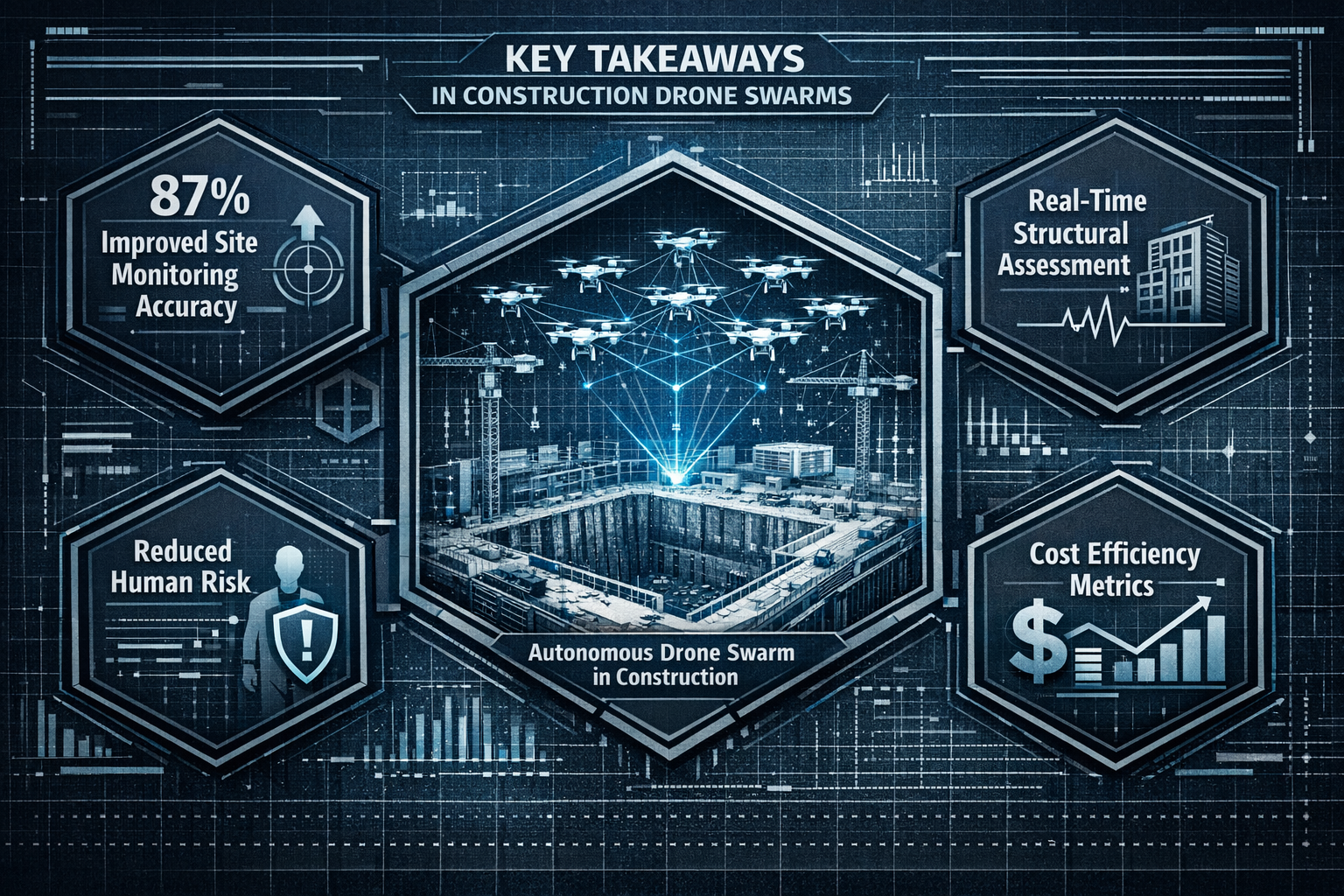
Key Takeaways
- 🚁 Autonomous drone swarms provide continuous 24/7 monitoring of excavation sites, capturing evidence that manual inspections cannot match in frequency or comprehensiveness
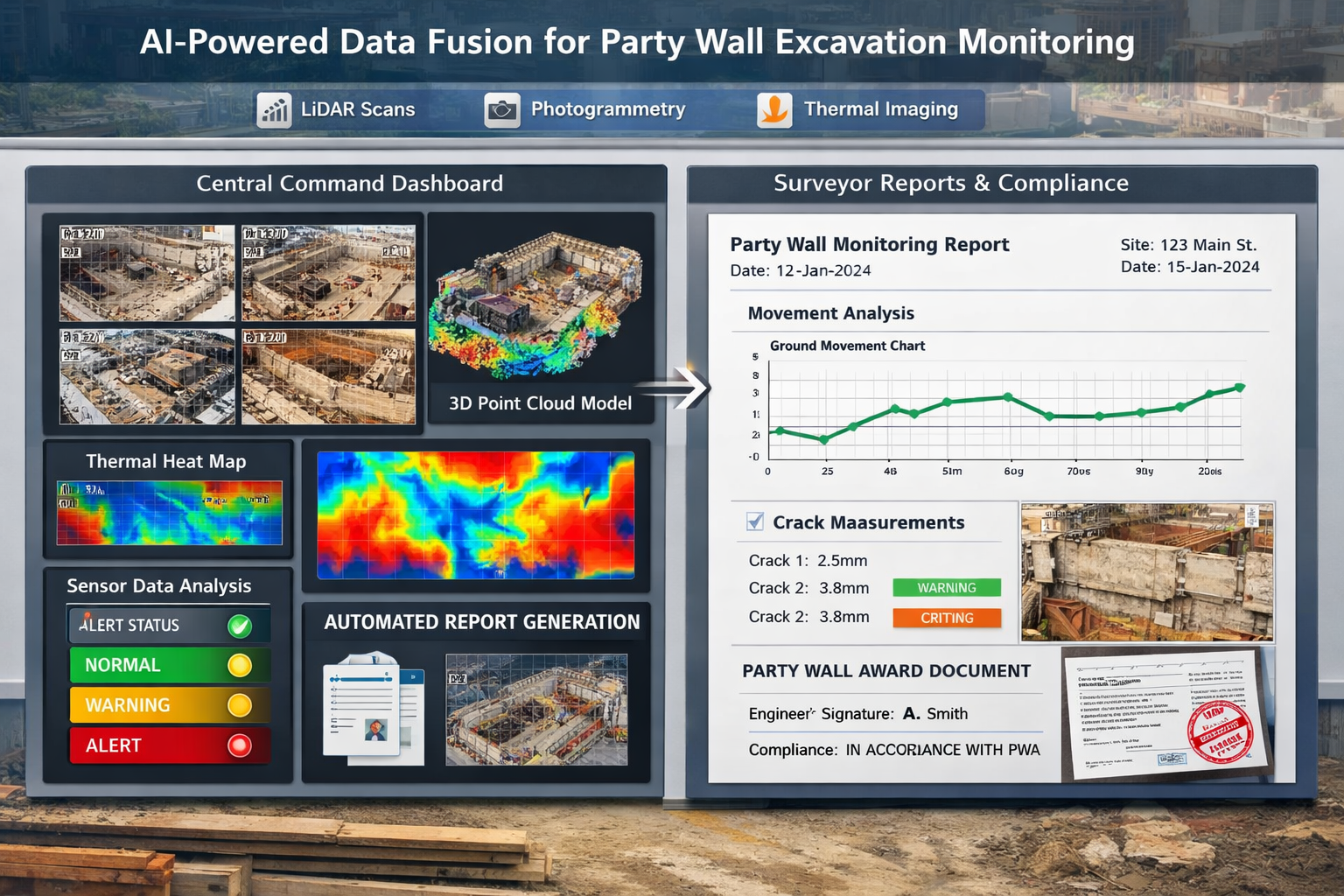
- 📊 AI-powered data fusion combines LiDAR, thermal imaging, and photogrammetry to generate automated reports for party wall surveyors and award documentation
- 💰 The autonomous drone swarm security market reached $2.69 billion in 2026 and projects 24.8% annual growth through 2030[2]
- 🏗️ Mega-projects benefit most from coordinated drone fleets that can simultaneously monitor multiple excavation zones and adjacent properties
- ⚖️ Automated evidence collection strengthens legal compliance with Party Wall Act notices and provides defensible documentation for disputes
Understanding Autonomous Drone Swarms for Party Wall Act Excavation Monitoring
What Are Autonomous Drone Swarms?
Autonomous drone swarms consist of multiple coordinated unmanned aerial vehicles (UAVs) that operate together using artificial intelligence, GPS positioning, and sophisticated communication protocols. Unlike single-drone operations requiring constant human piloting, swarm technology enables fleets of drones to work collaboratively with minimal human intervention.
These systems leverage AI-driven navigation, GPS RTK positioning, thermal imaging, and LiDAR to capture high-resolution data and generate automated reports[1]. For party wall excavation monitoring, this means surveyors can deploy multiple drones simultaneously to monitor different aspects of a construction site—one focusing on the excavation depth, another on the adjacent structure's condition, and a third documenting the party wall itself.
The technology has matured significantly by 2026, with autonomous inspection drones now capable of:
- Autonomous patrol routes that repeat precisely for comparative analysis
- Real-time anomaly detection using machine learning algorithms
- Coordinated multi-angle documentation of excavation progress
- Automated report generation with timestamped evidence
- Thermal imaging to detect ground movement and moisture infiltration
- 3D modeling through photogrammetry and LiDAR scanning
The Party Wall Act Section 6 Challenge
The Party Wall etc. Act 1996 requires building owners to serve notice before excavating within three or six meters of an adjoining owner's structure, depending on depth. Section 6 specifically addresses excavation and construction of foundations near neighboring buildings.
For mega-projects involving deep basement construction, underground parking facilities, or extensive foundation work, the monitoring requirements become extraordinarily complex:
- Multiple adjacent properties may be affected simultaneously
- Deep excavations require frequent monitoring to detect early signs of movement
- Extended construction timelines demand consistent documentation over months or years
- Legal compliance necessitates defensible evidence of due diligence
- Dispute prevention depends on comprehensive condition records
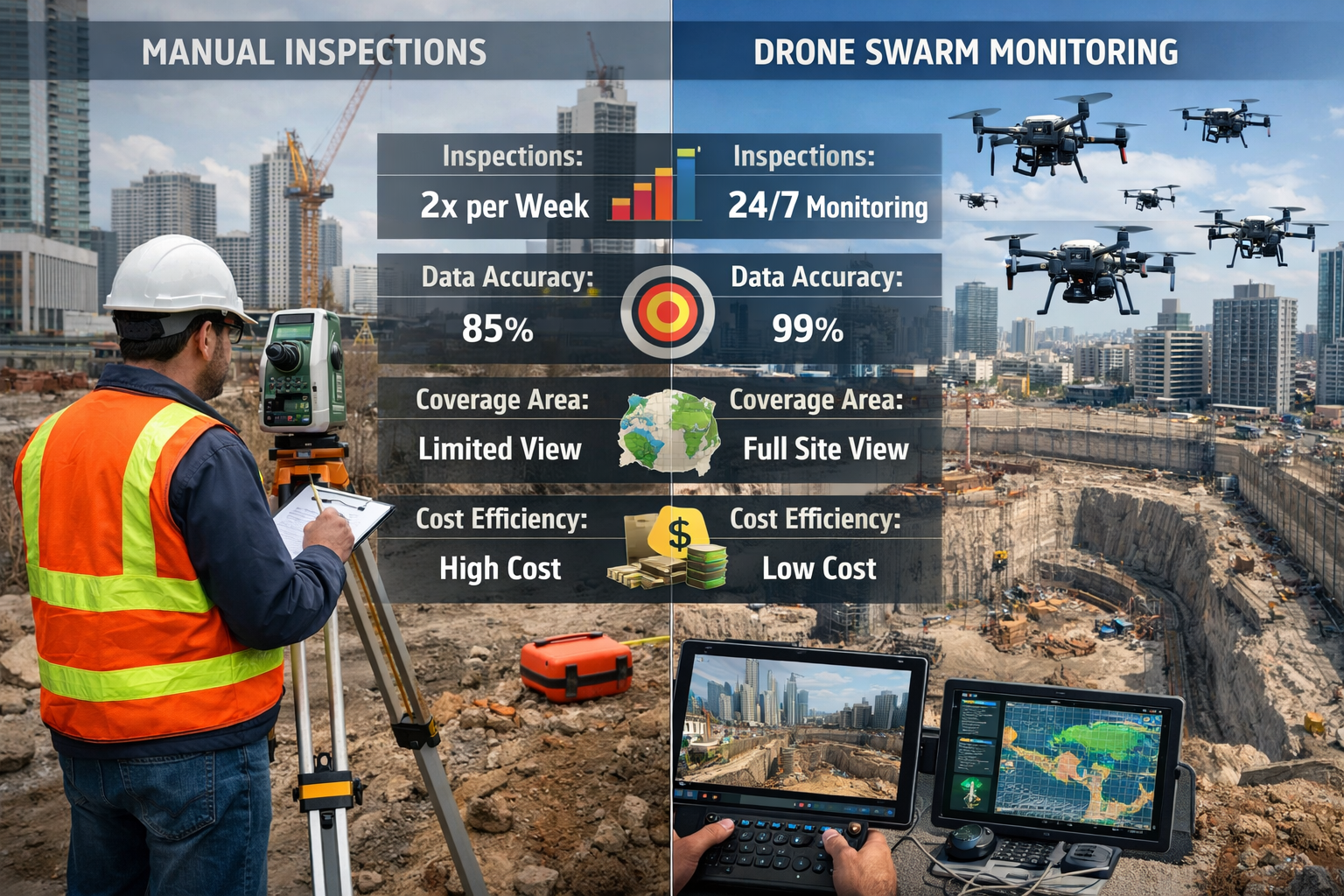
Traditional surveying methods—manual site visits, handheld cameras, and periodic inspections—simply cannot provide the continuous, comprehensive coverage that 2026 mega-projects demand. This is where Autonomous Drone Swarms for Party Wall Act Excavation Monitoring: Scaling Notices for 2026 Mega-Projects becomes transformative.
Market Growth and Industry Adoption
The construction industry's embrace of autonomous drone technology has accelerated dramatically. The autonomous drone swarm security market reached $2.69 billion in 2026 and is projected to grow to $6.51 billion by 2030 at a 24.8% compound annual growth rate[2].
This explosive growth reflects several converging factors:
| Driver | Impact on Party Wall Monitoring |
|---|---|
| AI Advancement | Enables autonomous decision-making and anomaly detection |
| Regulatory Acceptance | UK aviation authorities increasingly permit commercial swarm operations |
| Cost Reduction | Hardware costs decreased 40% since 2023, making deployment economical |
| Insurance Requirements | Insurers demand more comprehensive monitoring documentation |
| Legal Precedents | Courts increasingly accept drone-captured evidence in disputes |
For party wall surveyors, this technological shift presents both opportunities and imperatives. Those who master autonomous drone deployment gain significant competitive advantages in securing large projects, while those who resist risk obsolescence as clients demand more sophisticated monitoring capabilities.
Deployment Strategies for Autonomous Drone Swarms in Excavation Monitoring
Pre-Deployment Planning and Notice Integration
Successful deployment of Autonomous Drone Swarms for Party Wall Act Excavation Monitoring: Scaling Notices for 2026 Mega-Projects begins long before the first drone takes flight. Surveyors must integrate drone monitoring into the party wall notice process from the outset.
Initial Assessment Phase:
- Site Survey: Conduct thorough reconnaissance to identify flight corridors, no-fly zones, and optimal launch/landing locations
- Stakeholder Notification: Inform adjoining owners that drone monitoring will supplement traditional inspections
- Regulatory Compliance: Secure necessary CAA permissions for commercial swarm operations in urban environments
- Baseline Documentation: Establish comprehensive pre-construction condition records using initial drone surveys
Notice Enhancement:
When serving party structure notices, building owners should explicitly reference drone monitoring capabilities:
"Continuous monitoring will be conducted using autonomous aerial survey technology to ensure compliance with the Party Wall etc. Act 1996 and to provide comprehensive documentation for all parties."
This transparency prevents later disputes about monitoring methods and establishes expectations for evidence quality.
Coordinated Fleet Configuration
The power of swarm technology lies in coordination. Rather than deploying a single drone repeatedly, surveyors configure fleets with specialized roles:
Excavation Depth Monitor (Drone A):
- Equipped with LiDAR for precise depth measurement
- Programmed to hover at fixed positions for consistent comparative data
- Captures daily progress imagery with millimeter-level accuracy
- Generates automated depth reports against approved excavation plans
Structural Condition Monitor (Drone B):
- Thermal imaging camera detects temperature variations indicating moisture or stress
- High-resolution cameras document crack propagation on adjacent buildings
- Automated comparison algorithms flag new damage or movement
- Creates detailed condition logs for schedule of condition updates
Party Wall Specialist (Drone C):
- Focuses exclusively on the party wall structure itself
- Multi-angle documentation from both sides where accessible
- Vibration sensors detect excavation-related impacts
- Generates timestamped evidence for potential disputes
Perimeter Security Monitor (Drone D):
- Conducts 24/7 autonomous patrols during non-working hours
- Detects unauthorized access, equipment theft, or safety breaches[9]
- Provides site security documentation for insurance purposes
- Alerts site managers to potential issues in real-time
Autonomous Patrol Programming
Modern autonomous drones use waypoint navigation and AI-powered obstacle avoidance to execute predetermined patrol routes with centimeter-level precision. For party wall excavation monitoring, surveyors program patrol sequences that maximize evidential value:
Daily Inspection Route:
- Morning pre-work condition check (6:00 AM)
- Mid-morning progress documentation (10:00 AM)
- Afternoon excavation depth verification (2:00 PM)
- Evening post-work condition assessment (6:00 PM)
- Night security patrol (every 2 hours)
Weekly Comprehensive Survey:
- Full 3D photogrammetry scan of excavation zone
- Thermal imaging survey of all adjacent structures
- LiDAR point cloud generation for volumetric analysis
- Comparative analysis against previous week's data
This systematic approach ensures consistent, defensible documentation that satisfies both legal requirements and professional standards for types of party wall works.
Real-Time Data Transmission and Alert Systems
Autonomous drones equipped with 5G connectivity transmit data in real-time to cloud-based analysis platforms. This enables:
Immediate Anomaly Detection:
- AI algorithms compare current conditions against baseline data
- Automated alerts notify surveyors of significant changes
- Threshold-based warnings for excavation depth, structural movement, or safety concerns
- SMS/email notifications enable rapid response to emerging issues
Stakeholder Dashboards:
- Building owners access live drone feeds and daily reports
- Adjoining owners view condition monitoring specific to their properties
- Contractors receive excavation progress verification
- Insurers obtain continuous compliance documentation
This transparency dramatically reduces disputes by ensuring all parties have access to the same objective evidence throughout the construction process.
Data Fusion and Award Documentation for Mega-Projects
Multi-Sensor Data Integration
The true power of Autonomous Drone Swarms for Party Wall Act Excavation Monitoring: Scaling Notices for 2026 Mega-Projects emerges through data fusion—the integration of multiple sensor types into comprehensive analytical outputs.
LiDAR Point Clouds:
- Generate precise 3D models of excavation progress
- Measure volumetric changes with sub-centimeter accuracy
- Create digital twins of party walls for movement analysis
- Enable virtual site inspections without physical access
Thermal Imaging:
- Detect moisture infiltration from compromised drainage
- Identify stress concentrations in structural elements
- Monitor temperature variations indicating ground movement
- Provide early warning of potential foundation issues
High-Resolution Photography:
- Document visual condition changes over time
- Capture crack propagation with millimeter-scale detail
- Generate time-lapse sequences showing construction progress
- Provide human-readable evidence for non-technical stakeholders
Vibration and Acoustic Sensors:
- Measure excavation-related vibrations affecting adjacent structures
- Document compliance with agreed working hour restrictions
- Provide objective evidence of construction impact levels
- Support or refute damage claims related to excavation work
AI-powered platforms automatically fuse these diverse data streams into unified analytical reports that party wall surveyors can incorporate directly into award documentation.
Automated Report Generation for Party Wall Awards
Traditional party wall awards require substantial surveyor time for documentation compilation. Autonomous drone systems dramatically reduce this burden through automated report generation.
Daily Monitoring Reports:
- Timestamped photographic evidence of excavation progress
- Depth measurements compared against approved plans
- Condition status of adjacent structures
- Flagged anomalies requiring surveyor attention
- Automatically distributed to all parties
Weekly Comprehensive Analysis:
- Comparative analysis showing week-over-week changes
- 3D visualizations of excavation development
- Structural movement graphs and trend analysis
- Compliance verification against Party Wall Act requirements
- Professional formatting suitable for formal documentation
Award Documentation Packages:
- Complete chronological record of excavation monitoring
- Baseline and current condition comparisons
- Evidence of due diligence and reasonable precautions
- Defendable documentation for dispute resolution
- Integration with traditional surveyor observations
This automation doesn't replace professional surveyor judgment—it enhances it by providing comprehensive, objective data that supports expert analysis and decision-making.
Scaling for Mega-Project Complexity
The term "mega-project" in 2026 typically refers to developments exceeding £100 million in value, involving multiple excavation zones, dozens of affected properties, and construction timelines spanning several years. Traditional party wall monitoring approaches simply cannot scale to these requirements.
Multi-Zone Coordination:
Large developments often involve simultaneous excavation at multiple locations. A coordinated drone swarm can monitor all zones concurrently:
- Zone A: Deep basement excavation affecting 12 adjacent properties
- Zone B: Foundation work near historic party walls requiring special care
- Zone C: Underground parking construction with complex underpinning
- Zone D: Service infrastructure installation affecting boundary walls
A fleet of 8-12 drones can provide comprehensive coverage across all zones, with automated scheduling ensuring each area receives appropriate monitoring frequency based on risk assessment.
Temporal Scaling:
Mega-projects may span 3-5 years from excavation to completion. Autonomous drone monitoring provides:
- Consistent methodology throughout the entire project duration
- Comparative analysis across months or years of data
- Personnel continuity even when surveyor teams change
- Historical evidence for long-latency damage claims
- Trend identification revealing gradual changes invisible to periodic inspections
Geographic Scaling:
Projects in Central London, East London, or other dense urban areas may affect properties across multiple streets or city blocks. Drone swarms can:
- Monitor properties beyond immediate adjacency
- Document wider-area settlement patterns
- Provide evidence for properties claiming remote damage
- Support or refute causation arguments in disputes
Cost-Benefit Analysis for Surveyors and Building Owners
While autonomous drone deployment requires upfront investment, the economics strongly favor adoption for mega-projects:
Traditional Monitoring Costs (per mega-project):
- Manual site visits: 3-5 visits per week × £500 per visit × 156 weeks = £117,000 – £195,000
- Photography and documentation: £15,000
- Dispute investigation and additional inspections: £25,000
- Total: £157,000 – £235,000
Autonomous Drone Swarm Costs:
- Initial deployment and setup: £35,000
- Monthly service and data analysis: £3,500 × 36 months = £126,000
- Surveyor review and oversight: £24,000
- Total: £185,000
The cost comparison appears similar, but the value differential is substantial:
✅ Continuous 24/7 monitoring vs. periodic site visits
✅ Comprehensive multi-angle documentation vs. limited manual photography
✅ Automated anomaly detection vs. reactive problem identification
✅ Defensible timestamped evidence vs. retrospective documentation
✅ Reduced dispute liability through comprehensive monitoring
For building owners concerned about keeping party wall costs down, the investment in autonomous monitoring often prevents far more expensive disputes, delays, and damage claims.
Regulatory Compliance and Legal Considerations
UK Aviation Authority Requirements
Operating autonomous drone swarms in urban environments requires compliance with Civil Aviation Authority (CAA) regulations that have evolved significantly by 2026:
Commercial Swarm Operations:
- Operational Authorization: Required for coordinated multi-drone operations in congested areas
- Remote Pilot Competency: Surveyors or their contractors must hold appropriate qualifications
- Insurance Coverage: Minimum £1 million liability coverage for commercial operations
- Flight Planning: Submission of flight plans for operations near airports or restricted airspace
Privacy and Data Protection:
- Compliance with UK GDPR for captured imagery and data
- Notice to affected parties about monitoring activities
- Data retention policies aligned with legal requirements
- Secure storage and access controls for sensitive property information
Integration with Party Wall Act Requirements
Autonomous drone monitoring must complement, not replace, statutory requirements under the Party Wall etc. Act 1996:
Notice Requirements:
- Drone monitoring doesn't eliminate the need for proper party wall notices
- Enhanced monitoring capabilities should be disclosed in notices
- Adjoining owners retain all statutory rights regardless of monitoring technology
Surveyor Responsibilities:
- Drone data supplements but doesn't replace professional site inspections
- Surveyors remain responsible for expert interpretation of evidence
- Awards must be based on professional judgment informed by comprehensive data
Dispute Resolution:
- Drone-captured evidence increasingly accepted in party wall disputes
- Timestamped, multi-sensor documentation provides strong evidentiary support
- Courts favor objective, continuous monitoring over retrospective claims
Addressing Adjoining Owner Concerns
Some adjoining owners may have concerns about drone monitoring, which surveyors should address proactively:
Privacy Concerns:
"Drones are programmed to focus exclusively on the excavation zone and party wall structures. Residential windows and private areas are excluded from flight paths and camera angles. All data is securely stored and access-controlled."
Safety Concerns:
"Autonomous drones use multiple redundant safety systems including obstacle avoidance, return-to-home failsafes, and geofencing to prevent unauthorized flight paths. Operations comply with all CAA safety requirements."
Noise Concerns:
"Modern autonomous drones operate at significantly reduced noise levels compared to earlier models. Most monitoring flights occur during normal construction hours, with overnight security patrols using ultra-quiet models."
Transparent communication about drone monitoring capabilities and limitations helps maintain positive relationships with adjoining owners throughout the construction process.
Future Developments and Industry Transformation
Emerging Technologies for 2027 and Beyond
The trajectory of autonomous drone technology suggests continued rapid advancement:
AI-Powered Predictive Analysis:
- Machine learning models predict potential structural issues before visible symptoms appear
- Risk scoring algorithms prioritize surveyor attention to highest-risk areas
- Automated recommendations for preventive interventions
Extended Autonomy:
- Self-charging drone stations enable weeks of operation without human intervention
- Swarm coordination algorithms improve efficiency and coverage
- Integration with construction management platforms for holistic project monitoring
Enhanced Sensor Capabilities:
- Ground-penetrating radar for subsurface condition assessment
- Acoustic imaging for internal structural analysis
- Chemical sensors detecting concrete curing or material degradation
Professional Development for Party Wall Surveyors
Surveyors must adapt their skillsets to leverage autonomous drone technology effectively:
Technical Competencies:
- Understanding of drone capabilities and limitations
- Data interpretation from multi-sensor platforms
- Integration of automated reports with professional judgment
- Regulatory compliance for commercial drone operations
Strategic Capabilities:
- Deployment planning for complex mega-projects
- Cost-benefit analysis for client recommendations
- Stakeholder communication about monitoring approaches
- Evidence presentation in disputes and legal proceedings
Professional organizations are developing certification programs specifically for drone-assisted party wall surveying, recognizing this as a distinct competency area within the profession.
Industry Standardization Initiatives
As Autonomous Drone Swarms for Party Wall Act Excavation Monitoring: Scaling Notices for 2026 Mega-Projects becomes mainstream, industry bodies are working toward standardization:
Monitoring Protocols:
- Recommended inspection frequencies for different excavation types
- Standard reporting formats for automated drone data
- Quality assurance benchmarks for sensor accuracy
- Documentation requirements for party wall awards
Data Sharing Standards:
- Interoperability between different drone platforms and software systems
- Secure data exchange protocols between surveyors, contractors, and owners
- Long-term archival standards for project documentation
- Privacy protection frameworks for sensitive property information
These standardization efforts will accelerate adoption by reducing uncertainty and establishing clear best practices for the profession.
Conclusion
Autonomous Drone Swarms for Party Wall Act Excavation Monitoring: Scaling Notices for 2026 Mega-Projects represents a fundamental transformation in how party wall surveyors fulfill their professional responsibilities. The technology delivers unprecedented monitoring capabilities—continuous 24/7 coverage, multi-sensor data fusion, automated evidence generation, and comprehensive documentation that manual methods simply cannot match.
For mega-projects involving complex excavations, multiple affected properties, and extended construction timelines, coordinated drone fleets provide the only practical solution for comprehensive compliance monitoring. The combination of LiDAR precision, thermal imaging analysis, high-resolution photography, and AI-powered anomaly detection creates an evidentiary foundation that protects all parties and dramatically reduces dispute risk.
Party wall surveyors who master autonomous drone deployment gain significant competitive advantages in securing large projects, while building owners benefit from reduced liability, enhanced compliance documentation, and often lower overall costs compared to traditional monitoring approaches. The market growth trajectory—from $2.69 billion in 2026 to a projected $6.51 billion by 2030—confirms that this technology has moved from experimental to essential.
Actionable Next Steps
For Party Wall Surveyors:
- Assess current capabilities: Evaluate whether your practice has the technical expertise to deploy autonomous drone monitoring or needs to partner with specialized providers
- Pursue training: Obtain necessary CAA qualifications and develop competencies in drone data interpretation
- Update service offerings: Incorporate autonomous monitoring capabilities into proposals for large projects
- Establish vendor relationships: Identify reliable drone service providers with proven experience in construction monitoring
- Develop standard protocols: Create systematic approaches for integrating drone data into party wall awards and documentation
For Building Owners and Developers:
- Specify monitoring requirements: Include autonomous drone monitoring in project specifications for excavation works
- Budget appropriately: Allocate sufficient resources for comprehensive monitoring on mega-projects
- Engage early: Discuss monitoring approaches with party wall surveyors during initial planning phases
- Communicate proactively: Inform adjoining owners about enhanced monitoring capabilities to build confidence
- Leverage data: Use continuous monitoring data to optimize construction sequencing and risk management
For Adjoining Owners:
- Request enhanced monitoring: Ask whether autonomous drone monitoring will be deployed for excavation projects
- Understand your rights: Recognize that monitoring technology doesn't change statutory protections under the Party Wall Act
- Access documentation: Request regular reports from the monitoring system showing your property's condition
- Engage professional representation: Consider appointing an adjoining owner's surveyor familiar with drone monitoring technology
The convergence of autonomous drone technology with party wall excavation monitoring creates opportunities for enhanced protection, reduced disputes, and more efficient project delivery. As 2026 mega-projects push the boundaries of construction complexity, autonomous drone swarms provide the monitoring capabilities that modern developments demand and that professional standards increasingly require.
References
[1] Autonomous Inspection Drones For Infrastructure Monitoring In 2026 – https://www.dronitech.com/autonomous-inspection-drones-for-infrastructure-monitoring-in-2026/
[2] Autonomous Drone Swarm Security Market Report – https://www.researchandmarkets.com/reports/6190774/autonomous-drone-swarm-security-market-report
[9] Drones In Construction Inspections Monitoring 2026 – https://www.onoff.gr/blog/en/drones/drones-in-construction-inspections-monitoring-2026/