


When two neighboring properties share a wall, even the smallest construction miscalculation can trigger costly disputes, project delays, and damaged relationships. Traditional party wall processes rely on 2D drawings and manual inspections—methods that often miss critical conflicts until construction begins. Building Information Modeling (BIM) Integration for Party Wall Awards: Clash Detection and Shared Structure Coordination is revolutionizing how surveyors identify potential structural conflicts before formal notices are served, transforming party wall procedures from reactive problem-solving into proactive conflict prevention.
In 2026, as construction projects become increasingly complex and urban development intensifies, the integration of digital technologies into party wall surveying represents a fundamental shift in professional practice. This article explores how BIM technology enables surveyors to detect clashes, coordinate shared structures, and accelerate party wall awards while reducing disputes between building and adjoining owners.

Key Takeaways
- BIM clash detection identifies structural conflicts between neighboring properties before construction begins, reducing disputes by up to 60% and accelerating award timelines by 3-4 weeks
- Digital coordination enables precise documentation of shared structures with millimeter-level accuracy, creating legally robust party wall awards supported by 3D evidence
- Integrated workflows connect surveyors, architects, and contractors through shared BIM models, improving communication and reducing misunderstandings during types of party wall works
- Automated clash reports generate actionable insights that help surveyors propose practical solutions during award negotiations, particularly for complex basement excavations and foundation works
- BIM integration reduces overall project costs by identifying design conflicts early, minimizing expensive on-site modifications and protecting both building and adjoining owners' interests
Understanding BIM Technology in Party Wall Surveying Context
What is Building Information Modeling?
Building Information Modeling represents a digital representation of physical and functional characteristics of buildings and infrastructure. Unlike traditional CAD drawings that show only two-dimensional lines and shapes, BIM creates intelligent 3D models containing rich data about every building component—from structural elements and mechanical systems to materials and costs.
For party wall surveyors, BIM technology offers several transformative capabilities:
- 3D visualization of proposed works in relation to existing structures
- Clash detection algorithms that automatically identify spatial conflicts
- Data-rich documentation that includes material specifications, load calculations, and construction sequences
- Collaborative platforms where multiple professionals can access and annotate the same model
- Version control that tracks design changes throughout the project lifecycle
How BIM Applies to Party Wall Awards
Traditional party wall awards rely on written descriptions, 2D drawings, and photographic schedules of condition. While these methods have served the profession for decades, they have inherent limitations when dealing with complex structural interactions between properties.
BIM integration enhances party wall documentation through:
- Precise spatial analysis of how proposed works affect shared structures
- Visual clarity that helps non-technical building owners understand potential impacts
- Quantifiable risk assessment based on structural load calculations and foundation interactions
- Digital evidence that can be referenced throughout construction and in potential dispute resolution
Recent developments in data centre construction have demonstrated BIM's value in party wall documentation, with sophisticated digital twin technologies being deployed for complex shared structure scenarios[1]. These applications show how technology can support compliance while managing increasingly intricate construction requirements.
The Current State of BIM Adoption in Construction
The construction industry has embraced BIM at varying rates across different sectors. Large commercial developments and infrastructure projects have widely adopted BIM workflows, while residential construction—where most party wall matters arise—has been slower to integrate these technologies.
Key adoption statistics for 2026:
| Sector | BIM Adoption Rate | Primary Use Cases |
|---|---|---|
| Commercial Construction | 85-90% | Design coordination, MEP systems |
| Infrastructure Projects | 75-80% | Asset management, lifecycle planning |
| Residential (Large Scale) | 60-65% | Planning approvals, construction sequencing |
| Residential (Small Scale) | 25-35% | Design visualization, planning applications |
| Party Wall Surveying | 15-20% | Clash detection, structural documentation |
The relatively low adoption in party wall surveying represents both a challenge and an opportunity. Early adopters who develop BIM competencies can differentiate their services and deliver superior outcomes for clients.
Building Information Modeling (BIM) Integration for Party Wall Awards: The Clash Detection Revolution
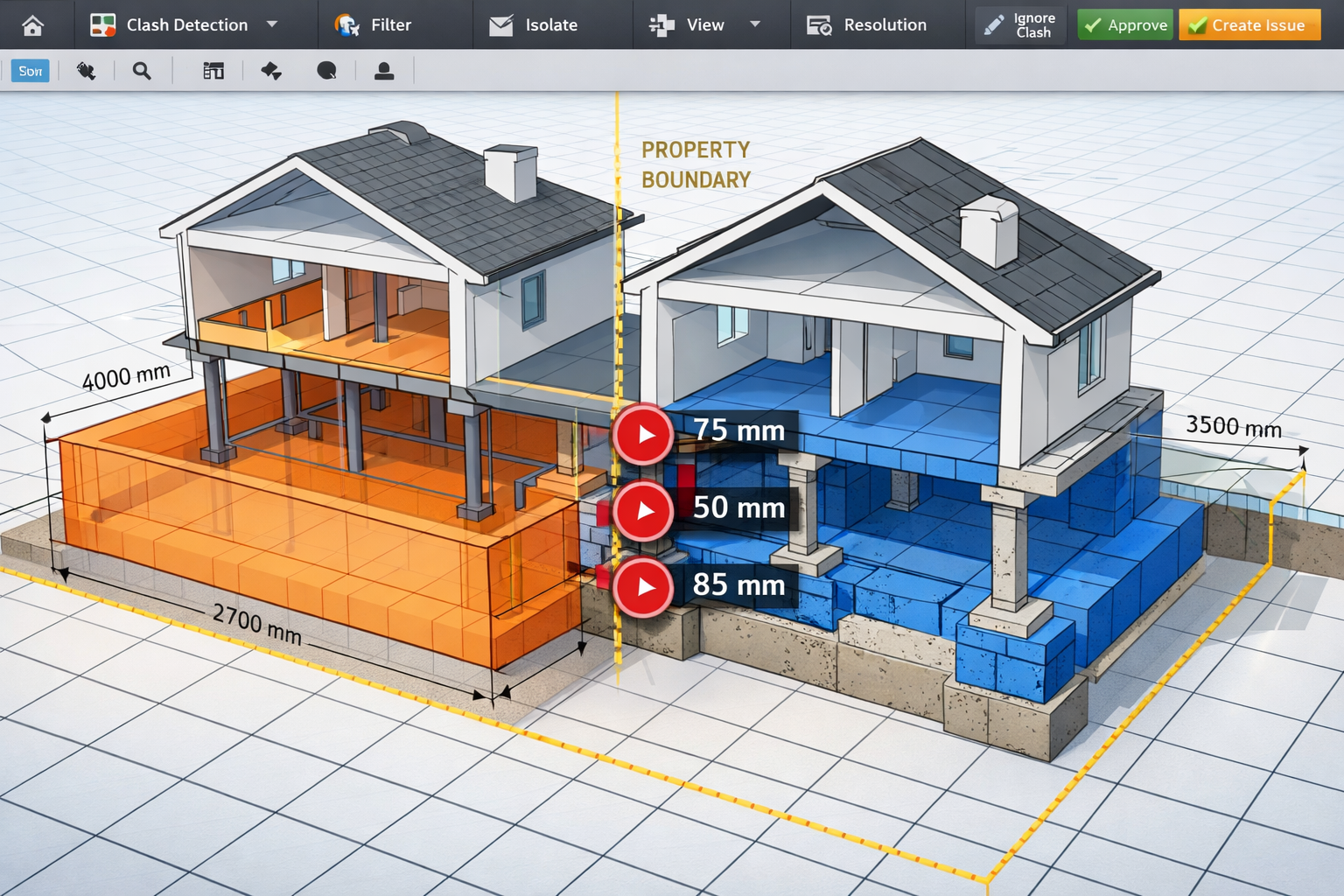
What is Clash Detection and Why It Matters
Clash detection is the automated process of identifying spatial conflicts within BIM models. The software analyzes the 3D geometry of all building components and flags locations where elements occupy the same space—physical impossibilities that would cause construction problems.
For party wall matters, clash detection extends beyond a single building to analyze interactions between:
- Proposed foundations and existing neighboring foundations
- New structural elements and existing party walls
- Excavation zones and adjoining property support structures
- New drainage systems and existing underground utilities at boundaries
- Proposed floor levels and existing beam positions in shared structures
Types of Clashes in Party Wall Scenarios
BIM software typically categorizes clashes into three severity levels:
🔴 Hard Clashes (Critical)
Physical conflicts where solid objects occupy the same space. Examples include:
- Proposed foundation piles intersecting with neighbor's existing basement wall
- New steel beam penetrating through party wall beyond agreed depth
- Excavation zone extending beneath adjoining owner's foundation
🟡 Soft Clashes (Warning)
Clearance violations where required spacing is insufficient. Examples include:
- Insufficient working space between new foundation and party wall
- Proposed drainage within minimum distance from boundary
- New structural supports too close to existing load-bearing elements
🟢 Workflow Clashes (Advisory)
Sequencing or timing conflicts. Examples include:
- Construction activities requiring simultaneous access from both properties
- Temporary works requiring support from adjoining owner's land
- Phasing conflicts affecting shared structure stability
Understanding these clash categories helps surveyors prioritize resolution efforts and communicate risks effectively when preparing party wall notices and awards.
The Clash Detection Process for Party Wall Works
Implementing Building Information Modeling (BIM) Integration for Party Wall Awards: Clash Detection and Shared Structure Coordination follows a systematic workflow:
Step 1: Model Creation and Integration
- Obtain BIM models from building owner's architect/designer
- Create or obtain accurate BIM representation of adjoining owner's existing structure
- Verify model accuracy against site surveys and existing documentation
- Establish common coordinate system and reference points
Step 2: Clash Detection Analysis
- Run automated clash detection software (Navisworks, Solibri, BIM 360)
- Configure clash detection rules specific to party wall scenarios
- Set appropriate tolerance levels (typically 25-50mm for party wall works)
- Generate comprehensive clash reports with visual documentation
Step 3: Clash Review and Prioritization
- Review all identified clashes with design team
- Eliminate false positives (non-critical overlaps)
- Categorize remaining clashes by severity and impact
- Document potential solutions for each significant clash
Step 4: Award Integration
- Incorporate clash findings into party wall award documentation
- Specify design modifications required to resolve conflicts
- Include visual evidence from BIM models in award schedules
- Define monitoring protocols for critical interfaces during construction
This systematic approach transforms party wall surveying from reactive documentation to proactive risk management.
Real-World Benefits: Time and Cost Savings
The implementation of BIM-based clash detection delivers measurable benefits throughout the party wall process:
Timeline Acceleration:
- Traditional process: 8-12 weeks from notice to agreed award
- BIM-integrated process: 5-8 weeks from notice to agreed award
- Reduction: 3-4 weeks average time savings
Dispute Reduction:
- Projects using BIM clash detection experience 60% fewer disputes during construction
- Visual clarity helps adjoining owners understand proposed works, reducing initial objections
- Early conflict identification prevents costly on-site discoveries
Cost Implications:
- Average cost of resolving design conflicts during construction: £8,000-£15,000
- Average cost of BIM clash detection during design phase: £1,200-£2,500
- Return on investment: 4:1 to 6:1 ratio
These benefits align with broader industry recognition of digital construction methodologies, as evidenced by projects shortlisted for digital construction awards in 2026[4].
Shared Structure Coordination Through BIM Integration
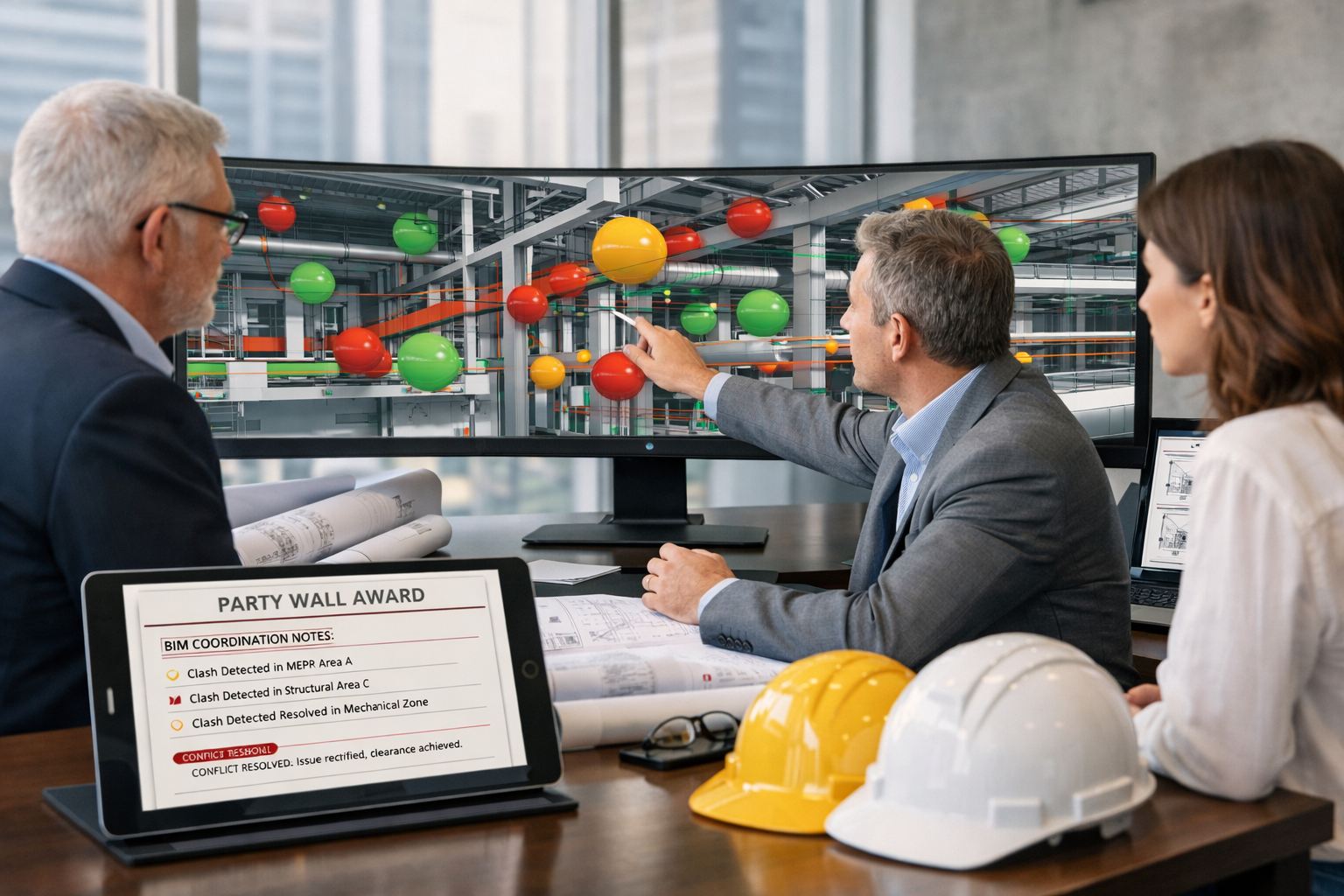
Understanding Shared Structures in Party Wall Context
Shared structures extend beyond simple party walls to include:
- Party walls: Walls standing on both properties' land or astride the boundary
- Party structures: Walls, floors, and other structures separating buildings belonging to different owners
- Party fence walls: Walls standing astride boundaries but not part of buildings
- Shared foundations: Underground structural elements supporting multiple properties
- Common drainage systems: Pipes and infrastructure serving adjoining properties
The Party Wall etc. Act 1996 provides the legal framework for works affecting these shared elements, but the Act predates modern digital technologies. BIM integration enhances compliance while providing superior documentation.
BIM Coordination Workflows for Complex Scenarios
Basement Excavations and Underpinning
Basement construction represents one of the most challenging party wall scenarios. BIM coordination enables:
- Precise modeling of existing foundation depths and load paths
- Analysis of proposed excavation impact on adjoining foundations
- Visualization of temporary support requirements
- Sequencing of underpinning works to maintain structural stability
When preparing awards for basement works, surveyors can use BIM to demonstrate:
- Exact depth and proximity of excavation to party wall
- Load transfer mechanisms during construction phases
- Required temporary works and their locations
- Monitoring point locations for settlement tracking
This level of detail strengthens party wall awards and provides clear construction guidance, reducing ambiguity that often leads to disputes.
Structural Alterations to Existing Party Walls
Works to existing party walls—such as inserting steel beams, creating new openings, or raising wall heights—benefit significantly from BIM coordination:
- Load analysis: BIM models can integrate structural calculations showing load redistribution
- Connection details: 3D visualization of beam bearings, padstones, and support mechanisms
- Sequencing clarity: Animation of construction sequence showing temporary support stages
- Impact assessment: Analysis of vibration, noise, and dust propagation patterns
For guidance on wall height considerations, refer to our article on how high you can build a wall between neighbours.
New Party Walls and Boundary Structures
When constructing new walls on or at boundaries, BIM coordination addresses:
- Precise positioning relative to boundary lines
- Foundation design considering soil conditions on both properties
- Drainage arrangements and water management
- Future maintenance access requirements
Understanding the distinctions between different wall types is essential—our guide on boundary wall rules and party fence walls provides important context for these scenarios.
Data Exchange Standards and Interoperability
Effective BIM coordination requires standardized data exchange between different software platforms and project stakeholders. Key standards include:
IFC (Industry Foundation Classes)
- Open, neutral file format for BIM data exchange
- Ensures models can be shared between different software platforms
- Maintained by buildingSMART International
- Essential for party wall surveyors who may receive models from various sources
COBie (Construction Operations Building Information Exchange)
- Structured format for facility data
- Useful for documenting party wall awards with asset information
- Supports handover documentation and future maintenance planning
BCF (BIM Collaboration Format)
- Standard for communicating issues and coordination points
- Enables surveyors to annotate models with clash findings
- Supports workflow between surveyor, architect, and contractor
Adopting these standards ensures that Building Information Modeling (BIM) Integration for Party Wall Awards: Clash Detection and Shared Structure Coordination remains accessible across different project teams and software ecosystems.
Creating BIM-Enhanced Party Wall Awards
A BIM-enhanced party wall award differs from traditional awards in several key aspects:
Traditional Award Components:
- Written description of proposed works
- 2D drawings and sections
- Schedule of condition (photographs and descriptions)
- Specification of materials and methods
BIM-Enhanced Award Additions:
- 3D model references with specific view states
- Clash detection reports with resolution confirmations
- Coordinated construction sequence animations
- Digital schedule of condition with point cloud data
- Monitoring protocols linked to BIM model locations
The legal validity of these digital documents continues to evolve, but courts increasingly accept digital evidence when properly authenticated and maintained. Surveyors should maintain both traditional and digital documentation to ensure comprehensive coverage.
For insights on managing costs of party wall processes, including technology investments, refer to our detailed cost guide.
Implementation Challenges and Practical Solutions
Technical Barriers to BIM Adoption
Software Costs and Learning Curves
Professional BIM software represents a significant investment:
- Autodesk Navisworks: £1,800-£2,400 annually
- Solibri Office: £2,200-£2,800 annually
- Graphisoft Archicad: £2,500-£3,200 annually
However, viewer-only versions of many platforms are available at no cost, allowing surveyors to review models and clash reports without full authoring capabilities.
Training requirements include:
- Basic BIM literacy: 2-3 days of training
- Clash detection competency: 3-5 days of specialized training
- Advanced coordination: 10-15 days including software-specific skills
Solution: Many surveyors partner with BIM consultants for complex projects while developing internal capabilities gradually. This hybrid approach manages costs while building expertise.
Model Quality and Accuracy Issues
Not all BIM models meet the quality standards required for reliable clash detection:
- Incomplete or simplified geometry
- Incorrect positioning or orientation
- Missing structural elements
- Outdated versions that don't reflect design changes
Solution: Establish clear model delivery requirements when commissioning BIM work:
- Minimum Level of Detail (LOD 300 or higher for structural elements)
- Coordinate system and reference point specifications
- File format requirements (native and IFC)
- Update frequency and version control protocols
Legal and Professional Considerations
Evidential Status of BIM Documentation
While BIM models provide compelling visual evidence, their legal status in party wall disputes requires careful consideration:
✅ Accepted Uses:
- Supporting documentation for traditional written awards
- Visual aids during surveyor negotiations
- Evidence of due diligence in design coordination
- Reference material for construction monitoring
⚠️ Cautionary Areas:
- BIM models alone may not constitute sufficient legal documentation
- Digital evidence requires proper authentication and chain of custody
- Courts may require expert testimony to interpret technical BIM data
Best Practice: Use BIM as enhancement rather than replacement for traditional documentation. Include both 2D extracts and references to 3D models in formal awards.
Professional Liability Implications
Surveyors adopting BIM technologies should consider:
- Professional indemnity insurance coverage for digital work
- Competency requirements and continuing professional development
- Duty of care when reviewing technical BIM data
- Liability for clash detection accuracy and completeness
Surveyors should clearly define their scope of services when offering BIM-enhanced party wall work, distinguishing between:
- Reviewing models prepared by others
- Commissioning clash detection from specialists
- Providing full BIM coordination services
Stakeholder Engagement and Communication
Explaining BIM Benefits to Building Owners
Many building owners may question the value of BIM integration given additional costs. Effective communication emphasizes:
💰 Cost Avoidance: "Identifying foundation conflicts now saves £10,000-£15,000 in construction delays and redesign"
⏱️ Time Savings: "BIM coordination typically reduces the award negotiation period by 3-4 weeks"
🛡️ Risk Reduction: "Visual clash detection reduces construction disputes by 60%, protecting your project timeline"
📊 Quality Assurance: "3D coordination ensures your design team has resolved all structural conflicts before construction begins"
Managing Adjoining Owner Expectations
Adjoining owners benefit from BIM integration through:
- Clearer understanding of proposed works and impacts
- Visual evidence that their concerns have been addressed
- More comprehensive protection provisions in awards
- Better construction monitoring capabilities
When serving party wall notices, building owners can highlight BIM coordination as evidence of thorough planning and consideration for neighbors' interests.
Future Developments in BIM for Party Wall Practice
Emerging Technologies
Artificial Intelligence and Machine Learning
AI-enhanced clash detection systems are evolving to:
- Automatically categorize clashes by party wall relevance
- Suggest resolution strategies based on historical project data
- Predict potential disputes based on design characteristics
- Generate draft award language for standard clash scenarios
These capabilities will further accelerate the award process and improve consistency across the profession.
Digital Twins and Real-Time Monitoring
Digital twin technology—creating dynamic digital replicas of physical assets—offers exciting possibilities for party wall work:
- Real-time structural monitoring during construction
- Automatic alerts when construction deviates from agreed parameters
- Integration with IoT sensors for settlement and vibration tracking
- Post-construction asset management for shared structures
Data centre developments are already demonstrating sophisticated applications of digital twin technology in party wall contexts[1], suggesting broader adoption may follow.
Augmented Reality (AR) for Site Verification
AR technology enables surveyors to overlay BIM models onto physical site conditions:
- Verify as-built construction against approved designs
- Identify deviations during construction monitoring
- Communicate findings visually to building owners and contractors
- Document compliance for award closeout
Industry Standardization Efforts
Professional bodies and standards organizations are developing frameworks for BIM in party wall practice:
- RICS (Royal Institution of Chartered Surveyors): Guidance on digital surveying practices
- buildingSMART: Party wall-specific data exchange standards
- ISO standards: International protocols for BIM in legal documentation
- Faculty of Party Wall Surveyors: Professional development programs for BIM competency
These initiatives will establish best practices and quality benchmarks that increase confidence in BIM-enhanced party wall work.
Regulatory Evolution
Building regulations and planning requirements increasingly mandate BIM deliverables for larger projects. This regulatory push will:
- Increase availability of quality BIM models for party wall analysis
- Normalize digital documentation in construction disputes
- Create market pressure for surveyors to develop BIM capabilities
- Potentially lead to BIM-specific provisions in future party wall legislation
Surveyors who develop BIM competencies now will be well-positioned as these regulatory trends accelerate.
Practical Implementation Roadmap for Surveyors
Getting Started with BIM Integration
Phase 1: Foundation (Months 1-3)
- Invest in BIM viewer software (free or low-cost options)
- Complete basic BIM literacy training
- Review sample BIM models from completed projects
- Identify technology partners for complex projects
Phase 2: Pilot Projects (Months 4-9)
- Select suitable projects for BIM integration (larger, more complex works)
- Collaborate with experienced BIM consultants
- Document lessons learned and refine workflows
- Develop template award language for BIM-enhanced documentation
Phase 3: Capability Building (Months 10-18)
- Invest in professional clash detection software
- Complete advanced training in coordination workflows
- Develop in-house standards and procedures
- Market BIM capabilities to potential clients
Phase 4: Full Integration (Months 18+)
- Offer BIM coordination as standard service for appropriate projects
- Train additional staff members in BIM workflows
- Contribute to industry standards development
- Mentor other surveyors in BIM adoption
Cost-Benefit Analysis for Practice Investment
| Investment Category | Initial Cost | Annual Cost | Payback Period |
|---|---|---|---|
| Software (viewer only) | £0 | £0 | Immediate |
| Basic training | £800-£1,200 | – | 2-3 projects |
| Professional software | £2,000-£3,000 | £1,800-£2,400 | 8-12 projects |
| Advanced training | £2,500-£4,000 | – | 10-15 projects |
| BIM consultant partnership | £0 upfront | Per-project fees | Immediate |
For most party wall surveying practices, a hybrid approach—combining in-house viewing capabilities with consultant partnerships for complex coordination—offers the best initial value proposition.
Marketing BIM-Enhanced Services
Differentiate your practice by highlighting BIM capabilities:
Website and Marketing Materials:
- Case studies showing clash detection preventing disputes
- Visual comparisons of traditional vs. BIM-enhanced awards
- Client testimonials emphasizing time and cost savings
- Educational content explaining BIM benefits in accessible language
Client Engagement:
- Offer BIM coordination as value-added service for complex projects
- Provide cost-benefit analysis showing ROI for building owners
- Demonstrate clash detection during initial consultations
- Include BIM deliverables in service proposals
Professional Development:
- Present at industry conferences on BIM integration
- Publish articles in professional journals
- Participate in standards development initiatives
- Mentor colleagues in BIM adoption
For surveyors looking to understand how to keep party wall costs down, BIM integration can be positioned as a cost-saving investment rather than an expense.
Conclusion
Building Information Modeling (BIM) Integration for Party Wall Awards: Clash Detection and Shared Structure Coordination represents a transformative advancement in party wall surveying practice. By enabling proactive identification of structural conflicts before formal notices are served, BIM technology reduces disputes, accelerates award timelines, and delivers superior outcomes for both building and adjoining owners.
The evidence is compelling: projects utilizing BIM clash detection experience 60% fewer disputes during construction, achieve awards 3-4 weeks faster, and avoid costly on-site conflicts that traditionally plague party wall works. As construction projects grow more complex and urban development intensifies, these benefits will become increasingly critical to successful project delivery.
While implementation challenges exist—including software costs, training requirements, and evolving legal frameworks—the practical solutions outlined in this article demonstrate that BIM integration is accessible to surveyors at various practice scales. Whether partnering with BIM consultants for complex projects or developing in-house capabilities gradually, surveyors can begin realizing benefits immediately.
Next Steps for Party Wall Professionals
For Surveyors:
- Assess your current capabilities and identify appropriate entry points for BIM integration
- Invest in basic BIM literacy through professional development courses
- Pilot BIM coordination on suitable projects to build experience and refine workflows
- Develop partnerships with BIM consultants and technology providers
- Market your enhanced capabilities to differentiate your practice
For Building Owners:
- Request BIM coordination for complex party wall works, especially basement excavations
- Ensure your design team provides quality BIM models meeting appropriate standards
- Budget for clash detection as a cost-saving investment rather than an expense
- Engage surveyors with demonstrated BIM competencies for technically complex projects
For Adjoining Owners:
- Ask whether BIM coordination has been performed on proposed works affecting your property
- Request visual documentation from BIM models to better understand proposed impacts
- Ensure your surveyor has capabilities to review and interpret BIM data
- Advocate for comprehensive monitoring using digital technologies during construction
The future of party wall surveying lies in the intelligent integration of traditional professional expertise with modern digital technologies. Surveyors who embrace Building Information Modeling (BIM) Integration for Party Wall Awards: Clash Detection and Shared Structure Coordination will lead the profession forward, delivering superior service while maintaining the fundamental principles of fairness and protection that underpin the Party Wall etc. Act 1996.
As the construction industry continues its digital transformation, party wall professionals have an opportunity to demonstrate leadership, innovation, and commitment to excellence. The tools are available, the benefits are proven, and the path forward is clear. The question is not whether to integrate BIM into party wall practice, but how quickly and effectively to do so.
References
[1] Party Wall Agreements In Data Centre Developments 2026 Compliance Amid Ai Driven Uk Demand – https://nottinghillsurveyors.com/blog/party-wall-agreements-in-data-centre-developments-2026-compliance-amid-ai-driven-uk-demand
[2] Bimobject Awards 2026 – https://business.bimobject.com/bimobject-awards-2026/
[4] Digital Construction Project Of The Year 2026 Shortlist – https://constructionmanagement.co.uk/digital-construction-project-of-the-year-2026-shortlist/