


{"cover":"Professional landscape format (1536×1024) hero image with bold text overlay 'GIS-Enhanced Party Wall Risk Mapping: Integrating Zoning, Utilities, and Structural Data for Comprehensive Assessments' in extra large 70pt white sans-serif font with dark shadow and semi-transparent navy overlay box, centered in upper third. Background shows detailed digital map interface with colorful zoning layers, utility lines in bright colors (blue water, yellow gas, red electric), property boundaries, and 3D building structures overlaid on aerial photography of dense urban residential area. Multiple data layers visible with transparency showing integration of information. Color scheme: deep blue, bright yellow, red, white accents. High contrast, modern GIS interface aesthetic, professional surveying and urban planning theme, editorial magazine cover quality with technical precision and visual sophistication.","content":["Detailed landscape format (1536×1024) illustration showing split-screen comparison of traditional party wall assessment versus GIS-enhanced approach. Left side shows surveyor with clipboard examining physical wall between two Victorian terraced houses, paper documents and basic measurements. Right side displays modern laptop screen with sophisticated GIS interface showing same properties with multiple colorful data layers: zoning districts in purple overlay, underground utility corridors in bright neon colors (water pipes blue, gas yellow, electrical red), historical structural data points as orange markers, soil conditions as gradient heat map, and 3D building models with transparency effects. Clear visual contrast between old and new methods. Photorealistic style with professional surveying equipment, urban London residential setting, bright natural lighting, technical precision.","Comprehensive landscape format (1536×1024) infographic-style visualization demonstrating the five key data layers in GIS party wall risk mapping system. Central circular diagram with property outline at center, surrounded by five distinct radiating sections each with unique color coding and icons: 1) Zoning regulations layer in purple with building height restrictions and setback lines, 2) Utility infrastructure in multicolor showing water mains, gas lines, electrical conduits with depth measurements, 3) Structural history in orange displaying foundation types, previous subsidence incidents, building age data, 4) Environmental factors in green showing tree root zones, soil types, flood risk areas, 5) Legal boundaries in red with easements and rights of way. Each section includes small data visualization elements like bar charts, depth profiles, and risk indicators. Clean professional design with clear labels, modern color palette, technical accuracy, educational poster aesthetic.","Detailed landscape format (1536×1024) photograph-quality scene of modern party wall surveyor conducting site assessment with integrated technology. Professional surveyor in high-visibility vest standing between two adjoining London properties, holding ruggedized tablet displaying real-time GIS interface with property location pinpointed. Tablet screen clearly visible showing overlay of current site photo with transparent data layers including underground utility locations marked with colored lines, zoning boundary highlighted in purple, historical structural issues flagged with warning icons, and 3D building models. Background shows typical London terraced houses with shared party wall visible, construction equipment nearby, neighboring properties. Surveyor using laser measuring device pointed at wall. Natural daylight, professional construction site atmosphere, technical equipment visible, realistic workplace documentation scene, high detail and clarity."]
When a homeowner in London begins basement excavation next to a Victorian terrace, dozens of hidden risks lurk beneath the surface—literally. Underground utilities, unstable soil conditions, historical subsidence, and complex zoning restrictions can transform a straightforward project into a costly nightmare. In 2026, Geographic Information Systems (GIS) are revolutionizing how party wall surveyors identify, analyze, and mitigate these risks before construction begins.
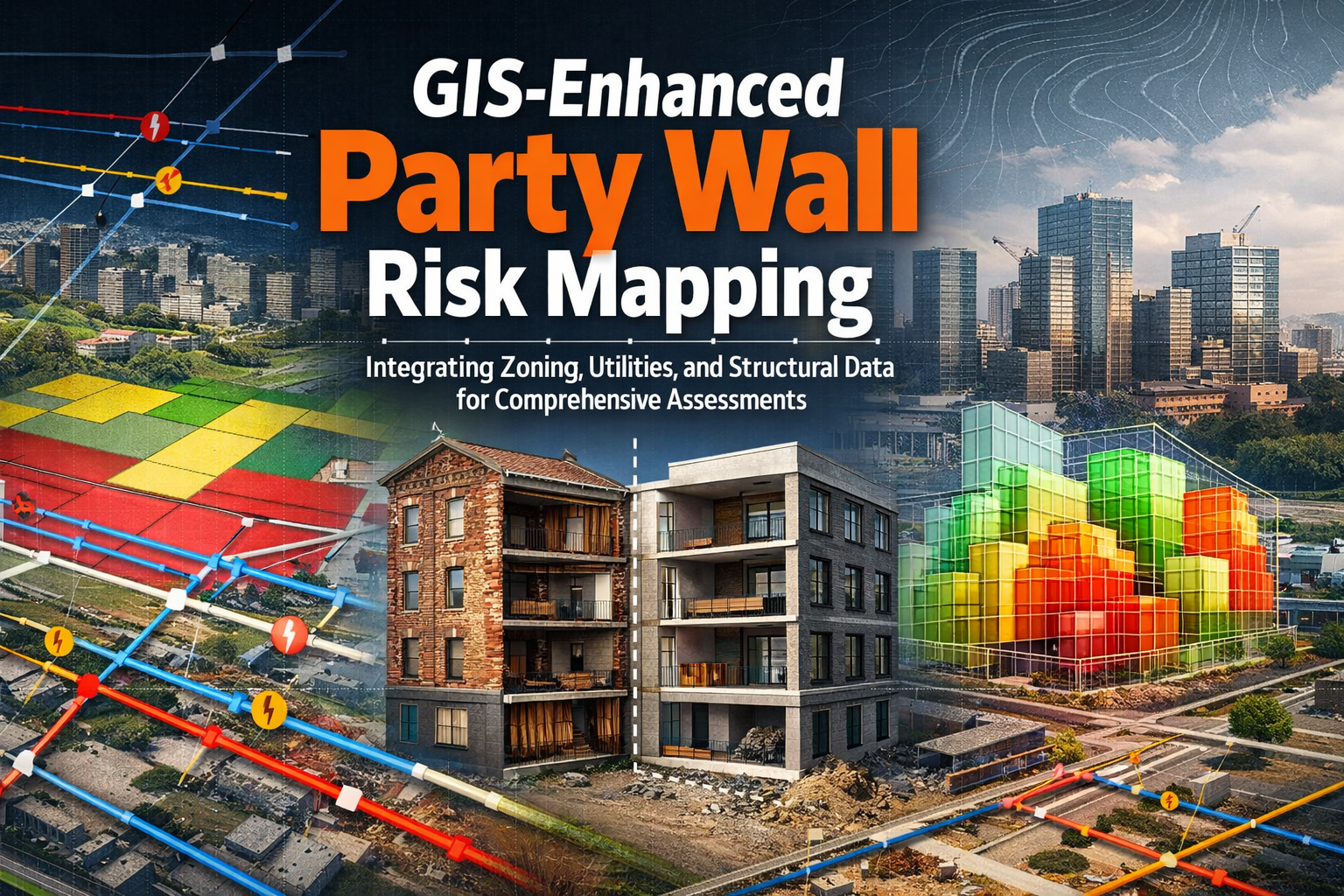
GIS-Enhanced Party Wall Risk Mapping: Integrating Zoning, Utilities, and Structural Data for Comprehensive Assessments represents a fundamental shift from traditional surveying methods to data-driven, multi-layered analysis. By overlaying zoning regulations, utility locations, historical structural information, and environmental data onto digital maps, surveyors can now visualize complex relationships that would otherwise remain invisible until problems emerge.
This technological advancement is particularly crucial in dense urban environments where properties share walls, foundations, and underground infrastructure. The ability to see what lies beneath the surface—and understand how different risk factors interact—enables more accurate assessments and robust party wall agreements that protect all parties involved.
Key Takeaways
- Multi-layered data integration allows surveyors to visualize zoning restrictions, utility corridors, structural history, and environmental factors simultaneously on digital maps
- Risk identification improves significantly when underground utilities, soil conditions, and historical subsidence data are overlaid with current property boundaries
- GIS technology reduces costly surprises by revealing hidden infrastructure conflicts and regulatory constraints before construction begins
- Comprehensive assessments using integrated data lead to more accurate party wall awards and better protection for adjoining owners
- Digital mapping platforms enable real-time updates and collaboration between surveyors, building owners, and regulatory authorities
Understanding GIS-Enhanced Party Wall Risk Mapping: Integrating Zoning, Utilities, and Structural Data for Comprehensive Assessments
What Makes GIS Technology Essential for Modern Party Wall Assessments
Geographic Information Systems transform how professionals analyze spatial relationships and risk factors in party wall scenarios. Unlike traditional surveying that relies on physical measurements and paper records, GIS platforms compile diverse data sources into unified digital maps where patterns and conflicts become immediately visible.
Core capabilities of GIS for party wall work include:
- 📊 Data layer overlay – Combining multiple information types on a single map view
- 🗺️ Spatial analysis – Identifying proximity relationships and buffer zones
- 📈 Risk visualization – Color-coding threat levels based on multiple variables
- 🔄 Real-time updates – Incorporating new information as projects progress
- 📱 Mobile accessibility – Accessing comprehensive data during site visits
The construction industry has increasingly recognized the value of integrated risk assessment tools. As one industry update notes, structural risk assessments and comprehensive condition surveys have become essential regulatory requirements in 2026, particularly for complex urban projects involving shared structures [5].
The Traditional Approach vs. GIS-Enhanced Methodology
Traditional party wall assessments typically involve physical site visits, manual measurements, and consultation of separate records held by various authorities. A surveyor might spend days gathering information from:
- Local planning departments for zoning regulations
- Utility companies for infrastructure locations
- Land registry for boundary definitions
- Historical archives for previous structural issues
- Environmental agencies for soil and flood data
This fragmented approach creates several problems:
❌ Information gaps – Missing data from incomplete records
❌ Time delays – Waiting for responses from multiple agencies
❌ Coordination errors – Conflicting information from different sources
❌ Limited visualization – Difficulty seeing how factors interact
❌ Update challenges – Static information that becomes outdated
GIS-enhanced methodology solves these issues by:
✅ Centralizing all relevant data in one accessible platform
✅ Providing instant access to current information
✅ Enabling visual analysis of complex spatial relationships
✅ Allowing scenario modeling before work begins
✅ Supporting evidence-based decision making
When preparing party wall notices, surveyors using GIS can provide adjoining owners with detailed visual documentation showing exactly how proposed works relate to existing infrastructure, zoning constraints, and historical risk factors.
Key Data Layers in GIS-Enhanced Party Wall Risk Mapping: Integrating Zoning, Utilities, and Structural Data

Zoning Regulations and Planning Constraints
Zoning data forms the regulatory foundation of any party wall assessment. GIS platforms overlay local planning restrictions directly onto property maps, revealing:
Height restrictions – Maximum building heights that affect excavation depth calculations
Setback requirements – Minimum distances from boundaries that impact foundation placement
Conservation area rules – Special protections for historic structures
Permitted development rights – What work can proceed without planning permission
Future development plans – Proposed changes to local zoning that affect long-term risk
Esri's research demonstrates how overlaying zoning maps with other risk factors helps identify areas where multiple constraints converge [3]. For party wall work, this means spotting properties where height restrictions, conservation rules, and structural limitations create particularly complex scenarios.
Understanding zoning is crucial when determining costs of party wall processes, as projects in conservation areas or with multiple planning constraints typically require more extensive assessments.
Underground Utility Infrastructure Mapping
Perhaps the most critical—and dangerous—hidden risk involves underground utilities. GIS platforms integrate utility company data to show:
🔵 Water mains and sewers – Location, depth, material, and age
🟡 Gas pipelines – High-pressure and low-pressure lines with safety buffers
🔴 Electrical cables – Power distribution networks and service connections
🟢 Telecommunications – Fiber optic and copper cable routes
🟣 District heating – Shared heating system pipes in some urban areas
The visualization of utility corridors is particularly valuable for basement excavations and foundation work. A surveyor can immediately see if proposed digging will intersect with critical infrastructure, allowing for design modifications before party wall awards are finalized.
Case scenario: A homeowner in East London plans to excavate 3 meters below ground for a basement extension. GIS mapping reveals a Victorian-era brick sewer running 2.5 meters deep directly beneath the proposed excavation zone. Without this advance knowledge, the project could have caused catastrophic utility failure and flooding to multiple properties.
Historical Structural Data and Subsidence Records
Buildings tell stories through their structural history. GIS platforms compile decades of information including:
- Previous subsidence incidents with dates, causes, and remediation methods
- Foundation types documented during construction or subsequent surveys
- Building age and construction methods affecting structural resilience
- Past party wall disputes and their resolutions
- Underpinning work performed on neighboring properties
- Tree root damage claims and vegetation removal records
This historical context proves invaluable when assessing risk to adjoining properties. A building that experienced subsidence in 1995 due to clay soil shrinkage presents different risks than one with no recorded structural issues.
Surveyors working in North London or South London can access neighborhood-wide patterns showing which streets have experienced repeated subsidence, helping predict where extra precautions are necessary.
Environmental and Geological Factors
The ground beneath London varies dramatically from street to street. GIS environmental layers include:
| Environmental Factor | Risk Implications |
|---|---|
| Soil type | Clay soils shrink/swell with moisture, sandy soils drain quickly |
| Groundwater levels | High water tables complicate excavation and increase hydrostatic pressure |
| Flood risk zones | Areas prone to surface water flooding during heavy rain |
| Tree preservation orders | Protected trees whose roots extend beneath properties |
| Contaminated land | Former industrial sites requiring special handling |
| Mining subsidence | Historical underground extraction affecting stability |
Research on GIS applications shows how combining vegetation indexes with soil and climate models creates comprehensive risk assessments [3]. For party wall work, this means understanding how mature trees in a neighbor's garden might affect foundation stability during excavation.
Legal Boundaries and Property Rights
Precise boundary definition prevents disputes and ensures compliance with the Party Wall etc. Act 1996. GIS layers include:
- Registered title boundaries from Land Registry data
- Easements and rights of way affecting access during construction
- Restrictive covenants limiting certain types of work
- Leasehold vs. freehold distinctions in mixed-tenure buildings
- Historic boundary disputes and their resolutions
Understanding the difference between party fence walls and boundary walls becomes clearer when surveyors can overlay legal boundaries with physical structures on GIS maps, revealing discrepancies that require resolution before work begins.
Implementing GIS-Enhanced Party Wall Risk Mapping: Integrating Zoning, Utilities, and Structural Data in Practice
Data Collection and Integration Workflows
Successful GIS implementation requires systematic data gathering from multiple sources:
Step 1: Base Map Creation
Start with accurate property boundaries from Land Registry and current aerial photography or satellite imagery showing existing structures.
Step 2: Regulatory Data Import
Add local authority planning data including zoning designations, conservation areas, Article 4 directions, and building height restrictions.
Step 3: Utility Infrastructure Overlay
Request utility location data from water, gas, electric, and telecommunications providers. Many UK utility companies now provide digital mapping data compatible with GIS platforms.
Step 4: Historical Records Integration
Compile building control records, previous party wall awards, subsidence insurance claims, and structural survey reports for the property and immediate neighbors.
Step 5: Environmental Data Addition
Incorporate British Geological Survey soil data, Environment Agency flood risk maps, tree preservation orders, and groundwater monitoring information.
Step 6: Validation and Ground-Truthing
Conduct site visits with mobile GIS devices to verify digital data against physical conditions, updating records where discrepancies exist.
This comprehensive approach aligns with 2026 regulatory trends emphasizing thorough pre-construction risk assessment [1]. Surveyors who invest time in proper data integration produce more accurate assessments and fewer surprises during construction.
Risk Analysis and Visualization Techniques
Once data layers are integrated, GIS platforms enable sophisticated analysis:
Proximity Analysis – Automatically identify all utilities within 3 meters of proposed excavation zones, flagging high-risk intersections.
Buffer Zone Mapping – Create visual safety buffers around critical infrastructure, showing where work restrictions apply.
Risk Heat Mapping – Assign numerical risk scores to different factors (soil instability, utility proximity, historical subsidence) and combine them into color-coded risk zones.
3D Visualization – Model proposed excavations in three dimensions alongside underground utilities and adjacent building foundations to spot conflicts.
Scenario Modeling – Test different construction approaches digitally to find the safest, most cost-effective solution before breaking ground.
These visualization tools transform complex technical information into clear graphics that building owners and adjoining owners can understand. When serving a party structure notice, including GIS-generated risk maps provides transparency and builds confidence in the assessment process.
Practical Applications Across Different Project Types
Basement Excavations and Extensions
GIS mapping is particularly valuable for basement projects where underground risks are highest. Surveyors can identify:
- Utility conflicts requiring rerouting or protection measures
- Soil conditions affecting excavation method selection
- Neighboring foundation depths and types
- Groundwater levels requiring waterproofing strategies
- Historic subsidence patterns suggesting extra monitoring
Loft Conversions and Roof Extensions
Even above-ground projects benefit from GIS analysis:
- Zoning height restrictions and permitted development limits
- Structural load paths through party walls to foundations
- Neighboring property heights and overlooking issues
- Conservation area requirements for materials and design
- Access routes for construction equipment and materials
Foundation Underpinning and Repair
When addressing structural issues:
- Historical subsidence patterns in the neighborhood
- Soil type and its response to moisture changes
- Tree locations and root zone extents
- Previous underpinning work on adjacent properties
- Underground utilities that constrain excavation locations
Boundary Wall Construction
For new party fence walls:
- Precise legal boundary locations
- Underground utilities crossing the boundary line
- Easements affecting wall placement
- Height restrictions and planning requirements
- Soil conditions affecting foundation design
Technology Platforms and Tools Available in 2026
Several GIS platforms serve the party wall surveying sector:
Esri ArcGIS – Industry-standard platform with extensive UK local authority data integration and mobile field apps for site work.
QGIS – Open-source alternative offering core GIS functionality without licensing costs, suitable for smaller surveying practices.
Promap – UK-specific mapping service providing Ordnance Survey data, Land Registry boundaries, and local authority planning information.
Utility mapping services – Specialized platforms like Linesearch BeforeUDig and National GRID's mapping portal providing verified underground asset locations.
Custom surveying apps – Purpose-built mobile applications that integrate GIS data with party wall-specific workflows, schedule of condition templates, and reporting tools.
The Insurance Institute for Business & Home Safety emphasizes that construction industry professionals must adopt advanced risk assessment technologies to meet evolving safety standards [4]. GIS platforms represent exactly this type of forward-thinking approach.
Cost-Benefit Analysis for Surveying Practices
Implementing GIS technology requires investment, but the returns are substantial:
Initial Costs:
- Software licensing (£500-£2,000 annually depending on platform)
- Data subscriptions (£300-£1,200 annually for utility and planning data)
- Training for surveyors (£500-£1,500 per person)
- Hardware (tablets/laptops suitable for GIS, £800-£2,000)
Ongoing Benefits:
- ⏱️ Time savings – Reduced research time per assessment (4-8 hours saved)
- 📉 Risk reduction – Fewer unexpected issues during construction
- 💰 Cost avoidance – Preventing utility strikes and structural damage
- 🎯 Accuracy improvement – More precise risk identification
- 🤝 Client confidence – Professional presentations with visual evidence
- 📱 Competitive advantage – Differentiation from traditional surveyors
For practices handling 50+ party wall assessments annually, the time savings alone typically justify the investment within 6-12 months. The risk mitigation value—avoiding even one major utility strike or structural failure—can exceed the entire annual technology cost.
Surveyors looking to keep party wall costs down for clients can use GIS to streamline assessments, reducing billable hours while improving quality.
Regulatory Compliance and Professional Standards
The Party Wall etc. Act 1996 doesn't specifically mandate GIS use, but it does require surveyors to act professionally and thoroughly assess risks to adjoining properties. GIS technology helps surveyors meet these obligations by:
✅ Demonstrating due diligence – Comprehensive data review shows thorough investigation
✅ Documenting decision-making – Visual records support professional judgments
✅ Providing evidence – Clear documentation if disputes arise
✅ Meeting duty of care – Identifying risks that manual methods might miss
✅ Supporting expert testimony – Professional-grade analysis if legal proceedings occur
Professional bodies including the Royal Institution of Chartered Surveyors (RICS) increasingly expect members to utilize appropriate technology for complex assessments. Surveyors working in Central London or West London where property values are high and construction is dense face particular scrutiny, making robust GIS-based assessments valuable professional protection.
Challenges and Future Developments in GIS-Enhanced Party Wall Risk Mapping
Current Limitations and Data Quality Issues
Despite significant advantages, GIS-enhanced party wall risk mapping faces several challenges:
Data accuracy concerns – Utility location records may be incomplete or inaccurate, particularly for older infrastructure installed before modern surveying techniques.
Update frequency – Some data layers update infrequently, potentially missing recent changes to underground infrastructure or planning regulations.
Access restrictions – Certain datasets remain restricted or expensive, limiting availability for smaller surveying practices.
Integration complexity – Combining data from multiple sources with different formats, coordinate systems, and accuracy standards requires technical expertise.
Interpretation skills – GIS tools provide information, but surveyors must still apply professional judgment to assess risk appropriately.
Technology adoption barriers – Traditional surveyors may resist changing established workflows or lack confidence with digital platforms.
These limitations don't negate GIS value but highlight the continued importance of experienced professional judgment. Technology enhances—rather than replaces—surveyor expertise.
Emerging Technologies and Integration Opportunities
The future of GIS-enhanced party wall risk mapping includes exciting developments:
🤖 Artificial Intelligence and Machine Learning
AI algorithms can analyze historical party wall disputes to identify patterns and predict high-risk scenarios based on property characteristics, helping surveyors prioritize investigation areas.
📡 Internet of Things (IoT) Sensors
Real-time monitoring devices installed during construction can feed data directly into GIS platforms, showing ground movement, vibration levels, and structural stress as work progresses.
🥽 Augmented Reality (AR) Integration
Surveyors wearing AR glasses during site visits could see underground utilities and risk zones overlaid on their actual field of view, making invisible hazards visible.
🚁 Drone Surveying and LiDAR
Aerial surveys create precise 3D models of existing structures and terrain, integrating with GIS to show exact building heights, roof conditions, and site topography.
⛓️ Blockchain for Data Verification
Distributed ledger technology could create tamper-proof records of party wall assessments, awards, and condition surveys, ensuring data integrity over decades.
☁️ Cloud-Based Collaboration Platforms
Real-time data sharing between building owners, adjoining owners, and surveyors improves transparency and speeds dispute resolution.
These technologies will make GIS-enhanced party wall risk mapping even more powerful, though implementation will require continued investment in training and infrastructure.
Training and Professional Development
Surveyors must develop new competencies to leverage GIS effectively:
Essential skills include:
- Basic GIS software operation and data layer management
- Spatial analysis and risk visualization techniques
- Data quality assessment and validation methods
- Digital report preparation with integrated mapping
- Mobile GIS use during site inspections
- Understanding coordinate systems and map projections
Professional development opportunities include:
- RICS-accredited GIS training courses for surveyors
- Software vendor training programs (Esri, etc.)
- Online tutorials and certification programs
- Peer learning through professional associations
- Mentorship from early GIS adopters
Surveying practices should budget for ongoing training as technology evolves. The investment in skills development pays dividends through improved service quality and efficiency.
Conclusion: The Future of Party Wall Risk Assessment
GIS-Enhanced Party Wall Risk Mapping: Integrating Zoning, Utilities, and Structural Data for Comprehensive Assessments represents more than technological advancement—it embodies a fundamental shift toward data-driven, evidence-based surveying that better protects property owners and reduces construction risks.
By overlaying zoning regulations, utility locations, historical structural data, environmental factors, and legal boundaries onto unified digital maps, surveyors can visualize complex spatial relationships that traditional methods simply cannot reveal. This comprehensive approach identifies hidden risks before they become costly problems, enabling more accurate party wall awards and robust protection for all parties.
The construction industry's evolution toward integrated risk assessment reflects broader recognition that thorough pre-construction analysis prevents problems more effectively than reactive responses [5]. GIS technology provides the tools to conduct this analysis efficiently and comprehensively.
Actionable Next Steps
For Building Owners planning construction:
- Request GIS-enhanced assessments when selecting party wall surveyors
- Ask to see visual risk maps showing utilities and constraints
- Understand how integrated data analysis protects your investment
- Budget appropriately for comprehensive assessments using modern technology
For Adjoining Owners receiving notices:
- Choose surveyors who utilize GIS for thorough risk evaluation
- Request detailed mapping showing how proposed works relate to your property
- Ensure schedules of condition include baseline data that can be verified against GIS records
- Understand your rights under the Party Wall etc. Act 1996
For Surveying Professionals:
- Evaluate GIS platforms suitable for your practice size and project types
- Invest in training to develop essential spatial analysis skills
- Build relationships with data providers for utility and planning information
- Integrate GIS into standard workflows for all types of party wall works
- Educate clients about the value of comprehensive data-driven assessments
For Industry Stakeholders:
- Support open data initiatives making critical information accessible
- Develop industry standards for GIS use in party wall assessments
- Promote professional development opportunities in spatial analysis
- Encourage utility companies to improve underground asset mapping accuracy
- Advocate for regulatory frameworks recognizing advanced risk assessment methods
The integration of Geographic Information Systems into party wall surveying isn't just about adopting new technology—it's about embracing a more thorough, transparent, and effective approach to protecting property rights and preventing construction disputes. As data quality improves and platforms become more sophisticated, GIS-enhanced risk mapping will transition from competitive advantage to industry standard.
Whether you're planning construction in East London, responding to a neighbor's party wall notice, or providing professional surveying services, understanding and utilizing GIS-enhanced party wall risk mapping will lead to better outcomes for everyone involved.
The future of party wall assessment is here—comprehensive, data-driven, and visualized through the powerful lens of Geographic Information Systems. 🏗️🗺️
References
[1] Party Wall Essentials For 2026 Net Zero Compliance Projects Surveyor Checklists For Epc Retrofit Disputes – https://nottinghillsurveyors.com/blog/party-wall-essentials-for-2026-net-zero-compliance-projects-surveyor-checklists-for-epc-retrofit-disputes
[2] March 2026 Engineering Construction Industry Update – https://flengineeringllc.com/march-2026-engineering-construction-industry-update/
[3] An 2026 48 1 Winter – https://www.esri.com/content/dam/esrisites/en-us/newsroom/arcnews/an-2026-48-1-winter.pdf
[4] Strategy 2026 – https://ibhs.org/strategy-2026/
[5] Watch – https://www.youtube.com/watch?v=DtTOt8XKsns