


"
More than 60% of homeowners in England and Wales unknowingly breach the Party Wall Act 1996 when undertaking renovations, primarily because they misunderstand which projects trigger formal notice requirements and which fall outside the legislation's scope. Understanding when does the Party Wall Act apply? Determining notifiable works vs. exemptions in 2026 remains one of the most critical yet confusing aspects of property development, with consequences ranging from work stoppages to costly legal disputes.
The Party Wall Act 1996 creates specific legal obligations for property owners planning construction work that affects shared walls, boundaries, or adjacent structures. However, not every home improvement project requires formal party wall procedures. This comprehensive guide clarifies the precise circumstances that trigger Party Wall Act requirements, identifies common exemptions, and provides practical decision frameworks for homeowners, developers, and construction professionals navigating these regulations in 2026.
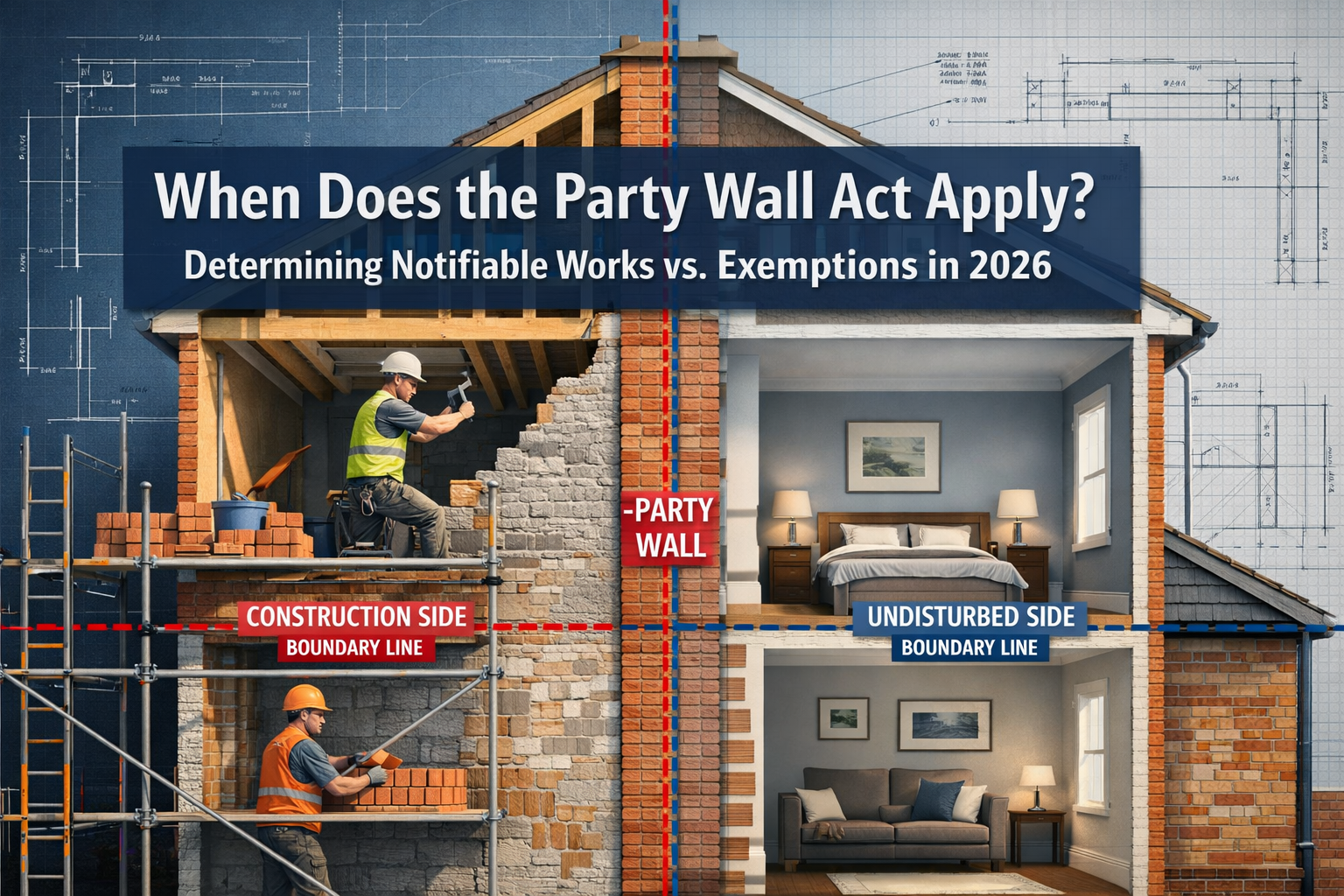
Key Takeaways
- Geographic Limitation: The Party Wall Act 1996 applies exclusively to England and Wales—not Scotland or Northern Ireland—establishing clear territorial boundaries for compliance.[5]
- Three Distinct Categories: The Act covers work to existing party walls (Section 2), new walls on boundaries (Section 1), and excavation near neighbouring structures (Section 6), each with specific notice requirements.
- Notice Timing Matters: Different work types require either two months' notice (existing party structures) or one month's notice (new boundary walls and excavation) before construction begins.[5]
- Common Exemptions Exist: Internal decorative work, repairs not affecting structure, and construction entirely within your property boundary typically fall outside the Act's scope.
- Professional Guidance Updated: The Royal Institution of Chartered Surveyors launched consultation on the 8th edition of Party Wall guidance in April 2026, representing the most current professional standards.[1]
Understanding the Fundamental Scope: When Does the Party Wall Act Apply?
The Party Wall Act 1996 establishes a legal framework governing specific construction activities that affect shared structures or boundaries between properties. Determining when does the Party Wall Act apply? Determining notifiable works vs. exemptions in 2026 requires understanding three fundamental trigger categories defined within the legislation.
The Three Core Sections of Notifiable Works
The Act divides notifiable works into three distinct categories, each governed by separate sections with unique requirements:
Section 1: New Walls on Boundaries 🏗️
This section addresses construction of new walls directly on the boundary line or astride it (straddling both properties). Works covered include:
- Building a new wall directly on the property boundary line
- Constructing a wall that straddles the boundary between two properties
- Erecting garden walls, fence walls, or boundary structures at the dividing line
Section 2: Work to Existing Party Walls 🔨
This represents the most commonly invoked section, covering modifications to structures already shared between properties:
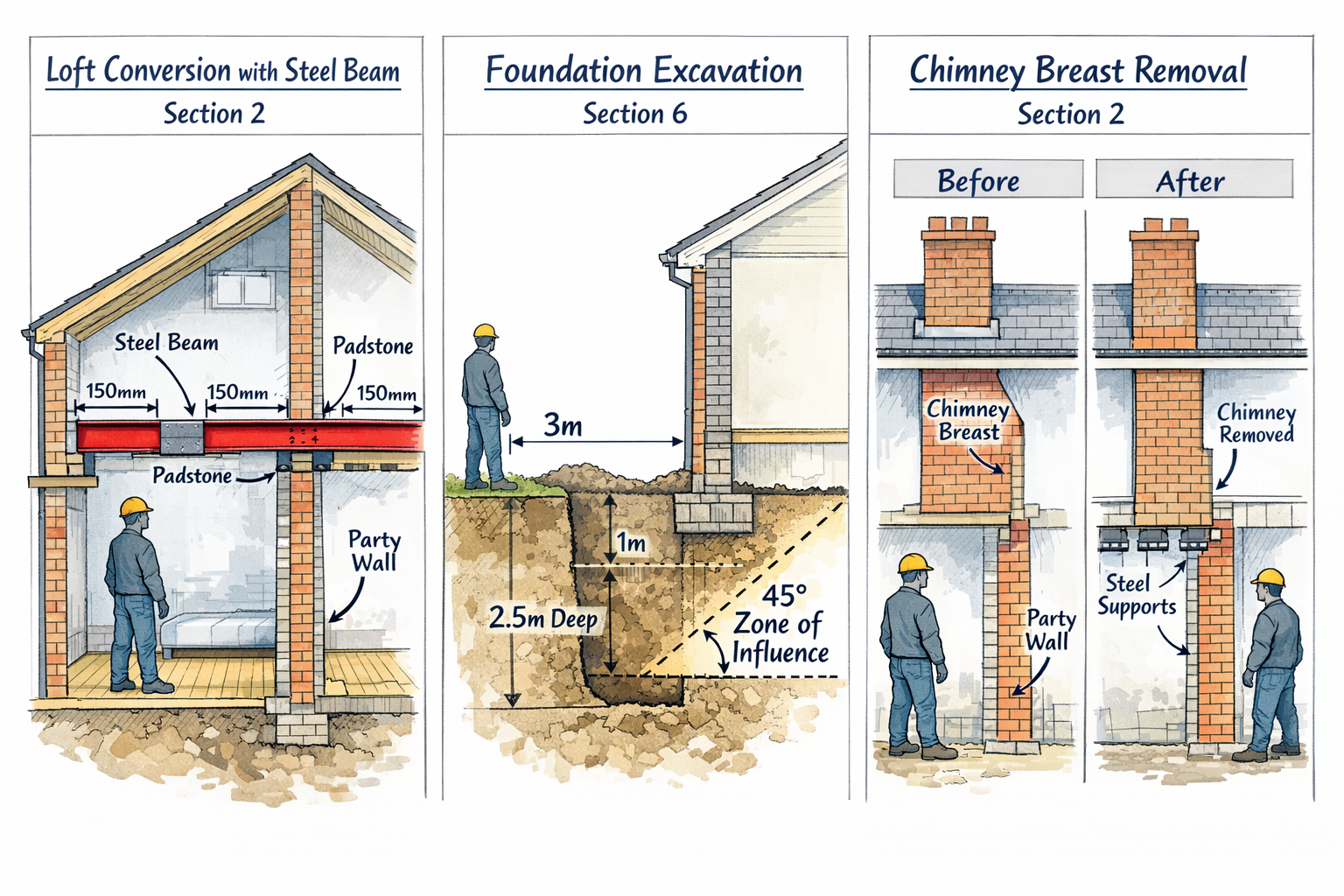
- Cutting into party walls to insert beams or joists
- Raising party walls for loft conversions or extensions
- Underpinning existing party walls or party structures
- Removing chimney breasts that form part of the party wall
- Demolishing and rebuilding party walls
- Cutting away projections or weathering from party walls
Section 6: Excavation Near Neighbouring Buildings ⛏️
This section governs excavation work within specified distances of adjoining structures:
- Excavating within 3 meters of a neighbour's building if going deeper than their foundations
- Excavating within 6 meters of a neighbour's building if going deeper than a line drawn at 45 degrees from the bottom of their foundations
Understanding these types of party wall works provides the foundation for determining whether your project requires formal notices.
Geographic and Property Type Limitations
The Party Wall Act 1996 applies exclusively within England and Wales.[5] Properties in Scotland operate under different legal frameworks, while Northern Ireland has separate legislation governing boundary disputes and shared structures.
The Act applies to all property types where structures are shared or boundaries are affected, including:
- ✅ Residential terraced houses
- ✅ Semi-detached properties
- ✅ Flats and maisonettes with shared floors/ceilings
- ✅ Commercial buildings with party walls
- ✅ Mixed-use properties
- ✅ Detached properties (for excavation provisions only)
Even detached properties can fall under the Act's jurisdiction when excavation work meets the distance and depth criteria specified in Section 6, making it incorrect to assume the legislation only affects attached buildings.
Comprehensive Guide to Notifiable Works: When Does the Party Wall Act Apply? Determining Notifiable Works vs. Exemptions in 2026
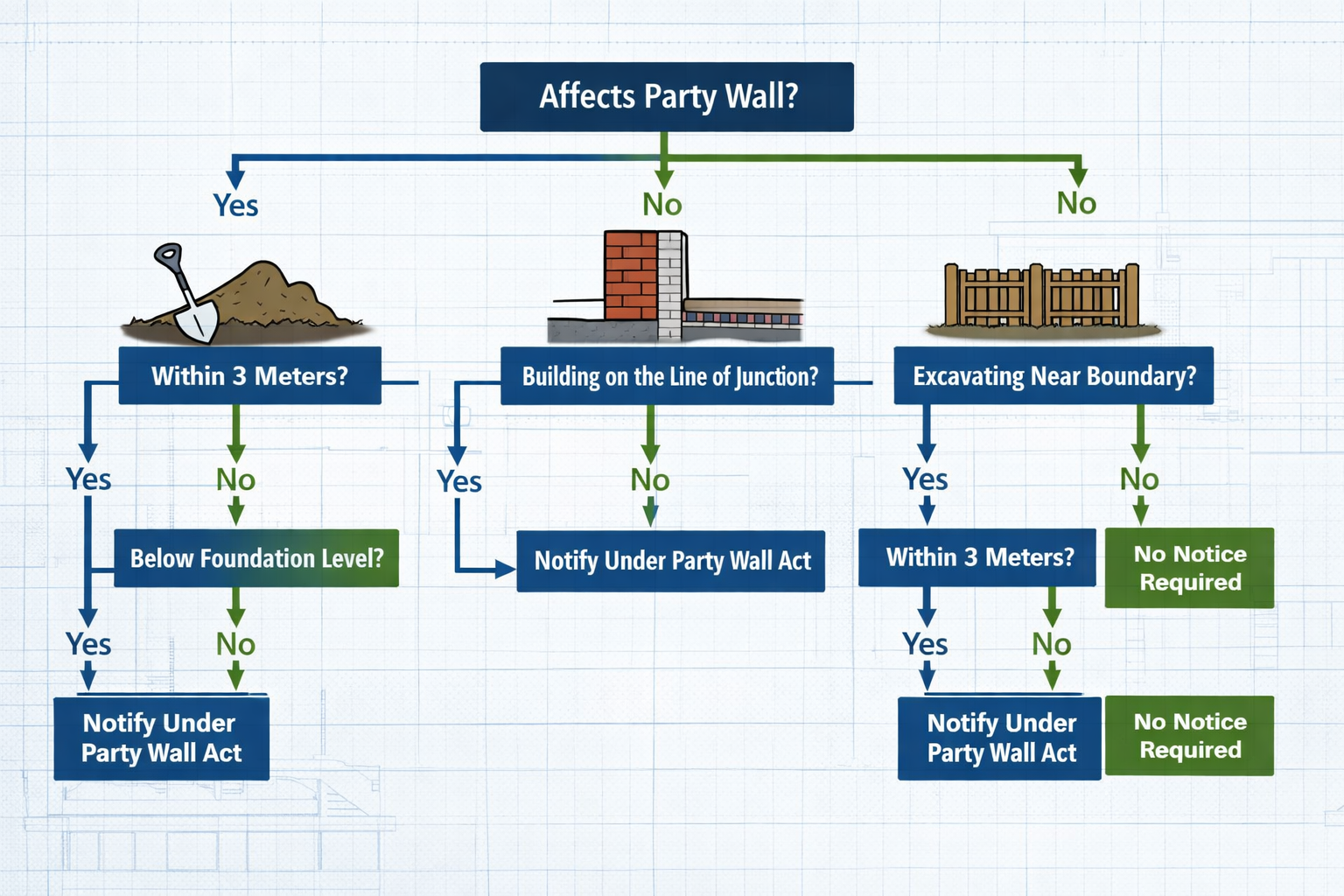
Determining which construction activities require party wall notices demands careful evaluation of both the work type and its relationship to shared structures or boundaries. The following comprehensive breakdown clarifies common scenarios.
Structural Work to Existing Party Walls (Section 2 Works)
These works represent the most frequent triggers for Party Wall Act procedures and require two months' written notice before commencing.[5]
Definite Notifiable Works ⚠️
| Work Type | Description | Why It's Notifiable |
|---|---|---|
| Loft Conversions | Installing steel beams through party walls | Structurally alters shared wall integrity |
| Beam Insertions | Cutting into party walls for load-bearing supports | Directly affects structural stability |
| Chimney Breast Removal | Removing chimney sections forming part of party wall | Changes structural loading and support |
| Wall Raising | Increasing party wall height for extensions | Alters shared structure dimensions |
| Underpinning | Strengthening foundations beneath party walls | Affects structural support system |
| Damp-Proof Course Installation | Inserting DPC through party wall thickness | Requires cutting into shared structure |
Common Scenarios Requiring Notices
Rear Extensions with Party Wall Involvement: When building a single-storey or two-storey rear extension that requires:
- Cutting into the party wall to tie in new walls
- Inserting steel beams or joists into the party wall
- Raising the party wall height to accommodate the extension
- Underpinning the party wall to support additional loads
Basement Conversions: Excavation beneath existing properties almost always triggers both Section 2 (if affecting party walls) and Section 6 (excavation provisions) requirements.[3]
Kitchen and Bathroom Renovations: These typically require notices when:
- Removing load-bearing walls that form part of the party structure
- Installing new steel beams that penetrate or rest on party walls
- Significantly altering drainage systems affecting party wall foundations
For building owners carrying out works, understanding these triggers prevents costly delays and legal complications.
Boundary Construction (Section 1 Works)
New construction directly on or astride property boundaries requires one month's written notice before starting work.[5]
When Section 1 Applies
Garden Walls and Boundary Structures: Building walls positioned:
- Directly on the boundary line between properties
- Straddling the boundary (partially on each property)
- As party fence walls separating gardens or yards
The distinction between party fence walls and boundary walls significantly impacts whether notices are required.
Important Distinction: A wall built entirely within your own property, even close to the boundary, does not require a Section 1 notice. The wall must be on or astride the actual boundary line to trigger this requirement.
Excavation Work (Section 6 Works)
Excavation provisions apply based on proximity and depth relative to neighbouring foundations, requiring one month's written notice.[5]
The Distance and Depth Tests
3-Meter Rule: Notice required if excavating:
- Within 3 meters of any part of a neighbouring building or structure
- To a depth lower than the neighbour's foundation level
6-Meter Rule: Notice required if excavating:
- Within 6 meters of any part of a neighbouring building or structure
- To a depth that would intersect a line drawn downward at 45 degrees from the bottom of the neighbour's foundations
Practical Excavation Scenarios
Basement Conversions in Terraced Houses: Almost always trigger Section 6 requirements due to proximity to adjoining properties and depth of excavation below existing foundation levels.
Swimming Pool Installation: May require notices if excavation depth and proximity meet the distance/depth criteria, even for detached properties.
Foundation Work for Extensions: Requires careful measurement of excavation depth relative to neighbouring foundations, particularly in areas with varying ground levels.
Understanding what constitutes a party structure notice helps clarify these complex excavation scenarios.
Critical Exemptions: When Does the Party Wall Act Apply? Determining Notifiable Works vs. Exemptions in 2026
Understanding exemptions proves equally important to identifying notifiable works. Many common home improvement projects fall outside the Act's scope, avoiding the need for formal procedures.
Works That Do NOT Require Party Wall Notices
Internal Non-Structural Work ✅
The following internal works typically proceed without party wall procedures:
Decorative and Finishing Work:
- Plastering or re-plastering party walls
- Painting or wallpapering shared walls
- Installing plasterboard or dry-lining on your side of party walls
- Fixing shelving, cabinets, or fixtures to party walls (using appropriate fixings)
Minor Services Installation:
- Running electrical cables through party walls (using existing routes)
- Installing sockets or switches on party walls
- Plumbing work that doesn't compromise structural integrity
- Installing central heating pipes within your property
Important Caveat: Even "minor" work requires notices if it involves cutting significantly into the party wall structure or affects its load-bearing capacity.[3]
Repairs and Maintenance
Like-for-Like Repairs: Maintenance work that restores existing conditions without structural alteration generally falls outside the Act:
- Repointing brickwork on your side of a party wall
- Replacing damaged render or external finishes
- Repairing roof coverings where they meet party walls
- Fixing leaks or damp issues without structural intervention
The "Making Good" Principle: Repairs that simply restore the wall to its previous condition, without altering dimensions, materials, or structural function, typically don't require notices.
Work Entirely Within Your Property
Single-Property Construction: Work confined completely within your property boundaries and not affecting shared structures:
- Building internal stud walls away from party walls
- Installing new windows in external walls only
- Constructing garden structures entirely on your land (not on boundary)
- Loft conversions using only your roof structure (not party walls)
Distance from Boundaries: Garden walls, sheds, or outbuildings built entirely within your property, at least several inches from the boundary line, don't trigger Section 1 requirements.
For guidance on boundary wall rules, consult detailed resources specific to your project type.
The Grey Areas: When Professional Advice Becomes Essential
Certain scenarios create ambiguity requiring professional surveyor assessment:
Permitted Development Roof Work: Some roof alterations fall under permitted development rights but may still require party wall notices if they affect shared structures. The two systems operate independently—permitted development addresses planning, while the Party Wall Act addresses neighbour rights.[6]
Minor Beam Insertions: Small structural changes may or may not require notices depending on whether they genuinely affect the party wall's structural integrity.
Superficial vs. Structural: The distinction between surface work and structural intervention isn't always clear-cut, particularly for older properties with complex construction.
When uncertainty exists, consulting experienced professionals prevents costly mistakes. Services offering party wall agreements without surveyors may seem attractive but risk non-compliance in complex cases.
Notice Requirements and Timelines: Practical Application in 2026
Understanding when does the Party Wall Act apply? Determining notifiable works vs. exemptions in 2026 extends beyond identifying notifiable works to implementing correct procedures.
Statutory Notice Periods
The Act establishes specific minimum notice periods:
Two-Month Notice (Section 2 Works):
- Work to existing party structures
- Must be served at least 2 months before intended start date
- Allows neighbours adequate time to consider implications and appoint surveyors if needed[5]
One-Month Notice (Sections 1 and 6 Works):
- New boundary walls
- Excavation work
- Must be served at least 1 month before intended start date[5]
Critical Timing Consideration: These represent minimum periods. Complex projects benefit from earlier notification, allowing time for surveyor appointments, schedule of condition surveys, and party wall awards preparation.
The Notice and Response Process
Step 1: Serve Formal Notice 📋
Written notice must include:
- Detailed description of proposed works
- Drawings and specifications
- Proposed start date
- Your contact information
Step 2: Neighbour Response (14 Days)
Neighbours have 14 days to either:
- Consent in writing (work may proceed after notice period expires)
- Dissent or fail to respond (triggers dispute resolution process)
Step 3: Dispute Resolution (If Consent Not Given)
- Both parties appoint surveyors (or agree to share an "agreed surveyor")
- Surveyors inspect properties and prepare schedule of condition
- Surveyors issue party wall award detailing work scope, timings, and protections
Understanding how to respond to party wall notices helps both building owners and adjoining owners navigate this process effectively.
2026 Professional Standards Update
In April 2026, the Royal Institution of Chartered Surveyors launched consultation on the draft 8th edition of Party Wall Legislation and Procedure, representing the most current authoritative revision of professional standards.[1] This consultation includes:
- Enhanced appendices with updated guidance
- Revised letters of appointment templates
- Updated award templates reflecting current best practices
- Clarifications on emerging issues in party wall practice
These updates reinforce the importance of working with qualified professionals familiar with current standards when navigating complex party wall scenarios.
Decision Framework: Applying the Rules to Your Project
To determine whether your specific project requires party wall procedures, apply this systematic framework:
Decision Tree for Common Projects
Question 1: Where is your property located?
- ❌ Scotland or Northern Ireland → Party Wall Act 1996 does NOT apply
- ✅ England or Wales → Proceed to Question 2
Question 2: Does your work affect a shared wall, floor, or structure?
- ✅ Yes → Likely requires Section 2 notice (proceed to Question 3)
- ❌ No → Proceed to Question 4
Question 3: What type of work to the shared structure?
- Cutting into it, inserting beams, raising height, underpinning → ✅ Requires 2-month notice
- Only plastering, decorating, or minor fixtures on your side → ❌ Likely exempt
Question 4: Are you building a new wall on or astride the boundary?
- ✅ Yes → Requires 1-month Section 1 notice
- ❌ No → Proceed to Question 5
Question 5: Are you excavating near a neighbour's building?
- Within 3m and deeper than their foundations → ✅ Requires 1-month Section 6 notice
- Within 6m and below 45-degree line from their foundations → ✅ Requires 1-month Section 6 notice
- Further away or shallower → ❌ Likely exempt
Regional Considerations
While the Act applies uniformly across England and Wales, practical implementation varies by location:
Urban Areas: Higher density means more party wall situations. Specialists in party wall surveying in Central London, North London, South London, East London, and West London handle complex terraced and semi-detached scenarios routinely.
Suburban and Rural Areas: Fewer attached properties but excavation provisions still apply to detached houses when work meets proximity/depth criteria.
Cost Implications and Risk Management
Understanding when the Act applies directly impacts project budgets and timelines.
Financial Considerations
Party Wall Surveyor Fees: Typically range from £700-£1,500+ depending on project complexity, with building owners responsible for both their own and the adjoining owner's reasonable surveyor fees.[6]
Schedule of Condition Costs: Professional photographic surveys documenting pre-work property condition add £300-£800 to budgets but provide essential protection.
Delay Costs: Non-compliance can result in:
- Injunctions stopping work immediately
- Legal costs defending disputes
- Relationship damage with neighbours
- Project delays extending months
For practical advice on keeping party wall costs down, explore cost-effective compliance strategies.
Risk Mitigation Strategies
Early Assessment: Determine applicability during project planning, not after contractors are booked.
Professional Consultation: When uncertainty exists, invest in professional advice early. The cost of preliminary surveyor consultation (often £200-£400) far outweighs the expense of non-compliance.
Neighbour Relations: Informal discussion before formal notices often smooths the process, though formal written notices remain legally required.
Documentation: Maintain comprehensive records of all notices served, responses received, and agreements reached.
Neighbour Perspective: Receiving Party Wall Notices
Understanding the Act from both sides provides complete perspective. If your neighbour is carrying out works affecting your property:
Your Rights as Adjoining Owner
Right to Information: Receive detailed notice of proposed works with adequate time to consider implications.
Right to Appoint Surveyor: Select your own professional surveyor to protect your interests, with reasonable fees paid by the building owner.
Right to Schedule of Condition: Insist on comprehensive pre-work documentation of your property's condition.
Right to Appropriate Award: Ensure the party wall award includes adequate protections, working hours restrictions, and remediation provisions.
Response Options
Consent: If satisfied with proposed works and confident no damage will occur, written consent allows work to proceed after the notice period.
Dissent or Non-Response: Triggers the surveyor appointment process, providing formal protections through a party wall award.
Never Ignore Notices: Failure to respond within 14 days constitutes dissent, and the building owner can appoint a surveyor on your behalf—losing your opportunity to select your own representative.
Understanding party wall contract templates and awards clarifies what to expect from the formal process.
Common Misconceptions and Mistakes
Several persistent myths about when does the Party Wall Act apply? Determining notifiable works vs. exemptions in 2026 lead to compliance failures:
Myth 1: "Planning Permission Covers Party Wall Requirements"
Reality: Planning permission and party wall procedures are completely separate legal frameworks. Obtaining planning approval doesn't satisfy Party Wall Act obligations.[6]
Myth 2: "Only Terraced Houses Need Party Wall Notices"
Reality: Semi-detached properties, flats, and even detached houses (for excavation work) fall under the Act when criteria are met.
Myth 3: "Good Neighbour Relations Make Formal Notices Unnecessary"
Reality: The Act requires written notices regardless of relationship quality. Informal agreements don't satisfy legal obligations or provide protection if disputes arise later.
Myth 4: "Small Projects Don't Need Notices"
Reality: Project size doesn't determine applicability—the type and location of work does. Even minor structural interventions affecting party walls require proper procedures.
Myth 5: "Builders Handle Party Wall Matters"
Reality: Legal responsibility for serving notices rests with property owners, not contractors. Builders may advise, but owners must ensure compliance.
Future Considerations: Party Wall Practice Beyond 2026
The landscape of party wall practice continues evolving with emerging trends:
Updated Professional Guidance: The RICS 8th edition consultation in April 2026 signals ongoing refinement of professional standards, with final publication expected later in 2026.[1]
Renters' Rights Act Implications: Recent legislation affecting landlord-tenant relationships may intersect with party wall procedures when landlords initiate works affecting multiple units.[2]
Digital Notice Systems: Increasing digitization of construction processes may eventually modernize notice serving and documentation, though current legal requirements remain paper-based.
Climate Adaptation Works: Increasing retrofit and insulation projects to improve energy efficiency often involve party wall works, driving higher volumes of notices.
Dispute Resolution Evolution: Professional bodies continue developing best practices for efficient, cost-effective dispute resolution that protects all parties' interests.
Conclusion
Determining when does the Party Wall Act apply? Determining notifiable works vs. exemptions in 2026 requires careful evaluation of work type, location, and relationship to shared structures or boundaries. The Act establishes clear triggers across three categories: work to existing party structures (Section 2), new boundary construction (Section 1), and excavation near neighbouring buildings (Section 6). However, numerous common home improvement projects fall outside the Act's scope, particularly internal decorative work and construction entirely within property boundaries.
The consequences of misunderstanding applicability range from project delays and legal disputes to damaged neighbour relations and costly remediation. Conversely, proper compliance protects all parties' interests, provides clear documentation of pre-work conditions, and establishes frameworks for addressing any issues that arise during construction.
Actionable Next Steps
✅ Assess Your Project Early: Determine Party Wall Act applicability during initial planning, not after booking contractors.
✅ Seek Professional Guidance: When uncertainty exists, consult qualified party wall surveyors familiar with current 2026 standards and the forthcoming RICS 8th edition guidance.
✅ Serve Notices Promptly: Allow adequate time for the full notice period plus potential surveyor appointment and award preparation—typically 3-4 months total for complex projects.
✅ Document Everything: Maintain comprehensive records of notices, responses, surveyor appointments, and agreements throughout the process.
✅ Communicate with Neighbours: While formal procedures remain legally required, early informal discussion often facilitates smoother processes and preserves relationships.
✅ Budget Appropriately: Include party wall surveyor fees, schedule of condition costs, and potential delays in project budgets from the outset.
For comprehensive support navigating party wall requirements, explore detailed resources on the Party Wall etc. Act 1996 and consider consulting qualified professionals who can assess your specific circumstances and ensure full compliance with current regulations.
Understanding when the Party Wall Act applies—and when it doesn't—empowers property owners to plan confidently, comply fully, and maintain positive neighbour relations while achieving their construction goals in 2026 and beyond.
References
[1] Rics Launches Consultation On Updated Party Wall Practice Guidance – https://www.rics.org/news-insights/rics-launches-consultation-on-updated-party-wall-practice-guidance
[2] Party Wall Surveys For Renters Rights Act Compliance Managing Notices When Landlord Initiated Works Face New Section 8 Ground Requirements – https://nottinghillsurveyors.com/blog/party-wall-surveys-for-renters-rights-act-compliance-managing-notices-when-landlord-initiated-works-face-new-section-8-ground-requirements
[3] Understanding Party Wall Act What Homeowners Need Know Before Renovating – https://www.partywallslimited.com/blog/understanding-party-wall-act-what-homeowners-need-know-before-renovating
[4] How To Serve A Party Wall Notice – https://onlinearchitecturalservices.com/how-to-serve-a-party-wall-notice/
[5] Party Wall Agreement – https://hoa.org.uk/advice/guides-for-homeowners/i-am-improving/party-wall-agreement/
[6] Do I Need Party Wall Agreement Uk 2026 – https://www.sharedwalls.co.uk/post/do-i-need-party-wall-agreement-uk-2026