


Over 85,000 planning applications are submitted in London every year, yet thousands of homeowners still begin rear extensions, side returns and basement digs without serving a single party wall notice — exposing themselves to injunctions, costly delays and neighbour disputes that can derail a project for months. If you are planning a home extension in 2026, understanding the Party Wall Act notice 2026 home extension procedure is not optional; it is a legal obligation that protects both you and the people next door.
💡 Important note: There are no new statutory amendments to the Party Wall etc. Act 1996 in 2026. The legislative framework remains unchanged. What has evolved is RICS best practice around documentation, condition schedules and electronic communication — all covered below.
Key Takeaways
- 📋 Most party wall works require two months' written notice before you start; excavation near foundations needs one month.
- ⏱️ Adjoining owners have 14 days to consent or dissent after receiving a notice.
- 🏗️ You cannot legally start notifiable works without written consent or a Party Wall Award in place.
- 📧 Electronic notices are valid following the May 2016 update, provided the adjoining owner has agreed to receive them digitally.
- 🔍 Basement extensions, loft conversions and kitchen extensions are the most common sources of party wall disputes in London.
Understanding the Party Wall Act Notice 2026 Home Extension Procedure: When Is a Notice Required?
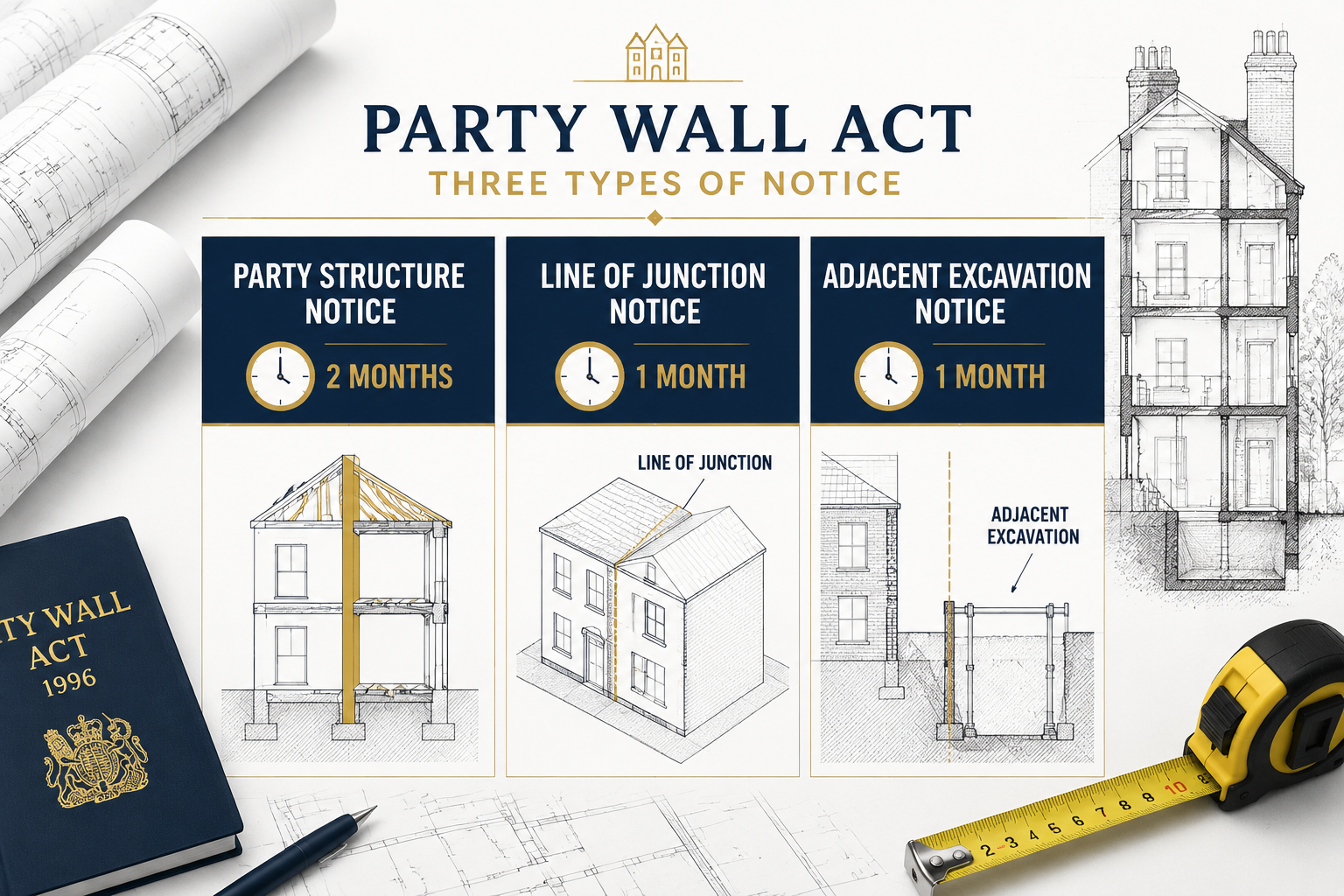
The Party Wall etc. Act 1996 applies only in England and Wales. It governs three distinct categories of work, each triggering a different type of notice. Knowing which section applies to your project is the first step in the Party Wall Act notice 2026 home extension procedure.
Section 1 — Line of Junction Notice (New Walls on or at the Boundary)
If you intend to build a new wall astride the boundary line — meaning equally on both properties — you must obtain the adjoining owner's express written consent. Without it, you may only build up to, but not across, the boundary under Section 1(5). A Line of Junction Notice carries a one-month notice period.
For London side-return extensions, this is particularly relevant where the flank wall is intended to sit on or close to the shared boundary. Our guide on boundary wall rules and the difference between party fence walls and boundary walls explains these distinctions clearly.
Section 2 — Party Structure Notice (Works to Existing Party Walls)
This is the most frequently triggered section for London home extensions. A Party Structure Notice with a two-month notice period is required whenever you intend to:
- Cut into or raise a shared party wall
- Remove a chimney breast from a party wall
- Cut away a rear flank wall to open up a kitchen extension (under Section 2(2)(g))
- Insert a damp-proof course through a party wall
- Underpin or strengthen existing party wall foundations
Loft conversions that involve steel beams bearing onto party walls also fall squarely under Section 2. You can explore the full scope of notifiable party wall works on our dedicated page.
Section 6 — Adjacent Excavation Notice (Foundations Near Neighbours)
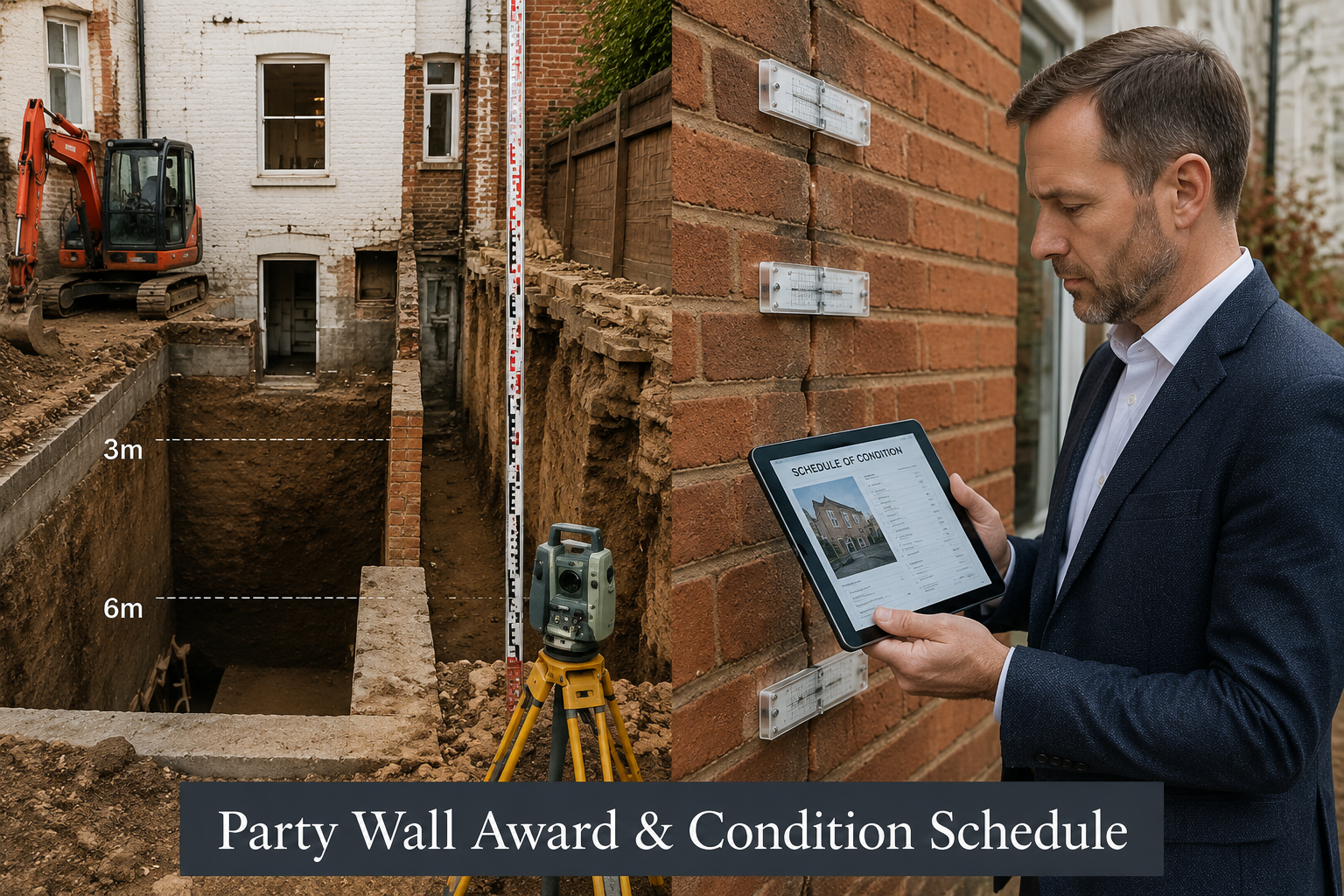
Excavation within 3.0 metres of an adjoining structure and deeper than the neighbour's existing foundations triggers Section 6(1). Where piled foundations go deeper and cut through a 45-degree plane drawn from the base of the adjoining foundation, Section 6(2) extends the notifiable radius to 6.0 metres. Both require a one-month notice period.
Basement extensions in London — particularly in areas such as Kensington, Notting Hill and Islington — almost always engage Section 6, and frequently Section 2 as well.
What Works Do Not Require a Notice?
Not everything triggers the Act. Minor works — plastering, drilling for kitchen shelves, electrical rewiring, or internal decorating — fall entirely outside its scope. The Act is concerned with structural works that could affect a shared or adjoining structure.
Notice Periods, Response Windows and the Dissent Process
Serving the Notice Correctly
A valid notice must be in writing and include:
| Required Information | Details |
|---|---|
| Your name and address | As building owner |
| Address of the property | Where works will take place |
| Description of proposed works | Sufficient detail for the adjoining owner to understand the impact |
| Proposed start date | Must respect the statutory notice period |
| Signature | Building owner or authorised agent |
Since May 2016, notices served electronically (by email) are valid under the Act, provided the adjoining owner has agreed to receive them in that format. This update has streamlined the process considerably, and RICS guidance in 2026 continues to encourage clear, documented trails of all electronic correspondence.
For a detailed walkthrough, see our guide on what a Party Structure Notice is and how to serve it in London.
The 14-Day Response Window
Once a valid notice is served, the adjoining owner has 14 days to respond in writing. There are three possible outcomes:
- ✅ Consent — Works may proceed without a formal Award.
- ❌ Dissent — Dispute resolution is triggered (see below).
- 🔇 No response — Deemed dissent after 14 days; dispute resolution is automatically triggered.
What Happens on Dissent?
Dissent does not mean the works cannot proceed — it means they cannot proceed without a Party Wall Award. The parties must appoint surveyors:
- Agreed Surveyor: Both parties jointly appoint a single impartial surveyor. This is typically faster and more cost-effective.
- Two Surveyors: Each party appoints their own surveyor. If those two cannot agree, they appoint a Third Surveyor whose decision is binding.
Our page on party wall notices — what they are and how to respond is a helpful resource for adjoining owners navigating this stage.
The Party Wall Award: What It Contains and Why It Matters
The Party Wall Award (also called a party wall agreement) is the legally binding document produced by the appointed surveyor(s). It sets out:
- The scope and method of the proposed works
- Working hours and access arrangements
- A Schedule of Condition recording the pre-works state of the adjoining property
- Provisions for making good any damage caused
- The surveyor's fees and who pays them (usually the building owner)
A thorough Schedule of Condition is one of the most valuable protections for both parties. In 2026, RICS best practice strongly recommends photographic and video documentation, not just written descriptions, to provide a clear baseline if damage claims arise later.
You can find a sample Party Wall Award template and guide on our website to understand what a typical document looks like.
🏛️ "The Award is not a barrier to building — it is the mechanism that allows building to proceed safely and fairly."
Common London Disputes: Basements, Lofts and Kitchen Extensions
Basement Extensions
London's basement boom has made Section 6 disputes the most technically complex category of party wall work. Excavations that underpin shared walls, lower floor slabs or install tanking systems routinely affect neighbouring properties. Key dispute triggers include:
- Inadequate notice describing the depth and method of excavation
- Failure to commission a pre-works structural survey
- Disputes over whether temporary propping was adequate
- Claims for cracking and settlement after works complete
Loft Conversions
Steel beams (typically RSJs) bearing onto party walls require a Party Structure Notice. Disputes often arise when builders commence cutting pockets into the party wall before the Award is finalised — a clear breach of the Act. Dormer extensions that raise the party wall also engage Section 2.
Kitchen and Rear Extensions
Removing a rear flank wall to create an open-plan kitchen-diner is one of the most popular London home improvements in 2026. Under Section 2(2)(g), cutting away any part of a party wall requires formal notice. Additionally, new foundations for the extension may trigger Section 6 if they are close to the neighbour's structure.
If you are an adjoining owner concerned about a neighbour's works, our page on what to do when your neighbour is carrying out works sets out your rights clearly.
Tips for Keeping the Process Smooth (and Costs Down)
- Serve notices early — two months goes quickly once you factor in design sign-off and contractor procurement.
- Engage your neighbour informally first — a brief conversation before the formal notice often leads to quicker consent.
- Use an agreed surveyor where possible — it reduces fees and speeds up the Award process. Our guide on how to keep party wall costs down covers this in detail.
- Document everything — electronic correspondence, photographs, and written records all matter if a dispute escalates.
- Do not start works early — commencing notifiable works without an Award or written consent exposes you to injunction proceedings and potential liability for all costs.
Frequently Asked Questions
Q: Can I serve a party wall notice by email in 2026?
Yes. Since May 2016, electronic notices are legally valid provided the adjoining owner has agreed to receive them electronically.
Q: What if my neighbour ignores my party wall notice?
After 14 days with no response, a dispute is deemed to have arisen. You must then appoint surveyors to proceed to an Award.
Q: Does the Party Wall Act apply to Scotland or Northern Ireland?
No. The Act applies only in England and Wales.
Q: Can I do a loft conversion without a party wall notice?
Only if no work touches or affects the party wall. If steel beams bear onto the party wall or the wall is raised, a Party Structure Notice with two months' notice is required.
Q: How much does a party wall surveyor cost in London?
Fees vary, but our full guide to party wall costs and the process provides a realistic breakdown.
Q: Can I handle the party wall process without a surveyor?
In theory, yes — if your neighbour consents in writing, no surveyor is needed. Our article on having a party wall agreement without a surveyor explains the risks and limitations.
Conclusion: Act Early, Build Confidently
The Party Wall Act notice 2026 home extension procedure has not changed in its legal framework, but the stakes of getting it wrong are higher than ever in a competitive London property market. Delays caused by incorrect notices, missed response windows or premature starts can cost thousands of pounds and months of programme time.
Your actionable next steps:
- ✅ Identify which sections of the Act apply to your specific project (Sections 1, 2 and/or 6).
- ✅ Calculate your notice periods and build them into your project programme before appointing a contractor.
- ✅ Speak to a qualified party wall surveyor early — ideally at the design stage.
- ✅ Commission a Schedule of Condition to protect both parties before works begin.
At Party Wall Surveyor London, we help building owners and adjoining owners across the capital navigate every stage of the process — from serving the first notice to finalising the Award.
📞 Ready to get started? Contact our team today for expert, impartial advice on your 2026 home extension project.