


{"cover":"Professional landscape format (1536×1024) hero image with bold text overlay: 'Avoiding Dated Wall Trends: 10 Updates for Timeless Party Wall Designs' in extra large 72pt white bold sans-serif font with deep shadow effect, centered upper third composition. Background showcases a sophisticated interior party wall featuring verdigris patina copper panels, silver metallic accents, and whimsical botanical patterns in sage green and warm ivory tones. Magazine cover aesthetic with a refined color palette of deep teal, silver, and warm white. Editorial quality, high contrast, visually striking.","content":["Landscape format (1536×1024) editorial illustration showing a side-by-side comparison of two party wall sections: left side depicts an outdated matchy-matchy flat matte black accent wall with geometric paneling looking sterile and dated; right side shows a transformed wall with warm wood tongue-and-groove paneling, silver hardware accents, and soft integrated LED uplighting. Bold label overlays read 'Dated' vs 'Timeless'. Clean architectural photography style, neutral background, professional interior design aesthetic, warm lighting.","Landscape format (1536×1024) close-up editorial photograph of a stunning party wall featuring fluted ribbed panels in natural cerused oak finish with verdigris patina copper inlay strips, whimsical hand-painted botanical motifs in sage green and dusty rose on a warm ivory background. Integrated recessed lighting casts dramatic shadows across the textured surface. Silver metallic sconce fixtures flank the wall. Full-height floor-to-ceiling panel installation visible. Luxurious, timeless, sophisticated interior design photography style.","Landscape format (1536×1024) professional infographic-style editorial image showing a structured checklist layout titled 'Party Wall Design: What to Avoid vs What Works in 2026' with two columns. Left column lists crossed-out dated trends: matte black overuse, heavy lacquer, asymmetric geometric panels, all-matching surfaces. Right column highlights timeless updates: silver accents, verdigris patina, whimsical patterns, natural finishes, layered minimalism. Clean sans-serif typography, muted teal and warm gold color scheme, architectural diagram elements in background."]
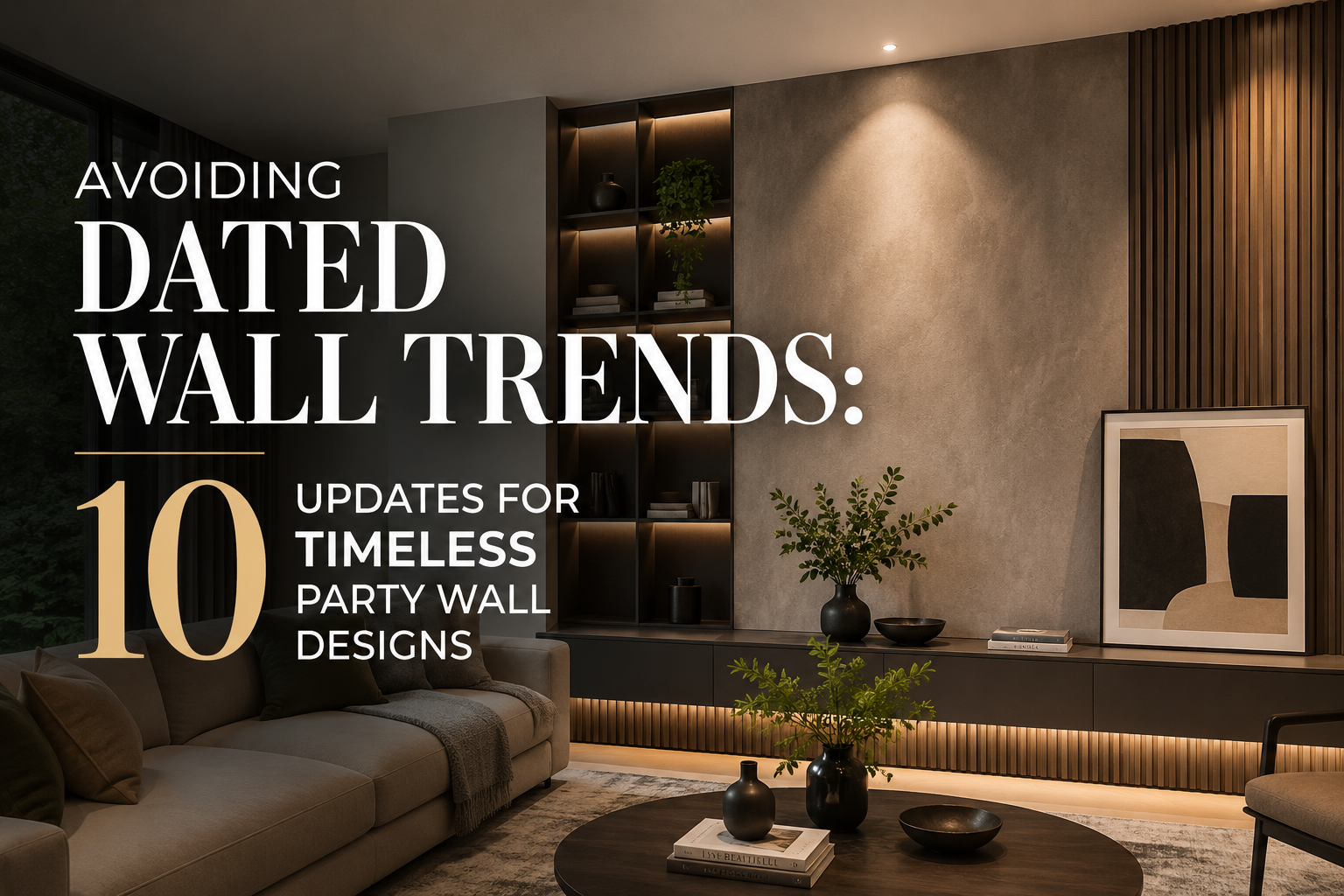
Nearly 60 percent of homeowners who renovate shared walls report regretting at least one design choice within five years — usually because a trend they chased faded faster than the paint dried. Avoiding Dated Wall Trends: 10 Updates for Timeless Party Wall Designs is not just a styling exercise; it is a practical investment in a shared structural element that carries legal weight, neighbourly obligations, and long-term property value. The updates outlined here steer firmly away from the matchy-matchy surfaces, flat matte black finishes, and cold minimalism that dominated the last decade, and point instead toward whimsical patterns, silver accents, verdigris patina, and design choices with genuine staying power.
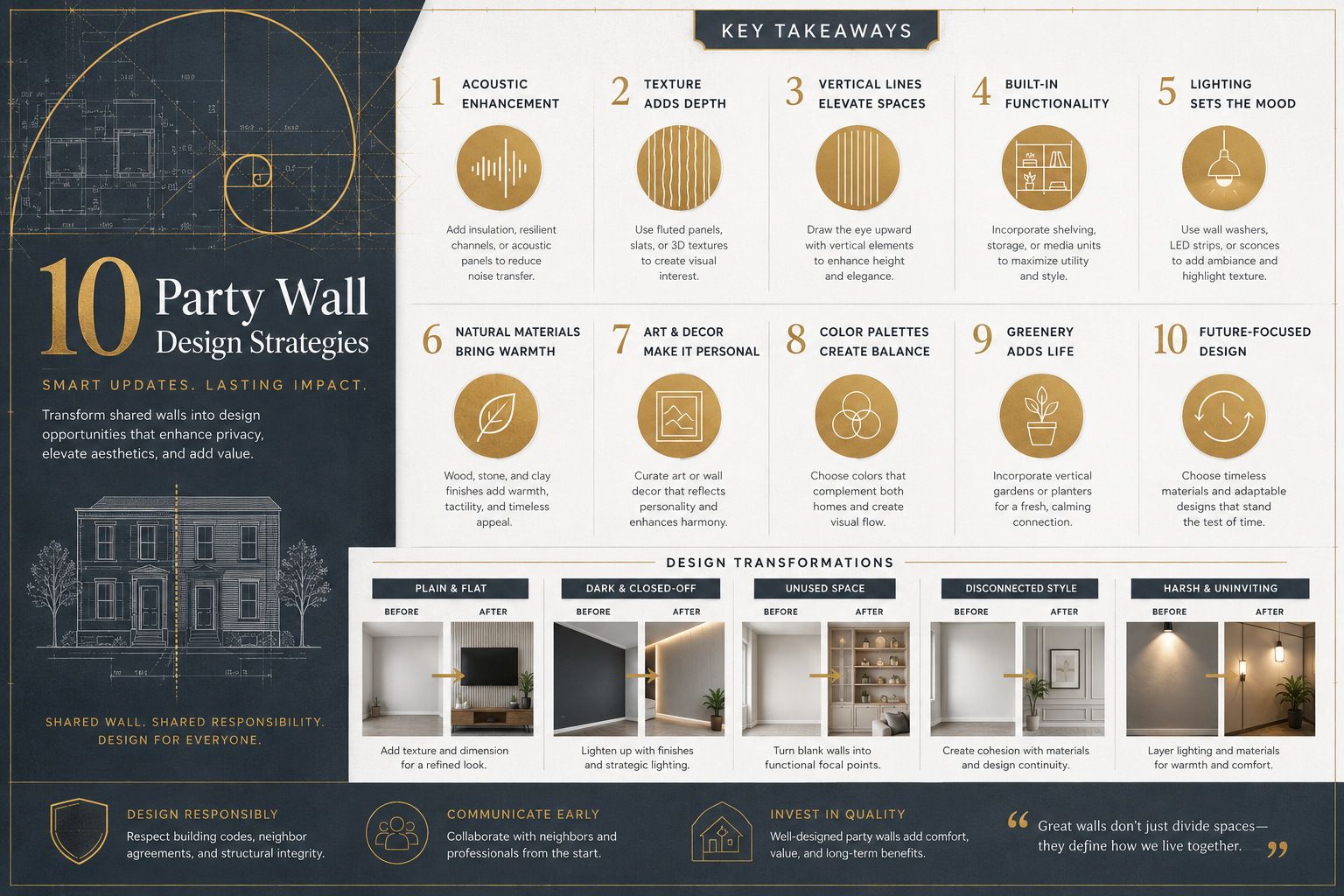
Key Takeaways
- Matte black, heavy lacquer, and all-matching wall surfaces are the fastest routes to a dated party wall in 2026.
- Whimsical botanical patterns, verdigris patina finishes, and silver metallic accents offer character without expiry dates.
- Classic paneling styles — tongue and groove, Shaker, and full-height vertical panels — consistently outperform trend-driven geometric designs.
- Natural finishes such as cerused oak and smoked wood age gracefully and require less maintenance than lacquered alternatives.
- Any physical changes to a party wall require proper legal compliance; understanding your obligations under the Party Wall etc. Act 1996 protects both you and your neighbour.
Why Party Wall Design Decisions Carry Extra Weight
A party wall is not a blank canvas owned by one person. It is a shared structure — legally defined and regulated — that sits on or straddles the boundary between two properties. Before exploring the aesthetic updates, it is worth noting that any structural or significant decorative work affecting a party wall may require formal notices and agreements.
Homeowners planning work should review the Party Wall etc. Act 1996 to understand their obligations. Serving the correct party wall notices before work begins protects both the building owner and the adjoining owner from costly disputes later.
With the legal groundwork clear, the design decisions become far more enjoyable.
The 10 Updates for Avoiding Dated Wall Trends in Party Wall Designs
Update 1: Replace Matte Black With Silver and Warm Metallic Accents
Matte black had its moment. It appeared on everything from cabinet hardware to entire feature walls, and it is now one of the clearest signals that a design is frozen in the early 2020s. Silver accents — whether in the form of metallic panel trims, brushed aluminium inlays, or pewter-toned fixtures — carry a cooler, more architectural quality that reads as both contemporary and enduring [5].
Silver works particularly well on party walls because it reflects light without overwhelming the space, adding depth rather than drama. Pair brushed silver trims with warm ivory or stone-coloured panels for a finish that will still look considered a decade from now.
Update 2: Introduce Verdigris Patina for Organic Character
Verdigris — the blue-green oxidised finish associated with aged copper — is one of the most distinctive and genuinely timeless finishes available for wall surfaces. Unlike painted-on colour trends, verdigris patina carries visual complexity: no two applications look identical, and the finish appears to deepen and improve with age [5].
Applied to copper panel inlays, decorative wall strips, or statement hardware on a party wall, verdigris creates a sense of history and craftsmanship. It pairs beautifully with natural timber paneling and warm stone tones, sitting at the opposite end of the spectrum from the sterile, uniform surfaces that date so quickly.
Update 3: Swap Geometric Paneling for Classic Tongue and Groove or Shaker Styles
Geometric paneling — asymmetric shapes, hexagonal arrangements, and chevron-patterned MDF — surged in popularity but has already begun to feel laboured. Interior designers now flag it as one of the wall decor choices most likely to date a space [4].
Classic tongue and groove and Shaker-style paneling, by contrast, have remained in continuous use for well over a century [2]. Their appeal lies in simplicity: clean lines, consistent rhythm, and a profile that suits both traditional and contemporary interiors. For party walls, these styles offer the additional advantage of being straightforward to repair or extend if future work is needed.
Update 4: Embrace Whimsical Patterns Instead of All-Matching Surfaces
The matchy-matchy approach — where every surface, panel, and trim shares an identical colour and finish — produces walls that feel corporate rather than considered. Whimsical patterns break that monotony in a way that feels personal and enduring.
What counts as whimsical without becoming chaotic?
- Botanical motifs in hand-painted or printed wallpaper panels
- Subtle trellis or lattice patterns in a tone-on-tone palette
- Irregular but repeated organic shapes inspired by natural forms
- Delicate illustrated scenes used as a single focal panel rather than repeated across every surface
The key is restraint. One panel or section carrying a whimsical pattern against a calm, neutral background creates interest without visual noise [6].
Update 5: Move From Heavy Lacquer to Natural Finishes
Heavy lacquered wall surfaces — high-gloss, uniformly reflective, and often in stark white or deep black — were a hallmark of the mid-2010s luxury interior trend. They are now widely associated with that specific era.
Natural finishes such as smoked oak, cerused wood, and lightly oiled timber panels age far more gracefully [5]. They do not show fingerprints as aggressively, they respond warmly to changing light throughout the day, and they develop a patina over time that adds rather than detracts from their appearance. For a party wall, where the surface may be difficult to repaint or refinish without involving a neighbour, choosing a forgiving natural finish from the outset is also a practical decision.
Update 6: Install Full-Height Panels for Architectural Presence
Half-height paneling — the dado-rail-and-panel combination that stops at waist or shoulder height — can feel timid on a party wall. Full-height panels running from floor to ceiling create a far more architectural statement, and the proportions read as both modern and classic simultaneously [7].
This approach works especially well in hallways and living rooms where the party wall is a dominant surface. The vertical lines of full-height paneling also draw the eye upward, making rooms feel taller without any structural intervention.
"Full-height panels transform a party wall from a background element into a genuine architectural feature — one that adds value to the property rather than simply covering a surface."
Update 7: Add Integrated Lighting Within Wall Panels
Flat, unlit wall surfaces are a missed opportunity. Integrated lighting — recessed LED strips within panel grooves, uplighting at the base of full-height panels, or backlit translucent stone inserts — adds depth and ambiance that no amount of paint colour can replicate [5].
This update is particularly effective on party walls because it draws attention to the wall as a designed feature rather than a structural boundary. Warm-toned LED lighting integrated into natural timber panels creates an effect that is simultaneously cosy and sophisticated, and it does not rely on any single trend to remain appealing.
Update 8: Use Textured Treatments — Fluted and Ribbed Panels
Flat drywall, even when painted in a carefully chosen colour, offers nothing for the eye to explore. Textured wall treatments — particularly fluted and ribbed panels — add tactile and visual depth that photographs well, ages well, and suits a wide range of interior styles [8].
Fluted paneling, with its repeated vertical grooves, has classical roots in architecture and furniture design. Its current resurgence is not a flash-in-the-pan trend but a return to a well-established design language [1]. Applied to a party wall, fluted panels in natural timber or a plaster finish create a surface that rewards close inspection without demanding constant attention.
| Treatment Type | Visual Effect | Longevity Rating | Best Pairing |
|---|---|---|---|
| Fluted panels | Vertical depth, classical | High | Natural oak, silver trims |
| Ribbed panels | Horizontal rhythm, modern | High | Plaster, warm stone |
| Tongue and groove | Cottage, architectural | Very High | Painted or natural finish |
| Shaker paneling | Clean, versatile | Very High | Any neutral palette |
| Geometric MDF | Bold, trend-driven | Low | Limited pairings |
Update 9: Apply Layered Minimalism Rather Than Stark Minimalism
Stark minimalism — bare walls, a single flat colour, no texture, no decoration — was positioned as the antidote to maximalist excess. In practice, it produced spaces that felt cold, impersonal, and difficult to warm up without a complete redesign.
Layered minimalism takes a more considered approach: clean lines and a restrained palette, but with curated elements that add character [6]. On a party wall, this might mean a simple paneled surface in a warm neutral, with a single piece of sculptural wall art, a set of silver-framed architectural prints, or a run of integrated shelving that carries meaningful objects rather than clutter.
The result is a wall that feels intentional and personal without being trend-dependent.
Update 10: Avoid Overusing Panels on Every Wall
The final update is as much about editing as it is about adding. When every wall in a room carries the same paneling treatment, the effect becomes overwhelming and the individual walls lose their impact [5]. Selective application — choosing the party wall as the primary feature wall and keeping adjacent surfaces calmer — ensures that the design reads as considered rather than wallpapered.
This selective approach also has practical benefits for party walls specifically. Concentrating the design investment on one surface means that if future structural work is required — perhaps an extension, a loft conversion, or repairs — the disruption to the overall scheme is contained.
Legal Considerations Before Any Party Wall Work Begins
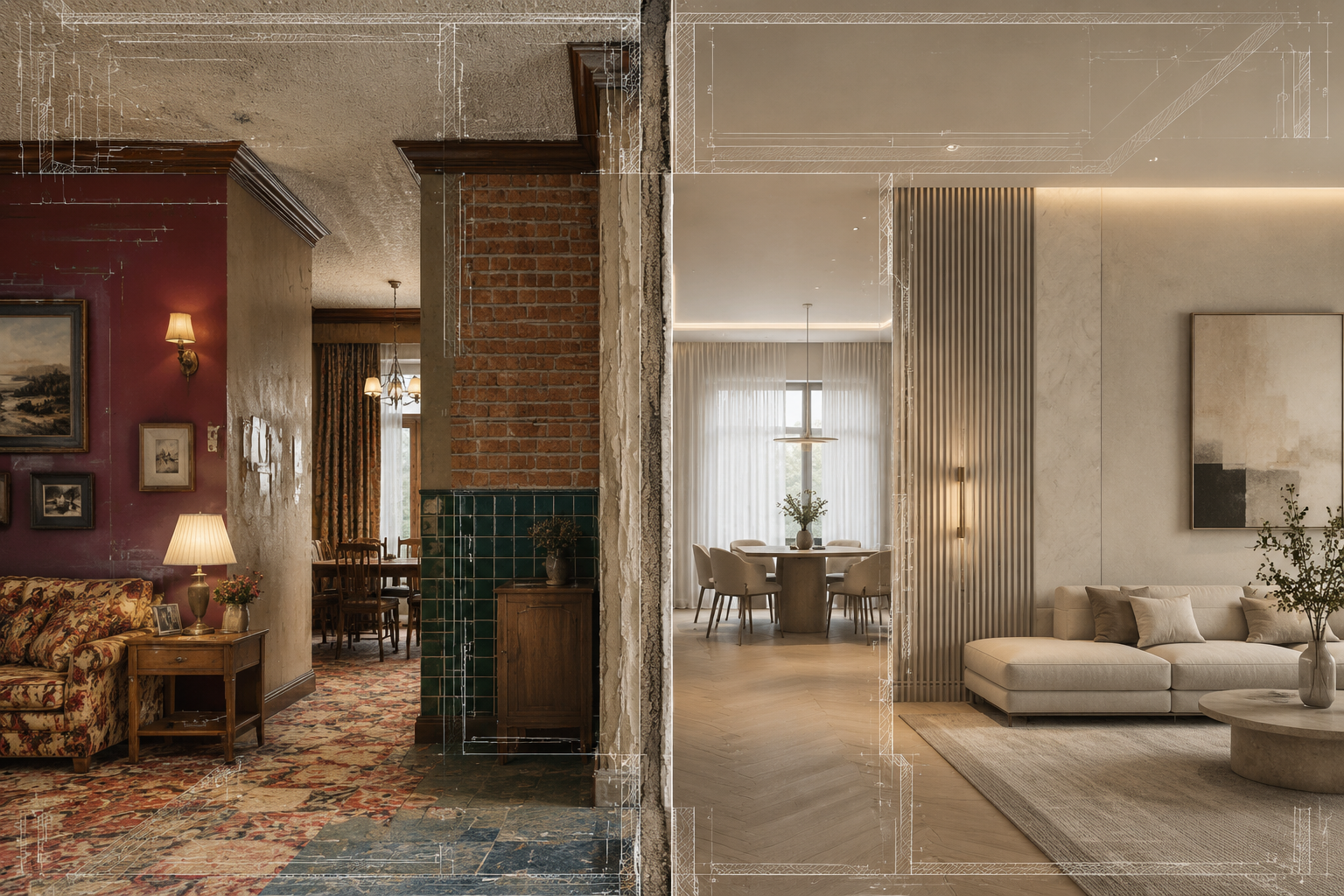
Design ambition must always be balanced against legal responsibility. Any work that involves cutting into, building on, or significantly altering a party wall requires proper process under UK law.
The types of party wall works that trigger legal obligations include notching for new beams, inserting damp-proof courses, raising the height of a wall, and excavating near a shared boundary. Homeowners who proceed without serving the correct notices risk injunctions, forced reinstatement, and damaged neighbourly relations.
For those planning work in the capital, specialist advice is available across all areas. Whether the property is in South London, North London, or East London, a qualified party wall surveyor can guide both building owners and adjoining owners through the process efficiently.
Understanding party wall act notices — what they are and how to respond is an essential first step for anyone planning significant work on or near a shared wall.
Comparing Dated Trends Against Timeless Alternatives
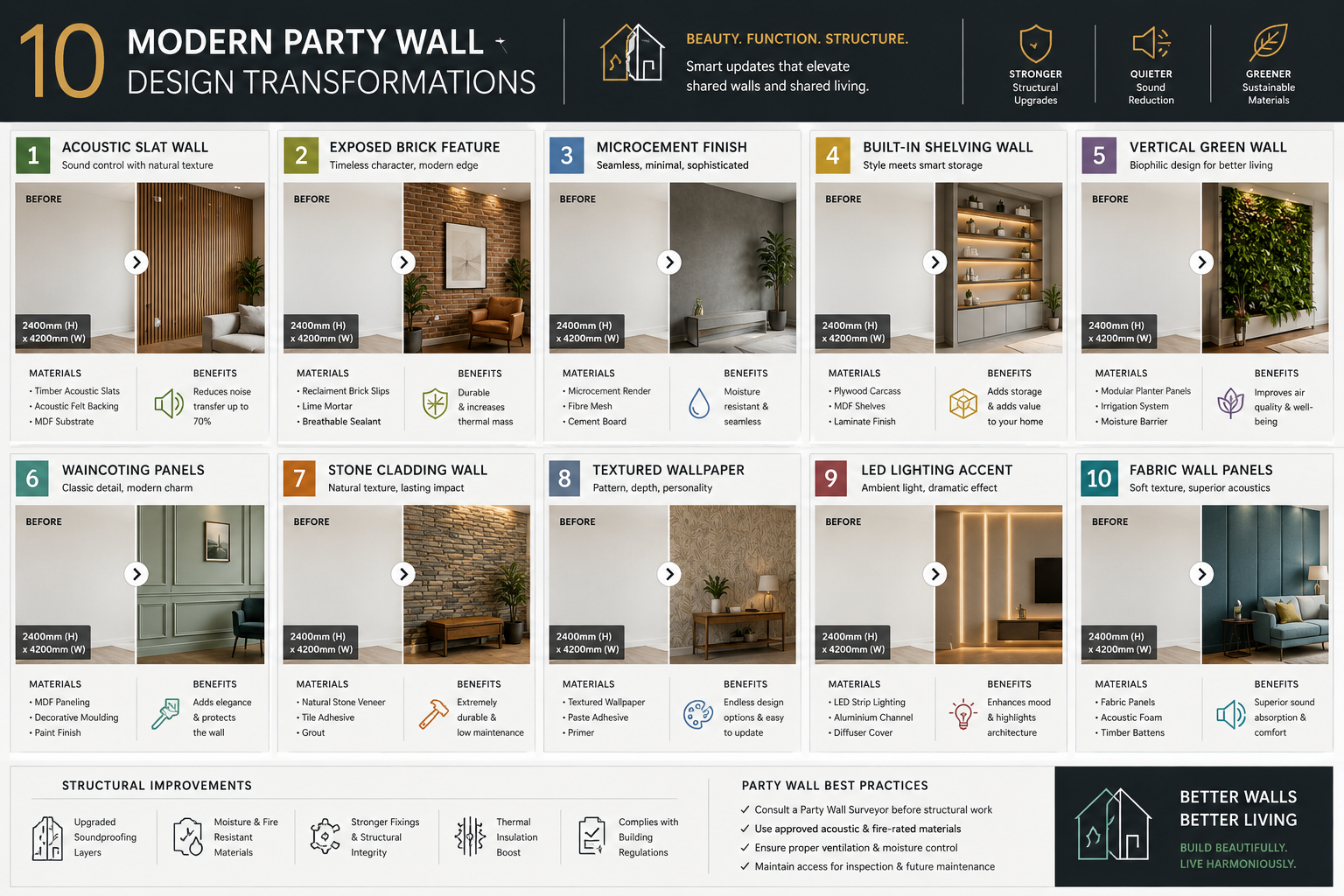
The table below summarises the core shifts outlined in this article, providing a quick reference for homeowners and designers making decisions in 2026.
| Dated Trend | Timeless Alternative | Why It Works |
|---|---|---|
| Matte black feature walls | Silver and warm metallic accents | Reflects light, ages well, versatile |
| Heavy lacquer finishes | Cerused oak, smoked wood | Natural patina improves with age |
| Geometric MDF paneling | Tongue and groove, Shaker panels | Classical roots, century-long track record |
| All-matching surfaces | Whimsical botanical or trellis patterns | Personal, layered, avoids sterility |
| Half-height dado paneling | Full-height floor-to-ceiling panels | Architectural, proportional, dramatic |
| Flat unlit drywall | Integrated LED panel lighting | Adds depth, ambiance, and dimension |
| Stark minimalism | Layered minimalism with curated pieces | Warm, personal, trend-resistant |
| Panels on every wall | Selective feature wall application | Focused, balanced, practical |
Practical Steps for Implementing These Updates
Before committing to any of the ten updates above, a structured approach saves time, money, and potential disputes.
Step 1: Assess the wall's legal status. Confirm whether the wall is a true party wall, a party fence wall, or a boundary wall. The distinctions matter legally and practically. A guide on boundary wall rules and the difference between party fence walls and boundary walls clarifies these definitions clearly.
Step 2: Determine whether notices are required. Not all decorative work triggers the Party Wall etc. Act, but structural changes do. Checking the costs of party wall work and the process helps homeowners budget realistically and understand the timeline.
Step 3: Choose materials suited to the wall's construction. Solid brick, timber frame, and concrete block party walls each respond differently to fixings, adhesives, and moisture. Natural timber panels, for example, require appropriate fixings and a vapour barrier in certain conditions.
Step 4: Apply the design updates selectively. Use the table above as a checklist. Not every update will suit every property. A period terrace may benefit most from tongue and groove paneling and verdigris patina accents, while a modern apartment might suit full-height ribbed panels with integrated lighting.
Step 5: Document the condition of the wall before work begins. A schedule of condition records the state of the wall and adjacent areas prior to any works, protecting both parties if a dispute arises later.
Conclusion
Avoiding Dated Wall Trends: 10 Updates for Timeless Party Wall Designs comes down to one consistent principle: choose depth over novelty. The finishes, patterns, and materials that endure are those rooted in natural materials, classical proportions, and genuine craft — not those chasing a social media moment.
The practical next steps are straightforward:
- Audit the current wall against the dated trends listed above and identify which apply.
- Prioritise two or three updates rather than attempting all ten simultaneously — layered minimalism, natural finishes, and integrated lighting offer the highest return for most properties.
- Confirm legal obligations before any structural or significant decorative work begins, serving the correct notices and engaging a qualified surveyor where required.
- Document everything — both the design intent and the pre-work condition of the wall — to protect the investment long-term.
A party wall that is designed with care, executed with quality materials, and maintained within the correct legal framework will add value to a property for decades. The trends avoided today are the regrets prevented tomorrow.
References
[1] Accent Walls Have Changed Here Are 7 Reasons Why – https://brick.com/stories/accent-walls-have-changed-here-are-7-reasons-why/?utm_source=openai
[2] What Are The Most Timeless Wall Panelling Styles – https://www.idealhome.co.uk/all-rooms/all-rooms-decor/what-are-the-most-timeless-wall-panelling-styles?utm_source=openai
[3] Modern Wood Paneling – https://www.thisoldhouse.com/walls/modern-wood-paneling?utm_source=openai
[4] Are Paneled Walls Still On Trend – https://www.homesandgardens.com/interior-design/are-paneled-walls-still-on-trend?utm_source=openai
[5] 2026 Wall Panel Trends Whats In Whats Out – https://www.thepanelhub.com/blogs/news/2026-wall-panel-trends-whats-in-whats-out?utm_source=openai
[6] Time Less Home Decor – https://www.mixtiles.com/blog/wall-art-home-decor/time-less-home-decor?utm_source=openai
[7] 10 Stunning Wall Panelling Styles For Your Home In 2026 404498 – https://www.thelondoneconomic.com/lifestyle/home-lifestyle/10-stunning-wall-panelling-styles-for-your-home-in-2026-404498/?utm_source=openai
[8] Wall Treatments Im Using Instead Of Flat Drywall In 2026 – https://www.homedit.com/wall-treatments-im-using-instead-of-flat-drywall-in-2026/?utm_source=openai