


The average party wall dispute adds six to twelve weeks to a construction project timeline — and in 2026, with the UK construction sector facing a shortfall of over 225,000 skilled workers, those delays are no longer a minor inconvenience. They are a project-killing liability. The emergence of Hybrid AI-Human Negotiation Bots for Party Wall Agreements: Accelerating Consent in 2026 Labor-Constrained Markets represents one of the most practical responses to this pressure: AI systems that simulate neighbor negotiations, draft optimized agreements, and free qualified surveyors to focus on high-value judgment calls that only a human can make.
This article examines how these systems work, where they fit within the legal framework of the Party Wall etc. Act 1996, the ethical guardrails that govern their use, and what building owners, adjoining owners, and surveyors should know before adopting them.
Key Takeaways
- Hybrid AI-Human negotiation bots can compress party wall consent timelines from weeks to days by automating notice drafting, response simulation, and agreement generation.
- These tools do not replace surveyors; they handle repetitive, data-heavy tasks so that qualified professionals can focus on complex disputes and condition assessments.
- Integration with the statutory notice timelines under the Party Wall etc. Act 1996 is essential — AI tools must respect the 14-day and one-month response windows built into the legislation.
- Ethical guidelines around transparency, data privacy, and human override are non-negotiable for responsible deployment.
- Construction AI adoption is accelerating rapidly, with platforms already reducing labor agreement review time by up to 95% in comparable sectors. [4]
Why Party Wall Consent Is a Bottleneck in 2026
The Party Wall etc. Act 1996 was designed to protect both building owners and their neighbors during construction works that affect shared structures. It works well in principle. In practice, the process depends heavily on human availability: surveyors must be appointed, notices must be served, responses must be tracked, and — if consent is not given — a formal award must be drafted.
Every one of those steps requires professional time. In a labor-constrained market, that time is scarce and expensive.
The construction sector is not alone in feeling this pressure. Across the industry, AI agents, safety systems, and robotics are being integrated into project planning and execution as labor pressures mount. [7] Party wall administration, which has historically been treated as a procedural back-office function, is now being re-examined as a target for intelligent automation.
The core problem breaks down into three parts:
- Volume — London alone processes tens of thousands of party wall notices each year, many of them for straightforward loft conversions, basement extensions, and rear additions.
- Repetition — The majority of these cases follow predictable patterns. The same clauses appear. The same objections arise. The same resolutions are reached.
- Bottleneck — Qualified surveyors spend a disproportionate amount of time on routine drafting and correspondence rather than on the nuanced assessments where their expertise is genuinely irreplaceable.
Hybrid AI-Human negotiation bots target precisely this gap.
How Hybrid AI-Human Negotiation Bots Work in Party Wall Contexts
At their core, these systems combine a large language model trained on construction contracts and legal frameworks with a structured workflow engine that mirrors the statutory process. The AI does not act unilaterally. It operates within a defined scope, escalating to a human surveyor whenever the situation moves outside its competence boundaries.
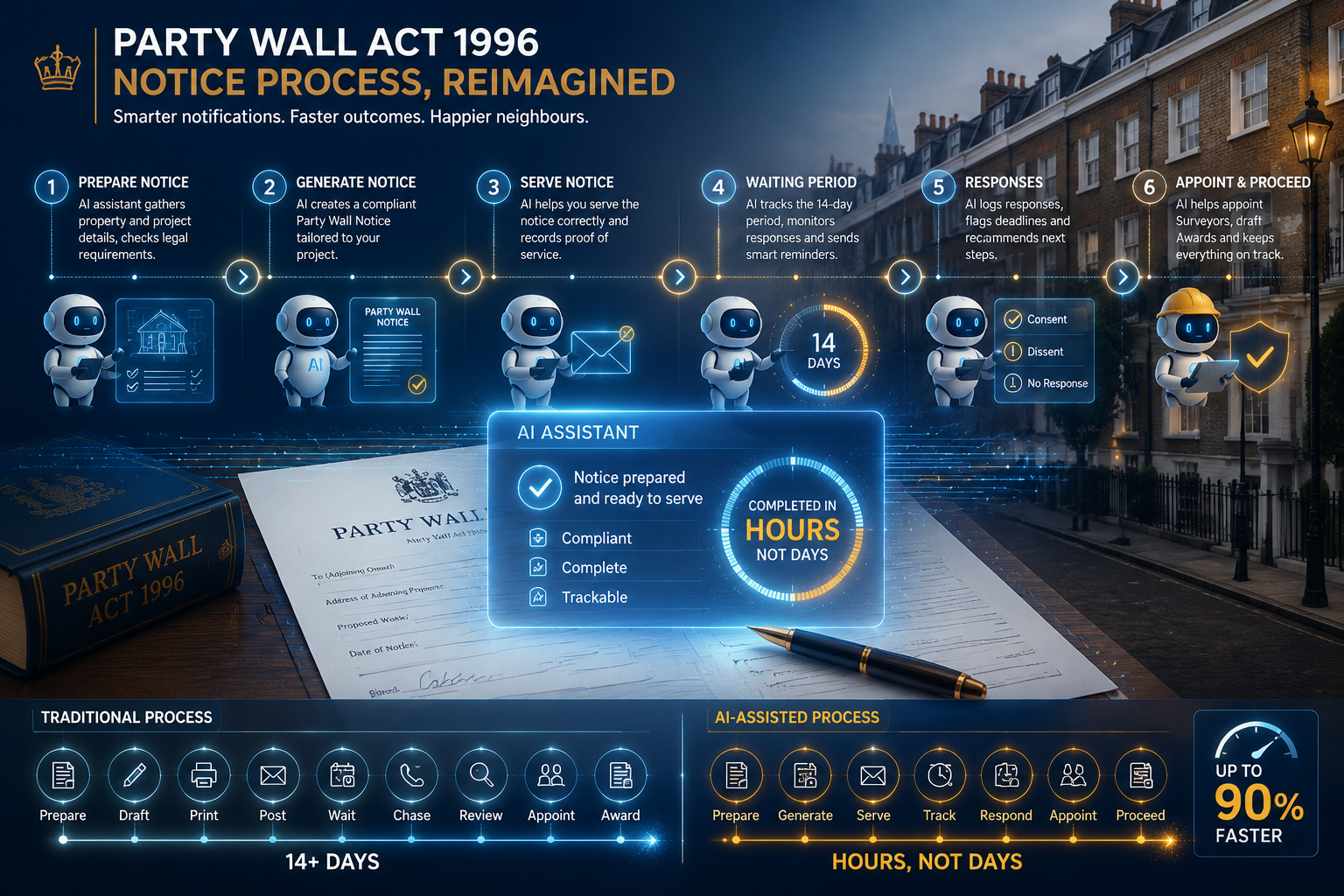
A typical workflow looks like this:
| Stage | AI Role | Human Role |
|---|---|---|
| Notice drafting | Generates compliant notice text based on project data | Reviews and approves before service |
| Adjoining owner response simulation | Models likely responses based on comparable cases | Flags edge cases for review |
| Agreement drafting | Produces a first-draft party wall agreement or award | Checks legal accuracy and site-specific conditions |
| Condition schedule coordination | Flags required schedule of condition items | Conducts physical inspection |
| Dispute escalation | Identifies trigger points and logs them | Takes over negotiation and resolution |
This mirrors the approach taken by platforms like Luminance, which has developed AI capable of end-to-end contract negotiation — reviewing agreements, applying legal standards, redlining terms, and tracking counterparty responses with full transparency into the reasoning behind each decision. [6] Applied to party wall work, the same logic holds: the AI handles the structured, repeatable elements while the human surveyor retains authority over judgment-dependent decisions.
FairBuild's construction-specific AI contract review system demonstrates a similar principle in the subcontractor space, enabling faster processing of complex contracts and more confident negotiation. [1] The translation to party wall agreements is direct: the legal language is standardized, the Act's requirements are well-defined, and the variables are finite enough for AI to handle reliably.
Integration with Party Wall Act Notice Timelines
One of the most critical design requirements for any AI negotiation tool in this space is strict compliance with the statutory timelines embedded in the Party Wall etc. Act 1996. These are not optional guidelines — they are legal requirements, and any system that mismanages them exposes the building owner to significant risk.
Key statutory windows the AI must track:
- 14 days — The period within which an adjoining owner must respond to a party wall notice before a dispute is deemed to have arisen.
- One month — The notice period required for a Party Structure Notice before works begin.
- Two months — The notice period required for a Line of Junction Notice.
- 10 days — The window for appointing a surveyor after a dispute is deemed to have arisen.
A well-designed hybrid bot embeds these timelines as hard constraints. It does not draft a notice with incorrect service dates. It does not allow a response window to expire without alerting the supervising surveyor. It tracks every deadline in real time and surfaces risks before they become legal problems.
This calendar-aware functionality is one of the most immediately valuable features these tools offer. Understanding what party wall notices are and how to respond to them is already complex for property owners — an AI layer that manages this complexity on their behalf, under professional supervision, reduces error rates substantially.
The Surveyor's Role in a Hybrid AI System
A common misconception is that AI negotiation tools are designed to replace surveyors. They are not — and in the party wall context, they legally cannot. The Party Wall etc. Act 1996 requires that a qualified surveyor be appointed when a dispute arises. No AI system currently holds the professional standing to fulfill that role independently.
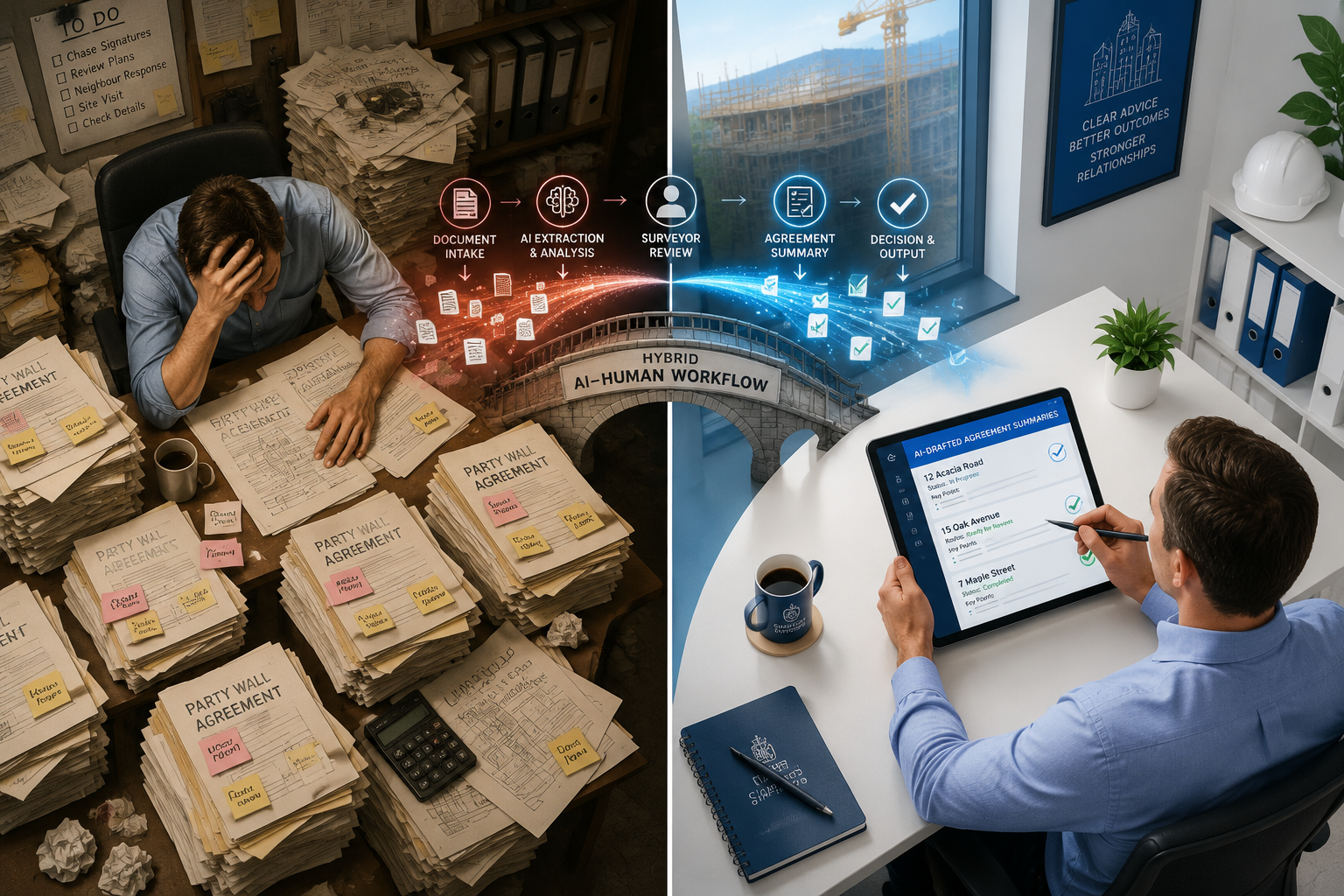
What these tools do is change the nature of surveyor work. Rather than spending hours drafting standard notices and chasing acknowledgments, a surveyor using a hybrid AI system can focus on:
- Complex dispute resolution where neighbor relationships, structural risk, and legal nuance require human judgment
- Schedule of condition surveys, which require physical site attendance and professional assessment
- Award drafting for non-standard cases involving unusual works or contentious adjoining owners
- Client advisory work, helping building owners understand their obligations and options
The AI handles the volume. The surveyor handles the value.
This division of labor mirrors what is happening across the broader construction sector. AI-driven platforms are being used to enhance bidding accuracy, analyze market trends, and improve negotiation strategies — not to replace the professionals who make final decisions, but to give them better data and more time. [2]
For those carrying out works that trigger the Act, this means faster service, lower costs, and a surveyor who has more bandwidth to focus on protecting their interests properly.
Ethical Guidelines for AI Deployment in Party Wall Negotiations
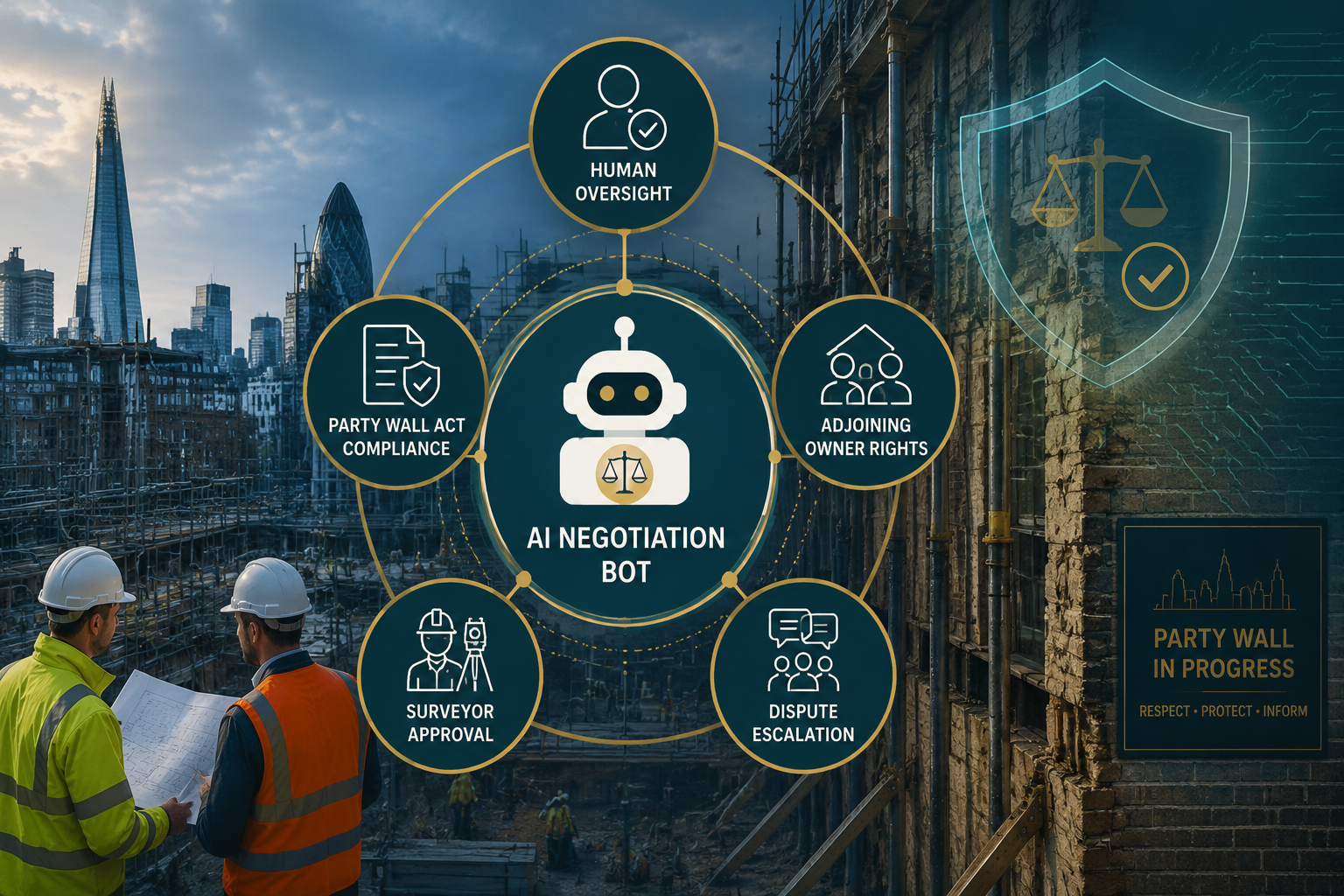
The use of AI in any legal or quasi-legal process carries ethical responsibilities that must be addressed explicitly. In the party wall context, three principles stand out.
Transparency
Both the building owner and the adjoining owner must know when they are interacting with an AI-assisted process. An adjoining owner who believes they are receiving a personally drafted notice from a human surveyor, when in fact it was generated by an AI, has a legitimate grievance if that fact is concealed. Responsible deployment requires clear disclosure.
Human Override
No AI system should be able to finalize a party wall agreement without human sign-off. The supervising surveyor must retain the ability to override, modify, or reject any AI-generated output. This is not just good practice — it is a professional obligation. The OANP (Ontology-based Agentic Negotiation Protocol), grounded in Harvard Negotiation Principles, explicitly builds in mechanisms for autonomous agents to operate within defined ethical boundaries and escalate when those boundaries are reached. [5]
Data Privacy
Party wall negotiations involve sensitive personal and property data. AI systems processing this data must comply with UK GDPR requirements. Data used to train or refine the AI model must be anonymized. Adjoining owners' personal information must not be retained beyond the scope of the specific negotiation.
A practical ethical checklist for firms deploying hybrid AI tools:
- Disclose AI involvement to all parties at the outset
- Ensure a named, qualified surveyor is responsible for every output
- Log all AI-generated recommendations and human review decisions
- Maintain a clear escalation path for disputes
- Conduct regular audits of AI outputs for accuracy and bias
- Comply with UK GDPR for all personal data processed
GoML and Plumbata's AI platform for interpreting complex union labor agreements demonstrates that these ethical frameworks are achievable in practice — their system reduced manual review time by up to 95% while maintaining full compliance and human oversight throughout. [4]
Practical Benefits for Building Owners and Adjoining Owners
The advantages of hybrid AI-human negotiation systems extend beyond efficiency gains for surveyors. Both parties in a party wall process stand to benefit.
For building owners:
- Faster notice service means earlier project start dates
- Reduced surveyor time on routine tasks translates to lower overall costs — a significant factor given the costs involved in the party wall process
- AI-generated draft agreements are consistent and comprehensive, reducing the risk of omissions that could cause problems later
- Real-time timeline tracking reduces the risk of procedural errors that could delay or invalidate the process
For adjoining owners:
- Faster, clearer communication about what works are proposed and what rights they have
- AI-assisted responses that help them understand their options without necessarily requiring their own surveyor appointment for straightforward cases
- Better documentation of agreed conditions, reducing post-construction disputes
For those wondering whether it is possible to proceed without a surveyor in simpler cases, AI tools may eventually lower the barrier to self-managed consent — though professional oversight remains strongly advisable for anything beyond the most routine works.
Limitations and Risks to Manage
Hybrid AI-Human Negotiation Bots for Party Wall Agreements: Accelerating Consent in 2026 Labor-Constrained Markets are not a universal solution. Several limitations must be acknowledged.
Structural complexity — Works involving unusual foundation designs, historic structures, or significant excavation require site-specific expertise that no current AI system can replicate. The AI should flag these cases early and route them to specialist surveyors.
Adversarial adjoining owners — When a neighbor is determined to obstruct a project, the negotiation moves into territory that requires human relationship management, legal knowledge, and professional authority. AI can prepare the groundwork, but a qualified surveyor must lead.
Regulatory change — The Party Wall etc. Act 1996 has not been substantially updated in three decades, but proposals for reform circulate periodically. Any AI system must be maintained and updated to reflect changes in legislation or case law.
Over-reliance — The greatest risk is that firms treat AI outputs as final rather than as a starting point for professional review. The hybrid model only works if the human element remains genuinely engaged.
The Road Ahead: AI and the Future of Party Wall Practice
The trajectory is clear. Construction is embracing AI agents, safety systems, and robotics as labor pressures intensify. [7] Party wall practice, as a specialist subset of construction administration, will follow the same path.
The firms and surveyors who will thrive are those who adopt hybrid tools thoughtfully — using AI to handle volume and routine complexity while investing their professional time in the work that genuinely requires human expertise. Those who resist automation entirely will find themselves at a competitive disadvantage as clients increasingly expect faster, more cost-effective service.
For adjoining owners and building owners alike, the practical implication is straightforward: ask your surveyor what tools they are using to manage your case efficiently, and whether their process includes robust human oversight at every critical decision point.
The party wall award process will not become fully automated in the near term. But it will become faster, more consistent, and more accessible — and that is a meaningful improvement for everyone involved.
Conclusion
Hybrid AI-Human Negotiation Bots for Party Wall Agreements: Accelerating Consent in 2026 Labor-Constrained Markets are not a distant prospect — they are an active development reshaping how party wall consent is obtained and managed. The technology is mature enough to handle notice drafting, timeline tracking, response simulation, and first-draft agreement generation. The ethical and legal frameworks for responsible deployment are well understood. The surveyor's role is not diminished; it is elevated.
Actionable next steps for stakeholders:
- Building owners: Ask your surveyor whether they use AI-assisted tools and what human oversight is in place. Faster consent does not have to mean lower quality.
- Adjoining owners: Understand your rights under the Act. If you receive a notice, confirm whether the process includes professional human review at each stage.
- Surveyors and firms: Audit your current workflows for the tasks that consume the most time with the least professional judgment required. Those are your AI integration starting points.
- Developers and PropTech providers: Ensure any party wall AI tool is built with statutory timeline compliance and human override as non-negotiable design requirements — not afterthoughts.
The labor constraints of 2026 are not going away. The firms that adapt their processes intelligently, combining AI efficiency with human expertise, will deliver better outcomes for clients and position themselves for sustainable growth in an increasingly competitive market.
References
[1] FairBuild AI – https://fairbuild.ai/?utm_source=openai
[2] AI in Construction Bidding and Negotiation – https://www.constructiondive.com/news/ai-construction-bidding-negotiation/756936/?utm_source=openai
[3] Skillit AI Hiring Platform – https://skillit.com/?utm_source=openai
[4] GoML Plumbata Launch AI Platform To Structure Interpret Complex Union Agreements For Engineering Construction – https://www.einnews.com/pr_news/898906863/goml-plumbata-launch-ai-platform-to-structure-interpret-complex-union-agreements-for-engineering-construction?utm_source=openai
[5] OANP Ontology-based Agentic Negotiation Protocol – https://www.oanp.live/?utm_source=openai
[6] Autonomous Negotiation – Luminance – https://www.luminance.com/autonomous-negotiation/?utm_source=openai
[7] Construction Embraces AI Agents Safety Systems And Robotics As Labor Pressures Mount – https://www.pymnts.com/news/artificial-intelligence/2026/construction-embraces-ai-agents-safety-systems-and-robotics-as-labor-pressures-mount/?utm_source=openai