

Party wall disputes in the UK have surged by 40% in 2026 compared to the previous year, driven by a construction boom across urban centres that shows no sign of slowing [2]. For homeowners planning extensions, loft conversions, or deep excavations, that statistic carries a direct financial warning: get the process wrong, and a neighbourly disagreement can spiral into a legal battle costing tens of thousands of pounds. The growing popularity of property and construction podcasts has created a valuable space where surveyors, solicitors, and homeowners share hard-won lessons about navigating the Party Wall etc. Act 1996 before problems take root. This article draws on those podcast discussions, current industry data, and the latest RICS guidance to deliver actionable advice on Podcast Insights: Resolving Party Wall Issues with Surveyors Before They Escalate in 2026.

Key Takeaways
- Party wall disputes have risen 40% in 2026, making early compliance more financially critical than ever.
- Over 90% of disputes involve some form of procedural error, most of which are entirely preventable.
- Serving a valid party wall notice on time is the single most effective step a building owner can take.
- Surveyor fees in 2026 range from £900 to over £15,000; building owners are legally responsible for all reasonable costs.
- The RICS 8th edition consultation, launched in April 2026, is reshaping how surveyors maintain independence and handle complex projects.
Why Party Wall Disputes Are Escalating in 2026
The construction boom reshaping UK cities in 2026 has placed enormous pressure on shared boundaries. Terraced and semi-detached properties, which dominate London's housing stock, mean that almost every significant home improvement project touches a party wall. When proper procedures are skipped or delayed, the consequences compound quickly.
The procedural error problem is stark. Research indicates that over 90% of party wall disputes in England and Wales involve some form of procedural error [5]. These errors range from serving notices too late, using incorrect notice formats, or failing to identify all relevant adjoining owners. Each mistake creates an opening for disputes that could have been closed before a single brick was moved.
Nearly 70% of homeowners undertaking extension or loft conversion projects also underestimate their party wall costs by at least 40% [4]. This miscalculation does not just strain budgets; it delays construction timelines and damages relationships with neighbours. Accurate financial planning, starting from the moment a project is conceived, is therefore not optional — it is essential.
The Financial Stakes in Plain Numbers
| Scenario | Estimated Cost Range (2026) |
|---|---|
| Standard party wall award (no dispute) | £900 – £2,500 |
| Disputed award requiring third surveyor | £3,000 – £8,000 |
| Complex project with legal challenge | £8,000 – £15,000+ |
| London hourly surveyor rate | £200 – £400/hr |
| Regional hourly surveyor rate | £80 – £200/hr |
Sources: [3][4]
Under the Party Wall etc. Act 1996, the building owner bears legal responsibility for all reasonable party wall costs, including fees for their own surveyor, the adjoining owner's surveyor, and any third surveyor if one is appointed [4]. Understanding this liability upfront changes how building owners approach the entire process.
Podcast Insights: Resolving Party Wall Issues with Surveyors Before They Escalate in 2026 — The Most Common Problems
Across several leading UK property and construction podcasts in 2026, a consistent set of problems emerges in listener questions and expert discussions. The themes below reflect the issues most frequently raised by homeowners, developers, and surveyors.
Notice Delays: The Root Cause of Most Disputes
The most repeated complaint heard on party wall podcasts in 2026 is simple: building owners serve notices too late, or not at all. Under the Act, a party wall notice must be served at least two months before work begins for party structure works, and at least one month before for line of junction works. Missing these windows does not just create legal exposure — it poisons the relationship with the adjoining owner before a spade hits the ground.
"The notice is not a formality. It is the foundation of the entire statutory process. Serve it late and you are already playing catch-up." — Party wall surveyor, UK construction podcast, 2026
Podcast guests consistently recommend that building owners serve notice as early as possible, ideally at the planning stage rather than just before construction begins. This gives adjoining owners time to consider their response, appoint their own surveyor if needed, and raise concerns before they become formal disputes.
For a clear breakdown of what notices are required and how to respond to them, the guide on party wall act notices — what they are and how to respond provides a practical starting point.
Award Disputes: When Agreements Break Down
Party wall awards are the legally binding documents that set out how work will be carried out, what protections are in place for the adjoining property, and how disputes will be resolved. When awards are poorly drafted or surveyors fail to maintain independence, challenges in court become more likely [5].
The RICS draft 8th edition guidance, released for consultation in April 2026, directly addresses this by emphasising that a party wall surveyor's appointment is personal and statutory, independent of client instruction [1]. This clarification matters because podcast discussions frequently highlight cases where surveyors appeared to act as advocates for the party who appointed them rather than as impartial statutory officers. The result is awards that fail legal scrutiny.
Updated RICS templates for letters of appointment, terms of engagement, and award drafts are part of the 8th edition consultation [7]. These revised frameworks are designed to reduce the ambiguities that generate disputes in the first place.
For building owners who want to understand what a properly drafted award looks like, reviewing a party wall contract template and guide on party wall awards is a useful reference.
Actionable Surveyor Steps for Deep Excavations and Wall Alterations
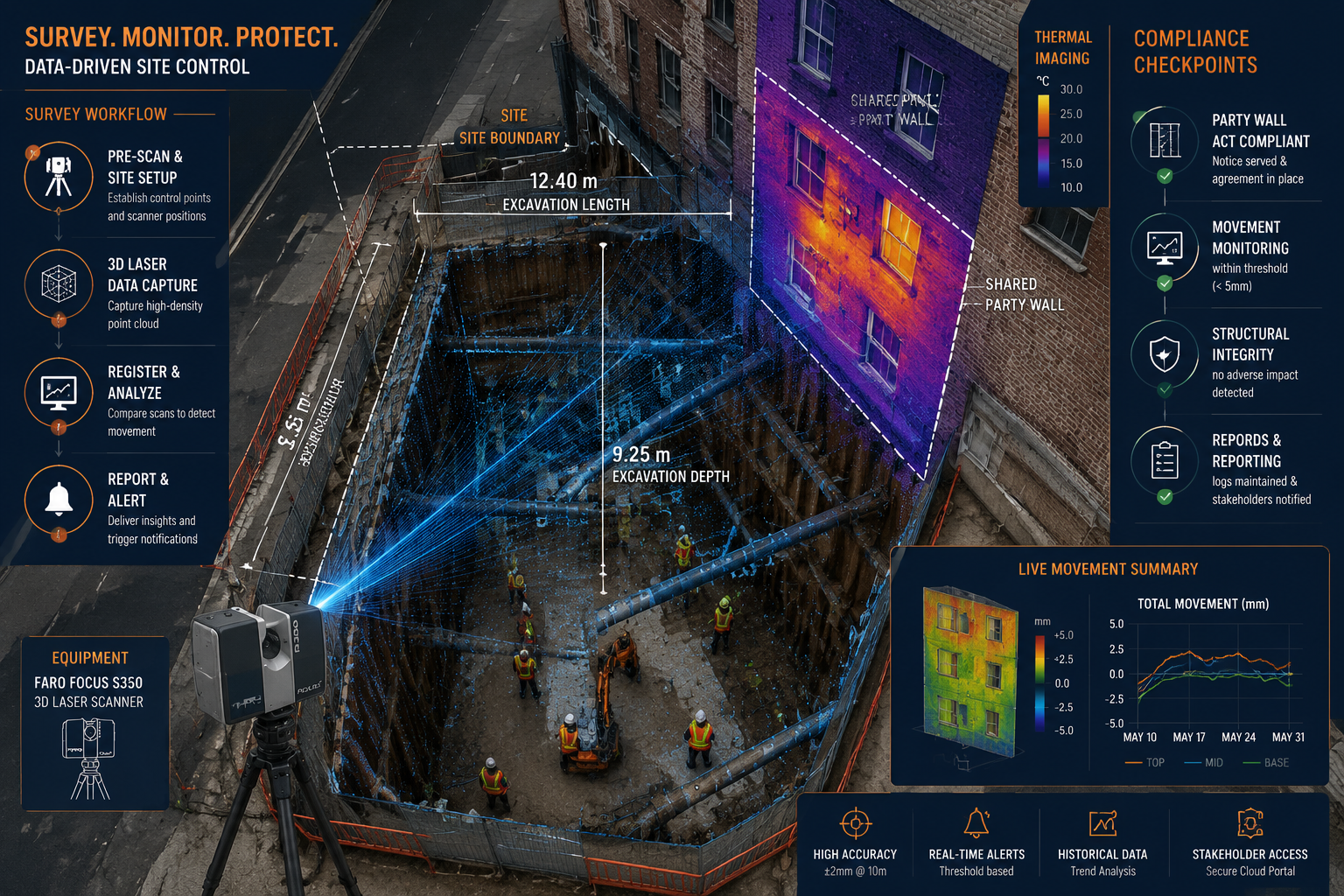
Deep excavations and structural wall alterations represent the highest-risk category of party wall work. Podcast guests who are experienced surveyors consistently outline a structured approach for these projects that goes well beyond the minimum statutory requirements.
Step 1: Conduct a Thorough Schedule of Condition
Before any work begins, a detailed schedule of condition must be prepared. This is a photographic and written record of the adjoining property's existing state. In 2026, the Pyramus & Thisbe Club — the specialist professional body for party wall practice — has introduced advanced protocols that include 3D laser scanning and thermal imaging for complex projects [6]. These technologies create an indisputable baseline record that protects both the building owner and the adjoining owner if damage claims arise later.
Why this matters for deep excavations specifically: Excavations within three or six metres of an adjoining structure (depending on depth) trigger specific notice requirements under the Act. Without a robust schedule of condition, any crack or settlement that appears during or after work becomes a contested liability.
Step 2: Serve the Correct Notice for the Correct Work Type
Different works trigger different notice requirements. A party structure notice is required for works directly to a party wall or structure. A line of junction notice applies when building on or near the boundary. A three-metre or six-metre notice applies to excavation works. Serving the wrong notice type is one of the procedural errors that appears in over 90% of disputes [5].
Podcast surveyors recommend using a checklist approach:
- Identify all party walls, party fence walls, and boundary structures affected
- Determine which notice types apply to each element
- Confirm the correct notice periods for each notice type
- Identify all adjoining owners, including those with a freehold or leasehold interest
- Serve notices in writing with proof of delivery
Step 3: Appoint Surveyors Early and Clarify Roles
When an adjoining owner does not consent to works within 14 days of receiving a notice, the dispute resolution mechanism under the Act is triggered automatically. At this point, each party appoints a surveyor — or they agree on a single agreed surveyor. Understanding the distinct roles of the building owner's surveyor and the adjoining owner's surveyor is essential for keeping the process on track.
Podcast discussions in 2026 frequently highlight cases where the agreed surveyor arrangement — while cost-effective — created conflicts of interest on complex projects. For deep excavations or structural alterations to load-bearing walls, appointing separate surveyors is generally the safer approach.
Step 4: Monitor Works and Maintain Communication
The award is not the end of the surveyor's role. On deep excavation projects, ongoing monitoring of the adjoining structure during works is standard practice among experienced surveyors. Crack monitors, settlement gauges, and regular photographic updates provide real-time evidence that the works are being carried out in accordance with the award. This proactive documentation dramatically reduces the likelihood of post-construction disputes.
Listener Q&A: Real Questions from Podcast Audiences in 2026
The following recreates the style and substance of listener questions raised on UK party wall podcasts in 2026, with responses reflecting current best practice.
Q: My neighbour has started building an extension without serving any notice. What can I do?
This is one of the most common questions raised by podcast listeners in 2026. If a building owner fails to serve notice, the adjoining owner can seek an injunction to stop the works. However, this is an expensive and time-consuming route. The practical first step is to write to the building owner formally, drawing their attention to the Act's requirements. If works have already caused damage, a surveyor should be appointed immediately to document the condition of the property. For guidance on what to do when a neighbour is carrying out works without notice, the page on my neighbour is carrying out works sets out the options clearly.
Q: Can I handle the party wall process without a surveyor to save money?
Technically, the Act allows parties to agree in writing without appointing surveyors. However, podcast experts consistently caution against this on any project involving structural works, deep excavations, or properties with a history of boundary disputes. The article on having a party wall agreement without a surveyor explains both the risks and the limited circumstances where it may be appropriate.
Q: My surveyor seems to be acting in my neighbour's interest, not mine. Is this normal?
This question reflects a fundamental misunderstanding that podcasts work hard to correct. Party wall surveyors are statutory officers, not advocates. Their duty is to the process and to the Act, not to the party who appointed them [1][5]. The RICS 8th edition guidance reinforces this point explicitly. If a surveyor appears to be acting outside their statutory role, the appropriate response is to raise the issue with RICS or seek independent legal advice.
Q: How can I keep party wall costs down without cutting corners?
This is a practical concern for many homeowners. Podcast guests recommend several strategies: serve notices as early as possible to avoid rushed appointments, provide surveyors with complete project drawings upfront to reduce back-and-forth, and consider whether an agreed surveyor arrangement is appropriate for straightforward projects. The detailed guide on how to keep party wall costs down covers these strategies in depth.
Podcast Insights: Resolving Party Wall Issues with Surveyors Before They Escalate in 2026 — The RICS 8th Edition Impact
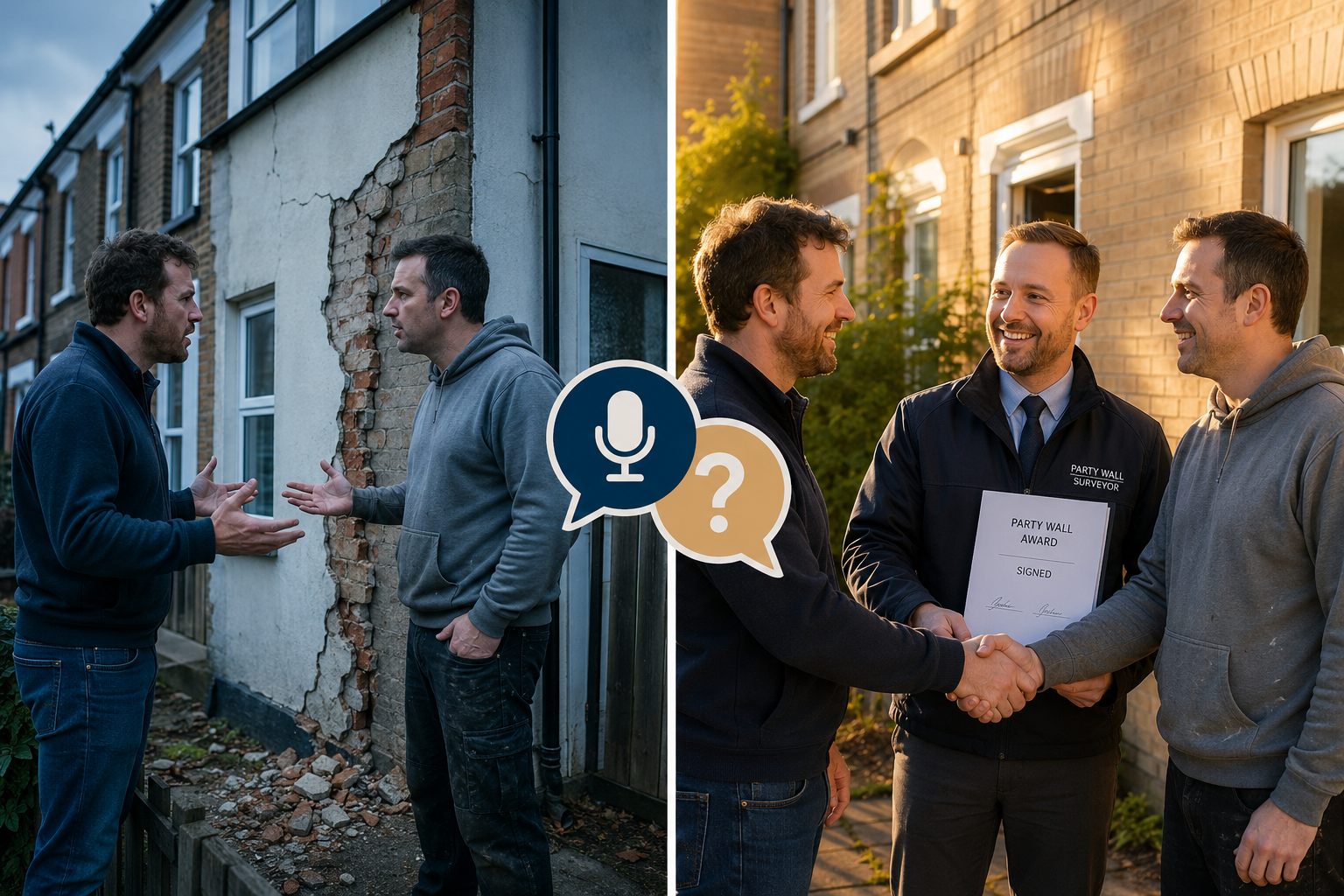
The April 2026 RICS consultation on the draft 8th edition of "Party Wall Legislation and Procedure" guidance is the most significant development in party wall practice for several years [1]. For podcast listeners and property professionals alike, understanding what is changing — and why — is directly relevant to avoiding disputes on current and planned projects.
What the 8th Edition Changes
The draft guidance introduces several key updates:
- Surveyor independence: The guidance makes explicit that a surveyor's appointment is personal and statutory, removing any ambiguity about whether clients can instruct surveyors to act outside their jurisdiction [1].
- Revised templates: Updated letters of appointment, terms of engagement, and award drafts provide clearer frameworks that reduce the procedural errors driving 90% of current disputes [7].
- Competence standards: The guidance raises the bar for professional competence, addressing concerns that have led to legal challenges when surveyors have acted inconsistently [1].
Advanced Protocols for Complex Projects
For projects involving deep excavations, historic structures, or multiple adjoining owners, the Pyramus & Thisbe Club's advanced protocols now recommend 3D laser scanning, thermal imaging, and comprehensive schedules of condition as standard tools [6]. These are no longer specialist extras — they are becoming baseline expectations for complex party wall work in 2026.
Building owners and their project teams should ask surveyors directly whether these technologies will be used on their project and how the resulting data will be stored and shared with all parties.
Conclusion: Actionable Next Steps for 2026
The evidence from podcast discussions, industry data, and the RICS 8th edition consultation points in one direction: early, informed action is the most effective way to resolve party wall issues before they escalate. The 40% rise in disputes in 2026 [2] is not inevitable for any individual project — it reflects the collective cost of delayed notices, procedural shortcuts, and misunderstood roles.
Actionable next steps for building owners:
- Identify all party walls, party fence walls, and boundary structures affected by planned works before engaging a contractor.
- Serve the correct notice type at the earliest opportunity — ideally at the planning stage.
- Appoint a qualified, RICS-registered surveyor who understands the 8th edition guidance and their statutory independence.
- Commission a detailed schedule of condition before works begin, using 3D scanning or thermal imaging where appropriate.
- Budget accurately for party wall costs from the outset, accounting for the possibility of a dispute and a third surveyor appointment.
Actionable next steps for adjoining owners:
- Respond to party wall notices within the statutory timeframe — silence is not consent.
- Appoint your own surveyor if you have any concerns about the proposed works; the building owner pays reasonable costs.
- Request a schedule of condition before works begin to protect your position if damage occurs.
For those in London, specialist support is available across all areas, including East London, North London, South London, and West London. Taking these steps now — before a dispute takes hold — is the clearest lesson that Podcast Insights: Resolving Party Wall Issues with Surveyors Before They Escalate in 2026 consistently delivers.
References
[1] Rics Launches Consultation – https://propertyindustryeye.com/rics-launches-consultation/?utm_source=openai
[2] Party Wall Surveys Amid 2026 Construction Boom Resolving High Demand Disputes In Uk Housing Hotspots – https://manchestersurveyors.com/party-wall-surveys-amid-2026-construction-boom-resolving-high-demand-disputes-in-uk-housing-hotspots/?utm_source=openai
[3] The Reality Of Party Wall Surveying In 2026 Fees Disputes And Daily Challenges From Industry Pros – https://www.canterburysurveyors.com/blog/the-reality-of-party-wall-surveying-in-2026-fees-disputes-and-daily-challenges-from-industry-pros/?utm_source=openai
[4] Cost Breakdown Of Party Wall Agreements In 2026 Surveyor Fees Who Pays What And Budgeting For Disputes – https://manchestersurveyors.com/cost-breakdown-of-party-wall-agreements-in-2026-surveyor-fees-who-pays-what-and-budgeting-for-disputes/?utm_source=openai
[5] Party Wall Surveyor Independence Under Rics 8th Edition Navigating Client Pressures And Statutory Duties In 2026 Projects – https://manchestersurveyors.com/party-wall-surveyor-independence-under-rics-8th-edition-navigating-client-pressures-and-statutory-duties-in-2026-projects/?utm_source=openai
[6] Pyramus Thisbe Club Insights Advanced Party Wall Protocols For Complex 2026 Projects – https://kingstonsurveyors.com/pyramus-thisbe-club-insights-advanced-party-wall-protocols-for-complex-2026-projects/?utm_source=openai
[7] Updated Rics Party Wall Templates For 2026 Letters Of Appointment Terms And Award Drafts From The 8th Edition Consultation – https://manchestersurveyors.com/updated-rics-party-wall-templates-for-2026-letters-of-appointment-terms-and-award-drafts-from-the-8th-edition-consultation/?utm_source=openai