


Color psychology research consistently shows that the hues surrounding people in their homes directly affect mood, sleep quality, and daily stress levels. In 2026, two landmark color announcements have converged to give homeowners and designers an extraordinary opportunity: Sikkens named Rhythm of Blues as its Color of the Year [1], while Pantone declared Cloud Dancer its defining shade for the year [6]. Together, these two choices create a palette that is both scientifically grounded and visually stunning — and party walls are the perfect canvas for bringing this combination to life.
This guide covers everything needed to understand Sikkens Rhythm of Blues and Pantone Cloud Dancer: Painting Party Walls for 2026 Harmony, from the psychology behind each shade to the practical application steps, legal considerations, and finish choices that will make the result last.
Key Takeaways
- Sikkens Rhythm of Blues is a deep, calming blue selected as the 2026 Color of the Year, evoking emotional depth and well-being.
- Pantone Cloud Dancer is a luminous, warm off-white that grounds and brightens any space it occupies.
- Party walls — shared walls between adjoining properties — offer a large, impactful surface for these two shades.
- Before painting or altering a party wall structurally, legal obligations under the Party Wall etc. Act 1996 must be considered.
- Combining blue gradients with a warm white finish on party walls creates balanced, well-being-focused interiors aligned with 2026 design trends.
Why 2026 Color Choices Matter for Party Walls
The Science Behind Rhythm of Blues and Cloud Dancer
Sikkens, the premium paint brand under AkzoNobel, describes Rhythm of Blues as a shade that "moves between the depth of the ocean and the clarity of the sky" [1]. It is not a flat, corporate navy. Instead, it carries undertones that shift in different lighting conditions — appearing almost violet in low light and a pure mid-blue in bright daylight. This dynamic quality makes it especially suitable for large wall surfaces, where the paint can reveal its full range throughout the day.
Pantone's Cloud Dancer sits at the opposite end of the tonal scale. Described as a "luminous, airy white with a soft warmth" [6], it avoids the clinical coldness of stark white. Interior designers responding to Pantone's announcement noted that Cloud Dancer functions as a "quiet anchor" — a shade that makes other colors in a room feel intentional rather than accidental [9].
"Cloud Dancer is not a background color. It is a presence in its own right." — Interior design commentary on Pantone's 2026 announcement [9]
When placed together on a party wall, Rhythm of Blues provides emotional weight and visual focus, while Cloud Dancer lifts the room and prevents the blue from feeling oppressive. The result is a balanced, well-being-focused interior that aligns with the dominant design conversation of 2026.
What Makes a Party Wall Different
A party wall is a shared structure that sits on the boundary between two properties. It could be the wall between two terraced houses, a wall separating a flat from a neighbor's flat, or a garden boundary structure. Because these walls are shared, they carry specific legal and practical considerations that a standard interior wall does not.
Understanding what a party wall actually is under the Party Wall etc. Act 1996 is the essential starting point. Painting the surface on your own side of a party wall is generally straightforward and does not require formal notice. However, if any preparatory work — such as cutting into the wall, attaching fixings, or applying render — crosses into structural territory, the legal framework becomes relevant immediately.
For homeowners planning a full decorative refresh that stays on the surface level, the focus can remain on color selection, finish type, and application method. For those planning more involved work, understanding party wall notices and how to respond to them is a necessary early step.
Applying Sikkens Rhythm of Blues and Pantone Cloud Dancer: Painting Party Walls for 2026 Harmony
Planning the Color Layout
The most successful applications of this palette on party walls use one of three layout approaches:
| Layout Style | Description | Best For |
|---|---|---|
| Full wall in Rhythm of Blues | Entire party wall in the deep blue, with Cloud Dancer on adjacent walls | Bold, statement-led rooms |
| Gradient wash | Blue fades upward into Cloud Dancer toward the ceiling | Open-plan spaces with high ceilings |
| Horizontal split | Lower two-thirds in blue, upper third and ceiling in Cloud Dancer | Rooms with standard ceiling heights |
| Panelled contrast | Blue within recessed panels, Cloud Dancer on surrounding flat surface | Period properties with architectural detail |
The gradient wash approach is gaining particular attention in 2026 design circles because it mirrors the natural transition from deep ocean to open sky — the very imagery Sikkens used when announcing Rhythm of Blues [4]. Achieving a clean gradient requires a wet-edge technique and careful blending while both shades are still wet.
Choosing the Right Finish
Finish selection is as important as color selection, especially on party walls, which can be subject to minor movement, condensation variation, and the occasional vibration from neighboring properties.
Recommended finishes for Rhythm of Blues:
- Eggshell or satin for living rooms and hallways — provides a subtle sheen that enhances the blue's depth without being reflective
- Matt emulsion for bedrooms — absorbs light and creates a cocooning, restful effect
- Durable mid-sheen for kitchens and utility areas — easier to wipe clean
Recommended finishes for Cloud Dancer:
- Flat matt for ceilings — keeps the luminous quality without glare
- Soft sheen for wall sections — adds a gentle warmth that prevents the off-white from looking chalky
- Moisture-resistant formulation for bathrooms or rooms with high humidity
Sikkens produces its Rhythm of Blues in multiple finish options within its professional range [2], allowing decorators to match the sheen level precisely to the room's function and natural light.
Surface Preparation on Party Walls
Party walls often have a history. They may have been plastered and re-plastered multiple times, carry old wallpaper adhesive residue, or show hairline cracks from minor settlement between properties. Skipping surface preparation is the single most common reason a high-quality paint job fails within the first year.
Step-by-step preparation guide:
- Inspect for damp — Party walls are more susceptible to penetrating damp than internal walls. Address any moisture issues before applying any paint.
- Fill cracks — Use a flexible filler for hairline cracks, as rigid fillers can crack again with minor wall movement.
- Sand and prime — Sand any filled areas smooth and apply a suitable primer. For deep blues like Rhythm of Blues, a tinted primer in a mid-grey or blue tone reduces the number of topcoats needed.
- Clean the surface — Remove dust, grease, and any mold with an appropriate solution before the first coat.
- Tape edges — Use low-tack painter's tape along skirting boards, cornices, and door frames to protect adjacent surfaces.
For rooms where the party wall is also an external wall — common in end-of-terrace properties — checking for any structural concerns before beginning is wise. If there is any uncertainty about the wall's condition, a schedule of condition can document the wall's state before work begins, protecting both the building owner and any adjoining neighbor.
Application Technique for a Professional Result
Applying Rhythm of Blues:
Deep blues require patience. Apply in thin, even coats rather than one heavy application. Two to three coats are standard for full, even coverage. Work in sections of approximately one square meter, maintaining a wet edge to avoid lap marks. Use a high-quality roller with a medium nap (10-12mm) for flat surfaces and a 50mm angled brush for cutting in at edges.
Applying Cloud Dancer:
Despite being a light shade, Cloud Dancer benefits from two coats for a consistent finish. Its warm undertone can look uneven if applied too thinly over a previously dark wall. If painting Cloud Dancer directly over an existing dark color, a white or off-white primer coat is essential.
Blending the gradient (if applicable):
Work from the top down. Apply Cloud Dancer to the upper section first, then Rhythm of Blues to the lower section. While both sections are still wet, use a dry brush or foam roller to blend the meeting point in short, feathering strokes. Work quickly and in consistent lighting to judge the blend accurately.
Legal Considerations When Working on Party Walls in 2026
When Painting Becomes a Legal Matter
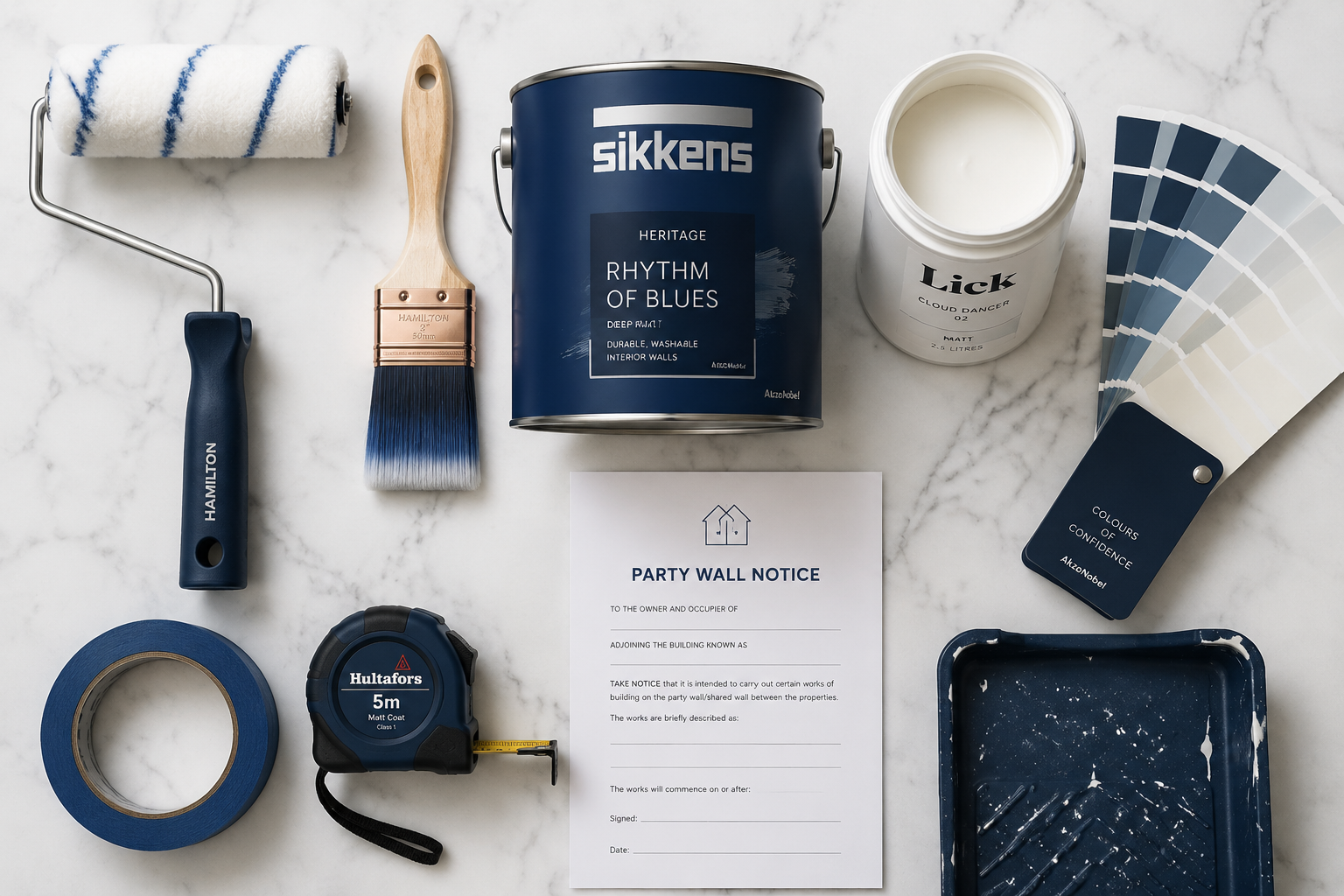
Surface decoration — painting, wallpapering, applying decorative plaster — on the side of a party wall that belongs to the building owner does not typically trigger the Party Wall etc. Act 1996. The Act is concerned with structural works: cutting into the wall, inserting beams, raising the height of the wall, or excavating near its foundations.
However, 2026 interior trends are encouraging homeowners to do more than just paint. Feature wall treatments that involve:
- Installing recessed shelving into a party wall
- Attaching heavy artwork or mirror fixings that penetrate deeply
- Applying thick render or textured coatings that add significant weight
- Removing plaster back to the masonry
…can cross into territory where the Act applies. If there is any doubt about whether planned work requires formal notification, consulting a professional is the safest approach. Those carrying out works near or on a party wall can find structured guidance on the process and obligations involved.
Protecting the Neighbor Relationship
One of the most overlooked aspects of party wall work — even purely decorative work — is the neighbor relationship. Informing an adjoining owner about planned work, even when it is not legally required, is good practice. It prevents misunderstandings and builds the cooperative relationship that makes shared-wall living comfortable.
If a neighbor raises concerns about planned work that extends beyond surface painting, understanding the costs of the party wall process helps both parties approach any formal procedure with realistic expectations. There are also practical strategies available for keeping party wall costs down where formal procedures do become necessary.
For those in specific areas of London, local expertise is available from party wall surveyors in West London, South London, North London, and East London.
The Broader Design and Structural Picture
The trend toward bold, intentional color on party walls in 2026 reflects a wider shift in how people relate to their homes. Post-pandemic living patterns have made interior well-being a genuine priority rather than a luxury concern. Sikkens' choice of Rhythm of Blues was explicitly connected to themes of emotional resonance and calm [1], while Pantone's selection of Cloud Dancer was described as a response to a collective desire for "clarity, openness, and light" [6].
Applying these shades to a party wall — the wall most closely shared with another household — carries a symbolic dimension as well as a practical one. It transforms a boundary into a focal point, and a structural necessity into a design statement.
Combining the Palette: Room-by-Room Guidance
Living Rooms and Open-Plan Spaces
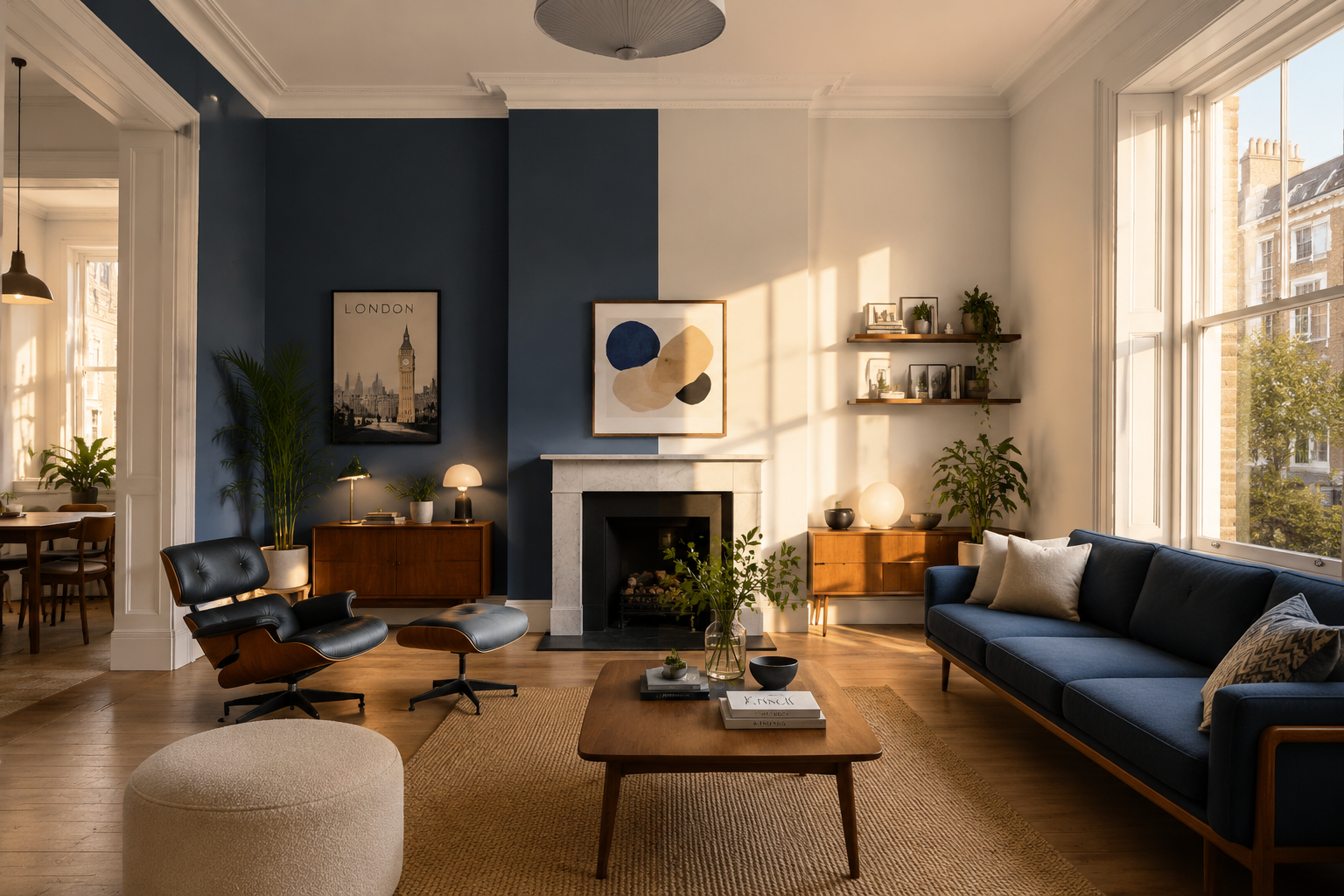
In living rooms, the party wall is often the longest uninterrupted wall surface. Painting it in Rhythm of Blues with Cloud Dancer on the ceiling and remaining walls creates a clear visual anchor. The blue draws the eye and defines the space, while the warm white prevents the room from feeling enclosed.
Complementary accents to consider:
- Natural wood tones (oak, walnut) warm up the blue without competing with it
- Brass or brushed gold metalwork adds contrast
- Terracotta or warm rust textiles provide a complementary opposite on the color wheel
- Linen and cream soft furnishings echo the Cloud Dancer tones
Bedrooms
The BBC's coverage of transformative paint colors for homes highlighted the growing use of deep blues in bedroom settings, noting their association with rest and psychological calm [5]. Rhythm of Blues in a matt finish on the party wall behind a bed headboard creates a natural focal point and a cocoon-like quality that supports sleep.
Cloud Dancer on the three remaining walls and ceiling keeps the room feeling spacious and light during daytime hours.
Home Offices and Study Spaces
The combination of Rhythm of Blues and Cloud Dancer is particularly well-suited to home offices. Research consistently links blue environments with focused, analytical thinking. The luminous quality of Cloud Dancer prevents the space from feeling dark or heavy, maintaining the energy needed for productive work.
A practical approach: paint the wall directly facing the desk in Rhythm of Blues, and all other surfaces in Cloud Dancer. This creates directional focus without visual fatigue.
Conclusion
The convergence of Sikkens Rhythm of Blues and Pantone Cloud Dancer in 2026 is not a coincidence — it reflects a shared cultural instinct toward calm, depth, and clarity. Applying these shades to party walls transforms one of the most structurally significant surfaces in a home into a powerful design statement rooted in well-being.
Actionable next steps for homeowners in 2026:
- Assess the party wall surface — Check for damp, cracks, or previous treatments that need addressing before painting begins.
- Order sample pots — Test both Rhythm of Blues and Cloud Dancer in the actual room under its natural and artificial lighting before committing to full coverage.
- Choose the right finish — Match the sheen level to the room's function and moisture levels.
- Confirm legal position — If any work beyond surface painting is planned, review obligations under the Party Wall etc. Act 1996 or seek professional advice.
- Plan the application sequence — Prime correctly, apply in thin coats, and allow full drying time between coats for the best result.
- Document the wall's condition — Particularly relevant for party walls, a pre-work record protects against any future disputes with adjoining owners.
The combination of Sikkens Rhythm of Blues and Pantone Cloud Dancer on party walls is one of the most accessible and impactful ways to align a home with the defining aesthetic of 2026 — and to create an interior that genuinely supports the people living in it.
References
[1] Akzonobel Celebrates Rhythm Of Blues as The 2026 Color Of The Year – https://www.sikkensvr.com/index.php/en/news/akzonobel-celebrates-rhythm-of-bluestm-as-the-2026-color-of-the-year
[2] Sikkens CF26 Book Completo – https://www.sikkens.it/content/dam/akzonobel-painters/sikkens/it/it/sikkens-cf26-book-completo.pdf
[3] 2026 Color Trends Pantones Controversial Cloud Dancer – https://nicolesteffen.com/2026/01/06/2026-color-trends-pantones-controversial-cloud-dancer/
[4] The Rhythm Of Blues 2026 Sikkens Colors Of The Year – https://www.archiproducts.com/en/news/the-rhythm-of-blues-2026-sikkens-colors-of-the-year_107881
[5] Eight Paint Colours That Can Transform Your Home – https://www.bbc.com/culture/article/20251204-eight-paint-colours-that-can-transform-your-home
[6] Cloud Dancer Is Pantone's Color Of The Year 2026 – https://www.archiproducts.com/en/news/cloud-dancer-is-pantone-s-color-of-the-year-2026_108270
[9] Designers Unlock The Impact Of Pantones 2026 Color Of The Year – https://www.forbes.com/sites/jamiegold/2025/12/16/designers-unlock-the-impact-of-pantones-2026-color-of-the-year/