
When construction work affects shared walls between properties, disputes can arise quickly. Cracks appear. Foundations shift. Neighbors disagree about what damage existed before work started. In 2026, property owners and surveyors are turning to 3D laser scanning for pre-award party wall documentation to create objective, millimeter-accurate records of baseline conditions before any construction begins. This technology transforms party wall surveys from subjective assessments into data-driven documentation that protects all parties involved.
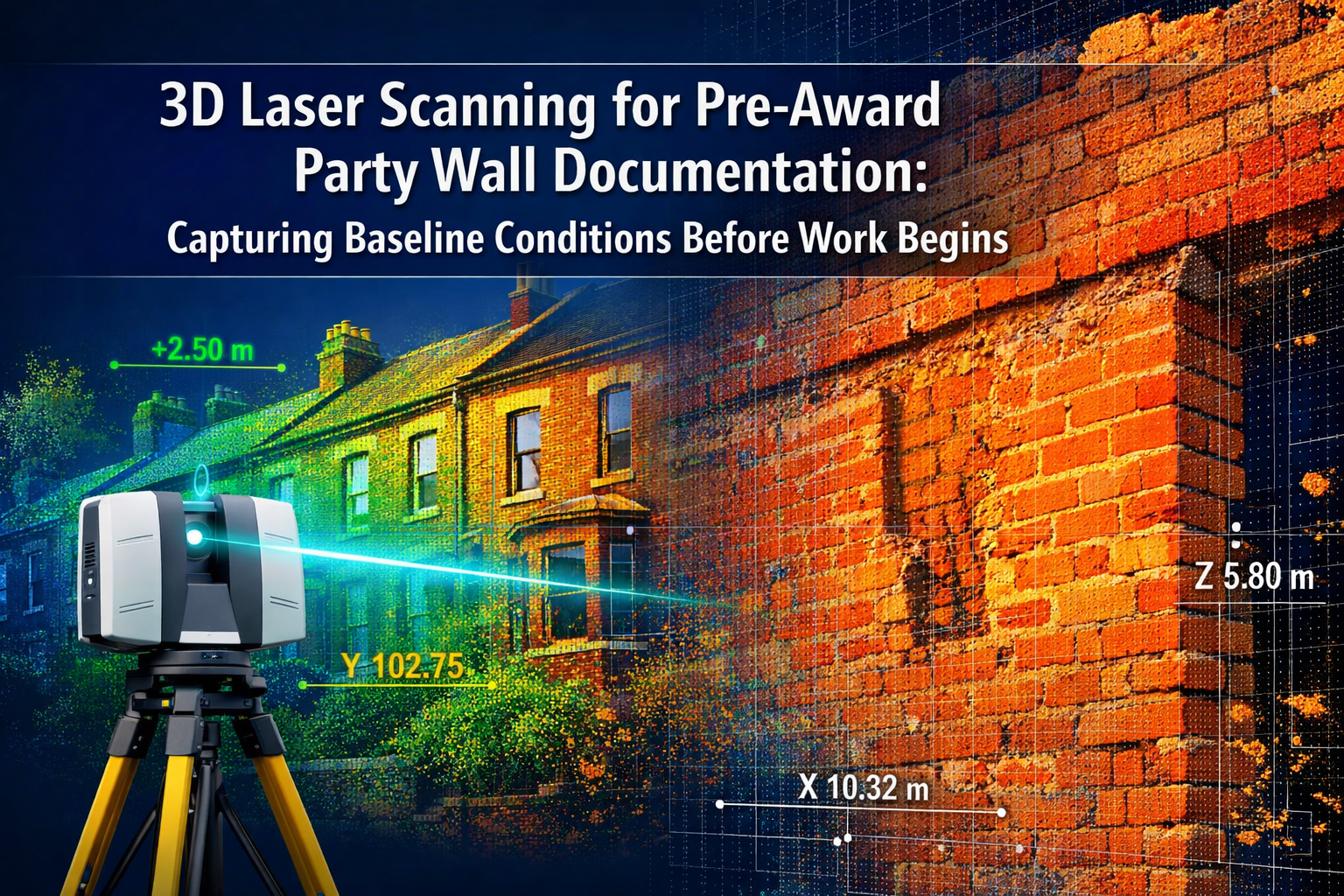
3D laser scanning for pre-award party wall documentation: capturing baseline conditions before work begins provides an irrefutable digital record of every surface, crack, and structural detail. Unlike traditional photography or written descriptions, laser scanning creates a comprehensive 3D model containing millions of precise measurement points. This baseline evidence becomes invaluable when determining whether construction work caused new damage or simply revealed pre-existing conditions.
Key Takeaways
- Millimeter-accurate documentation: Modern laser scanners capture 2.2 million measurement points per second with ±1-4mm accuracy, creating objective baseline records far superior to manual measurements
- Rapid data collection: Complete property documentation can be captured in a single working day, with individual 360-degree scans completing in just 2-5 minutes
- Dispute prevention: Digital point clouds provide irrefutable before-and-after evidence, eliminating subjective disagreements about pre-existing conditions versus construction-related damage
- Comprehensive coverage: Scanning captures all visible surfaces including walls, floors, ceilings, structural elements, and architectural details in a unified 3D model
- Long-term protection: Point cloud data remains accessible for years, supporting party wall awards and providing evidence if disputes emerge months or years after construction
Understanding Party Wall Documentation Requirements
The Legal Framework for Baseline Records
The Party Wall etc. Act 1996 establishes clear requirements for documenting property conditions before construction work begins. When serving party wall notices, building owners must allow adjoining owners to document existing conditions. Traditional schedule of condition reports rely on written descriptions, photographs, and manual measurements—methods that leave room for interpretation and dispute.
3D laser scanning for pre-award party wall documentation addresses these limitations by creating objective digital records that both parties can reference. When surveyors prepare party wall awards, they can incorporate scan data to establish undisputed baseline conditions. This documentation becomes particularly valuable for types of party wall works involving excavation, structural alterations, or demolition.
Why Traditional Documentation Falls Short
Traditional party wall surveys face several critical limitations:
- 📸 Photographs miss context: Images capture visible damage but lack dimensional accuracy and spatial relationships
- 📏 Manual measurements introduce error: Tape measurements can be off by inches over long distances, with cumulative errors compounding across multiple measurements[2]
- ✍️ Written descriptions are subjective: Terms like "minor cracking" or "slight settlement" mean different things to different people
- ⏰ Time-intensive processes: Thorough manual documentation requires multiple site visits and extensive note-taking
- 🔍 Limited detail capture: Surveyors cannot practically document every surface, crack, and detail manually
These shortcomings create vulnerability for both building owners and adjoining owners. When disputes arise months after construction, parties often disagree about what conditions existed beforehand. Without objective baseline data, resolution becomes expensive and contentious.
How 3D Laser Scanning Creates Definitive Baseline Records
The Technology Behind Millimeter-Accurate Documentation
Modern terrestrial laser scanners represent a quantum leap in documentation capability. Devices like the Trimble X12, FARO Focus Premium, and Leica RTC360 capture 2.2 million measurement points per second[2]. Each point records:
- XYZ coordinates: Precise three-dimensional position in space
- Reflectance intensity: Surface material properties
- Color information: RGB values for photorealistic visualization
A complete 360-degree scan captures all visible surfaces within range in just 2 to 5 minutes, with medium-resolution scans completing in approximately 3 minutes[2]. This speed allows comprehensive property documentation without disrupting occupants for extended periods.
Coverage and Accuracy Standards
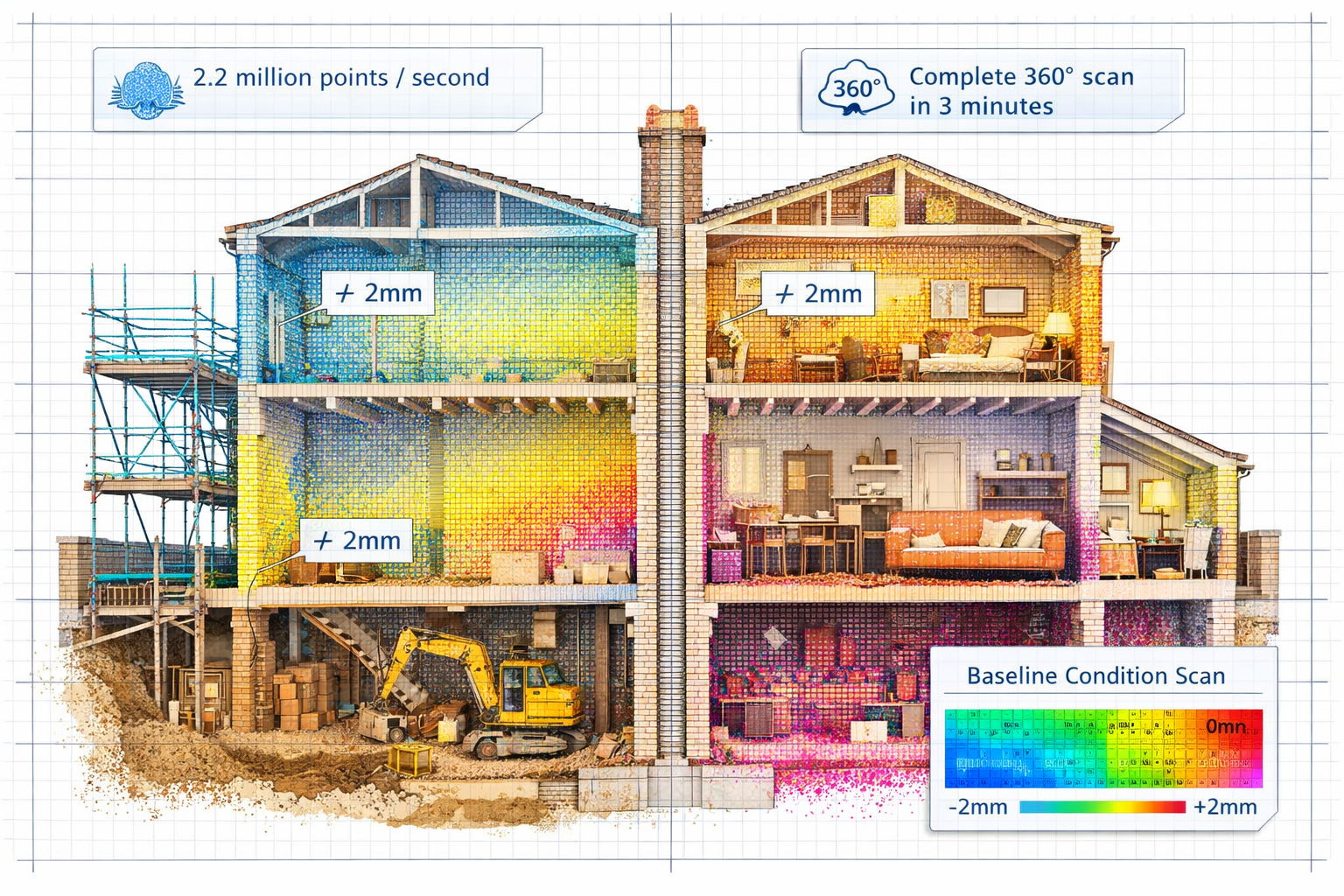
For party wall documentation, coverage and accuracy determine the value of baseline records. Modern laser scanning delivers:
| Specification | Performance | Benefit for Party Walls |
|---|---|---|
| Individual Point Accuracy | ±1 to 4 mm | Detects hairline cracks and minor settlement |
| Cumulative Floor Accuracy | ±2 to 6 mm | No error propagation across entire property |
| Points per Second | 2.2 million | Captures complete surface detail rapidly |
| Scan Duration | 2-5 minutes | Minimal disruption to occupants |
| Coverage per Day | 20,000 sq ft | Complete terraced house documentation in one visit |
A typical terraced property requires 40 to 80 scan positions to capture all relevant surfaces, with complete documentation achievable in a single working day[2]. This efficiency makes 3D laser scanning cost-effective even for standard residential party wall cases.
Point Cloud Generation and Registration
Individual scans must be aligned into a unified coordinate system through a process called registration. Modern scanning software automatically identifies common features between overlapping scans, creating a seamless 3D point cloud containing millions of individual measured points[2].
This unified point cloud represents every visible surface—walls, floors, ceilings, structural elements, architectural details, and existing damage. The result is a comprehensive digital twin of the property at a specific moment in time.
Implementing 3D Laser Scanning for Pre-Award Party Wall Documentation
Optimal Timing for Baseline Scanning
Timing determines the value of baseline documentation. 3D laser scanning for pre-award party wall documentation: capturing baseline conditions before work begins should occur:
✅ After party wall notice service: Once adjoining owners receive notice, scanning can document their property conditions
✅ Before construction mobilization: Capture baseline data before contractors, materials, or equipment arrive on site
✅ During dry weather: Moisture can affect crack appearance and measurement accuracy
✅ With property access confirmed: Ensure all relevant spaces (basements, lofts, shared structures) are accessible
For building owners planning work, early scanning protects against unfounded damage claims. For adjoining owners concerned about potential damage, baseline scans provide insurance against disputes. When both parties agree to scanning, the shared objective record reduces conflict and supports smoother party wall awards preparation.
What Gets Documented in Pre-Award Scans
Comprehensive party wall baseline documentation should capture:
🏠 Shared structures: Party walls, party fence walls, and party structures from both sides
🔨 Adjacent areas: Rooms, floors, and spaces immediately adjoining the shared structure
📐 Structural elements: Load-bearing walls, beams, columns, and foundations where visible
🪟 Architectural features: Windows, doors, decorative elements, and finishes
⚠️ Existing damage: Cracks, settlement, moisture damage, and structural defects
🌳 External conditions: Facades, boundary walls, and external structures potentially affected by excavation
The scanning process captures all visible surfaces within the scanner's line of sight. However, laser scanners cannot see through drywall, behind panels, or inside enclosed cavities[2]. Concealed MEP systems and internal wall construction require either manual investigation or specialized techniques like ground-penetrating radar[5].
The Scanning Process Step-by-Step
Professional 3D laser scanning for party wall documentation follows a systematic approach:
1. Site Assessment and Planning 🗺️
Survey teams evaluate property layout, identify scan positions, and plan optimal coverage. For party wall cases, this includes determining which rooms and external areas require documentation.
2. Scanner Setup and Calibration ⚙️
Technicians position the scanner on a stable tripod, level the device, and configure resolution settings based on required detail level.
3. Data Capture 📡
The scanner rotates 360 degrees, emitting laser pulses and recording return times to calculate distances. Each scan position takes 2-5 minutes depending on resolution settings[2].
4. Multiple Scan Positions 🔄
Teams move the scanner to capture overlapping coverage from different positions, ensuring no areas are missed due to obstructions or line-of-sight limitations.
5. Registration and Processing 💻
Specialized software aligns individual scans into a unified point cloud, creating a seamless 3D model of documented conditions.
6. Quality Control ✓
Technicians verify coverage completeness, check registration accuracy, and ensure all critical areas are captured with sufficient detail.
Output Formats and Deliverables
Point cloud data supports multiple output formats tailored to party wall documentation needs:
- Native point cloud files: E57, LAS, or proprietary formats for detailed analysis and measurement
- 2D floor plans: Extracted cross-sections showing wall positions, room dimensions, and structural elements
- Building sections: Vertical slices revealing floor levels, ceiling heights, and structural relationships
- Photorealistic renderings: Color-accurate visualizations showing existing conditions
- Comparison reports: Heat map overlays showing deviations when compared against post-construction scans
- BIM models: Building Information Modeling data for integration with design software like Revit[2]
For party wall awards, surveyors can reference point cloud data directly or incorporate extracted drawings and measurements into traditional schedule of condition reports. The digital data remains accessible for future reference, supporting long-term dispute resolution if needed.
Leveraging Baseline Scans for Dispute Prevention and Resolution
Before-and-After Comparison Capabilities
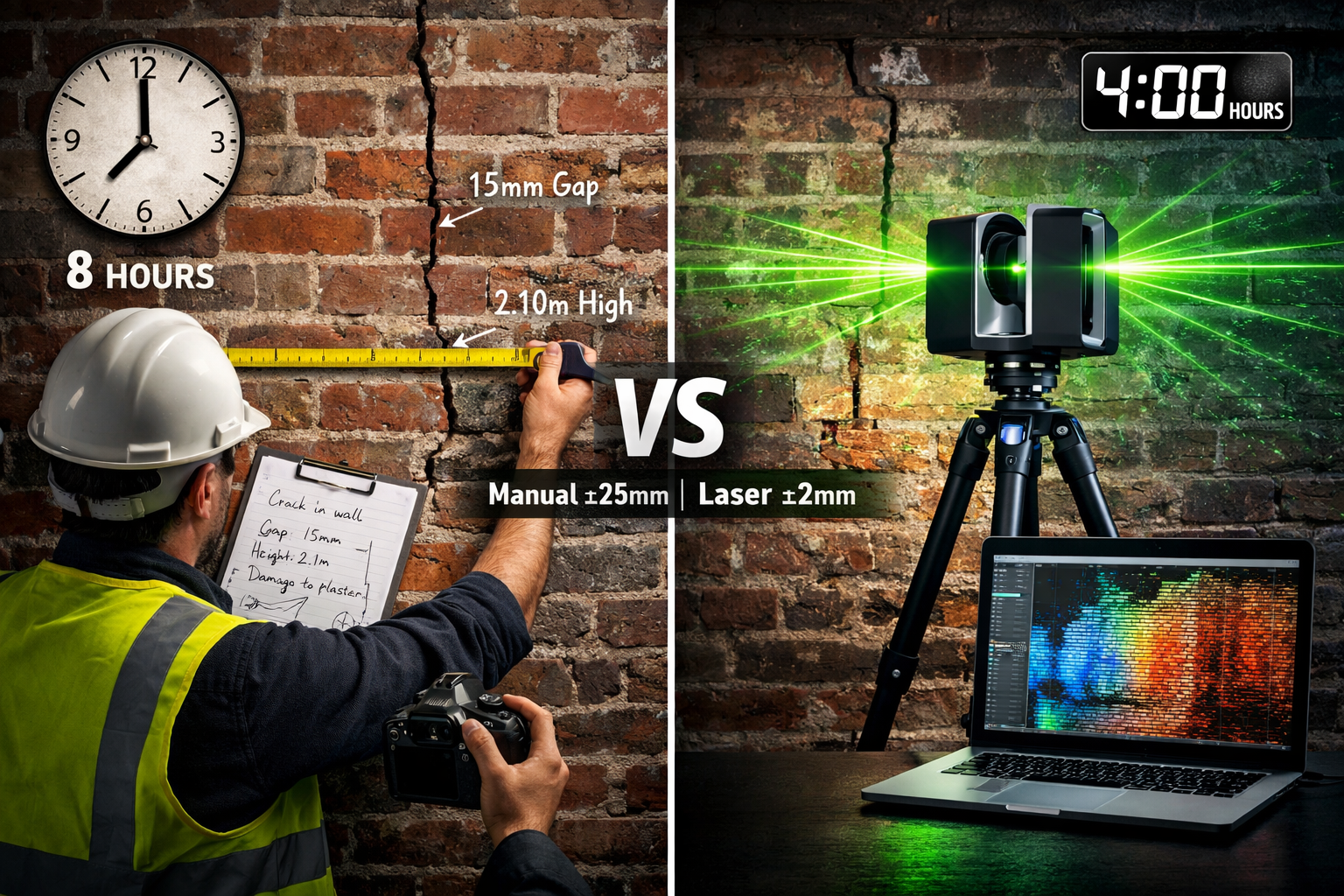
The true power of 3D laser scanning for pre-award party wall documentation emerges when disputes arise. Post-construction scanning creates a second dataset that can be compared directly against baseline conditions using sophisticated analysis tools.
Heat map overlays instantly reveal deviations between scans[3]. Areas where walls have moved, floors have settled, or cracks have appeared show up as color-coded differences. Measurements quantify these changes with millimeter precision, providing objective evidence of:
- 📏 Structural movement: Wall displacement, foundation settlement, or beam deflection
- 🔴 New damage: Cracks, fractures, or material failures not present in baseline scans
- 📊 Magnitude of change: Precise measurements of how much movement or damage occurred
- 🎯 Location specificity: Exact positions of changes relative to construction work
This objective evidence eliminates "he said, she said" disputes. When parties disagree about whether damage existed before work began, point cloud comparison provides definitive answers.
Evidence Standards for Party Wall Disputes
When party wall disputes escalate to formal resolution, evidence quality determines outcomes. 3D laser scanning data offers several advantages over traditional documentation:
Objectivity 🎯
Digital measurements eliminate subjective interpretation. A 5mm crack is documented as exactly 5mm, not "minor" or "significant" depending on observer perspective.
Completeness 📋
Point clouds capture entire surfaces rather than selected photographs. This prevents disputes about what was or wasn't documented.
Verifiability ✓
Third-party experts can analyze the same point cloud data independently, arriving at consistent conclusions about conditions and changes.
Temporal certainty 📅
Scan timestamps and metadata prove exactly when documentation occurred, establishing clear before-and-after timelines.
Measurement repeatability 🔁
Multiple analysts can extract measurements from the same point cloud, producing consistent results that support reliable conclusions.
These characteristics make point cloud evidence particularly persuasive in dispute resolution proceedings. Whether working with party wall surveyors in North London, South London, or other areas, objective baseline data strengthens positions for both building owners and adjoining owners.
Cost-Benefit Analysis for Party Wall Cases
Implementing 3D laser scanning involves upfront costs that must be weighed against benefits:
Typical Scanning Costs 💰
- Residential property baseline scan: £800-£1,500
- Point cloud processing and deliverables: £300-£600
- Post-construction comparison scan: £800-£1,500
- Analysis and reporting: £400-£800
- Total documentation package: £2,300-£4,400
Potential Dispute Costs Without Scanning 💸
- Extended surveyor involvement: £2,000-£5,000
- Legal representation: £5,000-£15,000
- Expert witness fees: £3,000-£8,000
- Court proceedings: £10,000-£50,000+
- Total dispute resolution: £20,000-£78,000+
For significant construction projects—basement excavations, structural alterations, or demolitions—the relatively modest cost of baseline scanning provides substantial insurance against expensive disputes. Even if scanning prevents just one contentious disagreement, the return on investment proves worthwhile.
For guidance on managing overall expenses, see our article on how to keep party wall costs down.
Best Practices and Limitations
When Scanning Provides Maximum Value
3D laser scanning for pre-award party wall documentation delivers greatest value in specific scenarios:
🏗️ Major excavation projects: Basement conversions and deep foundations that risk settlement of adjacent properties
🔨 Structural alterations: Removing or modifying party walls, inserting steel beams, or changing load paths
🏚️ Demolition work: Complete or partial demolition near shared boundaries
🏘️ High-value properties: Where potential damage claims could reach tens of thousands of pounds
⚖️ Contentious relationships: When adjoining owners have expressed concerns or previous disputes exist
🏛️ Historic buildings: Period properties where existing movement and damage may be difficult to distinguish from new issues
For routine works like simple loft conversions or minor repairs, traditional schedule of condition documentation may suffice. However, as scanning costs decrease and capabilities improve, the technology becomes viable for an increasingly broad range of party wall cases.
Understanding Scanner Limitations
While powerful, laser scanning has important constraints:
Line-of-sight requirement 👁️
Scanners only capture visible surfaces. Areas behind furniture, inside walls, or blocked by obstructions won't be documented[2]. Survey teams must plan scan positions carefully to minimize blind spots.
Surface material challenges 🪞
Highly reflective surfaces (mirrors, polished metal) or transparent materials (glass, clear plastic) can produce unreliable data. Specialized scanning techniques or supplementary documentation may be needed.
Concealed conditions 🔍
Internal wall construction, hidden MEP systems, and below-ground conditions remain invisible to laser scanning[5]. For comprehensive documentation, scanning should be combined with other investigation methods.
Weather sensitivity 🌧️
External scanning in rain, snow, or fog produces poor results. Moisture on surfaces can affect measurement accuracy.
Data volume management 💾
Point clouds generate massive files (often 1-10 GB per property). Proper data management, storage, and backup procedures are essential.
Integrating Scanning with Traditional Party Wall Procedures
3D laser scanning complements rather than replaces traditional party wall processes. Optimal integration involves:
1️⃣ Serve proper notices: Follow standard party wall notice procedures as required by legislation
2️⃣ Appoint surveyors: Engage qualified professionals experienced in both party wall matters and 3D scanning interpretation
3️⃣ Conduct baseline scanning: Document conditions after notice service but before work commences
4️⃣ Prepare party wall award: Incorporate scan data and extracted drawings into formal award documentation
5️⃣ Monitor during construction: Conduct interim inspections as specified in the award
6️⃣ Perform post-construction scanning: Document final conditions after work completion
7️⃣ Compare and analyze: Generate comparison reports showing any changes from baseline conditions
8️⃣ Resolve any issues: Use objective evidence to facilitate fair resolution of legitimate damage claims
This integrated approach provides the legal compliance of traditional procedures enhanced by the objective evidence of modern technology.
The Future of Party Wall Documentation in 2026 and Beyond
Industry Standards Evolution
The construction industry has shifted from manual "redlines" to digital "Reality Capture" as the standard for as-built documentation[3]. The concept of a "Golden Thread" of continuous digital information has become an industry mandate rather than static PDF deliverables[3].
This evolution extends naturally to party wall documentation. As 3D scanning becomes more accessible and affordable, it will likely become standard practice for significant party wall cases. Professional bodies and insurance providers increasingly recognize the value of objective baseline data in reducing disputes and associated costs.
Emerging Technologies and Capabilities
Several technological advances will enhance 3D laser scanning for pre-award party wall documentation in coming years:
Mobile scanning systems 📱
Handheld and smartphone-based scanning solutions are improving rapidly, offering lower-cost alternatives to traditional terrestrial scanners for smaller properties.
Automated analysis 🤖
Artificial intelligence and machine learning algorithms can automatically identify cracks, measure dimensions, and flag areas of concern within point cloud data.
Cloud-based collaboration ☁️
Web-based point cloud viewers allow all parties—building owners, adjoining owners, surveyors, and contractors—to access and review baseline data remotely.
Integration with monitoring systems 📊
Combining baseline scans with continuous structural monitoring sensors provides real-time alerts if movement exceeds acceptable thresholds during construction.
Augmented reality visualization 🥽
AR headsets can overlay point cloud data onto physical spaces, helping surveyors and property owners understand baseline conditions in context.
Recommendations for Property Owners and Surveyors
For building owners planning construction work:
- Consider 3D scanning for any project involving excavation, structural alterations, or work on shared walls
- Commission baseline scanning before serving party wall notices to document your own property's pre-existing conditions
- Include scanning costs in initial project budgets rather than treating them as unexpected expenses
- Ensure scanning contractors provide deliverables in multiple formats suitable for party wall documentation
For adjoining owners concerned about potential damage:
- Request baseline scanning as a condition of consent when responding to party wall notices
- If the building owner declines to fund scanning, consider commissioning your own documentation
- Ensure scan data is shared with your appointed surveyor for incorporation into party wall awards
- Retain access to original point cloud files for potential future reference
For party wall surveyors:
- Develop familiarity with point cloud data formats and analysis tools
- Establish relationships with reputable scanning contractors who understand party wall requirements
- Include scanning specifications in party wall awards for significant projects
- Consider requiring both pre-construction and post-construction scans for high-risk works
- Use point cloud evidence to facilitate objective dispute resolution when disagreements arise
Whether working with professionals in Central London, East London, West London, or other areas, incorporating 3D scanning into party wall procedures represents best practice for 2026 and beyond.
Conclusion
3D laser scanning for pre-award party wall documentation: capturing baseline conditions before work begins transforms party wall surveys from subjective assessments into objective, data-driven processes. By creating millimeter-accurate digital records of existing conditions, this technology protects both building owners and adjoining owners from unfounded claims and contentious disputes.
The evidence is compelling: modern terrestrial laser scanners capture 2.2 million measurement points per second with ±1-4mm accuracy, documenting complete properties in a single working day[2]. This efficiency and precision far exceeds traditional manual methods, providing irrefutable baseline evidence that remains accessible for years.
As construction projects become more complex and property values continue rising, the modest investment in baseline scanning delivers substantial returns through dispute prevention and efficient resolution. The technology has matured from specialized application to practical tool suitable for a wide range of party wall cases.
Next Steps for Implementation
If you're planning construction work affecting party walls:
- Consult with experienced party wall surveyors about whether your project would benefit from baseline scanning
- Obtain quotes from qualified scanning contractors before finalizing project budgets
- Schedule baseline scanning after serving party wall notices but before construction mobilization
- Ensure scan deliverables include formats suitable for party wall award documentation
If you're an adjoining owner concerned about potential damage:
- Discuss baseline scanning with your appointed surveyor when responding to party wall notices
- Request that scanning provisions be included in the party wall award
- Ensure you receive copies of all scan data and analysis reports
- Retain documentation for potential future reference if disputes arise
For professional guidance on party wall matters and modern documentation techniques, contact experienced party wall surveyors who understand both traditional procedures and emerging technologies.
The future of party wall documentation has arrived. By embracing 3D laser scanning for baseline condition capture, property owners and surveyors can navigate construction projects with confidence, knowing that objective evidence will support fair outcomes for all parties involved.
References
[1] 3d Laser Scanning Explained A Complete Guide – https://engrx.ca/2026/03/02/3d-laser-scanning-explained-a-complete-guide/
[2] 3d Scanning Replaced Manual As Builts – https://www.thefuture3d.com/blog-0/2026/3/14/3d-scanning-replaced-manual-as-builts/
[3] As Built Documentation Best Practices – https://iscano.com/laser-scanning-lidar-best-practices/as-built-documentation-best-practices/
[4] Scan To Bim Cost Guide – https://iscano.com/real-world-applications-laser-scanning-lidar/scan-to-bim-cost-guide/
[5] Behind Wall Information – https://www.existingconditions.com/knowledge-center-articles/behind-wall-information