
When construction work begins next door, the condition of your shared party wall becomes critical evidence. In 2026, property owners and surveyors face increasing pressure to document existing structures with unprecedented precision before any building work commences. Traditional measuring tapes and photographs no longer provide the forensic-level detail needed to protect both parties in potential disputes. Enter 3D laser scanning in party wall surveys: capturing millimeter accuracy for 2026 Act compliance—a revolutionary technology transforming how professionals document, analyze, and protect shared structures under The Party Wall (etc.) Act 1996.
This advanced surveying method creates digital twins of party walls, capturing millions of data points in minutes with precision down to 2mm tolerance[2]. For building owners planning extensions, loft conversions, or basement excavations, this technology provides irrefutable evidence of pre-construction conditions. For adjoining owners, it offers peace of mind that any damage will be accurately identified and fairly compensated.
Key Takeaways
- Millimeter precision: 3D laser scanning achieves 2mm accuracy at ranges exceeding 300 metres, providing forensic-level documentation for party wall disputes[2][5]
- Rapid data capture: Technology collects millions of measurement points in minutes, reducing site time and survey costs while minimizing disruption[2]
- Legal compliance: Digital point cloud models support enforceable party wall notices and schedules of condition under the Party Wall Act 1996[3]
- Risk reduction: Precise pre-works documentation significantly decreases litigation risks and dispute resolution costs for both building and adjoining owners
- Industry standard: Professional surveyors utilize Faro-series equipment following RICS guidance notes to ensure quality assurance and professional standards[1][3]
Understanding 3D Laser Scanning Technology in Party Wall Documentation
What Is 3D Laser Scanning?
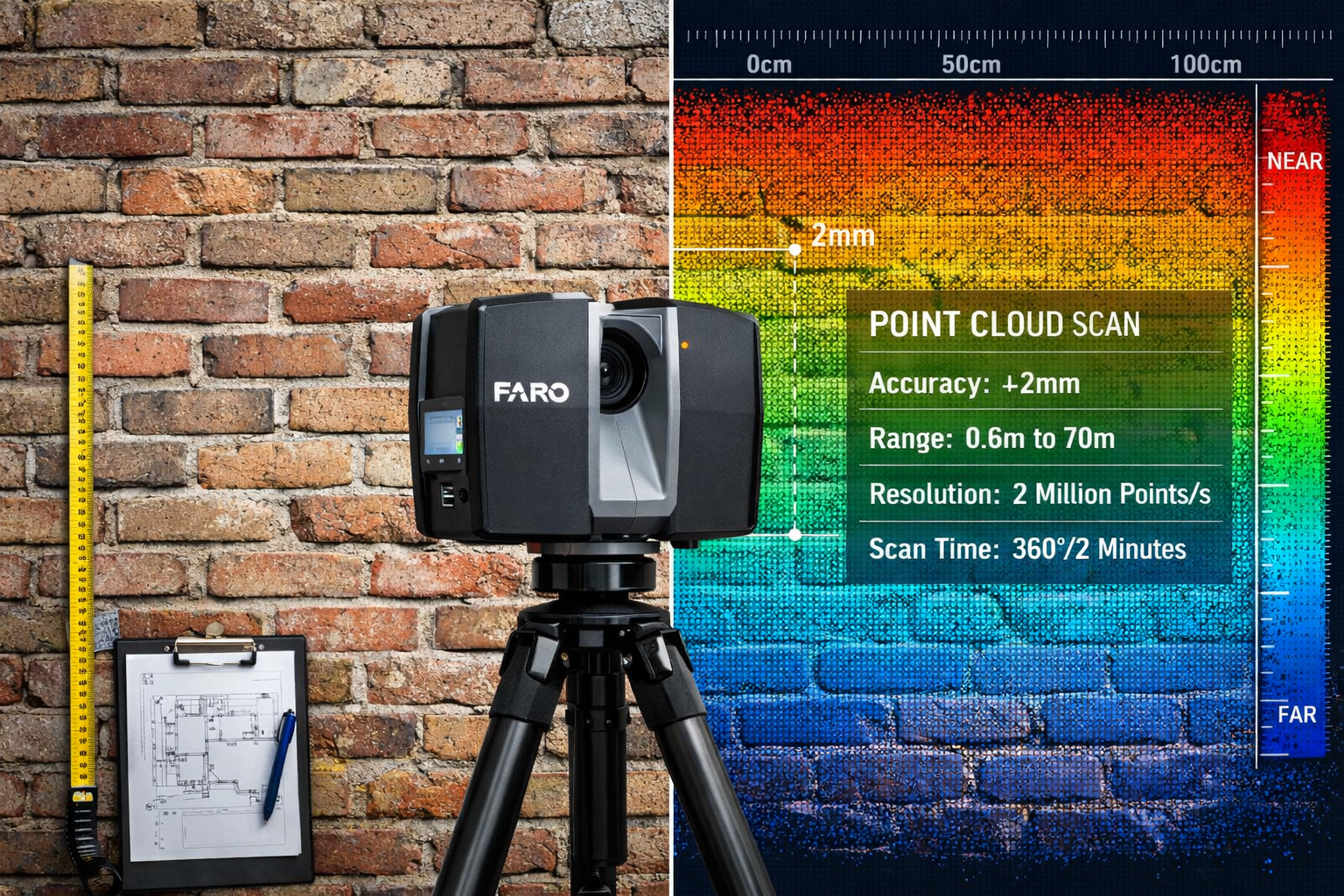
3D laser scanning represents a non-contact surveying method that rapidly captures the exact dimensions and geometry of physical structures. The technology works by emitting millions of laser pulses that bounce off surfaces and return to the scanner. By measuring the time each pulse takes to return, the equipment calculates precise distances and creates a detailed "point cloud"—a digital representation composed of millions of individual measurement points[2].
For party wall surveys, this technology offers transformative advantages:
- Speed: Captures complete wall conditions in minutes rather than hours
- Accuracy: Achieves millimeter precision across entire structures[5]
- Completeness: Records every crack, bulge, and surface irregularity
- Safety: Accesses difficult or dangerous areas remotely[2]
- Permanence: Creates archival-quality digital records
Industry-Standard Equipment for Party Wall Surveys
Professional surveying firms conducting party wall assessments typically deploy Faro-series laser scanning equipment[1][3], recognized as the industry benchmark for accuracy and reliability. These sophisticated instruments combine:
| Equipment Component | Function | Benefit for Party Wall Surveys |
|---|---|---|
| Rotating laser head | Emits millions of pulses per second | Captures complete 360° coverage |
| High-resolution camera | Records color photography | Adds visual context to geometric data[3] |
| GPS integration | Establishes precise coordinates | Enables accurate site positioning |
| Onboard processing | Performs initial data validation | Ensures quality during fieldwork |
The combination of laser precision and photographic documentation creates photorealistic 3D models that serve as powerful evidence in party wall proceedings. When disputes arise about pre-existing conditions, these digital records provide objective, measurable proof that courts and arbitrators readily accept.
How Millimeter Accuracy Supports Act Compliance
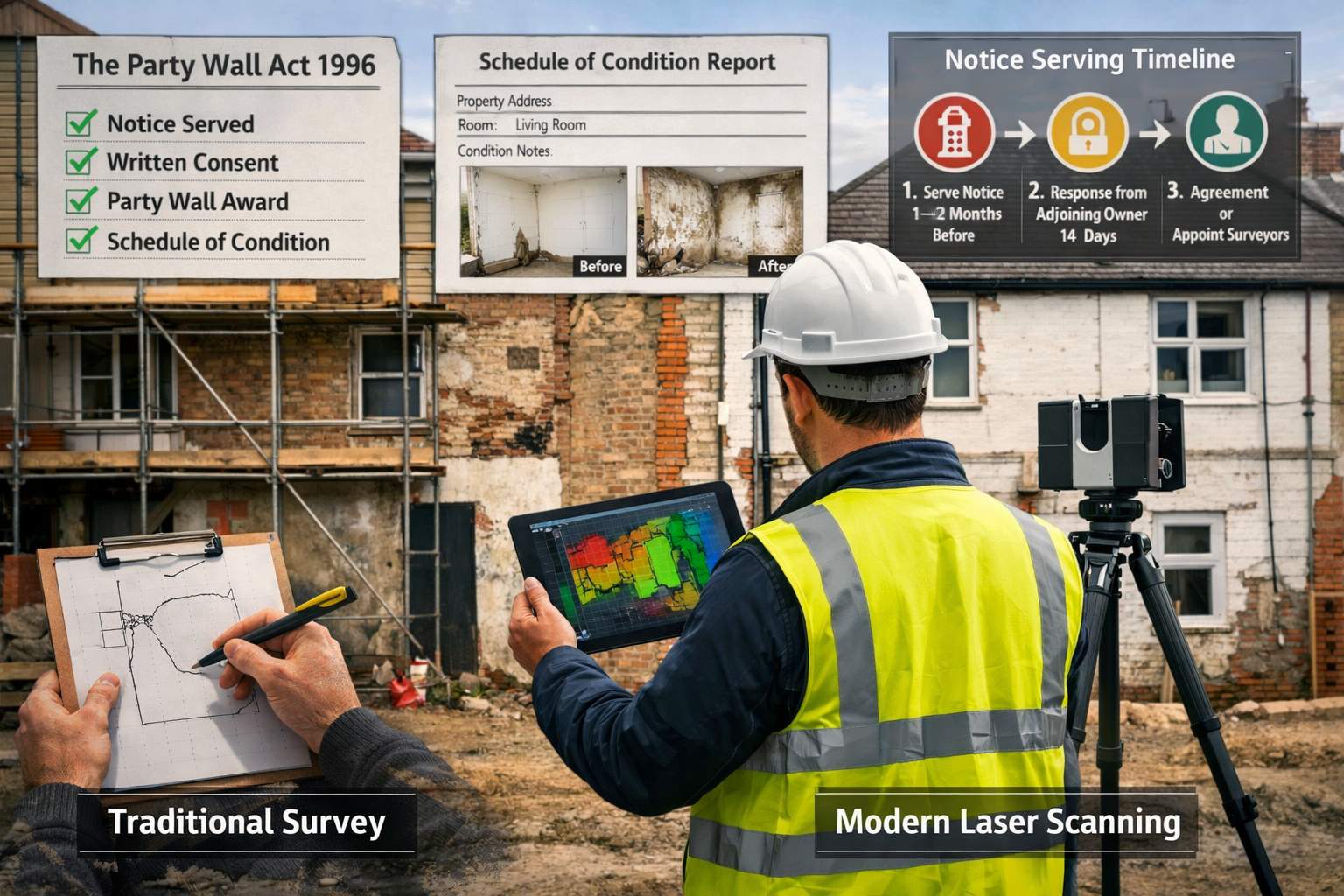
The Party Wall (etc.) Act 1996 requires building owners to serve proper notices and prepare comprehensive schedules of condition before commencing works that might affect adjoining properties[3]. These schedules must document:
✅ Existing cracks, defects, and structural issues
✅ Wall alignment, verticality, and levelness
✅ Surface conditions and material deterioration
✅ Any pre-existing movement or settlement
Traditional survey methods rely on manual measurements, photographs, and written descriptions—all subject to human error and interpretation disputes. 3D laser scanning eliminates this ambiguity by creating objective, measurable records with 2mm accuracy[2]. When a building owner's excavation or construction work potentially causes damage, surveyors can rescan the structure and overlay the new data onto the original baseline, revealing changes with mathematical certainty.
This precision proves particularly valuable when types of party wall works involve:
- Basement excavations within 3-6 metres of adjoining foundations
- Structural alterations to load-bearing party walls
- Underpinning or foundation reinforcement
- Demolition and rebuilding of party structures
Practical Applications: 3D Laser Scanning in Party Wall Surveys for 2026 Projects
Pre-Construction Baseline Documentation
Before any building work begins, establishing an accurate baseline condition represents the most critical step in party wall compliance. In 2026, forward-thinking surveyors increasingly recommend 3D laser scanning as standard practice for all significant projects involving shared structures.
The typical workflow includes:
1. Initial Site Assessment
Professional surveyors visit the property to identify all party walls, party structures, and areas requiring documentation. This assessment determines optimal scanner positions and access requirements.
2. Laser Scanning Fieldwork
Using Faro-series equipment[1], surveyors position scanners at strategic locations to capture complete coverage of party walls from multiple angles. Each scan position takes just 3-5 minutes to complete[2], though multiple positions ensure no areas remain hidden.
3. High-Resolution Photography
Integrated cameras capture color imagery synchronized with laser data[3], adding visual context that helps identify specific features like cracks, staining, or material defects.
4. Point Cloud Processing
Back in the office, specialists process raw scan data using sophisticated software that aligns multiple scan positions, removes noise, and creates unified 3D models containing millions of precisely measured points.
5. Schedule of Condition Preparation
Surveyors extract measurements, cross-sections, and annotated images from the point cloud to create comprehensive schedules of condition that accompany party wall awards.
Supporting Enforceable Party Wall Notices
When serving party wall notices under the Act, building owners must provide sufficient detail about proposed works and their potential impact on adjoining properties[3]. 3D laser scanning strengthens these notices by:
- Demonstrating professional due diligence and thorough documentation
- Providing precise measurements of existing conditions referenced in notices
- Creating visual evidence that helps adjoining owners understand proposed works
- Establishing credibility that facilitates agreement and reduces disputes
For adjoining owners receiving notices, commissioning an independent 3D laser scan provides powerful protection. This proactive step ensures an objective record exists before works commence, eliminating later arguments about whether damage occurred during construction or existed previously.
Professional party wall surveyors across London increasingly recommend this approach for projects in areas like North London, West London, and East London, where property values and construction activity remain high.
Reducing Litigation Risks Through Precise Documentation
Party wall disputes frequently escalate into costly litigation when parties cannot agree on whether damage occurred or its extent. 3D laser scanning dramatically reduces these risks by providing:
Objective Evidence 📊
Point cloud data offers mathematical proof rather than subjective opinions. When a crack measures 2.3mm in the baseline scan and 8.7mm in the post-construction scan, the 6.4mm increase becomes indisputable fact.
Temporal Comparison ⏱️
Surveyors can rescan structures at any point and overlay new data onto baseline models, creating visual "difference maps" that highlight every change with color-coded precision.
Expert Witness Support ⚖️
In legal proceedings, 3D scan data provides compelling evidence that expert witnesses can present clearly to judges, arbitrators, or mediators. The technology's scientific basis and industry acceptance strengthen credibility.
Settlement Facilitation 🤝
When both parties view objective scan data showing precise damage extent, settlement negotiations become more productive. The technology removes emotion and speculation, focusing discussions on measurable facts.
"3D laser scanning has revolutionized party wall practice by transforming subjective assessments into objective measurements. Disputes that once took months to resolve now settle in weeks when both parties trust the data." — Senior Party Wall Surveyor
Cost-Benefit Analysis for 2026 Projects
Property owners naturally question whether 3D laser scanning justifies its cost compared to traditional survey methods. The 2026 economic reality strongly favors the technology:
Traditional Survey Costs:
- Multiple site visits: 4-6 hours of surveyor time
- Manual measurements: prone to errors requiring revisits
- Photographic documentation: limited detail and perspective
- Written descriptions: subject to interpretation disputes
- Total cost: £800-£1,200 for typical party wall survey
3D Laser Scanning Costs:
- Single site visit: 1-2 hours of fieldwork
- Automated data capture: millions of measurements simultaneously
- Complete digital record: permanent archive with unlimited analysis
- Reduced dispute risk: fewer costly legal proceedings
- Total cost: £1,500-£2,500 for comprehensive scan
While the upfront cost increases by approximately £700-£1,300, this investment provides:
✅ Dispute avoidance: Preventing a single legal dispute saves £5,000-£15,000 in legal fees
✅ Time savings: Faster surveys reduce project delays and holding costs
✅ Insurance benefits: Some insurers offer premium reductions for comprehensive documentation
✅ Future value: Digital archives support future renovations or sales
For projects in South London and other high-value areas, where property values exceed £1 million, the additional cost represents just 0.15-0.25% of property value—a minimal investment for maximum protection.
Professional Standards and Quality Assurance in 3D Laser Scanning
RICS Guidance and Industry Best Practices
Professional surveyors conducting 3D laser scanning for party wall purposes must adhere to Royal Institution of Chartered Surveyors (RICS) guidance notes[1]. These standards ensure:
- Competency requirements: Surveyors must demonstrate specific training and experience in laser scanning technology
- Equipment calibration: Regular testing and certification of scanning equipment accuracy
- Data processing protocols: Standardized methods for point cloud registration and quality control
- Reporting standards: Clear, consistent presentation of scan data and derived measurements
- Professional indemnity: Adequate insurance coverage for technology-dependent work
When selecting a surveyor for party wall work involving 3D laser scanning, property owners should verify:
🔍 RICS membership and relevant professional qualifications
🔍 Equipment specifications (Faro-series or equivalent industry-standard scanners[1][3])
🔍 Experience portfolio showing similar party wall projects
🔍 Quality assurance processes for data capture and processing
🔍 Professional indemnity insurance covering technology errors
Data Security and Long-Term Archiving
3D laser scan data represents valuable legal evidence that may be required years after initial capture. Professional surveying firms implement robust data management protocols:
- Redundant storage: Multiple backup copies in geographically separate locations
- Format standards: Industry-standard file formats ensuring long-term accessibility
- Version control: Tracking all processing steps and modifications
- Access security: Encrypted storage with controlled access logs
- Retention policies: Maintaining archives for statutory limitation periods (typically 6-12 years)
For party wall purposes, scan data should remain accessible throughout the construction project and for at least six years afterward—the limitation period for most breach of contract claims in England and Wales.
Integration with Traditional Party Wall Services
3D laser scanning complements rather than replaces traditional party wall services. The technology enhances:
Notice Serving 📋
Precise measurements support detailed descriptions in party wall notices, helping adjoining owners understand proposed works and their potential impacts.
Award Preparation 📄
Point cloud data provides accurate dimensions for party wall awards, reducing ambiguity and potential disputes about work scope or specifications.
Condition Monitoring 🔍
Periodic rescanning during construction enables early detection of movement or damage, allowing prompt remedial action before problems escalate.
Dispute Resolution ⚖️
When disagreements arise, scan data provides objective evidence that facilitates faster, more cost-effective resolution.
Understanding how to keep party wall costs down while maintaining thorough documentation remains a priority for property owners. 3D laser scanning achieves this balance by preventing expensive disputes through superior evidence quality.
Future Developments: 3D Laser Scanning Technology in 2026 and Beyond
Emerging Technologies and Integration
The surveying industry continues advancing 3D laser scanning capabilities through:
Mobile Scanning Systems 📱
Handheld and backpack-mounted scanners enable faster data capture in complex environments, reducing fieldwork time and costs while maintaining accuracy.
Automated Processing 🤖
Artificial intelligence and machine learning algorithms increasingly automate point cloud processing, extracting walls, floors, and structural elements automatically with minimal human intervention.
Cloud-Based Collaboration ☁️
Web-based platforms allow multiple parties—building owners, adjoining owners, and their respective surveyors—to access and review scan data remotely, improving transparency and communication.
Integration with BIM 🏗️
Building Information Modeling (BIM) workflows increasingly incorporate laser scan data, enabling architects and engineers to design renovations around precise as-built conditions rather than assumed dimensions.
Regulatory Trends and Professional Adoption
As 3D laser scanning demonstrates its value in party wall matters, several trends are emerging:
Increased Adoption 📈
More surveyors invest in scanning equipment as costs decrease and client expectations rise. What was considered premium service in 2020 is becoming standard practice in 2026.
Insurance Requirements 🛡️
Some professional indemnity insurers now recommend or require 3D scanning for high-value party wall projects, recognizing its risk-reduction benefits.
Court Acceptance ⚖️
Judges and arbitrators increasingly expect digital evidence in construction disputes. Parties relying solely on traditional documentation may find their evidence questioned when opponents present laser scan data.
Standard Specifications 📋
Industry bodies are developing standardized specifications for laser scanning in party wall contexts, ensuring consistency and quality across different surveyors and projects.
Practical Recommendations for Property Owners
Whether planning construction work or responding to a neighbor's project, property owners should consider:
For Building Owners:
- Commission 3D laser scanning before serving party wall notices to demonstrate professionalism and due diligence
- Include scan data with schedules of condition to facilitate agreement and reduce dispute risks
- Budget for periodic rescanning during construction to monitor structural behavior
- Retain scan data archives for the full limitation period after project completion
For Adjoining Owners:
- Request 3D laser scanning as part of the party wall process, especially for significant projects
- Consider commissioning independent scans if concerned about the building owner's documentation quality
- Ensure scan data is included in party wall awards and schedules of condition
- Verify that surveyors use industry-standard equipment and follow RICS guidance[1]
For Both Parties:
- Understand that upfront scanning costs represent insurance against far more expensive disputes
- Ensure surveyors have appropriate professional qualifications and experience
- Request clear explanations of scan data and its implications
- Maintain copies of all scan data and related documentation
Conclusion
3D laser scanning in party wall surveys: capturing millimeter accuracy for 2026 Act compliance represents more than technological innovation—it fundamentally transforms how property owners protect their interests when construction work affects shared structures. By capturing millions of precise measurements in minutes, this technology creates objective, irrefutable records that support enforceable notices, reduce litigation risks, and facilitate fair dispute resolution.
The combination of 2mm accuracy[2][5], rapid data capture, and permanent digital archives addresses the core challenges of party wall compliance under The Party Wall (etc.) Act 1996. Whether documenting existing conditions before basement excavations, monitoring structural behavior during construction, or resolving disputes about alleged damage, laser scanning provides the forensic-level evidence that modern party wall practice demands.
For property owners planning construction projects in 2026, investing in professional 3D laser scanning represents prudent risk management rather than optional luxury. The modest additional cost compared to traditional surveys delivers substantial protection against disputes that can cost tens of thousands in legal fees and project delays.
Next Steps
If you're planning building work:
- Consult a qualified party wall surveyor about 3D laser scanning requirements
- Commission baseline scans before serving party wall notices
- Include comprehensive scan data in schedules of condition
- Plan for monitoring scans during construction phases
If you've received a party wall notice:
- Appoint your own surveyor experienced in 3D scanning technology
- Request baseline scanning before works commence
- Ensure scan data is referenced in party wall awards
- Establish protocols for monitoring and post-construction verification
For professional guidance:
Contact experienced party wall surveyors who utilize industry-standard Faro-series equipment[1][3] and follow RICS guidance notes[1]. Verify their qualifications, review their technology capabilities, and confirm their experience with similar projects in your area.
The future of party wall surveying has arrived. In 2026, millimeter-accurate 3D laser scanning isn't just available—it's becoming the professional standard that protects property owners, reduces disputes, and ensures compliance with the Party Wall Act. Don't let your next construction project proceed without this essential protection.
References
[1] Measured Survey And 3d Laser Scanning In London – https://quatrefoils.co.uk/measured-survey-and-3d-laser-scanning-in-london/
[2] Point Cloud Survey – https://fourwalls-group.com/services/surveys/point-cloud-survey/
[3] Building Surveying – https://www.masonclark.co.uk/services/building-surveying
[4] 3d Laser Scanning For Property Surveys From Adoption Boom To Practical Implementation – https://nottinghillsurveyors.com/blog/3d-laser-scanning-for-property-surveys-from-adoption-boom-to-practical-implementation
[5] 3d Laser Scanning – https://interlocksurveys.co.uk/surveying-services/3d-laser-scanning/