


When planning construction work that affects a shared wall with your neighbour in 2026, one decision could save you thousands of pounds: choosing between an agreed surveyor or separate surveyors. With Agreed Surveyors vs Three Surveyor Scenarios: Cost-Benefit Analysis for 2026 Party Wall Disputes becoming increasingly critical as construction costs rise, understanding the financial implications of surveyor appointments can mean the difference between a £1,200 project and a £15,000+ nightmare. In an era where party wall disputes are adding 5-15% to overall construction budgets[3], making the right choice at the outset isn't just smart—it's essential.
Key Takeaways
✅ Agreed surveyors can reduce costs by 50% or more compared to two-surveyor scenarios, with typical savings ranging from £900 to £7,500 depending on project complexity
💷 Three-surveyor scenarios represent the most expensive option, triggered only when two appointed surveyors cannot reach agreement, potentially pushing costs beyond £15,000 for complex basement projects
⏱️ Early negotiation with neighbours to appoint a single agreed surveyor is the most cost-efficient strategy under the Party Wall etc. Act 1996
📊 Project type significantly impacts costs: loft conversions average £900-£1,200 with agreed surveyors versus £1,800-£2,400 with two surveyors[1][2]
🎯 Strategic planning can prevent escalation to three-surveyor scenarios, avoiding dispute premiums that add substantial delays and expenses
Understanding Party Wall Surveyor Appointment Options
The Party Wall etc. Act 1996 provides three distinct pathways for appointing surveyors when construction work affects shared structures. Each option carries different cost implications, timelines, and relationship dynamics that building owners must carefully consider.
The Agreed Surveyor Model
An agreed surveyor is a single impartial professional appointed jointly by both the building owner and the adjoining owner. This individual acts as a neutral third party, preparing the party wall award and managing the entire process from initial notice to completion. The agreed surveyor must maintain impartiality while protecting the interests of both parties equally.
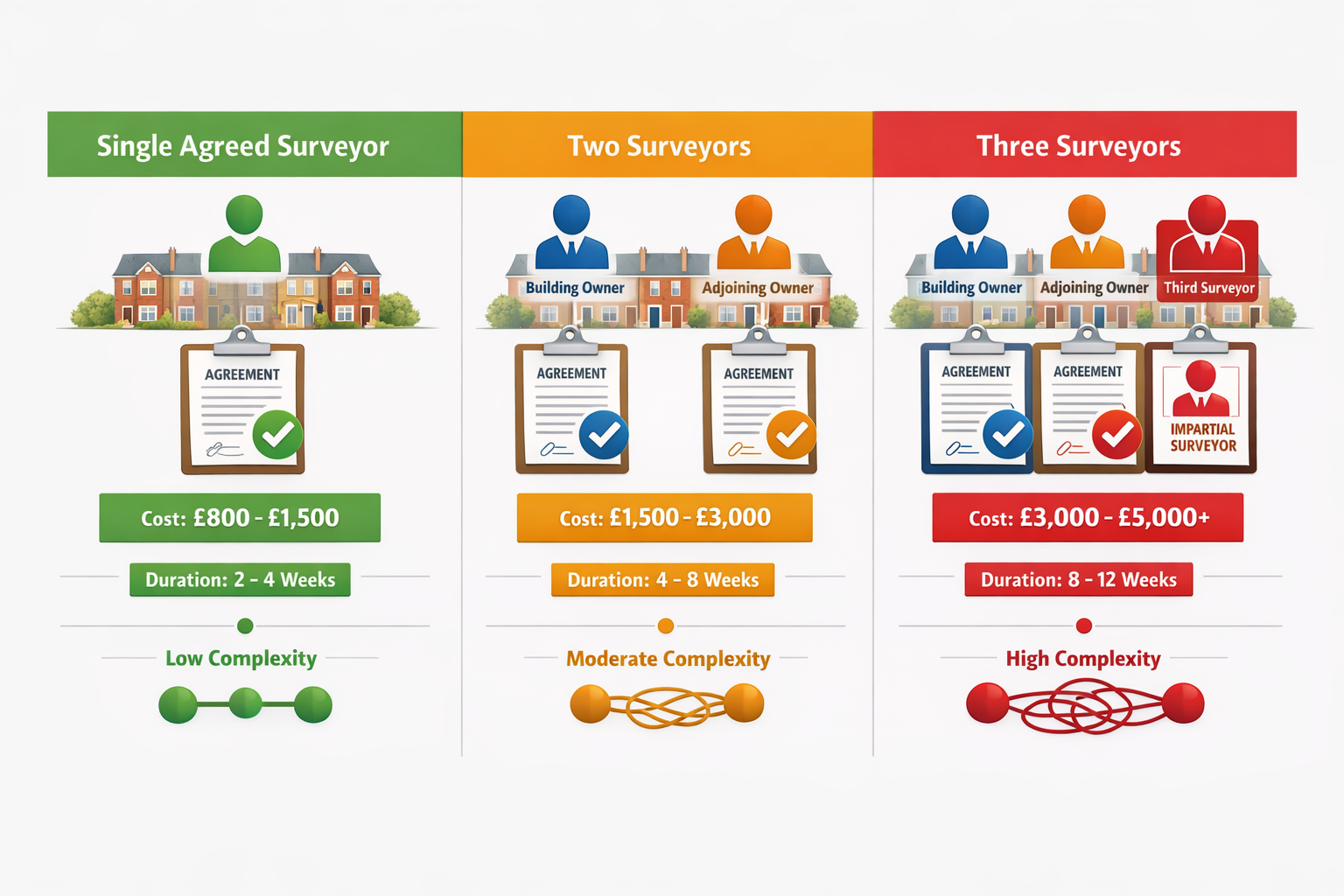
For straightforward projects, a single agreed surveyor arrangement costs between £900 and £2,700[1]. This represents the most economical option available under the Act. The surveyor charges between £100 and £450 per hour, with typical jobs requiring 6-8 hours of professional work[2]. A baseline party wall agreement using this model hovers around £1,500 for standard residential projects[2].
The Two-Surveyor Scenario
When neighbours cannot agree on a single surveyor—or when the adjoining owner prefers independent representation—each party appoints their own surveyor. The building owner's surveyor and the adjoining owner's surveyor then work together to produce a joint party wall award.
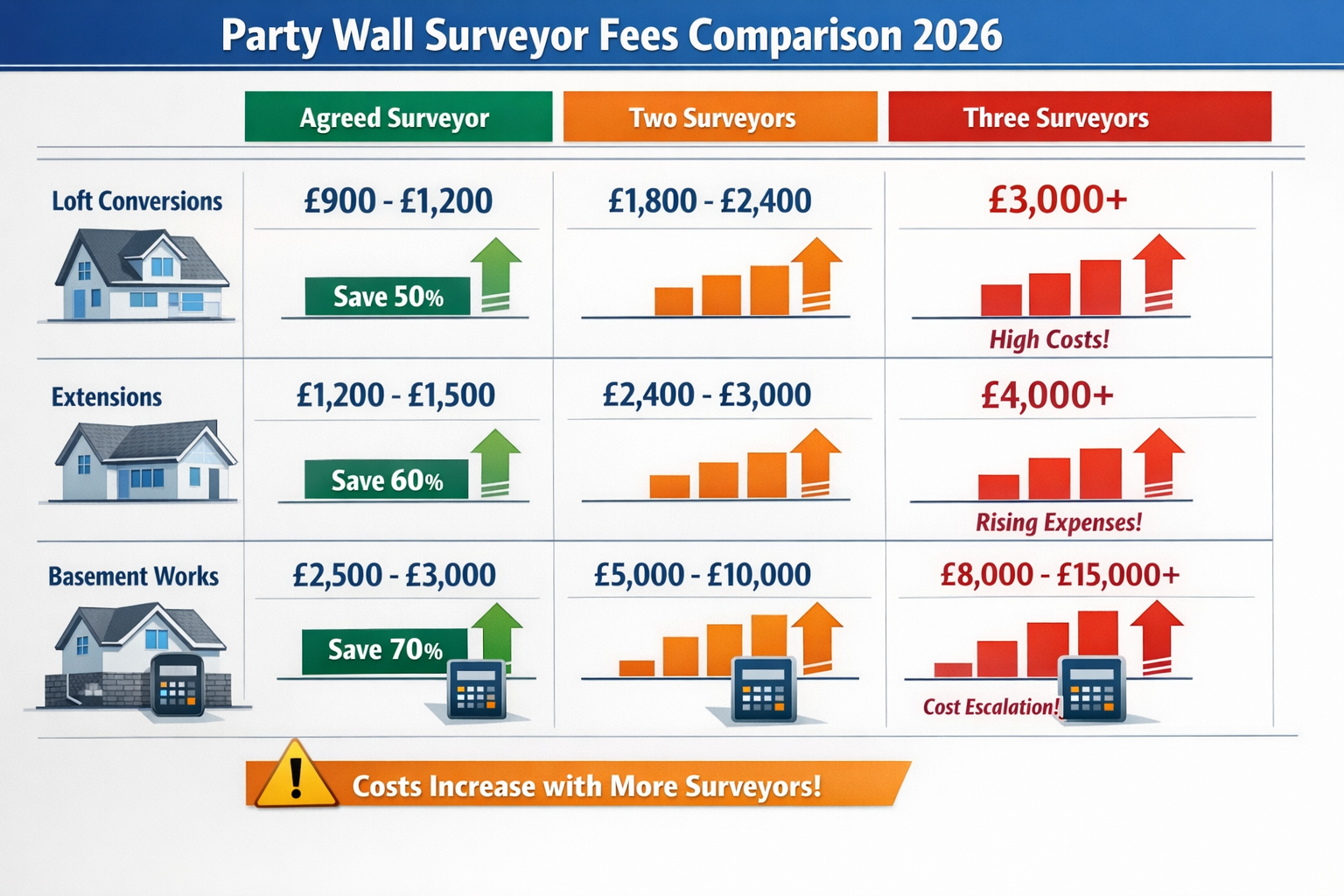
This arrangement typically doubles the costs compared to agreed surveyor scenarios[2]. Loft conversions that cost £900-£1,200 with an agreed surveyor rise to £1,800-£2,400 with two surveyors. Extensions increase from £1,200-£1,500 to £2,400-£3,000. The total range spans £1,800 to £2,700 for standard projects[1], but complex basement works can escalate to £5,000-£10,000[2].
Importantly, under the Party Wall etc. Act 1996, the building owner typically pays all surveyor fees[1], meaning they bear the financial burden of both appointments even when the neighbour insists on separate representation.
The Three-Surveyor Escalation
The most expensive scenario occurs when two appointed surveyors cannot reach agreement on specific matters within the party wall award. At this point, they must jointly appoint a third surveyor to act as an impartial arbitrator on disputed issues[1].
This escalation significantly increases costs beyond the two-surveyor model. Complex baseline projects that might cost £6,000 with two surveyors can potentially exceed £15,000 when a third surveyor becomes involved[2]. The third surveyor's fees, combined with extended timelines and potential legal consultation, create a substantial financial burden that most building owners desperately want to avoid.
Agreed Surveyors vs Three Surveyor Scenarios: Detailed Cost Breakdown for 2026
Understanding the precise financial implications of each surveyor scenario requires examining costs across different project types. The following analysis provides 2026 cost ranges based on current market data and surveyor fee structures.
Cost Comparison by Project Type
| Project Type | Agreed Surveyor | Two Surveyors | Three Surveyors |
|---|---|---|---|
| Loft Conversion | £900 – £1,200[1] | £1,800 – £2,400[2] | £3,000 – £4,500 |
| Single-Story Extension | £1,200 – £1,500[1] | £2,400 – £3,000[2] | £4,000 – £5,500 |
| Two-Story Extension | £1,500 – £2,000 | £3,000 – £4,000 | £5,000 – £7,000 |
| Basement Excavation | £2,500 – £3,000 | £5,000 – £10,000[2] | £8,000 – £15,000+[2] |
| Simple Wall Repairs | £600 – £900 | £1,200 – £1,800 | £2,000 – £3,000 |
Hourly Rate Structures
Party wall surveyors in 2026 charge between £100 and £450 per hour[2], with rates varying based on:
- Geographic location: Surveyors in Central London and West London typically command higher rates than those in East London or North London
- Experience level: Senior chartered surveyors with 15+ years of party wall expertise charge premium rates
- Project complexity: Basement excavations and structural alterations require more specialized knowledge
- Dispute involvement: Contentious cases requiring extensive negotiation increase hourly commitments
Multiple Property Considerations
For projects affecting multiple adjoining properties, costs multiply accordingly. Budget approximately £1,000 per additional owner/surveyor for low to medium-risk projects[2]. A terraced house renovation affecting properties on both sides could therefore require:
- Agreed surveyor model: £1,500 (single surveyor handling both neighbours)
- Two-surveyor model: £3,000 (building owner's surveyor + two adjoining owner surveyors)
- Three-surveyor model: £5,000+ (if disputes arise requiring third-party arbitration)
Hidden Costs and Dispute Premiums
Beyond direct surveyor fees, party wall disputes can add 5-15% to overall construction budgets[3] through:
- ⏰ Delay penalties: Construction timeline extensions while surveyors negotiate
- 📋 Additional documentation: Supplementary schedules of condition and monitoring reports
- ⚖️ Legal consultation: Solicitor involvement when disputes escalate
- 🔧 Remedial works: Additional protective measures required to satisfy concerned neighbours
- 💼 Administrative overhead: Extended project management and coordination efforts
Understanding these comprehensive cost structures helps building owners make informed decisions about party wall surveyor costs before serving their initial party wall notices.
Strategic Decision-Making: When to Choose Each Scenario
Selecting the appropriate surveyor arrangement requires balancing cost considerations against relationship dynamics, project complexity, and risk tolerance. The following strategic framework helps building owners navigate this critical decision in 2026.
When Agreed Surveyors Make Sense
The single agreed surveyor model represents the optimal choice when:
✅ Neighbourly relations are positive: Existing goodwill and trust facilitate joint appointments
✅ Projects are straightforward: Standard loft conversions, extensions, and minor works without unusual complications
✅ Cost control is paramount: Building owners want to minimize expenses while maintaining legal compliance
✅ Timeline efficiency matters: Single surveyors can move faster without inter-surveyor coordination delays
✅ Both parties are reasonable: Neighbours understand the mutual benefits of cost-sharing and cooperation
"Early negotiation with neighbours to agree on a single shared surveyor is identified as the most cost-efficient approach to avoid surveyor doubling and potential third-party involvement."[2]
To maximize success with this approach, building owners should:
- Approach neighbours early before serving formal notices
- Propose experienced, neutral surveyors with strong local reputations
- Emphasize mutual cost savings and efficiency benefits
- Provide reassurance about the surveyor's impartiality obligations
- Consider offering to cover all fees as a goodwill gesture (which is typically required anyway)
For guidance on maintaining positive neighbour relations throughout this process, review our tips on how to keep party wall costs down.
When Two Surveyors Become Necessary
The dual surveyor arrangement becomes appropriate when:
⚠️ Neighbours are cautious or concerned: Adjoining owners want independent professional representation
⚠️ Projects involve significant risk: Basement excavations, substantial structural alterations, or works affecting building stability
⚠️ Previous disputes exist: Historical conflicts make joint appointments impractical
⚠️ Property values are substantial: High-value properties justify the additional expense for independent oversight
⚠️ Technical complexity is high: Specialized works requiring detailed technical assessment and monitoring
⚠️ Neighbours formally dissent: When adjoining owners exercise their right to appoint their own surveyor under the Act
While this scenario doubles costs, it provides important benefits:
- 🛡️ Independent advocacy: Each party has a professional protecting their specific interests
- 📊 Balanced perspectives: Two technical viewpoints can identify issues a single surveyor might miss
- 🤝 Reduced conflict potential: Professional intermediaries manage communications and negotiations
- ✅ Greater neighbour confidence: Independent representation can prevent escalation to disputes
Building owners should budget accordingly and recognize that paying for both surveyors, while expensive, often prevents the far costlier three-surveyor scenario.
Avoiding Three-Surveyor Escalation
The three-surveyor scenario should be avoided whenever possible through:
🎯 Proactive surveyor selection: Choose experienced professionals with strong negotiation skills and dispute resolution track records
🎯 Clear initial instructions: Provide comprehensive project details and documentation to both surveyors from the outset
🎯 Regular communication: Encourage ongoing dialogue between surveyors to address issues before they become disputes
🎯 Reasonable expectations: Avoid unrealistic demands that force surveyors into unresolvable positions
🎯 Professional mediation: If disagreements emerge, consider informal mediation before triggering third surveyor appointment
When three surveyors do become necessary, costs escalate dramatically. The third surveyor's fees, combined with the extended timeline and additional professional involvement, can push total expenses to £8,000-£15,000+ for complex projects[2]. This represents a 150-300% increase over agreed surveyor costs—money that could be better spent on the actual construction work.
Geographic Considerations in London
Location significantly impacts both surveyor availability and strategic considerations. Building owners should consider:
- South London: Higher density of terraced housing increases likelihood of multiple adjoining owners
- Central London: Premium property values may justify two-surveyor arrangements despite higher costs
- Suburban areas: Lower property values and larger plot sizes may favor agreed surveyor economics
Understanding the specific dynamics of your location helps inform the most appropriate surveyor strategy for your circumstances.
Timeline and Process Implications
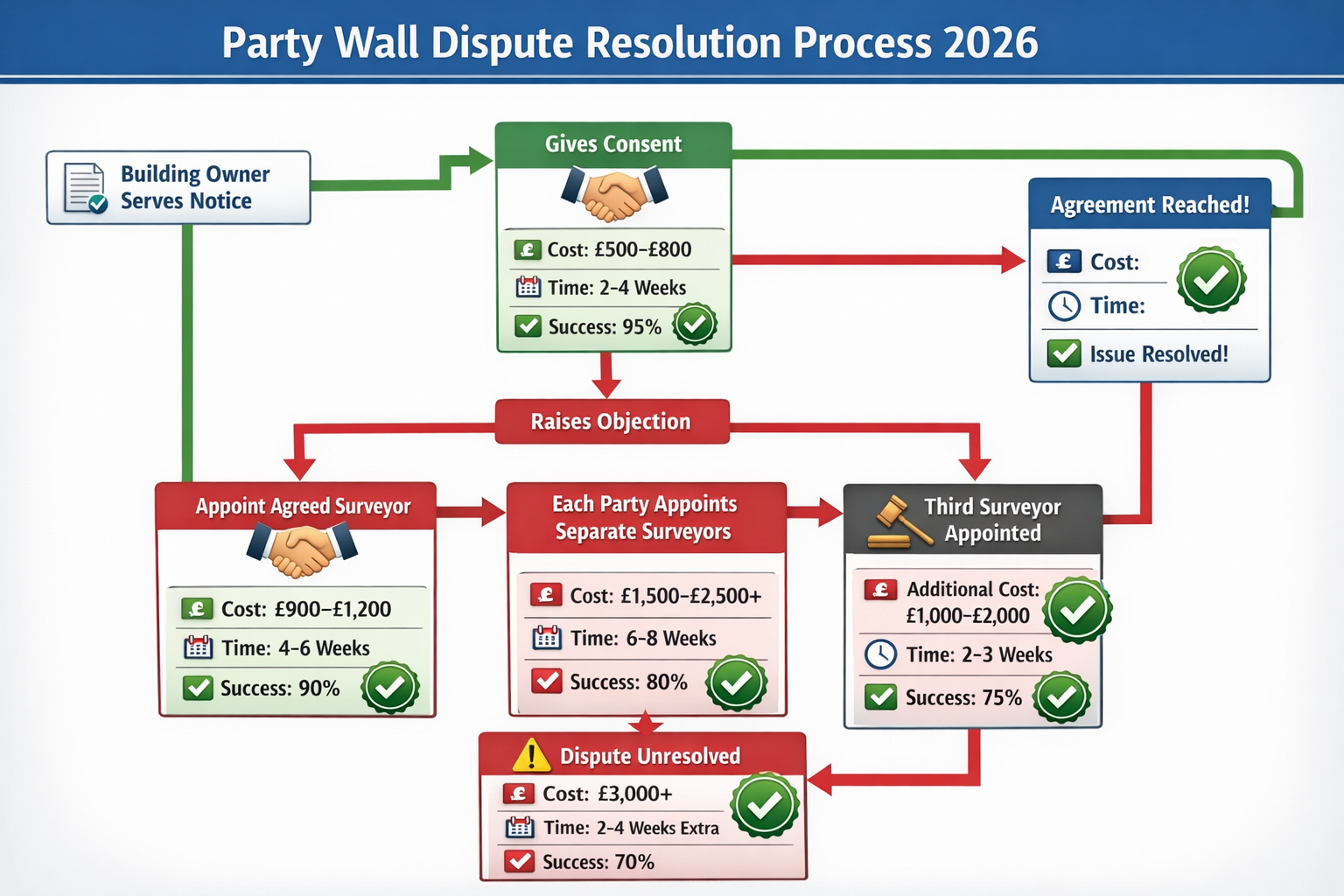
Beyond direct costs, surveyor appointment choices significantly impact project timelines and procedural complexity. Understanding these temporal dimensions helps building owners plan effectively in 2026.
Agreed Surveyor Timeline
The single surveyor process typically follows this timeline:
Week 1-2: Initial appointment and instruction following party wall notice service
Week 3-4: Property inspections and schedule of condition preparation
Week 5-6: Draft award preparation and circulation to both parties
Week 7-8: Final award issuance and commencement authorization
Total duration: 6-8 weeks for straightforward projects
This streamlined timeline allows construction to begin relatively quickly, minimizing holding costs and contractor scheduling complications.
Two-Surveyor Timeline
The dual surveyor arrangement extends timelines due to coordination requirements:
Week 1-2: Separate appointments and individual instructions
Week 3-4: Independent property inspections (may require separate access arrangements)
Week 5-6: Individual schedules of condition preparation
Week 7-9: Inter-surveyor negotiations and draft award development
Week 10-12: Final award agreement and issuance
Total duration: 10-12 weeks for standard projects
The additional 4-6 weeks can impact construction scheduling, contractor availability, and seasonal weather considerations. Building owners should factor these delays into their overall project planning.
Three-Surveyor Timeline
When third surveyor appointment becomes necessary:
Week 1-10: Initial two-surveyor process (as above)
Week 11-12: Identification of disagreement and third surveyor selection
Week 13-15: Third surveyor review of disputed matters
Week 16-18: Third surveyor determination and final award modification
Week 19-20: Award finalization and distribution
Total duration: 16-20+ weeks for disputed projects
This extended timeline can devastate construction schedules, particularly for projects with:
- 🏗️ Foundation work requiring specific weather conditions
- 📅 Time-sensitive permits with expiration dates
- 👷 Contractor availability limited to specific booking windows
- 💰 Financing arrangements with drawdown schedules tied to construction milestones
Practical Recommendations for 2026 Party Wall Projects
Based on the comprehensive cost-benefit analysis of Agreed Surveyors vs Three Surveyor Scenarios: Cost-Benefit Analysis for 2026 Party Wall Disputes, building owners should implement these strategic recommendations:
Before Serving Notice
- Research local surveyors: Identify 2-3 experienced professionals with strong reputations for both technical competence and dispute resolution
- Approach neighbours informally: Discuss your plans before formal notice service to gauge receptiveness
- Propose agreed surveyor: Present the economic and efficiency benefits of joint appointment
- Budget conservatively: Assume two-surveyor costs in your initial budget, treating agreed surveyor savings as a bonus
- Review project complexity: Honestly assess whether your work justifies independent representation
During the Appointment Process
- Provide complete information: Supply comprehensive project details to prevent misunderstandings
- Maintain open communication: Stay accessible to your surveyor and encourage neighbour dialogue
- Be reasonable: Accept legitimate protective measures and monitoring requirements
- Document everything: Keep records of all communications and agreements
- Monitor progress: Regular check-ins with your surveyor prevent surprises
If Disputes Emerge
- Address issues early: Don't let small disagreements escalate into formal disputes
- Consider compromise: Evaluate whether concessions cost less than third surveyor involvement
- Seek professional advice: Consult your surveyor about dispute resolution options
- Understand your rights: Know when to stand firm on legitimate positions
- Calculate escalation costs: Compare dispute costs against compromise alternatives
Cost Optimization Strategies
To minimize party wall expenses while maintaining compliance:
💡 Negotiate agreed surveyors whenever possible—potential savings of 50% or more
💡 Choose experienced professionals who can prevent disputes through skillful negotiation
💡 Provide excellent documentation to reduce surveyor time requirements
💡 Maintain positive neighbour relations to facilitate cooperation
💡 Plan construction carefully to minimize party wall impact where possible
💡 Consider timing to avoid rush fees or premium rates during busy periods
For additional cost-saving strategies, explore our comprehensive guide on types of party wall works and their relative complexity.
Real-World Cost Scenarios
To illustrate the practical implications of surveyor choice, consider these 2026 examples:
Scenario 1: Loft Conversion in Terraced House
Project: Single-story loft conversion affecting party walls on both sides
Option A – Agreed Surveyor: £1,200 total (single surveyor handling both neighbours)
Option B – Two Surveyors: £2,400 total (building owner's surveyor + two adjoining owner surveyors)
Option C – Three Surveyors: £4,200 total (dispute over beam placement requiring third surveyor determination)
Savings: Choosing Option A saves £1,200-£3,000 (50-71% reduction)
Scenario 2: Basement Excavation Under Semi-Detached Property
Project: Full basement excavation requiring underpinning of party wall
Option A – Agreed Surveyor: £2,800 total (complex project with extensive monitoring)
Option B – Two Surveyors: £7,500 total (neighbour insists on independent representation due to structural concerns)
Option C – Three Surveyors: £12,500 total (dispute over underpinning methodology and monitoring frequency)
Savings: Choosing Option A saves £4,700-£9,700 (63-78% reduction)
Scenario 3: Extension Affecting Multiple Properties
Project: Two-story rear extension affecting three adjoining properties
Option A – Agreed Surveyor: £2,000 total (single surveyor managing all three neighbours)
Option B – Two Surveyors: £5,000 total (building owner's surveyor + three separate adjoining owner surveyors)
Option C – Three Surveyors: £8,500 total (one neighbour's surveyor disputes foundation design)
Savings: Choosing Option A saves £3,000-£6,500 (60-76% reduction)
These real-world examples demonstrate the substantial financial impact of surveyor appointment decisions, reinforcing the value of early negotiation and strategic planning.
Conclusion
The Agreed Surveyors vs Three Surveyor Scenarios: Cost-Benefit Analysis for 2026 Party Wall Disputes reveals a clear financial hierarchy: agreed surveyors offer the most economical solution (£900-£2,700 for standard projects), two-surveyor arrangements double these costs (£1,800-£10,000), and three-surveyor escalations can exceed £15,000 for complex basement works[1][2]. With party wall disputes adding 5-15% to overall construction budgets[3], choosing the right surveyor strategy at the outset isn't merely a procedural decision—it's a critical financial planning element that can save thousands of pounds.
The evidence overwhelmingly supports early negotiation with neighbours to appoint a single agreed surveyor whenever possible. This approach delivers not only substantial cost savings of 50% or more but also faster timelines, reduced complexity, and better preservation of neighbourly relationships. Building owners who invest time in pre-notice discussions and present the mutual benefits of joint appointments position themselves for optimal outcomes.
However, when project complexity, property values, or neighbour concerns justify independent representation, the two-surveyor model provides important protections worth the additional expense. The key is making this decision strategically rather than defaulting into it through poor planning or communication failures.
Next Steps for Building Owners
If you're planning construction work affecting party walls in 2026:
- ✅ Review your project scope and assess complexity level
- ✅ Research qualified surveyors in your area with strong dispute resolution records
- ✅ Approach neighbours early before formal notice service
- ✅ Propose agreed surveyor appointment emphasizing mutual benefits
- ✅ Budget conservatively assuming two-surveyor costs as your baseline
- ✅ Consult professionals for complex projects or challenging neighbour dynamics
- ✅ Document everything throughout the process
For expert guidance on navigating party wall procedures and minimizing costs while maintaining full legal compliance, consider consulting with experienced professionals who understand the nuances of the Party Wall etc. Act 1996 and can help you avoid the costly three-surveyor scenario entirely.
The choice between agreed surveyors and multiple surveyor scenarios will significantly impact your project's budget, timeline, and stress level. Make it wisely, make it early, and make it strategically—your construction budget will thank you.
References
[1] Party Wall Surveyor Cost – https://hoa.org.uk/advice/guides-for-homeowners/i-am-improving/party-wall-surveyor-cost/
[2] Party Wall Surveyor Cost Analysis How Much Does A Party Wall Agreement Cost – https://www.surveymerchant.com/blog/party-wall-surveyor-cost-analysis-how-much-does-a-party-wall-agreement-cost
[3] Party Wall Surveys For Data Centre Expansions Navigating Agreements In The 2026 Investment Surge – https://nottinghillsurveyors.com/blog/party-wall-surveys-for-data-centre-expansions-navigating-agreements-in-the-2026-investment-surge