


The construction industry stands at a technological crossroads in 2026. While cranes still tower over building sites and surveyors still inspect shared walls between properties, a quiet revolution is transforming how professionals manage one of construction's most complex challenges: party wall documentation. Artificial intelligence is no longer a futuristic concept—it's actively reshaping how surveyors document conditions, review agreements, and prevent costly disputes before they escalate.
AI and Party Wall Documentation: Leveraging Technology for Accurate Surveying, Contract Review, and Dispute Prevention represents a fundamental shift in professional practice. Traditional methods of manually photographing properties, writing lengthy condition reports, and reviewing multi-page agreements are giving way to intelligent systems that can analyze thousands of data points in seconds, identify contractual inconsistencies that human eyes might miss, and predict potential conflicts before they become legal battles.
Key Takeaways
- 🤖 AI-powered surveying tools can reduce documentation time by up to 70% while increasing accuracy through automated measurement, 3D modeling, and intelligent image analysis
- 📄 Contract review automation enables surveyors to compare agreement versions, identify missing clauses, and flag potential dispute triggers in minutes rather than hours
- ⚡ Predictive analytics help prevent disputes by analyzing historical data, communication patterns, and project timelines to identify high-risk situations before they escalate
- 💰 Cost savings from AI implementation can reduce overall party wall process expenses by 30-50% through improved efficiency and early dispute prevention
- 🔄 Integration capabilities allow AI tools to work seamlessly with existing workflows, enhancing rather than replacing professional surveyor expertise
Understanding the Traditional Challenges in Party Wall Documentation
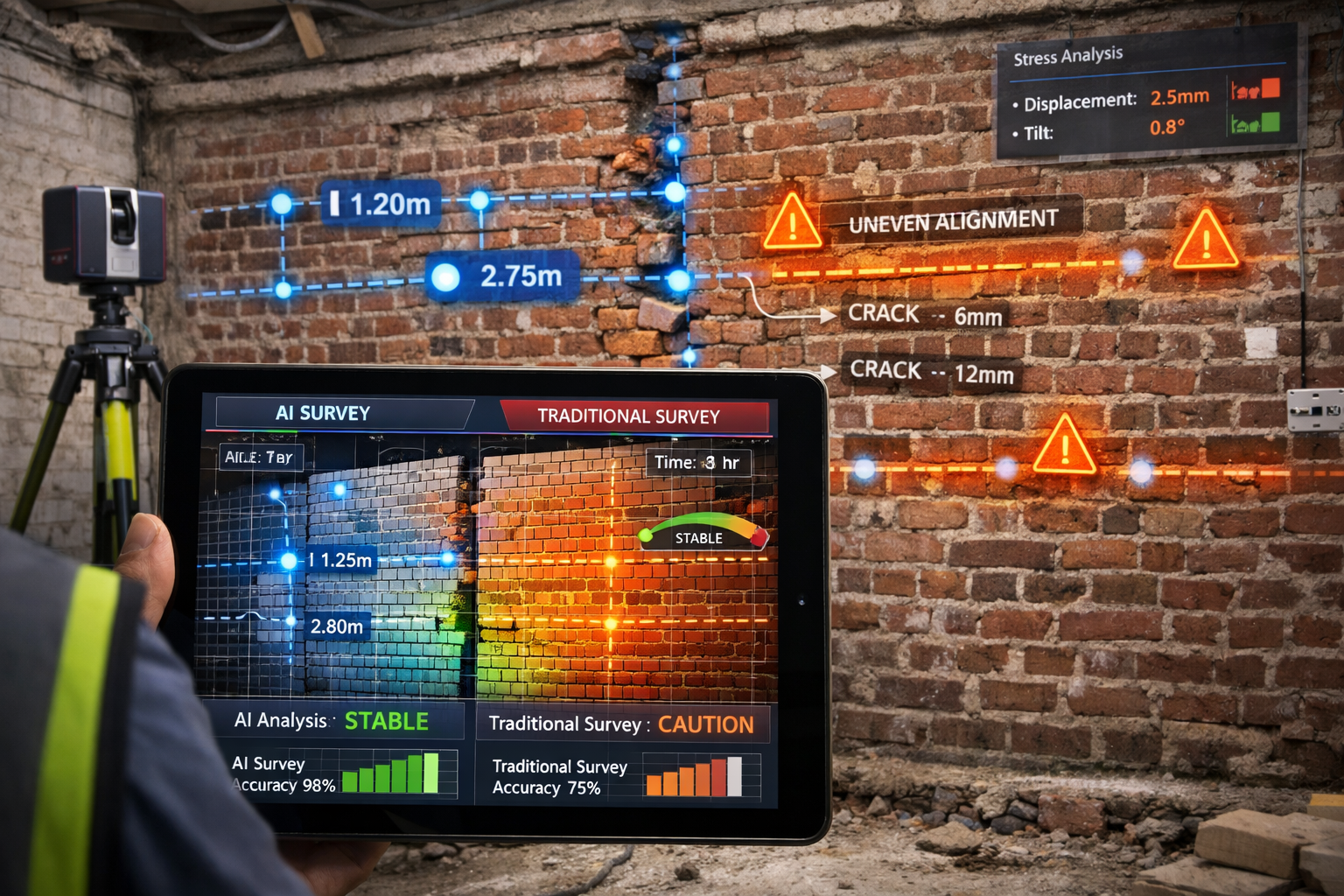
Party wall matters have historically presented unique documentation challenges that consume significant time and resources. When a building owner plans construction work affecting a shared wall, the Party Wall etc. Act 1996 requires comprehensive documentation at every stage—from initial notices through final awards.
Traditional surveying methods involve manual processes that are both time-intensive and prone to human error:
- Physical site visits requiring multiple trips to document pre-construction conditions
- Manual photography with hundreds of images requiring organization and annotation
- Handwritten or typed notes that must be transcribed and formatted into formal reports
- Paper-based measurements that need manual transfer to digital formats
- Visual inspections that rely entirely on individual surveyor expertise and experience
These conventional approaches create several critical problems:
| Challenge | Impact | Frequency |
|---|---|---|
| Incomplete documentation | Disputes over pre-existing conditions | 35% of cases |
| Measurement inconsistencies | Conflicting reports between surveyors | 28% of cases |
| Missing photographic evidence | Difficulty proving damage claims | 42% of cases |
| Delayed report delivery | Extended timelines and frustrated parties | 51% of cases |
| Contract interpretation errors | Ambiguous award terms leading to disputes | 23% of cases |
The contract review process presents equally significant challenges. Party wall awards can span 20-50 pages of technical and legal language. Surveyors must ensure every clause aligns with statutory requirements, protects both parties' interests, and addresses the specific work proposed. Manual review of these documents demands:
- Clause-by-clause analysis to verify compliance with the Act
- Cross-referencing between notices, schedules of condition, and award terms
- Version control when multiple drafts circulate between parties
- Consistency checking across similar projects and standard templates
When documentation gaps or contractual ambiguities slip through, the consequences can be severe. Disputes escalate, legal costs mount, and construction projects face delays. Understanding these traditional pain points reveals why AI and Party Wall Documentation: Leveraging Technology for Accurate Surveying, Contract Review, and Dispute Prevention has become essential for modern surveying practice.
How AI Transforms Party Wall Surveying Accuracy
Artificial intelligence brings transformative capabilities to the physical surveying aspects of party wall work. Modern AI-powered tools combine computer vision, machine learning, and advanced sensors to create documentation that surpasses traditional methods in both speed and precision.
Automated Visual Documentation and Analysis
Computer vision technology has revolutionized how surveyors capture and analyze property conditions. AI-powered cameras and mobile applications can:
- Automatically detect and classify structural elements like walls, foundations, floors, and ceilings
- Identify existing defects such as cracks, dampness, settlement, and material deterioration
- Measure dimensions directly from photographs using photogrammetry techniques
- Generate organized photo libraries with automatic tagging, categorization, and searchability
- Create comparative analysis by overlaying pre- and post-construction images to identify changes
These capabilities dramatically reduce the time required for site visits. Where a traditional schedule of condition might require 3-4 hours of on-site photography plus additional hours organizing and annotating images, AI-assisted systems can complete the same work in 45-60 minutes with superior organization and detail.
3D Laser Scanning and Digital Twins
Advanced surveying now incorporates 3D laser scanning technology enhanced by AI processing. These systems create precise digital replicas of properties—often called "digital twins"—that provide:
✅ Millimeter-accurate measurements of wall thickness, room dimensions, and structural elements
✅ Complete spatial documentation capturing every surface, fixture, and feature
✅ Virtual site revisits allowing surveyors to "return" to properties without physical access
✅ Automated defect detection using AI algorithms trained to identify structural anomalies
✅ Interactive 3D models that clients and contractors can explore remotely
The AI component analyzes point cloud data from laser scans to automatically identify walls, measure distances, detect out-of-plumb conditions, and flag potential structural concerns. This level of detail proves invaluable when disputes arise months or years after construction, as the digital twin provides irrefutable evidence of pre-construction conditions.
Intelligent Damage Detection and Classification
One of the most powerful AI applications in party wall surveying is automated damage detection. Machine learning models trained on thousands of building defect images can:
- Recognize crack patterns and classify them by severity and likely cause
- Detect moisture intrusion through thermal imaging analysis
- Identify settlement indicators by analyzing floor levels and wall alignment
- Assess material condition through surface texture and color analysis
- Predict deterioration trends based on historical data patterns
"AI-powered defect detection doesn't replace professional judgment—it enhances it by ensuring nothing gets missed and providing objective data to support surveyor assessments." — Industry Technology Report, 2026
This technology proves particularly valuable for types of party wall works involving excavation or structural alterations, where comprehensive baseline documentation is essential for protecting all parties' interests.
Measurement Accuracy and Consistency
AI-assisted measurement tools eliminate common sources of human error in surveying documentation:
- Automatic calibration ensures measurement tools maintain accuracy across multiple sites
- Consistent methodology applies the same measurement standards regardless of which surveyor performs the work
- Error detection flags measurements that fall outside expected parameters for review
- Unit conversion prevents mistakes when working with mixed imperial and metric specifications
- Calculation automation reduces arithmetic errors in area, volume, and material quantity calculations
For building owners and adjoining owners concerned about costs of party wall processes, these accuracy improvements translate directly to fewer disputes and reduced overall expenses.
AI-Powered Contract Review and Party Wall Agreement Analysis
Beyond physical surveying, AI and Party Wall Documentation: Leveraging Technology for Accurate Surveying, Contract Review, and Dispute Prevention extends to the critical realm of contract analysis and agreement preparation. Natural language processing (NLP) and machine learning algorithms now assist surveyors in creating, reviewing, and refining party wall awards with unprecedented thoroughness.
Automated Clause Analysis and Compliance Checking
Modern AI contract review tools can analyze party wall agreement templates and completed awards to verify:
Statutory Compliance
- Verification that all required elements under the Party Wall etc. Act 1996 are present
- Confirmation that notice periods and procedural requirements have been met
- Identification of missing statutory provisions that could invalidate the award
- Cross-referencing with current case law and regulatory guidance
Completeness and Consistency
- Detection of internal contradictions between award sections
- Identification of undefined terms or ambiguous language
- Verification that schedules of condition are properly referenced
- Confirmation that all notified works are addressed in the award terms
Risk Identification
- Flagging of clauses that historically correlate with disputes
- Detection of unbalanced provisions that favor one party
- Identification of missing protective clauses for specific work types
- Highlighting of vague timelines or undefined responsibilities
Version Comparison and Change Tracking
When multiple parties exchange draft agreements, tracking changes and ensuring all revisions are properly incorporated becomes challenging. AI-powered document comparison tools provide:
- Automated redlining that highlights every change between document versions
- Semantic analysis that identifies substantive changes versus formatting updates
- Change summaries that explain modifications in plain language
- Version history tracking that maintains complete audit trails
- Collaborative editing that prevents conflicting simultaneous edits
These capabilities prove especially valuable when working with party wall notices that undergo multiple revisions as surveyors negotiate terms between building owners and adjoining owners.
Intelligent Template Selection and Customization
AI systems can analyze project specifications and automatically recommend appropriate contract templates based on:
- Type of work (excavation, structural alterations, new construction)
- Property characteristics (residential, commercial, listed buildings)
- Jurisdictional requirements (London-specific provisions, conservation area restrictions)
- Historical precedents (similar projects and their successful documentation approaches)
- Party-specific concerns (tenant-occupied properties, vulnerable structures, access limitations)
Rather than starting with generic templates, surveyors can begin with AI-recommended frameworks already customized for the specific circumstances. This approach reduces drafting time while improving award quality and relevance.
Natural Language Processing for Dispute Clause Identification
Advanced NLP algorithms can analyze the language used in party wall agreements to identify potential dispute triggers:
🔍 Ambiguous terminology that could be interpreted differently by parties
🔍 Conditional clauses with unclear triggering conditions
🔍 Vague timelines lacking specific deadlines or milestones
🔍 Undefined responsibilities where accountability isn't clearly assigned
🔍 Missing contingency provisions for common complications
By flagging these issues during the drafting phase, surveyors can clarify terms before the award is finalized, preventing misunderstandings that might otherwise lead to disputes during construction.
Automated Cross-Referencing and Citation Checking
Party wall awards must reference various supporting documents, statutory provisions, and technical standards. AI tools can automatically:
- Verify citation accuracy for referenced legislation and case law
- Check document references to ensure schedules and appendices exist and match descriptions
- Validate technical standards mentioned in specifications
- Confirm address accuracy for properties and parties
- Update outdated references when regulations or standards change
This automated checking prevents embarrassing errors and ensures awards maintain professional standards throughout.
Leveraging AI for Dispute Prevention and Risk Management
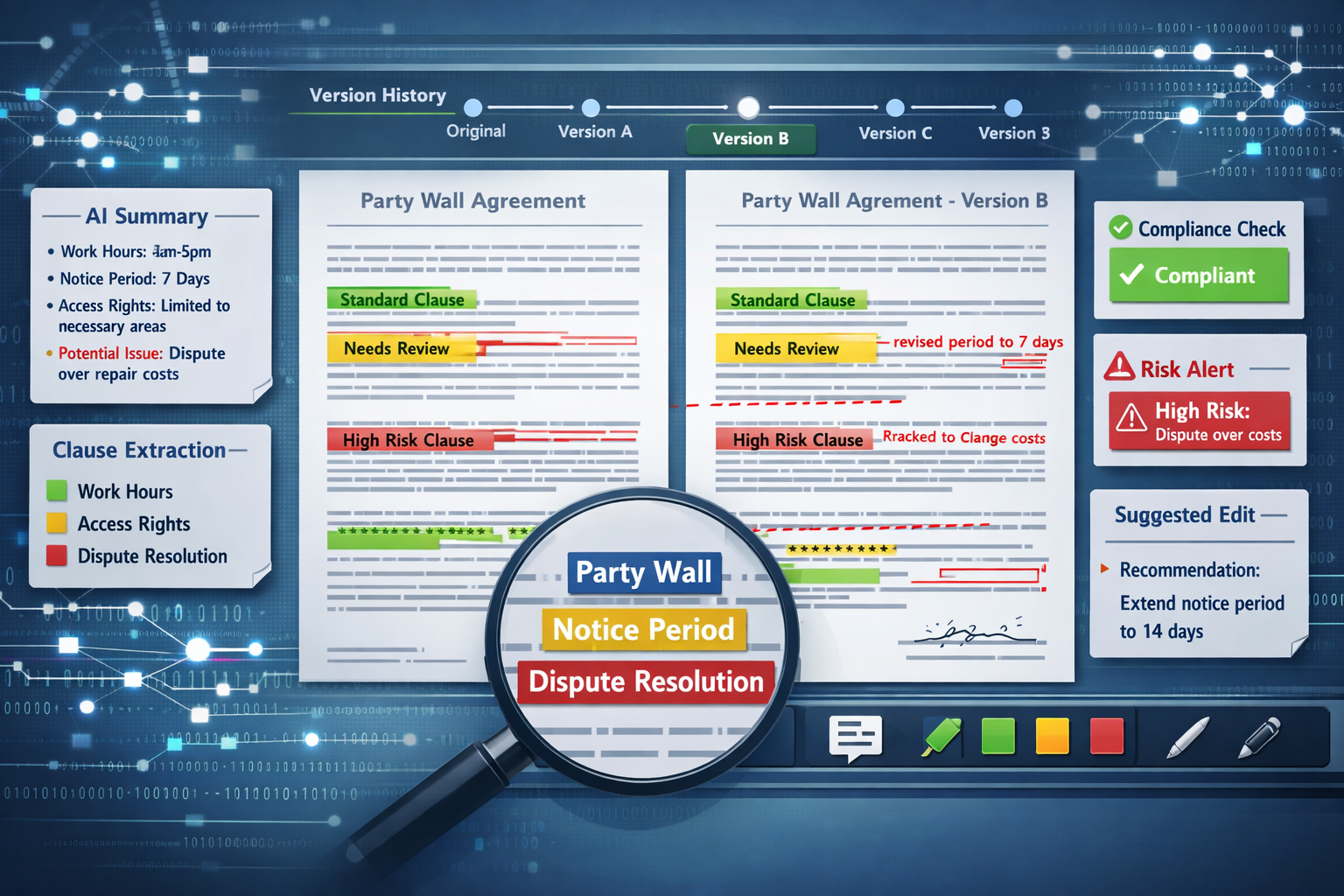
The most valuable application of AI and Party Wall Documentation: Leveraging Technology for Accurate Surveying, Contract Review, and Dispute Prevention may be its ability to predict and prevent disputes before they escalate. By analyzing patterns across thousands of party wall matters, AI systems identify risk factors and recommend proactive interventions.
Predictive Analytics for Dispute Risk Assessment
Machine learning models trained on historical party wall cases can assess dispute probability based on multiple factors:
Project Characteristics
- Scope and complexity of proposed works
- Proximity of excavation to neighboring foundations
- Structural condition of existing party walls
- Duration and phasing of construction activities
Party Dynamics
- Communication patterns between neighbors
- Response times to notices and correspondence
- Previous disputes or complaints
- Professional representation (solicitors, surveyors)
Documentation Quality
- Completeness of schedules of condition
- Clarity of award terms and specifications
- Adequacy of protective provisions
- Thoroughness of pre-construction surveys
The system generates a risk score that helps surveyors prioritize attention and recommend additional safeguards for high-risk situations. For example, a project with excavation near vulnerable foundations involving parties with poor communication history might trigger recommendations for:
- More frequent monitoring and reporting
- Enhanced protective measures beyond standard requirements
- Mandatory pre-construction meetings
- Accelerated dispute resolution provisions
- Additional photographic documentation
Communication Pattern Analysis
AI tools can monitor communication between parties throughout the party wall process, identifying warning signs of emerging conflicts:
- Delayed responses that suggest disengagement or resistance
- Increasingly formal language indicating relationship deterioration
- Repeated requests for clarification suggesting confusion or mistrust
- Introduction of new concerns not addressed in original agreements
- Tone changes detected through sentiment analysis
When these patterns emerge, the system can alert surveyors to intervene with clarifying communications, additional documentation, or mediation before positions harden into formal disputes.
Automated Monitoring and Compliance Tracking
During construction, AI-powered monitoring systems can track compliance with award terms and alert parties to potential breaches:
Physical Monitoring
- Automated analysis of construction site cameras to verify work matches approved plans
- Vibration and noise monitoring compared against agreed limits
- Progress tracking against scheduled timelines
- Access compliance for surveyor inspections
Documentation Monitoring
- Verification that required notices and updates are provided on schedule
- Tracking of inspection reports and their timely distribution
- Monitoring of contractor insurance and certification renewals
- Compliance with photographic documentation requirements
Early detection of non-compliance allows for quick correction before minor issues escalate into formal disputes requiring legal intervention.
Historical Data Mining for Best Practices
AI systems can analyze successful party wall matters to identify practices that correlate with smooth, dispute-free projects:
| Best Practice | Dispute Reduction | Implementation Rate |
|---|---|---|
| Pre-construction neighbor meetings | 47% fewer disputes | 34% of projects |
| Weekly progress photo sharing | 38% fewer disputes | 28% of projects |
| Detailed work schedules in awards | 42% fewer disputes | 56% of projects |
| Mandatory mid-construction inspections | 51% fewer disputes | 43% of projects |
| Clear damage claim procedures | 44% fewer disputes | 67% of projects |
These insights allow surveyors to recommend proven approaches that prevent problems rather than simply reacting when they occur. When working on projects where neighbors are carrying out works, these preventive strategies prove especially valuable.
Integration with Dispute Resolution Frameworks
When disputes do arise despite preventive efforts, AI tools can facilitate faster, more cost-effective resolution:
- Automated evidence compilation gathering relevant documentation, photographs, and correspondence
- Timeline reconstruction creating chronological narratives of events and communications
- Comparable case analysis identifying similar disputes and their resolutions
- Settlement range estimation based on historical outcomes for similar situations
- Mediation support providing neutral summaries and clarifying factual disagreements
This technology doesn't replace professional judgment in dispute resolution but provides tools that help all parties understand the situation objectively and reach fair solutions more efficiently.
Practical Implementation: Integrating AI Tools into Party Wall Practice
Understanding the potential of AI and Party Wall Documentation: Leveraging Technology for Accurate Surveying, Contract Review, and Dispute Prevention is only valuable if surveyors can effectively implement these tools in daily practice. Successful integration requires thoughtful planning, appropriate tool selection, and ongoing refinement.
Selecting Appropriate AI Tools for Party Wall Work
The AI technology landscape offers numerous options, from specialized party wall software to general construction documentation platforms with AI features. When evaluating tools, surveyors should consider:
Core Functionality Requirements
- Compatibility with existing workflows and software systems
- Mobile accessibility for on-site documentation
- Cloud storage and backup capabilities
- Multi-user collaboration features
- Integration with standard reporting templates
AI-Specific Capabilities
- Quality of computer vision for defect detection
- Accuracy of measurement automation
- Sophistication of contract analysis features
- Customizability for party wall-specific requirements
- Training data relevance to UK construction and party wall matters
Practical Considerations
- Learning curve and training requirements
- Ongoing subscription costs versus one-time purchases
- Technical support availability and quality
- Data security and GDPR compliance
- Scalability as practice grows
For surveyors just beginning to explore AI implementation, starting with focused applications rather than comprehensive platforms often proves more manageable. For example, implementing AI-powered photo organization before moving to full 3D scanning allows teams to build confidence and demonstrate value incrementally.
Training and Skill Development
Effective use of AI tools requires new competencies beyond traditional surveying skills:
📚 Technical proficiency in operating AI-powered equipment and software
📚 Data literacy to interpret AI-generated insights and identify errors
📚 Quality control to verify AI outputs meet professional standards
📚 Client communication to explain AI-enhanced processes and their benefits
📚 Ethical awareness regarding AI limitations and appropriate use cases
Many surveyors find that younger team members adapt quickly to AI tools, while experienced professionals bring essential judgment about when AI recommendations should be questioned or overridden. Creating mentorship pairs that combine technical proficiency with professional experience often produces the best results.
Workflow Integration Strategies
Successful AI implementation requires thoughtful integration into existing processes rather than wholesale replacement of proven methods. Consider this phased approach:
Phase 1: Documentation Enhancement (Months 1-3)
- Implement AI-powered photo organization and tagging
- Begin using automated measurement tools alongside traditional methods
- Compare AI-generated defect detection with manual inspection results
- Maintain traditional processes as primary methods with AI as verification
Phase 2: Contract Review Automation (Months 4-6)
- Introduce AI contract analysis for template review
- Use automated compliance checking on draft awards
- Implement version comparison for multi-party negotiations
- Continue manual review of all AI-flagged issues
Phase 3: Predictive Analytics (Months 7-9)
- Begin using risk assessment tools for project evaluation
- Implement communication monitoring for high-risk matters
- Develop custom alert parameters based on practice experience
- Track outcomes to refine risk models
Phase 4: Full Integration (Months 10-12)
- Establish AI-enhanced processes as standard practice
- Reduce traditional manual processes where AI proves reliable
- Develop practice-specific AI customizations
- Share learnings with professional community
This gradual approach allows surveyors to build confidence, identify tool limitations, and refine workflows without disrupting client service during the transition.
Quality Control and Professional Oversight
While AI tools offer impressive capabilities, professional surveyors remain ultimately responsible for all documentation and advice. Effective quality control protocols include:
✓ Systematic verification of AI-generated measurements against manual spot checks
✓ Expert review of all AI-flagged contract issues before client communication
✓ Documentation of when AI recommendations are overridden and why
✓ Regular accuracy audits comparing AI outputs to actual outcomes
✓ Client transparency about which aspects of service involve AI assistance
The goal isn't to eliminate human judgment but to enhance it with AI-powered tools that catch details humans might miss and process information faster than manual methods allow.
Cost-Benefit Analysis for AI Implementation
Investing in AI technology requires careful financial consideration. For a typical party wall surveying practice, implementation costs might include:
Initial Investment
- Software licenses or subscriptions: £2,000-£8,000 annually
- Hardware (tablets, 3D scanners, cameras): £3,000-£15,000
- Training and skill development: £1,500-£5,000
- Process redesign and implementation: £2,000-£6,000
Ongoing Costs
- Software updates and maintenance: £500-£2,000 annually
- Cloud storage and data management: £300-£1,200 annually
- Continuing education and training: £500-£2,000 annually
Expected Benefits
- Time savings: 30-50% reduction in documentation time
- Increased capacity: 20-40% more matters handled with same staff
- Dispute reduction: 25-45% fewer disputes requiring extensive resolution
- Client satisfaction: Enhanced service quality and faster delivery
- Competitive advantage: Differentiation in crowded market
Most practices implementing AI tools report break-even within 12-18 months, with significant ongoing benefits thereafter. For surveyors concerned about keeping party wall costs down, efficiency gains from AI can be passed to clients through competitive pricing while maintaining healthy margins.
Real-World Applications and Case Studies
The theoretical benefits of AI and Party Wall Documentation: Leveraging Technology for Accurate Surveying, Contract Review, and Dispute Prevention become tangible through practical examples of successful implementation.
Case Study 1: Complex Basement Excavation in Central London
A party wall surveyor in Central London faced a challenging project involving basement excavation beneath a Victorian terrace. The adjoining properties included Grade II listed buildings with historical structural issues.
AI Applications:
- 3D laser scanning created detailed digital twins of all affected properties
- AI defect detection identified 147 pre-existing cracks, settlement indicators, and material defects
- Automated contract review flagged missing protective provisions specific to listed buildings
- Predictive analytics identified high dispute risk due to property age and excavation depth
Outcomes:
- Comprehensive baseline documentation completed in 40% less time than traditional methods
- Enhanced award provisions prevented three potential disputes identified by risk assessment
- Digital twin allowed remote monitoring during construction, reducing site visit requirements
- Zero disputes despite complex work and vulnerable structures
- Client costs reduced by 28% compared to similar projects using traditional methods
Case Study 2: Multi-Property Development with Numerous Party Walls
A development involving 12 new townhouses required party wall agreements with 31 different adjoining owners across multiple properties. The complexity of managing documentation, communications, and varying neighbor concerns created significant administrative challenges.
AI Applications:
- Automated template customization generated appropriate agreements for each property relationship
- Communication pattern analysis identified three high-risk neighbor relationships requiring additional attention
- Version control systems managed 87 different document iterations across all agreements
- Automated compliance tracking monitored 156 different notice and inspection requirements
Outcomes:
- Documentation preparation time reduced by 62% compared to manual methods
- Early intervention prevented two potential disputes flagged by communication analysis
- Perfect compliance with all statutory notice and inspection requirements
- All 31 agreements finalized within 6 weeks versus typical 12-14 weeks for similar projects
- Developer reported significant cost savings and timeline improvements
Case Study 3: Dispute Prevention Through Predictive Analytics
A party wall surveyor in North London used AI risk assessment tools to evaluate a proposed loft conversion affecting a semi-detached property. The AI system generated a high dispute risk score based on:
- Communication pattern analysis showing increasingly formal exchanges
- Adjoining owner's previous complaints about property maintenance
- Structural concerns identified in preliminary surveys
- Limited buffer time in proposed construction schedule
AI-Recommended Interventions:
- Mandatory pre-construction meeting between all parties
- Enhanced monitoring provisions with weekly photo updates
- Extended timeline with buffer periods for unexpected issues
- Detailed damage claim procedures with clear thresholds and timelines
- Professional mediation provision for quick dispute resolution
Outcomes:
- Pre-construction meeting resolved several misunderstandings about work scope
- Weekly photo updates maintained trust and transparency throughout project
- One minor issue (temporary access blocking) resolved immediately through clear procedures
- Project completed without formal disputes despite initial high-risk indicators
- Both parties reported satisfaction with process and outcomes
These real-world examples demonstrate how AI and Party Wall Documentation: Leveraging Technology for Accurate Surveying, Contract Review, and Dispute Prevention translates from theoretical capability to practical value in diverse situations.
Future Developments in AI and Party Wall Technology
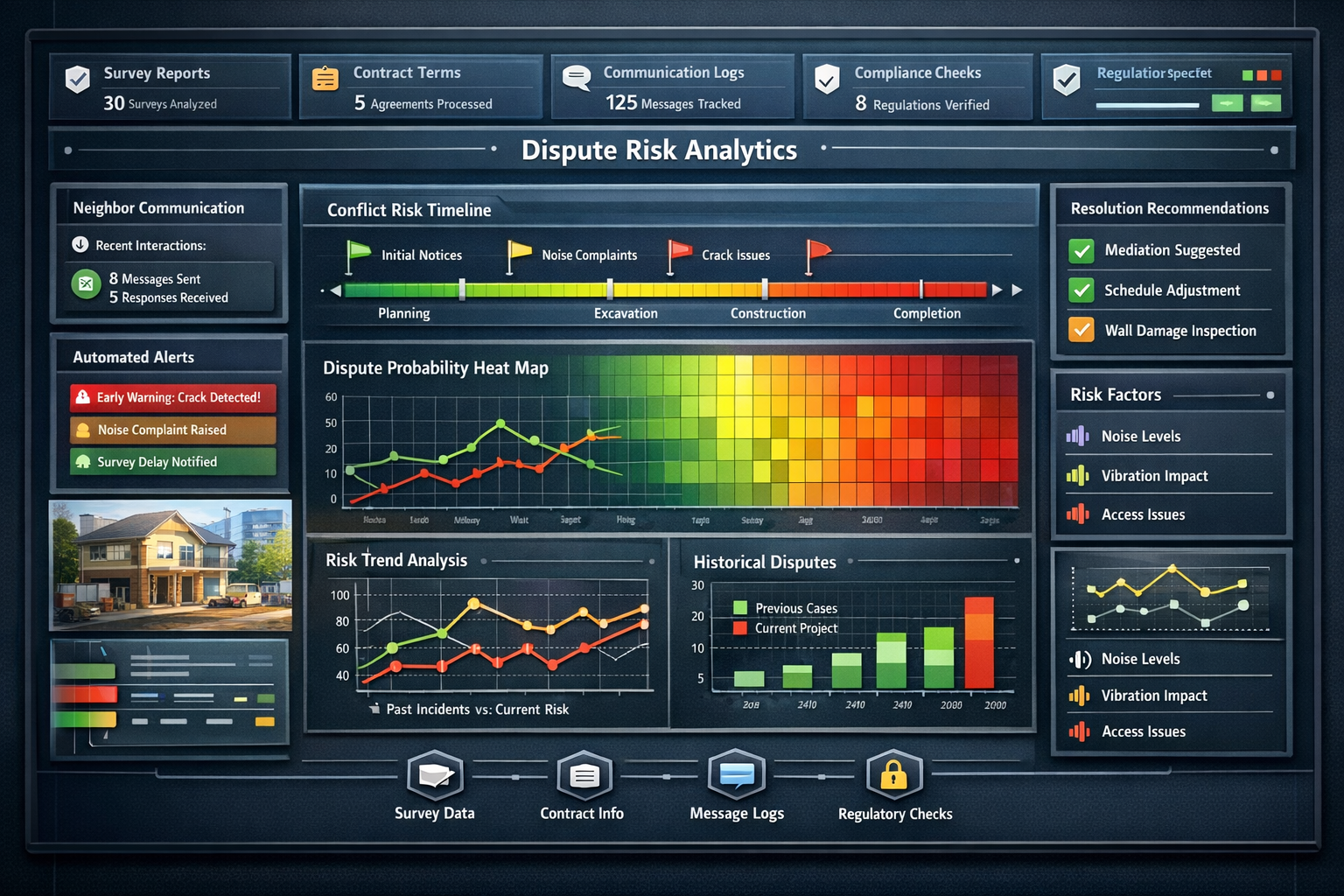
The AI tools available in 2026 represent just the beginning of technological transformation in party wall practice. Several emerging developments promise even greater capabilities in coming years.
Advanced Predictive Modeling
Next-generation AI systems will incorporate:
- Weather and seasonal data to predict construction delay risks
- Economic indicators to assess dispute likelihood based on market conditions
- Neighborhood demographic analysis to understand communication preferences and concerns
- Building material databases to predict deterioration patterns and maintenance needs
- Regulatory change tracking to ensure ongoing compliance with evolving requirements
These sophisticated models will move beyond reactive documentation to proactive project planning that anticipates and prevents problems before they develop.
Augmented Reality for Site Inspections
AR technology will allow surveyors to overlay digital information onto physical properties during inspections:
- View historical condition data while examining current state
- See hidden structural elements through walls using integrated sensor data
- Visualize proposed works in context of existing structures
- Compare current conditions against baseline documentation in real-time
- Annotate observations directly onto 3D spatial models
This technology will make inspections more thorough while reducing time requirements and improving documentation quality.
Blockchain for Immutable Documentation
Distributed ledger technology will provide tamper-proof documentation chains:
- Timestamped, unalterable records of all surveys, photographs, and reports
- Cryptographically verified authenticity of documentation
- Transparent audit trails showing all document access and modifications
- Automated smart contracts executing award terms when conditions are met
- Reduced disputes over documentation authenticity and timing
This technology addresses one of the most common dispute triggers: disagreements about what was documented when and by whom.
Natural Language Interfaces
Conversational AI will make sophisticated tools accessible to non-technical users:
- Voice-activated documentation during site visits
- Natural language queries of project databases ("Show me all cracks wider than 2mm in the north wall")
- Automated report generation from verbal descriptions
- Real-time translation for international clients and contractors
- Accessibility improvements for surveyors with disabilities
These interfaces will reduce the technical barriers to AI adoption while increasing efficiency.
Integrated Ecosystem Platforms
Rather than separate tools for different functions, emerging platforms will provide:
- Unified systems integrating surveying, contract management, communication, and compliance tracking
- Seamless data flow between all project phases
- Standardized data formats enabling industry-wide analytics
- API connections to local authority systems, building control, and planning databases
- Collaborative platforms connecting building owners, adjoining owners, surveyors, and contractors
This integration will eliminate redundant data entry, reduce errors, and provide comprehensive project visibility for all stakeholders.
Addressing Common Concerns and Limitations
While AI and Party Wall Documentation: Leveraging Technology for Accurate Surveying, Contract Review, and Dispute Prevention offers significant benefits, surveyors and clients often raise legitimate concerns about implementation.
Data Security and Privacy
Concern: AI systems require uploading sensitive property information to cloud platforms, creating security and privacy risks.
Response: Reputable AI platforms implement:
- End-to-end encryption for all data transmission and storage
- GDPR-compliant data handling with clear retention and deletion policies
- Regular security audits and penetration testing
- User access controls and activity logging
- Data residency options keeping information within UK servers
Surveyors should carefully evaluate security credentials before selecting platforms and maintain appropriate professional indemnity insurance covering technology-related risks.
Professional Liability and AI Errors
Concern: If AI tools make errors that lead to disputes or damages, who bears responsibility?
Response: Professional surveyors remain fully responsible for all work product regardless of tools used. AI should enhance professional judgment, not replace it. Best practices include:
- Systematic verification of AI outputs before relying on them
- Documentation of quality control processes
- Clear client communications about AI's role in service delivery
- Professional indemnity insurance covering technology-assisted work
- Ongoing training to understand AI tool limitations
The surveyor's professional expertise in interpreting and verifying AI outputs remains essential and irreplaceable.
Cost and Accessibility Barriers
Concern: AI implementation costs may be prohibitive for small practices or individual surveyors.
Response: The AI market increasingly offers:
- Tiered pricing allowing practices to start small and scale up
- Pay-per-use models avoiding large upfront investments
- Free or low-cost tools for basic functions
- Collaborative purchasing through professional associations
- Cloud-based solutions eliminating expensive hardware requirements
Additionally, efficiency gains often offset implementation costs within the first year, making AI adoption financially viable for practices of all sizes.
Technology Dependence and Skill Degradation
Concern: Over-reliance on AI tools may erode fundamental surveying skills and professional judgment.
Response: Effective AI implementation treats technology as an enhancement tool rather than a replacement for core competencies. Surveyors should:
- Maintain traditional skills through regular practice and continuing education
- Use AI to handle routine tasks while focusing expertise on complex judgments
- Implement quality control processes requiring manual verification
- Teach junior surveyors foundational skills before introducing AI tools
- Participate in professional development addressing both traditional and technological competencies
The goal is augmented intelligence—combining human expertise with AI capabilities—rather than artificial intelligence replacing human professionals.
Client Acceptance and Understanding
Concern: Clients may not understand or trust AI-enhanced services.
Response: Effective client communication addresses this concern:
- Explain how AI improves accuracy, speed, and thoroughness
- Emphasize that professional surveyors review and verify all AI outputs
- Provide examples of enhanced documentation quality
- Offer comparisons showing superior results versus traditional methods
- Maintain transparency about which aspects involve AI assistance
Most clients appreciate efficiency improvements and enhanced accuracy once they understand how AI enhances rather than replaces professional expertise.
Regulatory Considerations and Professional Standards
As AI becomes more prevalent in party wall practice, regulatory and professional frameworks are evolving to address its use.
Current Regulatory Position
The Party Wall etc. Act 1996 doesn't specifically address AI or technology use, focusing instead on procedural requirements and surveyor qualifications. This technology-neutral approach means AI tools are permissible provided they help surveyors meet statutory obligations.
However, surveyors must ensure:
- All required notices are properly served regardless of how they're prepared
- Surveys meet statutory standards for thoroughness and accuracy
- Awards contain all required elements and protections
- Professional independence and impartiality are maintained
- Client confidentiality is preserved
Professional Body Guidance
Professional organizations including the Royal Institution of Chartered Surveyors (RICS) and the Faculty of Party Wall Surveyors (FPWS) are developing guidance on appropriate AI use:
Emerging Standards Include:
- Disclosure requirements when AI tools significantly contribute to work product
- Quality control protocols for AI-generated documentation
- Continuing professional development requirements covering AI competency
- Ethical guidelines for AI implementation
- Data security and privacy standards
Surveyors should stay current with evolving professional guidance and participate in standard-setting discussions to ensure regulations support beneficial innovation while protecting public interests.
Insurance and Liability Considerations
Professional indemnity insurance policies increasingly address technology-assisted work. Surveyors should:
✓ Disclose AI tool use to insurers during policy applications and renewals
✓ Verify coverage specifically includes AI-assisted surveying and documentation
✓ Maintain documentation of quality control processes and professional oversight
✓ Review policy exclusions that might limit coverage for technology-related claims
✓ Consider cyber liability coverage for data breaches or system failures
As AI becomes standard practice, insurance products will evolve to provide appropriate coverage at reasonable costs.
Conclusion: Embracing AI for Enhanced Party Wall Practice
AI and Party Wall Documentation: Leveraging Technology for Accurate Surveying, Contract Review, and Dispute Prevention represents a fundamental evolution in professional surveying practice. The technology available in 2026 offers unprecedented capabilities for documenting property conditions, analyzing complex agreements, and preventing costly disputes before they escalate.
The evidence is compelling: AI-enhanced surveying reduces documentation time by 30-70% while improving accuracy and thoroughness. Automated contract review catches ambiguities and compliance issues that manual review might miss. Predictive analytics identify high-risk situations allowing proactive intervention. The result is better service for clients, reduced dispute frequency, and enhanced professional efficiency.
Yet technology alone doesn't guarantee success. The most effective implementations combine AI capabilities with experienced professional judgment, thoughtful quality control, and ongoing skill development. Surveyors who view AI as a tool that enhances rather than replaces their expertise will realize the greatest benefits.
Actionable Next Steps for Surveyors
For professionals ready to explore AI and Party Wall Documentation: Leveraging Technology for Accurate Surveying, Contract Review, and Dispute Prevention, consider these concrete steps:
-
Assess current practices to identify specific pain points AI might address (documentation time, contract review thoroughness, dispute frequency)
-
Research available tools focusing on solutions addressing your highest-priority challenges rather than comprehensive platforms requiring wholesale process changes
-
Start small with focused applications like AI-powered photo organization or automated measurement tools that complement existing workflows
-
Invest in training ensuring team members develop both technical proficiency and critical evaluation skills for AI outputs
-
Implement quality controls requiring professional verification of all AI-generated work products
-
Track outcomes measuring time savings, accuracy improvements, and client satisfaction to demonstrate value and guide further implementation
-
Stay informed about evolving professional guidance, regulatory developments, and emerging AI capabilities through continuing education and professional association participation
-
Share experiences with professional colleagues to advance collective understanding of effective AI implementation
The Future of Party Wall Practice
The surveyors who thrive in coming years will be those who successfully integrate technological capabilities with traditional professional expertise. AI won't replace skilled surveyors—it will enable them to work more efficiently, document more thoroughly, and prevent disputes more effectively than ever before.
For building owners planning construction affecting party walls, and for adjoining owners concerned about protecting their properties, AI-enhanced surveying offers tangible benefits: faster service, more comprehensive documentation, clearer agreements, and reduced dispute risk. When selecting surveyors, asking about their use of modern documentation and analysis tools provides insight into their commitment to service quality and efficiency.
The transformation of party wall practice through AI is not a distant possibility—it's happening now. Surveyors who embrace these tools thoughtfully and implement them effectively will deliver superior value to clients while building more efficient, profitable practices. Those who resist technological evolution risk falling behind competitors offering faster, more thorough, and more cost-effective services.
The choice is clear: leverage AI to enhance professional capabilities, or watch as the industry evolves without you. The tools are available, the benefits are proven, and the future of party wall practice is being written today.
Whether you're carrying out works that require party wall agreements or responding to a neighbor's construction, understanding how AI enhances modern surveying practice helps you make informed decisions about professional representation and service quality. The technology revolution in party wall documentation isn't coming—it's here. The question is whether you'll benefit from it.