
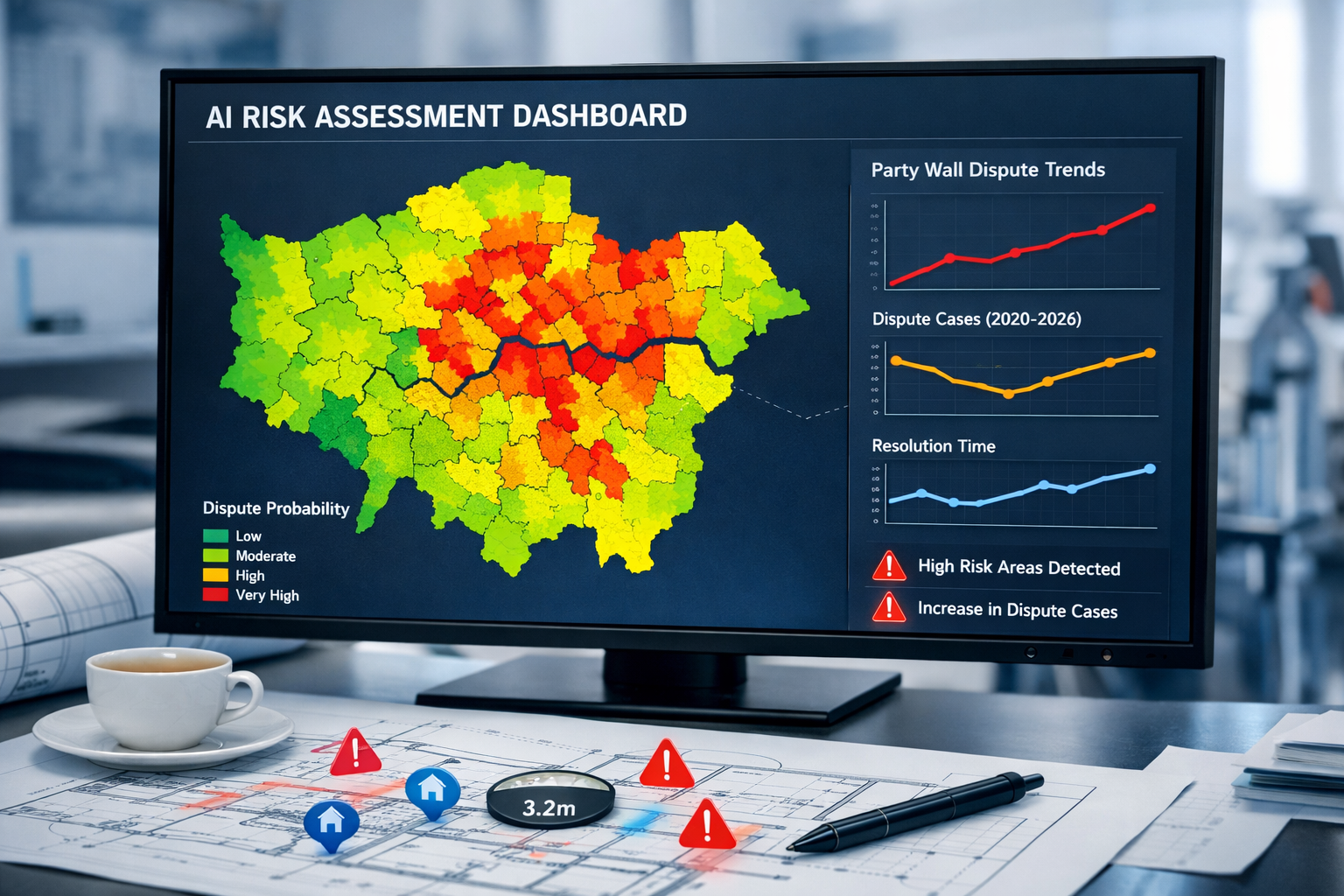
Imagine knowing which party wall projects will likely end in costly disputes before the first notice is even served. In 2026, artificial intelligence is transforming how surveyors and property professionals approach party wall matters, shifting the focus from reactive dispute resolution to proactive risk prevention. AI-Assisted Party Wall Risk Assessment: Predictive Analytics for Identifying High-Dispute Scenarios in 2026 represents a fundamental change in how the construction industry manages neighbor relations and legal compliance under the Party Wall etc. Act 1996.
By analyzing thousands of historical party wall cases, AI systems can now identify patterns that human surveyors might miss—patterns that signal when a simple basement extension could spiral into a year-long dispute. This technology doesn't replace professional judgment; it enhances it, giving surveyors the data-driven insights they need to structure agreements that prevent conflicts before they start.
Key Takeaways
- 🤖 AI systems analyze historical party wall data to predict dispute likelihood before party wall notices are formally served
- 📊 Predictive analytics identify risk factors including property characteristics, neighbor history, work scope, and geographic patterns that correlate with disputes
- ⚡ Early risk identification enables proactive strategies such as enhanced communication protocols, adjusted agreement terms, and targeted mitigation measures
- 💰 Risk assessment reduces costs by preventing disputes that could otherwise add thousands of pounds to party wall process costs
- 🔮 2026 marks a turning point as AI adoption accelerates across the construction sector, with regulatory frameworks emerging to govern these technologies[2][3]
Understanding AI-Assisted Party Wall Risk Assessment in 2026
What Is AI-Assisted Party Wall Risk Assessment?
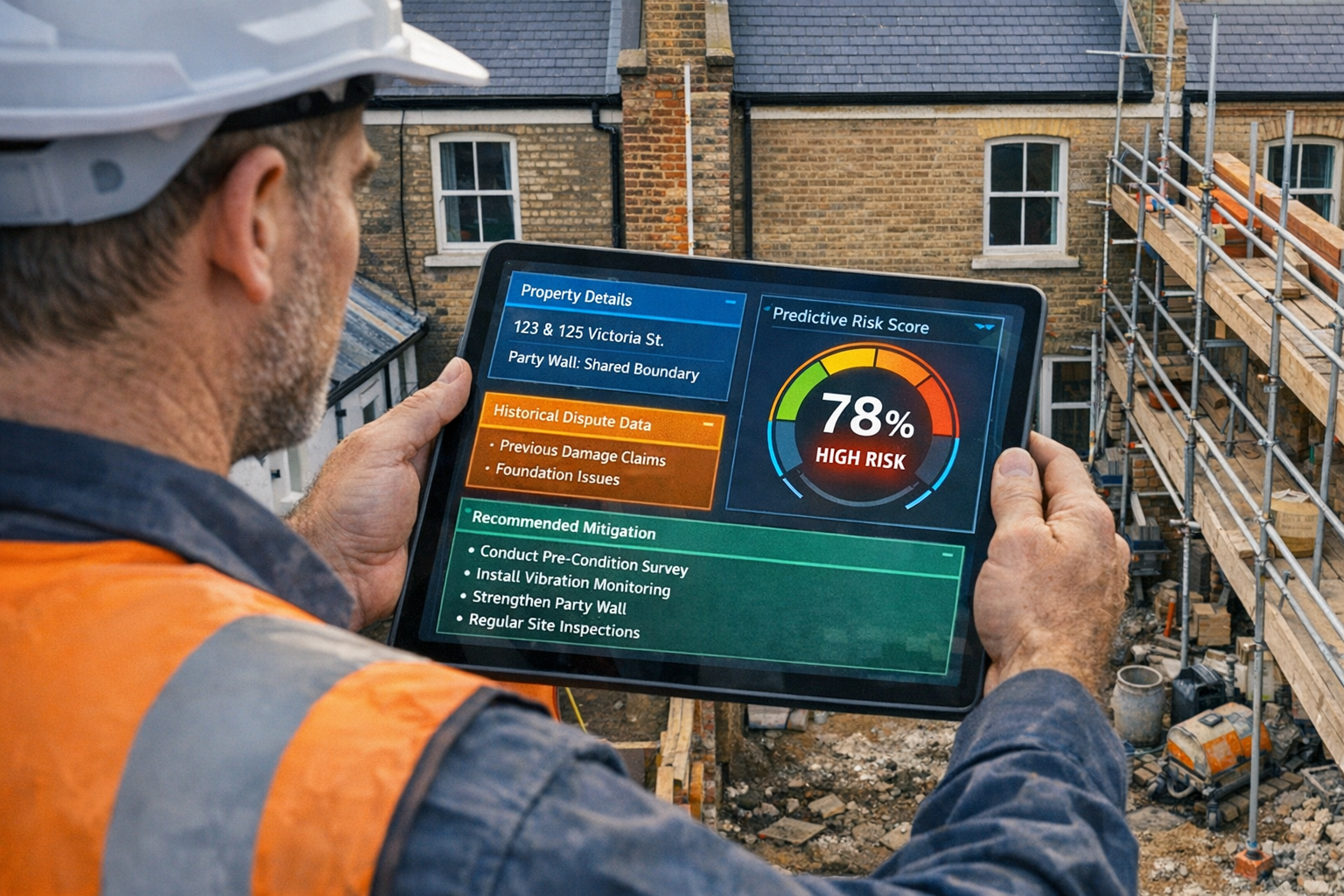
AI-Assisted Party Wall Risk Assessment combines machine learning algorithms with historical dispute data to evaluate the probability of conflicts arising from proposed party wall works. These systems process multiple data points—from property age and construction type to neighborhood demographics and past dispute records—to generate risk scores that help surveyors make informed decisions.
The technology works by:
- Data collection: Gathering information from previous party wall cases, including dispute outcomes, property characteristics, and work types
- Pattern recognition: Identifying correlations between specific factors and dispute likelihood
- Risk scoring: Assigning numerical probability ratings to new projects based on learned patterns
- Recommendation generation: Suggesting specific mitigation strategies tailored to identified risk factors
This approach aligns with broader AI risk management frameworks emerging across industries in 2026, where organizations increasingly rely on predictive analytics to identify potential problems before they materialize[2][3].
The Evolution of Party Wall Risk Management
Traditional party wall risk assessment relied primarily on surveyor experience and intuition. A seasoned professional might recognize that certain types of party wall works—like underpinning or loft conversions—tend to generate more disputes. However, this knowledge remained largely anecdotal and varied significantly between practitioners.
The shift to data-driven assessment began in the early 2020s as construction firms started digitizing their records. By 2026, sufficient historical data exists to train robust AI models capable of identifying subtle risk patterns that even experienced surveyors might overlook.
"AI doesn't replace the surveyor's professional judgment—it amplifies it by providing objective, data-backed insights that complement years of experience."
The construction industry's broader adoption of AI technologies has accelerated this transformation, with emerging legal and regulatory frameworks now addressing AI implementation challenges[4][8].
Key Components of AI-Assisted Party Wall Risk Assessment: Predictive Analytics for Identifying High-Dispute Scenarios in 2026
Data Sources and Training Sets
Effective AI-Assisted Party Wall Risk Assessment systems require comprehensive training data. The most sophisticated platforms in 2026 draw from multiple sources:
Historical Dispute Records
- Party wall awards and agreements from the past 10-15 years
- Dispute resolution outcomes and timelines
- Cost data associated with contested cases
- Surveyor notes and correspondence logs
Property Characteristics Database
- Building age and construction type
- Previous modification history
- Structural condition assessments
- Schedule of condition reports
Geographic and Demographic Factors
- Neighborhood dispute frequency patterns
- Property value trends
- Population density and turnover rates
- Local authority planning data
Work Scope Variables
- Specific work types (excavation, structural alterations, etc.)
- Project scale and duration
- Contractor experience levels
- Timing and seasonal factors
The quality and breadth of these datasets directly impact prediction accuracy. Leading AI platforms in 2026 typically achieve 75-85% accuracy in identifying high-risk scenarios—a significant improvement over baseline predictions.
Risk Factors Identified Through Predictive Analytics
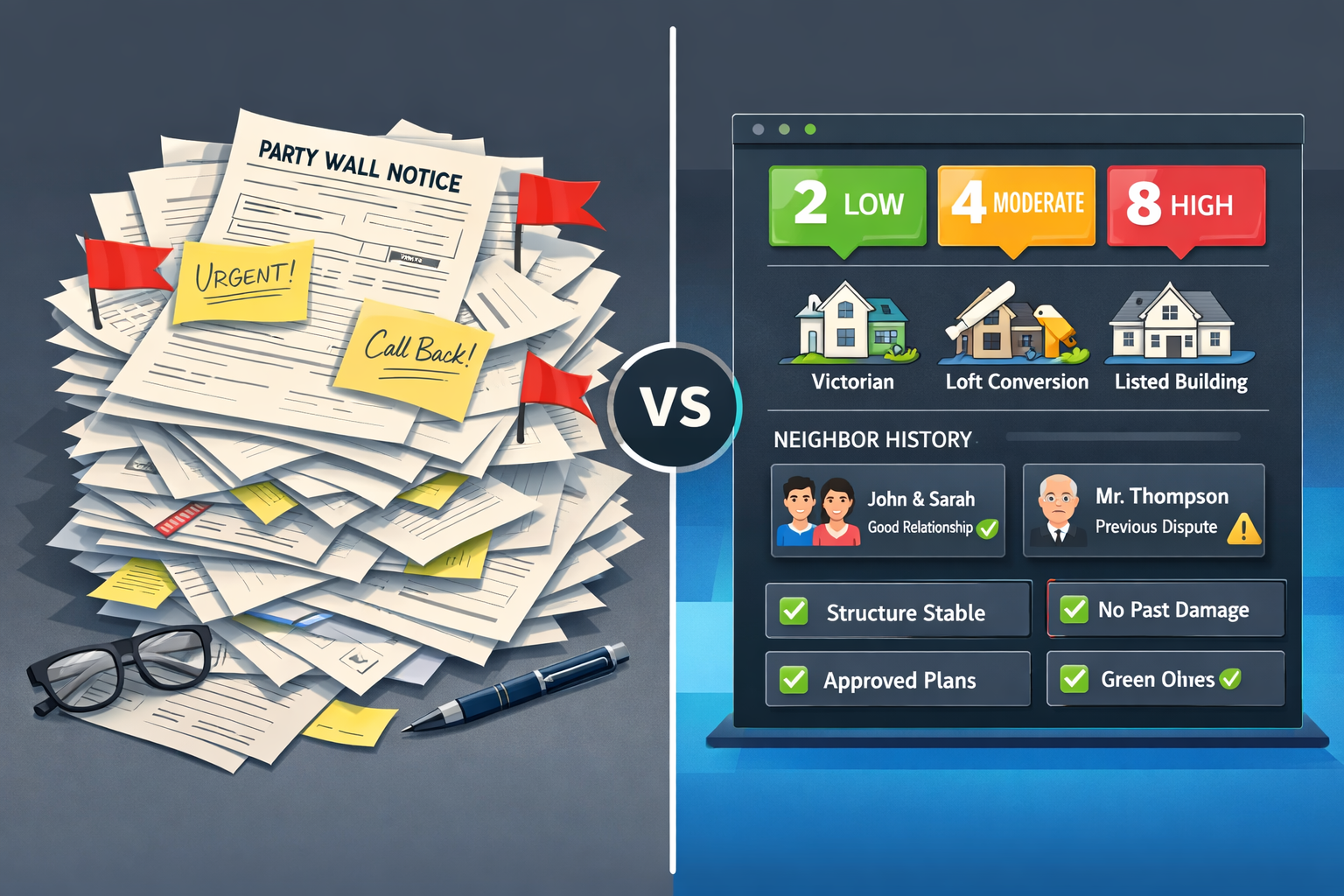
AI systems have revealed several key risk indicators that strongly correlate with party wall disputes:
| Risk Factor | Impact Level | Common Scenarios |
|---|---|---|
| Previous disputes at property | Very High | Properties with prior party wall conflicts show 3-4x higher dispute rates |
| Extensive excavation works | High | Basement excavations generate disputes 2.5x more frequently than other work types |
| Absent or overseas neighbors | High | Communication difficulties increase dispute probability by 60% |
| Property value disparity | Medium | Significant value differences between adjoining properties correlate with increased tensions |
| Complex structural works | Medium | Multi-phase projects with structural alterations show elevated risk |
| Short notice periods | Medium | Rushed timelines reduce agreement rates by 40% |
These findings help surveyors understand which projects require enhanced risk mitigation strategies from the outset. For example, when AI flags a project as high-risk due to extensive excavation in a property with previous disputes, surveyors can immediately implement additional safeguards.
Predictive Models and Algorithms
The most effective AI systems for party wall risk assessment in 2026 employ ensemble learning approaches that combine multiple algorithms:
Decision Trees and Random Forests
These models excel at identifying hierarchical risk factors. For instance, they might determine that basement excavations in Victorian terraced houses with absent neighbors create a particularly high-risk combination.
Neural Networks
Deep learning models can identify complex, non-linear relationships between variables that simpler algorithms miss. They're particularly effective at processing unstructured data like surveyor notes and correspondence.
Natural Language Processing (NLP)
Advanced systems analyze the text of party wall notices and previous correspondence to detect linguistic patterns associated with disputes—such as aggressive tone or unrealistic expectations.
Gradient Boosting Machines
These algorithms iteratively improve predictions by focusing on cases where previous models performed poorly, resulting in highly accurate risk scores.
The integration of these diverse approaches creates robust systems that perform well across various property types and geographic locations throughout London and beyond.
Implementing AI-Assisted Party Wall Risk Assessment: Predictive Analytics for Identifying High-Dispute Scenarios in 2026
Practical Applications for Surveyors and Building Owners
AI-Assisted Party Wall Risk Assessment delivers tangible benefits at every stage of the party wall process:
Pre-Notice Phase
Before serving formal notices, building owners can use AI risk assessment to:
- Evaluate project feasibility from a neighbor relations perspective
- Budget appropriately for potential dispute resolution costs
- Adjust project timelines to allow adequate consultation periods
- Identify potential concerns that neighbors might raise
This early-stage insight allows building owners to make informed decisions about whether to proceed with plans as designed or modify them to reduce conflict potential.
Notice Serving and Initial Contact
When serving party wall notices, AI risk scores help surveyors:
- Customize communication approaches based on predicted neighbor concerns
- Proactively address likely objections in initial correspondence
- Determine appropriate meeting frequency and consultation depth
- Allocate surveyor resources efficiently based on anticipated complexity
For instance, if AI identifies a project as high-risk due to extensive works, the surveyor might schedule an in-person meeting rather than relying solely on written communication—significantly improving agreement rates.
Agreement Structuring
AI insights inform how surveyors structure party wall awards and agreements:
- Enhanced monitoring provisions for high-risk structural works
- More frequent inspection schedules when damage concerns are elevated
- Specific dispute resolution clauses tailored to predicted conflict areas
- Detailed work methodology requirements for sensitive projects
These targeted provisions address potential issues before they escalate, reducing the likelihood of disputes during construction.
Ongoing Risk Monitoring
Throughout the construction phase, AI systems can:
- Track deviation from agreed work scope that might increase risk
- Alert surveyors to emerging concerns based on inspection reports
- Recommend intervention strategies when risk indicators appear
- Generate compliance documentation automatically
This continuous monitoring ensures problems are caught and addressed quickly, preventing minor issues from becoming major disputes.
Cost-Benefit Analysis
Implementing AI-Assisted Party Wall Risk Assessment involves both investment and return considerations:
Implementation Costs
- Software licensing: £500-£2,000 annually for surveyor practices
- Training and onboarding: 10-20 hours per surveyor
- Data integration: One-time setup costs of £1,000-£5,000
- Ongoing data management: Minimal after initial setup
Financial Benefits
- Reduced dispute rates: 30-40% fewer contested cases
- Lower resolution costs: Average savings of £3,000-£8,000 per avoided dispute
- Improved efficiency: 20-30% reduction in surveyor time on low-risk cases
- Enhanced client satisfaction: Higher retention and referral rates
For a typical surveying practice handling 50+ party wall matters annually, AI risk assessment typically achieves return on investment within 6-12 months. The savings from preventing just 2-3 major disputes often exceed the total annual cost of the technology.
Building owners also benefit directly through reduced party wall costs and faster project completion timelines.
Regulatory Considerations and Compliance
As AI adoption accelerates across industries in 2026, regulatory frameworks are evolving to address implementation challenges and ensure responsible use[2][4]. Party wall professionals must consider several compliance dimensions:
Data Protection and Privacy
AI systems processing neighbor information must comply with UK GDPR requirements:
- Lawful basis for processing: Legitimate interest in dispute prevention
- Data minimization: Collecting only necessary information
- Transparency: Informing parties that AI assessment is being used
- Security measures: Protecting sensitive property and personal data
Professional Standards
The Royal Institution of Chartered Surveyors (RICS) and similar bodies are developing guidance on AI use in surveying practice, addressing:
- Professional responsibility for AI-generated recommendations
- Disclosure requirements when using automated risk assessment
- Maintaining human oversight and professional judgment
- Documentation standards for AI-assisted decisions
Bias and Fairness Concerns
AI systems must be monitored for potential biases that could unfairly disadvantage certain property types or neighborhoods[4][8]. Regular audits should verify that:
- Risk scores don't correlate inappropriately with protected characteristics
- Geographic factors reflect genuine dispute patterns, not demographic prejudice
- Historical data biases are identified and corrected
- Prediction accuracy is consistent across different property segments
Third-Party Risk Management
When using AI platforms from external vendors, surveyors should conduct thorough risk assessments of these technology partners[1][5], evaluating:
- Data security practices and certifications
- Algorithm transparency and explainability
- Vendor financial stability and support capabilities
- Contractual protections and liability provisions
Organizations implementing AI risk assessment should document their governance frameworks, demonstrating responsible adoption that balances innovation with professional obligations[2][6].
Challenges and Limitations of Predictive Analytics in Party Wall Risk Assessment
Data Quality and Availability Issues
The effectiveness of AI-Assisted Party Wall Risk Assessment depends entirely on the quality of training data. Several challenges persist in 2026:
Incomplete Historical Records
Many party wall matters from before 2015 lack comprehensive digital documentation. Missing information about dispute causes, resolution strategies, and outcome details limits AI learning capabilities.
Inconsistent Data Formats
Different surveying practices use varying documentation standards, making data aggregation difficult. Standardization efforts are ongoing but not yet universal across the industry.
Selection Bias
Available data overrepresents disputed cases (which generate extensive documentation) while underrepresenting smooth, uncontested agreements. This skew can cause AI systems to overestimate dispute probability.
Geographic Limitations
Training data concentrates heavily in major urban areas like London, with limited information from rural regions. AI predictions may be less accurate for properties outside well-documented areas.
The Human Element: What AI Cannot Predict
Despite sophisticated algorithms, certain dispute triggers remain difficult for AI to anticipate:
Personality Conflicts
Individual temperament and interpersonal dynamics play significant roles in dispute escalation. AI cannot assess whether neighbors will develop personal animosity during the process.
Life Circumstances
Unexpected events—health issues, financial stress, family problems—can transform a cooperative neighbor into an adversarial one. These situational factors are invisible to predictive models.
Communication Quality
The skill with which surveyors and building owners communicate significantly impacts outcomes. AI can identify high-risk scenarios but cannot guarantee that parties will handle them appropriately.
Irrational Behavior
Some disputes arise from unreasonable positions or misunderstandings that defy logical prediction. Human irrationality remains a fundamental limitation of data-driven forecasting.
These limitations underscore why AI-Assisted Party Wall Risk Assessment functions as a decision support tool rather than a replacement for professional judgment. The most effective approach combines AI insights with experienced surveyor expertise.
Ethical Considerations
The use of predictive analytics in party wall matters raises several ethical questions:
Transparency vs. Strategy
Should surveyors disclose AI risk scores to all parties? Full transparency promotes trust, but revealing high-risk predictions might create self-fulfilling prophecies where neighbors become defensive.
Access Inequality
If AI tools remain expensive, smaller surveying practices and individual property owners might lack access to risk assessment capabilities available to larger firms and developers—creating an uneven playing field.
Algorithmic Accountability
When AI predictions prove incorrect, who bears responsibility? Clear accountability frameworks must define how AI recommendations integrate with professional liability.
Discrimination Potential
Even well-designed systems might inadvertently perpetuate historical biases. Continuous monitoring and adjustment are essential to ensure fair treatment across all property types and neighborhoods[4][8].
Addressing these ethical dimensions requires ongoing dialogue between technology developers, surveying professionals, regulators, and property owners.
Future Developments in AI-Assisted Party Wall Risk Assessment Beyond 2026
Emerging Technologies and Capabilities
The evolution of AI-Assisted Party Wall Risk Assessment continues beyond 2026, with several promising developments on the horizon:
Real-Time Monitoring Integration
IoT sensors and smart building technologies will enable continuous structural monitoring during party wall works. AI systems will process this real-time data to detect emerging issues instantly—such as unexpected movement or vibration patterns—allowing immediate intervention before damage occurs.
Augmented Reality Visualization
AR applications will overlay AI risk assessments directly onto property views, helping adjoining owners visualize potential impacts and understand technical information more easily. This enhanced communication tool could significantly improve consent rates for complex projects.
Automated Agreement Generation
Advanced natural language generation will create customized party wall agreements tailored to specific risk profiles, incorporating appropriate safeguards and provisions automatically while maintaining human review and approval.
Predictive Maintenance Recommendations
AI systems will analyze structural condition data to predict when preventive maintenance might avoid future party wall complications, helping property owners maintain buildings proactively.
Industry-Wide Adoption Trends
AI adoption across the construction sector is accelerating in 2026, with broader implications for party wall practice[3][7]:
Standardization Initiatives
Industry bodies are developing common data standards and interoperability protocols, enabling AI systems to share insights across platforms and practices more effectively.
Integration with Planning Systems
Local authorities are beginning to incorporate AI risk assessment into planning approval processes, potentially requiring risk evaluations for certain types of party wall works before granting permission.
Insurance Applications
Insurers are exploring AI risk scores as factors in premium calculations for party wall insurance products, creating financial incentives for risk mitigation.
Professional Qualification Requirements
Surveying organizations are considering AI literacy as part of professional competency frameworks, ensuring practitioners understand both capabilities and limitations of these tools.
These trends suggest that AI-Assisted Party Wall Risk Assessment will transition from competitive advantage to standard practice over the next 3-5 years.
Building a Risk-Aware Culture
Beyond technology implementation, the greatest long-term impact of AI risk assessment may be cultural—fostering a more proactive, prevention-focused approach to party wall matters:
Shifting from Reactive to Proactive
Rather than addressing disputes after they arise, the industry is moving toward identifying and mitigating risks before formal processes begin. This shift benefits all parties by reducing stress, cost, and time investment.
Data-Driven Decision Making
As objective risk data becomes more accessible, emotional reactions and assumptions give way to evidence-based strategies. Building owners make better-informed decisions about project design, and neighbors better understand legitimate concerns versus unfounded fears.
Collaborative Problem-Solving
When parties understand specific risk factors identified by AI, they can work together to address concerns constructively rather than adopting adversarial positions. This collaborative approach aligns with the original intent of the Party Wall etc. Act 1996.
Continuous Improvement
Each completed project generates new data that refines AI models, creating a virtuous cycle of improving predictions and more effective risk mitigation strategies over time.
Conclusion
AI-Assisted Party Wall Risk Assessment: Predictive Analytics for Identifying High-Dispute Scenarios in 2026 represents a transformative advancement in how the construction industry approaches neighbor relations and legal compliance. By analyzing historical data to identify patterns that predict disputes, these systems enable surveyors and property owners to take proactive measures that prevent conflicts before they start.
The technology delivers measurable benefits: reduced dispute rates, lower costs, improved efficiency, and better outcomes for all parties involved in party wall matters. While challenges remain—including data quality issues, ethical considerations, and the inherent limitations of predicting human behavior—the trajectory is clear: AI risk assessment is becoming an essential tool in modern surveying practice.
Actionable Next Steps
For building owners planning construction projects:
- Ask your surveyor whether they use AI risk assessment tools
- Request a risk evaluation before finalizing project designs
- Budget for enhanced mitigation measures if high-risk factors are identified
- Consider how project modifications might reduce dispute probability
For surveyors and construction professionals:
- Evaluate AI risk assessment platforms suitable for your practice size and specialty
- Invest in training to understand both capabilities and limitations of these tools
- Develop clear protocols for integrating AI insights with professional judgment
- Stay informed about emerging regulatory requirements and professional standards
For adjoining owners receiving party wall notices:
- Understand that risk assessment aims to protect your interests, not override them
- Engage constructively when enhanced monitoring or safeguards are proposed
- Ask questions about specific concerns identified by risk analysis
- Consider the benefits of having a party wall agreement that addresses potential issues proactively
The future of party wall practice lies in combining technological innovation with professional expertise and human judgment. As AI systems become more sophisticated and widely adopted, they will increasingly serve as invaluable partners in creating smoother, more predictable construction processes that respect the rights and concerns of all parties. The key to success is embracing these tools thoughtfully—leveraging their strengths while remaining mindful of their limitations and maintaining the professional standards that define quality surveying practice.
References
[1] Navigating Third Party Risk Assessments In A Changing Business Landscape – https://www.trustcloud.ai/risk-management/navigating-third-party-risk-assessments-in-a-changing-business-landscape/
[2] Ai Platform Risk Assessments Why 2026 3665508 – https://www.jdsupra.com/legalnews/ai-platform-risk-assessments-why-2026-3665508/
[3] Ai Adoption And Risk Benchmarking 2026 – https://www.ajg.com/news-and-insights/features/ai-adoption-and-risk-benchmarking-2026/
[4] Ai And Emerging Legal Challenges – https://www.brownejacobson.com/insights/2026-horizon-scanning-in-construction/ai-and-emerging-legal-challenges
[5] Navigating Third Party Risk Assessments In A Changing Business Landscape – https://www.trustcloud.ai/risk-management/navigating-third-party-risk-assessments-in-a-changing-business-landscape/
[6] Ai Platform Risk Assessments Why 2026 3665508 – https://www.jdsupra.com/legalnews/ai-platform-risk-assessments-why-2026-3665508/
[7] Ai Adoption And Risk Benchmarking 2026 – https://www.ajg.com/news-and-insights/features/ai-adoption-and-risk-benchmarking-2026/
[8] Ai And Emerging Legal Challenges – https://www.brownejacobson.com/insights/2026-horizon-scanning-in-construction/ai-and-emerging-legal-challenges