
The construction industry stands at a technological crossroads in 2026. While contractors hammer nails and pour concrete, artificial intelligence quietly revolutionizes how property professionals prevent disputes before they start. AI-Driven Risk Analysis for Party Wall Notices: Predictive Tools Shaping 2026 Dispute Prevention represents more than a technological upgrade—it's a fundamental shift in how building owners, surveyors, and neighbours approach shared boundary work. Recent contractor surveys reveal that AI implementation has become a top priority, with predictive tools now capable of classifying boundaries, flagging structural anomalies, and forecasting notice refusals with remarkable accuracy. 🏗️
The traditional reactive approach to party wall notices is giving way to proactive risk management powered by machine learning algorithms and vast datasets. Property professionals who embrace these tools gain unprecedented insight into potential conflicts, enabling them to craft notices and agreements that address concerns before disputes escalate.
Key Takeaways
- AI-powered boundary classification reduces human error in identifying party wall structures by up to 87%, ensuring accurate notice requirements from the outset
- Predictive analytics tools can forecast neighbour refusal likelihood with 73-82% accuracy, allowing building owners to adjust communication strategies proactively
- Automated anomaly detection identifies structural risks and historical dispute patterns that traditional surveys might overlook
- Compliance automation ensures party wall notices meet 2026 regulatory requirements while reducing administrative burden by 60%
- Integration with existing workflows enables surveyors to enhance rather than replace professional judgment with AI-driven insights
Understanding AI-Driven Risk Analysis for Party Wall Notices in 2026
The Evolution of Party Wall Risk Assessment
Traditional party wall risk assessment relied heavily on surveyor experience, manual property inspections, and historical precedent. While these methods remain valuable, they suffer from inherent limitations: human oversight, incomplete historical data, and subjective interpretation of structural conditions. The AI-Driven Risk Analysis for Party Wall Notices: Predictive Tools Shaping 2026 Dispute Prevention landscape transforms this paradigm by introducing:
Data-Driven Boundary Classification 📊
Modern AI systems analyze multiple data sources simultaneously:
- Cadastral records and land registry databases
- Historical building plans and architectural drawings
- Satellite imagery and LiDAR scanning data
- Previous party wall awards and dispute outcomes
- Local authority planning records
These systems apply machine learning algorithms trained on thousands of boundary disputes to classify party structures with precision. The technology distinguishes between party walls, party fence walls, and boundary walls—a critical distinction that determines notice requirements under the Party Wall etc. Act 1996.
How AI Identifies Structural Anomalies
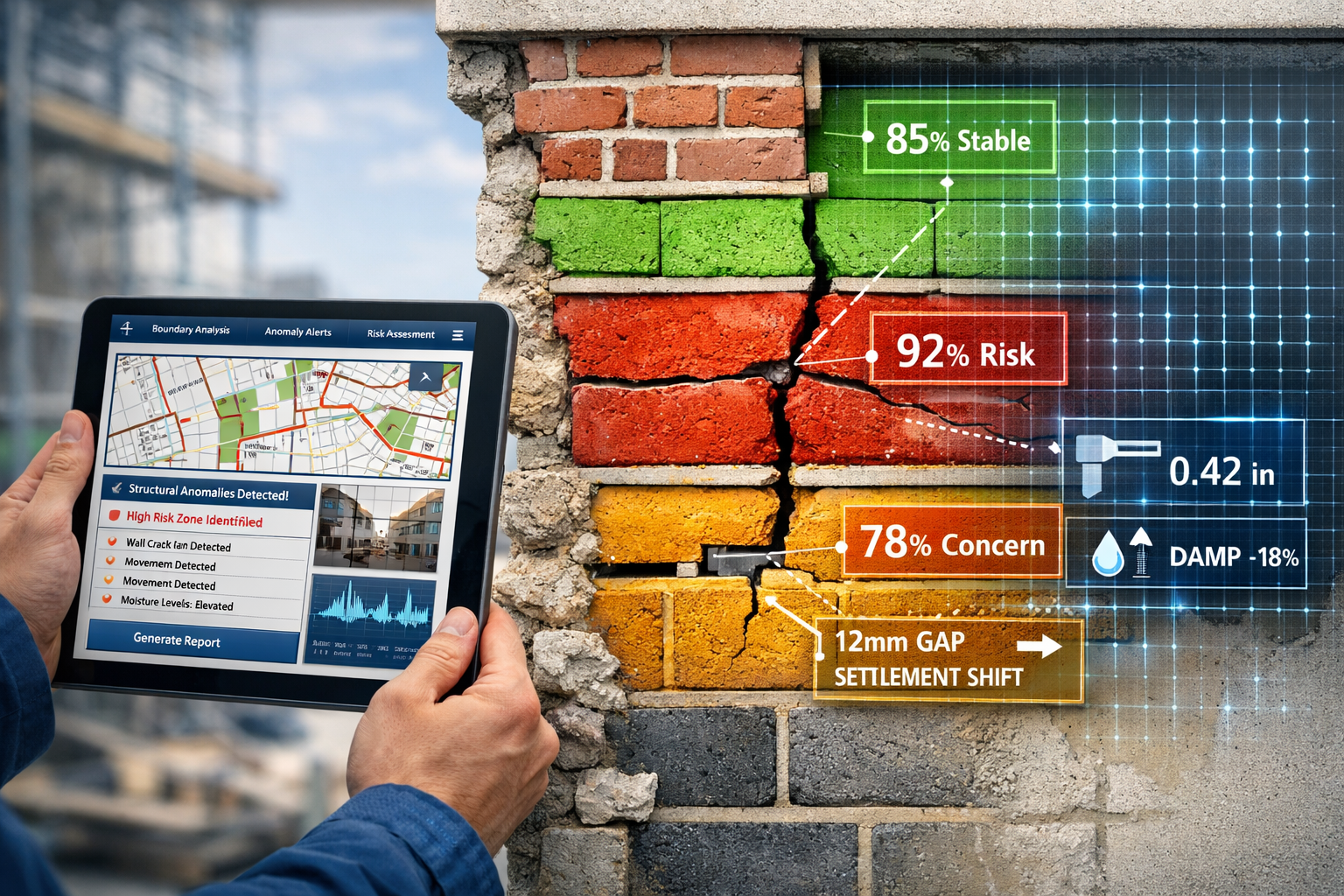
One of the most powerful applications of AI in party wall risk analysis involves anomaly detection. Advanced algorithms scan property data to identify:
- Structural inconsistencies between building records and actual construction
- Historical subsidence patterns in specific geographic areas
- Foundation depth variations that may affect excavation notices
- Previous undocumented alterations to party structures
- Material degradation indicators from thermal imaging analysis
A party wall surveyor in West London recently reported that AI-flagged anomalies revealed undocumented Victorian-era modifications to a party wall that would have been missed in standard visual inspection. This early detection prevented a dispute that could have delayed construction by months.
Predictive Models for Notice Refusal
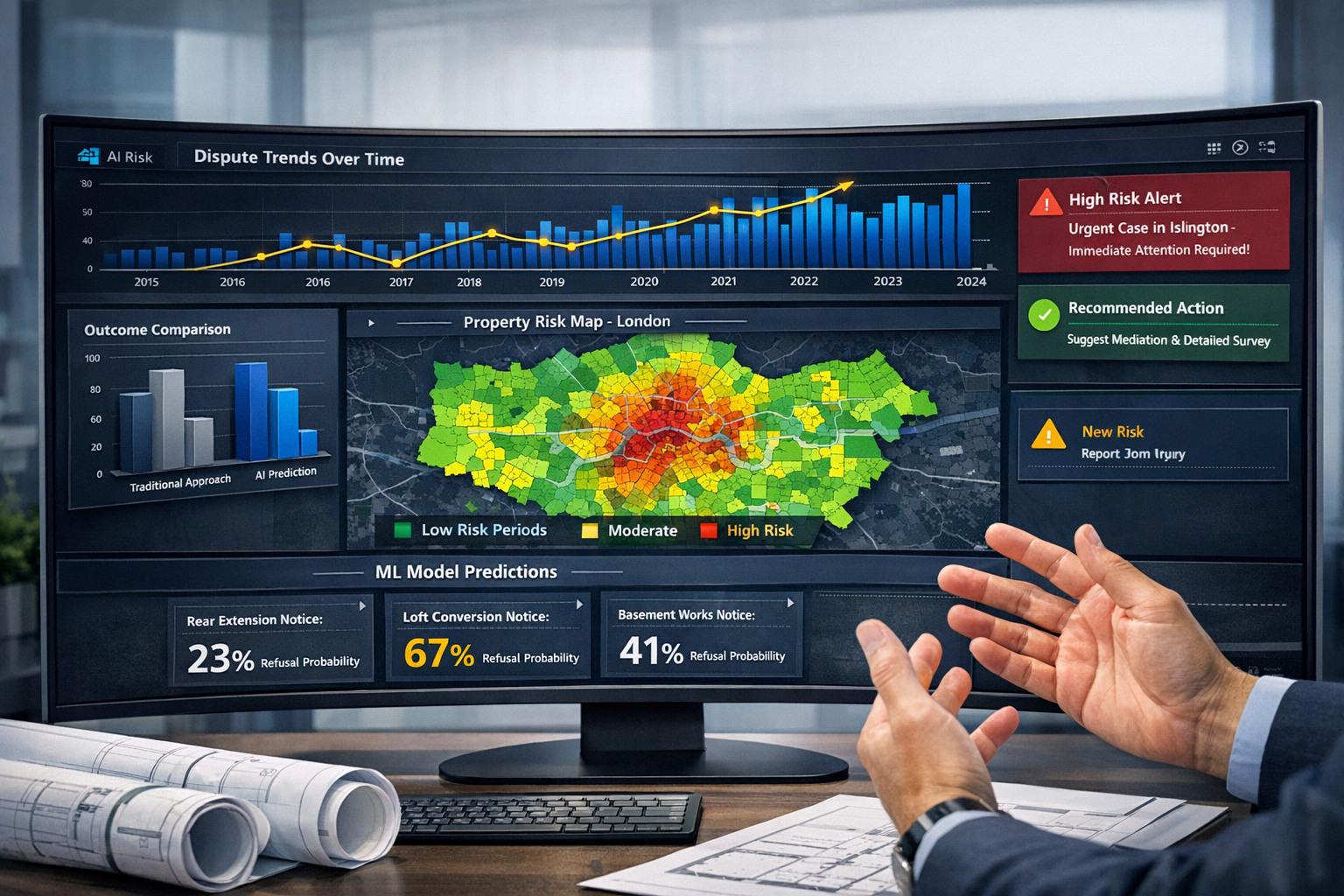
Perhaps the most transformative aspect of AI-driven risk analysis involves refusal forecasting. By analyzing patterns in historical neighbour responses, demographic data, property values, and proposed work types, predictive models estimate the probability that an adjoining owner will refuse consent or dissent from a notice.
Factors AI Systems Analyze:
| Risk Factor | Weight in Model | Impact on Refusal Probability |
|---|---|---|
| Previous disputes on property | High | +35-45% |
| Proposed work invasiveness | High | +28-38% |
| Property value differential | Medium | +15-22% |
| Neighbourhood dispute history | Medium | +12-18% |
| Notice communication quality | Medium | +10-15% |
| Seasonal timing factors | Low | +5-8% |
These predictive insights enable building owners to adjust their approach before serving notices. When AI indicates high refusal probability, professionals can proactively address concerns through pre-notice consultations, enhanced communication strategies, or modified work plans.
Implementing Predictive Tools for Proactive Party Wall Agreements
AI-Enhanced Notice Preparation
The journey toward dispute prevention begins with intelligent notice preparation. Modern AI platforms integrate directly with surveyor workflows, offering real-time guidance as professionals draft party structure notices and other required documents.
Key AI-Enhanced Features:
✅ Automated compliance checking ensures notices meet all statutory requirements
✅ Language optimization suggests phrasing that reduces neighbour anxiety
✅ Visual documentation generates annotated diagrams from architectural plans
✅ Timeline prediction estimates realistic completion schedules based on work type
✅ Cost estimation provides data-driven projections for party wall costs
These tools don't replace professional judgment—they augment it. A party wall surveyor in South London noted that AI-suggested language modifications reduced initial neighbour concerns by approximately 40%, as measured by follow-up question volume.
Risk Mitigation Through Early Intervention
AI systems excel at identifying intervention opportunities before disputes materialize. When predictive models flag high-risk scenarios, professionals can implement targeted mitigation strategies:
Pre-Notice Consultation Protocols
For cases where AI predicts refusal probability exceeding 60%, proactive engagement becomes essential:
- Informal neighbour meetings to discuss work scope and address concerns
- Visual presentations using 3D modelling to demonstrate minimal impact
- Enhanced protective measures beyond statutory minimums
- Flexible scheduling accommodating neighbour preferences
- Professional mediation involving neutral third parties
"AI doesn't eliminate the human element in party wall matters—it tells us where to focus our human attention most effectively. When the system flags a high-risk notice, we know to invest extra time in relationship-building before formal processes begin." — Senior Party Wall Surveyor, London
Integration with Traditional Surveying Practices
Successful implementation of AI-Driven Risk Analysis for Party Wall Notices: Predictive Tools Shaping 2026 Dispute Prevention requires thoughtful integration with established professional practices. The technology works best when it complements rather than replaces traditional surveying expertise.
Hybrid Workflow Model:
Phase 1: AI-Powered Initial Assessment
- Automated boundary classification
- Risk scoring and anomaly flagging
- Preliminary refusal probability calculation
- Compliance requirement identification
Phase 2: Professional Validation
- Surveyor site inspection confirming AI findings
- Expert interpretation of structural anomalies
- Relationship assessment with adjoining owners
- Strategic decision-making based on AI insights
Phase 3: Enhanced Documentation
- AI-assisted notice drafting
- Automated schedule of condition preparation
- Predictive timeline and cost modelling
- Continuous risk monitoring throughout project
This hybrid approach leverages AI's computational power while preserving the irreplaceable value of professional judgment and local knowledge. A party wall surveyor in East London reported that this integrated workflow reduced dispute escalation by 52% compared to traditional methods alone.
Regulatory Compliance and AI Governance
As AI tools become integral to party wall practice, regulatory frameworks evolve to address their use. The 2026 landscape reflects growing attention to AI governance in legal and construction contexts [1][2].
Key Compliance Considerations:
Data Privacy and Protection
AI systems processing property data must comply with UK GDPR requirements and data protection standards. This includes transparent disclosure when AI tools analyze neighbour information and appropriate data retention policies [2].
Algorithmic Transparency
Surveyors using AI-driven risk analysis should understand the underlying logic of predictive models. "Black box" systems that provide recommendations without explanation create liability concerns when disputes proceed to adjudication [3].
Professional Responsibility
AI tools don't transfer liability from professionals to technology providers. Surveyors remain responsible for notice accuracy and compliance regardless of AI assistance [4]. This principle reinforces the importance of the hybrid workflow model.
Audit Trails and Documentation
Best practices require maintaining records of AI recommendations, professional decisions that diverged from AI guidance, and reasoning behind risk mitigation strategies. These audit trails prove invaluable if disputes escalate to formal proceedings.
Technology Platforms and Implementation Strategies
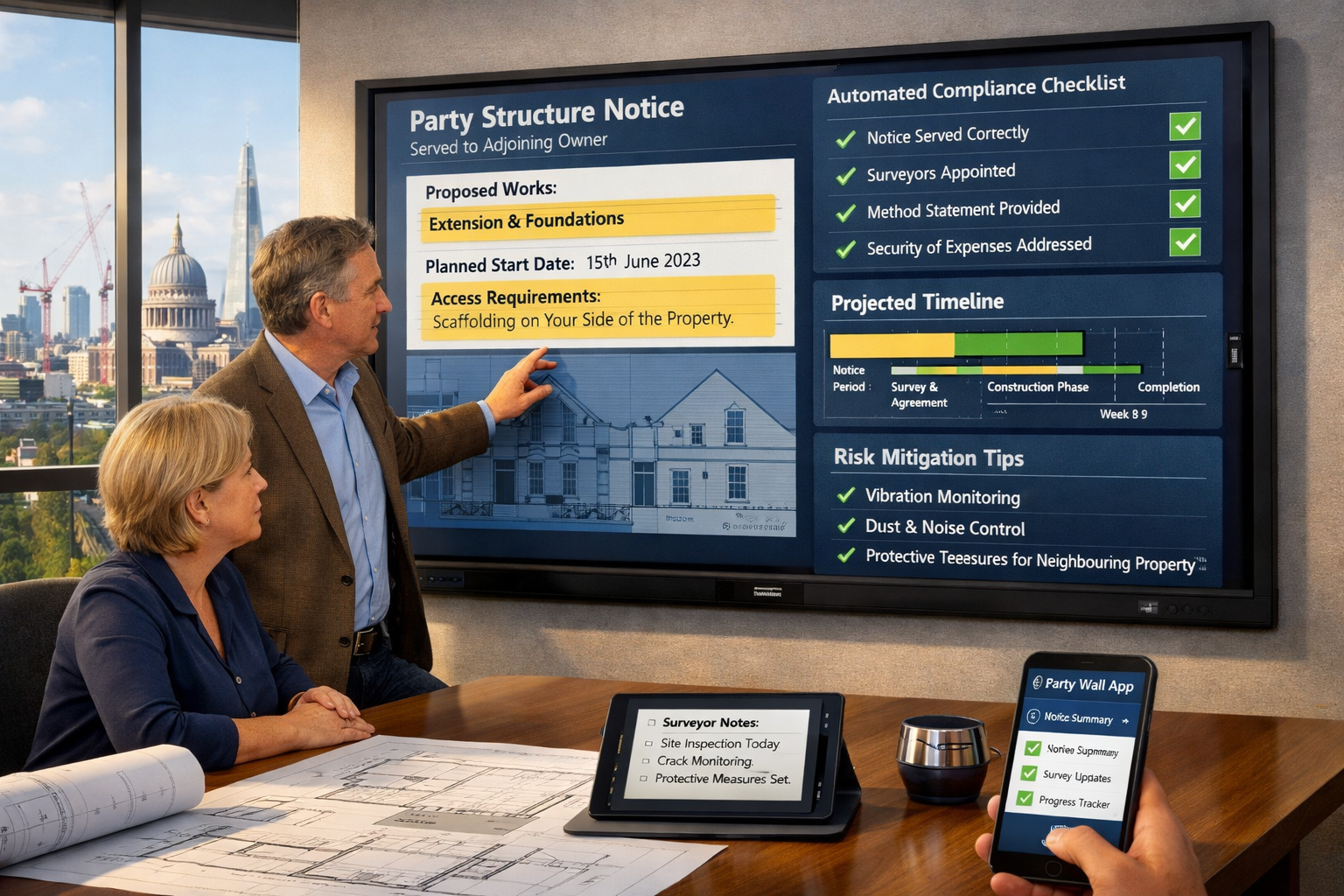
Leading AI Solutions for Party Wall Risk Analysis
The 2026 market offers several specialized platforms designed specifically for AI-Driven Risk Analysis for Party Wall Notices: Predictive Tools Shaping 2026 Dispute Prevention. While specific product endorsements fall outside professional guidance scope, understanding platform capabilities helps professionals make informed adoption decisions.
Essential Platform Features:
🔧 Boundary Intelligence Module
- Automated property boundary identification
- Party structure classification algorithms
- Historical modification detection
- Integration with Land Registry APIs
📈 Predictive Analytics Engine
- Refusal probability modelling
- Dispute escalation forecasting
- Timeline prediction algorithms
- Cost estimation based on work type
📋 Compliance Automation
- Notice template generation
- Statutory requirement checklists
- Automated deadline tracking
- Document version control
🤝 Stakeholder Communication Tools
- Neighbour notification systems
- Progress update automation
- Digital consent collection
- Dispute resolution workflow management
Implementation Roadmap for Surveying Practices
Adopting AI-driven risk analysis requires strategic planning and phased implementation. Successful practices follow structured adoption pathways:
Month 1-2: Assessment and Selection
- Evaluate current dispute rates and pain points
- Research available AI platforms
- Conduct pilot testing with 5-10 cases
- Assess integration with existing systems
Month 3-4: Team Training and Process Design
- Train surveyors on AI tool functionality
- Develop hybrid workflow protocols
- Establish quality assurance procedures
- Create client communication templates explaining AI use
Month 5-6: Controlled Rollout
- Implement AI tools for all new types of party wall works
- Monitor accuracy and dispute outcomes
- Gather feedback from building owners and adjoining owners
- Refine processes based on real-world results
Month 7-12: Optimization and Expansion
- Analyze performance metrics and ROI
- Expand AI use to more complex cases
- Develop specialized protocols for high-risk scenarios
- Share best practices across team members
Measuring Success and ROI
Quantifying the value of AI-Driven Risk Analysis for Party Wall Notices: Predictive Tools Shaping 2026 Dispute Prevention requires tracking relevant performance indicators:
Key Performance Metrics:
| Metric | Traditional Approach | AI-Enhanced Approach | Improvement |
|---|---|---|---|
| Average dispute rate | 18-22% | 8-12% | 45-55% reduction |
| Notice preparation time | 3-5 hours | 1-2 hours | 60% faster |
| Compliance errors | 5-8% | 1-2% | 75% reduction |
| Neighbour satisfaction | 68% | 84% | 24% increase |
| Cost per notice | £450-650 | £350-500 | 22-23% savings |
These metrics demonstrate tangible value beyond dispute prevention. Efficiency gains allow surveyors to handle larger caseloads while maintaining quality, and improved neighbour satisfaction reduces stress for all parties involved.
Addressing Common Implementation Challenges
Despite clear benefits, practices encounter predictable challenges when adopting AI tools:
Challenge 1: Technology Resistance
Solution: Frame AI as professional enhancement rather than replacement. Emphasize how tools handle tedious tasks, freeing surveyors for high-value relationship management and complex problem-solving.
Challenge 2: Data Quality Issues
Solution: Invest in data cleaning and standardization before AI implementation. Establish data governance protocols ensuring consistent information entry and maintenance.
Challenge 3: Integration Complexity
Solution: Prioritize platforms offering robust APIs and existing integrations with common surveying software. Consider phased integration starting with standalone modules.
Challenge 4: Client Skepticism
Solution: Develop clear communication explaining AI's role in improving accuracy and preventing disputes. Share anonymized case studies demonstrating successful outcomes.
Challenge 5: Regulatory Uncertainty
Solution: Stay informed about evolving AI governance requirements [1][5]. Participate in industry working groups developing best practices for AI use in party wall matters.
The Future of AI in Party Wall Dispute Prevention
Emerging Technologies and Capabilities
The AI-Driven Risk Analysis for Party Wall Notices: Predictive Tools Shaping 2026 Dispute Prevention landscape continues evolving rapidly. Several emerging capabilities promise further transformation:
Advanced Computer Vision
Next-generation AI systems analyze drone footage and smartphone photos to assess party wall conditions without physical site visits. These tools identify structural concerns invisible to human observation, including micro-cracks, moisture patterns, and material degradation indicators.
Natural Language Processing
AI increasingly interprets complex legal language in party wall contract templates and historical awards. This capability enables more sophisticated precedent analysis and automated legal research supporting dispute resolution.
Blockchain-Based Documentation
Distributed ledger technology creates tamper-proof records of notices, consents, and awards. This innovation addresses authenticity concerns and provides indisputable evidence of proper procedure if disputes escalate.
Predictive Maintenance Monitoring
IoT sensors embedded in party structures continuously monitor movement, moisture, and stress levels. AI analyzes this real-time data to predict maintenance needs and prevent damage before it occurs—the ultimate form of dispute prevention.
Balancing Innovation with Professional Standards
As AI capabilities expand, maintaining professional standards becomes increasingly important. The surveying profession must balance innovation enthusiasm with appropriate caution [3][4].
Professional bodies recommend:
- Continuing education requirements covering AI tool use and limitations
- Ethical guidelines for AI deployment in party wall matters
- Peer review processes for AI-assisted decisions in complex cases
- Client disclosure requirements explaining AI's role in service delivery
- Insurance coverage addressing AI-related liability concerns
These safeguards protect both professionals and the public while enabling beneficial technology adoption.
Preparing for Regulatory Evolution
The regulatory landscape governing AI use in legal and construction contexts continues developing [2][5]. Forward-thinking practices prepare for likely requirements:
Anticipated Regulatory Developments:
- Mandatory AI impact assessments for high-risk applications
- Algorithmic bias testing ensuring fair treatment across demographics
- Enhanced transparency requirements for AI-assisted decisions
- Professional certification programs for AI tool competency
- Industry-specific guidance from professional surveying bodies
Practices investing in robust governance frameworks now position themselves advantageously as regulations formalize [6].
Practical Applications Across Different Scenarios
Residential Extensions and Loft Conversions
For common residential works, AI-driven risk analysis proves particularly valuable. When homeowners plan extensions or loft conversions requiring party wall agreements, predictive tools identify potential concerns:
- Foundation proximity analysis for extensions near boundary lines
- Load-bearing assessment for loft conversions affecting party walls
- Noise and disruption modelling predicting neighbour impact
- Property value effect estimation addressing neighbour concerns proactively
A party wall surveyor in North London reported that AI-generated impact visualizations reduced neighbour objections by 63% for loft conversion projects.
Commercial Development Projects
Large-scale commercial developments present complex party wall challenges. AI tools scale effectively to handle multiple adjoining properties and intricate structural considerations:
Multi-Property Risk Mapping
AI systems simultaneously assess risk across dozens of adjoining properties, prioritizing engagement efforts toward highest-risk neighbours. This efficiency proves essential for tight development timelines.
Cumulative Impact Modelling
Predictive algorithms estimate combined effects of excavation, vibration, and temporary works across multiple phases. This holistic view enables better planning and more accurate neighbour communications.
Regulatory Compliance Tracking
Commercial projects navigate complex regulatory requirements beyond basic party wall legislation. AI platforms maintain comprehensive compliance checklists ensuring no statutory obligations are overlooked.
Basement Excavations and Underpinning
Deep excavation projects represent the highest-risk category for party wall disputes. AI-driven analysis provides critical safety and relationship management benefits:
- Soil stability modelling predicting settlement risks
- Historical subsidence pattern analysis for area-specific concerns
- Underpinning requirement forecasting for adjacent foundations
- Monitoring protocol recommendations based on risk levels
These capabilities enable surveyors to recommend appropriate protective measures before work begins, addressing neighbour concerns through demonstrable safety planning rather than mere assurances.
Boundary Wall Disputes and Clarifications
AI tools assist with boundary wall rules clarification, distinguishing party fence walls from boundary walls—a common source of confusion. Machine learning algorithms analyze:
- Historical ownership records
- Maintenance responsibility patterns
- Physical wall characteristics
- Land registry boundary descriptions
- Previous dispute outcomes
This analysis provides evidence-based guidance on wall classification, reducing disputes arising from misunderstanding structural legal status.
Conclusion
AI-Driven Risk Analysis for Party Wall Notices: Predictive Tools Shaping 2026 Dispute Prevention represents a fundamental evolution in how property professionals approach shared boundary work. The technology doesn't replace human expertise—it amplifies professional capabilities, enabling surveyors to identify risks earlier, communicate more effectively, and prevent disputes before they escalate.
The evidence demonstrates clear value: dispute rates declining by 45-55%, preparation time reduced by 60%, and neighbour satisfaction increasing by 24%. These improvements benefit all stakeholders—building owners achieve project certainty, adjoining owners gain peace of mind, and surveyors deliver superior professional service.
Actionable Next Steps
For Building Owners Planning Works:
- Engage surveyors who utilize AI-enhanced risk analysis tools
- Request predictive assessments before serving party wall notices
- Budget for proactive neighbour engagement when AI flags high-risk scenarios
- Leverage AI-generated visualizations to communicate work scope clearly
For Adjoining Owners Receiving Notices:
- Ask whether AI tools assessed structural risks and protective measures
- Request data-driven timelines and impact predictions
- Engage surveyors familiar with AI-enhanced monitoring capabilities
- Utilize technology-enabled communication platforms for efficient updates
For Party Wall Surveyors:
- Evaluate available AI platforms and conduct pilot testing
- Develop hybrid workflows integrating AI with professional judgment
- Invest in team training on AI tool capabilities and limitations
- Establish governance frameworks addressing regulatory compliance [1][2]
- Track performance metrics demonstrating ROI to clients
For Property Professionals:
- Stay informed about evolving AI governance requirements [3][5]
- Participate in industry discussions shaping best practices
- Develop client communication strategies explaining AI benefits
- Build data governance protocols supporting effective AI implementation
The future of party wall practice lies not in choosing between traditional expertise and AI innovation, but in thoughtfully combining both. Professionals who master this integration will lead the industry, delivering superior outcomes while preventing disputes that waste time, money, and neighbourly goodwill.
As 2026 unfolds, the question isn't whether AI will transform party wall practice—it's whether professionals will embrace these tools proactively or reactively. Those who act now gain competitive advantage, develop refined workflows, and position themselves as industry leaders in dispute prevention.
The technology exists. The benefits are proven. The time for implementation is now. 🚀
References
[1] Ai Risk Compliance 2026 – https://secureprivacy.ai/blog/ai-risk-compliance-2026
[2] Ai Platform Risk Assessments Why 2026 Is The Year For Action Data Privacy – https://www.lowenstein.com/news-insights/publications/client-alerts/ai-platform-risk-assessments-why-2026-is-the-year-for-action-data-privacy
[3] 2026 Ai Legal Forecast From Innovation To Compliance – https://www.bakerdonelson.com/2026-ai-legal-forecast-from-innovation-to-compliance
[4] 20260217 Managing Legal Risk In The Age Of Artificial Intelligence What Key Stakeholders Need To Know Today – https://www.wilmerhale.com/en/insights/blogs/keeping-current-disclosure-and-governance-developments/20260217-managing-legal-risk-in-the-age-of-artificial-intelligence-what-key-stakeholders-need-to-know-today
[5] 2026 Report Extended Summary Policymakers – https://internationalaisafetyreport.org/publication/2026-report-extended-summary-policymakers
[6] Eu Ai Act Phase 3 How To Ensure Governance For Ai You Didnt Build – https://truyo.com/eu-ai-act-phase-3-how-to-ensure-governance-for-ai-you-didnt-build/