


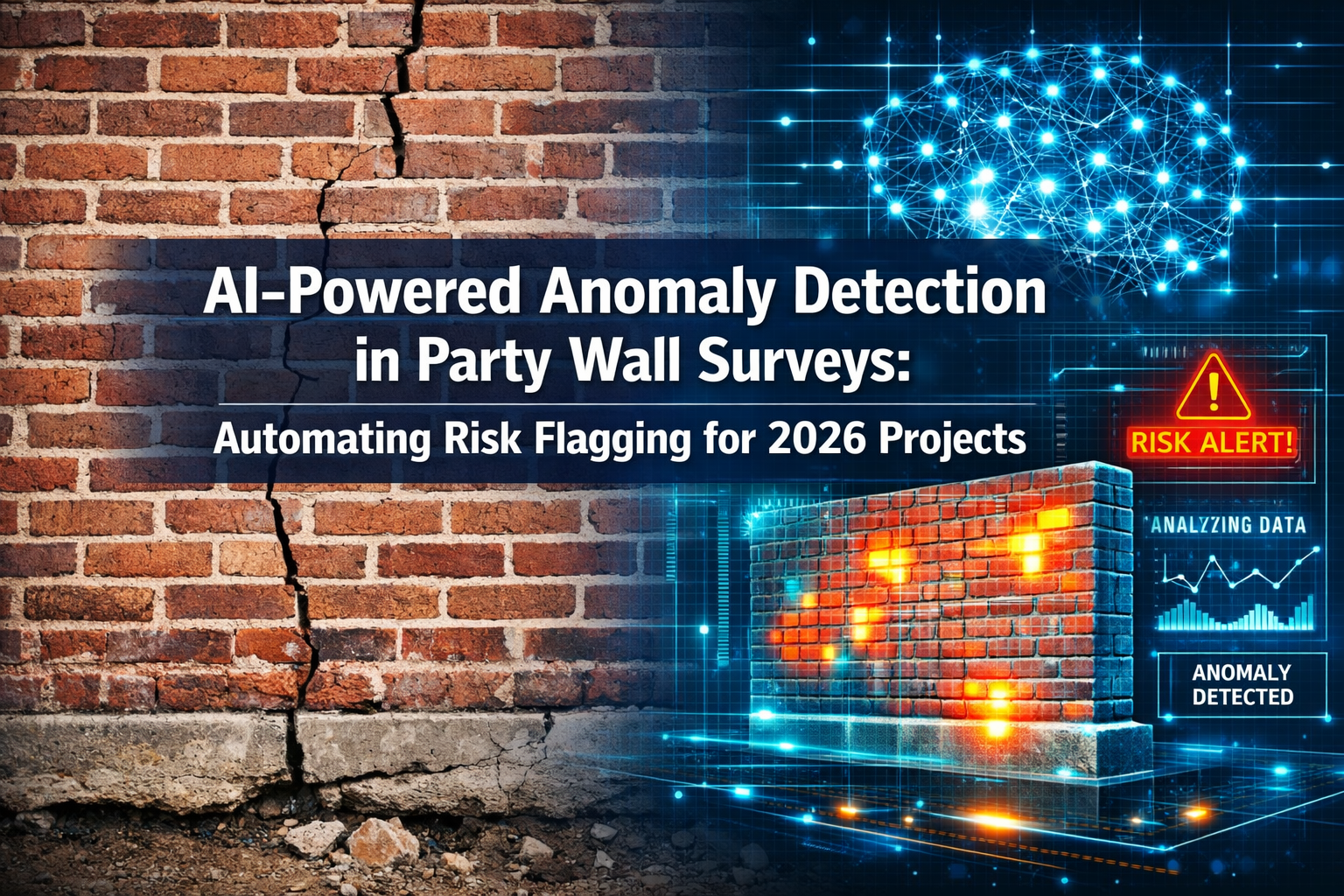
Picture a seasoned party wall surveyor examining a Victorian terrace in London, meticulously documenting every crack, measuring foundation depths, and assessing structural integrity. Now imagine that same surveyor equipped with artificial intelligence that can scan thousands of data points in seconds, automatically flag hidden risks, and predict potential disputes before they arise. This isn't science fiction—it's the reality of AI-Powered Anomaly Detection in Party Wall Surveys: Automating Risk Flagging for 2026 Projects.
As construction activity continues to surge across urban areas in 2026, the traditional methods of conducting party wall surveys are being transformed by machine learning algorithms that can identify structural anomalies, foundation risks, and compliance red flags that even experienced human surveyors might overlook. This technological revolution is reducing dispute potential, accelerating project timelines, and fundamentally changing how property professionals approach risk assessment under the Party Wall etc. Act 1996.
Key Takeaways
- 🤖 AI algorithms can detect structural anomalies in party walls with greater consistency than traditional manual inspections, identifying patterns across thousands of data points simultaneously
- ⚡ Only 13% of organizations currently use AI for anomaly detection, indicating significant growth potential in the surveying sector throughout 2026[3]
- 📊 Automated risk flagging reduces human error and provides standardized assessment criteria across all party wall projects
- 💰 Early anomaly detection prevents costly disputes by identifying potential issues before construction work begins
- 🔄 Machine learning improves over time, continuously refining its ability to recognize risk patterns specific to party wall scenarios
Understanding AI-Powered Anomaly Detection in Party Wall Surveys
What Is Anomaly Detection in Party Wall Context?
Anomaly detection refers to the identification of patterns in data that deviate from expected behavior. In party wall surveys, this means using artificial intelligence to automatically spot irregularities that could indicate structural problems, compliance issues, or potential dispute triggers.
Traditional party wall surveys rely heavily on human observation and experience. A surveyor conducts a visual inspection, takes measurements, photographs conditions, and documents findings in a schedule of condition. While effective, this approach has limitations:
- Human fatigue can affect attention to detail during lengthy inspections
- Subjective interpretation varies between different surveyors
- Hidden defects may not be visible to the naked eye
- Time constraints limit the depth of analysis possible
- Inconsistent documentation standards across the industry
AI-powered systems address these challenges by processing multiple data streams simultaneously—including high-resolution photography, thermal imaging, laser measurements, and historical records—to identify anomalies that warrant further investigation.
How Machine Learning Transforms Party Wall Risk Assessment
Machine learning algorithms excel at pattern recognition. When applied to party wall surveys, these systems are trained on thousands of examples of both normal and problematic structural conditions. Over time, they learn to recognize subtle indicators of risk that might escape human notice.
According to recent industry research, AI-driven precision in property surveying is revolutionizing workflows in 2026, with machine learning models capable of analyzing structural data with unprecedented accuracy[2]. The technology processes information in layers:
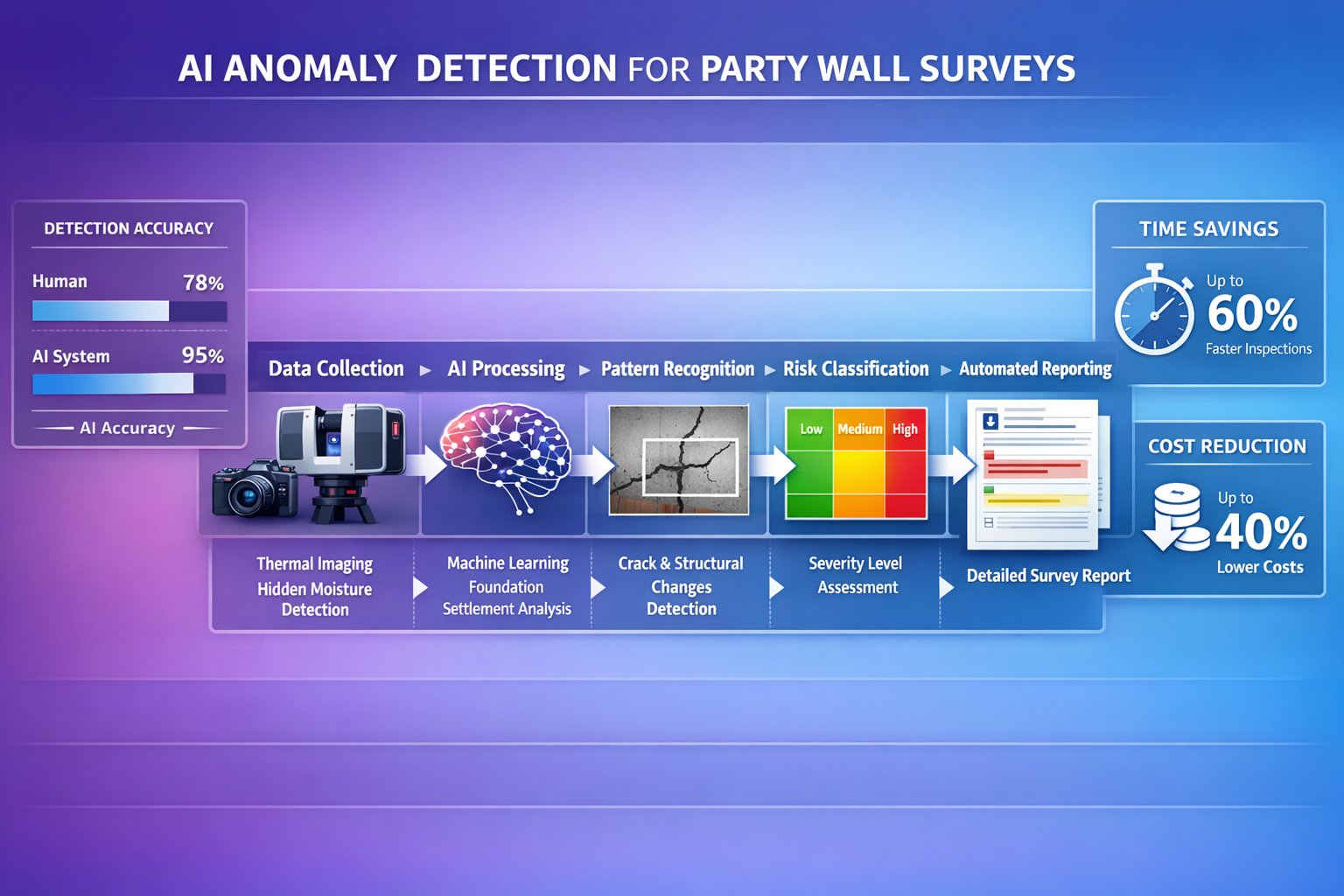
Layer 1: Data Collection
- High-resolution digital photography
- 3D laser scanning for precise measurements
- Thermal imaging for moisture detection
- Ground-penetrating radar for foundation assessment
- Historical property records and previous survey data
Layer 2: Pattern Recognition
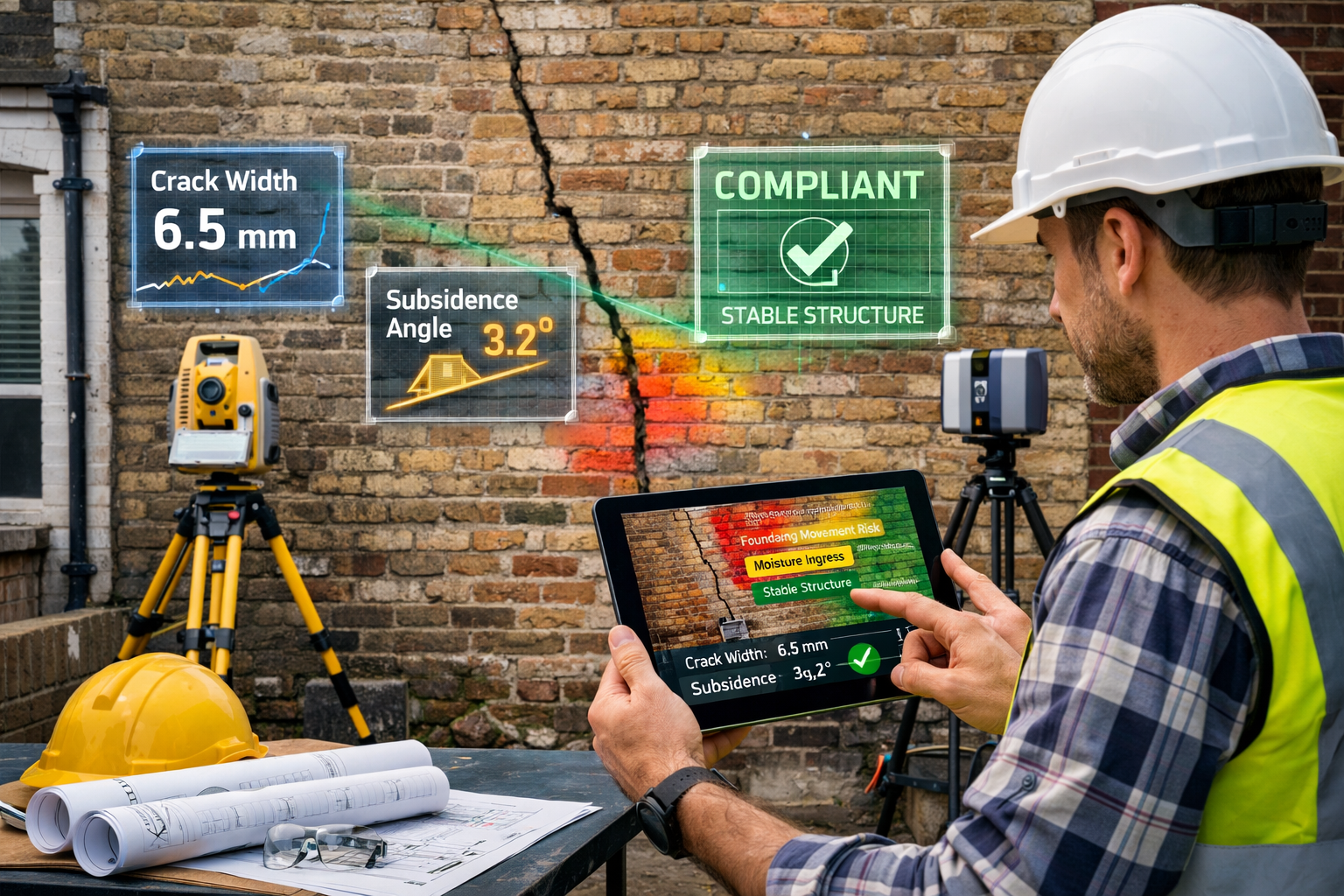
- Crack propagation patterns indicating foundation movement
- Moisture signatures suggesting water ingress
- Structural deformation beyond normal tolerances
- Non-compliant modifications to party structures
- Comparative analysis against similar properties
Layer 3: Risk Classification
- Severity scoring (low, medium, high, critical)
- Probability assessment for future deterioration
- Compliance verification against Party Wall Act requirements
- Dispute likelihood prediction
- Recommended intervention priorities
The Current State of AI Adoption in Surveying
Despite the transformative potential, AI adoption in surveying remains in relatively early stages. Research indicates that only 4% of organizations have fully operationalized AI across their operations, with 49% still running pilots and experiments in limited environments[3]. More specifically, just 13% use AI mainly for anomaly detection in their operational technology[3].
This adoption gap represents both a challenge and an opportunity for the party wall surveying sector in 2026. Early adopters gain competitive advantages through:
- Faster turnaround times for survey reports
- More comprehensive risk identification
- Reduced liability through standardized assessments
- Enhanced client confidence in findings
- Lower long-term operational costs
Automating Risk Flagging for 2026 Party Wall Projects
Key Risk Categories AI Systems Identify
AI-powered anomaly detection systems are particularly effective at identifying specific risk categories relevant to types of party wall works:
🏗️ Structural Integrity Risks
Foundation Movement
Machine learning algorithms analyze crack patterns, wall deflection, and settlement indicators to detect foundation issues. Unlike human surveyors who might assess cracks individually, AI systems recognize patterns across the entire structure, identifying progressive movement that suggests ongoing subsidence or heave.
Load-Bearing Capacity
By processing structural data alongside building plans and construction records, AI can flag situations where proposed works might compromise load-bearing elements of party walls. This is particularly valuable when building owners plan significant alterations.
Material Degradation
Thermal imaging combined with visual analysis allows AI systems to detect deteriorating materials—such as spalling brickwork, corroded steel supports, or degraded mortar—that might not be immediately obvious during standard inspections.
💧 Environmental and Moisture Risks
Water Ingress Detection
AI algorithms trained on thermal imaging data can identify moisture patterns indicating leaks, rising damp, or penetrating dampness. These issues are critical in party wall scenarios because water damage can quickly spread between properties, creating disputes over responsibility.
Drainage Complications
Machine learning models can assess drainage patterns and flag situations where proposed excavation work might affect water flow, potentially causing problems for adjoining owners.
⚖️ Compliance and Legal Risks
Party Wall Act Violations
AI systems cross-reference survey findings against Party Wall Act 1996 requirements, automatically flagging situations where proper party wall notices may not have been served or where works exceed permitted scope.
Boundary Disputes
By analyzing property boundaries, historical records, and physical evidence, AI can identify potential boundary disputes before they escalate, particularly relevant for party fence walls.
Documentation Gaps
Machine learning algorithms can identify missing documentation or inconsistencies in party wall awards that might create legal vulnerabilities.
Real-World Applications Across London Regions
The implementation of AI-powered anomaly detection varies across different London areas, each with unique architectural characteristics:
| Region | Common Property Types | Key AI Detection Focus | Typical Risks Flagged |
|---|---|---|---|
| Central London | Georgian/Victorian terraces, modern developments | Foundation settlement in older buildings, high-density construction impacts | Subsidence from nearby excavation, heritage compliance |
| East London | Victorian terraces, warehouse conversions | Structural modifications, mixed-use boundaries | Non-compliant alterations, commercial/residential interfaces |
| North London | Edwardian semis, interwar terraces | Clay soil movement, tree root damage | Seasonal subsidence, vegetation-related foundation issues |
| South London | Victorian terraces, post-war housing | Varied soil conditions, flood risk areas | Water table changes, drainage complications |
| West London | Period properties, luxury developments | Heritage constraints, premium finishes | Conservation area compliance, high-value damage prevention |
Integration with Traditional Survey Workflows
AI-powered anomaly detection doesn't replace human expertise—it enhances it. The most effective implementations in 2026 combine automated risk flagging with experienced surveyor judgment:
Pre-Survey Phase
- AI analyzes historical data, satellite imagery, and public records
- System generates preliminary risk assessment
- Surveyor reviews AI findings to plan inspection focus areas
During Survey
- Real-time AI processing of captured data
- Immediate flagging of anomalies for surveyor attention
- Guided inspection prompts for high-risk areas
Post-Survey Analysis
- Comprehensive AI report generation
- Surveyor validation and contextualization
- Integrated findings in final documentation
This hybrid approach addresses the reality that 62% of organizations are piloting AI but adoption at production scale remains significantly behind[3]. By gradually integrating AI tools into existing workflows, surveying firms can build confidence while maintaining quality standards.
Benefits and Challenges of Implementing AI Risk Flagging Systems
Advantages for Surveyors and Property Owners
⏱️ Significant Time Savings
AI systems process data in minutes that would take human surveyors hours to analyze manually. This efficiency translates to faster project timelines and reduced party wall costs.
🎯 Enhanced Accuracy and Consistency
Machine learning algorithms apply the same analytical standards to every survey, eliminating variations caused by surveyor experience levels, fatigue, or subjective interpretation. This consistency is particularly valuable when multiple properties require assessment.
📈 Predictive Capabilities
Beyond identifying current problems, AI systems can predict future risks based on historical patterns. This foresight allows property owners to address potential issues proactively, preventing disputes before they arise.
💼 Reduced Liability Exposure
Comprehensive, AI-assisted documentation provides stronger evidence in dispute resolution. When party wall awards are challenged, detailed automated risk assessments support surveyor findings.
📊 Data-Driven Decision Making
AI systems generate quantitative risk scores and probability assessments, giving property owners clear metrics for prioritizing remedial work and budgeting appropriately.
Implementation Challenges and Solutions
Initial Investment Costs
High-quality AI systems require significant upfront investment in hardware, software, and training. However, the long-term efficiency gains typically justify these costs within 18-24 months of implementation.
Data Quality Requirements
Machine learning algorithms are only as good as their training data. Surveyors must ensure high-quality, consistent data collection to maximize AI effectiveness. Standardized photography protocols, calibrated measurement equipment, and systematic documentation practices are essential.
Integration with Legacy Systems
Many surveying firms operate with established workflows and documentation systems. Integrating AI tools requires careful planning to avoid disruption. Phased implementation—starting with pilot projects before full deployment—helps manage this transition.
Skill Development Needs
Surveyors must develop new competencies to work effectively with AI systems. This includes understanding algorithm limitations, interpreting AI-generated risk scores, and knowing when human judgment should override automated recommendations. Professional development programs are essential for successful adoption.
Regulatory and Insurance Considerations
As AI becomes more prevalent in party wall surveys, regulatory frameworks and professional insurance policies are evolving. Surveyors must ensure their use of AI tools complies with professional standards and maintains adequate insurance coverage.
Best Practices for 2026 Implementation
Start with Clear Objectives
Define specific goals for AI implementation—whether reducing survey time, improving risk detection, or enhancing documentation quality. Measurable objectives allow for effective evaluation of system performance.
Choose Appropriate Technology
Not all AI solutions are equally suited to party wall surveying. Select systems specifically designed for structural assessment with proven track records in similar applications. Consider factors like:
- Compatibility with existing equipment
- Training and support availability
- Scalability for growing practices
- Integration capabilities with documentation software
- Vendor stability and ongoing development commitment
Maintain Human Oversight
AI should augment, not replace, professional judgment. Establish clear protocols for surveyor review of all AI-generated findings. Critical decisions—particularly those affecting party wall awards—should always involve human validation.
Continuous Learning and Refinement
Machine learning systems improve with use. Regularly update training datasets with new survey findings, document cases where AI missed issues, and refine algorithms based on real-world performance. This iterative approach maximizes long-term effectiveness.
Transparent Communication
When presenting AI-assisted findings to clients and adjoining owners, clearly explain how the technology was used and its role in the assessment process. Transparency builds confidence and helps manage expectations.
Future Developments in Party Wall Survey Automation
Emerging Technologies on the Horizon
Advanced Computer Vision
Next-generation systems will use sophisticated computer vision algorithms to analyze video footage from drone surveys, providing comprehensive external assessments without scaffolding or access equipment. This technology will be particularly valuable for tall buildings and difficult-to-access party walls.
Integrated IoT Monitoring
Continuous monitoring through Internet of Things (IoT) sensors embedded in party walls will enable real-time anomaly detection. These systems can alert property owners to developing issues—such as progressive crack widening or moisture ingress—allowing intervention before significant damage occurs.
Natural Language Processing for Documentation
AI-powered natural language processing will automate report generation, converting technical survey data into clear, comprehensive documentation that meets legal requirements while remaining accessible to non-technical property owners.
Blockchain for Verification
Blockchain technology may provide immutable records of party wall conditions, creating tamper-proof documentation that reduces disputes over pre-existing conditions. This could revolutionize how schedules of condition are created and verified.
Regulatory Evolution
As AI becomes more prevalent in party wall surveys, regulatory frameworks will likely evolve to address:
- Standardization of AI assessment criteria across the industry
- Professional certification requirements for AI-assisted surveying
- Data protection and privacy standards for property information
- Liability frameworks clarifying responsibility when AI systems miss defects
- Minimum accuracy thresholds for automated risk detection
Professional bodies and industry associations are already beginning discussions around these issues, with formal guidance expected to emerge throughout 2026 and beyond.
Impact on the Surveying Profession
Rather than replacing human surveyors, AI-powered anomaly detection is transforming the profession. Surveyors are evolving from primarily data collectors to expert interpreters who:
- Validate and contextualize AI findings
- Apply professional judgment to complex scenarios
- Manage stakeholder relationships and dispute resolution
- Provide strategic advice based on AI-enhanced insights
- Ensure ethical and appropriate technology use
This evolution requires ongoing professional development but ultimately enhances the value surveyors provide to clients. Those who embrace AI tools position themselves as forward-thinking professionals offering superior service quality.
Conclusion
AI-Powered Anomaly Detection in Party Wall Surveys: Automating Risk Flagging for 2026 Projects represents a fundamental shift in how property professionals approach structural assessment and risk management. By leveraging machine learning algorithms to automatically identify structural anomalies, foundation risks, and compliance red flags, surveyors can provide more comprehensive, consistent, and accurate assessments than ever before.
The technology addresses critical limitations of traditional survey methods—human fatigue, subjective interpretation, and time constraints—while enhancing rather than replacing professional expertise. With only 13% of organizations currently using AI for anomaly detection[3], significant growth opportunities exist for early adopters who can differentiate their services through superior risk identification and dispute prevention.
Actionable Next Steps
For property owners planning construction work:
- Seek surveyors who utilize AI-enhanced assessment tools
- Request detailed risk flagging reports with quantitative scoring
- Use AI-generated insights to budget appropriately for potential issues
- Review the types of party wall works requiring formal notices
For surveying professionals:
- Evaluate AI anomaly detection systems suited to your practice
- Start with pilot implementations on select projects
- Invest in professional development for AI tool competency
- Establish protocols for human validation of automated findings
- Consider how keeping party wall costs down can be achieved through efficiency gains
For adjoining owners concerned about neighboring works:
- Understand how AI-enhanced surveys provide better protection
- Request AI-assisted risk assessments when neighbours are carrying out works
- Review AI-generated documentation for comprehensive condition records
The integration of artificial intelligence into party wall surveying is not a distant future possibility—it's happening now in 2026. Those who embrace these tools while maintaining the essential human judgment that defines professional surveying will lead the industry forward, delivering superior outcomes for all parties involved in party wall matters.
Whether you're planning construction work, responding to a neighbor's development, or providing professional surveying services, understanding AI-powered anomaly detection is essential for navigating the evolving landscape of party wall risk management. The technology promises fewer disputes, faster resolutions, and better protection for all property owners—a genuine win-win for the built environment.
References
[1] Observability Survey Ai 2026 – https://grafana.com/blog/observability-survey-AI-2026/
[2] Ai Driven Precision In Property Surveying Revolutionizing Workflows In 2026 – https://nottinghillsurveyors.com/blog/ai-driven-precision-in-property-surveying-revolutionizing-workflows-in-2026
[3] Observability Ai Trends 2026 – https://www.logicmonitor.com/blog/observability-ai-trends-2026