

The party wall surveying profession stands at a technological crossroads in 2026. As London continues its relentless pace of development and property owners pursue ever-more-ambitious building projects, party wall surveyors face mounting pressure to deliver faster, more accurate, and more cost-effective services. Enter artificial intelligence: a transformative force that promises to revolutionize how surveyors draft party wall notices, review agreements, and document disputes while maintaining the rigorous standards demanded by the Royal Institution of Chartered Surveyors (RICS) and the Party Wall etc. Act 1996.
AI Tools for Party Wall Surveyors in 2026: Streamlining Notices, Agreements, and Dispute Documentation represents more than just technological advancement—it signals a fundamental shift in professional practice. The integration of AI-powered platforms into everyday workflows enables surveyors to automate repetitive tasks, minimize human error, and focus their expertise where it matters most: professional judgment, client relationships, and complex dispute resolution.
Key Takeaways
✅ AI automation reduces party wall notice drafting time by up to 70% while improving statutory compliance and accuracy under the Party Wall Act 1996
✅ Intelligent document review tools can identify inconsistencies, missing clauses, and compliance gaps in party wall agreements within seconds, enhancing professional standards
✅ Dispute documentation systems powered by AI create comprehensive chronologies, organize evidence, and suggest resolution pathways based on historical case outcomes
✅ RICS compliance guardrails must be embedded in all AI workflows to ensure professional standards, ethical practice, and surveyor accountability remain paramount
✅ Hybrid approaches combining AI efficiency with human expertise deliver the best outcomes for building owners, adjoining owners, and the surveying profession
Understanding the AI Revolution in Party Wall Surveying
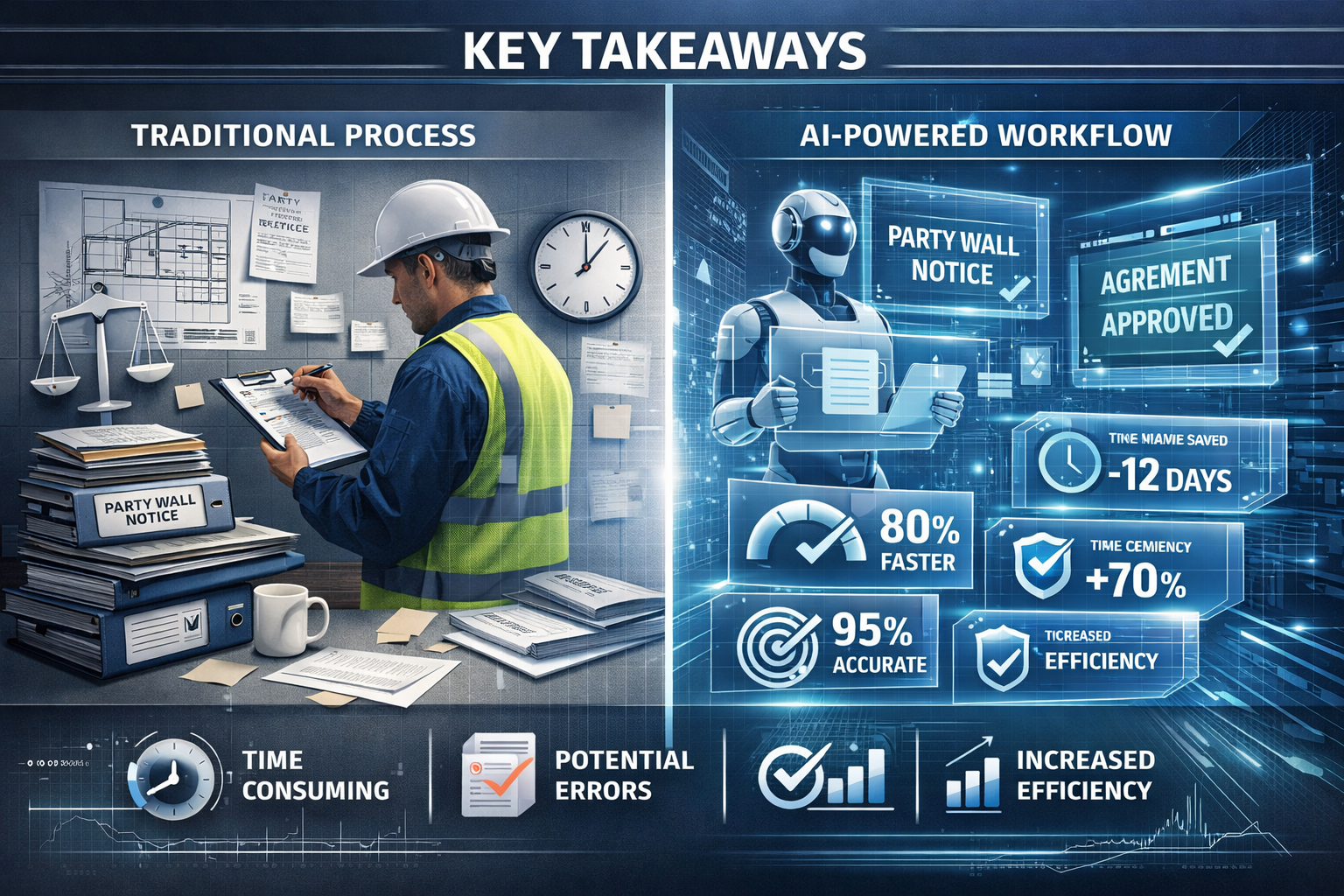
The surveying profession has traditionally relied on manual processes, template libraries, and individual expertise to navigate the complexities of party wall notices and awards. While these methods have served the industry well, they present significant challenges in 2026's fast-paced construction environment.
The Traditional Challenges
Party wall surveyors routinely manage multiple concurrent cases, each requiring:
- Precise statutory notices tailored to specific works and property configurations
- Detailed agreements that protect both building and adjoining owners
- Comprehensive condition surveys documenting pre-works property status
- Meticulous dispute records tracking communications, site visits, and resolution attempts
- Legally compliant awards that stand up to scrutiny and potential appeals
Manual preparation of these documents consumes substantial time, introduces opportunities for transcription errors, and creates bottlenecks when surveyors handle high caseloads across Central London, North London, and beyond.
How AI Changes the Game
Artificial intelligence platforms designed for building surveying applications are transforming these workflows through several key capabilities:
Document Generation 📄
AI systems can analyze project specifications, property details, and statutory requirements to auto-generate compliant party wall notices in minutes rather than hours. These tools draw from extensive databases of precedent language while customizing content to specific circumstances.
Intelligent Review 🔍
Machine learning algorithms trained on thousands of party wall agreements can identify missing clauses, inconsistent terms, and potential compliance issues that human reviewers might overlook during time-pressured reviews.
Workflow Automation ⚙️
From scheduling site visits to tracking response deadlines and generating reminder communications, AI-powered practice management systems keep cases moving efficiently while ensuring nothing falls through the cracks.
Data Analytics 📊
AI tools can analyze historical case data to identify patterns in dispute resolution, predict potential conflict areas, and suggest proactive measures based on similar past situations.
According to recent industry analysis, AI is already changing building surveying by automating lease reviews, processing documentation, and enhancing efficiency across various surveying disciplines[1]. The same principles apply powerfully to party wall work, where standardized procedures and statutory frameworks create ideal conditions for AI augmentation.
AI Tools for Drafting Party Wall Notices: Speed Meets Compliance
Serving proper notice represents the critical first step in any party wall matter. Under the Party Wall etc. Act 1996, building owners must provide specific statutory notices depending on the proposed works. Getting these notices right—with accurate descriptions, correct timelines, and complete information—sets the foundation for smooth project progression.
The Notice Drafting Challenge
Party wall surveyors must prepare several types of notices:
- Party Structure Notices for works directly to party walls
- Line of Junction Notices for new walls at boundaries
- 3-Metre and 6-Metre Notices for excavations near neighboring structures
Each notice type requires specific information, statutory language, and timing. Traditional drafting involves:
- Reviewing architectural plans and structural specifications
- Identifying affected neighbors and properties
- Selecting appropriate notice templates
- Manually populating property addresses, work descriptions, and dates
- Cross-checking statutory requirements and timings
- Proofreading for accuracy and completeness
This process typically consumes 1-3 hours per notice, depending on project complexity.
AI-Powered Notice Generation
Modern AI platforms streamline this workflow dramatically through:
Automated Data Extraction 🤖
AI systems can analyze uploaded architectural drawings, structural calculations, and project specifications to automatically identify:
- Work types requiring party wall notices
- Affected party walls and boundaries
- Excavation depths and proximities
- Structural elements involved
Template Intelligence
Rather than static templates, AI tools use dynamic document assembly that:
- Selects appropriate notice types based on identified works
- Populates fields automatically from extracted project data
- Adjusts language based on specific work descriptions
- Calculates proper notice periods and response deadlines
- Incorporates property-specific details from land registry data
Compliance Checking ✅
Before finalizing notices, AI systems verify:
- Statutory language requirements under the Act
- Completeness of required information
- Accuracy of timelines and deadlines
- Consistency between multiple notices for the same project
- Compliance with recent case law and RICS guidance
Real-World Application Example
Consider a typical loft conversion project in West London involving:
- Steel beam insertion into party wall
- Underpinning within 3 metres of adjoining property
- New party wall at rear extension line of junction
Traditional approach: A surveyor would spend approximately 2.5 hours drafting three separate notices, manually describing each work type, calculating distances, and ensuring statutory compliance.
AI-assisted approach: The surveyor uploads project drawings and specifications. The AI system:
- Identifies all three notice requirements (2 minutes)
- Extracts relevant work descriptions and measurements (3 minutes)
- Generates draft notices with populated fields (5 minutes)
- Runs compliance checks against statutory requirements (2 minutes)
- Presents notices for surveyor review and approval (15 minutes)
Total time: Approximately 30 minutes—an 80% reduction—while improving accuracy and consistency.
Guardrails for Professional Standards
While AI dramatically accelerates notice drafting, professional surveyors must maintain critical oversight:
| AI Function | Required Human Oversight |
|---|---|
| Work identification from drawings | Verify AI correctly interpreted architectural details |
| Automated measurements | Confirm distances and depths against site conditions |
| Template population | Review descriptions for accuracy and clarity |
| Statutory language | Ensure notice remains comprehensible to lay recipients |
| Final approval | Surveyor signs off as professionally responsible party |
The RICS emphasizes that technology should augment, not replace, professional judgment. Surveyors remain personally accountable for all notices served, regardless of the tools used to prepare them.
For those wondering about party wall agreements without a surveyor, AI tools don't eliminate the need for professional expertise—they enhance it by freeing surveyors to focus on judgment calls, client communication, and complex situations where experience matters most.
Streamlining Party Wall Agreements and Awards with AI
Once notices are served and responses received, party wall surveyors must prepare detailed agreements or awards that govern how works proceed. These documents form legally binding contracts between building and adjoining owners, making accuracy and completeness absolutely essential.
The Agreement and Award Process
Traditional preparation of party wall awards involves:
Information Gathering 📋
- Reviewing condition survey reports
- Analyzing structural engineer specifications
- Documenting agreed working hours and access arrangements
- Recording special conditions or concerns
- Compiling photographic evidence
Document Drafting
- Describing permitted works in precise detail
- Specifying protective measures and working methods
- Establishing compensation provisions
- Setting dispute resolution procedures
- Including relevant schedules and appendices
Review and Finalization
- Cross-checking against statutory requirements
- Ensuring consistency with notice descriptions
- Verifying all parties' details and addresses
- Obtaining surveyor signatures
- Serving completed awards on all parties
This process typically requires 4-8 hours for straightforward cases and considerably longer for complex projects involving multiple properties or contentious issues.
AI-Enhanced Agreement Workflows
Artificial intelligence transforms this workflow through several sophisticated capabilities:
Intelligent Document Assembly 🏗️
AI platforms can:
- Pull relevant content from condition survey reports automatically
- Extract work specifications from architectural and structural documents
- Populate award templates with case-specific information
- Generate consistent descriptions across multiple sections
- Create properly formatted schedules and appendices
Clause Libraries and Precedents
Advanced AI systems maintain extensive databases of:
- Standard clauses for common work types
- Precedent language from thousands of previous awards
- Jurisdiction-specific requirements for different London boroughs
- Recent case law affecting award provisions
- RICS best practice recommendations
The system suggests appropriate clauses based on project characteristics while allowing surveyors to customize language for specific circumstances.
Consistency and Completeness Checking ✔️
Machine learning algorithms can:
- Identify inconsistencies between notice descriptions and award provisions
- Flag missing standard clauses or required information
- Detect contradictory terms within the document
- Verify cross-references and section numbering
- Ensure all parties and properties are correctly identified throughout
Advanced Features for Complex Cases
For challenging situations involving multiple types of party wall works, AI tools offer additional capabilities:
Multi-Property Coordination
When works affect several adjoining properties (common in terraced housing), AI systems can:
- Generate coordinated awards with consistent provisions
- Track different response statuses and timelines
- Manage separate condition surveys and schedules
- Ensure fair allocation of costs among multiple parties
Version Control and Amendments
AI-powered document management provides:
- Automatic tracking of draft versions and revisions
- Highlighted changes between versions for easy review
- Audit trails showing who made which modifications
- Simplified amendment processes when work scopes change
Integration with Condition Surveys
Leading platforms connect award generation with schedule of condition documentation:
- Automatically incorporating photographic evidence
- Linking award clauses to specific pre-existing conditions
- Generating comprehensive appendices from survey data
- Creating baseline references for post-works comparisons
Case Study: Basement Excavation in South London
A recent South London basement excavation project demonstrates AI's practical benefits:
Project complexity:
- Excavation exceeding 3 metres depth
- Affecting four adjoining properties
- Requiring underpinning and temporary shoring
- Involving listed building considerations
Traditional approach: The appointed surveyor would spend approximately 12-15 hours preparing four separate awards, ensuring consistency while addressing each property's unique concerns.
AI-assisted approach:
- Surveyor inputs core project specifications once (30 minutes)
- AI generates base award template with standard clauses (15 minutes)
- System creates four property-specific versions (20 minutes)
- AI incorporates unique conditions from each survey (40 minutes)
- Surveyor reviews, customizes, and approves all awards (3 hours)
Total time: Approximately 5 hours—a 60% reduction—with improved consistency across all four documents and fewer opportunities for transcription errors between versions.
Professional Judgment Remains Essential
Despite AI's impressive capabilities, critical decisions require human expertise:
"AI can draft an award, but only an experienced surveyor can determine whether the protective measures are truly adequate for the specific ground conditions and construction methodology involved."
Surveyors must apply professional judgment to:
- Assess risk levels and determine appropriate protective measures
- Evaluate compensation claims for fairness and reasonableness
- Mediate disagreements between building and adjoining owners
- Adapt standard provisions to unusual property configurations
- Consider practical implications of working methods and access requirements
The most effective approach combines AI's efficiency in handling routine documentation with the surveyor's irreplaceable expertise in professional decision-making.
For those seeking guidance on party wall contract templates and awards, AI tools provide excellent starting points, but professional review and customization remain essential for legally sound, practically workable agreements.
AI-Powered Dispute Documentation and Resolution Support

Despite best efforts, party wall disputes arise in approximately 15-20% of cases. When disagreements occur, thorough documentation becomes critical for protecting all parties' interests and supporting fair resolution. This area represents one of the most promising applications of AI Tools for Party Wall Surveyors in 2026: Streamlining Notices, Agreements, and Dispute Documentation.
The Dispute Documentation Challenge
Party wall disputes require meticulous record-keeping:
Communication Tracking 📧
- Emails, letters, and phone call notes
- Site visit reports and observations
- Photographic and video evidence
- Expert opinions and technical reports
- Neighbor complaints and concerns
Timeline Management ⏰
- Chronological sequence of events
- Deadline tracking and compliance monitoring
- Response time documentation
- Escalation point identification
Evidence Organization
- Categorizing documents by issue type
- Cross-referencing related materials
- Maintaining version control
- Ensuring accessibility for all parties
Traditional dispute management relies on manual filing systems, spreadsheet trackers, and individual surveyor organization methods—approaches that become unwieldy as disputes escalate and documentation accumulates.
AI-Enhanced Dispute Management Systems
Modern AI platforms revolutionize dispute handling through:
Automated Chronology Building 📅
AI systems can:
- Scan emails, letters, and reports to extract key dates and events
- Automatically construct chronological timelines
- Identify critical decision points and escalation triggers
- Link related documents to timeline entries
- Update chronologies in real-time as new information arrives
Intelligent Document Categorization
Machine learning algorithms:
- Classify incoming documents by type and subject matter
- Tag materials with relevant issue categories
- Identify duplicate or superseded versions
- Flag urgent items requiring immediate attention
- Organize evidence by claim or counterclaim
Pattern Recognition and Precedent Analysis 🔎
Advanced AI tools can:
- Compare current disputes to historical cases with similar characteristics
- Identify common resolution pathways that proved successful
- Suggest negotiation strategies based on past outcomes
- Predict likely points of compromise or continued disagreement
- Recommend expert evidence types that proved persuasive in comparable situations
Practical Applications in Dispute Resolution
Early Warning Systems
AI platforms can monitor case communications for indicators of escalating conflict:
- Sentiment analysis detecting increasingly hostile language
- Identification of new issues or expanding scope of disagreement
- Recognition of communication breakdowns or non-responses
- Flagging of potential professional conduct concerns
These early warnings enable surveyors to intervene proactively before disputes become entrenched.
Evidence Gap Identification 🕵️
AI systems can analyze dispute documentation to identify:
- Missing evidence needed to support positions
- Inconsistencies requiring clarification
- Unanswered questions or unaddressed concerns
- Areas where additional expert input would strengthen cases
Resolution Pathway Suggestions
Based on dispute characteristics and historical data, AI can propose:
- Mediation approaches likely to succeed
- Technical solutions addressing both parties' concerns
- Compensation ranges consistent with similar cases
- Procedural options for breaking deadlocks
Integration with RICS Professional Standards
The Royal Institution of Chartered Surveyors maintains strict standards for professional conduct in dispute situations. AI tools must support, not undermine, these requirements:
| RICS Requirement | AI Support Function |
|---|---|
| Impartiality and independence | Audit trails showing unbiased documentation of all parties' positions |
| Transparent communication | Automatic logging of all correspondence and discussions |
| Timely responses | Deadline tracking and reminder systems |
| Professional competence | Access to technical resources and precedent research |
| Confidentiality | Secure document storage with access controls |
Ethical Guardrails ⚖️
AI systems must incorporate safeguards ensuring:
- Surveyors retain final decision-making authority
- AI suggestions are clearly identified as such, not presented as determinations
- All parties receive equal access to relevant information
- Professional judgment overrides algorithmic recommendations when appropriate
- Confidential information remains protected
Real-World Dispute Case Example
A recent East London case illustrates AI's value in complex disputes:
Situation: Disagreement over alleged damage to adjoining property during basement excavation, involving:
- Conflicting claims about pre-existing cracks
- Disputes over monitoring data interpretation
- Questions about contractor working methods
- Compensation demands
AI-assisted resolution:
-
Chronology generation (AI): System compiled 6-month timeline from 200+ emails, site reports, and monitoring records in 30 minutes (versus 4+ hours manually)
-
Evidence organization (AI): Categorized 500+ photographs, documents, and reports by issue type and date, with cross-referencing
-
Precedent research (AI): Identified 12 similar historical cases with comparable damage patterns and resolution outcomes
-
Pattern analysis (AI): Highlighted that monitoring data showed movement within normal settlement ranges for the soil type and excavation depth
-
Resolution pathway (Human surveyor): Used AI-compiled evidence and precedents to facilitate mediated settlement, avoiding formal third surveyor appointment
Outcome: Dispute resolved in 6 weeks rather than the typical 4-6 months for comparable cases, with significant cost savings for all parties.
Limitations and Human Oversight Requirements
Despite impressive capabilities, AI dispute tools have important limitations:
Contextual Understanding 🧠
AI systems may miss:
- Subtle interpersonal dynamics affecting negotiations
- Cultural or communication style factors
- Unstated concerns underlying stated positions
- Creative compromise solutions outside standard patterns
Professional Judgment Calls
Surveyors must personally assess:
- Credibility of witness statements and expert opinions
- Reasonableness of claims and counterclaims
- Appropriate balance between technical correctness and practical resolution
- Ethical considerations in settlement recommendations
Legal and Professional Accountability
Ultimately, the appointed surveyor—not the AI system—bears professional responsibility for:
- Award determinations
- Procedural fairness
- Compliance with statutory requirements
- Professional conduct standards
The most effective approach treats AI as a powerful research assistant and documentation tool while preserving the surveyor's essential role as impartial decision-maker and professional expert.
For those dealing with party wall act notices and responses, AI-enhanced dispute documentation provides unprecedented clarity and organization, supporting fair and efficient resolution.
Implementing AI Tools: Practical Considerations for Party Wall Surveyors
Adopting AI Tools for Party Wall Surveyors in 2026: Streamlining Notices, Agreements, and Dispute Documentation requires thoughtful planning and implementation. Success depends on selecting appropriate tools, integrating them into existing workflows, and maintaining professional standards throughout.
Selecting the Right AI Platform
Party wall surveyors should evaluate potential AI tools against several criteria:
Functionality Match 🎯
Does the platform address your specific needs?
- Notice generation and statutory compliance checking
- Agreement and award drafting with precedent libraries
- Dispute documentation and case management
- Condition survey integration
- Practice management and deadline tracking
Data Security and Confidentiality 🔒
Critical considerations include:
- UK data protection compliance (GDPR)
- Secure cloud storage with encryption
- Access controls and user permissions
- Backup and disaster recovery provisions
- Client confidentiality protections
Integration Capabilities
Effective AI tools should connect with:
- Existing practice management systems
- Document storage platforms (cloud and local)
- Email and communication tools
- Accounting and billing software
- Survey and photographic documentation systems
Training and Support 📚
Evaluate vendor offerings for:
- Initial onboarding and training programs
- Ongoing technical support availability
- User documentation and resources
- Regular updates and feature enhancements
- User community and knowledge sharing
Cost Structure
Consider total cost of ownership:
- Subscription fees (monthly or annual)
- Per-user licensing costs
- Implementation and training expenses
- Integration and customization fees
- Long-term value versus manual process costs
Implementation Best Practices
Phased Rollout Approach 📈
Rather than attempting complete transformation overnight, successful firms typically:
- Pilot phase (1-2 months): Test AI tools on a small number of straightforward cases
- Evaluation (2-4 weeks): Assess time savings, accuracy improvements, and user experience
- Refinement (1 month): Adjust workflows and configurations based on pilot learning
- Broader deployment (2-3 months): Expand to full practice with ongoing monitoring
- Optimization (ongoing): Continuously improve processes and leverage new features
Staff Training and Change Management
Technology adoption succeeds when team members:
- Understand the benefits and purpose of new tools
- Receive adequate training and support
- Have opportunities to provide feedback
- See leadership commitment to the change
- Experience quick wins demonstrating value
Quality Assurance Protocols ✅
Maintain professional standards through:
- Mandatory human review of all AI-generated documents before serving
- Spot-checking AI outputs against manual preparation for accuracy validation
- Regular audits of compliance with statutory and RICS requirements
- Client feedback mechanisms to identify issues or concerns
- Continuous improvement processes addressing identified weaknesses
Maintaining RICS Compliance and Professional Standards
The Royal Institution of Chartered Surveyors expects members to use technology responsibly while maintaining professional competence and ethical standards.
Key RICS Principles for AI Use:
Professional Competence 🎓
Surveyors must:
- Understand how AI tools work and their limitations
- Maintain underlying technical knowledge and expertise
- Recognize when AI outputs require additional scrutiny
- Stay current with evolving technology and best practices
Client Service
AI adoption should enhance, not compromise:
- Quality of advice and documentation
- Responsiveness and communication
- Transparency about processes and methods
- Value for money and cost-effectiveness
Accountability
Surveyors remain personally responsible for:
- All professional work product, regardless of tools used
- Accuracy and completeness of documents
- Compliance with statutory requirements
- Ethical conduct and professional standards
Transparency
Consider informing clients about:
- Use of AI tools in service delivery
- How technology enhances quality and efficiency
- Continued professional oversight and accountability
- Data security and confidentiality protections
Cost-Benefit Analysis for Practices
Investing in AI tools requires evaluating financial implications:
Quantifiable Benefits 💰
| Metric | Typical Improvement | Annual Value (10 cases/month) |
|---|---|---|
| Notice drafting time | 70% reduction | 140 hours saved |
| Award preparation time | 60% reduction | 200 hours saved |
| Dispute documentation | 50% reduction | 80 hours saved |
| Error correction/rework | 40% reduction | 60 hours saved |
| Total time savings | 480 hours/year | £24,000-£48,000 (at £50-£100/hour) |
Additional Benefits:
- Improved client satisfaction through faster turnaround
- Enhanced professional reputation for efficiency
- Reduced stress and burnout from administrative burden
- Capacity to handle more cases without additional staff
- Better work-life balance for surveyors
Investment Costs:
- Software subscriptions: £1,200-£3,600 annually
- Training and implementation: £2,000-£5,000 one-time
- Ongoing support and updates: included in subscription
Net benefit: Most practices achieve positive ROI within 3-6 months of implementation.
For surveyors concerned about keeping party wall costs down, AI tools enable more efficient service delivery that benefits both practices and clients through reduced fees and faster resolution.
Future Trends: Where AI and Party Wall Surveying Are Headed
The landscape of AI Tools for Party Wall Surveyors in 2026: Streamlining Notices, Agreements, and Dispute Documentation continues evolving rapidly. Understanding emerging trends helps surveyors prepare for the profession's future.
Emerging Technologies on the Horizon
Natural Language Processing Advances 💬
Next-generation AI will:
- Understand complex verbal instructions and convert them to draft documents
- Analyze site meeting notes and automatically extract action items
- Translate technical surveying language into plain English for lay clients
- Generate customized explanations of awards tailored to recipient sophistication
Computer Vision for Condition Surveys 📸
AI-powered image analysis will:
- Automatically identify and catalog defects from photographs
- Measure crack widths and structural movements from images
- Compare pre- and post-works photographs to detect changes
- Generate annotated condition reports with minimal manual input
Predictive Analytics 📊
Machine learning models will:
- Forecast dispute likelihood based on project and party characteristics
- Predict optimal resolution strategies for specific situations
- Estimate realistic timelines for complex cases
- Identify high-risk projects requiring additional protective measures
Integration with Building Information Modeling (BIM) 🏗️
AI tools will connect directly with:
- 3D building models to automatically identify party wall implications
- Structural analysis software to assess work impacts
- Project management systems for coordinated scheduling
- Contractor documentation for real-time progress tracking
Industry-Wide Transformation
Standardization and Best Practices 📋
As AI adoption grows, expect:
- Industry-wide standards for AI-assisted party wall documentation
- RICS guidance on appropriate AI use and professional oversight
- Shared precedent libraries and knowledge bases
- Collaborative platforms connecting surveyors across regions
Enhanced Accessibility 🌐
AI tools will democratize access to quality party wall services:
- Reduced costs making professional surveying more affordable
- Faster turnaround times minimizing project delays
- Improved consistency reducing disputes and confusion
- Better documentation supporting clearer understanding
Professional Evolution
The surveyor's role will shift toward:
- Strategic advisory work rather than routine documentation
- Complex problem-solving requiring human judgment
- Client relationship management and communication
- Quality oversight of AI-assisted processes
- Specialized expertise in unusual or contentious situations
Preparing for the AI-Augmented Future
Continuous Learning 📖
Successful surveyors will:
- Stay current with emerging AI capabilities and tools
- Develop complementary skills in technology management
- Maintain core technical expertise in party wall matters
- Cultivate judgment and communication abilities AI cannot replicate
Ethical Leadership
The profession must:
- Establish clear guidelines for responsible AI use
- Maintain human accountability and professional standards
- Ensure technology serves clients' and society's interests
- Address concerns about automation and professional roles
Collaborative Innovation
Progress requires:
- Surveyor feedback shaping AI tool development
- Vendor responsiveness to professional needs
- Industry cooperation on standards and best practices
- Regulatory adaptation to technological change
Industry experts predict that digital transformation will continue accelerating across surveying disciplines in 2026 and beyond[4], with AI playing an increasingly central role in professional practice.
Conclusion: Embracing AI While Preserving Professional Excellence
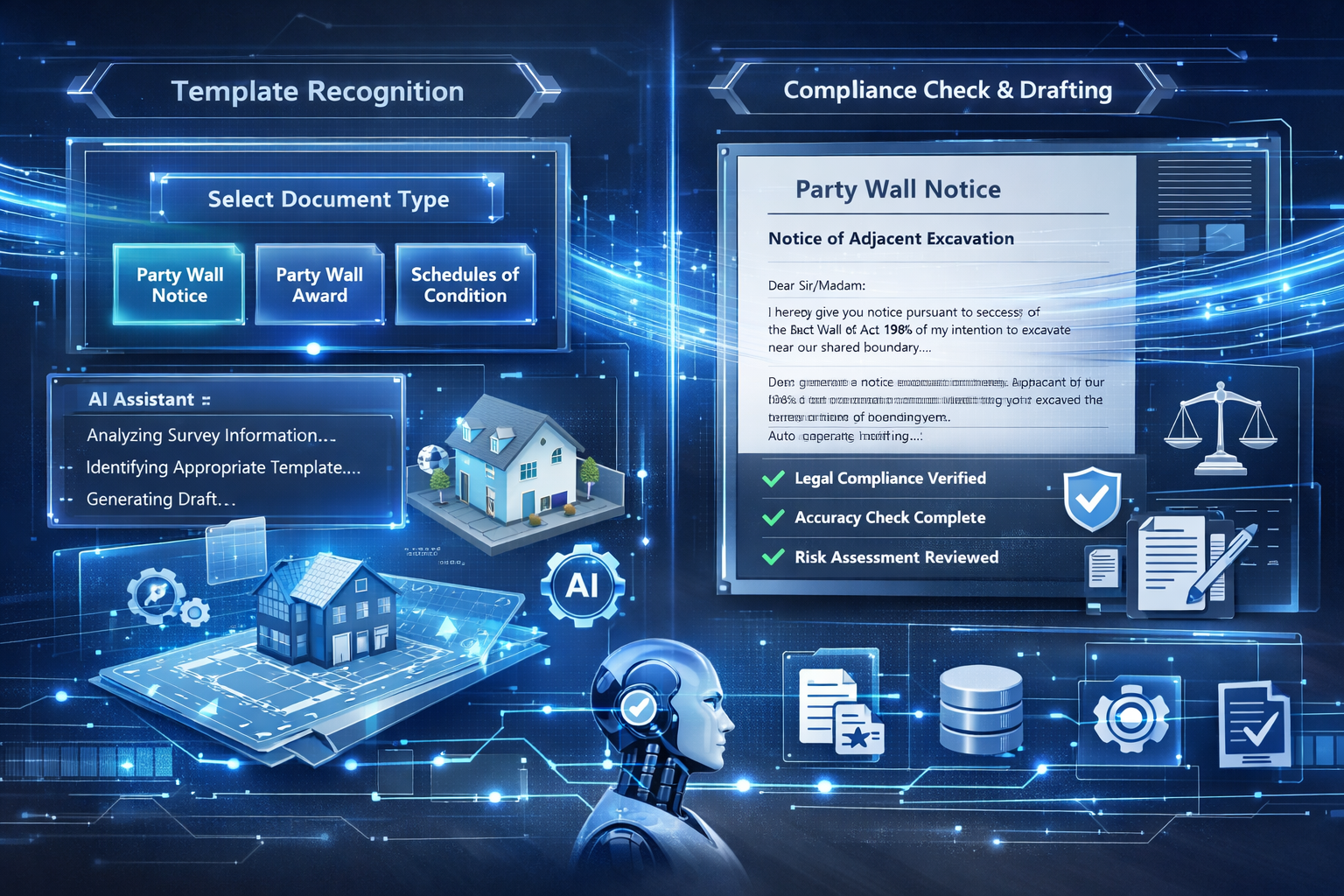
AI Tools for Party Wall Surveyors in 2026: Streamlining Notices, Agreements, and Dispute Documentation represents a transformative opportunity for the profession. By automating routine tasks, enhancing accuracy, and accelerating workflows, artificial intelligence enables surveyors to deliver better service while managing growing caseloads and client expectations.
The evidence is compelling:
✅ 70-80% time savings in notice drafting through automated document generation
✅ 60% faster award preparation with intelligent templates and consistency checking
✅ 50% reduction in dispute documentation time via automated chronologies and organization
✅ Improved accuracy through AI-powered compliance checking and error detection
✅ Enhanced client satisfaction from faster turnaround and reduced costs
Yet technology's promise comes with important responsibilities. Party wall surveyors must:
🎯 Maintain professional judgment as the ultimate decision-making authority
🎯 Ensure RICS compliance through proper oversight and quality assurance
🎯 Preserve accountability for all professional work product
🎯 Protect client interests through ethical, transparent AI use
🎯 Continue developing expertise in core surveying competencies
The most successful approach combines AI's efficiency with human expertise, creating a powerful partnership that elevates professional practice.
Actionable Next Steps for Party Wall Surveyors
Immediate Actions (This Month):
- Research available AI platforms designed for surveying and legal documentation
- Assess current workflows to identify time-consuming tasks suitable for automation
- Calculate potential ROI based on your practice's caseload and fee structure
- Consult with peers about their AI experiences and recommendations
Short-Term Implementation (Next 3 Months):
- Select and trial one AI tool for a specific function (notices, awards, or dispute documentation)
- Establish quality assurance protocols ensuring professional oversight
- Train team members on proper AI tool use and limitations
- Monitor results tracking time savings, accuracy, and client feedback
Long-Term Development (Next 6-12 Months):
- Expand AI integration to additional practice areas based on pilot success
- Refine workflows optimizing the balance between automation and human expertise
- Invest in ongoing training keeping current with evolving capabilities
- Contribute to professional dialogue sharing experiences and shaping best practices
The Path Forward
The party wall surveying profession stands at an inflection point. Those who thoughtfully embrace AI tools while maintaining rigorous professional standards will thrive in 2026's competitive environment. They'll deliver superior service, achieve better work-life balance, and position themselves as forward-thinking leaders in the field.
The technology exists. The benefits are proven. The question is no longer whether to adopt AI, but how to implement it responsibly and effectively.
For building owners, adjoining owners, and the broader construction industry, AI-augmented party wall surveying promises faster project progression, reduced costs, and more consistent outcomes. For surveyors themselves, it offers liberation from administrative burden and the opportunity to focus on the challenging, rewarding aspects of professional practice that drew them to the field.
The future of party wall surveying is here—intelligent, efficient, and more professional than ever.
Whether you're a building owner's surveyor, an adjoining owner's surveyor, or serve in both capacities, embracing AI tools while maintaining professional excellence will define success in 2026 and beyond.
References
[1] How Ai Is Changing Building Surveying Opportunities And Limitations – https://www.eddisons.com/insights/how-ai-is-changing-building-surveying-opportunities-and-limitations
[2] Top 7 Ai Powered Tools Land Surveyors Can T Afford To Ignore In T – https://landsurveyorsunited.com/articles/top-7-ai-powered-tools-land-surveyors-can-t-afford-to-ignore-in-t
[3] Best Ai Tools For Real Estate – https://www.v7labs.com/blog/best-ai-tools-for-real-estate
[4] Doubling Down On Digital Top 6 Surveying Trends Shaping 2026 From Trimble Experts – https://nottinghillsurveyors.com/blog/doubling-down-on-digital-top-6-surveying-trends-shaping-2026-from-trimble-experts
[5] Where We Are And Where We Are Headed With Ai On Ibm I – https://www.itjungle.com/2026/02/16/where-we-are-and-where-we-are-headed-with-ai-on-ibm-i/
[6] 97984 Beyond The Blueprint Six Ai Solutions Revolutionizing Walls And Ceilings – https://www.wconline.com/articles/97984-beyond-the-blueprint-six-ai-solutions-revolutionizing-walls-and-ceilings