

When deep foundation work threatens neighboring properties, time matters. In 2026, autonomous drones in Party Wall Act excavations are revolutionizing how building professionals conduct safe, rapid notice assessments for deep foundations, eliminating traditional access barriers while delivering unprecedented accuracy. This technological shift represents more than efficiency—it's transforming compliance, safety, and neighbor relations in construction projects across the UK.
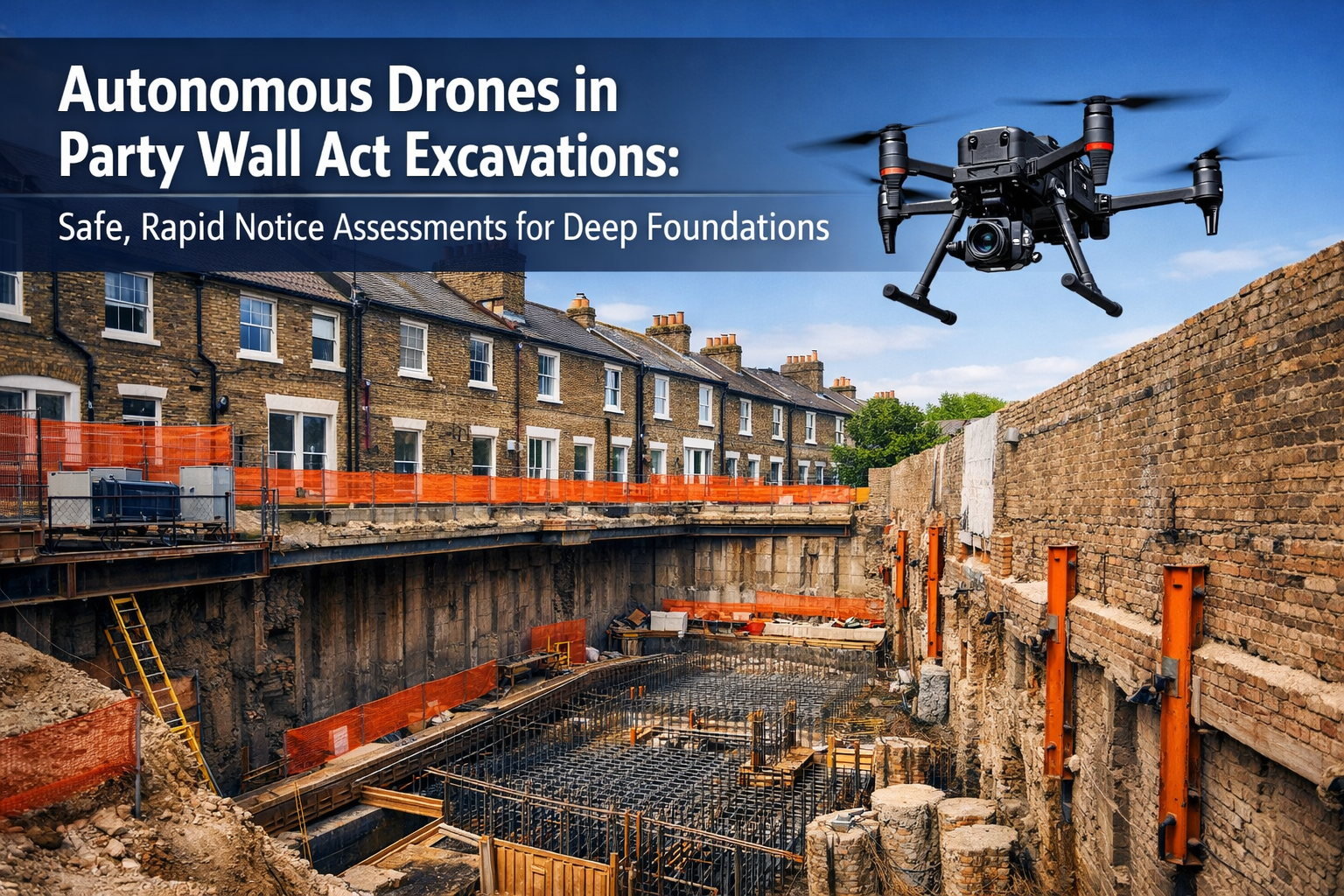
The traditional approach to Party Wall Act notices often involved surveyors navigating dangerous excavation sites, requesting access to adjoining properties, and manually documenting conditions. Autonomous drones now capture comprehensive data from safe distances, complete assessments in hours rather than days, and provide irrefutable digital evidence that satisfies legal requirements under the Party Wall etc. Act 1996.
Key Takeaways
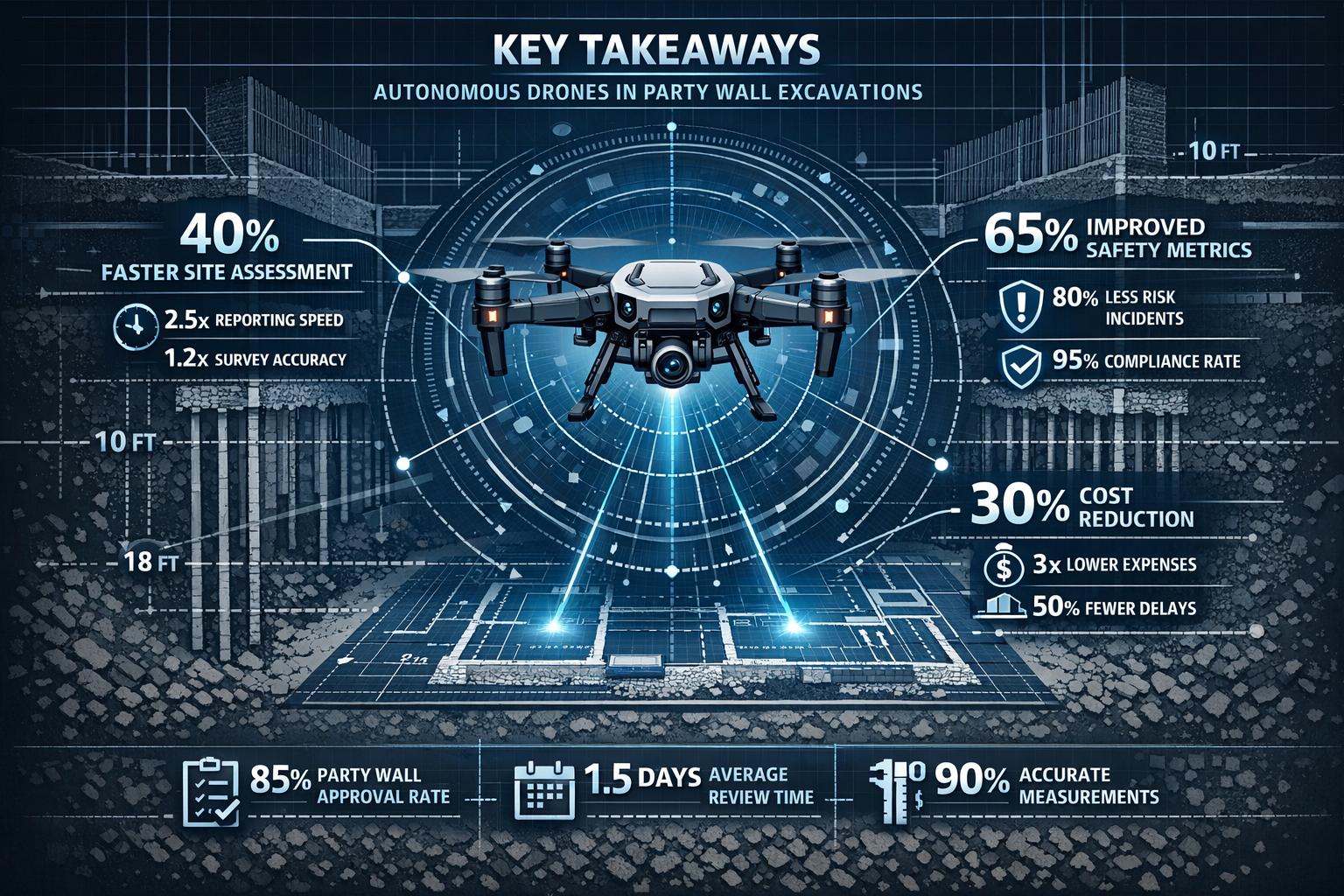
- 🚁 Autonomous drones eliminate access barriers for Section 6 notice assessments, capturing excavation risks without entering adjoining properties
- ⚡ Assessment speed increases by 70-80% compared to traditional manual surveys, with AI-driven analysis delivering reports within hours
- 🛡️ Safety improvements are substantial, removing surveyors from hazardous deep excavation environments while maintaining compliance standards
- 📊 Digital evidence quality surpasses manual documentation, with 3D models, thermal imaging, and millimeter-precise measurements
- ⚖️ 2026 protocols ensure full Party Wall Act compliance, with drone data meeting legal standards for condition reports and dispute resolution
Understanding Party Wall Act Requirements for Deep Foundation Work
The Party Wall etc. Act 1996 establishes specific obligations when excavation work occurs near neighboring properties. Section 6 notices specifically address excavations within three or six meters of adjoining structures, depending on depth relative to neighboring foundations.
Traditional Section 6 Notice Challenges
Building owners undertaking deep foundation work traditionally faced several obstacles:
- Access negotiations with adjoining owners often delayed projects by weeks
- Safety concerns required extensive precautions for surveyors inspecting deep excavations
- Documentation limitations meant relying on photographs and manual measurements
- Dispute vulnerability arose from subjective assessments and incomplete records
- Weather dependencies restricted when assessments could occur safely
These challenges created friction between neighbors, increased costs of party wall processes, and sometimes compromised assessment quality when conditions were less than ideal.
What Section 6 Requires
Before excavating for foundations within the prescribed distances, building owners must:
- Serve proper party wall notices to adjoining owners
- Document existing conditions of neighboring properties through a schedule of condition
- Demonstrate adequate underpinning or safeguarding measures
- Monitor for movement or damage during excavation
- Address any damage caused by the works
Autonomous drones now address each requirement with greater efficiency and accuracy than traditional methods.
How Autonomous Drones Transform Section 6 Assessments
The integration of autonomous drones in Party Wall Act excavations represents a fundamental shift in assessment methodology. Unlike manually piloted drones, autonomous systems follow pre-programmed flight paths, ensuring comprehensive coverage and repeatable results.
AI-Driven Autonomy in Construction Surveying
Modern construction drones leverage artificial intelligence to navigate complex environments safely. According to industry analysis, AI-driven autonomy is transforming industries worldwide in 2026, with construction surveying among the primary beneficiaries [5]. These systems incorporate:
- Obstacle avoidance algorithms that detect scaffolding, cranes, and structures in real-time
- Automated flight planning that optimizes coverage based on site geometry
- Adaptive positioning that adjusts for wind and environmental conditions
- Intelligent data capture that identifies areas requiring additional documentation
The autonomous capability proves particularly valuable for types of party wall works involving deep excavations, where site conditions change rapidly and manual piloting would be challenging.
Capturing Excavation Risks Without Site Access
One of the most significant advantages involves eliminating the need to enter adjoining properties for initial assessments. Autonomous drones equipped with high-resolution cameras, thermal sensors, and LiDAR systems can:
Document external conditions comprehensively:
- Capture 360-degree imagery of all elevations
- Identify existing cracks, settlement, or structural concerns
- Record drainage systems, landscaping, and site features
- Generate baseline 3D models for comparison
Monitor excavation proximity safely:
- Measure exact distances from excavation to foundations
- Document soil conditions and water table indicators
- Track excavation depth progression
- Identify potential undermining risks
Provide non-intrusive monitoring:
- Conduct regular flyovers without disturbing occupants
- Capture data during optimal lighting conditions
- Create time-lapse documentation of work progression
- Enable remote review by all parties
This approach significantly reduces friction in the party wall agreement process, as adjoining owners need not accommodate multiple site visits during initial assessment phases.
Speed and Safety Advantages
Assessment timeframes compress dramatically with autonomous systems:
| Assessment Phase | Traditional Method | Autonomous Drone Method |
|---|---|---|
| Initial site survey | 4-6 hours | 30-45 minutes |
| Condition documentation | 2-3 site visits | Single automated flight |
| Measurement verification | Manual with tools | Automated from 3D model |
| Report compilation | 3-5 business days | 4-8 hours with AI analysis |
| Follow-up monitoring | Scheduled site visits | On-demand automated flights |
Safety improvements are equally substantial. Rather than surveyors descending into deep excavations or working near unstable ground, drones capture all necessary data from safe positions. This aligns with 2026 public safety protocols emphasizing risk reduction in construction environments [3].
Technical Capabilities: What Autonomous Drones Capture for Party Wall Compliance
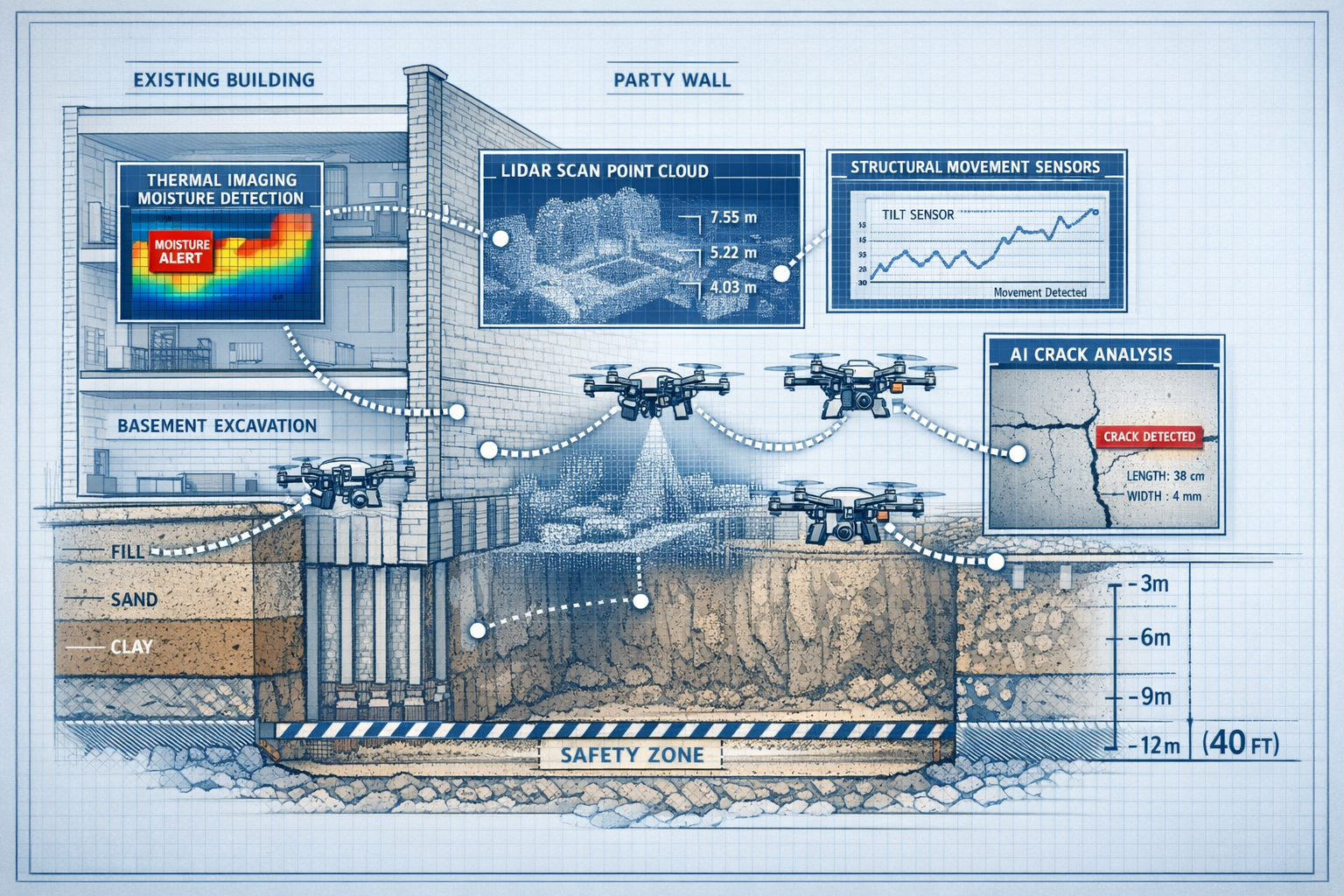
The data quality from autonomous drone systems exceeds traditional manual documentation in both precision and comprehensiveness. Modern systems integrate multiple sensor types to create detailed digital records that satisfy legal requirements under the Party Wall Act.
Multi-Sensor Data Integration
High-resolution optical imaging provides:
- 48+ megapixel photographs with millimeter-level detail
- True-color documentation of existing conditions
- Macro imaging of cracks and structural features
- Time-stamped, GPS-tagged image metadata
Thermal imaging capabilities reveal:
- Moisture infiltration indicating drainage issues
- Insulation gaps that may affect structural assessments
- Heat signatures suggesting cavity problems
- Underground water flow patterns near excavations
LiDAR scanning technology generates:
- 3D point clouds with sub-centimeter accuracy
- Precise distance measurements to foundations
- Volumetric calculations of excavation depth
- Digital terrain models for settlement analysis
Multispectral sensors detect:
- Vegetation stress indicating subsurface issues
- Material composition variations in walls
- Historical repair work not visible to naked eye
- Moisture patterns in building facades
This comprehensive data collection ensures party wall awards rest on objective, verifiable evidence rather than subjective observations.
AI-Powered Analysis and Reporting
Artificial intelligence transforms raw drone data into actionable insights. Advanced algorithms automatically:
Identify structural concerns:
- Detect and measure crack patterns
- Classify crack severity using established engineering standards
- Compare current conditions against baseline surveys
- Flag changes requiring immediate attention
Generate compliance documentation:
- Produce detailed schedules of condition
- Create annotated site plans showing excavation proximity
- Compile photographic evidence organized by property elevation
- Generate measurement reports with accuracy certifications
Enable predictive monitoring:
- Track subtle movement over time using repeat surveys
- Predict settlement risks based on soil and excavation data
- Alert stakeholders to emerging issues before visible damage
- Recommend mitigation measures based on detected patterns
This AI-driven approach dramatically reduces the time required for building owners' surveyors and adjoining owners' surveyors to compile comprehensive reports.
Digital Evidence Standards for Legal Compliance
For drone-captured data to satisfy Party Wall Act requirements, it must meet specific standards:
✅ Authenticity verification through blockchain timestamping
✅ Measurement calibration with certified reference points
✅ Chain of custody documentation for dispute resolution
✅ Format compatibility with standard surveying software
✅ Retention protocols meeting legal archival requirements
Professional drone operators working on party wall matters in 2026 follow established protocols ensuring data admissibility in dispute resolution proceedings. This includes calibration certificates for sensors, flight log documentation, and quality assurance checks comparing drone measurements against traditional survey methods.
2026 Protocols: Regulatory Framework and Best Practices
The regulatory landscape for construction drones has matured significantly. While security concerns have led to restrictions on certain drone technologies in sensitive applications [4], construction surveying for party wall matters operates under clear guidelines that balance innovation with safety.
UK Construction Drone Regulations
Civil Aviation Authority (CAA) requirements for construction drones include:
- Operator certification and ongoing training
- Registration of drones over 250 grams
- Operational authorizations for specific use cases
- Insurance coverage for third-party liability
- Compliance with privacy and data protection laws
Construction-specific protocols address:
- Site notification requirements before drone operations
- Coordination with other contractors and equipment
- Emergency procedures for equipment malfunctions
- Weather limitations and operational windows
- Noise considerations in residential areas
Privacy and Data Protection Considerations
When conducting autonomous drone surveys for party wall assessments, operators must navigate privacy concerns carefully. The balance between legitimate surveying needs and privacy rights has been examined extensively, with policy frameworks emphasizing transparency and proportionality [2].
Best practices include:
- Advance notification to all affected parties about drone operations
- Purpose limitation ensuring captured data serves only party wall assessment needs
- Data minimization avoiding unnecessary capture of private spaces
- Secure storage with encryption and access controls
- Retention limits deleting data after legal retention periods expire
These protocols ensure that party wall notices accompanied by drone survey data respect both legal requirements and neighbor privacy.
Integration with Traditional Surveying Practice
Autonomous drones complement rather than replace professional surveying expertise. The 2026 best practice framework positions drones as tools that enhance surveyor capabilities:
Surveyors remain essential for:
- Interpreting data within legal and technical contexts
- Making professional judgments about risk and remediation
- Negotiating between building and adjoining owners
- Preparing formal party wall awards and agreements
- Providing expert testimony in dispute resolution
Drones excel at:
- Data collection in hazardous or inaccessible locations
- Providing objective, repeatable measurements
- Creating comprehensive visual documentation
- Enabling frequent monitoring without disruption
- Reducing assessment costs and timeframes
This collaborative approach ensures that technology serves the fundamental purposes of the Party Wall Act: protecting adjoining owners while enabling necessary construction work.
Practical Implementation: Deploying Drones for Deep Foundation Projects
Successfully integrating autonomous drones into party wall processes requires careful planning and execution. Projects involving deep foundations present unique challenges that demand specialized approaches.
Pre-Excavation Assessment Workflow
Step 1: Initial Site Analysis
- Survey site boundaries and identify all adjoining properties
- Determine Section 6 notice requirements based on excavation plans
- Assess airspace constraints (trees, overhead wires, building proximity)
- Plan autonomous flight paths for comprehensive coverage
Step 2: Stakeholder Communication
- Serve proper party wall notices to adjoining owners
- Inform neighbors about planned drone operations
- Explain data collection purposes and privacy protections
- Coordinate timing to minimize disruption
Step 3: Baseline Documentation
- Execute autonomous survey flights capturing all elevations
- Generate detailed schedules of condition for adjoining properties
- Create 3D models establishing pre-work conditions
- Archive data with proper metadata and certification
Step 4: Excavation Planning Validation
- Verify excavation depth and proximity measurements
- Assess underpinning requirements using terrain models
- Identify potential risks to adjoining foundations
- Document safeguarding measures in party wall awards
During-Excavation Monitoring
Autonomous drones provide unmatched capability for ongoing monitoring as deep foundation work progresses:
Weekly monitoring flights:
- Track excavation depth progression
- Monitor for ground movement or settlement
- Document water management and dewatering
- Verify compliance with approved methods
Triggered assessments:
- Respond immediately to adjoining owner concerns
- Investigate reported cracks or damage
- Document weather events affecting site conditions
- Capture evidence following unexpected ground conditions
Comparative analysis:
- Overlay current surveys against baseline models
- Quantify any structural movement in millimeters
- Generate change detection reports automatically
- Alert stakeholders to significant variations
This continuous monitoring capability transforms party wall practice from periodic inspections to real-time oversight, catching potential issues before they escalate into disputes.
Post-Completion Documentation
Final drone surveys provide closure documentation:
- Confirm completion of underpinning or safeguarding works
- Document final conditions of adjoining properties
- Verify no damage occurred or document remediation
- Archive final survey data for future reference
This comprehensive digital record protects both building and adjoining owners, providing clear evidence of conditions throughout the project lifecycle.
Cost-Benefit Analysis: Economic Impact on Party Wall Projects
The financial implications of adopting autonomous drone technology extend beyond direct surveying costs to affect overall project economics.
Direct Cost Comparisons
Traditional manual assessment costs:
- Surveyor site visits: £800-1,200 per property
- Follow-up inspections: £400-600 each
- Specialist equipment rental: £200-400
- Report preparation: £600-1,000
- Total typical cost: £2,000-3,200 per adjoining property
Autonomous drone assessment costs:
- Initial drone survey: £600-900 (covers multiple properties)
- AI-powered analysis: £300-500
- Report generation: £200-400
- Follow-up surveys: £200-300 each
- Total typical cost: £1,300-2,100 for first property, £400-600 for additional properties
Indirect Economic Benefits
Project timeline acceleration:
- Reduced assessment time prevents construction delays
- Faster dispute resolution through objective evidence
- Earlier project completion and occupancy
- Estimated value: £2,000-5,000 per week saved
Risk mitigation value:
- Early detection prevents major damage claims
- Comprehensive documentation reduces dispute liability
- Insurance premium reductions for documented projects
- Estimated value: £5,000-20,000 in avoided claims
Relationship preservation:
- Non-intrusive monitoring maintains neighbor goodwill
- Reduced friction decreases dispute likelihood
- Positive relationships facilitate future projects
- Estimated value: Difficult to quantify but substantial
For projects involving multiple adjoining properties—common in Central London, East London, or other dense urban areas—the economic advantages multiply significantly.
Case Applications: Where Autonomous Drones Excel
Certain party wall scenarios benefit particularly from autonomous drone deployment:
Terraced Housing Developments
Victorian and Edwardian terraces present classic party wall challenges. Deep basement conversions or foundation repairs affect multiple adjoining properties simultaneously. Autonomous drones can:
- Survey entire terrace blocks in single operations
- Identify shared structural issues affecting multiple properties
- Monitor settlement patterns across connected structures
- Provide consistent documentation for all affected owners
This proves especially valuable in areas like North London and South London where terraced housing predominates.
Commercial Deep Foundations
Large commercial developments with substantial excavations benefit from:
- Rapid assessment of numerous adjoining properties
- Continuous monitoring throughout extended construction periods
- Integration with project management systems
- Stakeholder access to real-time survey data
Complex Boundary Situations
Properties with challenging boundary wall configurations or party fence walls benefit from precise 3D mapping that clarifies ownership and structural relationships.
Restricted Access Scenarios
When adjoining properties are vacant, occupied by vulnerable residents, or otherwise difficult to access, autonomous drones provide assessment capabilities without requiring entry.
Future Developments: What's Next for Construction Drones
The trajectory of autonomous drone technology suggests continued advancement in capabilities relevant to party wall practice.
Enhanced Autonomy and AI Capabilities
Emerging developments include:
- Fully autonomous operations requiring no human pilot oversight
- Advanced AI interpretation providing preliminary structural engineering assessments
- Predictive modeling forecasting settlement risks based on soil and loading data
- Integrated reporting automatically generating draft party wall awards
Regulatory Evolution
The regulatory framework continues evolving to accommodate technological capabilities while addressing legitimate concerns. Recent legislative developments, such as enhanced law enforcement capabilities and security frameworks [1][3], inform construction drone protocols by establishing precedents for responsible deployment.
Integration with Building Information Modeling (BIM)
Future systems will seamlessly integrate drone survey data with BIM platforms, enabling:
- Real-time updates to digital building models
- Automated clash detection between excavations and existing structures
- Coordinated planning across multiple construction disciplines
- Enhanced collaboration between building owners, surveyors, and contractors
Standardization and Certification
Industry bodies are developing standardized protocols for drone-based party wall assessments, including:
- Certification programs for construction drone operators
- Data format standards ensuring interoperability
- Quality assurance frameworks for survey accuracy
- Professional indemnity insurance tailored to drone operations
Conclusion: Embracing Innovation While Respecting Tradition
Autonomous drones in Party Wall Act excavations represent a significant advancement in construction practice, delivering safe, rapid notice assessments for deep foundations while maintaining the protective intent of the legislation. The technology addresses longstanding challenges in party wall practice: access difficulties, safety concerns, documentation quality, and assessment speed.
However, successful implementation requires balancing innovation with the fundamental principles underlying the Party Wall etc. Act 1996. The legislation exists to protect property rights and ensure fair treatment of all parties affected by construction work. Drones serve these purposes by providing better information more efficiently—they don't replace the professional judgment, negotiation skills, and legal expertise that surveyors bring to party wall matters.
Key Implementation Recommendations
For building owners planning deep foundation work:
- Engage surveyors experienced with drone technology early in project planning
- Budget for comprehensive drone surveys as part of party wall costs
- Communicate proactively with adjoining owners about assessment methods
- Leverage drone data to demonstrate commitment to protecting neighboring properties
For adjoining owners receiving Section 6 notices:
- Understand that drone surveys provide superior documentation of your property's condition
- Request access to digital survey data for your own records
- Ensure your appointed surveyor has expertise interpreting drone-captured data
- Recognize that non-intrusive monitoring protects your privacy while ensuring oversight
For surveyors and construction professionals:
- Invest in training on drone technology and data interpretation
- Develop relationships with certified drone operators specializing in construction
- Establish protocols integrating drone data into traditional party wall workflows
- Stay current on regulatory developments affecting construction drone operations
Taking Action
The construction industry stands at a technological inflection point. Those who thoughtfully integrate autonomous drone capabilities into party wall practice will deliver superior outcomes for clients while advancing professional standards. The technology exists, regulations provide clear frameworks, and economic benefits are substantial.
Whether you're planning deep foundation work, responding to a neighbor's excavation project, or providing professional surveying services, consider how autonomous drones can enhance safety, accuracy, and efficiency in your next party wall matter. The future of construction surveying has arrived—and it's taking flight.
For expert guidance on party wall matters incorporating the latest technology, contact experienced professionals who understand both traditional practice and innovative assessment methods.
References
[1] Europes Drone Wall A New Strategy For A New Era Of Airspace Threats – https://d-fendsolutions.com/blog/europes-drone-wall-a-new-strategy-for-a-new-era-of-airspace-threats/
[2] Aclu Drone Policy White Paper Access – https://dronelife.com/2026/03/26/aclu-drone-policy-white-paper-access/
[3] Public Safety Uas In 2026 A Year Of Transition Security And Innovation – https://www.autonomyglobal.co/public-safety-uas-in-2026-a-year-of-transition-security-and-innovation/
[4] Artba Seeks Clarity On Drones – https://www.artba.org/news/artba-seeks-clarity-on-drones/
[5] 2026 Drone Revolution Ai Autonomy Transforms Industries Worldwide – https://droneworld.co.in/2026-drone-revolution-ai-autonomy-transforms-industries-worldwide/