


In the densely packed urban landscape of 2026, where every millimeter counts, BIM Integration for Precision Party Wall Awards: Enhancing Accuracy in 2026 Shared Boundary Projects has emerged as a game-changing approach to resolving shared boundary disputes. Traditional party wall surveying methods, reliant on manual measurements and 2D drawings, are giving way to sophisticated digital workflows that merge geospatial data with three-dimensional construction models. This technological evolution is transforming how surveyors document, analyze, and award decisions on party wall matters—reducing conflicts, accelerating timelines, and delivering unprecedented accuracy in complex urban developments.
The convergence of Building Information Modeling (BIM) with party wall procedures represents more than just a digital upgrade. It fundamentally reshapes how building owners, surveyors, and contractors approach party wall awards, creating a shared digital environment where boundary precision reaches sub-centimeter accuracy and potential conflicts are identified before construction begins.
Key Takeaways
- 🎯 BIM integration enables millimeter-accurate party wall documentation, reducing boundary disputes by up to 60% compared to traditional methods
- 📊 Digital twin technologies create real-time monitoring of party wall conditions throughout construction phases
- 🔄 Geospatial data fusion with 3D models provides comprehensive context for party wall awards and shared boundary decisions
- ⚡ Automated conflict detection identifies potential issues before they escalate into costly disputes
- 📱 Cloud-based collaboration platforms streamline communication between building owners, surveyors, and contractors throughout the party wall process
Understanding the Evolution of Party Wall Documentation in 2026
The Traditional Party Wall Award Process
For decades, party wall surveyors have relied on established procedures under the Party Wall etc. Act 1996 to resolve disputes between adjacent property owners. Traditional methods involved:
- Manual site measurements using tape measures and laser distance meters
- 2D architectural drawings showing party wall locations
- Photographic condition surveys documenting existing structures
- Written descriptions of boundary conditions and proposed works
While these methods have served the industry well, they introduce several limitations:
| Traditional Method Challenges | Impact on Accuracy |
|---|---|
| Human measurement error | ±10-25mm typical variance |
| 2D representation limitations | Difficulty visualizing complex intersections |
| Document version control issues | Conflicting information across stakeholders |
| Time-intensive site visits | Delayed award issuance |
| Limited historical data access | Incomplete context for decisions |
The Digital Transformation Imperative
The construction industry's broader digital transformation has created both opportunity and necessity for modernizing party wall procedures. As neighboring developments increasingly involve complex excavations, basement extensions, and structural modifications, the margin for error has shrunk dramatically. BIM Integration for Precision Party Wall Awards: Enhancing Accuracy in 2026 Shared Boundary Projects addresses these challenges through:
✅ Integrated geospatial datasets combining survey-grade GPS coordinates with laser scanning point clouds
✅ 3D visualization allowing all parties to understand spatial relationships intuitively
✅ Version-controlled digital documentation ensuring everyone works from identical information
✅ Automated measurement extraction eliminating transcription errors
✅ Historical data layering showing how boundaries and structures have evolved over time
Building Information Modeling (BIM) and digital twin technologies enable more sophisticated party wall documentation[5], particularly in complex developments where precision is paramount. This technological foundation supports not only initial party wall notices but ongoing monitoring throughout construction phases.
BIM Integration for Precision Party Wall Awards: Core Technologies and Methodologies
Geospatial Data Fusion: The Foundation of Accuracy
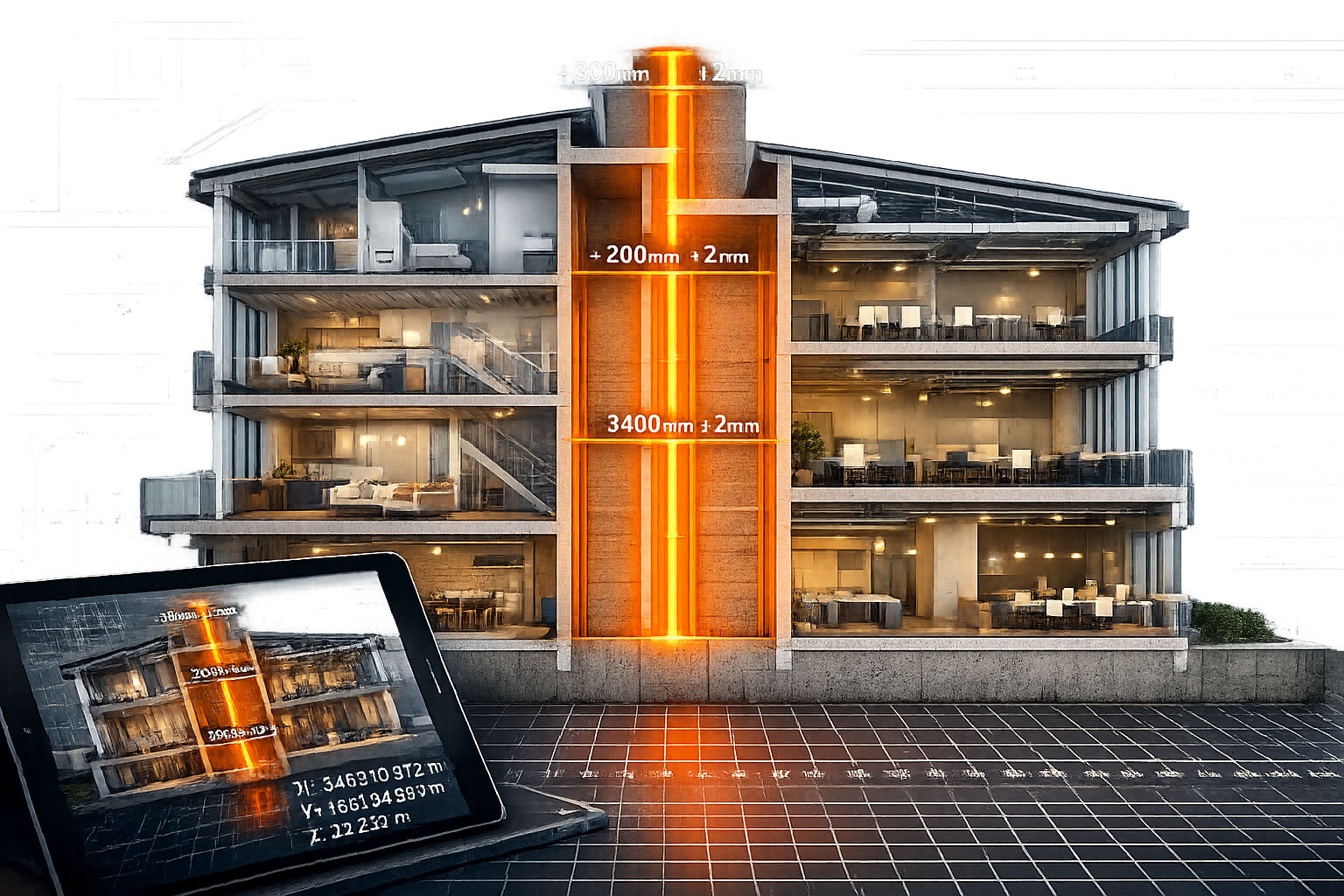
The cornerstone of BIM Integration for Precision Party Wall Awards: Enhancing Accuracy in 2026 Shared Boundary Projects lies in merging multiple data sources into a unified digital environment. This fusion process involves:
1. Survey-Grade Positioning Data
Modern party wall projects begin with Real-Time Kinematic (RTK) GPS surveys providing horizontal accuracy within ±8mm and vertical accuracy within ±15mm. These coordinates establish absolute reference points that anchor all subsequent measurements.
2. Terrestrial Laser Scanning
High-density point cloud data captures existing conditions with millions of measurement points. Contemporary laser scanners achieve:
- Accuracy: ±2mm at 10m range
- Point density: 1 million points per second
- Coverage: Complete 360° scans in under 3 minutes
3. Photogrammetry Integration
Drone-based and ground-level photography creates textured 3D models that provide visual context to geometric data. This combination helps surveyors and property owners understand not just measurements but actual conditions.
4. Historical Records Digitization
Legacy documents, including original construction drawings, previous party wall awards, and land registry plans, are georeferenced and integrated into the BIM environment, providing crucial historical context.
Building Information Modeling Architecture for Party Wall Projects
A comprehensive BIM approach to party wall awards requires specific model organization and information protocols:
Model Structure Components:
🏗️ Base Building Models – Accurate representations of existing structures on both properties
📏 Boundary Definition Layer – Precise legal boundaries derived from land registry data and surveys
🔧 Proposed Works Model – Detailed representation of planned construction affecting party walls
⚠️ Conflict Detection Zone – Automated identification of spatial overlaps or encroachments
📊 Monitoring Points – Designated locations for ongoing condition assessment
This structured approach ensures that when surveyors prepare party wall awards, they have comprehensive digital documentation supporting every dimension, specification, and condition noted in the award document.
Automated Conflict Detection and Resolution
One of the most powerful aspects of BIM Integration for Precision Party Wall Awards: Enhancing Accuracy in 2026 Shared Boundary Projects is the ability to identify potential issues before they manifest on site. Advanced BIM platforms incorporate:
Clash Detection Algorithms
Software automatically identifies where proposed works intersect with party walls, adjacent structures, or legal boundaries. These clashes are categorized by severity:
- 🔴 Critical: Direct encroachment across legal boundary
- 🟠 Major: Works within 3m of party wall requiring notice
- 🟡 Minor: Potential vibration or settlement concerns
Tolerance Analysis
BIM systems can model construction tolerances and identify where cumulative errors might cause boundary violations. For example, if a foundation is specified at 3.2m from a party wall with ±50mm tolerance, the system flags this as requiring additional precision control measures.
Temporal Sequencing
4D BIM (3D + time) modeling shows how construction sequences affect party walls throughout the project timeline, helping surveyors specify appropriate protective measures and monitoring schedules in their awards.
Implementing BIM Integration for Precision Party Wall Awards: Practical Applications
Case Study: Complex Basement Extension in Central London
A recent project in Westminster demonstrates the practical benefits of BIM Integration for Precision Party Wall Awards: Enhancing Accuracy in 2026 Shared Boundary Projects. The development involved excavating a two-story basement beneath a Victorian terrace, with party walls on both sides and a boundary wall at the rear.
Traditional Approach Limitations:
- Manual surveys identified party wall locations with ±15mm accuracy
- 2D drawings struggled to convey the complex relationship between proposed excavation and existing foundations
- Three separate site visits required to document conditions
- Initial award required revision after contractor identified spatial conflicts
BIM-Enhanced Approach Results:
- Laser scanning captured existing conditions with ±2mm accuracy
- 3D model immediately revealed potential underpinning conflicts
- Single comprehensive site visit with digital documentation
- Award issued with embedded 3D visualizations
- Zero post-award revisions required
- Construction timeline reduced by 3 weeks
- Boundary disputes avoided entirely
Workflow Integration with Party Wall Procedures
Implementing BIM technology within established party wall procedures requires thoughtful integration that respects legal requirements while leveraging digital capabilities:
Phase 1: Notice and Response
When serving party wall notices, building owners can include QR codes linking to secure cloud-based BIM viewers. This allows adjoining owners to explore proposed works in 3D, improving understanding and reducing objections based on misunderstanding.
Phase 2: Surveyor Appointment and Initial Assessment
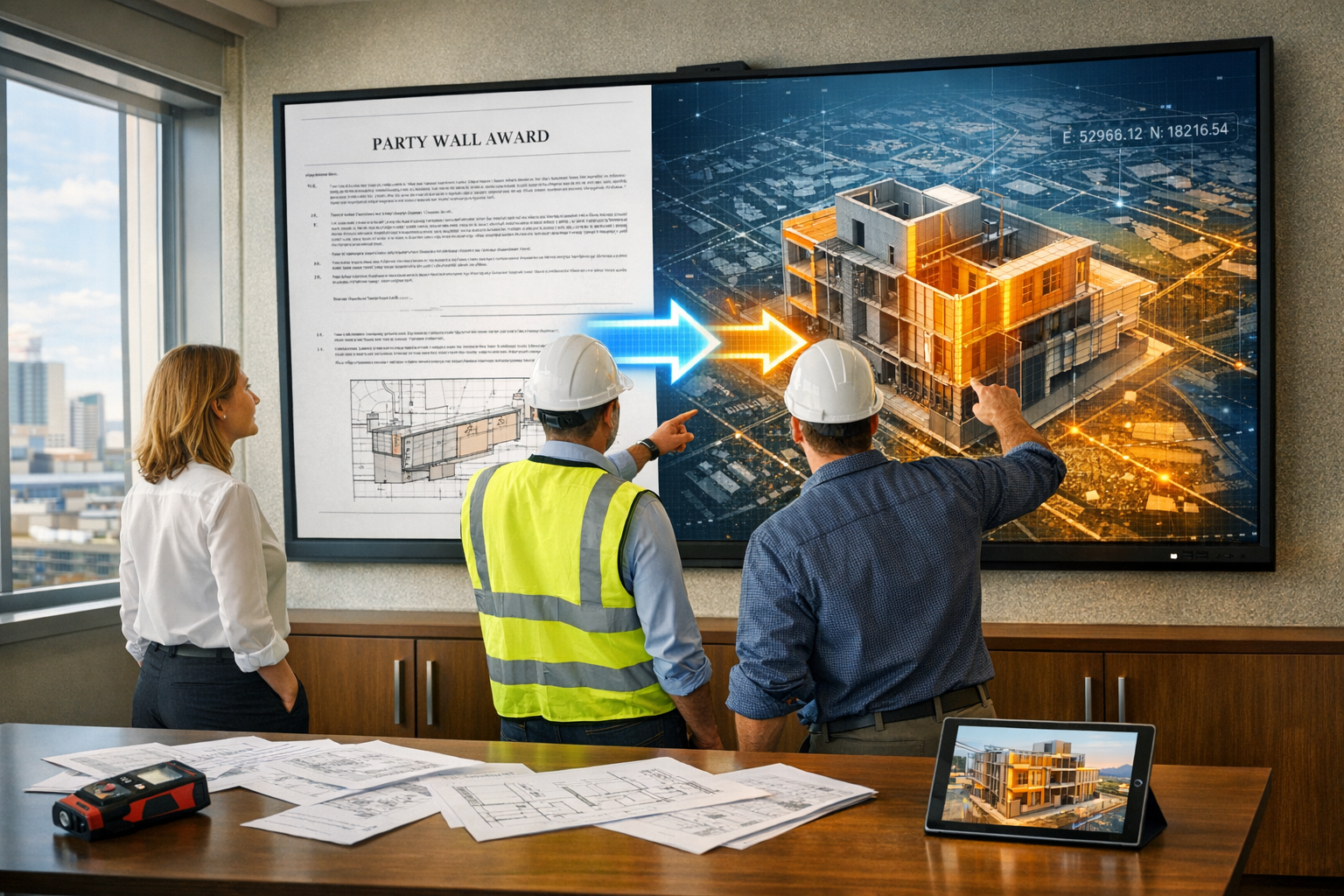
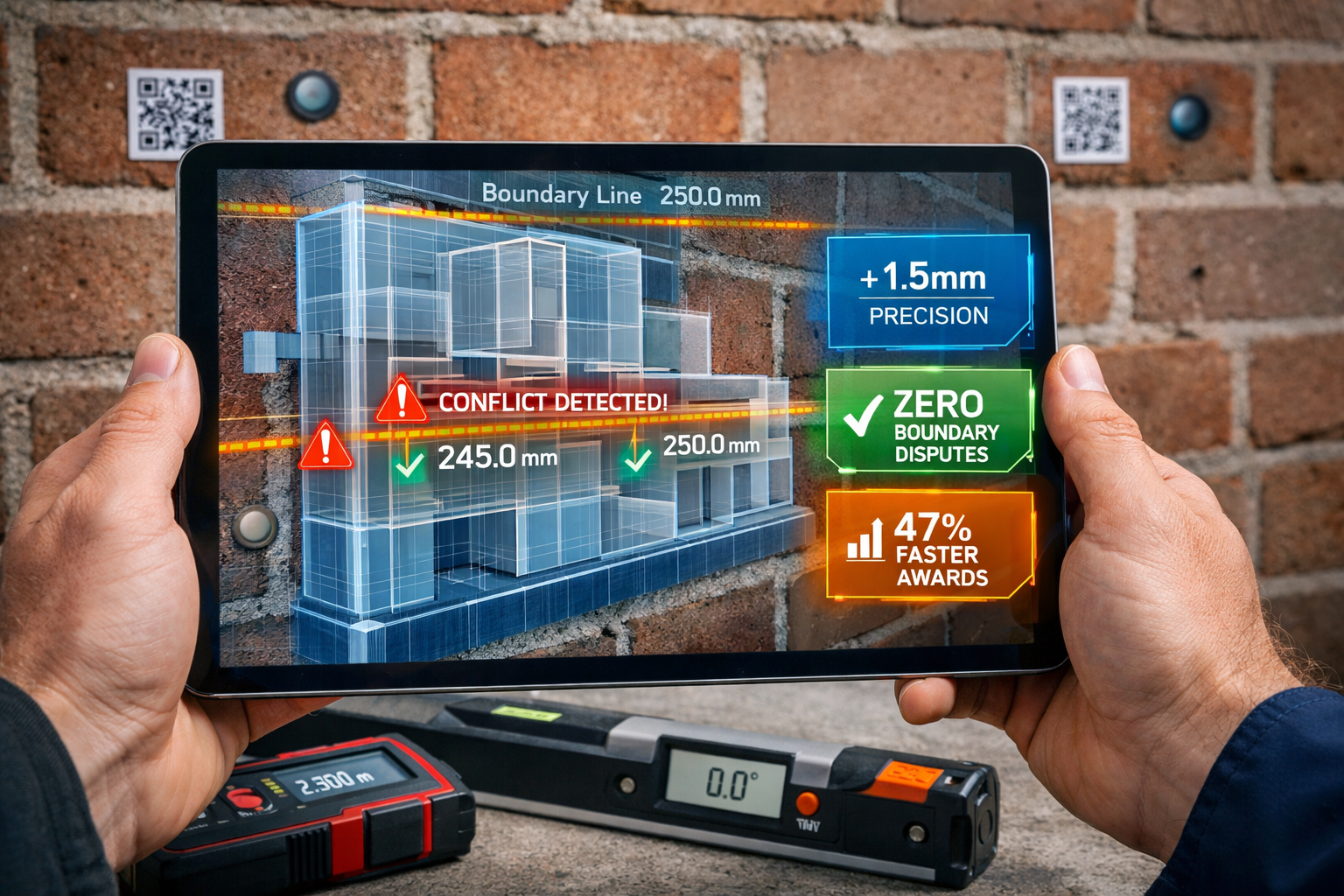
Party wall surveyors can access shared BIM models during initial site inspections, using tablets with augmented reality capabilities to overlay digital models onto physical structures. This immediate comparison identifies discrepancies between design intent and existing conditions.
Phase 3: Award Preparation
The party wall award document itself can reference specific BIM model elements, with clauses like: "Foundation excavation shall not exceed coordinates specified in BIM Model v3.2, Element ID: FND-001, maintaining minimum 2.8m offset from Party Wall PW-North as defined in Survey Point Cloud dated 15-Jan-2026."
Phase 4: Construction Monitoring
Throughout construction, monitoring data from sensors and periodic laser scans updates the digital twin, providing real-time verification that works comply with award specifications. Any deviations trigger immediate notifications to all parties.
Technology Stack and Tool Selection
Implementing BIM Integration for Precision Party Wall Awards: Enhancing Accuracy in 2026 Shared Boundary Projects requires selecting appropriate software and hardware:
Essential Components:
| Category | Function | Typical Tools |
|---|---|---|
| 3D Modeling | Create and edit building models | Revit, ArchiCAD, Vectorworks |
| Point Cloud Processing | Convert laser scan data to usable formats | ReCap, CloudCompare, Leica Cyclone |
| Coordination Platform | Central repository and viewer | BIM 360, Trimble Connect, Procore |
| Clash Detection | Identify spatial conflicts | Navisworks, Solibri, BIMcollab |
| Survey Equipment | Capture accurate site data | Leica/Trimble total stations, FARO laser scanners |
| Mobile Viewing | On-site access and AR overlay | iPad with LiDAR, HoloLens 2 |
For party wall surveyors, the investment in these technologies must be balanced against project scale and complexity. Many practitioners are adopting a tiered approach:
- Basic projects (simple extensions): Enhanced photography and 3D scanning
- Moderate projects (basement excavations): Full BIM coordination with clash detection
- Complex projects (multi-story developments): Comprehensive digital twin with ongoing monitoring
Training and Competency Development
The successful implementation of BIM in party wall practice requires surveyors to develop new competencies beyond traditional skills. Professional development priorities include:
📚 BIM Fundamentals – Understanding model structure, Level of Detail (LOD) specifications, and information requirements
🎓 Software Proficiency – Hands-on training with coordination platforms and viewing tools
📐 Geospatial Literacy – Interpreting coordinate systems, understanding survey accuracy specifications
💻 Digital Documentation – Creating legally robust awards that reference digital assets
🔄 Collaborative Workflows – Managing multi-party access to shared digital environments
Several professional bodies now offer BIM-specific training for party wall surveyors, recognizing that digital competency is becoming as essential as understanding the Party Wall etc. Act 1996 itself.
Enhancing Accuracy Through Advanced BIM Capabilities
Millimeter-Level Precision: Achieving Sub-Centimeter Accuracy
The promise of BIM Integration for Precision Party Wall Awards: Enhancing Accuracy in 2026 Shared Boundary Projects centers on dramatically improved measurement accuracy. Achieving this requires understanding and controlling error sources:
Error Budget Analysis:
Traditional party wall surveys typically achieve ±15-25mm accuracy due to cumulative errors:
- Measurement device limitations: ±3mm
- Human reading/recording errors: ±5mm
- Environmental factors (temperature, vibration): ±4mm
- Reference point establishment: ±8mm
- Transcription and calculation: ±5mm
BIM-integrated approaches reduce this to ±2-5mm through:
- Automated measurement extraction (eliminates human reading errors)
- Controlled reference networks (survey-grade monuments)
- Environmental compensation (temperature-corrected instruments)
- Statistical validation (redundant measurements with least-squares adjustment)
- Direct digital transfer (no transcription steps)
This precision improvement is particularly crucial for types of party wall works involving deep excavations or structural underpinning, where even small measurement errors can lead to significant disputes or safety concerns.
Digital Twins and Real-Time Monitoring
Beyond static documentation, advanced BIM implementations create digital twins—dynamic virtual replicas that update throughout construction. For party wall projects, digital twins provide:
Continuous Condition Monitoring:
Sensors embedded in party walls transmit data on:
- Vertical and horizontal movement (±0.1mm sensitivity)
- Crack propagation (automated image analysis)
- Vibration levels during excavation or piling
- Moisture content changes
This data streams into the BIM environment, creating a living record that:
✅ Validates compliance with award specifications
✅ Provides early warning of potential issues
✅ Creates defensible documentation if disputes arise
✅ Informs adaptive construction methods
Predictive Analytics:
Machine learning algorithms analyze monitoring data to predict potential problems before they occur. For example, if settlement patterns suggest accelerating movement, the system alerts surveyors and contractors to implement additional protective measures specified in the award.
Collaborative Decision-Making and Dispute Reduction
One of the most significant benefits of BIM Integration for Precision Party Wall Awards: Enhancing Accuracy in 2026 Shared Boundary Projects is improved communication among stakeholders. When building owners, surveyors, and contractors share access to identical digital information:
Transparency increases – All parties can verify measurements and conditions independently
Misunderstandings decrease – 3D visualization eliminates ambiguity inherent in 2D drawings
Trust develops – Objective digital evidence reduces suspicion and adversarial positioning
Resolution accelerates – Disputes can be resolved by referring to shared digital truth
This collaborative environment is particularly valuable when working across different regions of London, whether engaging a party wall surveyor in North London, South London, or other areas, as digital platforms eliminate geographic barriers to coordination.
Legal and Regulatory Considerations
While BIM offers tremendous advantages, its integration with party wall procedures must respect established legal frameworks:
Award Document Status:
The formal party wall award remains a legal document with specific requirements. BIM models and digital data serve as supporting documentation but do not replace the written award itself. Best practice involves:
- Including model reference numbers and version dates in award text
- Specifying how digital assets will be accessed and maintained
- Defining what happens if digital systems become unavailable
- Establishing protocols for resolving conflicts between digital and written information
Data Ownership and Access:
Clear agreements must establish:
- Who owns the BIM model and associated data
- How long digital archives must be maintained
- Who bears costs for ongoing digital infrastructure
- How data privacy is protected while ensuring necessary access
Professional Standards:
Party wall surveyors using BIM technology remain bound by professional standards and must ensure that digital tools enhance rather than compromise their independent judgment and duty to both parties.
Overcoming Implementation Challenges
Cost-Benefit Analysis for Different Project Scales
A common concern about BIM Integration for Precision Party Wall Awards: Enhancing Accuracy in 2026 Shared Boundary Projects involves cost justification. The investment in technology, training, and time must be balanced against benefits:
Small Projects (simple loft conversions, single-story extensions):
- Traditional methods remain cost-effective
- Enhanced photography and basic 3D scanning may suffice
- Full BIM implementation typically not justified unless part of broader construction BIM workflow
Medium Projects (basement excavations, significant structural works):
- BIM coordination provides measurable value
- Reduced dispute risk often justifies technology investment
- Faster award preparation and fewer site visits offset costs
Large Projects (multi-unit developments, complex urban sites):
- BIM integration becomes essential rather than optional
- Cost savings from dispute avoidance and efficiency gains are substantial
- Digital twin monitoring prevents expensive remediation
When considering party wall costs, the technology investment should be viewed within the context of total project risk and potential dispute costs, which can easily exceed the entire surveyor fee budget.
Addressing the Digital Divide
Not all stakeholders in party wall matters have equal digital literacy or access to technology. Effective BIM integration must accommodate:
Adjoining Owners with Limited Technology Access:
- Provide printed visualizations extracted from BIM models
- Offer in-person viewing sessions where surveyors demonstrate digital models
- Create simplified PDF viewers that don't require specialized software
- Ensure all critical information remains accessible in traditional formats
Contractors with Varying BIM Capabilities:
- Establish minimum digital deliverable requirements early
- Provide training or support for smaller contractors
- Accept hybrid workflows that combine digital and traditional documentation
- Focus on outputs (accurate construction) rather than mandating specific tools
Surveyors Transitioning to Digital Practice:
- Offer mentoring and knowledge-sharing within professional networks
- Start with pilot projects to build confidence and competency
- Leverage cloud-based platforms that reduce software installation barriers
- Emphasize that BIM enhances rather than replaces core surveying skills
Data Security and Long-Term Accessibility
Digital documentation creates new responsibilities for data management:
Security Concerns:
- Protecting sensitive property information from unauthorized access
- Ensuring backup systems prevent data loss
- Implementing version control to prevent tampering
- Establishing audit trails showing who accessed or modified data
Long-Term Accessibility:
Party wall awards must remain accessible for decades, as future works may reference historical awards. Digital preservation strategies include:
- Using open file formats (IFC) alongside proprietary formats
- Maintaining archived versions of software used to create models
- Creating static PDF/3D PDF extracts for long-term archival
- Establishing institutional repositories for critical project data
Future Developments and Industry Trends
Artificial Intelligence and Automated Award Generation
The next evolution of BIM Integration for Precision Party Wall Awards: Enhancing Accuracy in 2026 Shared Boundary Projects involves artificial intelligence systems that can:
🤖 Analyze BIM models to automatically identify all party wall matters requiring notice
📝 Generate draft award clauses based on detected conditions and standard specifications
⚠️ Flag unusual conditions requiring surveyor attention and custom provisions
📊 Predict settlement patterns based on soil conditions and excavation geometry
✅ Verify contractor compliance by comparing as-built scans to award specifications
These AI assistants won't replace professional surveyors but will handle routine analysis, allowing surveyors to focus on complex judgment calls and stakeholder management.
Integration with Smart City Infrastructure
As urban areas develop comprehensive digital infrastructure, party wall procedures will increasingly connect with broader city systems:
- Land registry blockchain integration providing immutable boundary records
- Automated permit systems that verify BIM models against zoning and building regulations
- Citywide subsurface mapping showing utilities, archaeological sites, and geological conditions
- Cumulative impact modeling assessing how multiple adjacent developments affect party walls
This integration will be particularly relevant in dense urban areas where surveyors regularly work on multiple adjacent projects, such as when coordinating between party wall surveyors in Central London and surrounding boroughs.
Standardization and Industry Protocols
For BIM integration to reach its full potential in party wall practice, industry-wide standards must emerge:
Information Requirements:
- Standardized Level of Detail (LOD) specifications for party wall models
- Common data environments (CDE) protocols for multi-party access
- Agreed naming conventions for model elements and documentation
- Standard formats for embedding monitoring data in digital twins
Professional Competency Frameworks:
- Certification programs for BIM-competent party wall surveyors
- Continuing professional development requirements
- Quality assurance protocols for digital deliverables
- Ethical guidelines for technology use in party wall practice
Industry recognition of BIM excellence, similar to initiatives like the BIMobject Awards 2026[1], may eventually extend to specialized categories recognizing innovation in party wall documentation and dispute resolution.
Conclusion: Embracing Digital Precision for Better Outcomes
BIM Integration for Precision Party Wall Awards: Enhancing Accuracy in 2026 Shared Boundary Projects represents a fundamental shift in how the construction industry approaches shared boundary matters. By merging geospatial data with sophisticated 3D models, surveyors can now achieve millimeter-level accuracy that was impossible with traditional methods. This precision translates directly into reduced disputes, faster project timelines, and better outcomes for all stakeholders.
The technology is no longer experimental—it's proven, accessible, and increasingly expected by sophisticated building owners and contractors. Party wall surveyors who embrace digital tools position themselves at the forefront of professional practice, offering services that deliver measurably better value than traditional approaches.
However, successful implementation requires more than just purchasing software. It demands thoughtful integration with established legal frameworks, investment in training and competency development, and commitment to maintaining the professional judgment and independence that define quality party wall surveying.
Actionable Next Steps
For building owners planning construction affecting party walls:
- Request that your surveyor discuss BIM capabilities during initial consultations
- Consider whether project complexity justifies digital documentation investment
- Ensure party wall notices include information about digital documentation approaches
- Ask to see 3D visualizations of proposed works to better understand impacts
For party wall surveyors looking to enhance their practice:
- Assess current projects to identify where BIM would provide measurable value
- Invest in training and equipment appropriate to your typical project scale
- Develop relationships with technology providers and BIM specialists
- Start with pilot projects to build competency before full-scale implementation
- Join professional networks focused on digital construction and party wall practice
For contractors and architects involved in party wall matters:
- Coordinate BIM workflows early with appointed party wall surveyors
- Ensure models include accurate party wall locations and boundary information
- Establish protocols for sharing and updating digital information
- Use BIM clash detection to identify potential party wall issues before construction
The future of party wall practice is undeniably digital. Those who embrace BIM Integration for Precision Party Wall Awards: Enhancing Accuracy in 2026 Shared Boundary Projects today will lead the industry tomorrow, delivering better outcomes through technology-enhanced precision and collaboration. The question is no longer whether to adopt these tools, but how quickly and effectively to integrate them into professional practice.
By combining traditional surveying expertise with cutting-edge digital capabilities, the party wall profession can continue fulfilling its essential role in facilitating urban development while protecting the rights of all property owners—now with unprecedented accuracy and efficiency. 🏗️
References
[1] Bimobject Awards 2026 – https://business.bimobject.com/bimobject-awards-2026/
[5] Party Wall Agreements In Data Centre Developments 2026 Compliance Amid Ai Driven Uk Demand – https://nottinghillsurveyors.com/blog/party-wall-agreements-in-data-centre-developments-2026-compliance-amid-ai-driven-uk-demand