


Nearly one in three party wall disputes that reach formal resolution in England and Wales involves work that began before a proper agreement was in place. That single statistic reveals a persistent grey area that building owners, neighbours, and even some contractors misunderstand every year. The question — can you start work without a signed party wall agreement, and what happens after silence, delay, or informal consent? — sits at the heart of countless renovation projects in 2026. The short answer is: technically possible in narrow circumstances, but almost always a serious legal and financial risk. The longer answer requires understanding the difference between a neighbour's silence, a verbal nod, a written consent letter, and a formal party wall award.

Key Takeaways 📋
- Silence is not consent. Under the Party Wall etc. Act 1996, a neighbour who does not respond within 14 days is deemed to have dissented, not agreed.
- Verbal or informal consent carries no legal weight and cannot substitute for a written agreement or a formal party wall award.
- Starting notifiable work without a signed agreement exposes the building owner to injunctions, compensation claims, and potential criminal liability.
- The statutory route — serving a notice, waiting for a response, and proceeding to an award if needed — is the only fully protected path.
- Even when a neighbour gives written consent, a schedule of condition is strongly recommended before work begins.
Understanding the Legal Framework First
Before exploring what happens when things go wrong, it helps to be clear on what the law actually requires. The Party Wall etc. Act 1996 applies to three main categories of work in England and Wales:
| Work Type | Notice Required | Notice Period |
|---|---|---|
| Works on or to a party wall or structure | Party Structure Notice | 2 months |
| New building at or astride the boundary line | Line of Junction Notice | 1 month |
| Excavation near a neighbouring building | 3-metre or 6-metre Notice | 1 month |
If any proposed work falls into these categories, the building owner must serve the appropriate notice on every adjoining owner before starting. There is no discretion here — the Act is mandatory, not advisory.
For a detailed breakdown of which projects trigger the Act, the guide on types of party wall works is a useful starting point.
💡 Pull Quote: "The Act does not ask whether work is major or minor. It asks whether the work falls within its scope. If it does, a notice is required — full stop."
What Happens After Silence, Delay, or Informal Consent — The Three Scenarios Explained
This is where most building owners find themselves in trouble. The question of can you start work without a signed party wall agreement after silence, delay, or informal consent does not have one answer — it has three distinct ones, each with different legal consequences.
Scenario 1: The Neighbour Goes Silent 🤐
A building owner serves a party wall notice and hears nothing back. Days pass. The contractor is booked. The temptation to press ahead is understandable.
What the law says: Under Section 5 of the Act, if an adjoining owner fails to respond within 14 days of receiving a notice, they are deemed to be in dispute with the building owner. This is not the same as consent. It triggers the dispute resolution mechanism, which means both parties must appoint surveyors to produce a party wall award.
What this means in practice:
- The building owner cannot start notifiable work simply because the neighbour has not replied.
- Work started during this silence is work started without a valid agreement.
- The adjoining owner retains the right to seek an injunction stopping the work immediately.
Scenario 2: The Neighbour Delays Responding ⏳
Sometimes a neighbour acknowledges the notice but asks for more time, says they are "looking into it," or simply drags their feet. Weeks pass. The 14-day window closes.
Once the 14-day period expires without a written consent being received, the deemed dissent rule applies regardless of any informal communication. A verbal assurance that the neighbour is "fine with it" does not reset the clock or substitute for written consent.
The only safe options at this point are:
- Wait for the neighbour to provide written consent (which restarts the process properly).
- Proceed with appointing surveyors to produce a formal award.
Scenario 3: Informal or Verbal Consent 🗣️
This is perhaps the most dangerous grey area. A neighbour says over the fence, "Go ahead, I don't mind." They send a casual WhatsApp message. They wave the notice away at the door. Building owners often interpret this as permission to proceed.
It is not. Under the Act, the only valid forms of consent are:
- ✅ A written consent letter signed by the adjoining owner within 14 days of receiving the notice.
- ✅ A formal party wall award produced by appointed surveyors.
Verbal consent, text messages, and emails that do not constitute a formal written agreement under the Act offer no legal protection to the building owner if a dispute arises later.
The Risks of Starting Work Without a Signed Agreement
The consequences of proceeding without proper authority under the Act are serious and can be costly. Here is what building owners risk:
🚫 Injunctions
An adjoining owner can apply to the county court for an injunction to stop the work immediately. Courts have consistently granted these, even where work is partially complete. The cost of halting a project mid-way — paying idle contractors, securing the site, and restarting later — can dwarf the cost of getting the process right from the start.
💷 Compensation and Damages
If the work causes damage to the adjoining property — even minor cracking or vibration damage — the building owner has no formal schedule of condition to rely on. A schedule of condition documents the state of the neighbouring property before work begins. Without one, any pre-existing damage can be attributed to the works, leaving the building owner exposed to compensation claims they cannot easily defend.
⚖️ Trespass and Nuisance Claims
Starting work on or near a party wall without authority can constitute a trespass in civil law. This is separate from the Act and can result in damages claims independent of any party wall proceedings.
🔨 Retrospective Awards
Even after work has begun or been completed, surveyors can be appointed and a retrospective award made. This can include conditions, requirements to make good damage, and costs — none of which the building owner can control once the process is out of their hands.
💡 Pull Quote: "An injunction to stop work costs far more than a party wall award ever would. The Act's process exists to protect both sides — skipping it protects neither."
Written Consent: The One Exception That Actually Works ✅
There is one legitimate route to starting work without a formal surveyor-produced award: written consent from the adjoining owner.
If an adjoining owner receives a notice and responds in writing within 14 days stating they consent to the works, the parties are said to have reached an "agreed notice." In this case:
- No surveyors need to be appointed.
- No formal award is required.
- Work can proceed once the relevant notice period has expired.
This is sometimes called proceeding without a surveyor, and it is entirely lawful when done correctly.
However, even with written consent, best practice strongly recommends:
- Obtaining a schedule of condition of the adjoining property before work starts.
- Keeping a copy of the written consent in a safe place throughout the project.
- Ensuring the consent covers the full scope of works — consent to one element does not imply consent to others.
A written consent letter is not a party wall award. It does not give the building owner the same statutory rights to access the neighbouring property or carry out specific works that an award would. If the scope of work is complex or involves significant structural interference, an award may still be the more appropriate route.
How the Formal Dispute Route Actually Protects Everyone
When a neighbour dissents — or is deemed to have dissented through silence — the dispute resolution process under the Act begins. This is not a hostile process. It is a structured, professional mechanism designed to allow work to proceed safely.
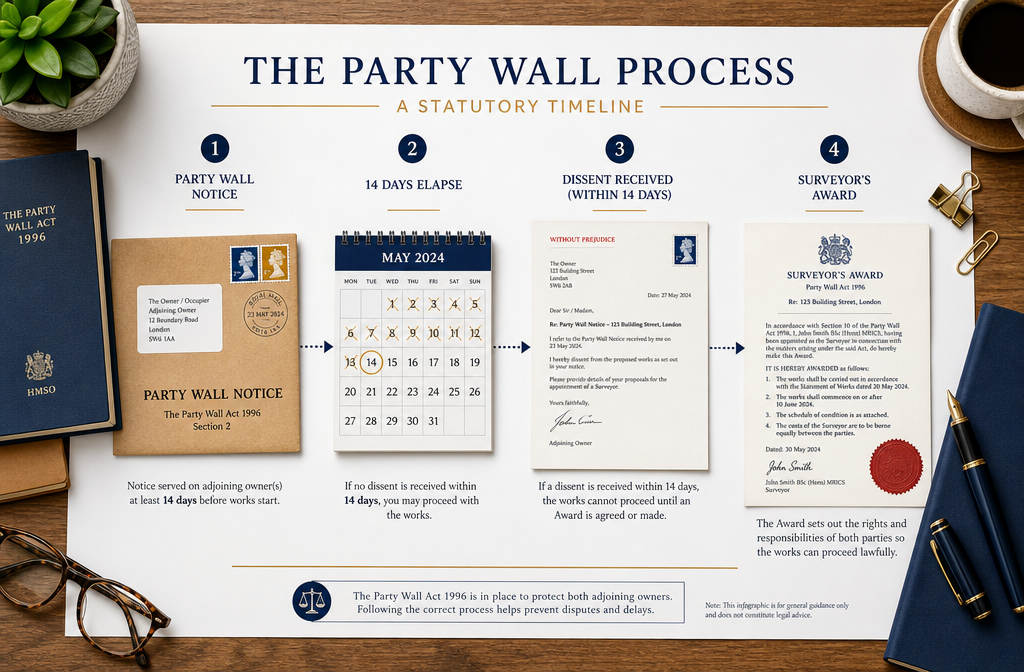
The process works as follows:
- Both parties appoint surveyors (or agree on a single agreed surveyor).
- The surveyors produce a party wall award — a legally binding document setting out how and when work may be carried out.
- The award typically includes a schedule of condition, working hours, methods of work, and provisions for making good any damage.
- Work can then proceed within the terms of the award.
For building owners carrying out works, the building owners section of a specialist surveyor's website explains the rights and obligations in plain terms.
For adjoining owners who have received a notice and are unsure how to respond, the party wall act notices guide provides clear guidance on options.
The costs of this process are generally paid by the building owner, and while there is a fee involved, the protection it provides — for both parties — is substantial. Tips on keeping party wall costs down can help manage the expense without cutting corners on the process itself.
Common Misconceptions That Lead to Problems
Several myths circulate among homeowners and contractors that cause real harm when acted upon:
| Misconception | Reality |
|---|---|
| "We've always got on well with the neighbours — we don't need a notice." | The Act applies regardless of the relationship between neighbours. |
| "The work is minor, so it doesn't count." | The Act applies based on the type and location of work, not its scale. |
| "My builder says we don't need one." | Contractors are not qualified to make this legal determination. |
| "We shook hands on it — that's enough." | Only written consent or a formal award provides legal protection. |
| "If they don't reply, we can just start." | Silence triggers deemed dissent, not consent. |
What to Do If Work Has Already Started Without an Agreement
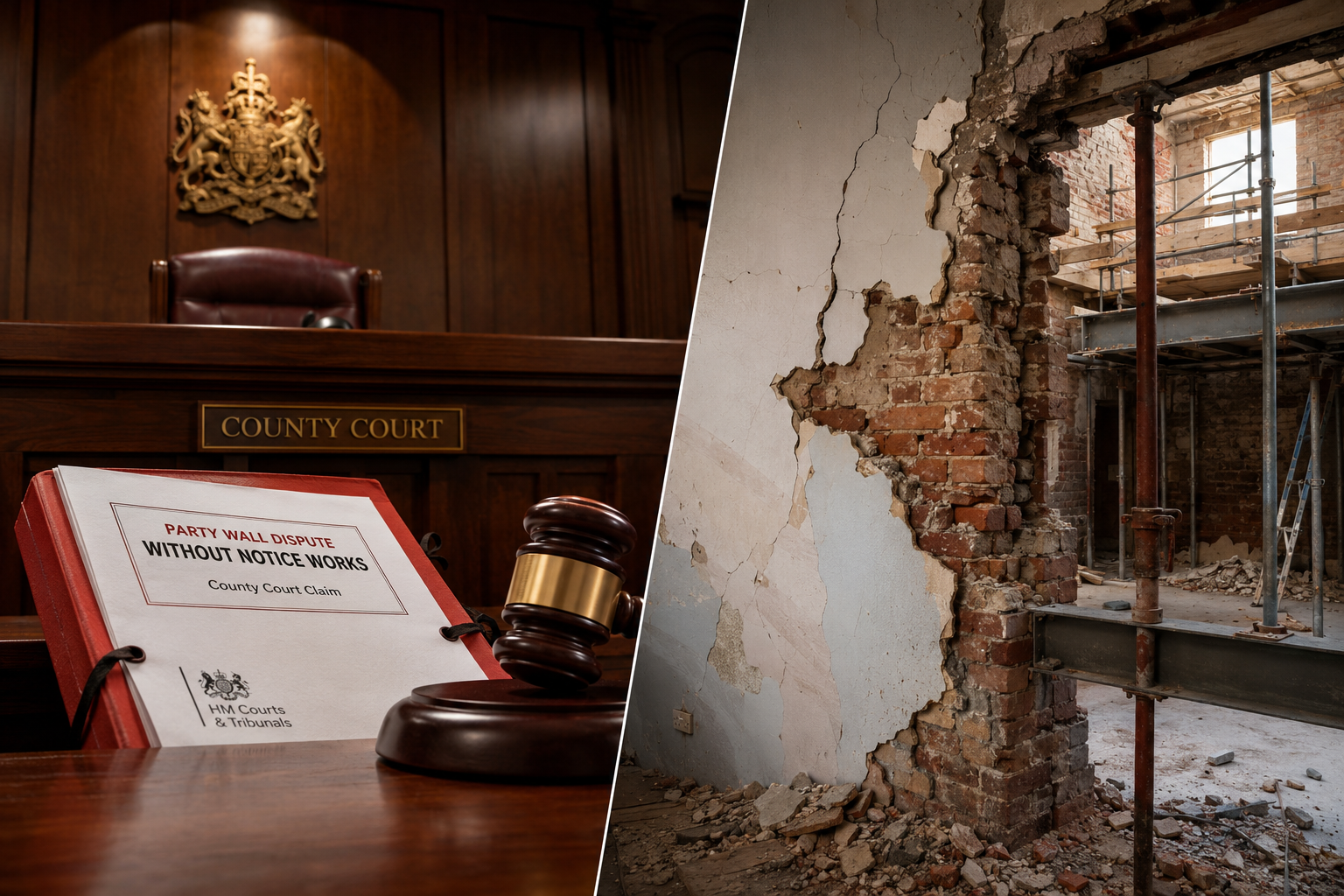
If work has begun without a valid agreement in place, the situation is serious but not always irreparable. The recommended steps are:
- Stop work immediately on any elements that are notifiable under the Act.
- Seek specialist advice from a qualified party wall surveyor as soon as possible.
- Do not attempt to obtain retrospective verbal consent — this will not resolve the legal position.
- Engage with the adjoining owner formally — surveyors can still be appointed and a retrospective award made.
- Document the current condition of both properties as thoroughly as possible.
For adjoining owners who discover that a neighbour has started work without serving notice, the my neighbour is carrying out works page outlines the options available, including the right to appoint a surveyor and seek an injunction if necessary.
A Note on Boundary and Fence Wall Works
It is worth noting that not all wall-related works fall under the Party Wall etc. Act. Works to boundary walls — as opposed to party walls — are governed by different rules. Understanding the difference between a party fence wall and a boundary wall is essential before assuming the Act applies or does not apply to a given project.
Misidentifying the type of wall involved is a common source of error. A wall that appears to be a garden boundary wall may in fact be a party fence wall under the Act's definition, triggering notice requirements that the building owner has not anticipated.
Conclusion: The Signed Agreement Is Not a Formality — It Is the Foundation
The question of can you start work without a signed party wall agreement comes down to a clear principle: the Act exists to protect both building owners and their neighbours, and bypassing it — whether through silence, delay, or informal consent — removes that protection entirely.
Actionable next steps for building owners in 2026:
- ✅ Identify whether your project triggers the Act before booking contractors.
- ✅ Serve the correct notice with the required notice period — do not wait until the last moment.
- ✅ Chase written responses from adjoining owners and do not interpret silence as consent.
- ✅ If a neighbour consents in writing, still commission a schedule of condition.
- ✅ If a neighbour dissents or goes silent, appoint a surveyor promptly to begin the award process.
- ✅ Seek professional advice early — a qualified party wall surveyor can guide the entire process efficiently and cost-effectively.
The formal process is not an obstacle to getting work done. It is the mechanism that allows work to proceed with legal authority, clear documentation, and protection for everyone involved. Treating it as a formality to be bypassed is the single most common — and most avoidable — mistake building owners make.