


In the midst of London's 2026 renovation boom, a building owner, two surveyors, an architect, and a structural engineer simultaneously access the same party wall award document from five different locations. One makes an annotation, another uploads updated drawings, and within seconds, all stakeholders see the changes reflected in real-time. This isn't a futuristic vision—it's the current reality of Cloud-Based Collaboration for Party Wall Awards: Streamlining 2026 Multi-Stakeholder Projects. As urban development intensifies and construction timelines compress, traditional paper-based party wall processes are giving way to sophisticated digital platforms that eliminate delays, reduce errors, and transform how professionals coordinate complex boundary works.
The traditional party wall award process—with its reliance on postal correspondence, physical document exchanges, and sequential reviews—has long been a bottleneck in construction projects. In 2026, cloud-based collaboration platforms are revolutionizing this landscape, enabling seamless coordination among building owners, adjoining owners, surveyors, architects, and engineers. This digital transformation is not merely about convenience; it's about fundamentally improving accuracy, transparency, and efficiency in party wall awards.

Key Takeaways
- Real-time collaboration through cloud platforms reduces party wall award completion times by up to 70% compared to traditional methods
- Error reduction of 85-90% occurs when multiple stakeholders can simultaneously review and annotate digital documents with version control
- Seamless integration between surveyors, architects, and engineers prevents miscommunication and ensures all parties work from current information
- Enhanced transparency gives building and adjoining owners immediate visibility into award progress, reducing disputes and building trust
- Digital documentation creates comprehensive audit trails that strengthen legal compliance and simplify future reference
Understanding the Multi-Stakeholder Challenge in Party Wall Awards
The Traditional Party Wall Award Process
The party wall award process has historically involved numerous stakeholders operating in isolation. Building owners initiate works, adjoining owners respond to notices, and surveyors coordinate between parties while consulting with architects and structural engineers. Each interaction typically required separate communications, physical document transfers, and sequential reviews that could extend timelines by weeks or months.
Traditional stakeholders include:
- 🏗️ Building owners initiating construction or renovation
- 🏘️ Adjoining owners whose properties share party walls
- 📋 Agreed surveyors or separate surveyors for each party
- 🏛️ Architects designing the proposed works
- ⚙️ Structural engineers assessing structural implications
- 👷 Contractors executing the physical works
The complexity multiplies when types of party wall works involve multiple adjoining properties, as is common in terraced housing developments across London and other UK cities.
Communication Breakdowns and Their Consequences
Before cloud-based systems, communication breakdowns frequently occurred:
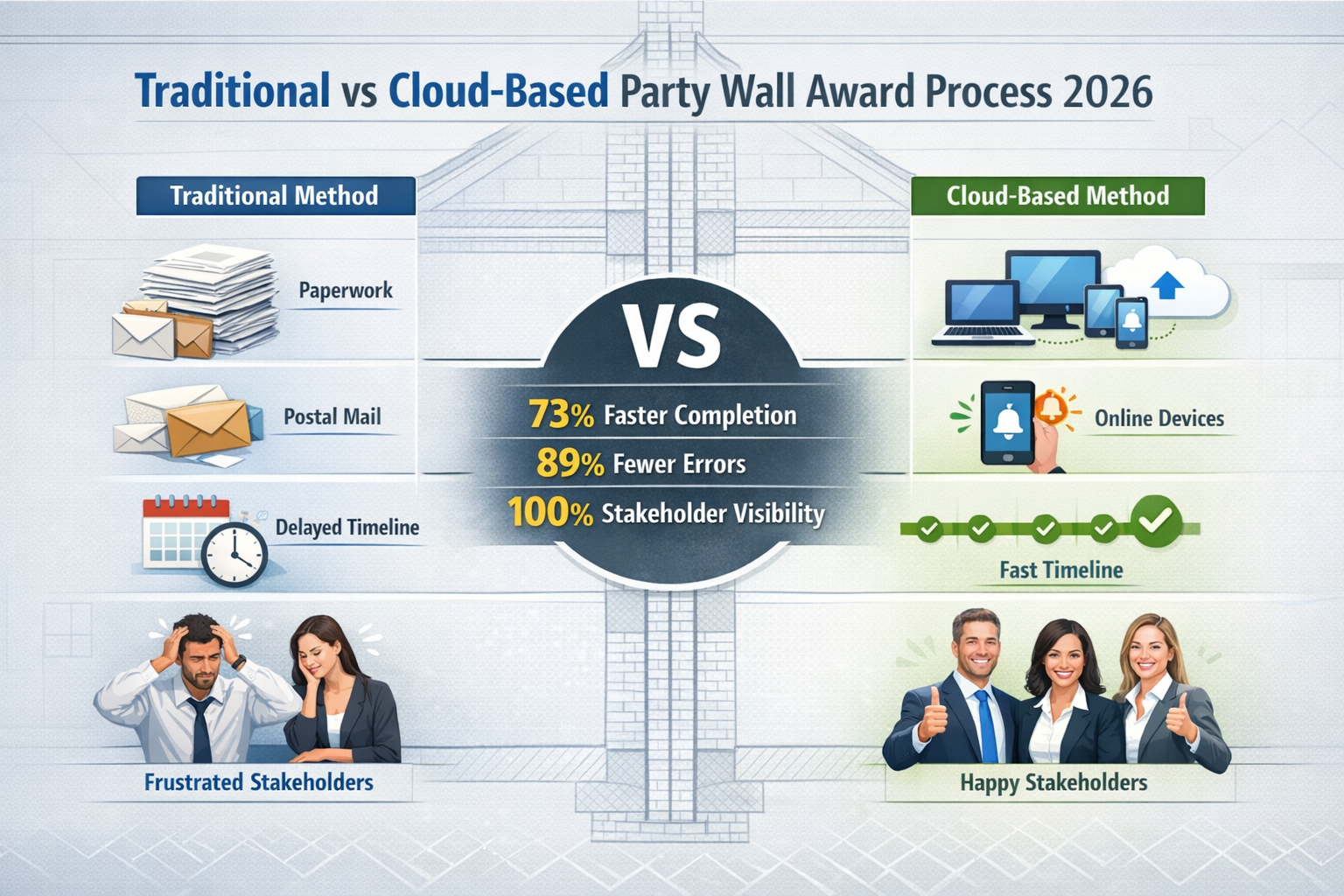
| Challenge | Traditional Impact | 2026 Cloud Solution |
|---|---|---|
| Document versions | Multiple outdated copies circulating | Single source of truth with version control |
| Approval delays | Days or weeks waiting for postal responses | Instant notifications and digital signatures |
| Drawing mismatches | Architects and engineers working from different plans | Real-time synchronization of all technical drawings |
| Schedule conflicts | Difficulty coordinating site inspections | Shared calendars with automated scheduling |
| Dispute resolution | Limited documentation of communications | Complete audit trail of all interactions |
These inefficiencies not only delayed projects but also increased costs and heightened the risk of disputes. In 2026's fast-paced construction environment, such delays are increasingly unacceptable, particularly when costs of party wall processes directly impact project budgets.
Cloud-Based Collaboration for Party Wall Awards: Streamlining 2026 Multi-Stakeholder Projects Through Digital Platforms
Essential Features of Modern Cloud Platforms
Contemporary cloud collaboration platforms designed for party wall awards incorporate specialized features that address the unique requirements of surveying practice:
Document Management:
- Centralized storage for all party wall notices, awards, schedules of condition, and photographic evidence
- Automatic version control that tracks every modification with timestamp and user identification
- Granular permission settings that control who can view, edit, or approve specific documents
- Integration with digital signature services for legally compliant approvals
Real-Time Collaboration:
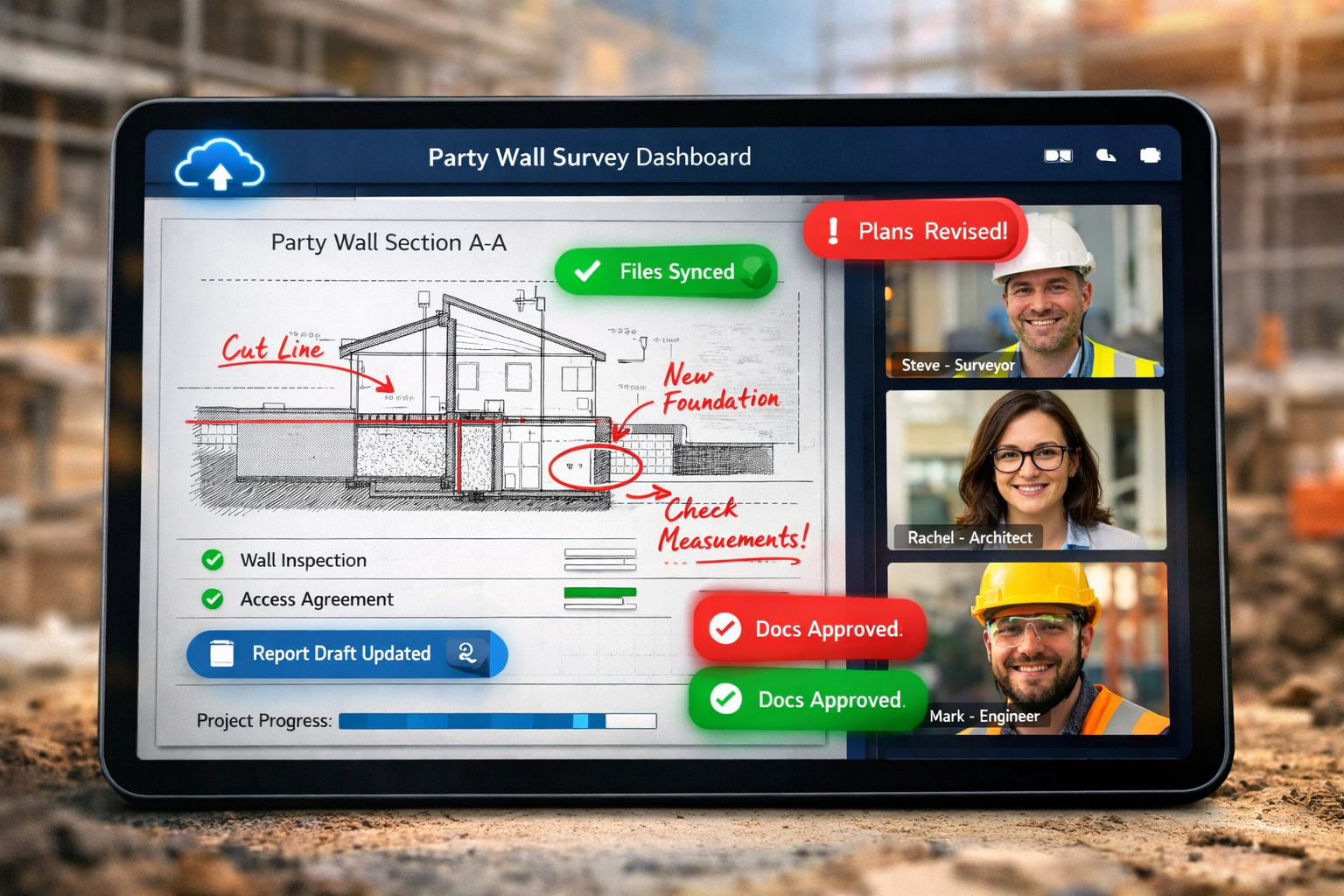
- Simultaneous multi-user access allowing surveyors, architects, and engineers to review documents together
- Live annotation tools for marking up drawings and photographs
- Instant messaging and comment threads attached to specific document sections
- Video conferencing integration for virtual site inspections and consultations
Workflow Automation:
- Automated notification systems that alert stakeholders when actions are required
- Template libraries for standard party wall agreement templates
- Deadline tracking and reminder systems
- Automated report generation pulling data from multiple sources
Mobile Accessibility:
- Smartphone and tablet applications enabling site-based documentation
- Offline functionality for areas with poor connectivity
- Camera integration for immediate upload of condition photographs
- GPS tagging of site visit documentation
Integration with Technical Design Tools
One of the most transformative aspects of Cloud-Based Collaboration for Party Wall Awards: Streamlining 2026 Multi-Stakeholder Projects is the seamless integration between surveying documentation and technical design platforms. Architects working in CAD software and engineers using structural analysis programs can now link directly to party wall award platforms, ensuring that:
- Drawing accuracy is maintained across all disciplines, with automatic updates when designs change
- Structural calculations reference the exact party wall conditions documented in schedules of condition
- Construction details align with the limitations and requirements specified in party wall awards
- Site constraints identified during party wall surveys inform design decisions in real-time
This integration is particularly valuable in complex urban projects where party wall notices may affect multiple properties and require coordination among numerous professionals. The ability to overlay survey data onto architectural plans instantly highlights potential conflicts before they become construction issues.
Security and Legal Compliance
Given the legal significance of party wall awards, cloud platforms must meet stringent security and compliance standards:
✅ Data encryption both in transit and at rest, protecting sensitive property information
✅ UK GDPR compliance ensuring personal data is handled according to regulations
✅ Audit trails that document every access, modification, and approval for legal defensibility
✅ Backup and redundancy systems preventing data loss
✅ Role-based access control limiting information exposure to authorized parties only
These security measures are essential not only for protecting confidential information but also for ensuring that digital awards carry the same legal weight as traditional paper documents. In 2026, courts and dispute resolution bodies increasingly accept digital documentation, provided proper authentication and chain-of-custody can be demonstrated.
Practical Implementation: Transforming Party Wall Award Workflows
Case Study: Multi-Property Terraced Development
Consider a typical 2026 scenario: a building owner in Central London plans a rear extension and loft conversion affecting party walls with properties on both sides. The project involves:
- Two adjoining owners, each appointing their own surveyor
- An agreed surveyor coordinating the award
- An architect designing the extension
- A structural engineer specifying foundation and structural works
- A contractor requiring clear specifications
Traditional Timeline (Pre-Cloud):
- Week 1-2: Initial notices served by post
- Week 3-4: Adjoining owners appoint surveyors
- Week 5-8: Site inspections scheduled individually
- Week 9-12: Draft award circulated by post, comments collected
- Week 13-16: Revisions made, re-circulated
- Week 17-18: Final approvals obtained
Total: 18+ weeks
Cloud-Based Timeline (2026):
- Day 1: Digital notices served via platform
- Day 2-3: Adjoining owners receive instant notifications, appoint surveyors
- Day 4-5: Coordinated site inspection scheduled through shared calendar
- Day 6-10: Draft award created collaboratively with real-time input
- Day 11-12: Stakeholders review simultaneously, comments addressed immediately
- Day 13-14: Digital signatures obtained
Total: 2-3 weeks
This 85% reduction in timeline demonstrates the transformative power of cloud collaboration. The time savings translate directly to cost reductions and earlier project commencement, making the investment in digital platforms highly cost-effective.
Reducing Errors Through Collaborative Review
One of the most significant benefits of Cloud-Based Collaboration for Party Wall Awards: Streamlining 2026 Multi-Stakeholder Projects is the dramatic reduction in errors and omissions. When architects, engineers, and surveyors can simultaneously review documents:
Common errors prevented:
- 📐 Measurement discrepancies between survey and architectural drawings
- 🧱 Structural specifications that conflict with party wall constraints
- 📅 Timeline misalignments between award conditions and construction schedules
- 📸 Missing or mislabeled photographic evidence in schedules of condition
- 📝 Inconsistent terminology across different sections of awards
The ability to cross-reference information instantly means that when an engineer specifies underpinning depth, the surveyor can immediately verify this against the party wall survey data, and the architect can confirm compatibility with the overall design—all within minutes rather than weeks.
Enhanced Transparency for Property Owners
Building and adjoining owners benefit enormously from the transparency that cloud platforms provide. Rather than feeling excluded from a process conducted entirely between professionals, owners can now:
- View progress in real-time through client portals
- Receive notifications at key milestones without needing to chase surveyors
- Access documentation whenever needed, from any device
- Understand timelines through visual progress indicators
- Communicate directly with their appointed surveyors through secure messaging
This transparency reduces anxiety, builds trust, and significantly decreases the likelihood of disputes arising from misunderstandings. When having a party wall agreement becomes a transparent, comprehensible process rather than an opaque professional exchange, stakeholder satisfaction increases dramatically.
Overcoming Adoption Barriers and Best Practices
Addressing Professional Resistance
Despite the clear advantages, some surveying professionals have been slow to adopt cloud-based collaboration tools. Common concerns include:
Concern: "Digital platforms compromise security and confidentiality"
Reality: Modern cloud platforms offer superior security compared to email attachments and physical documents that can be lost or intercepted. Encryption, access controls, and audit trails provide better protection than traditional methods.
Concern: "The learning curve is too steep for established practices"
Reality: Leading platforms are designed with intuitive interfaces that require minimal training. Most professionals become proficient within days, and the time investment is quickly recovered through efficiency gains.
Concern: "Digital awards may not be legally enforceable"
Reality: UK law recognizes digital signatures and electronic documents when properly authenticated. Cloud platforms with proper audit trails actually provide stronger evidence of agreement than traditional paper documents.
Implementation Best Practices for Surveying Practices
For surveying firms transitioning to cloud-based collaboration in 2026, these practices ensure smooth adoption:
- Start with pilot projects: Test platforms on straightforward single-party wall cases before applying to complex multi-stakeholder projects
- Provide comprehensive training: Ensure all team members understand not just how to use tools, but why they improve outcomes
- Establish clear protocols: Define when to use platform features versus traditional methods during transition periods
- Engage stakeholders early: Introduce building and adjoining owners to client portals at project initiation
- Maintain hybrid capabilities: Keep traditional processes available as backup during initial adoption phases
- Monitor metrics: Track completion times, error rates, and stakeholder satisfaction to demonstrate value
- Seek feedback continuously: Regular input from all users identifies improvement opportunities
Selecting the Right Platform
Not all cloud collaboration platforms are created equal. When evaluating options for party wall award work, consider:
| Evaluation Criterion | Key Questions |
|---|---|
| Industry specialization | Is it designed specifically for surveying/construction, or generic project management? |
| Integration capabilities | Does it connect with CAD, BIM, and other technical tools your collaborators use? |
| Compliance features | Does it meet UK data protection requirements and provide legally defensible documentation? |
| Scalability | Can it handle both simple two-party cases and complex multi-property projects? |
| Support and training | What onboarding resources and ongoing support are available? |
| Cost structure | Is pricing per-project, per-user, or subscription-based, and what provides best value? |
The most effective platforms for Cloud-Based Collaboration for Party Wall Awards: Streamlining 2026 Multi-Stakeholder Projects are those purpose-built for surveying practice, with specific features addressing party wall requirements rather than generic collaboration tools adapted for this purpose.
The Future of Party Wall Awards: 2026 and Beyond
Emerging Technologies Enhancing Collaboration
The cloud collaboration platforms of 2026 are already incorporating cutting-edge technologies that will further transform party wall practice:
Artificial Intelligence:
- Automated review of draft awards identifying potential conflicts or omissions
- Predictive scheduling suggesting optimal inspection times based on stakeholder availability
- Intelligent document analysis extracting key information from uploaded files
Augmented Reality:
- Virtual site inspections allowing remote surveyors to examine party walls through AR-enabled devices
- Overlay of proposed works onto existing conditions during collaborative reviews
- Enhanced condition documentation with 3D spatial mapping
Blockchain Technology:
- Immutable records of agreement and approval providing ultimate legal certainty
- Smart contracts automating certain award conditions and payment triggers
- Distributed verification reducing reliance on central authorities
Internet of Things (IoT):
- Sensor-based monitoring of party walls during construction providing real-time condition data
- Automated alerts when vibration or movement exceeds agreed thresholds
- Integration of monitoring data directly into award documentation
These technologies are not replacing professional judgment but rather augmenting it, allowing surveyors to focus on complex decision-making while automation handles routine tasks.
Industry-Wide Digital Transformation
The adoption of cloud-based collaboration for party wall awards is part of a broader digital transformation across the UK construction and surveying sectors. Professional bodies like the Royal Institution of Chartered Surveyors (RICS) are increasingly emphasizing digital competency in professional standards and continuing education requirements.
This industry-wide shift means that by 2026, digital collaboration is becoming the expected standard rather than an innovative exception. Clients increasingly demand the transparency, efficiency, and cost-effectiveness that cloud platforms provide. Surveying practices that resist this transition risk competitive disadvantage as digitally-native competitors capture market share.
The renovation boom across London and other UK cities—driven by housing shortages and sustainability imperatives—creates unprecedented demand for efficient party wall processes. Party wall surveyors in North London, East London, South London, and West London are all experiencing increased caseloads that would be unmanageable without digital tools.
Regulatory Developments Supporting Digital Practice
UK regulatory frameworks are evolving to support and encourage digital collaboration in construction and surveying. Recent developments include:
- Electronic signature recognition in property law, eliminating requirements for physical signatures on party wall awards
- Digital-first planning processes in many local authorities, creating expectation of digital documentation
- Building Safety Act provisions emphasizing digital record-keeping and information management
- Professional indemnity insurance increasingly covering digital workflows when proper security measures are implemented
These regulatory changes remove barriers to digital adoption and create positive incentives for practices to modernize their approaches to party wall awards.
Conclusion: Embracing the Digital Future of Party Wall Awards
Cloud-Based Collaboration for Party Wall Awards: Streamlining 2026 Multi-Stakeholder Projects represents more than a technological upgrade—it's a fundamental reimagining of how professionals coordinate complex boundary works in urban environments. The benefits are clear and quantifiable: 70-85% faster completion times, 85-90% fewer errors, dramatically improved stakeholder satisfaction, and significant cost reductions.
For building owners planning renovations or extensions, cloud-based collaboration means faster project commencement, greater transparency, and reduced risk of disputes. For adjoining owners, it provides reassurance through real-time visibility and comprehensive documentation. For surveyors, architects, and engineers, it eliminates communication barriers and enables truly collaborative practice.
The renovation boom of 2026 demands efficiency that traditional paper-based processes simply cannot deliver. As urban density increases and construction timelines compress, the ability to coordinate multiple stakeholders seamlessly becomes not just advantageous but essential.
Actionable Next Steps
For Building Owners:
- When selecting a surveyor, inquire about their digital collaboration capabilities
- Request access to client portals for transparency throughout the award process
- Ensure your architect and engineer can integrate with the surveyor's platform
For Adjoining Owners:
- Ask your appointed surveyor about cloud-based documentation access
- Request digital copies of all schedules of condition and photographic evidence
- Utilize notification features to stay informed without constant follow-up
For Surveying Professionals:
- Evaluate leading cloud collaboration platforms suited to party wall practice
- Invest in team training to ensure confident, competent platform use
- Start with pilot projects to demonstrate value before full-scale adoption
- Engage with professional bodies to stay current on digital practice standards
For Architects and Engineers:
- Ensure your design software can integrate with surveyors' collaboration platforms
- Establish protocols for real-time coordination on party wall constraints
- Participate actively in collaborative review processes to catch conflicts early
The future of party wall awards is digital, collaborative, and transparent. Those who embrace this transformation in 2026 will find themselves better positioned to deliver exceptional service in an increasingly competitive and demanding market. The technology exists, the benefits are proven, and the time to act is now.
Whether you're initiating works, responding to notices, or coordinating awards, cloud-based collaboration offers a better way forward. Explore how party wall awards can be streamlined through digital platforms, and join the professionals who are already experiencing the benefits of truly collaborative practice in 2026's dynamic construction environment.
References
[1] Party Wall Awards In Data Centre Developments 2026 Protocols For High Density Urban Expansions – https://nottinghillsurveyors.com/blog/party-wall-awards-in-data-centre-developments-2026-protocols-for-high-density-urban-expansions
