


When three surveyors, two property owners, and a contractor need to coordinate on a single party wall award, traditional paper-based methods quickly become a logistical nightmare. Lost emails, conflicting document versions, and delayed approvals can turn a straightforward process into months of frustration. In 2026, Cloud Platforms for Collaborative Party Wall Awards: Streamlining Revisions and Stakeholder Access in 2026 represent a transformative solution that brings real-time collaboration, version control, and transparent communication to an industry that has historically relied on manual processes.
The construction and property sectors are increasingly recognizing that cloud-based collaboration tools can dramatically reduce errors, accelerate approval timelines, and improve stakeholder satisfaction. As market leaders across industries move to cloud solutions for enhanced efficiency and collaboration[7], party wall professionals are discovering that these platforms offer specific advantages for managing the complex documentation and multi-party coordination inherent in party wall procedures.
Key Takeaways
- Real-time collaboration through cloud platforms eliminates version confusion and reduces document errors by enabling simultaneous access for all stakeholders involved in party wall awards
- Automated revision tracking provides complete audit trails, showing exactly who made changes and when, which is critical for legal compliance and dispute resolution
- Enhanced stakeholder access allows building owners, adjoining owners, and surveyors to review and approve documents from any location, significantly reducing approval timelines
- Cost reduction through streamlined processes can help property owners keep party wall costs down while improving service quality
- Digital sovereignty and data security features ensure sensitive property information remains protected while maintaining accessibility for authorized parties[1]
Understanding Party Wall Awards and Their Documentation Challenges
What Makes Party Wall Awards Complex?
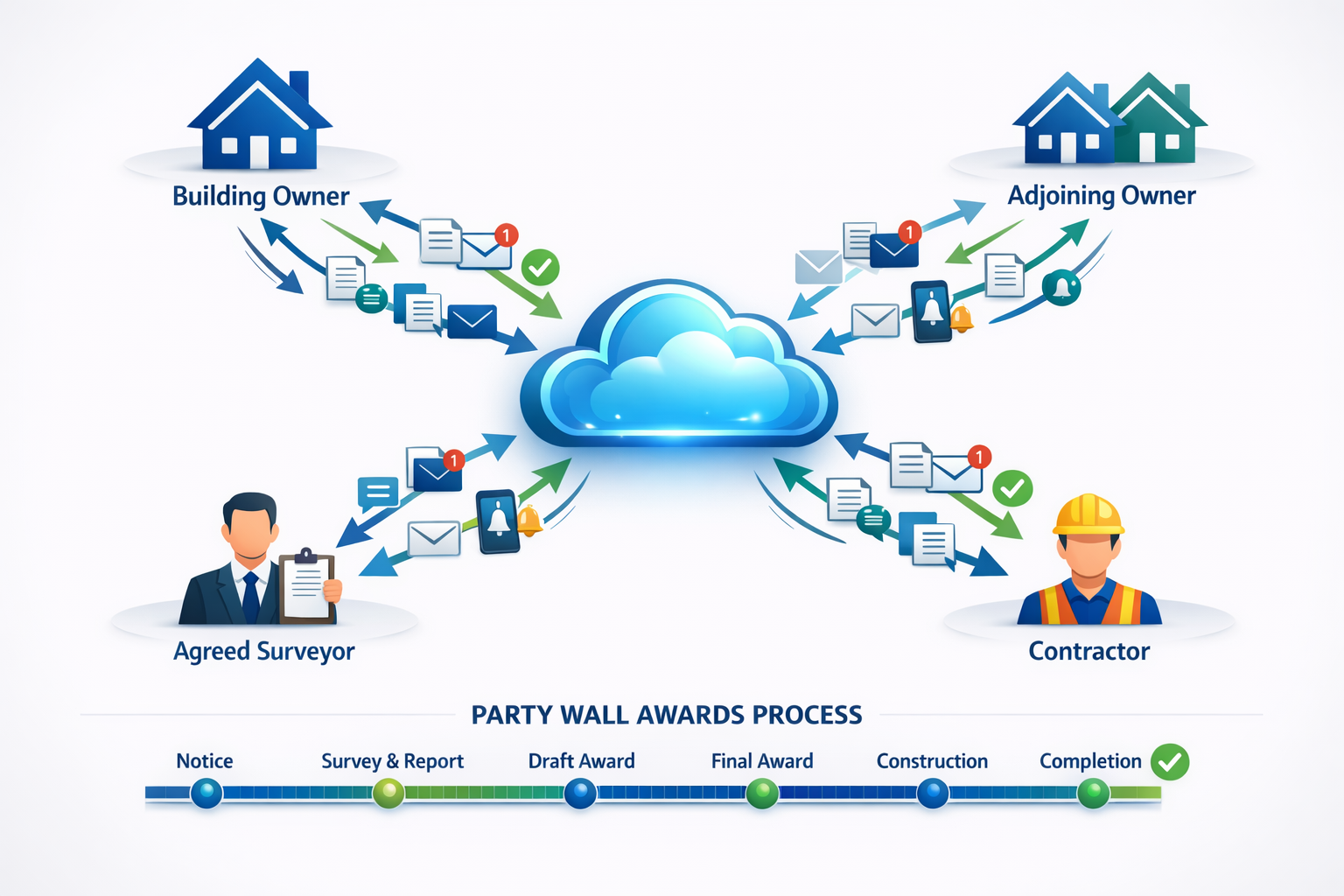
A party wall award is a legally binding document that sets out the rights and responsibilities of property owners when construction work affects a shared wall, boundary, or structure. These awards must be precise, comprehensive, and agreed upon by multiple parties—typically including:
- Building owners who initiate the construction work
- Adjoining owners whose property shares the wall or boundary
- Agreed surveyors or separate surveyors representing each party
- Contractors who will execute the work
The documentation process involves multiple stages, from initial party wall notices through schedules of condition, detailed award specifications, and ongoing amendments as projects evolve.
Traditional Documentation Pain Points
Before cloud platforms became viable solutions, party wall professionals faced numerous challenges:
📄 Version Control Issues: Multiple drafts circulating via email created confusion about which document was current
⏰ Delayed Approvals: Physical signatures and postal delivery added days or weeks to the approval process
🔍 Limited Transparency: Stakeholders often lacked visibility into document status or pending changes
💼 Document Security: Sensitive property information sent via unsecured email posed privacy risks
📝 Revision Tracking: Manual tracking of changes made error identification difficult and time-consuming
These challenges not only frustrated professionals but also increased costs for property owners and created potential legal vulnerabilities when documentation discrepancies arose.
How Cloud Platforms Transform Party Wall Award Management
Real-Time Collaboration Features
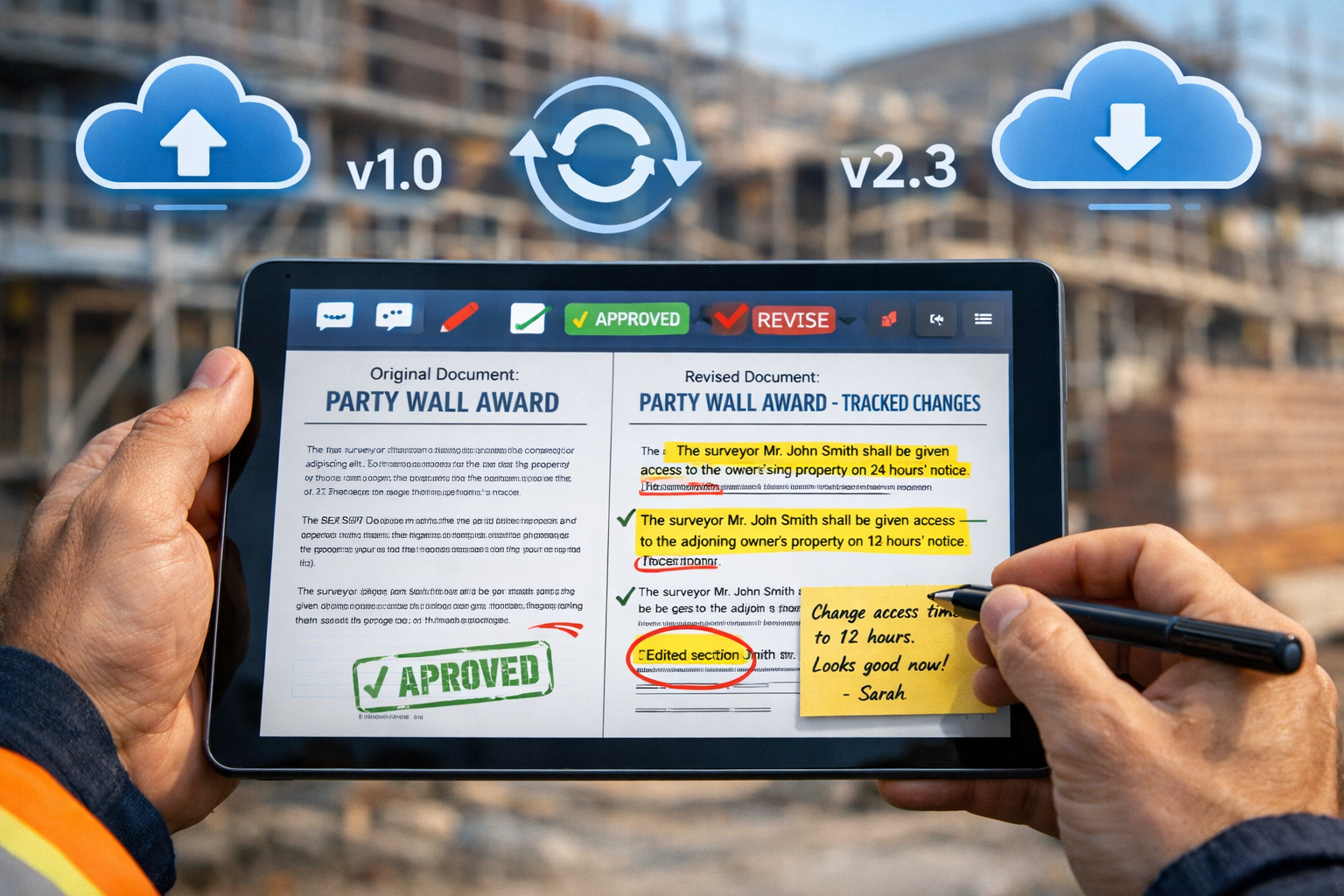
Modern cloud platforms designed for professional collaboration offer features specifically valuable for party wall work. These systems enable multiple authorized users to access the same document simultaneously, with changes visible in real-time. When an agreed surveyor updates a condition specification, both the building owner and adjoining owner can immediately see the modification, add comments, or request clarifications.
This immediate visibility eliminates the "email tennis" that traditionally characterized party wall negotiations. Instead of waiting for revised documents to arrive via email, stakeholders can engage in productive dialogue directly within the platform, with all discussions preserved alongside the relevant document sections.
Intelligent Revision Tracking and Audit Trails
Cloud platforms for collaborative party wall awards provide automatic version history that captures every change made to documents. This functionality proves invaluable when disputes arise or when parties need to understand how specific terms evolved during negotiations.
Key benefits include:
✅ Complete change history showing who modified what content and when
✅ Ability to revert to previous versions if negotiations require backtracking
✅ Comment threads that preserve the rationale behind specific decisions
✅ Comparison tools that highlight differences between document versions
These features create a transparent record that can protect all parties in case of future disagreements about what was agreed upon during the award process.
Enhanced Stakeholder Access and Permissions
Cloud platforms enable granular control over who can view, comment on, or edit different sections of party wall documentation. A building owner might have full access to their project documents, while contractors receive read-only access to relevant specifications. Adjoining owners can review proposed work details without the ability to modify surveyor recommendations.
This permission structure ensures:
🔐 Appropriate access for each stakeholder role
🛡️ Document integrity through controlled editing rights
📱 Mobile accessibility allowing reviews from any device
🌍 Location independence enabling participation regardless of physical location
For property owners working with surveyors across different London areas—whether in North London, South London, or Central London—cloud platforms eliminate geographic barriers to effective collaboration.
Integration with Party Wall Workflows
Leading cloud collaboration platforms can integrate with existing professional workflows, supporting the entire party wall process from initial notice through final award and ongoing monitoring:
| Project Stage | Cloud Platform Function | Stakeholder Benefit |
|---|---|---|
| Notice Period | Template management and distribution | Consistent, compliant notices |
| Schedule of Condition | Photo and annotation storage | Comprehensive property documentation |
| Award Drafting | Collaborative editing | Faster consensus building |
| Approval Process | Digital signatures | Immediate execution |
| Construction Phase | Progress updates and amendments | Real-time project awareness |
| Dispute Resolution | Complete audit trail | Clear documentation of agreements |
This comprehensive support across all stages makes cloud platforms particularly valuable for complex projects involving multiple types of party wall works.
Cloud Platforms for Collaborative Party Wall Awards: Key Features for 2026
Security and Compliance Considerations
When dealing with sensitive property information and legally binding agreements, security cannot be compromised. Modern cloud platforms designed for professional use incorporate enterprise-grade security features that often exceed what individual practices can implement on their own systems.
Essential security features include:
🔒 End-to-end encryption for data in transit and at rest
🔑 Multi-factor authentication preventing unauthorized access
📊 Compliance certifications meeting UK data protection requirements
💾 Automated backups ensuring no document loss
🚨 Activity monitoring detecting unusual access patterns
The concept of digital sovereignty—maintaining control over where and how data is stored—has become increasingly important in 2026[1]. Party wall professionals should prioritize platforms that offer data residency options within the UK, ensuring compliance with local regulations while maintaining accessibility for authorized users.
Cost-Benefit Analysis for Party Wall Practices
Implementing cloud collaboration platforms requires investment, but the return typically justifies the expense through multiple efficiency gains:
Direct Cost Savings:
- Reduced printing and postal expenses
- Fewer hours spent on document coordination
- Lower risk of errors requiring corrective work
- Decreased storage costs for physical documents
Indirect Benefits:
- Faster project completion improving client satisfaction
- Enhanced professional reputation through modern service delivery
- Reduced liability from improved documentation
- Ability to handle more projects simultaneously
For practices serving multiple London locations, cloud platforms eliminate the need for physical document transfer between offices, enabling seamless collaboration across geographic areas.
Selecting the Right Platform for Party Wall Work
Not all cloud collaboration platforms suit party wall applications equally well. When evaluating options, professionals should consider:
Essential Capabilities:
- Document editing with tracked changes
- Secure file sharing with permission controls
- Digital signature integration
- Mobile device compatibility
- Offline access for site visits
- Template libraries for standard documents
Professional Requirements:
- UK-based data storage options
- Professional indemnity insurance compatibility
- Integration with existing practice management software
- Scalability for practices of different sizes
- Technical support and training resources
User Experience:
- Intuitive interface requiring minimal training
- Quick onboarding for clients unfamiliar with technology
- Clear visual indicators of document status
- Simple approval workflows
While specific platform recommendations depend on individual practice needs, the broader trend toward cloud communications and collaboration services continues to accelerate in 2026[6], with numerous providers competing to offer specialized solutions for professional services.
Implementing Cloud Collaboration in Party Wall Practice
Getting Started: A Phased Approach
Transitioning from traditional methods to Cloud Platforms for Collaborative Party Wall Awards: Streamlining Revisions and Stakeholder Access in 2026 works best when approached systematically:
Phase 1: Internal Adoption (Weeks 1-4)
- Select and configure the platform
- Train staff on core features
- Migrate document templates
- Establish internal workflows
Phase 2: Pilot Projects (Weeks 5-12)
- Introduce platform on straightforward projects
- Gather feedback from team members
- Refine processes based on experience
- Document best practices
Phase 3: Client Onboarding (Weeks 13+)
- Create client guidance materials
- Offer training sessions for regular clients
- Provide technical support during transition
- Maintain traditional options for resistant clients
This gradual implementation allows practices to build confidence and competence before fully committing to cloud-based workflows.
Training Stakeholders for Success
The most sophisticated platform delivers value only when all stakeholders can use it effectively. Successful implementation requires attention to the human element:
For Surveyors:
- Comprehensive training on document creation and editing
- Best practices for revision tracking
- Security protocols and data handling
- Troubleshooting common technical issues
For Property Owners:
- Simple quick-start guides focusing on review and approval
- Video tutorials demonstrating key tasks
- Responsive support for questions
- Alternative access methods for less tech-savvy clients
For Contractors:
- Read-only access orientation
- Document download procedures
- Update notification settings
- Communication protocols within the platform
Remember that some stakeholders may prefer having a party wall agreement without extensive digital involvement, so maintaining flexibility in service delivery remains important.
Maintaining Hybrid Workflows During Transition
Complete digital transformation happens gradually. During the transition period, practices often maintain hybrid workflows that accommodate both cloud-based and traditional methods:
- Digital-first approach with paper backup for signatures if required
- Cloud storage of scanned paper documents for centralized access
- Email integration allowing traditional communicators to participate
- Printed copies provided upon request for stakeholder review
This flexibility ensures no client feels excluded while encouraging adoption of more efficient methods.
Real-World Applications and Benefits
Case Study: Streamlining Complex Multi-Party Awards
Consider a typical scenario: a building owner in East London plans a rear extension affecting two adjoining properties. Traditional methods would involve:
- Separate communications with each adjoining owner
- Multiple surveyor consultations via phone and email
- Physical document delivery for review
- Postal return of signed agreements
- Revision cycles requiring complete document reissue
Timeline: 8-12 weeks from notice to final award
With cloud collaboration platforms, the same project becomes:
- Centralized document accessible to all authorized parties
- Real-time surveyor updates visible immediately
- Instant notification when review or approval needed
- Digital signatures executed within minutes
- Revision tracking showing exactly what changed
Timeline: 4-6 weeks from notice to final award
This 50% time reduction translates directly to cost savings and improved stakeholder satisfaction.
Reducing Errors and Disputes
Document errors create costly problems in party wall work. Common issues include:
- Incorrect property descriptions
- Inconsistent measurements or specifications
- Outdated terms carried over from previous projects
- Missing signatures or approvals
- Conflicting information between related documents
Cloud platforms reduce these errors through:
✅ Template standardization ensuring consistent formatting
✅ Automated cross-referencing highlighting inconsistencies
✅ Mandatory field completion preventing information gaps
✅ Real-time review catching errors before finalization
✅ Version control eliminating outdated document circulation
When disputes do arise, the complete audit trail provided by cloud platforms offers clear evidence of what was agreed upon and when, often resolving disagreements without formal proceedings.
Improving Client Experience and Professional Reputation
Property owners facing party wall procedures often feel anxious about the process, particularly when their neighbour is carrying out works that affect their property. Cloud collaboration platforms improve the client experience by:
🌟 Increasing transparency through real-time access to project status
🌟 Reducing uncertainty with clear communication channels
🌟 Empowering participation through easy document review
🌟 Demonstrating professionalism with modern service delivery
These improvements enhance professional reputation, leading to increased referrals and repeat business—particularly valuable in competitive London markets like West London where client expectations continue rising.
Future Trends in Cloud-Based Party Wall Management
Artificial Intelligence and Automation
As cloud platforms evolve, artificial intelligence capabilities are beginning to enhance party wall workflows:
- Automated document drafting using project parameters and standard clauses
- Intelligent error detection flagging potential inconsistencies
- Predictive timeline estimation based on project complexity
- Natural language processing for contract analysis
- Automated compliance checking against Party Wall Act 1996 requirements
While these AI features remain in early stages for specialized applications like party wall work, the broader trend toward intelligent automation in professional services suggests significant developments ahead.
Integration with Building Information Modeling (BIM)
The construction industry's adoption of Building Information Modeling creates opportunities for deeper integration between design tools and party wall documentation. Future cloud platforms may:
- Import 3D models showing proposed work in relation to party structures
- Automatically generate schedules of condition from BIM data
- Link party wall specifications directly to construction drawings
- Provide visual simulations of work impact for stakeholder review
This integration could further streamline the connection between design, approval, and construction phases.
Enhanced Mobile Capabilities
Mobile functionality continues improving, with 2026 platforms offering increasingly sophisticated capabilities on smartphones and tablets:
📱 On-site document access during property inspections
📱 Photo capture and annotation directly into cloud documents
📱 Voice-to-text for quick note-taking
📱 Augmented reality overlays showing proposed work on actual structures
📱 Instant notifications ensuring no approval delays
These mobile enhancements particularly benefit surveyors conducting site visits and preparing schedules of condition, allowing immediate documentation without returning to the office.
Industry Standardization Efforts
As cloud adoption increases across the party wall profession, industry bodies may develop standardized approaches to:
- Document templates and formats
- Security and privacy protocols
- Data retention and archiving requirements
- Interoperability between different platforms
- Professional practice guidelines for digital workflows
Such standardization would further accelerate adoption by reducing implementation uncertainty and ensuring consistent professional standards across the industry.
Overcoming Common Concerns and Objections
"Our Clients Prefer Traditional Methods"
While some clients initially resist change, experience shows that most quickly appreciate cloud platforms' benefits once they experience them. Strategies for managing this concern include:
- Demonstrating value through pilot projects with willing clients
- Offering choice while gently encouraging digital adoption
- Providing exceptional support during initial platform use
- Highlighting benefits like faster approvals and cost savings
- Sharing success stories from similar clients who made the transition
Remember that client preferences often reflect unfamiliarity rather than genuine opposition. Once stakeholders experience the convenience of reviewing documents from their phone rather than waiting for postal delivery, resistance typically diminishes.
"What If the Platform Provider Goes Out of Business?"
This legitimate concern requires practical mitigation strategies:
✓ Choose established providers with proven track records
✓ Ensure data portability allowing export in standard formats
✓ Maintain local backups of critical documents
✓ Review contract terms regarding data access if service ends
✓ Monitor provider financial health and industry reputation
The broader trend toward cloud adoption across industries[7] suggests that established platforms will continue operating, with market consolidation more likely than widespread failures.
"How Do We Handle Clients Without Internet Access?"
While internet connectivity has become nearly universal in 2026, occasional situations require accommodation:
- Provide printed copies of documents for review
- Offer in-person meetings for document explanation
- Accept traditional signatures with staff scanning for cloud storage
- Use telephone support for clients preferring verbal communication
- Maintain hybrid workflows accommodating various preferences
These accommodations ensure inclusive service while still capturing efficiency benefits for the practice and most clients.
"Aren't Cloud Platforms Expensive?"
Cost concerns often stem from incomplete analysis. When evaluating cloud platform expenses, consider:
Visible Costs:
- Monthly or annual subscription fees
- Initial setup and training time
- Ongoing technical support
Hidden Traditional Costs:
- Printing, paper, and postage
- Staff time for document coordination
- Physical storage space and filing systems
- Lost productivity from version confusion
- Professional liability from documentation errors
- Opportunity cost of slower project completion
For most practices, total cost of ownership actually decreases with cloud adoption, while service quality simultaneously improves.
Conclusion: Embracing Digital Transformation in Party Wall Practice
Cloud Platforms for Collaborative Party Wall Awards: Streamlining Revisions and Stakeholder Access in 2026 represent more than just a technological upgrade—they embody a fundamental shift toward more efficient, transparent, and client-centered professional practice. The benefits extend across every stakeholder group: surveyors gain efficiency and reduced liability, property owners experience faster approvals and lower costs, and the entire process becomes more accessible and less stressful for all involved.
The transition from traditional paper-based methods to cloud collaboration requires initial investment in both technology and change management, but the return manifests quickly through reduced errors, accelerated timelines, and improved client satisfaction. As the construction and property industries continue their digital evolution, party wall professionals who embrace these tools position themselves as forward-thinking leaders rather than reactive followers.
Next Steps for Implementation
For party wall professionals ready to modernize their practice:
- Assess current workflows to identify specific pain points cloud platforms could address
- Research platform options focusing on security, features, and professional services compatibility
- Start with a pilot project to build internal competence before broad rollout
- Invest in training for both staff and clients to maximize adoption success
- Monitor results tracking time savings, error reduction, and client feedback
- Iterate and improve refining processes based on real-world experience
For property owners and building owners planning construction work, ask your surveyor about their digital collaboration capabilities. Professionals offering cloud-based workflows signal commitment to efficiency and modern service delivery—qualities that typically correlate with overall practice excellence.
The future of party wall practice is collaborative, transparent, and cloud-based. Those who embrace this transformation in 2026 will find themselves better positioned to serve clients effectively while building more sustainable, scalable, and satisfying professional practices.
References
[1] Nextcloud Awards 2026 Movers And Shakers In Digital Sovereignty – https://nextcloud.com/blog/nextcloud-awards-2026-movers-and-shakers-in-digital-sovereignty/
[6] Frost And Sullivan Identifies Top 10 Growth Opportunities In Cloud Communications And Collaboration Services For 2026 – https://www.newswiretoday.com/news/185698/Frost-and-Sullivan-Identifies-Top-10-Growth-Opportunities-in-Cloud-Communications-and-Collaboration-Services-for-2026/
[7] Why Market Leaders Are Moving To The Cloud 2026 – https://www.cloud-awards.com/why-market-leaders-are-moving-to-the-cloud-2026
