


Imagine receiving a party wall notice from your neighbour, only to discover weeks later that you've been reviewing an outdated version while your surveyor worked from a completely different document. Version conflicts, lost emails, and miscommunication have plagued party wall negotiations for decades—but 2026 marks a turning point. Common Data Environments for Party Wall Agreements: Real-Time Collaboration in 2026 Neighbour Negotiations represents a digital transformation that centralizes party wall notices, schedules of condition, and agreements into a single, accessible platform where all parties work from the same information simultaneously.
The traditional approach to party wall agreements has created unnecessary friction between neighbours, delayed construction projects, and increased costs through inefficient document management. As property development intensifies across London and the UK, the need for streamlined communication has never been more critical. Common Data Environments (CDEs)—originally developed for large construction projects—now offer a practical solution for managing the complex documentation requirements of the Party Wall etc. Act 1996.
This article explores how Common Data Environments for Party Wall Agreements: Real-Time Collaboration in 2026 Neighbour Negotiations addresses data silos, eliminates version control nightmares, and creates transparent workflows that benefit building owners, adjoining owners, and surveyors alike. 🏗️
Key Takeaways
- Centralized Documentation: CDEs eliminate version conflicts by providing a single source of truth for all party wall notices, schedules of condition, and agreements
- Real-Time Updates: All stakeholders receive instant notifications when documents are updated, ensuring everyone works with current information
- Enhanced Compliance: Automated workflows and audit trails help ensure full compliance with the Party Wall etc. Act 1996 requirements
- Cost Reduction: Streamlined communication and reduced disputes can significantly lower party wall costs for all parties
- Improved Neighbour Relations: Transparency and accessibility foster trust and reduce misunderstandings during construction projects
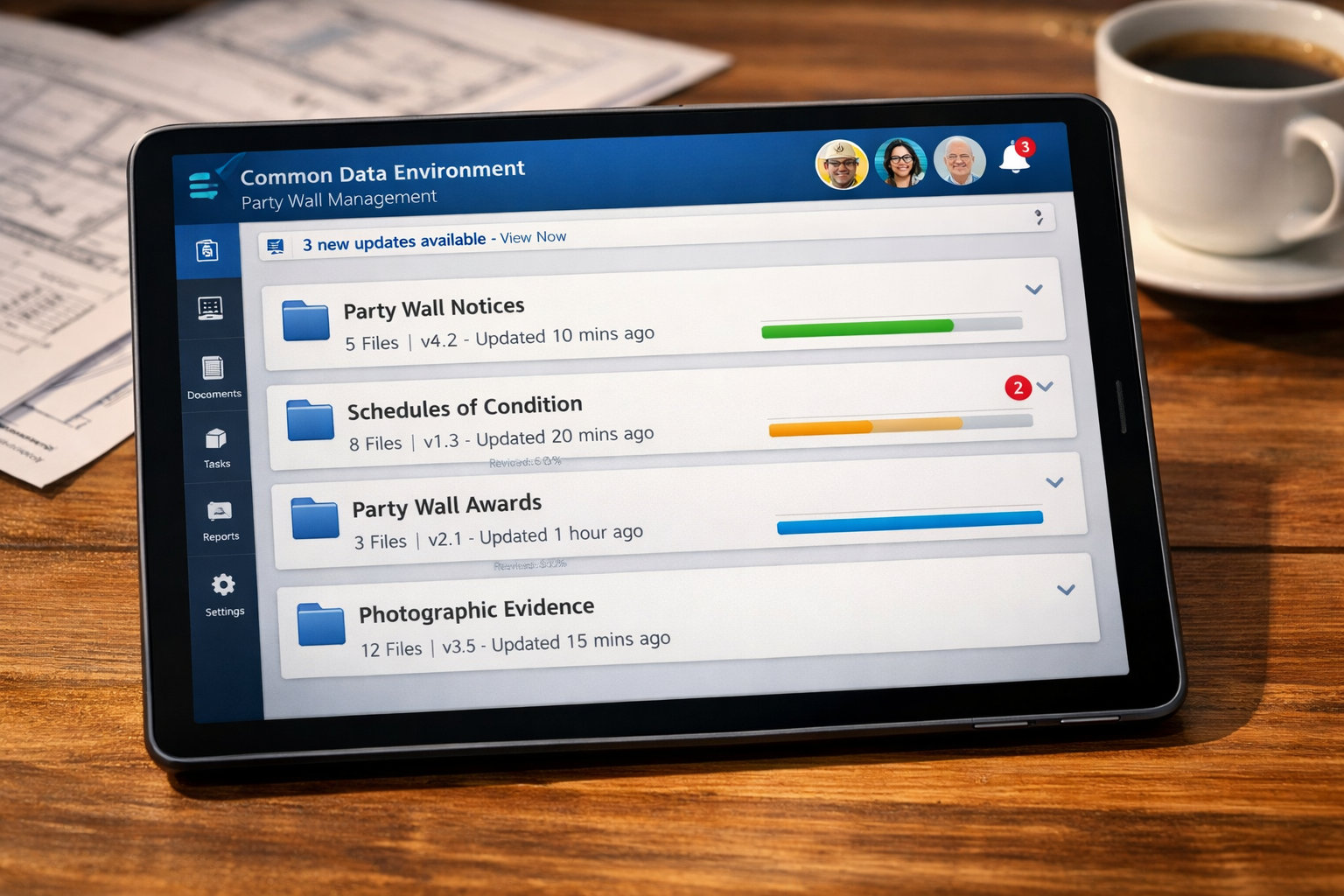
Understanding Common Data Environments for Party Wall Agreements
What Are Common Data Environments?
A Common Data Environment (CDE) is a centralized digital platform that serves as the single source of truth for all project information. Originally developed for Architecture, Engineering, and Construction (AEC) projects, CDEs enable multiple stakeholders to access, share, and collaborate on documents in real-time without creating conflicting versions.
Connected CDEs represent the next evolution in project information management, enabling seamless, secure, and standardized data exchange across multiple platforms and stakeholders.[3] Unlike traditional file-sharing systems where documents exist in isolation across various email inboxes and local drives, CDEs maintain a structured hierarchy with clear version control and access permissions.
Why Party Wall Negotiations Need CDEs
Party wall matters involve multiple parties with different interests:
- Building Owners initiating construction work
- Adjoining Owners whose properties may be affected
- Party Wall Surveyors representing each party or acting as Agreed Surveyors
- Contractors executing the work
- Legal advisors reviewing documentation
Each stakeholder requires access to accurate, current information about party wall notices, schedules of condition, photographic evidence, and agreements. Traditional methods—relying on email chains, postal services, and physical documents—create numerous opportunities for miscommunication and errors.
The Data Silo Problem in Traditional Party Wall Processes
Data silos occur when information becomes trapped in separate systems or with individual parties. In traditional party wall negotiations, common scenarios include:
- Building owners working from one version of a schedule of condition while adjoining owners review another
- Surveyors unable to access the latest photographic evidence
- Email communications scattered across multiple threads with different participants
- Physical documents requiring manual delivery and signatures
- No clear audit trail of who reviewed or approved specific clauses
These silos create friction, extend negotiation timelines, and increase the likelihood of disputes—exactly what the Party Wall etc. Act 1996 was designed to prevent.
How Common Data Environments Transform Party Wall Collaboration in 2026
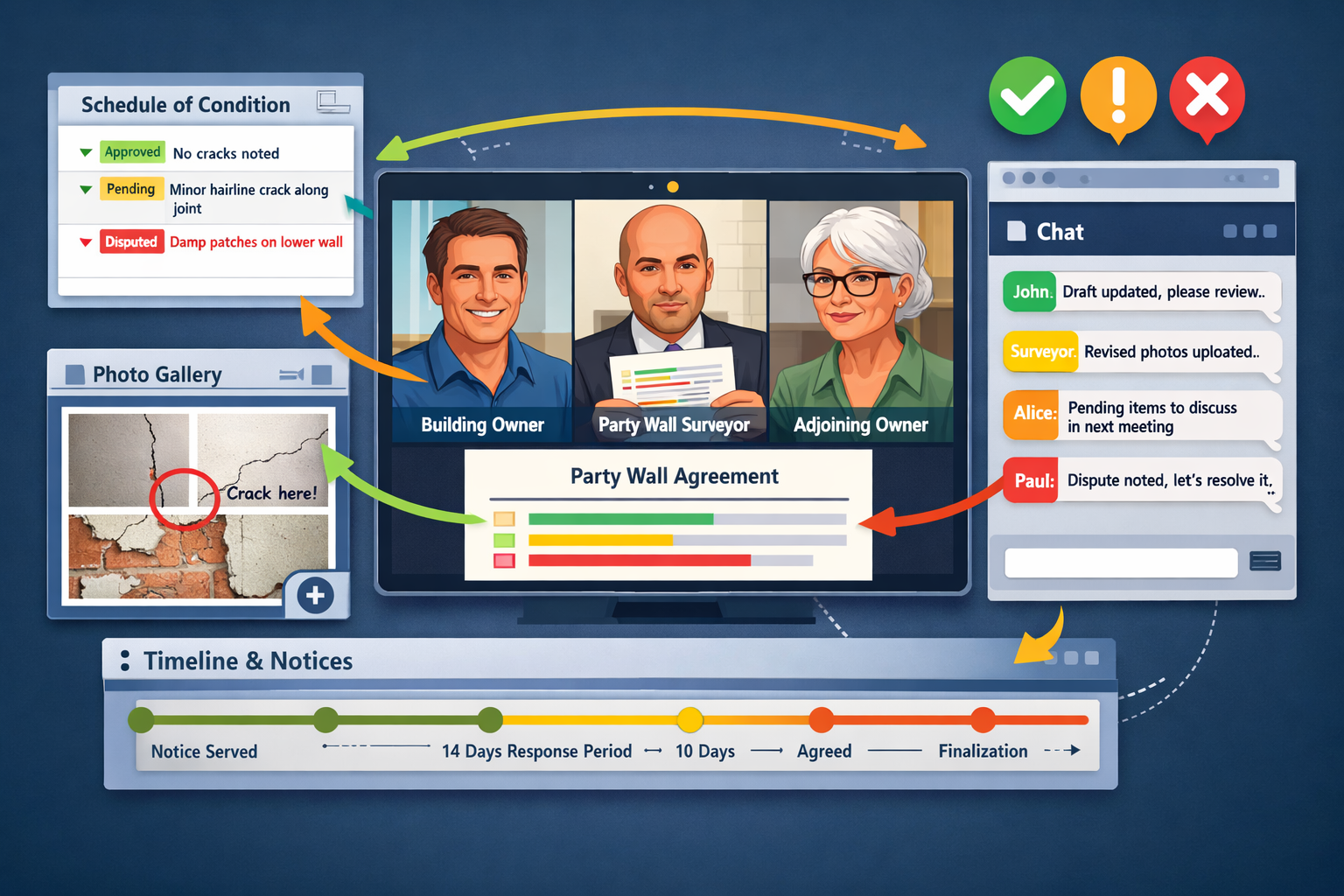
Centralized Document Management
CDEs organize all party wall documentation in a structured, accessible format. Key features include:
Organized Folder Structure:
- 📋 Party Wall Notices (Line of Junction, Party Structure, Adjacent Excavation)
- 📸 Schedules of Condition with timestamped photographs
- 📄 Draft and Final Party Wall Awards
- 💬 Correspondence logs
- 📊 Technical drawings and specifications
- ✅ Consent and approval documents
Each document carries metadata including upload date, author, version number, and review status. When serving party wall notices, the CDE automatically timestamps the submission and notifies relevant parties, creating an indisputable record of compliance with statutory timelines.
Real-Time Collaboration Features
The power of Common Data Environments for Party Wall Agreements: Real-Time Collaboration in 2026 Neighbour Negotiations lies in simultaneous access and instant updates:
Live Document Editing: Multiple surveyors can review and annotate schedules of condition simultaneously, with changes visible to all authorized users in real-time. Color-coded comments identify which surveyor made specific observations, eliminating confusion about authorship.
Instant Notifications: When a building owner uploads revised construction plans, the CDE immediately alerts the adjoining owner and both surveyors via email, SMS, or in-app notifications. This eliminates delays caused by unread emails or lost postal communications.
Version Control: Every document revision is automatically saved with a complete history. Users can view previous versions, compare changes, and restore earlier iterations if needed—critical when negotiating specific clauses in party wall awards.
Mobile Access: Surveyors conducting site inspections can upload photographs and notes directly from smartphones, making them immediately available to all parties. This is particularly valuable when documenting schedules of condition for adjoining properties.
Enhanced Compliance and Audit Trails
Compliance with the Party Wall etc. Act 1996 requires strict adherence to notice periods, response timelines, and documentation requirements. CDEs support compliance through:
| Compliance Requirement | CDE Solution |
|---|---|
| Notice Service | Automated timestamping and delivery confirmation |
| 14-Day Response Period | Countdown timers and automatic reminders |
| Document Retention | Permanent, searchable archive of all communications |
| Dispute Resolution | Complete audit trail showing all parties' actions |
| Statutory Notices | Templates ensuring all required information is included |
Effective party wall compliance requires surveyors with specialized knowledge spanning multiple disciplines,[1] and CDEs provide the technological infrastructure to support this expertise. When disputes arise, the complete audit trail—showing who accessed what information and when—provides invaluable evidence for resolution or third surveyor review.
Improved Communication Between Neighbours
Perhaps the most underappreciated benefit of Common Data Environments for Party Wall Agreements: Real-Time Collaboration in 2026 Neighbour Negotiations is improved neighbour relations. Construction projects inevitably create tension, but transparency reduces suspicion and builds trust.
Transparency Benefits:
- Adjoining owners can view construction schedules and understand project timelines
- Both parties see the same information simultaneously, eliminating "he said, she said" disputes
- Clear documentation of agreed-upon protections and monitoring arrangements
- Accessible photographic evidence showing pre-construction property conditions
When neighbours are carrying out works, access to real-time information about project progress and compliance with party wall awards provides reassurance and reduces anxiety. Building owners benefit from demonstrating their commitment to proper procedures and protecting adjoining properties.
Implementing Common Data Environments for Party Wall Agreements in Practice
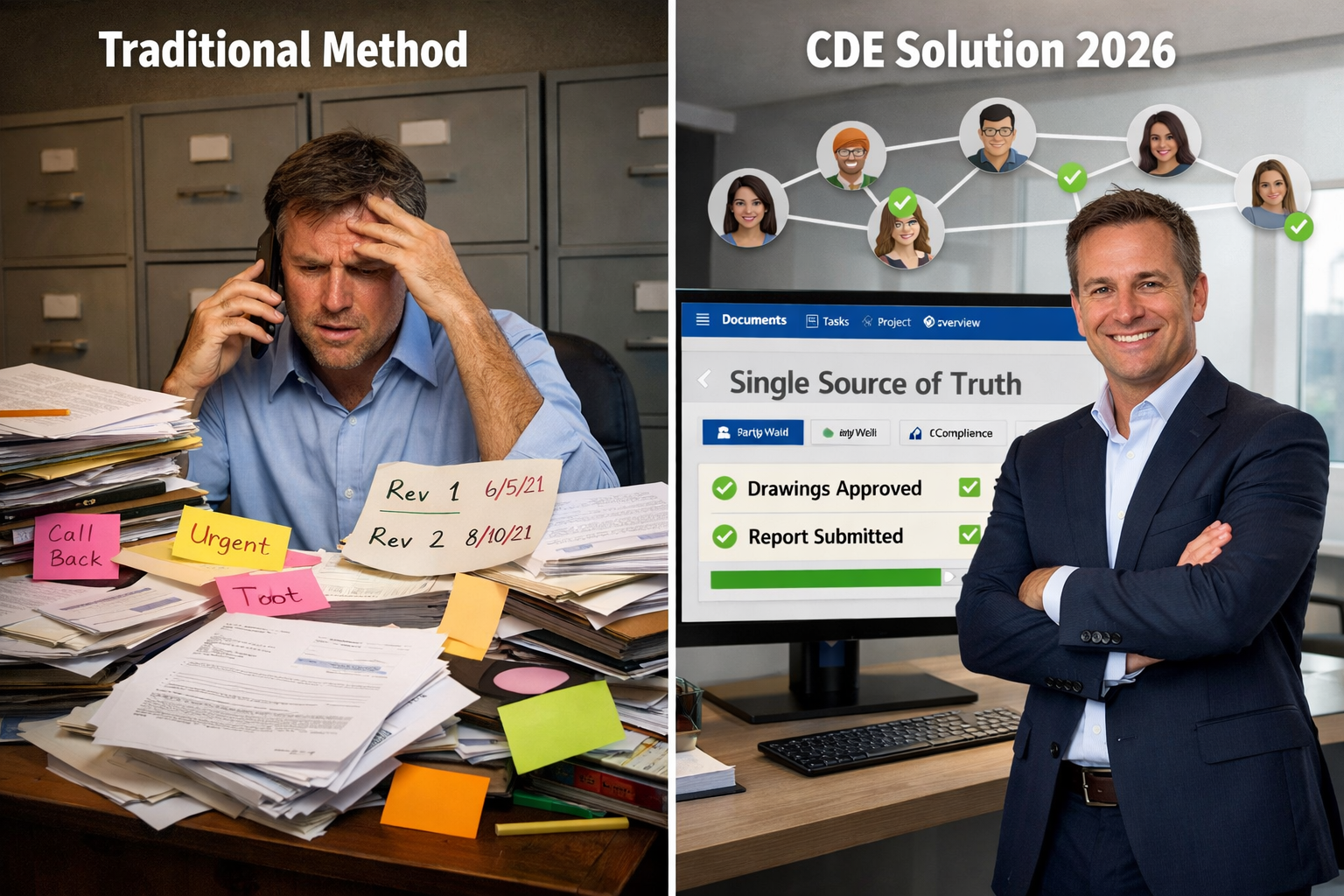
Selecting the Right CDE Platform
Not all CDEs are created equal. When choosing a platform for party wall negotiations, consider:
Essential Features:
- ✅ User-friendly interface accessible to non-technical users
- ✅ Mobile compatibility for site inspections
- ✅ Granular permission controls (view-only vs. editing rights)
- ✅ Secure cloud storage with encryption
- ✅ Integration with email and calendar systems
- ✅ Automated notification systems
- ✅ Document comparison tools
- ✅ Audit trail and activity logs
Privacy and Security Considerations: As comprehensive privacy laws continue evolving in 2026,[2][4] CDEs must comply with data protection regulations. Personal information about property owners, photographs of private spaces, and financial details require robust security measures. Choose platforms with:
- End-to-end encryption
- Multi-factor authentication
- Regular security audits
- GDPR compliance certification
- Clear data retention and deletion policies
Onboarding Stakeholders
The success of Common Data Environments for Party Wall Agreements: Real-Time Collaboration in 2026 Neighbour Negotiations depends on user adoption. Stakeholders unfamiliar with digital collaboration tools require support:
Onboarding Best Practices:
- Initial Setup Meeting: Gather all parties for a brief video call or in-person session demonstrating the platform
- Role-Specific Training: Provide tutorials tailored to each user type (building owner, adjoining owner, surveyor)
- Quick Reference Guides: Create one-page instructions for common tasks (uploading documents, adding comments, viewing notifications)
- Technical Support: Designate a primary contact for troubleshooting and questions
- Gradual Implementation: Start with basic features before introducing advanced collaboration tools
Many adjoining owners—particularly elderly property owners—may feel overwhelmed by technology. Offering alternative access methods (such as email summaries of CDE activity) ensures inclusivity while maintaining the CDE as the authoritative record.
Workflow Integration with Traditional Party Wall Processes
CDEs complement rather than replace established party wall procedures. The integration might look like:
Stage 1: Notice Service
- Building owner uploads party wall notice to CDE
- System generates PDF for postal delivery (statutory requirement)
- CDE timestamps upload and tracks delivery
- Adjoining owner receives email notification with secure link to view notice
Stage 2: Surveyor Appointment
- Parties upload surveyor appointment letters to CDE
- Contact information automatically populates for all surveyors
- System creates shared workspace for surveyor collaboration
Stage 3: Schedule of Condition
- Surveyors upload photographs and observations in real-time during site visit
- Both building and adjoining owners can view progress
- Draft schedule circulates for review with comment functionality
- Final version marked as "approved" with digital signatures
Stage 4: Party Wall Award
- Draft award uploaded for review
- Parties and surveyors annotate specific clauses
- Revisions tracked with version control
- Final award signed digitally or uploaded after physical signature
- All parties receive instant notification of execution
Stage 5: Construction Monitoring
- Contractors upload progress reports and photographs
- Surveyors document inspections
- Any damage or concerns immediately flagged to all parties
- Compliance with award conditions tracked and verified
This workflow ensures statutory requirements are met while leveraging CDE benefits for efficiency and transparency. For those wondering about having a party wall agreement without a surveyor, CDEs can facilitate direct negotiation between neighbours, though professional surveyor involvement remains advisable for complex projects.
Cost Considerations and ROI
Implementing a CDE involves costs, but these are typically offset by savings:
CDE Costs:
- Platform subscription fees (£20-100/month depending on features)
- Initial setup and training time
- Technical support (usually included in subscription)
Cost Savings:
- Reduced surveyor time spent on document management and communication
- Fewer disputes requiring third surveyor intervention
- Faster negotiation timelines reducing project delays
- Lower printing, postage, and courier costs
- Reduced risk of costly mistakes from version conflicts
For building owners undertaking significant construction, the investment in a CDE can keep party wall costs down by streamlining the entire process. Even for simpler projects, the peace of mind and improved neighbour relations justify the modest expense.
Regional Considerations for CDE Implementation in London
London's dense urban environment creates unique party wall challenges. Whether working with a party wall surveyor in North London, South London, East London, West London, or Central London, CDEs address region-specific issues:
High-Density Developments: Central London projects often affect multiple adjoining properties. CDEs scale efficiently, allowing one building owner to manage relationships with numerous neighbours through a single platform.
Heritage Properties: Detailed schedules of condition for listed buildings require extensive photographic documentation. CDEs provide unlimited storage and organization for thousands of images, far exceeding email attachment limits.
International Owners: London's property market includes many overseas investors. CDEs enable remote participation in party wall negotiations without requiring physical presence in the UK.
Complex Projects: Large-scale developments involving various types of party wall works benefit from CDEs' ability to organize multiple work streams, each with its own notices, awards, and monitoring requirements.
Future Developments in CDE Technology for Party Wall Matters
As we progress through 2026, emerging technologies promise further enhancements to Common Data Environments for Party Wall Agreements: Real-Time Collaboration in 2026 Neighbour Negotiations:
Artificial Intelligence Integration: AI could analyze historical party wall awards to suggest standard clauses, identify potential dispute areas based on project characteristics, and predict negotiation timelines.
Blockchain Verification: Immutable blockchain records could provide additional security for critical documents like signed party wall awards, creating tamper-proof evidence of agreements.
Virtual Reality Site Inspections: VR technology might enable remote participation in schedule of condition inspections, particularly valuable for overseas property owners or during travel restrictions.
Automated Compliance Checking: Systems could automatically verify that notices contain all statutory requirements and flag missing information before service, reducing technical errors.
Integration with Planning Systems: Future CDEs might connect with local authority planning databases, automatically importing relevant planning permissions and building control approvals into party wall documentation.
These innovations will further reduce friction in party wall negotiations, making the process more accessible and less adversarial for all participants.
Common Challenges and Solutions
Challenge 1: Digital Literacy Gaps
Problem: Some stakeholders, particularly elderly adjoining owners, may struggle with technology.
Solution: Offer hybrid approaches where surveyors manage CDE access on behalf of less tech-savvy parties, providing printed summaries of key documents while maintaining the CDE as the official record. Consider video calls to walk users through the platform step-by-step.
Challenge 2: Data Security Concerns
Problem: Property owners may worry about sensitive information security.
Solution: Choose CDEs with robust security certifications, provide clear explanations of encryption and access controls, and offer demonstrations of security features. Emphasize that CDEs are often more secure than email, which lacks encryption and proper access controls.
Challenge 3: Initial Resistance to Change
Problem: "We've always done it this way" mentality from traditional practitioners.
Solution: Start with pilot projects, share success stories demonstrating time and cost savings, and emphasize that CDEs enhance rather than replace professional expertise. Highlight how CDEs reduce administrative burden, allowing surveyors to focus on technical assessment rather than document management.
Challenge 4: Platform Selection Confusion
Problem: Numerous CDE options with varying features and price points.
Solution: Create a requirements checklist based on project complexity, conduct free trials of shortlisted platforms, and seek recommendations from surveyor professional bodies. For straightforward party wall matters, simpler platforms may suffice, while complex developments justify more sophisticated systems.
Best Practices for Maximizing CDE Benefits
To fully realize the potential of Common Data Environments for Party Wall Agreements: Real-Time Collaboration in 2026 Neighbour Negotiations, follow these best practices:
🎯 Establish Clear Protocols
- Define naming conventions for documents (e.g., "PWN_LineOfJunction_2026-03-15_v1")
- Set expectations for response times to CDE notifications
- Clarify who has permission to upload, edit, or approve different document types
- Create templates for common documents to ensure consistency
📱 Leverage Mobile Capabilities
- Conduct schedule of condition inspections with tablet or smartphone
- Upload photographs immediately with location tagging
- Use voice-to-text for quick observation notes
- Enable push notifications for time-sensitive updates
🔒 Maintain Security Hygiene
- Regularly review and update access permissions as projects progress
- Remove access for parties no longer involved (e.g., after award execution)
- Use strong, unique passwords and enable multi-factor authentication
- Conduct periodic security audits of stored information
📊 Utilize Reporting Features
- Generate activity reports showing all stakeholder engagement
- Create compliance dashboards tracking statutory deadlines
- Export complete document sets for archival purposes
- Use analytics to identify bottlenecks in negotiation processes
💬 Encourage Active Participation
- Set expectations that all parties check the CDE regularly
- Use @mentions to draw attention to specific items requiring review
- Schedule regular check-in meetings to discuss CDE-flagged issues
- Celebrate milestones (e.g., "Schedule of Condition Approved!") to maintain engagement
Conclusion
Common Data Environments for Party Wall Agreements: Real-Time Collaboration in 2026 Neighbour Negotiations represents a fundamental shift in how building owners, adjoining owners, and surveyors manage the complex documentation and communication requirements of the Party Wall etc. Act 1996. By centralizing party wall notices, schedules of condition, and agreements into a single, accessible platform, CDEs eliminate the version conflicts, data silos, and miscommunications that have plagued traditional processes for decades.
The benefits are clear and measurable: reduced negotiation timelines, lower costs, improved compliance, and most importantly, better neighbour relations during what can be a stressful period of construction activity. As data centre developments and other complex projects continue to drive demand for effective party wall management,[1] the surveyors and property owners who embrace CDE technology will find themselves better positioned to navigate these challenges efficiently and professionally.
For building owners planning construction work, the investment in a CDE platform is modest compared to overall project costs and can deliver significant returns through streamlined processes and reduced disputes. Adjoining owners benefit from unprecedented transparency and access to information about works affecting their properties. Surveyors gain powerful tools that reduce administrative burden and allow them to focus on their core expertise: technical assessment and dispute prevention.
Next Steps
For Building Owners Planning Construction:
- Research CDE platforms suitable for party wall management (start with free trials)
- Discuss CDE implementation with your appointed surveyor
- Budget for platform subscription in overall project costs
- Consider downloading a sample party wall agreement template to understand documentation requirements
- Review boundary wall rules to determine which works require party wall procedures
For Adjoining Owners Receiving Notices:
- Ask the building owner or their surveyor if a CDE will be used
- Request a brief training session on accessing and using the platform
- Set up email notifications to stay informed of updates
- Understand your rights and options when responding to party wall notices
- Consider appointing a surveyor familiar with CDE technology
For Party Wall Surveyors:
- Evaluate CDE platforms and select one to recommend to clients
- Develop onboarding materials for property owners unfamiliar with CDEs
- Create standard folder structures and document templates
- Build CDE implementation into your fee proposals
- Stay informed about emerging technologies and best practices
The future of party wall negotiations is collaborative, transparent, and digital. By embracing Common Data Environments in 2026, all stakeholders can transform what has traditionally been an adversarial process into a streamlined, professional collaboration that protects everyone's interests while maintaining good neighbour relations. The technology is here, proven, and accessible—the only question is when, not if, you'll make the transition. 🚀
References
[1] Party Wall Agreements In Data Centre Developments 2026 Compliance Amid Ai Driven Uk Demand – https://nottinghillsurveyors.com/blog/party-wall-agreements-in-data-centre-developments-2026-compliance-amid-ai-driven-uk-demand
[2] Newsroom Publications A New Era Of Comprehensive Privacy Laws And The Surge In Data Privacy Litigation Important Updates For 2026 – https://www.stinson.com/newsroom-publications-a-new-era-of-comprehensive-privacy-laws-and-the-surge-in-data-privacy-litigation-important-updates-for-2026
[3] Connected Common Data Environment Guide – https://www.12dsynergy.com/connected-common-data-environment-guide/
[4] Global Privacy Compliance Trends In 2026 – https://www.schellman.com/blog/privacy/global-privacy-compliance-trends-in-2026
