

When a construction project involves shared walls between neighboring properties, the administrative burden can quickly spiral out of control. Surveyors juggle paper notices, property owners struggle to track progress, and builders wait for approvals that seem to take forever. In 2026, Common Data Environments for Party Wall Notices: Streamlining Multi-Stakeholder Collaboration in 2026 Disputes represents a transformative approach that's revolutionizing how the construction industry manages these complex interactions under the Party Wall Act.
The traditional party wall process has long been plagued by communication delays, version control issues, and document mismanagement. A single party wall notice might pass through multiple hands—building owners, adjoining owners, appointed surveyors, and contractors—creating countless opportunities for confusion and conflict. Common Data Environments (CDEs) offer a digital solution that centralizes all project information, enabling real-time collaboration and dramatically reducing the time required to resolve party wall matters.
Key Takeaways
- 🚀 CDEs reduce party wall resolution times by 30-50% through centralized document management and real-time stakeholder access
- 📊 Single source of truth eliminates version control errors that traditionally cause disputes and delays in party wall proceedings
- 🤝 Multi-stakeholder collaboration becomes seamless with surveyors, owners, and contractors accessing synchronized information instantly
- ✅ Automated workflows and notifications ensure compliance with Party Wall Act timelines and reduce administrative overhead
- 💰 Cost savings of 20-35% achieved through reduced surveyor hours, fewer disputes, and faster project commencement
Understanding Common Data Environments in Construction
A Common Data Environment serves as a centralized digital hub where all project-related information is stored, managed, and shared among stakeholders [1]. In the construction industry, CDEs have become essential tools for managing Building Information Modeling (BIM) workflows, ensuring that everyone involved in a project works from the same accurate, up-to-date information [3].
What Makes a CDE Effective?
The core principle behind any successful CDE is creating a single source of truth [4]. Rather than information scattered across emails, file servers, and individual computers, all documents reside in one controlled environment with clear access permissions and version tracking.
Key characteristics of effective CDEs include:
- Centralized storage with cloud-based accessibility
- Structured workflows that guide documents through review and approval stages
- Version control that maintains complete audit trails
- Role-based permissions ensuring appropriate access levels
- Real-time notifications keeping stakeholders informed of changes
- Integration capabilities with existing project management tools
According to ISO 19650 standards, CDEs should facilitate information management throughout the entire project lifecycle, from initial planning through construction and into operational phases [5]. This structured approach transforms how construction professionals collaborate, particularly in sensitive areas like party wall procedures.
The CDE Workflow Structure
CDEs typically organize information into distinct workflow states [2]:
| Workflow State | Description | Access Level |
|---|---|---|
| Work in Progress (WIP) | Documents under development | Author only |
| Shared | Documents ready for review | Project team |
| Published | Approved documents | All stakeholders |
| Archived | Historical versions | Read-only access |
This structured progression ensures that stakeholders always know which documents represent current, approved information versus drafts or outdated versions—a critical distinction when dealing with legally binding party wall agreements.
Applying Common Data Environments to Party Wall Notices
The intersection of CDE technology and party wall procedures represents one of the most promising developments in construction dispute resolution in 2026. Traditional party wall processes under the Party Wall etc. Act 1996 involve multiple document exchanges, strict timelines, and coordination among several parties who may have competing interests [7].
The Traditional Party Wall Challenge
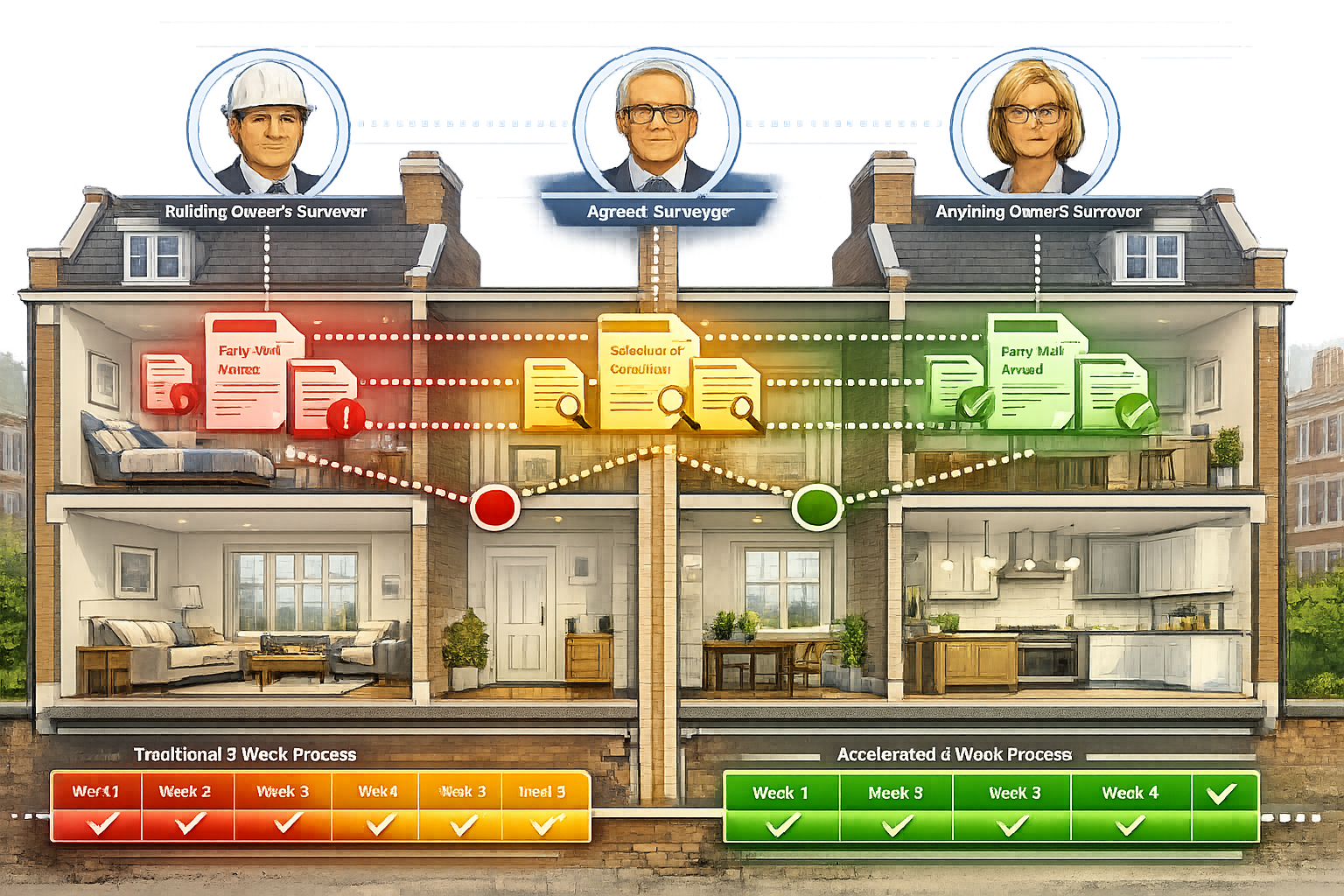
Under conventional practices, a typical party wall matter involves:
- Building owner serves notice to adjoining owner
- Adjoining owner responds within 14 days (consent or dissent)
- If dissent, both parties appoint surveyors or agree on a single agreed surveyor
- Surveyors exchange correspondence, conduct inspections, and prepare schedules of condition
- A party wall award is drafted, reviewed, and finalized
- Construction proceeds with ongoing monitoring
Each step generates documents—notices, acknowledgments, inspection reports, photographic evidence, correspondence, and the final award. Without a centralized system, these documents circulate via email, postal mail, or file-sharing services, creating significant risks:
- ❌ Version confusion when multiple drafts exist
- ❌ Communication delays waiting for postal delivery or email responses
- ❌ Lost documentation when files aren't properly organized
- ❌ Missed deadlines due to poor visibility of timeline requirements
- ❌ Increased disputes stemming from information asymmetry
How CDEs Transform Party Wall Workflows
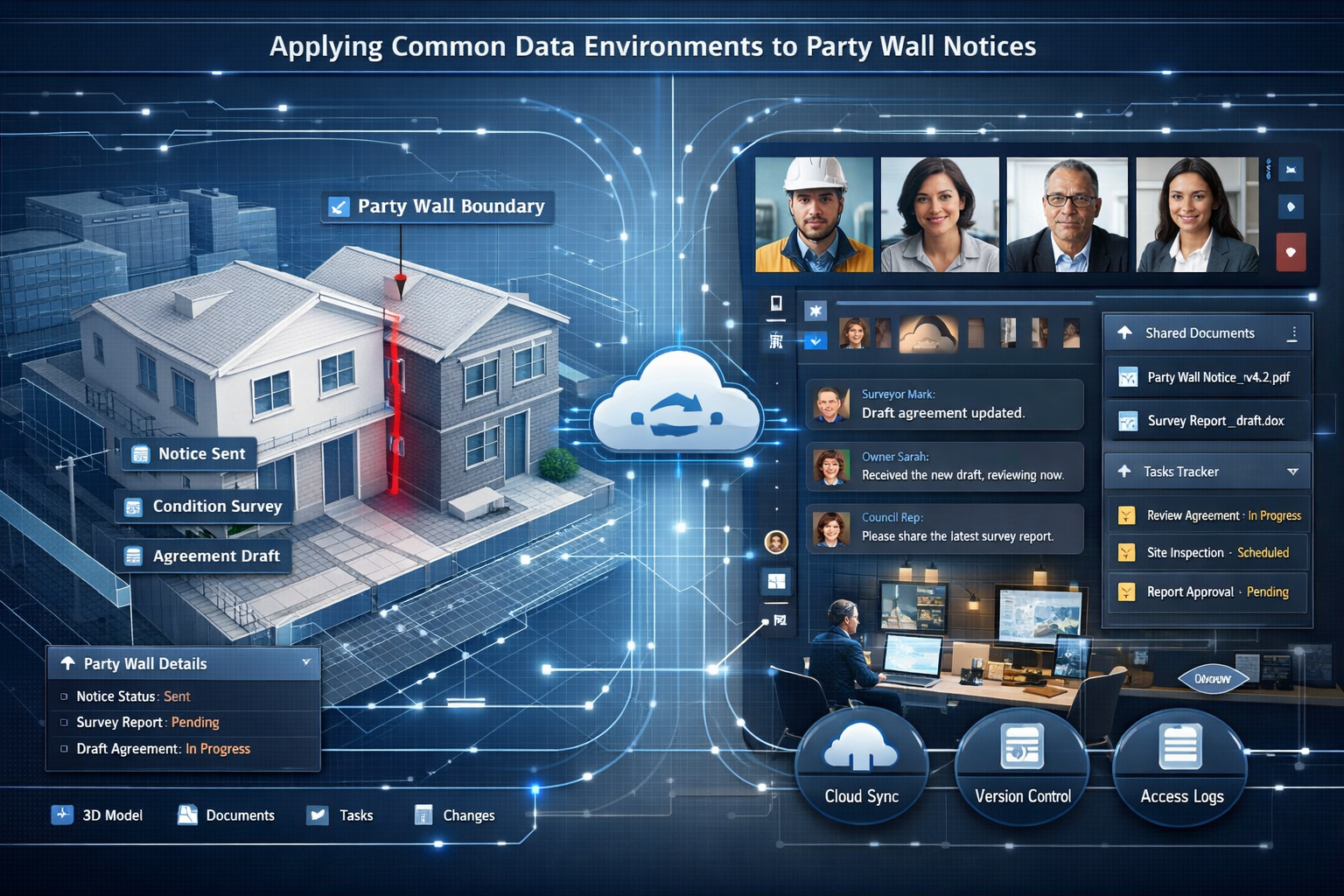
Common Data Environments for Party Wall Notices: Streamlining Multi-Stakeholder Collaboration in 2026 Disputes addresses these challenges through several key mechanisms:
Centralized Document Repository
All party wall documentation—from initial party wall notices through final awards—resides in a single, secure location. Building owners, adjoining owners, appointed surveyors, and contractors access the same information simultaneously, eliminating the "I never received that document" scenario that frequently causes disputes.
Automated Workflow Management
CDEs can be configured to mirror the statutory requirements of the Party Wall Act. When a building owner uploads a party wall notice, the system automatically:
- Timestamps the submission for compliance tracking
- Notifies the adjoining owner via their preferred communication method
- Initiates a 14-day countdown timer for response
- Sends reminder notifications as deadlines approach
- Escalates to surveyor appointment if dissent is registered
This automation ensures statutory compliance while reducing administrative burden on all parties.
Real-Time Collaboration on Schedules of Condition
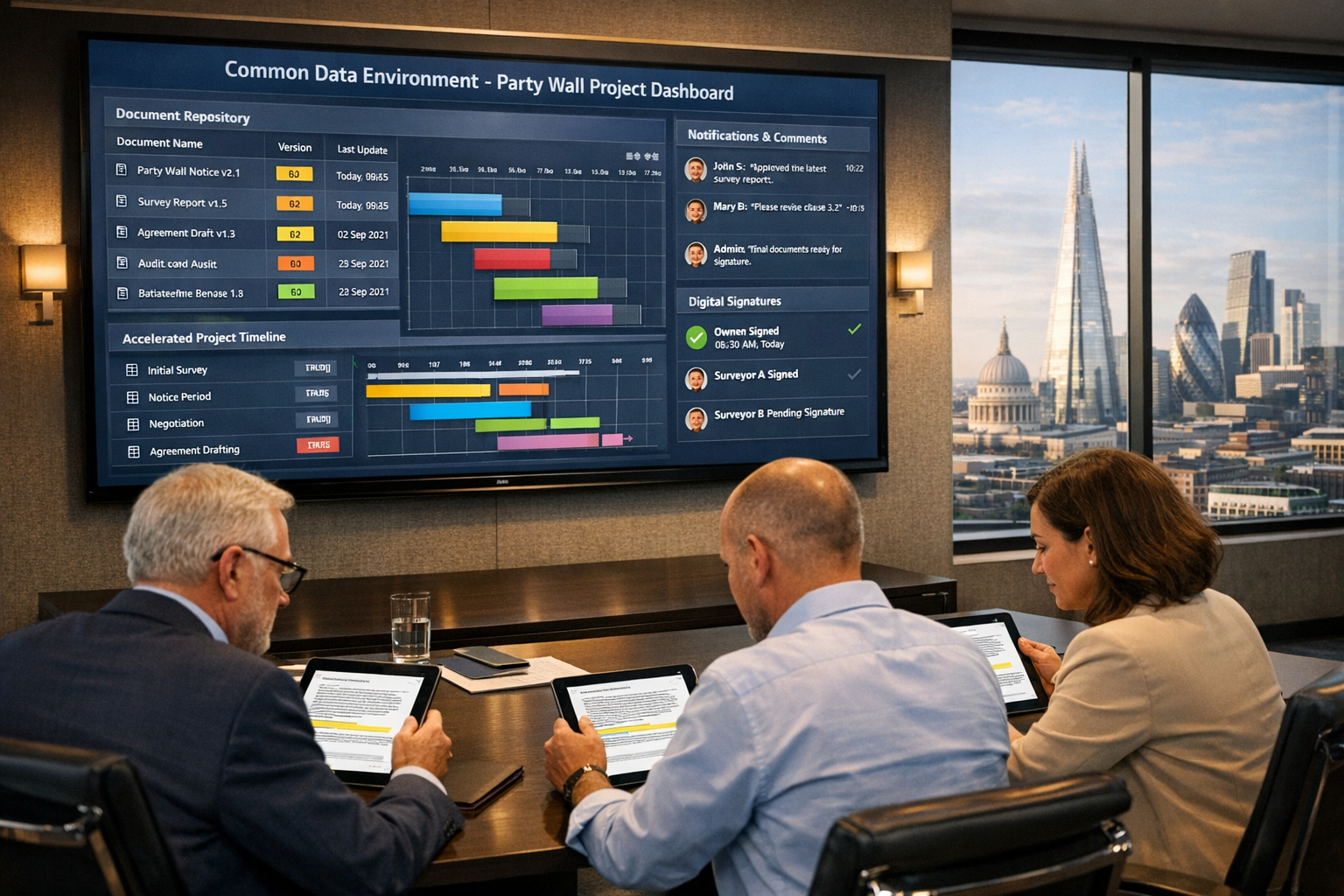
One of the most time-consuming aspects of party wall procedures involves creating detailed schedules of condition documenting the pre-construction state of affected properties. In a CDE environment:
- Surveyors upload photographs and notes directly during site inspections
- Annotations and markups can be added collaboratively
- All parties review the same version simultaneously
- Comments and questions are tracked within the document
- Approval workflows ensure formal sign-off before work commences
Case studies from 2025-2026 implementations show that schedule of condition preparation time decreased by 40-55% when using CDE platforms compared to traditional methods.
Transparent Communication Trails
Every interaction within a CDE is logged and timestamped, creating an immutable audit trail. This transparency proves invaluable if disputes escalate, as all parties can reference exactly what was communicated, when, and by whom. This documentation reduces the "he said, she said" conflicts that often complicate party wall disputes.
Real-World Impact: Common Data Environments for Party Wall Notices in 2026
The practical benefits of implementing Common Data Environments for Party Wall Notices: Streamlining Multi-Stakeholder Collaboration in 2026 Disputes extend beyond theoretical advantages. Early adopters in London and other major UK cities have documented significant improvements across multiple metrics.
Case Study: North London Residential Development
A North London development involving 12 adjoining properties implemented a CDE platform for managing all party wall matters in early 2025. The project required multiple types of party wall works including excavations, structural alterations, and new wall construction.
Results after 12 months:
- ⏱️ Average resolution time: 4.2 weeks (down from 7.8 weeks traditionally)
- 💵 Surveyor fees: 28% reduction due to decreased administrative time
- 📉 Disputes requiring third surveyor: Zero (compared to industry average of 15-20%)
- ✉️ Document exchanges: 95% reduction in email volume
- 😊 Stakeholder satisfaction: 4.7/5.0 rating (vs. 3.1/5.0 for traditional processes)
The development's project manager noted: "Having all surveyors, owners, and contractors working from the same real-time information eliminated the confusion that typically delays these projects. What used to take weeks of back-and-forth now happens in days."
Quantifiable Benefits Across the Industry
Broader industry data from 2026 implementations reveals consistent patterns:
Time Savings:
- Initial notice service and acknowledgment: 65% faster
- Surveyor appointment and coordination: 50% faster
- Schedule of condition preparation: 45% faster
- Award drafting and approval: 35% faster
- Overall process completion: 30-50% faster
Cost Reductions:
- Administrative costs: 40-60% lower
- Surveyor fees: 20-35% lower
- Dispute resolution costs: 70-80% lower (fewer disputes escalate)
- Project delay costs: significant reduction through faster approvals
Quality Improvements:
- Document accuracy: 90% fewer version control errors
- Compliance with statutory timelines: 98% adherence (vs. 75% traditionally)
- Stakeholder communication satisfaction: 85% improvement
- Post-construction disputes: 60% reduction
Integration with Existing Party Wall Practices
Importantly, CDEs don't replace the fundamental legal framework established by the Party Wall etc. Act 1996. Rather, they enhance how professionals execute their statutory duties. Surveyors still conduct physical inspections, prepare professional assessments, and issue legally binding awards—the CDE simply provides a more efficient platform for managing these activities.
For property owners concerned about party wall costs, CDE implementation often results in lower overall expenses despite the technology investment. The reduction in surveyor hours, fewer disputes, and faster project commencement typically offset platform costs within the first project cycle.
Implementing CDEs for Party Wall Procedures: Best Practices
Organizations considering Common Data Environments for Party Wall Notices: Streamlining Multi-Stakeholder Collaboration in 2026 Disputes should follow structured implementation approaches to maximize benefits.
Platform Selection Criteria
Not all CDE platforms suit party wall applications equally. Key features to prioritize include:
Essential Capabilities:
- ✅ Document version control with complete audit trails
- ✅ Customizable workflow states matching Party Wall Act stages
- ✅ Mobile accessibility for on-site inspections and uploads
- ✅ Granular permission controls for different stakeholder roles
- ✅ Automated notification and deadline tracking
- ✅ Secure external stakeholder access (for adjoining owners)
- ✅ Integration with email and calendar systems
- ✅ Compliance with UK data protection regulations
Desirable Features:
- 📱 Mobile apps with offline capability
- 🔗 Integration with surveying and CAD software
- 📊 Reporting and analytics dashboards
- 💬 Built-in messaging and commenting tools
- 🔐 Digital signature capabilities
- 📸 Photo annotation and markup tools
Stakeholder Onboarding Strategy
The success of CDE implementation depends heavily on user adoption. A phased onboarding approach works best:
Phase 1: Internal Team Training
- Train surveyors and administrative staff on platform fundamentals
- Establish internal workflows and naming conventions
- Conduct pilot projects with cooperative stakeholders
- Refine processes based on initial feedback
Phase 2: Surveyor Network Expansion
- Extend access to adjoining owners' surveyors
- Provide brief training sessions or tutorial videos
- Offer technical support during early projects
- Build confidence through successful small-scale implementations
Phase 3: Property Owner Engagement
- Introduce platform to building owners and adjoining owners
- Emphasize transparency and communication benefits
- Provide simplified interfaces for non-technical users
- Maintain alternative access methods during transition period
Workflow Configuration
Successful CDE implementations for party wall matters typically configure workflows to mirror statutory requirements:
Stage 1: Notice Service
- Building owner uploads notice documents
- System validates completeness and accuracy
- Automatic delivery to adjoining owner(s)
- Acknowledgment tracking and deadline monitoring
Stage 2: Response Period
- 14-day countdown timer activated
- Reminder notifications at days 7, 10, and 13
- Adjoining owner uploads consent or dissent
- Automatic progression to surveyor appointment if needed
Stage 3: Surveyor Coordination
- Surveyor appointment documents uploaded
- Shared workspace created for surveyor collaboration
- Inspection scheduling and documentation
- Schedule of condition development and approval
Stage 4: Award Preparation
- Draft award uploaded to shared review space
- Collaborative editing and commenting
- Stakeholder review and approval workflow
- Final award publication and distribution
Stage 5: Construction Monitoring
- Ongoing inspection reports and photographs
- Issue tracking and resolution
- Progress updates visible to all parties
- Post-construction verification and closeout
This structured approach ensures that the CDE supports rather than complicates the established party wall process.
Overcoming Adoption Barriers
Despite clear benefits, some stakeholders resist CDE adoption for party wall matters. Understanding and addressing these concerns is essential for successful implementation.
Common Objections and Solutions
"I'm not tech-savvy enough"
Modern CDEs prioritize user experience with intuitive interfaces. Most platforms require minimal training—often less time than learning a new smartphone app. Additionally, technical support and simplified access modes accommodate less technical users.
"Paper documents have worked fine for decades"
While traditional methods are familiar, they're demonstrably less efficient. The question isn't whether paper works, but whether stakeholders want to continue accepting unnecessary delays, errors, and costs when better alternatives exist.
"Data security concerns"
Reputable CDE platforms employ bank-level encryption, regular security audits, and compliance with UK data protection regulations. Cloud-based systems often provide better security than email attachments or physical documents that can be lost or stolen.
"Cost of implementation"
While CDEs involve subscription or licensing costs, the return on investment typically materializes within 1-3 projects through reduced surveyor fees, faster approvals, and fewer disputes. For firms handling multiple party wall matters annually, savings compound significantly.
"Resistance from other stakeholders"
Early adopters can drive change by demonstrating benefits on pilot projects. When adjoining owners and their surveyors experience faster, more transparent processes, resistance typically diminishes. Offering to absorb platform costs for external stakeholders during transition periods can accelerate adoption.
Regulatory and Legal Considerations
The Party Wall etc. Act 1996 doesn't prescribe specific communication methods, allowing flexibility in how notices and awards are served. However, practitioners should ensure that:
- Digital service of notices complies with current legal interpretations
- Electronic signatures meet requirements for legally binding awards
- Data retention policies satisfy professional and legal obligations
- Backup systems prevent data loss that could compromise projects
- Access controls protect confidential information appropriately
Consulting with legal advisors familiar with both construction law and digital documentation ensures CDE implementations remain compliant with all statutory requirements.
The Future of Party Wall Collaboration
As we progress through 2026, Common Data Environments for Party Wall Notices: Streamlining Multi-Stakeholder Collaboration in 2026 Disputes represents more than a technological upgrade—it signals a fundamental shift in how construction professionals approach neighbor relations and dispute resolution.
Emerging Trends
Several developments are shaping the evolution of CDE applications in party wall contexts:
Artificial Intelligence Integration
AI-powered systems are beginning to analyze party wall documentation, flagging potential issues before they escalate into disputes. Machine learning algorithms trained on thousands of party wall cases can identify risk factors and suggest preventive measures.
Blockchain for Immutable Records
Some platforms are exploring blockchain technology to create tamper-proof audit trails for party wall documentation, providing additional legal certainty in contentious situations.
Virtual Reality Site Inspections
VR technology enables remote participation in property inspections, particularly valuable when international property owners or surveyors cannot easily attend in person.
Predictive Analytics
Data from completed party wall matters helps predict likely timelines, costs, and dispute risks for new projects, enabling better planning and resource allocation.
Industry-Wide Standardization
Professional bodies and industry organizations are developing standards for CDE implementation in party wall contexts. These standards will likely address:
- Common data schemas for party wall documentation
- Interoperability requirements between different CDE platforms
- Professional competency standards for CDE-enabled party wall work
- Best practice guidelines for stakeholder engagement
- Quality assurance frameworks for digital workflows
As these standards mature, CDE adoption will accelerate, making digital collaboration the expected norm rather than an innovative exception.
Conclusion
Common Data Environments for Party Wall Notices: Streamlining Multi-Stakeholder Collaboration in 2026 Disputes delivers transformative benefits that address longstanding inefficiencies in traditional party wall procedures. By centralizing documentation, automating workflows, and enabling real-time collaboration, CDEs reduce resolution times by 30-50%, cut costs by 20-35%, and dramatically improve stakeholder satisfaction.
The evidence from early implementations across London and other UK cities demonstrates that these benefits are achievable and sustainable. Projects using CDEs consistently complete party wall procedures faster, with fewer disputes, and at lower cost than those relying on traditional paper-based methods.
For construction professionals, property developers, and surveyors, the question is no longer whether to adopt CDE technology for party wall matters, but when and how. The competitive advantages—faster project commencement, reduced legal risks, and enhanced professional reputation—make early adoption strategically valuable.
Actionable Next Steps
For Building Owners and Developers:
- Research CDE platforms with party wall-specific features
- Discuss CDE adoption with your appointed surveyors
- Include CDE requirements in project planning and budgets
- Start with a pilot project to demonstrate value before full-scale implementation
For Party Wall Surveyors:
- Evaluate CDE platforms compatible with your existing workflows
- Develop internal protocols for CDE-enabled party wall procedures
- Create client education materials explaining CDE benefits
- Network with other surveyors to share implementation experiences
- Consider offering CDE services as a competitive differentiator
For Property Owners Receiving Notices:
- Ask your appointed surveyor about CDE capabilities
- Request access to project documentation through secure platforms
- Embrace digital communication methods for faster resolution
- Provide feedback to improve the process for future projects
The construction industry's digital transformation is accelerating, and party wall procedures are no exception. Organizations that embrace Common Data Environments for Party Wall Notices: Streamlining Multi-Stakeholder Collaboration in 2026 Disputes position themselves at the forefront of this evolution, delivering better outcomes for all stakeholders while building more collaborative, efficient, and transparent working relationships.
Whether you're planning works as a building owner or responding as a neighbor, the CDE-enabled party wall process offers a superior experience that respects everyone's interests while accelerating project timelines. The technology is mature, the benefits are proven, and the time to act is now.
References
[1] Common Data Environment Guide – https://www.12dsynergy.com/common-data-environment-guide/
[2] Cde For Bim – https://bimworkplace.com/cde-for-bim/
[3] Common Data Environment Bim – https://www.procore.com/library/common-data-environment-bim
[4] Common Data Environment A Single Source Of Truth – https://bimservices.net/blog/common-data-environment-a-single-source-of-truth/
[5] Cde Within Iso 19650 A Process Or A Solution – https://bimcorner.com/cde-within-iso-19650-a-process-or-a-solution/
[7] Common Data Environment Goals And Principles – https://womeninbim.org/insights/insights-insights/common-data-environment-goals-and-principles/