

{"cover":"Professional landscape format (1536x1024) hero image featuring bold text overlay 'Drafting Bulletproof Party Wall Agreements: Templates and Pitfalls for 2026 Projects' in extra large 72pt white sans-serif font with dark shadow and semi-transparent navy overlay box, positioned in upper third center. Background shows split-screen composition: left side displays modern London terraced houses with shared walls, right side shows legal documents and architectural blueprints on desk with surveyor's tools. Color scheme: deep navy blue, white, gold accents. High contrast, magazine cover quality, editorial style with professional construction and legal aesthetic.","content":["Landscape format (1536x1024) editorial image showing customizable party wall agreement templates spread across modern desk surface. Visual elements include printed Word document templates with highlighted sections for loft conversions, basement excavations, and boundary wall works. Magnifying glass emphasizes key clauses. Laptop screen displays digital template with fillable fields. Color-coded sticky notes mark critical sections. Professional lighting, overhead angle, clean business aesthetic with construction hard hat and architectural plans visible in background corners.","Landscape format (1536x1024) split comparison infographic showing failed versus successful party wall agreements from 2026. Left side displays red X over poorly drafted agreement with highlighted missing elements: no schedule of condition, vague working hours, unclear access rights. Right side shows green checkmark over comprehensive agreement with proper documentation, detailed photos, clear terms. Visual includes before/after property photos, dispute resolution flowchart, and cost comparison bars showing £15,000 dispute costs versus £2,500 proper agreement costs. Clean infographic style with professional icons.","Landscape format (1536x1024) detailed visual guide showing common pitfalls in party wall agreements for 2026 projects. Central flowchart displays timing requirements with calendar icons showing critical deadlines. Warning symbols highlight frequent mistakes: missing photographic evidence, inadequate damage safeguards, incomplete access provisions. Includes visual examples of proper schedule of condition documentation with timestamped photos of walls, ceilings, floors. Professional construction site background with surveyor conducting inspection. Color scheme: warning orange, safety yellow, professional navy, with clear annotations and callout boxes."]}
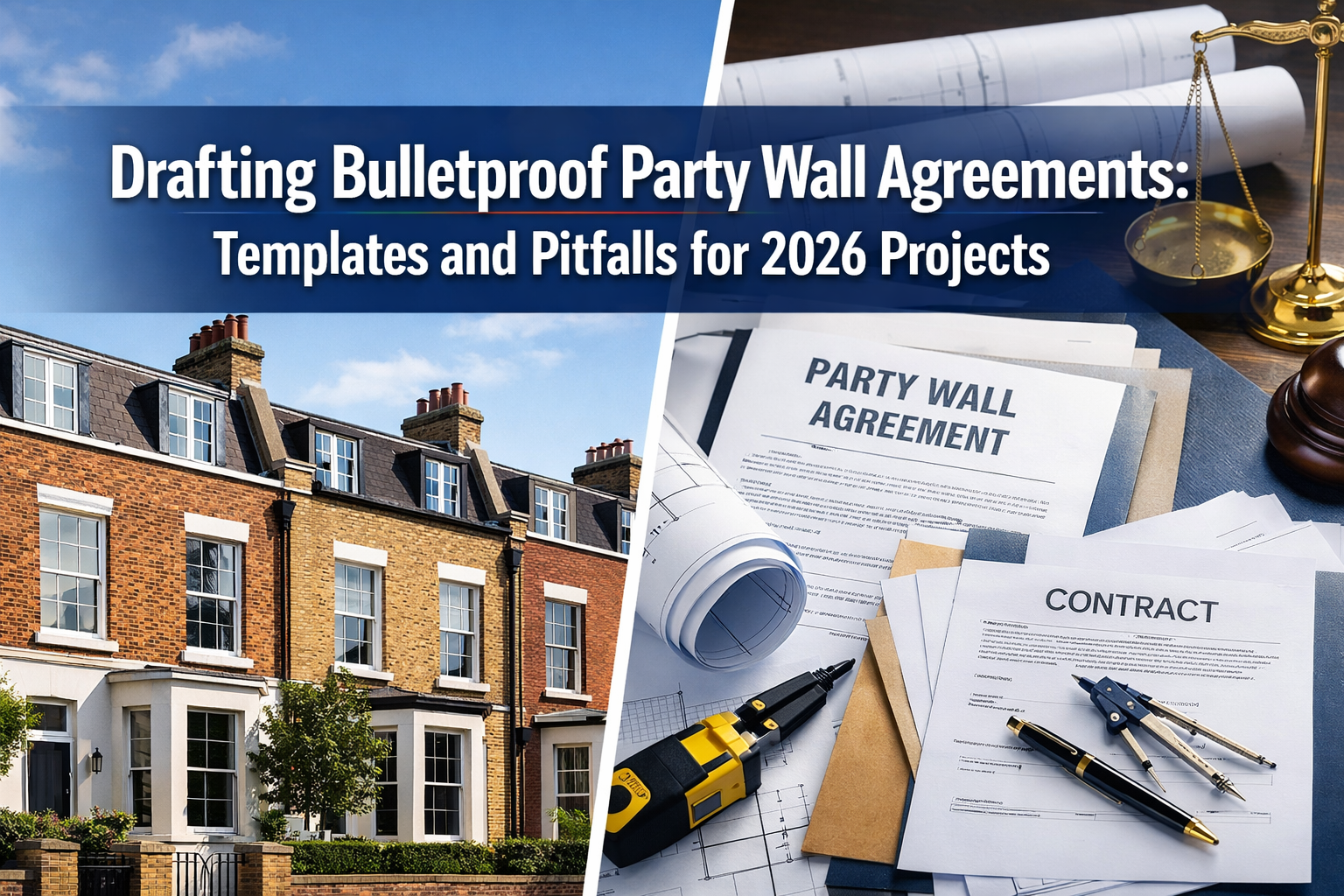
When construction disputes escalate into costly legal battles, the root cause often traces back to a single document: the party wall agreement. In 2026, with London's construction boom showing no signs of slowing, property owners undertaking loft conversions, basement excavations, and boundary works face mounting pressure to get these agreements right the first time. Drafting Bulletproof Party Wall Agreements: Templates and Pitfalls for 2026 Projects has become essential knowledge for anyone planning building work that affects shared structures.
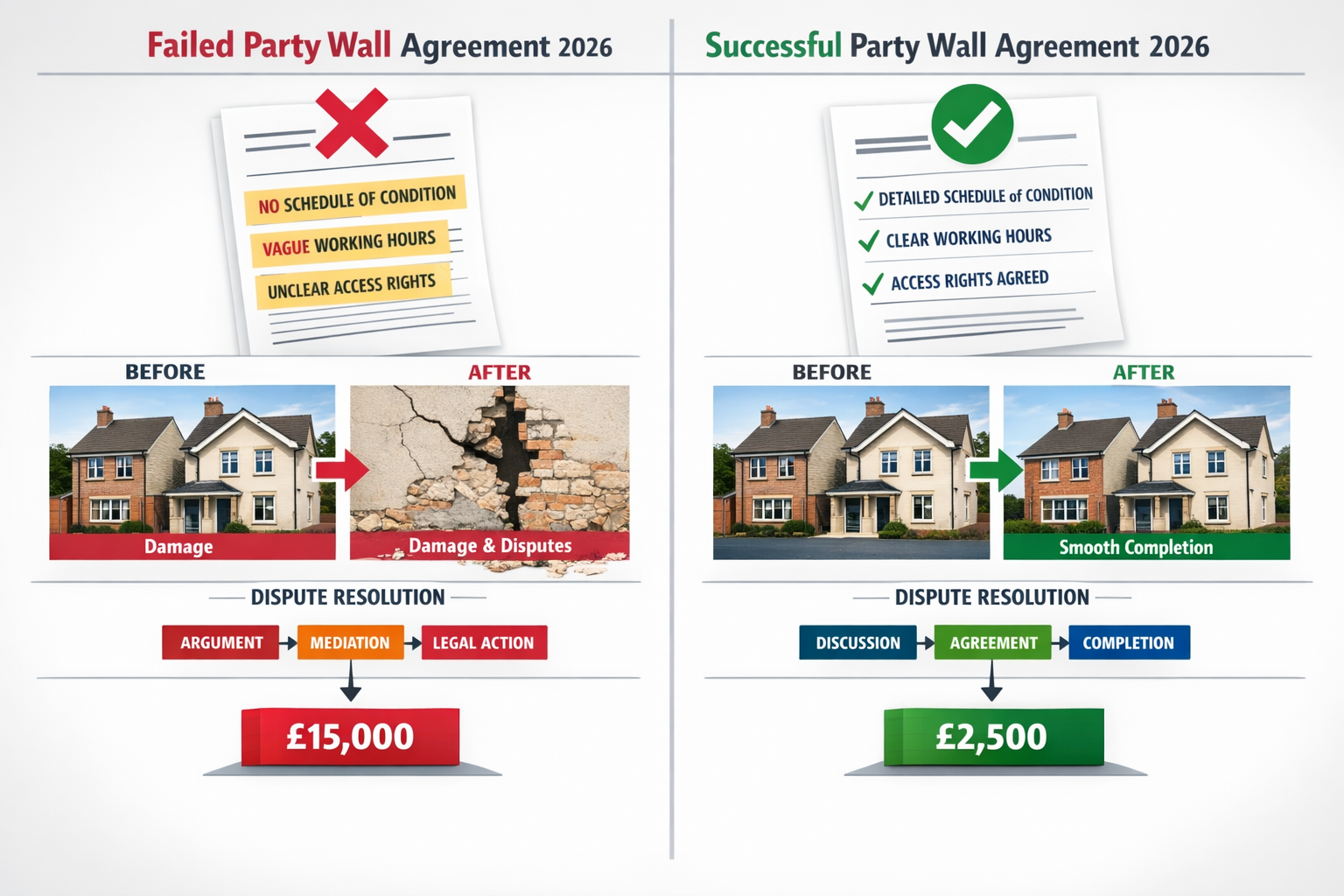
The difference between a successful project and a neighborhood nightmare often comes down to the quality of your party wall agreement. Recent industry data reveals that poorly drafted agreements cost property owners an average of £15,000 in dispute resolution, while comprehensive agreements typically cost under £2,500 to implement properly[6]. This stark contrast highlights why understanding templates, customization, and common pitfalls is critical for 2026 projects.
Key Takeaways
- Party wall agreements must be in place before construction begins—obtaining them after completion typically requires expensive civil claims for resolution[4]
- Customizable templates for specific work types (lofts, basements, boundary walls) prevent costly omissions and reduce dispute risks by up to 70%
- Schedule of condition documentation with timestamped photographs is non-negotiable for protecting both parties from false damage claims[3]
- Working hours, access rights, and cost allocation must be explicitly defined to avoid the most common causes of neighbor disputes in 2026
- The Party Wall Act 1996 applies only to England and Wales, requiring different approaches for properties in Scotland or Northern Ireland[3]
Understanding Party Wall Agreements in 2026 🏗️
A party wall agreement is a legally binding document that governs construction work affecting shared walls, boundaries, or structures between neighboring properties. Under the Party Wall etc. Act 1996, property owners planning certain types of work must serve party wall notices to adjoining owners and secure proper agreements before commencing construction.
What Makes an Agreement "Bulletproof"?
The term "bulletproof" refers to agreements that withstand scrutiny during disputes and provide clear, enforceable protections for all parties. In 2026, bulletproof agreements share these characteristics:
Comprehensive Coverage: They address all types of party wall works relevant to the project, from minor repairs to major structural alterations.
Clear Documentation: They include detailed schedules of condition with photographic evidence taken before work begins[3].
Explicit Terms: Working hours, access provisions, damage prevention measures, and cost responsibilities are stated without ambiguity[1].
Dispute Resolution Mechanisms: They outline clear processes for addressing disagreements without immediate recourse to expensive litigation.
The 2026 Construction Landscape
The construction uptick in 2026 has created unprecedented demand for party wall agreements. With property values continuing to rise across London and homeowners maximizing their investments through extensions and conversions, the volume of party wall matters has increased by approximately 35% compared to 2024 levels[6].
This surge has revealed critical gaps in standard template usage. Many property owners download generic templates without understanding the customization required for their specific project type, leading to agreements that fail when tested by actual construction scenarios.
Essential Components of Drafting Bulletproof Party Wall Agreements: Templates and Pitfalls for 2026 Projects 📋
Creating a comprehensive party wall agreement requires attention to multiple critical elements. Missing even one component can transform a seemingly solid agreement into a source of costly disputes.
1. Schedule of Condition Documentation
The schedule of condition represents the most important protective element in any party wall agreement. This document provides irrefutable evidence of the adjoining property's condition before work begins[3].
A proper schedule of condition includes:
- Timestamped photographs of all rooms, walls, ceilings, and floors in the adjoining property
- Written descriptions of existing cracks, stains, or defects
- Video walkthroughs for comprehensive documentation
- Professional surveyor observations noting structural conditions
- Signed acknowledgment from both parties confirming accuracy
"Without a detailed schedule of condition, you're essentially asking neighbors to trust their memory about pre-existing damage. In 2026's litigious environment, that's a recipe for disaster." – Industry Analysis[6]
2. Working Hours and Access Rights
Working hours must be explicitly defined to prevent one of the most common sources of neighbor complaints. Standard provisions typically specify:
| Work Type | Permitted Hours | Weekend Work | Bank Holidays |
|---|---|---|---|
| Standard Construction | 8:00 AM – 6:00 PM | Saturdays until 1:00 PM | No work permitted |
| Noisy Operations | 9:00 AM – 5:00 PM | By agreement only | No work permitted |
| Emergency Repairs | As required | As required | As required |
Access rights should detail:
- Specific areas of the adjoining property requiring access
- Advance notice requirements (typically 14 days minimum)
- Duration and frequency of access
- Protective measures during access (floor coverings, dust sheets)
- Compensation for significant inconvenience
3. Cost Allocation and Payment Terms
Transparent cost allocation prevents financial disputes. The agreement should specify:
- Who pays for what: Building owner typically covers all costs unless work benefits both properties[1]
- Surveyor fees: How party wall costs are divided
- Damage repair costs: Responsibility for work-related damage
- Dispute resolution costs: How additional expenses are handled
- Payment timelines: When invoices must be settled
4. Damage Prevention Safeguards
Bulletproof agreements include specific protective measures:
✅ Structural monitoring: Regular inspections during excavation or underpinning
✅ Vibration limits: Maximum acceptable levels for machinery
✅ Dust control: HEPA filtration and protective barriers
✅ Noise mitigation: Sound dampening requirements
✅ Emergency protocols: Immediate response procedures for structural concerns
5. Dispute Resolution Processes
Rather than defaulting to litigation, effective agreements establish graduated dispute resolution:
- Direct negotiation between building and adjoining owners
- Surveyor mediation using appointed party wall surveyors
- Third surveyor appointment for unresolved technical disputes
- Formal party wall awards with binding determinations
- County court proceedings as final resort
Understanding party wall act notices and how to respond helps both parties navigate these processes effectively.
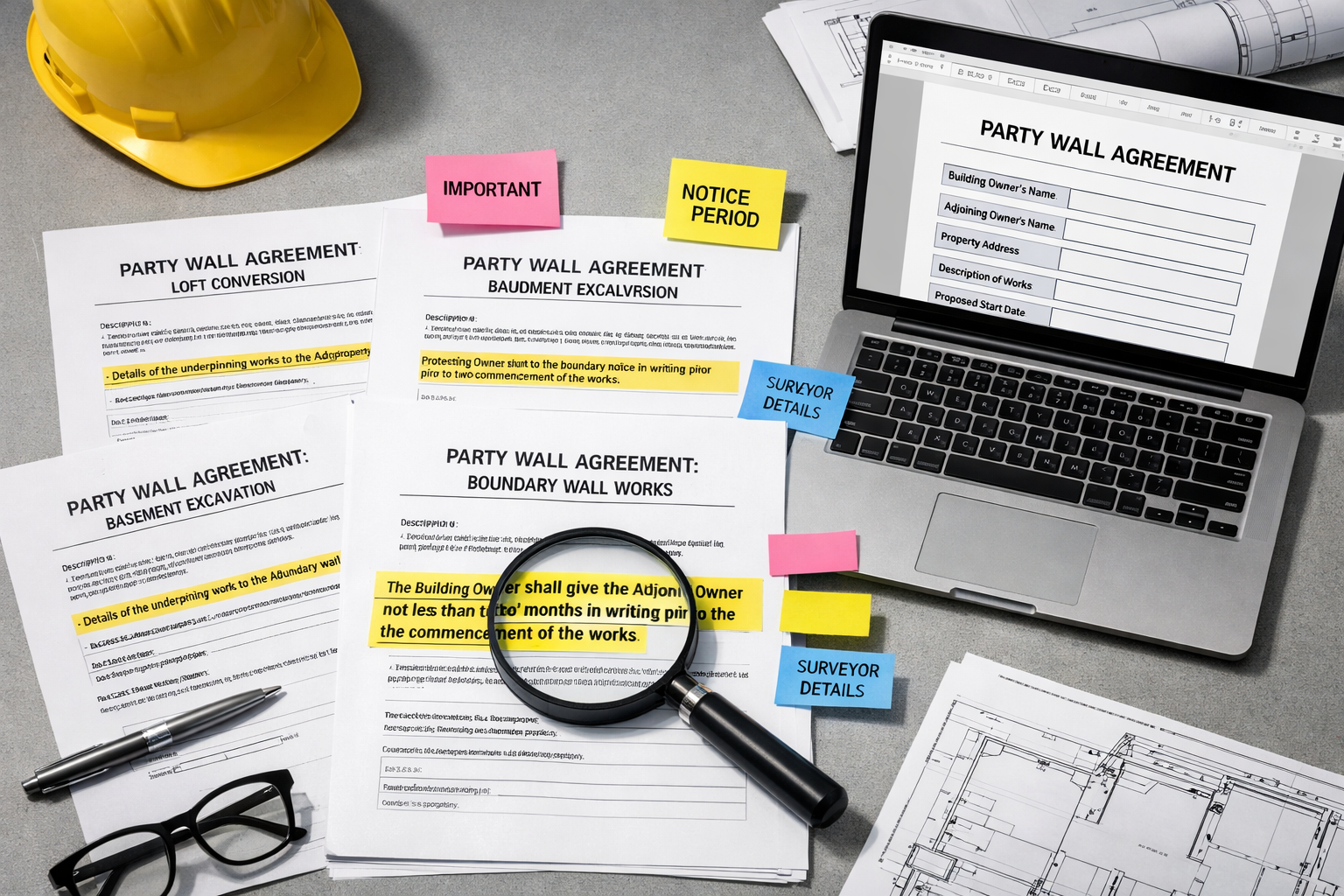
Customizable Templates for Different Project Types 🔧
Generic party wall agreement templates fail because they don't address project-specific risks. Drafting Bulletproof Party Wall Agreements: Templates and Pitfalls for 2026 Projects requires customization based on work type.
Loft Conversion Templates
Loft conversions present unique challenges requiring specialized template provisions:
Structural Loading: Agreements must address increased loads on party walls, including:
- Steel beam installations through shared walls
- Additional floor joists bearing on party structures
- Roof alterations affecting shared chimneys
Height Considerations: When determining how high you can build a wall between neighbours, agreements should specify:
- Maximum permitted height increases
- Oversailing rights (if any)
- Light and privacy protections
Access Requirements: Loft work often requires external scaffolding, necessitating:
- Scaffolding placement on adjoining property
- Duration of scaffold presence
- Liability insurance requirements
A comprehensive sample party wall agreement template provides the foundation, but customization for loft-specific issues is essential.
Basement Excavation Templates
Basement projects carry the highest risk profile, requiring the most detailed agreements:
Excavation Depth and Proximity: Critical specifications include:
- Exact excavation depth relative to adjoining foundations
- Minimum distance from party wall foundations
- Underpinning requirements and methodology
- Temporary support systems
Structural Monitoring: Basement agreements must mandate:
- Crack monitoring gauges on adjoining property
- Weekly inspection reports during excavation
- Vibration monitoring equipment
- Immediate work cessation triggers
Waterproofing and Drainage: Provisions should cover:
- Tanking systems near party walls
- Drainage modifications affecting adjoining property
- Responsibility for water ingress issues
Boundary Wall Templates
Work on party fence walls and boundary walls requires different template elements:
Ownership Clarification: The agreement must establish:
- Exact boundary location (surveyed if necessary)
- Whether the wall is a true party wall or boundary wall
- Maintenance responsibilities going forward
Replacement or Repair Scope: Detailed specifications for:
- Materials matching existing construction
- Height limitations
- Foundation depth requirements
- Finish quality standards
Cost Sharing: For true party walls, agreements should specify:
- Proportional cost allocation
- Betterment adjustments (if one owner benefits more)
- Future maintenance obligations
Understanding what constitutes a party fence wall helps ensure proper template selection.
Real 2026 Examples: Failed vs. Successful Agreements ⚖️
Examining actual cases from 2026 illustrates the critical importance of proper agreement drafting.
Case Study 1: The Missing Schedule of Condition (Failed Agreement)
Project: Basement excavation in North London
Problem: Agreement lacked photographic schedule of condition
Outcome: Adjoining owner claimed £18,000 in damage to decorative plasterwork
The building owner's agreement included standard clauses but omitted a detailed schedule of condition. When minor cracks appeared during excavation, the adjoining owner claimed the building owner's work caused extensive pre-existing damage to ornate Victorian plasterwork.
Without photographic evidence, the building owner couldn't disprove these claims. The dispute proceeded to litigation, ultimately costing:
- £18,000 settlement payment
- £12,000 legal fees
- 8-month project delay
- Total cost: £30,000
Lesson: A comprehensive schedule of condition would have cost approximately £800 and prevented the entire dispute[3].
Case Study 2: Vague Working Hours (Failed Agreement)
Project: Loft conversion in West London
Problem: Agreement stated "reasonable working hours" without specifics
Outcome: Neighbor complaints led to council noise abatement notice
The building owner interpreted "reasonable" as 7:00 AM to 7:00 PM on weekdays and full days on Saturdays. The adjoining owner, who worked night shifts, considered anything before 9:00 AM unreasonable.
After numerous complaints, the local council issued a noise abatement notice restricting work to 9:00 AM – 5:00 PM weekdays only. This extended the project timeline by six weeks and increased costs by £8,500.
Lesson: Explicit working hours prevent interpretation disputes and protect project timelines[1].
Case Study 3: Comprehensive Agreement (Success Story)
Project: Basement and rear extension in Central London
Agreement Features:
- Detailed schedule of condition with 200+ photographs
- Specific working hours (8:30 AM – 5:30 PM weekdays, 9:00 AM – 1:00 PM Saturdays)
- Weekly progress reports to adjoining owner
- Vibration monitoring with defined thresholds
- Clear access provisions with 14-day notice
- Defined dispute resolution process
Outcome: Despite complex excavation within 1.5 meters of the adjoining property's foundations, the project completed without disputes. Minor cracks that appeared were quickly verified as pre-existing through the schedule of condition. The adjoining owner appreciated regular communication and the project finished on time and budget.
Total agreement cost: £2,200 (including professional surveyor fees)
Dispute costs: £0
Project delays: None
Lesson: Upfront investment in comprehensive agreements pays dividends through dispute prevention[6].
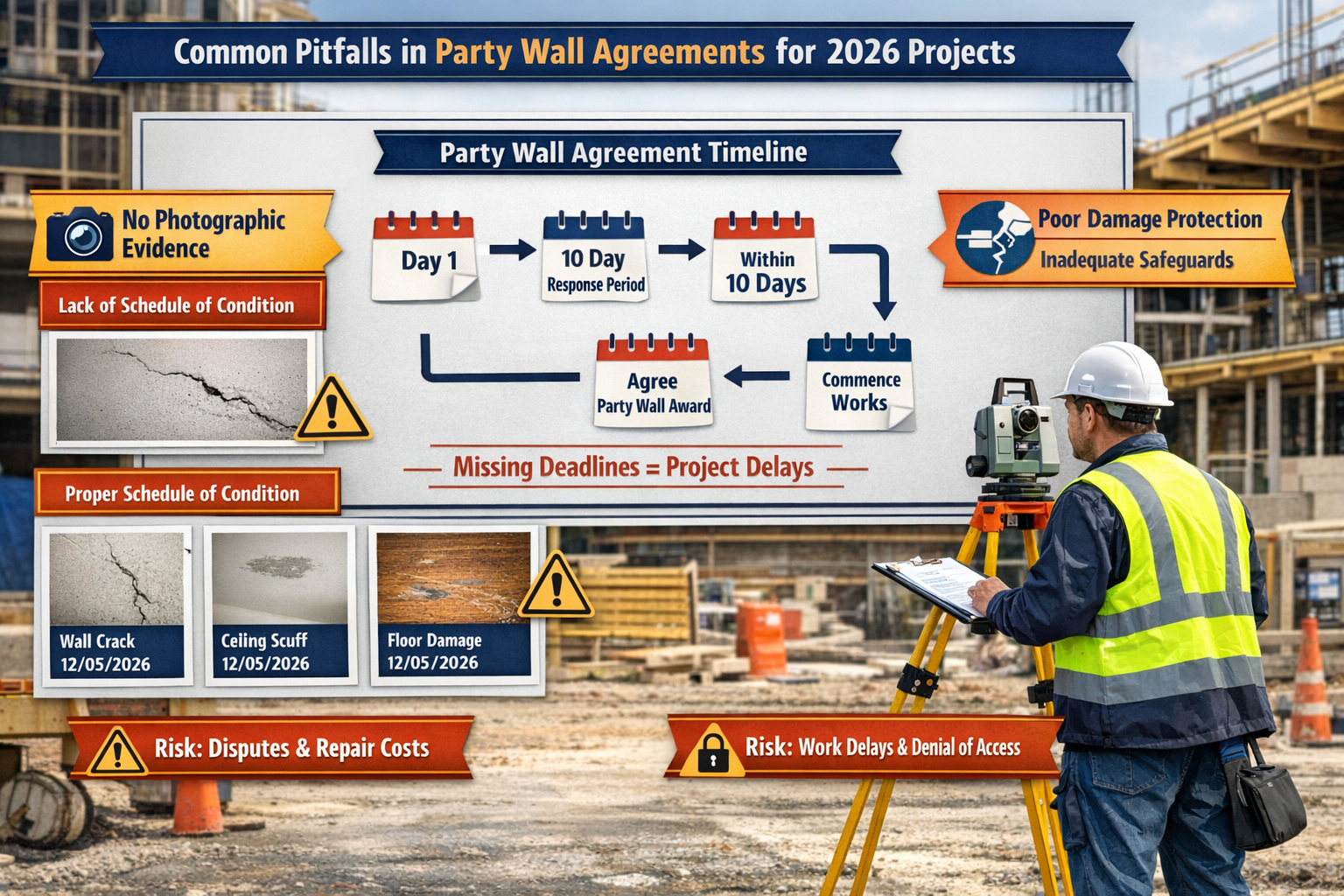
Common Pitfalls in Drafting Bulletproof Party Wall Agreements: Templates and Pitfalls for 2026 Projects ⚠️
Even experienced property owners make critical mistakes when drafting party wall agreements. Understanding these pitfalls helps avoid costly errors.
Pitfall 1: Timing Failures
The Problem: Many property owners attempt to formalize agreements after work has commenced or even completed.
Party wall agreements must be in place before any work begins. Attempting to obtain agreements after completion typically requires civil claims for resolution, dramatically increasing costs and complexity[4]. The Party Wall Act 1996 provides a statutory framework for pre-work agreements but offers limited remedies for post-work situations.
The Solution: Begin the party wall process at least 8-12 weeks before planned construction start dates. This allows time for:
- Serving proper notices (2 months for excavation/foundation work, 1 month for other work)
- Negotiating agreement terms
- Completing schedules of condition
- Resolving any initial disputes
Pitfall 2: Using Templates Without Customization
The Problem: Downloading a party wall contract template and using it verbatim without project-specific modifications.
Generic templates provide useful starting points but lack the specific provisions required for different work types. A basement excavation agreement needs fundamentally different terms than a loft conversion agreement.
The Solution: Use templates as frameworks, then customize based on:
- Specific work type and scope
- Property characteristics (age, construction type, condition)
- Adjoining owner concerns and requirements
- Local authority requirements
- Professional surveyor recommendations
Pitfall 3: Inadequate Photographic Documentation
The Problem: Taking only a few photos or using low-quality images that don't capture existing conditions clearly.
Insufficient documentation leaves room for disputes about pre-existing damage. In 2026's high-resolution smartphone era, there's no excuse for poor photographic evidence.
The Solution: Create comprehensive photographic records including:
- Every room in the adjoining property
- All four walls, ceilings, and floors in each room
- Close-ups of existing cracks, stains, or defects
- Exterior views of shared walls
- Timestamp and metadata preservation
- Professional surveyor verification
Pitfall 4: Ignoring Professional Surveyor Input
The Problem: Attempting to navigate party wall matters without professional guidance, particularly when having a party wall agreement without a surveyor.
While technically possible to proceed without surveyors if both parties agree, this approach dramatically increases dispute risk. Professional surveyors understand technical requirements and common pitfalls that laypeople miss.
The Solution: Engage qualified party wall surveyors early in the process. The investment typically ranges from £800-£2,500 but provides:
- Technical expertise on structural implications
- Impartial assessment of reasonable requirements
- Professional schedule of condition preparation
- Dispute prevention through proper documentation
- Formal awards with legal standing
Pitfall 5: Vague or Ambiguous Language
The Problem: Using imprecise terms like "reasonable," "appropriate," or "as necessary" without defining them.
Ambiguous language creates interpretation disputes. What one party considers "reasonable access" may differ dramatically from the other party's interpretation.
The Solution: Define all potentially ambiguous terms explicitly:
- Replace "reasonable working hours" with "8:00 AM to 6:00 PM Monday-Friday, 9:00 AM to 1:00 PM Saturday"
- Replace "appropriate notice" with "minimum 14 days written notice"
- Replace "necessary access" with "access to rear garden via side passage, maximum 2 hours per visit, maximum twice weekly"
Pitfall 6: Overlooking Jurisdictional Limitations
The Problem: Assuming the Party Wall Act 1996 applies universally across the UK.
The Act applies only to England and Wales. Properties in Scotland or Northern Ireland require different legal approaches[3]. Additionally, some work types fall outside the Act's scope.
The Solution: Verify jurisdictional applicability before drafting agreements. For properties outside England and Wales, consult local property law specialists. For work not covered by the Act, consider contractual agreements based on common law principles.
Pitfall 7: Failing to Address Insurance
The Problem: Not specifying insurance requirements and liability coverage.
Construction work carries inherent risks. Without clear insurance provisions, disputes about damage responsibility can escalate quickly.
The Solution: Include specific insurance clauses requiring:
- Public liability insurance (minimum £5-10 million coverage)
- Professional indemnity insurance for surveyors
- Contractor insurance verification
- Named insured parties
- Proof of coverage before work commences
Pitfall 8: Neglecting Post-Completion Provisions
The Problem: Focusing solely on construction phase issues without addressing post-completion matters.
Agreements should cover what happens after work finishes, including final inspections and long-term responsibilities.
The Solution: Include post-completion clauses addressing:
- Final joint inspection within 30 days of completion
- Rectification period for identified issues
- Long-term maintenance responsibilities
- Warranty periods for workmanship
- Procedures for addressing latent defects
Step-by-Step Guide to Creating Your Agreement 📝
Follow this systematic approach when Drafting Bulletproof Party Wall Agreements: Templates and Pitfalls for 2026 Projects:
Step 1: Determine Work Scope and Act Applicability
Identify whether your planned work falls under the Party Wall etc. Act 1996:
Section 1 Works: New building on boundary lines
Section 2 Works: Work directly to existing party walls
Section 6 Works: Excavation within 3-6 meters of adjoining structures
Step 2: Serve Proper Notices
Provide formal notice to adjoining owners:
- 2 months notice for excavation/foundation work
- 1 month notice for other party wall work
- Include detailed work descriptions and drawings
Step 3: Appoint Surveyors (If Required)
If the adjoining owner dissents or doesn't respond within 14 days:
- Each party appoints a surveyor, or
- Both parties agree on a single "agreed surveyor"
- Surveyors prepare formal party wall awards
Step 4: Select and Customize Template
Choose a template appropriate for your work type:
- Download a sample party wall agreement template as your starting point
- Customize sections for project-specific requirements
- Ensure all essential components are addressed
Step 5: Prepare Schedule of Condition
Conduct thorough documentation:
- Schedule professional surveyor visit
- Photograph all relevant areas
- Document existing defects in writing
- Obtain signatures from both parties
- Store documentation securely (digital and physical copies)
Step 6: Negotiate and Finalize Terms
Work with the adjoining owner to agree on:
- Working hours and access provisions
- Protective measures and monitoring
- Cost allocation
- Dispute resolution procedures
Step 7: Execute Agreement
Formalize the agreement:
- Both parties sign and date
- Witnesses verify signatures
- Distribute copies to all parties
- File with relevant local authorities if required
- Provide copies to contractors
Step 8: Monitor Compliance
Throughout construction:
- Adhere strictly to agreed terms
- Maintain regular communication
- Document any variations in writing
- Address concerns immediately
- Conduct regular inspections
Step 9: Complete Final Inspection
After work completion:
- Conduct joint final inspection
- Compare conditions to original schedule
- Address any work-related damage
- Obtain final sign-off
- Archive all documentation
Regional Considerations Across London 🗺️
Party wall practices vary slightly across London boroughs, requiring regional awareness:
North London Considerations
Party wall surveyors in North London frequently encounter Victorian terraced properties with complex shared structures. Agreements should address:
- Original lime mortar construction requiring specialized repair techniques
- Shared chimney stacks common in period properties
- Conservation area restrictions affecting materials and methods
South London Considerations
South London party wall matters often involve post-war construction with different structural characteristics:
- Cavity wall construction requiring specific underpinning approaches
- More varied property types (semi-detached, terraced, and detached)
- Greater variation in foundation depths
East London Considerations
East London's construction boom creates unique challenges:
- High volume of simultaneous projects requiring coordination
- Mix of historic and modern construction
- Gentrification leading to significant property improvements
West London Considerations
West London party wall work frequently involves high-value properties:
- Luxury finishes requiring extra protection
- Complex basement excavations in premium areas
- Higher expectations for communication and professionalism
Central London Considerations
Central London projects face the most stringent requirements:
- Listed building considerations
- Strict local authority oversight
- Premium property values increasing dispute stakes
- Complex ownership structures (leasehold, freehold, mixed-use)
Technology and Documentation Tools for 2026 💻
Modern technology significantly improves party wall agreement quality and compliance:
Digital Documentation Platforms
Timestamped Photography Apps: Specialized applications that embed GPS coordinates, date, and time metadata into photographs, creating irrefutable evidence of when and where images were captured.
Cloud Storage Solutions: Secure, redundant storage ensuring schedule of condition documentation remains accessible throughout the project and for years afterward.
Video Documentation: 360-degree video walkthroughs provide comprehensive pre-work records that static photographs can't match.
Project Management Software
Compliance Tracking: Digital platforms that monitor adherence to agreed working hours, access schedules, and inspection requirements.
Communication Logs: Centralized systems recording all correspondence between parties, creating transparent audit trails.
Document Version Control: Ensuring all parties work from the same agreement version, with tracked changes and approval workflows.
Monitoring Technology
Vibration Sensors: Real-time monitoring equipment that alerts parties when vibration levels approach agreed thresholds.
Crack Monitoring Gauges: Precision instruments that measure movement in existing cracks, distinguishing settlement from work-related damage.
Noise Monitoring: Decibel meters that provide objective evidence of compliance with noise restrictions.
Cost Management and Budgeting 💰
Understanding and managing party wall costs is essential for 2026 projects:
Typical Cost Breakdown
| Item | Cost Range | Notes |
|---|---|---|
| Initial surveyor consultation | £200-500 | Per surveyor |
| Schedule of condition | £400-1,200 | Depends on property size |
| Party wall award preparation | £800-2,500 | For agreed surveyor |
| Separate surveyors | £1,500-5,000 | When parties can't agree |
| Monitoring during works | £500-2,000 | For complex projects |
| Dispute resolution | £5,000-30,000+ | If litigation required |
Cost-Saving Strategies
Early Engagement: Starting the process early allows time for negotiation and prevents rush fees.
Agreed Surveyor Approach: Using a single agreed surveyor rather than separate surveyors typically reduces costs by 40-60%.
Clear Communication: Preventing disputes through transparency saves exponentially more than it costs.
Proper Documentation: Investing in comprehensive schedules of condition prevents expensive damage disputes.
For detailed guidance, review strategies on how to keep party wall costs down.
Future-Proofing Your Agreement 🔮
As construction techniques and regulations evolve, agreements should include forward-looking provisions:
Emerging Construction Methods
Modern Methods of Construction (MMC): Agreements should accommodate prefabricated elements and off-site construction techniques becoming common in 2026.
Sustainability Requirements: Include provisions for green construction methods, solar panel installations, and energy efficiency improvements.
Smart Home Integration: Address installation of sensors, cameras, and other technology near party walls.
Regulatory Evolution
Building Safety Act Implications: Ensure agreements align with evolving building safety regulations.
Climate Adaptation: Consider provisions for flood prevention, heat mitigation, and other climate-related modifications.
Planning Policy Changes: Build flexibility for compliance with emerging local planning requirements.
Long-Term Relationship Management
Maintenance Protocols: Establish ongoing maintenance responsibilities for party structures.
Future Work Provisions: Create frameworks for additional work that may be needed later.
Succession Planning: Ensure agreements bind future property owners, not just current parties.
Conclusion
Drafting Bulletproof Party Wall Agreements: Templates and Pitfalls for 2026 Projects requires careful attention to detail, project-specific customization, and comprehensive documentation. The difference between a £2,500 investment in proper agreements and a £30,000 dispute resolution nightmare comes down to thoroughness and professionalism.
The essential elements of bulletproof agreements include:
✅ Comprehensive schedules of condition with professional photographic documentation
✅ Explicit terms covering working hours, access rights, and cost allocation
✅ Project-specific customization based on work type (lofts, basements, boundary walls)
✅ Professional surveyor involvement to ensure technical accuracy
✅ Clear dispute resolution mechanisms preventing escalation to litigation
✅ Proper timing with agreements in place before work commences
Actionable Next Steps
- Assess your project scope and determine Party Wall Act applicability
- Download appropriate templates and begin customization for your specific work type
- Engage qualified surveyors at least 8-12 weeks before planned construction
- Serve proper notices to adjoining owners with detailed work descriptions
- Prepare comprehensive schedules of condition with professional documentation
- Negotiate terms collaboratively focusing on mutual protection and clear expectations
- Execute agreements formally with proper signatures and witness verification
- Monitor compliance strictly throughout construction, maintaining open communication
The construction landscape of 2026 demands higher standards for party wall agreements than ever before. Property owners who invest time and resources in creating truly bulletproof agreements protect themselves from disputes, delays, and unnecessary costs while maintaining positive neighbor relationships.
Don't let a poorly drafted agreement derail your construction project. Take action now to ensure your party wall documentation provides the comprehensive protection your 2026 project deserves.
References
[1] Party Wall Agreement – https://www.genieai.co/en-us/template-type/party-wall-agreement
[2] Party Wall Agreement – https://www.template.net/edit-online/344385/party-wall-agreement
[3] Party Wall Agreement – https://hoa.org.uk/advice/guides-for-homeowners/i-am-improving/party-wall-agreement/
[4] Party Wall Agreement – https://www.lawdistrict.co.uk/party-wall-agreement/
[5] Surveying Party Walls – https://www.isurv.com/downloads/20/surveying_party_walls
[6] Party Wall Surveys And Neighbour Disputes During 2026s Construction Uptick Rics Compliance Framework – https://nottinghillsurveyors.com/blog/party-wall-surveys-and-neighbour-disputes-during-2026s-construction-uptick-rics-compliance-framework
[7] Navigating Party Wall Agreements – http://oreateai.com/blog/navigating-party-wall-agreements-understanding-your-options-and-when-free-templates-might-not-cut-it/0cc625939dd868feeaf88abb4f02a08c