

The London skyline continues its dramatic transformation in 2026, with high-rise residential towers and multi-unit renovation projects reshaping neighborhoods from Canary Wharf to King's Cross. But behind every gleaming facade lies a complex web of legal obligations, structural considerations, and neighbor relations that can make or break a project. Drafting bulletproof party wall awards for 2026's high-rise and multi-unit renovations has become more critical than ever, as surveyors and building owners navigate unprecedented challenges in vertical construction and shared-structure modifications. 🏗️
As multi-story developments grow more ambitious and renovation scopes expand across multiple adjoining properties, the traditional party wall award template simply doesn't cut it anymore. Today's awards must address structural vibrations that ripple through entire buildings, coordinate multiple adjoining owners across different floors, and incorporate sustainability clauses that meet 2026's stringent environmental standards. One overlooked clause or inadequate risk assessment can trigger costly disputes, project delays, and even structural liability claims that extend years beyond completion.
Key Takeaways
- Modern high-rise awards require expanded clauses covering structural vibrations, multi-floor coordination, and enhanced risk assessments beyond traditional templates
- RICS-compliant documentation ensures enforceability and protects all parties through standardized protocols adapted for complex vertical construction scenarios
- 2026 sustainability requirements must be integrated into awards, including thermal performance standards and eco-compliance verification procedures
- Comprehensive schedules of condition become exponentially more critical when multiple adjoining owners and shared structural elements are involved
- Professional surveyor expertise is essential for navigating the increased complexity of multi-unit renovations and preventing disputes before they arise
Understanding the Unique Challenges of High-Rise Party Wall Awards
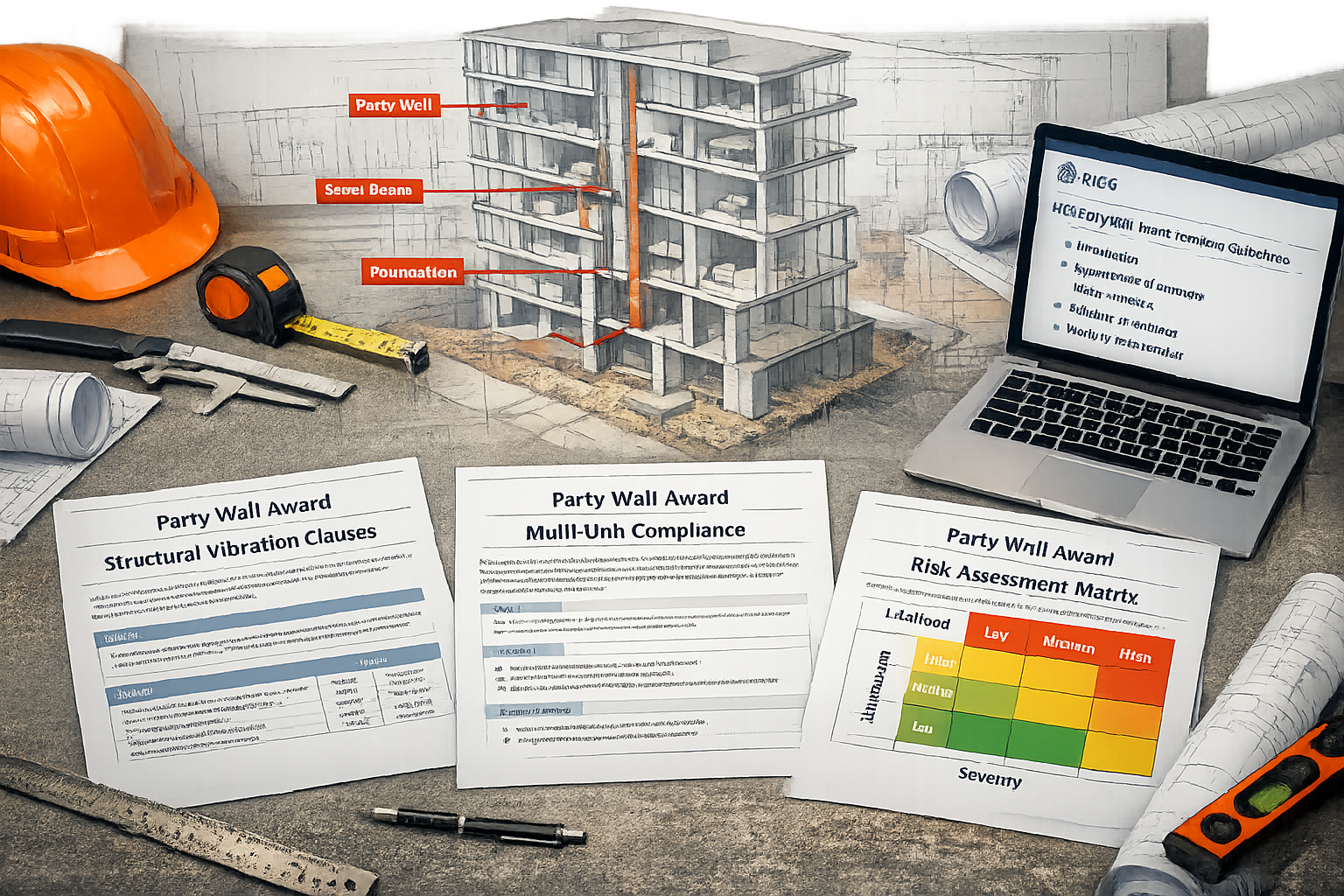
High-rise and multi-unit renovation projects present fundamentally different challenges compared to traditional two-story residential work. When construction affects party walls spanning multiple floors or involves structural modifications in buildings with dozens of units, the complexity multiplies exponentially.
Structural Vibration and Settlement Risks
Vibration transmission represents one of the most significant concerns in vertical construction. When foundation work, pile driving, or structural modifications occur in one unit, the impact can reverberate through the entire building structure. Modern party wall awards must include:
- Vibration monitoring protocols with specific threshold limits (typically measured in peak particle velocity)
- Continuous assessment schedules throughout the construction phase
- Remediation procedures if vibration levels exceed agreed parameters
- Third-party verification requirements from structural engineers
Settlement patterns in high-rise buildings differ dramatically from low-rise properties. Differential settlement affecting one unit can compromise structural integrity across multiple floors, making comprehensive pre-work assessments absolutely essential.
Coordinating Multiple Adjoining Owners
Unlike straightforward neighbor-to-neighbor scenarios, high-rise renovations often involve:
- Vertical adjoining owners on floors above and below the work
- Horizontal adjoining owners sharing side party walls
- Diagonal structural connections through load-bearing elements
- Common area considerations including lobbies, corridors, and shared facilities
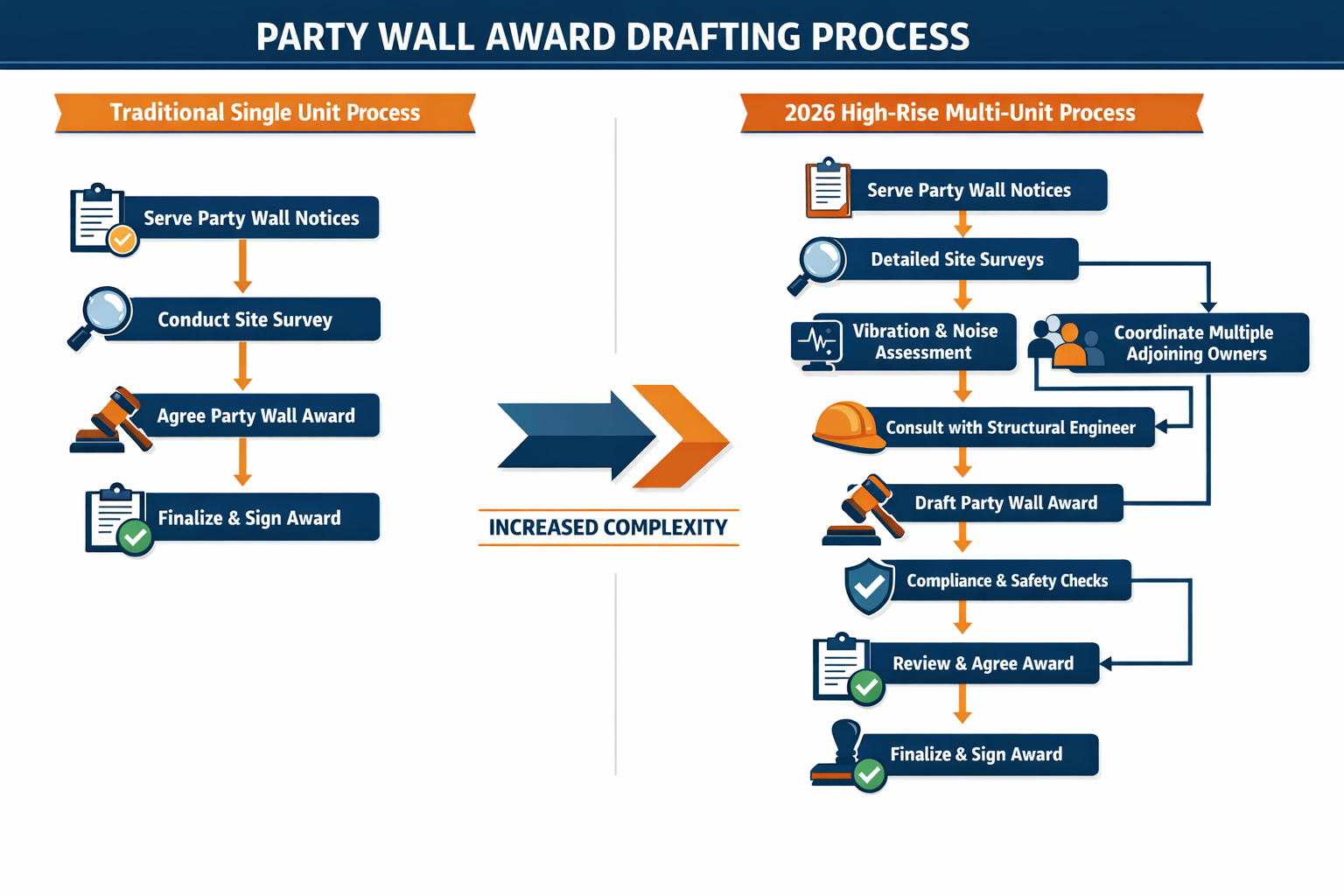
Each adjoining owner has distinct rights under the Party Wall etc. Act 1996, and awards must address how notices are served, how multiple surveyors coordinate (or how a single agreed surveyor manages conflicting interests), and how costs are apportioned when work benefits some parties more than others.
Enhanced Documentation Requirements
The schedule of condition becomes significantly more comprehensive in multi-unit settings. Rather than documenting a single shared wall, surveyors must create detailed records of:
- All party walls and party structures affected by the work
- Common structural elements including beams, columns, and foundations
- Existing conditions in multiple adjoining properties
- Photographic and video evidence with timestamps and metadata
- Baseline vibration and noise measurements
This documentation serves as the critical baseline for resolving any disputes about damage or deterioration during construction.
Essential Components of Drafting Bulletproof Party Wall Awards for 2026's High-Rise and Multi-Unit Renovations
Creating enforceable, comprehensive awards requires understanding both the statutory requirements and the practical realities of complex construction projects. The following components form the foundation of bulletproof documentation.
RICS-Compliant Templates and Standards
The Royal Institution of Chartered Surveyors (RICS) provides guidance that has become the industry standard for professional party wall practice. Awards drafted in 2026 should incorporate:
Standardized Award Structure:
- Formal preamble identifying all parties and their surveyors
- Detailed description of the proposed works with architectural drawings referenced
- Specific conditions and restrictions on construction methods
- Time limitations and working hours
- Access provisions and notice requirements
- Cost allocation and payment terms
Professional Certification Requirements:
All surveyors involved should maintain current RICS membership and professional indemnity insurance. The award should explicitly state surveyor qualifications and include registration numbers.
Dispute Resolution Mechanisms:
Built-in procedures for addressing disagreements without resorting to litigation, including:
- Third surveyor appointment protocols
- Mediation timelines
- Evidence submission requirements
- Appeal procedures within statutory frameworks
Comprehensive Risk Assessment Clauses
Modern awards must anticipate and address potential risks specific to high-rise work. This includes:
| Risk Category | Required Award Provisions |
|---|---|
| Structural Integrity | Pre-work structural surveys, ongoing monitoring, load transfer calculations |
| Vibration Impact | PPV limits, monitoring schedule, mitigation measures, remediation protocols |
| Water Ingress | Weatherproofing requirements, emergency response procedures, liability allocation |
| Fire Safety | Compartmentation maintenance, temporary fire barriers, compliance verification |
| Access Disruption | Advance notice periods, alternative access provisions, compensation frameworks |
Each risk assessment should include quantifiable thresholds rather than vague language. For example, instead of stating "excessive vibration will be avoided," specify "peak particle velocity shall not exceed 10mm/s at any adjoining owner's property, measured continuously via calibrated seismographs."
Sustainability and Environmental Compliance
As noted in recent guidance on sustainable extensions, 2026 awards increasingly incorporate environmental standards.[2] For high-rise renovations, this includes:
- Thermal performance requirements ensuring party wall modifications maintain or improve insulation values (U-values not exceeding 0.15 W/m²K for new construction elements)[2]
- Acoustic insulation standards meeting or exceeding Building Regulations Part E requirements
- Material specifications for sustainable, low-carbon construction materials
- Waste management protocols for demolition and construction debris
- Energy efficiency verification through post-completion testing
These clauses protect adjoining owners from substandard work that could increase their energy costs or reduce comfort levels.
Work Specification and Method Statements
Vague descriptions of proposed work are a primary source of disputes. Bulletproof awards include:
Detailed Work Descriptions:
- Specific structural elements to be modified or removed
- Construction methodology with step-by-step procedures
- Equipment to be used and its specifications
- Duration estimates for each phase
- Sequencing of work to minimize disruption
Restricted Practices:
Clear prohibitions on high-risk methods, such as:
- Underpinning without continuous monitoring
- Removal of load-bearing elements without temporary support
- Work outside specified hours (typically 8am-6pm weekdays)
- Storage of hazardous materials near party structures
For guidance on types of party wall works that require specific methodologies, professional surveyors can provide tailored specifications.
Best Practices for Drafting Bulletproof Party Wall Awards for 2026's High-Rise and Multi-Unit Renovations
Beyond including the right components, how awards are drafted and implemented determines their effectiveness in preventing disputes and ensuring smooth project completion.
Engaging Qualified Professionals Early
The complexity of multi-unit renovations demands professional expertise from the project's inception. Building owners should:
Select Experienced Surveyors:
Look for professionals with demonstrable experience in high-rise and multi-unit projects. A surveyor who primarily handles two-story residential extensions may lack the specialized knowledge required for complex vertical construction. Party wall surveyors in Central London, where high-rise development is concentrated, often have the most relevant experience.
Involve Structural Engineers:
Complex party wall work requires structural engineering input to:
- Assess load transfer implications
- Design temporary support systems
- Calculate settlement predictions
- Verify construction methodology safety
The award should explicitly require structural engineer certification at key project milestones.
Coordinate with Building Control:
Party wall awards and Building Regulations approval are separate processes, but they must align. Ensure the award specifications meet or exceed Building Regulations requirements to avoid conflicting obligations.
Transparent Communication and Documentation
Pre-Award Consultations:
Before finalizing awards, conduct face-to-face meetings with adjoining owners to:
- Explain the proposed work in plain language
- Address concerns and incorporate reasonable requests
- Establish communication channels for the construction phase
- Build goodwill that prevents minor issues from escalating
Photographic and Video Evidence:
Modern technology enables comprehensive condition documentation. Best practice includes:
- High-resolution photographs of all affected areas
- Video walkthroughs with narration describing existing conditions
- Drone footage for external elevations (where permitted)
- 3D laser scanning for critical structural elements
- Cloud storage with restricted access for all parties
This evidence becomes invaluable if disputes arise months or years after completion.
Proportionate Cost Allocation
Understanding party wall costs and their allocation prevents financial disputes. Awards should clearly specify:
Surveyor Fee Responsibility:
Typically, the building owner pays for both their own surveyor and the adjoining owner's surveyor, with fees ranging from £150-£200 per hour and total awards costing approximately £1,000 for straightforward cases.[1] Complex multi-unit projects can cost significantly more, and the award should cap fees or require advance approval for expenses exceeding specified thresholds.
Construction Cost Allocation:
When work benefits both parties (such as rebuilding a deteriorated party wall), costs are shared proportionately. The award must include:
- Clear formulas for cost apportionment
- Payment schedules and milestones
- Procedures for approving variations
- Dispute resolution for cost disagreements
Damage Remediation:
Establish that the building owner bears full responsibility for repairing any damage caused by the works, with specific procedures for:
- Damage notification timelines
- Assessment and quotation processes
- Approval requirements before repairs commence
- Quality standards for remediation work
Monitoring and Compliance Verification
The most comprehensive award is worthless without enforcement mechanisms. Include:
Regular Inspection Schedules:
- Weekly site visits during high-risk phases
- Monthly inspections during routine construction
- Immediate access rights for surveyors if concerns arise
- Mandatory notification before commencing each work phase
Condition Monitoring:
- Vibration monitoring with real-time alerts
- Settlement monitoring via precise leveling surveys
- Crack monitoring with calibrated gauges
- Photographic comparison against baseline conditions
Compliance Reporting:
Require the building owner to provide:
- Weekly progress reports to all parties
- Immediate notification of any deviations from approved methods
- Copies of all structural engineer certifications
- Final completion certification with as-built drawings
For those looking to keep party wall costs down, efficient monitoring and clear compliance procedures actually reduce expenses by preventing disputes and rework.
Addressing Buy-to-Let and Commercial Considerations
With institutional landlords increasingly involved in multi-unit renovations, awards must address commercial property considerations.[3] This includes:
- Tenant notification requirements beyond adjoining owner notices
- Business interruption provisions for commercial premises
- Lease obligation compliance ensuring work doesn't breach tenant agreements
- Insurance coordination between building owners, landlords, and tenants
Commercial properties often have more stringent requirements for work hours, noise limits, and access restrictions that must be incorporated into awards.

Common Pitfalls and How to Avoid Them
Even experienced professionals can overlook critical elements in complex multi-unit scenarios. Awareness of common mistakes helps draft more robust awards.
Inadequate Scope Definition
The Pitfall:
Vague descriptions like "structural alterations to party wall" leave room for interpretation and disputes about what work is actually authorized.
The Solution:
Reference specific architectural drawings with revision numbers, include detailed written descriptions, and attach photographic annotations showing exactly which elements will be affected. Cross-reference party wall notices to ensure consistency between initial notifications and final awards.
Overlooking Secondary Adjoining Owners
The Pitfall:
Focusing only on immediate neighbors while missing owners whose properties share structural connections through load-bearing elements or foundations.
The Solution:
Conduct a comprehensive structural analysis before serving notices to identify all properties potentially affected. In high-rise buildings, this often includes units two or three floors away from the actual work location.
Insufficient Condition Documentation
The Pitfall:
Rushed or superficial schedules of condition that miss existing defects, leading to disputes about whether damage was caused by the works or pre-existed.
The Solution:
Allocate adequate time and budget for thorough condition surveys. For multi-unit projects, this might require several days of surveying across multiple properties. The investment prevents far more expensive disputes later.
Ignoring Building-Specific Regulations
The Pitfall:
Failing to account for additional restrictions in listed buildings, conservation areas, or buildings with specific lease covenants or management company rules.
The Solution:
Conduct comprehensive due diligence on all regulatory layers affecting the property. Party wall awards must complement, not conflict with, these additional requirements. Understand the boundary wall rules and how they interact with party wall obligations.
Unrealistic Timelines
The Pitfall:
Awards that specify completion dates without adequate contingency for delays, weather, or unforeseen conditions.
The Solution:
Include realistic timelines with built-in flexibility. Rather than absolute completion dates, specify work duration (e.g., "works shall be completed within 16 weeks of commencement") and define force majeure provisions that extend deadlines for circumstances beyond the building owner's control.
Regional Considerations Across London
London's diverse property landscape means awards must be tailored to specific area characteristics:
Central London High-Rises:
Properties in areas served by party wall surveyors in Central London often involve:
- Premium properties with higher damage liability risks
- International owners requiring additional communication considerations
- Stricter noise and disruption limitations due to dense populations
North and South London Conversions:
Areas covered by North London and South London surveyors frequently see:
- Victorian terraces being converted to multi-unit dwellings
- Complex ownership structures with freeholders and multiple leaseholders
- Heritage considerations in conservation areas
East and West London Developments:
Regions served by East London and West London surveyors experience:
- New-build high-rise clusters requiring coordination across multiple simultaneous projects
- Mixed-use developments combining residential and commercial party wall issues
- Regeneration areas with varying property values affecting cost allocation discussions
Legal Framework and Enforcement
Understanding the statutory foundation ensures awards are legally enforceable.
The Party Wall etc. Act 1996
The Party Wall etc. Act 1996 provides the legal framework for all party wall matters in England and Wales. Key provisions include:
- Section 1: New building on the line of junction
- Section 2: Party wall and party structure works
- Section 6: Excavation and construction near adjoining buildings
Awards must comply with the Act's requirements while providing additional detail for complex scenarios. The Act establishes minimum standards; awards can and should exceed these for high-risk projects.
Enforceability and Dispute Resolution
Awards are legally binding documents enforceable through:
County Court Proceedings:
If a building owner proceeds without a valid award or violates award terms, adjoining owners can seek injunctions to stop work or damages for losses incurred.
Third Surveyor Determination:
When appointed surveyors disagree, the third surveyor's decision is final and binding (subject only to appeal on limited grounds).
Professional Standards Enforcement:
RICS members who draft inadequate awards or fail to follow professional standards face disciplinary proceedings that can result in loss of membership.
Templates and Resources for 2026
While every award must be tailored to specific circumstances, starting with robust templates ensures nothing is overlooked.
RICS Template Adaptations
RICS provides model forms that should be adapted for high-rise contexts by:
- Expanding the work description section to accommodate complex multi-phase projects
- Adding appendices for structural calculations and engineer certifications
- Incorporating vibration monitoring schedules and protocols
- Including sustainability compliance verification procedures
Digital Tools and Management Systems
Modern practice increasingly relies on:
Project Management Software:
Platforms that track notice periods, inspection schedules, and compliance milestones across multiple properties simultaneously.
Condition Monitoring Systems:
Digital tools that compare current photographs against baseline images to identify changes and potential damage.
Communication Portals:
Secure platforms where all parties can access documents, receive updates, and submit queries, creating an auditable communication trail.
For those seeking party wall contract templates, professional resources provide starting points that must be customized for specific projects.
Conclusion
Drafting bulletproof party wall awards for 2026's high-rise and multi-unit renovations requires a sophisticated understanding of structural engineering, legal frameworks, and practical construction realities that extends far beyond traditional party wall practice. As London's vertical development continues accelerating, the stakes have never been higher—both literally and figuratively. Awards that fail to address structural vibrations, coordinate multiple adjoining owners effectively, or incorporate comprehensive risk assessments expose all parties to costly disputes, project delays, and potential structural liabilities that can persist for years.
The investment in professional expertise, thorough documentation, and comprehensive award drafting pays dividends throughout the construction process and beyond. By engaging experienced surveyors early, incorporating RICS-compliant templates adapted for complex scenarios, and establishing clear monitoring and enforcement mechanisms, building owners protect their projects while respecting neighbors' rights. Adjoining owners benefit from robust protection against damage and disruption, with clear remediation procedures if issues arise.
Next Steps for Building Owners
✅ Engage qualified party wall surveyors with demonstrable high-rise experience before serving any notices
✅ Commission structural engineering assessments to identify all potentially affected properties and structural risks
✅ Allocate adequate budget and timeline for comprehensive condition surveys across all adjoining properties
✅ Review and customize RICS templates to address project-specific risks and requirements
✅ Establish communication protocols with all adjoining owners before work commences
Next Steps for Adjoining Owners
✅ Respond promptly to party wall notices to preserve your rights under the Act
✅ Appoint an experienced surveyor rather than attempting to navigate complex awards alone
✅ Document existing conditions in your property before work begins
✅ Review proposed awards carefully and raise concerns before signing
✅ Maintain communication with your surveyor throughout the construction process
The complexity of modern multi-unit renovations demands professional expertise at every stage. Whether you're planning ambitious high-rise modifications or responding to a neighbor's development, investing in bulletproof party wall awards protects your interests, preserves relationships, and ensures construction proceeds smoothly. In 2026's competitive property market, cutting corners on party wall procedures is a risk no one can afford to take.
References
[1] Party Wall Agreement – https://hoa.org.uk/advice/guides-for-homeowners/i-am-improving/party-wall-agreement/
[2] Party Wall Notices For Sustainable Home Extensions In 2026 Eco Compliance Clauses – https://nottinghillsurveyors.com/blog/party-wall-notices-for-sustainable-home-extensions-in-2026-eco-compliance-clauses
[3] Party Wall Awards For Buy To Let Expansions In 2026 Protocols Amid Institutional Landlord Surge – https://nottinghillsurveyors.com/blog/party-wall-awards-for-buy-to-let-expansions-in-2026-protocols-amid-institutional-landlord-surge