
When a party wall dispute escalates to the point where surveyors must issue an award, the quality of that document can mean the difference between swift resolution and years of costly litigation. In 2026, the landscape of Drafting Enforceable Party Wall Awards in 2026: RICS Standards and Best Practices has evolved significantly, with updated professional standards, digital reporting requirements, and heightened expectations for risk management integration. Understanding these changes is essential for surveyors seeking to produce awards that stand up to legal scrutiny while protecting their professional reputation.
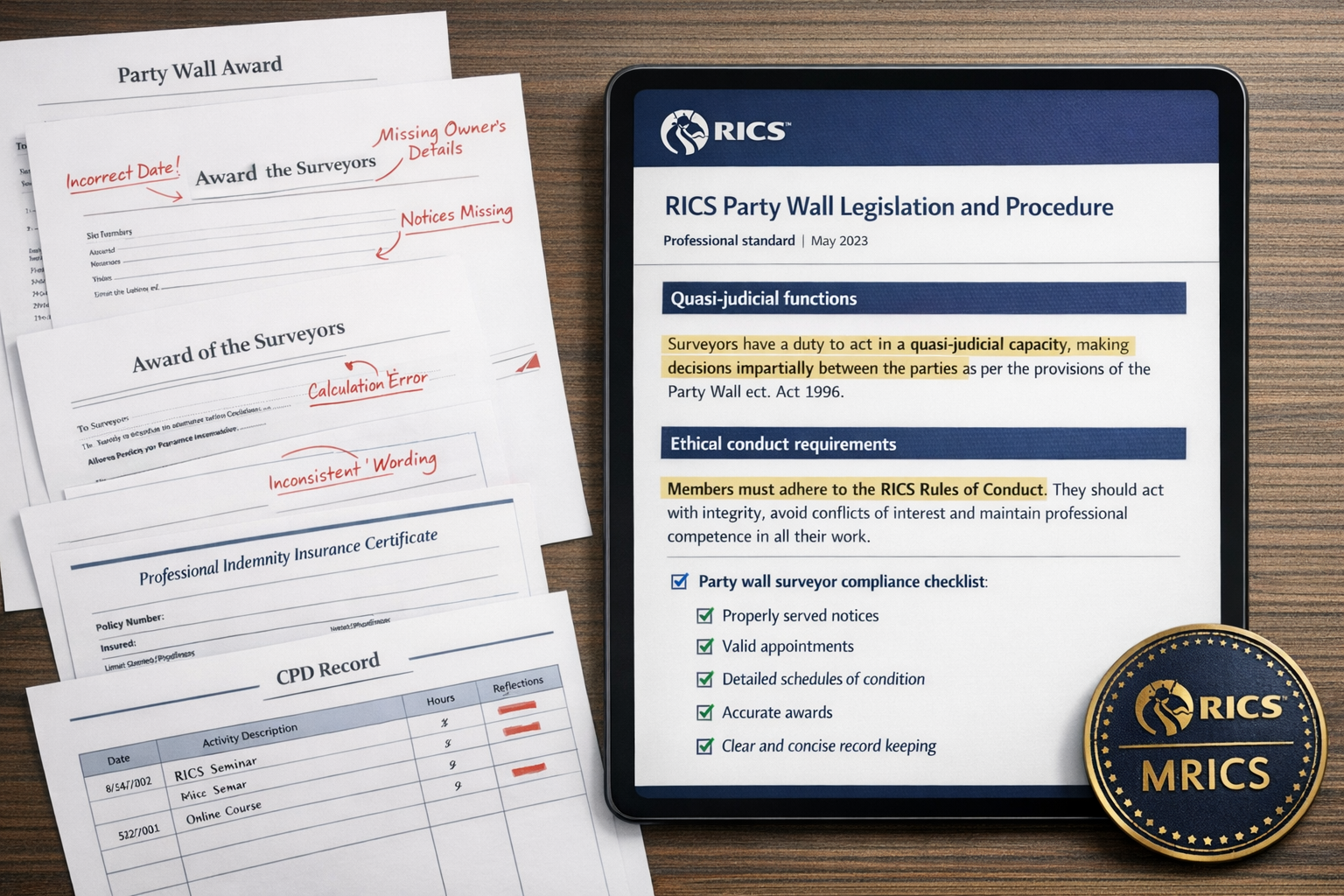
The Royal Institution of Chartered Surveyors (RICS) published their Party Wall Legislation and Procedure as a professional standard in May 2023, representing their most recent comprehensive guidance that superseded the previous August 2019 guidance note.[2] This updated framework emphasizes that RICS members have professional duties extending beyond strict adherence to the Party Wall etc. Act 1996, requiring both statutory compliance and ethical conduct.[2] As we navigate 2026, surveyors must recognize that compliance with the Act's wording alone may not satisfy RICS standards, and those appearing before disciplinary panels are not protected against allegations of incompetence or bad faith.[2]
Key Takeaways
✅ RICS professional standards from May 2023 require surveyors to exceed statutory minimums, combining legal compliance with ethical conduct and professional competence
✅ Standard form award templates contain recurring legal problems including unenforceable clauses and inappropriate attempts to limit surveyor responsibility
✅ Only chartered surveyors holding MRICS or FRICS designations should be appointed as party wall surveyors to ensure adequate insurance, continuing professional development, and demonstrated competence[3]
✅ Digital reporting and risk management integration are now essential components of modern party wall award drafting in 2026
✅ Jurisdictional limitations must be respected, particularly regarding boundary disputes which surveyors cannot resolve within party wall awards
Understanding the RICS Framework for Party Wall Awards
The Evolution of RICS Professional Standards
The transition from guidance notes to professional standards represents a fundamental shift in how RICS approaches party wall work. The May 2023 professional standard on Party Wall Legislation and Procedure establishes mandatory requirements rather than mere recommendations.[2] This distinction is critical for anyone involved in Drafting Enforceable Party Wall Awards in 2026: RICS Standards and Best Practices.
The professional standard addresses the quasi-judicial function of party wall surveyors, clarifying that their role extends beyond simple technical assessment.[2] Surveyors must act impartially, apply professional judgment, and ensure their awards are legally sound and practically enforceable. This quasi-judicial capacity means surveyors cannot simply follow templates or standard procedures without exercising independent professional judgment.
Key Requirements for RICS Members
RICS recommends that only chartered surveyors holding MRICS or FRICS designations be appointed as party wall surveyors.[3] This recommendation is grounded in practical necessity:
- Continuing Professional Development (CPD): Chartered members must maintain current knowledge through structured learning
- Professional Indemnity Insurance (PII): Adequate coverage protects all parties in case of errors or omissions
- Demonstrated Competence: RICS membership requires proven expertise in relevant areas
- Ethical Obligations: Members are bound by professional conduct standards that exceed statutory requirements
These requirements ensure that surveyors possess not just theoretical knowledge but practical capability to draft awards that withstand legal challenge. For those seeking professional assistance, understanding party wall awards and the qualifications of appointed surveyors is fundamental.
Beyond Statutory Compliance
One of the most significant aspects of the 2023 professional standard is its explicit statement that compliance with the Act's wording alone may not satisfy RICS standards.[2] This creates a higher bar for RICS members, who must consider:
- Fairness and Reasonableness: Awards must be equitable to both building and adjoining owners
- Professional Expertise: Surveyors cannot disclaim responsibility for areas within their professional competence
- Clarity and Precision: Awards must be drafted in clear, unambiguous language
- Enforceability: Awards must be practically enforceable without requiring further legal interpretation
This elevation of standards reflects the reality that party wall awards are legal documents with significant consequences. A poorly drafted award can expose surveyors to professional liability, damage client relationships, and create unnecessary disputes.
Essential Components of Enforceable Party Wall Awards
Structural Requirements and Format
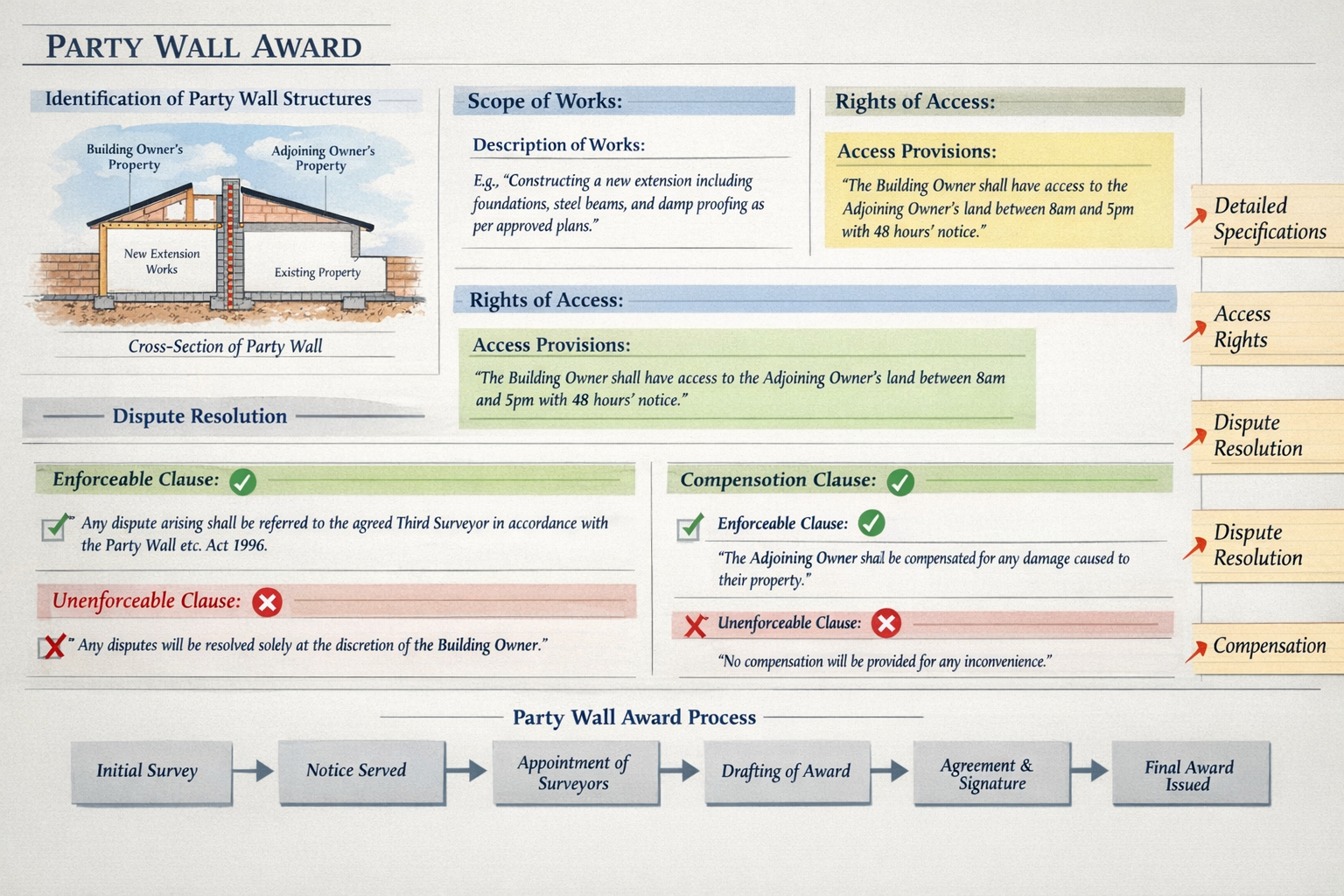
An enforceable party wall award must contain specific elements to satisfy both statutory requirements and RICS professional standards. The foundation of Drafting Enforceable Party Wall Awards in 2026: RICS Standards and Best Practices rests on understanding these essential components:
1. Proper Identification of Parties
- Full legal names and addresses of building and adjoining owners
- Clear identification of appointed surveyors with professional credentials
- Date of appointment and scope of authority
2. Description of the Party Wall or Structure
- Precise location and dimensions
- Current condition (often supported by a schedule of condition)
- Legal status (party wall, party fence wall, or party structure)
3. Scope of Proposed Works
- Detailed description of intended construction activities
- Reference to relevant notices served under the Party Wall etc. Act 1996
- Alignment with types of party wall works permitted under the Act
4. Rights and Obligations
- Access rights for the building owner
- Protection measures required during works
- Timing and notification requirements
5. Compensation and Costs
- Any compensation payable to the adjoining owner
- Allocation of surveyor fees and expenses
- Security for expenses (if appropriate)
Common Pitfalls in Standard Form Templates
Legal analysis has identified recurring problems with commonly-used standard form award templates.[1] These issues can render awards unenforceable or expose surveyors to professional liability:
| Common Problem | Why It's Problematic | RICS-Compliant Alternative |
|---|---|---|
| Blanket Disclaimers | Surveyors attempt to avoid responsibility for professional expertise areas | Clearly define scope while maintaining professional responsibility for core competencies |
| Vague Work Descriptions | Insufficient detail to determine compliance | Detailed specifications with drawings and technical requirements |
| Unenforceable Conditions | Conditions that cannot be practically monitored or enforced | Specific, measurable conditions with clear enforcement mechanisms |
| Jurisdictional Overreach | Attempting to resolve boundary disputes | Acknowledge jurisdictional limits and recommend appropriate legal remedies |
| Inadequate Compensation Clauses | Failure to address potential losses or damages | Comprehensive compensation framework with clear assessment methodology |
The determination of whether a structure qualifies as a "party wall" within awards is particularly problematic because surveyors lack jurisdiction to resolve boundary disputes, which is the primary context where this question arises.[1] When boundary uncertainty exists, surveyors must acknowledge this limitation and recommend that parties seek legal advice rather than attempting to resolve the issue within the award.
For those working with templates, reviewing a comprehensive party wall contract template guide can help identify these common pitfalls before they become embedded in final awards.
Drafting Clauses That Withstand Legal Scrutiny
The enforceability of a party wall award depends heavily on the precision and clarity of its clauses. In 2026, best practices for Drafting Enforceable Party Wall Awards in 2026: RICS Standards and Best Practices include:
Access Rights Clauses
Rather than generic statements like "reasonable access shall be granted," enforceable clauses specify:
- Days and hours when access may be exercised
- Notice period required before each access
- Number of personnel permitted on site
- Specific areas accessible
- Duration of access rights
Condition Monitoring Clauses
Effective awards establish clear procedures for monitoring the adjoining owner's property:
- Baseline condition documentation (photographs, descriptions, measurements)
- Scheduled inspection points during works
- Post-completion verification inspection
- Dispute resolution if damage is alleged
- Standard of proof required for damage claims
Compensation Determination Clauses
Where compensation is appropriate, awards should specify:
- Basis for calculating compensation (loss of amenity, inconvenience, diminution in value)
- Time period for which compensation applies
- Payment schedule and method
- Adjustment mechanisms if circumstances change
- Process for reassessment if needed
Security for Expenses
When requiring security for expenses, awards must detail:
- Amount of security required (with justification)
- Form of security (deposit, bond, guarantee)
- Conditions for release
- Interest treatment (if applicable)
- Consequences of failure to provide security
Digital Reporting and Modern Award Documentation
Integration of Digital Tools in Award Preparation
The practice of Drafting Enforceable Party Wall Awards in 2026: RICS Standards and Best Practices has been transformed by digital technology. Modern surveyors leverage various digital tools to enhance accuracy, efficiency, and enforceability:
📱 Digital Survey and Documentation
- High-resolution photography with embedded GPS and timestamp data
- 3D laser scanning for precise dimensional records
- Drone surveys for roof and upper-level structures
- Digital annotation tools for marking defects and conditions
💻 Award Drafting Software
- Template management systems with compliance checking
- Automated clause libraries with jurisdictional variations
- Version control and collaborative editing platforms
- Digital signature and authentication systems
☁️ Cloud-Based Case Management
- Centralized document repositories accessible to all parties
- Automated notification and deadline tracking
- Secure communication channels with audit trails
- Integration with professional indemnity insurance reporting
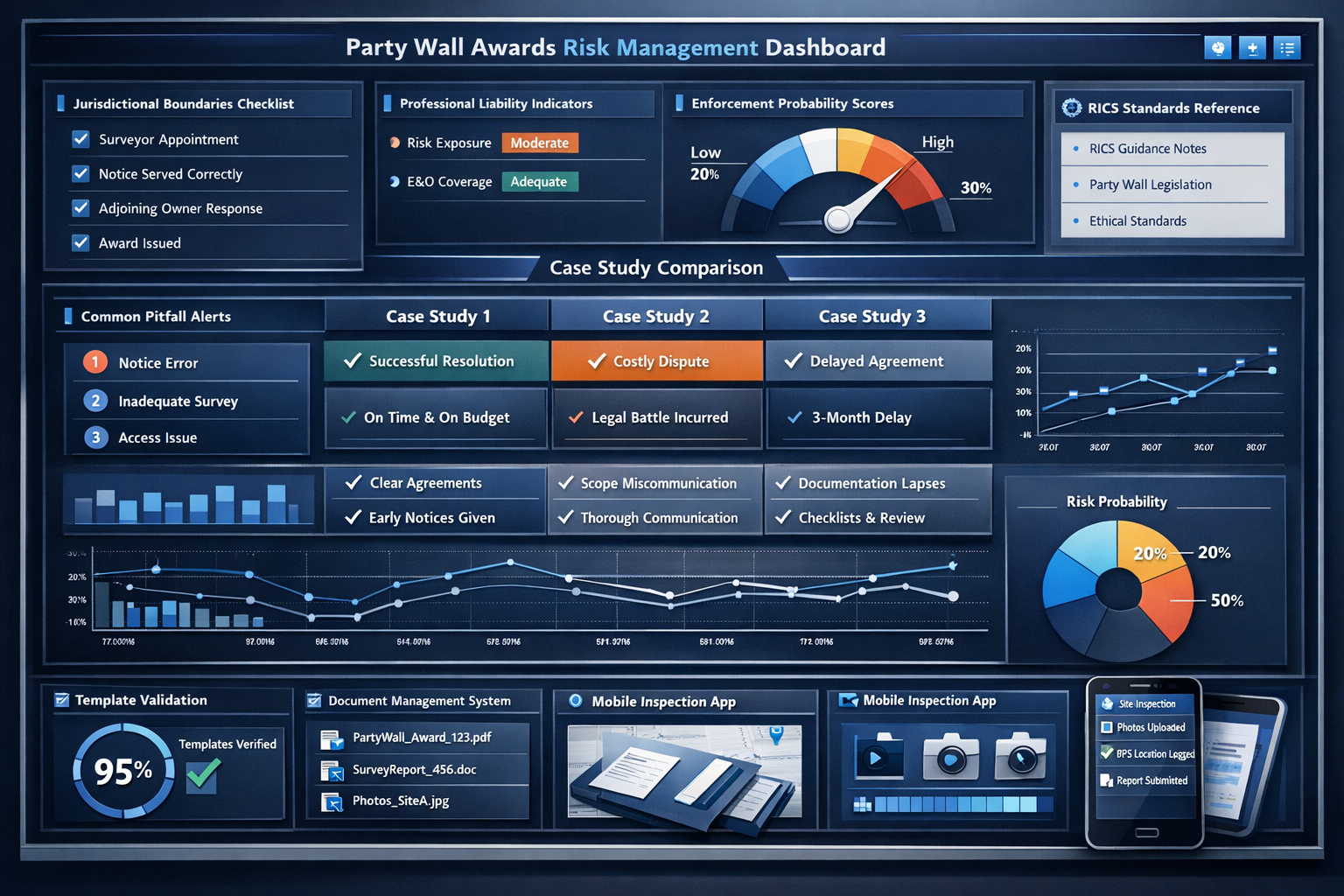
📊 Risk Assessment Dashboards
- Real-time compliance monitoring against RICS standards
- Automated flagging of common pitfalls and problematic clauses
- Jurisdictional boundary checking
- Professional liability exposure indicators
These digital tools not only improve efficiency but also create comprehensive audit trails that demonstrate professional diligence. When disputes arise, the ability to produce detailed records of the award drafting process can be invaluable.
Digital Delivery and Execution of Awards
The execution and delivery of party wall awards has also evolved in 2026. While the Party Wall etc. Act 1996 was drafted in an era of paper documents, modern practice accommodates digital delivery:
Electronic Service of Awards
- Email delivery with read receipts and delivery confirmation
- Secure portal access for parties to download awards
- Digital signature platforms for formal execution
- Blockchain-based authentication for enhanced security (emerging practice)
Accessibility and Format Considerations
- PDF/A format for long-term archival compliance
- Accessible formats for parties with disabilities
- Mobile-responsive layouts for viewing on various devices
- Searchable text with proper document structure
Record Retention
- Cloud backup with redundancy and disaster recovery
- Compliance with data protection regulations (GDPR, etc.)
- Retention periods aligned with professional indemnity insurance requirements
- Secure deletion protocols when retention periods expire
Understanding the procedural requirements is essential, and parties should familiarize themselves with party wall act notices and how to respond to ensure proper service and execution of awards.
Risk Management Integration in Award Drafting
Identifying and Mitigating Professional Liability Risks
The integration of risk management into Drafting Enforceable Party Wall Awards in 2026: RICS Standards and Best Practices is no longer optional—it's essential professional practice. Surveyors face multiple liability exposures when drafting awards:
🎯 Key Risk Areas
-
Jurisdictional Overreach
- Risk: Attempting to resolve matters outside party wall surveyor authority
- Mitigation: Clear acknowledgment of jurisdictional limits; referral to appropriate legal or technical specialists
-
Inadequate Investigation
- Risk: Issuing awards without sufficient factual basis
- Mitigation: Comprehensive site inspections, document review, and technical analysis before drafting
-
Bias or Appearance of Bias
- Risk: Failing to maintain impartiality in quasi-judicial role
- Mitigation: Documented conflict checks, transparent communication with both parties, balanced consideration of interests
-
Technical Errors
- Risk: Incorrect specifications, measurements, or technical requirements
- Mitigation: Peer review processes, specialist consultation when needed, clear documentation of assumptions
-
Ambiguous Language
- Risk: Awards that are open to multiple interpretations
- Mitigation: Plain language drafting, defined terms, specific rather than general provisions
Professional Indemnity Insurance Considerations
RICS members must maintain adequate professional indemnity insurance (PII), and award drafting presents specific considerations for coverage:
Coverage Adequacy
- Ensure policy limits reflect the potential value of disputes
- Verify that party wall work is explicitly covered (not all PII policies include it)
- Understand territorial limitations if working across jurisdictions
- Review retroactive date coverage for ongoing matters
Claims Prevention
- Document all advice given to clients in writing
- Maintain detailed file notes of decision-making processes
- Obtain client confirmation of key decisions
- Implement quality control procedures before issuing awards
Claims Notification
- Understand policy requirements for notifying potential claims
- Report circumstances that might give rise to claims promptly
- Maintain detailed records of all communications during disputes
- Coordinate with insurers before making admissions or settlements
For those concerned about costs, reviewing guidance on how to keep party wall costs down can help manage both client expenses and risk exposure.
Quality Assurance Protocols
Leading practices in 2026 include formal quality assurance protocols for award drafting:
Pre-Issue Checklist
- ✅ All statutory requirements satisfied
- ✅ RICS professional standards compliance verified
- ✅ Jurisdictional limitations respected
- ✅ Technical specifications reviewed by appropriate specialists
- ✅ Plain language review completed
- ✅ All parties properly identified and addresses current
- ✅ Execution formalities prepared
- ✅ File documentation complete
Peer Review Process
For complex or high-value matters, peer review by another qualified surveyor can identify issues before awards are issued. This might include:
- Technical review of specifications and requirements
- Legal review of enforceability and jurisdictional issues
- Risk assessment of potential liability exposures
- Quality control of drafting and formatting
Post-Issue Monitoring
After issuing awards, surveyors should:
- Track compliance with award requirements
- Document any variations or modifications
- Monitor for potential disputes or non-compliance
- Maintain communication channels with parties
- Update risk assessments as circumstances evolve
Real-World Case Studies and Practical Applications
Case Study 1: Avoiding Jurisdictional Overreach
Background: A surveyor was appointed to resolve a dispute regarding proposed basement excavation adjacent to a shared boundary wall. During the process, the adjoining owner raised questions about the exact location of the boundary, suggesting the wall might be entirely on their property.
The Problem: The surveyor initially attempted to include a determination of the wall's legal status within the award, relying on old deeds and plans. This exceeded the surveyor's jurisdiction, as boundary disputes are matters for legal determination, not party wall surveyors.[1]
The Solution: Following RICS standards, the surveyor:
- Acknowledged the jurisdictional limitation explicitly in the award
- Recommended that parties obtain legal advice on the boundary question
- Proceeded on the assumption that the wall was a party wall (as claimed in the notice)
- Included a provision that the award would be without prejudice to either party's legal rights regarding ownership
- Recommended that works not commence until the boundary issue was resolved
Outcome: The parties obtained legal advice, resolved the boundary question through negotiation, and the works proceeded under the award without further dispute. The surveyor avoided potential professional liability for exceeding jurisdiction.
Key Lesson: Recognize and respect jurisdictional boundaries. When legal questions arise, refer parties to appropriate legal counsel rather than attempting to resolve issues outside surveyor competence.
Case Study 2: Enforceable Compensation Clauses
Background: An award was issued for significant structural works including underpinning and beam installation. The adjoining owner would experience substantial disruption over an extended period.
The Problem: An initial draft award included only a vague statement that "reasonable compensation shall be paid for loss of amenity." This lacked the specificity needed for enforcement and created uncertainty about quantum.
The Solution: The surveyor revised the award to include:
- A specific compensation amount based on comparable cases and professional judgment
- Clear statement of the basis for calculation (loss of amenity during 6-month construction period)
- Payment schedule (50% at commencement, 50% at completion)
- Provision for reassessment if works extended beyond anticipated timeframe
- Clear dispute resolution mechanism if parties disagreed with the amount
Outcome: The building owner understood their financial obligation from the outset, the adjoining owner felt fairly compensated, and the works proceeded without payment disputes. The clarity prevented potential litigation.
Key Lesson: Compensation clauses must be specific, justified, and enforceable. Vague provisions create uncertainty and potential disputes.
Case Study 3: Digital Documentation Preventing Damage Disputes
Background: A loft conversion required works to a party wall. The adjoining owner was concerned about potential damage to their recently renovated property.
The Problem: Traditional paper-based schedules of condition can be disputed, with parties claiming photographs don't accurately represent pre-existing conditions or that defects were missed.
The Solution: The surveyor implemented comprehensive digital documentation:
- 360-degree photography of all adjoining rooms
- High-resolution images with embedded timestamp and GPS data
- Digital annotation of all existing defects
- Cloud-based storage with access provided to both parties
- Scheduled interim inspections with comparative photography
- Final completion inspection with side-by-side comparison tools
Outcome: Minor cracking occurred during works, but the digital record clearly showed it was pre-existing. The building owner was exonerated, the adjoining owner accepted the evidence, and no compensation claim was pursued. The comprehensive documentation prevented a potentially costly dispute.
Key Lesson: Investment in thorough digital documentation protects all parties and provides clear evidence if disputes arise. The schedule of condition is a critical protective tool.
Practical Templates and Drafting Guidance
Structuring Awards for Maximum Clarity
When Drafting Enforceable Party Wall Awards in 2026: RICS Standards and Best Practices, structure and organization are as important as content. A well-structured award should follow this hierarchy:
Award Structure Template
1. Header Section
- Title: "Party Wall Award under the Party Wall etc. Act 1996"
- Reference number and date
- Names and addresses of building owner, adjoining owner, and appointed surveyors
2. Recitals Section
- Background to the dispute
- Notices served and responses received
- Appointment of surveyors and their qualifications
- Inspections and investigations conducted
- Relevant statutory provisions
3. Definitions
- Clear definitions of key terms used throughout the award
- Interpretation provisions
- Reference to plans and schedules
4. Determinations
- Findings regarding the party wall or structure
- Assessment of proposed works
- Consideration of adjoining owner's concerns
- Technical requirements and specifications
5. Award Provisions
- Consent to works (with or without conditions)
- Conditions and requirements for execution of works
- Access rights and procedures
- Protective measures required
- Monitoring and inspection provisions
- Compensation (if applicable)
- Costs allocation
6. Dispute Resolution
- Process for resolving disagreements about award interpretation
- Variation procedures if circumstances change
- Appeal rights under the Act
7. Execution
- Signatures of surveyors
- Date of award
- Service provisions
Sample Clauses for Common Scenarios
Access Rights Clause Example
"The Building Owner shall be entitled to access the Adjoining Owner's property for the purposes of executing the Works subject to the following conditions:
(a) Access shall be limited to Monday through Friday between 8:00 AM and 6:00 PM, excluding public holidays;
(b) The Building Owner shall provide not less than 48 hours' written notice before each occasion of access, specifying the date, anticipated duration, and number of personnel;
(c) Access shall be limited to no more than three personnel at any one time;
(d) Access shall be to the following areas only: [specify rooms/areas];
(e) The Building Owner shall make good any damage caused by the exercise of access rights within 14 days of completion of the relevant work;
(f) These access rights shall expire on [date] or upon practical completion of the Works, whichever is earlier."
Protective Measures Clause Example
"The Building Owner shall implement the following protective measures during execution of the Works:
(a) Installation of dust barriers and protective sheeting to prevent migration of dust and debris to the Adjoining Owner's property;
(b) Use of vibration monitoring equipment with alert thresholds set at [specify technical parameters], with monitoring data to be shared with the Adjoining Owner's surveyor weekly;
(c) Temporary support to the party wall in accordance with the structural engineer's specifications attached as Schedule [X];
(d) Daily inspection by the Building Owner's surveyor during excavation works, with photographic records maintained;
(e) Immediate notification to the Adjoining Owner's surveyor if any unexpected conditions are encountered or if monitoring thresholds are exceeded."
Compensation Clause Example
"The Surveyors determine that compensation is payable to the Adjoining Owner in the sum of £[X] in respect of:
(a) Loss of amenity during the construction period, estimated at [X] weeks, calculated at £[X] per week;
(b) Inconvenience caused by access requirements and noise disruption;
(c) This compensation shall be paid as follows: 50% (£[X]) within 7 days of commencement of Works, and 50% (£[X]) within 7 days of practical completion;
(d) If the Works extend beyond [date], additional compensation at the rate of £[X] per week shall be payable for each additional week of delay;
(e) This compensation is in full and final settlement of all claims for loss of amenity and inconvenience, without prejudice to any claims for physical damage to the Adjoining Owner's property."
Those seeking additional template resources may find value in reviewing a free sample party wall agreement template, though it's essential to customize any template to specific circumstances.
Adapting Awards to Different Work Types
Different types of party wall works require different award approaches. Understanding types of party wall works helps surveyors tailor awards appropriately:
Excavation Works (Section 6)
- Emphasis on structural stability and support
- Detailed specifications for temporary works
- Monitoring requirements for settlement and movement
- Clear trigger points for remedial action
Works to Party Walls (Section 2)
- Precise description of proposed alterations
- Protection of adjoining owner's interests in the wall
- Weatherproofing and fire protection requirements
- Making good provisions
New Building on Line of Junction (Section 1)
- Foundation design and depth specifications
- Protection of adjoining owner's property during construction
- Future maintenance access provisions
- Contribution to costs (if applicable)
Party Fence Walls
- Height and construction specifications
- Maintenance responsibilities
- Boundary confirmation (with appropriate caveats about jurisdictional limits)
For specific guidance on party fence walls, reviewing the party wall act definition can provide helpful context.
Regional Considerations and Local Variations
London-Specific Considerations
Party wall work in London presents unique challenges that affect Drafting Enforceable Party Wall Awards in 2026: RICS Standards and Best Practices:
High-Density Development
- Multiple adjoining owners are common
- Complex structural interdependencies
- Limited working space requiring creative solutions
- Higher property values increasing compensation considerations
Historic Buildings
- Listed building consent interaction with party wall procedures
- Conservation area requirements
- Specialized technical expertise needed
- Enhanced protective measures
Basement Excavations
- Particularly prevalent in London
- Significant structural implications
- Groundwater and drainage considerations
- Extended construction periods
Surveyors practicing in different areas of London should understand regional nuances, whether working in West London, East London, North London, South London, or Central London.
Jurisdictional Variations Across England and Wales
While the Party Wall etc. Act 1996 applies uniformly across England and Wales, practical considerations vary:
Urban vs. Rural Settings
- Urban areas: higher density, more frequent disputes, established surveyor networks
- Rural areas: fewer specialists, potentially higher costs, different construction types
Regional Building Practices
- Construction methods vary regionally
- Local materials and techniques affect specifications
- Regional cost variations impact compensation calculations
Local Authority Relationships
- Building control interaction varies
- Planning permission considerations differ
- Local enforcement approaches vary
Cross-Border and International Considerations
While the Party Wall etc. Act 1996 is specific to England and Wales, surveyors may encounter international dimensions:
Scotland and Northern Ireland
- Different legal frameworks apply
- Party wall concepts exist but under different legislation
- Cross-border properties require careful jurisdictional analysis
International Best Practices
- RICS international standards may apply to members working abroad
- Comparative approaches from other jurisdictions can inform best practices
- International clients may have different expectations
The Future of Party Wall Award Drafting
Emerging Trends in 2026 and Beyond
The practice of Drafting Enforceable Party Wall Awards in 2026: RICS Standards and Best Practices continues to evolve:
🚀 Technology Integration
- Artificial intelligence for clause drafting and risk assessment
- Blockchain for award authentication and immutable records
- Virtual reality for remote inspections and condition surveys
- Automated compliance checking against RICS standards
📱 Enhanced Accessibility
- Mobile-first award delivery platforms
- Plain language summaries for lay parties
- Multi-language support for diverse communities
- Accessibility features for parties with disabilities
🌍 Sustainability Considerations
- Awards addressing environmental impact of works
- Sustainable construction method specifications
- Energy efficiency implications of party wall works
- Climate change adaptation in structural requirements
⚖️ Alternative Dispute Resolution
- Online dispute resolution platforms
- Mediation integration before award issuance
- Collaborative drafting processes
- Early neutral evaluation
Professional Development and Continuing Competence
RICS members must maintain competence through continuing professional development.[3] Key areas for ongoing learning include:
Technical Knowledge
- Building pathology and defect diagnosis
- Structural engineering principles
- Construction technology and methods
- Materials science and performance
Legal Understanding
- Party wall legislation and case law developments
- Contract law and enforceability principles
- Property law and boundary issues
- Dispute resolution procedures
Professional Skills
- Negotiation and mediation
- Report writing and communication
- Risk management and professional liability
- Ethics and professional conduct
Digital Competence
- Survey technology and digital documentation
- Award drafting software and tools
- Data protection and cybersecurity
- Digital delivery and authentication
Regulatory Developments on the Horizon
Potential future changes that may affect party wall award drafting:
Legislative Reform
- Possible amendments to the Party Wall etc. Act 1996
- Enhanced consumer protection provisions
- Clarification of jurisdictional boundaries
- Modernization for digital age
Professional Standards Evolution
- Further RICS guidance on specific scenarios
- Enhanced quality assurance requirements
- Standardized competence assessments
- International harmonization
Insurance Market Changes
- Professional indemnity insurance requirements
- Claims trends affecting coverage
- Risk-based pricing models
- Cyber insurance integration
Conclusion: Achieving Excellence in Award Drafting
Drafting Enforceable Party Wall Awards in 2026: RICS Standards and Best Practices requires a sophisticated blend of legal knowledge, technical expertise, professional judgment, and practical skill. The RICS professional standard published in May 2023 has elevated expectations, requiring surveyors to exceed statutory minimums and demonstrate genuine professional competence.[2]
The key principles for drafting enforceable awards in 2026 include:
✨ Professional Competence: Only appropriately qualified chartered surveyors should undertake party wall work, with MRICS or FRICS designations providing assurance of competence, insurance, and ethical standards.[3]
✨ Jurisdictional Awareness: Respect the boundaries of party wall surveyor authority, particularly regarding boundary disputes and matters requiring legal determination.[1]
✨ Clarity and Precision: Draft awards in clear, unambiguous language with specific, enforceable provisions rather than vague generalities.
✨ Risk Management Integration: Implement comprehensive risk assessment, quality assurance protocols, and professional indemnity insurance coverage.
✨ Digital Excellence: Leverage modern technology for documentation, drafting, delivery, and record-keeping while maintaining security and accessibility.
✨ Ethical Conduct: Maintain impartiality, transparency, and fairness in the quasi-judicial role of party wall surveyor.
Actionable Next Steps
For surveyors seeking to improve their award drafting practice:
-
Review the RICS Professional Standard: Ensure thorough familiarity with the May 2023 Party Wall Legislation and Procedure standard and implement its requirements systematically.[2]
-
Audit Existing Templates: Review current award templates against the common pitfalls identified in legal analysis, eliminating problematic clauses and enhancing enforceability.[1]
-
Implement Quality Assurance: Establish formal pre-issue checklists, peer review processes, and post-issue monitoring procedures.
-
Invest in Technology: Adopt digital tools for survey documentation, award drafting, and case management to improve accuracy and efficiency.
-
Enhance Professional Development: Pursue targeted CPD in technical, legal, and professional skills areas relevant to party wall work.
-
Build Specialist Networks: Develop relationships with structural engineers, solicitors, and other specialists for consultation on complex matters.
-
Review Insurance Coverage: Ensure professional indemnity insurance is adequate and specifically covers party wall work.
For building owners planning works, understanding party wall notices and the award process is essential. For adjoining owners receiving notices, knowing your rights and the surveyor's obligations ensures fair treatment.
The practice of party wall surveying serves a vital function in facilitating development while protecting property rights. By adhering to RICS standards and implementing best practices, surveyors can draft awards that are legally sound, practically enforceable, and professionally defensible—achieving excellence in this specialized field while serving the interests of all parties involved.
Whether you're carrying out works or your neighbour is carrying out works, understanding the award drafting process ensures better outcomes for everyone involved in party wall matters.
References
[1] A Critique Of The Rics Standard Form Awards – https://tanfieldchambers.co.uk/a-critique-of-the-rics-standard-form-awards/
[2] Party Wall Legislation And Procedure – https://www.rics.org/profession-standards/rics-standards-and-guidance/sector-standards/building-surveying-standards/party-wall-legislation-and-procedure
[3] Party Walls – https://www.rics.org/consumer-guides/party-walls
[4] Rics Consumer Guide Party Walls – https://www.ricsfirms.com/residential/legal-issues/party-walls/rics-consumer-guide-party-walls/
[5] What Is Party Wall Award Often Called An Agreement – https://www.peterbarry.co.uk/blog/what-is-party-wall-award-often-called-an-agreement/
[6] Party Wall Agreement – https://hoa.org.uk/advice/guides-for-homeowners/i-am-improving/party-wall-agreement/