The construction industry stands at a critical crossroads in 2026, where traditional building practices meet urgent sustainability demands. When commercial property owners plan retrofits or new builds involving shared walls, they face a dual challenge: complying with the Party Wall etc. Act 1996 while meeting increasingly stringent environmental standards. Drafting Party Wall Awards with IMPs and Sustainable Clauses for 2026 High-Performance Walls represents a forward-thinking approach that protects both neighboring property rights and our planet's future.
Insulated metal panels (IMPs) offer exceptional thermal performance and dramatically reduced carbon footprints compared to conventional masonry construction. Yet incorporating these innovative systems into legally binding party wall agreements requires careful consideration of technical specifications, long-term durability commitments, and sustainable material sourcing. This comprehensive guide explores how property professionals can draft robust party wall awards that embrace modern building science while maintaining full legal compliance.
Key Takeaways
✅ IMPs reduce embodied carbon by 40-60% compared to traditional masonry while delivering superior thermal performance (R-values of R-20 to R-40)
✅ Sustainable clauses in party wall awards must address material sourcing, end-of-life recyclability, and long-term maintenance responsibilities
✅ Legal compliance requires explicit documentation of IMP specifications, thermal bridging prevention, and acoustic performance standards
✅ Commercial retrofits benefit most from IMP integration when awards include performance guarantees and monitoring provisions
✅ Professional surveyor involvement ensures technical specifications meet both Party Wall Act requirements and building regulations
Understanding IMPs in Modern Party Wall Construction
What Are Insulated Metal Panels?
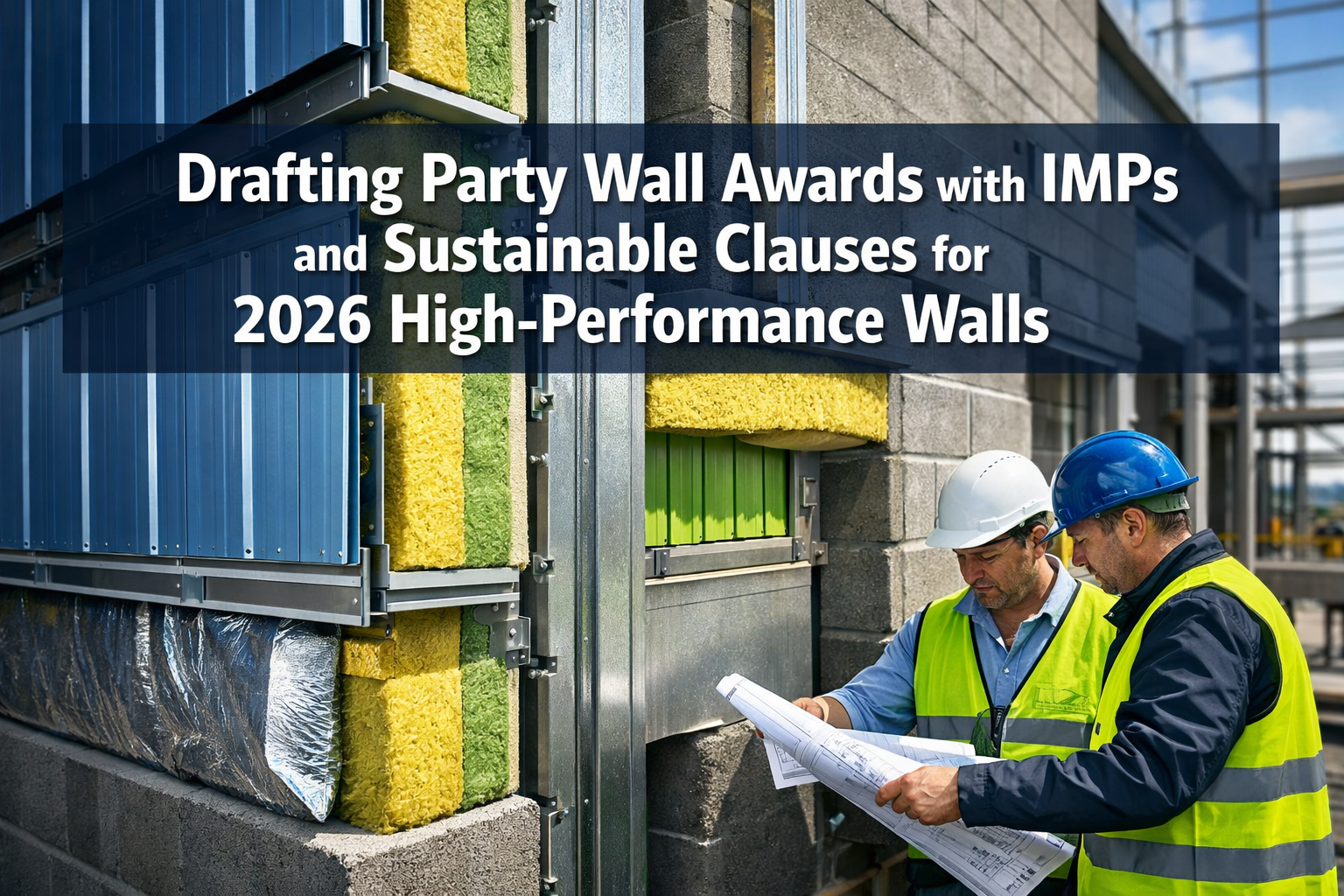
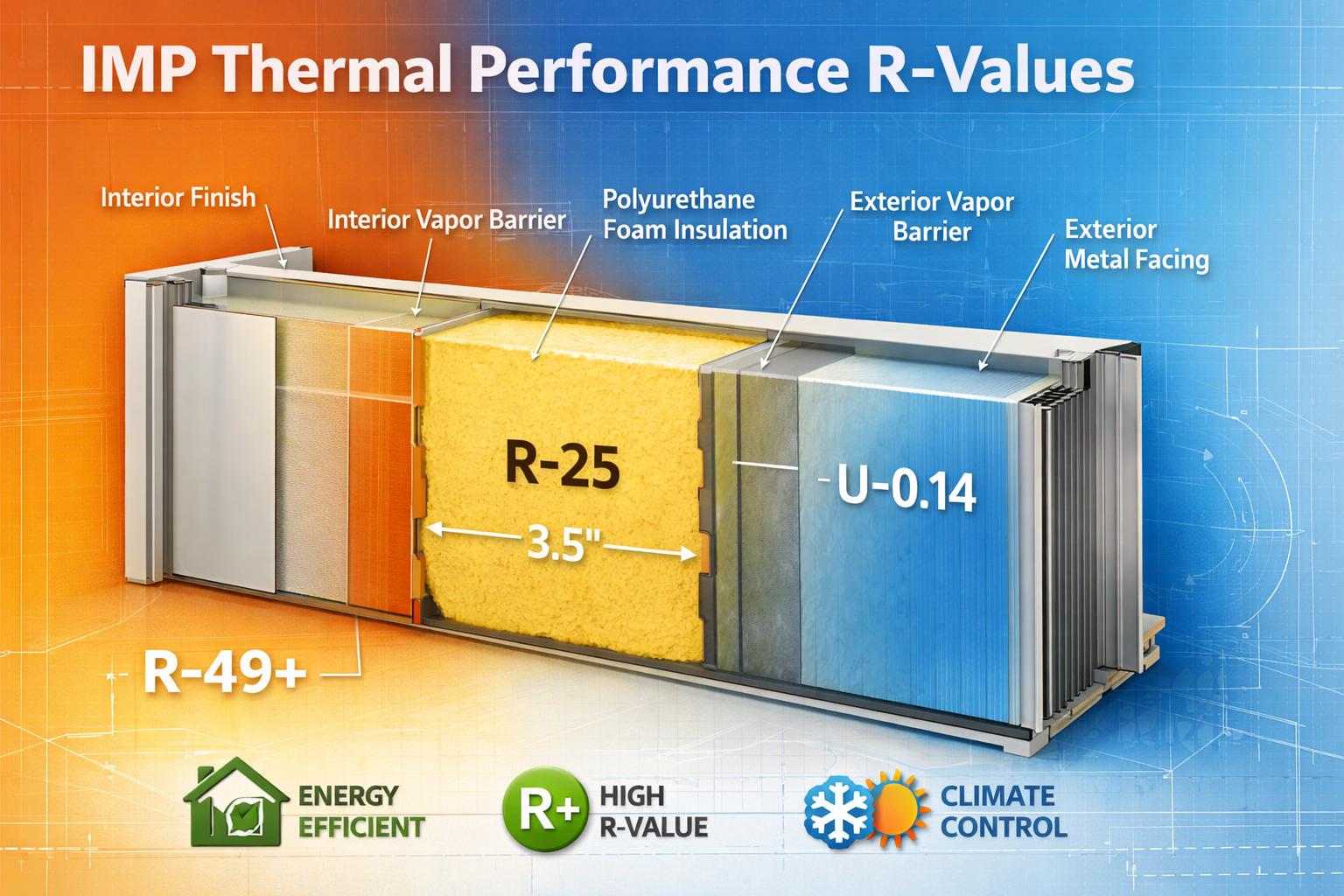
Insulated metal panels represent a revolutionary building envelope system that combines structural support, thermal insulation, and weather protection in a single prefabricated component. Unlike traditional party wall construction that relies on brick, block, or concrete, IMPs consist of:
- Exterior metal facing (typically steel or aluminum with protective coatings)
- High-performance insulation core (polyurethane, polyisocyanurate, or mineral wool)
- Interior metal facing with vapor barrier properties
- Interlocking joint systems that eliminate thermal bridging
The panels arrive on-site ready for rapid installation, reducing construction time by 30-50% compared to conventional methods. For party wall applications, this speed advantage minimizes disruption to adjoining owners—a significant consideration when drafting party wall awards.
Environmental Benefits of IMP Systems
The sustainability credentials of IMPs make them increasingly attractive for 2026 commercial projects:
Carbon Footprint Reduction 🌱
- Manufacturing requires 60% less energy than concrete block production
- Transportation emissions reduced due to lightweight construction (5-8 kg per square meter versus 150-200 kg for masonry)
- Installation generates minimal waste (typically under 2% material loss)
Energy Performance ⚡
- Continuous insulation eliminates thermal bridging common in traditional framed walls
- R-values ranging from R-20 to R-40 depending on panel thickness
- Reduced operational carbon through lower heating and cooling demands
- Potential for 40-50% energy cost savings over building lifecycle
Circular Economy Compatibility ♻️
- Metal facings are 100% recyclable at end of life
- Foam cores can be recovered and repurposed
- Panels can be disassembled and relocated rather than demolished
- Estimated 75-90% material recovery rate versus 20-30% for traditional masonry
Key Elements When Drafting Party Wall Awards with IMPs and Sustainable Clauses for 2026 High-Performance Walls
Technical Specifications That Must Be Documented
A comprehensive party wall award incorporating IMP systems requires precise technical documentation that goes beyond standard templates. The following specifications protect both building and adjoining owners:
Thermal Performance Standards
The award must explicitly state:
- Minimum R-value requirements (recommend R-30 minimum for commercial applications in 2026)
- Thermal bridging prevention measures at panel joints and penetrations
- Condensation control strategies including vapor barrier placement
- Testing and verification protocols to confirm as-built performance
Structural Integration Details
Party wall awards should address:
- Load-bearing capacity of IMP systems and supporting framework
- Connection methods to existing structures
- Seismic and wind load considerations specific to the location
- Deflection limits that prevent damage to adjoining properties
Acoustic Performance Criteria
Shared walls require sound transmission control:
- STC (Sound Transmission Class) ratings of 50 or higher for commercial applications
- Impact noise isolation if floors connect to party walls
- Acoustic testing requirements post-installation
- Remediation protocols if performance standards aren't met
Sustainable Material Sourcing Clauses
Forward-thinking party wall awards in 2026 should include sustainability commitments that align with broader environmental goals:
Material Certification Requirements 📋
- Specify percentage of recycled content in metal facings (recommend 25% minimum)
- Require third-party environmental product declarations (EPDs)
- Mandate low-VOC adhesives and sealants
- Document supply chain transparency for conflict minerals
Manufacturing Standards
- Preference for locally manufactured panels (within 500 miles) to reduce transportation emissions
- Requirement for ISO 14001 certified manufacturing facilities
- Documentation of manufacturing energy sources and renewable energy percentages
- Waste management practices at production facilities
End-of-Life Planning
- Include decommissioning plan specifying material recovery targets
- Establish responsibility for future recycling costs
- Document disassembly procedures that maximize material recovery
- Create material passport for future renovations or demolition
Maintenance and Longevity Provisions
The durability of IMP systems depends on proper maintenance, making these clauses essential:
| Maintenance Activity | Frequency | Responsible Party | Documentation Required |
|---|---|---|---|
| Visual inspection of panel joints | Annual | Building Owner | Photo log with date stamps |
| Sealant condition assessment | Every 2 years | Building Owner | Professional inspection report |
| Thermal imaging survey | Every 5 years | Both parties (shared cost) | Infrared report with thermal anomaly documentation |
| Coating condition evaluation | Every 3 years | Building Owner | Surface degradation assessment |
| Fastener integrity check | Every 5 years | Building Owner | Structural engineer certification |
The award should specify that maintenance records must be shared with adjoining owners and made available during property transfers. This transparency protects long-term performance and property values.
Legal Compliance and Party Wall Act Considerations
Aligning IMP Specifications with Statutory Requirements
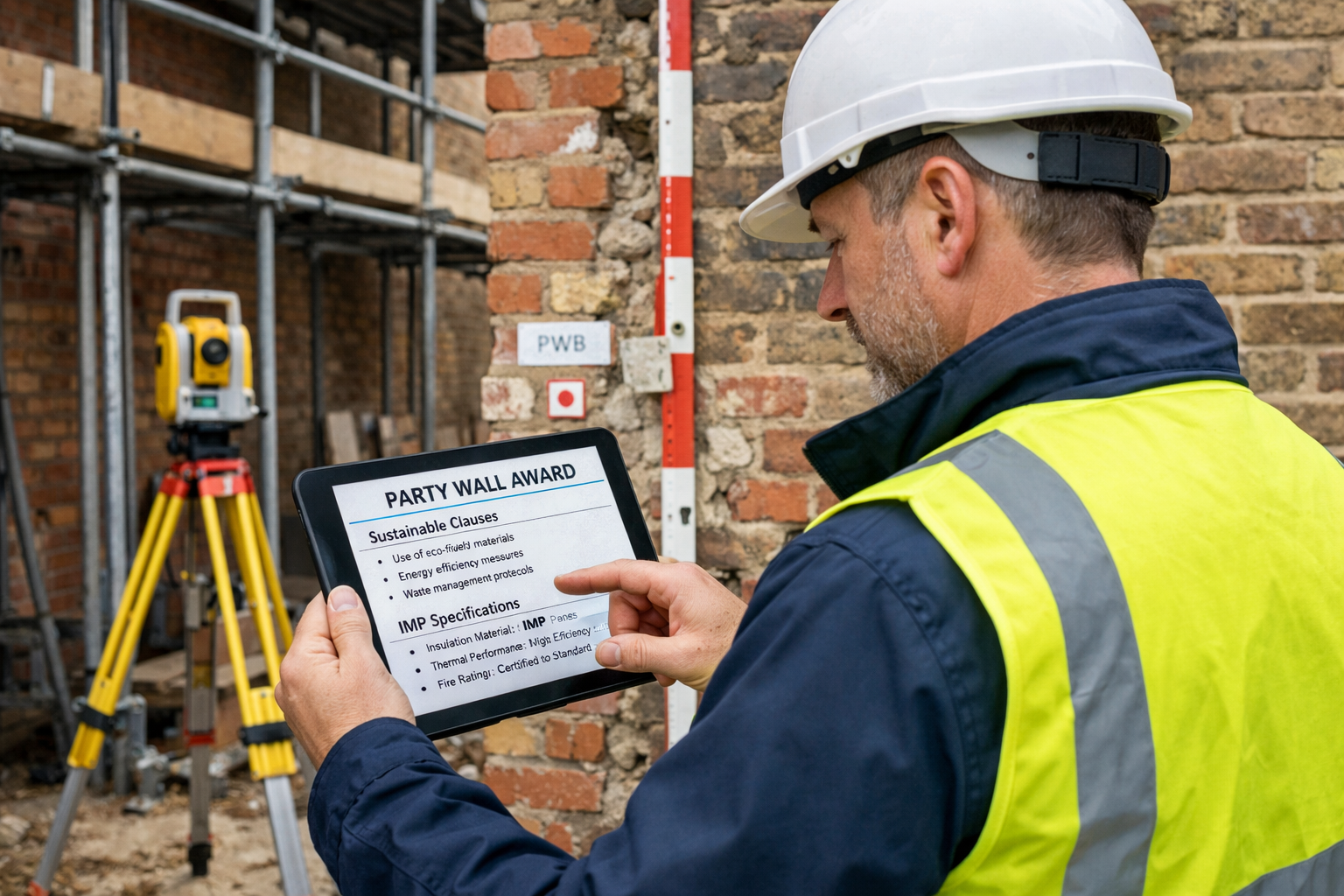
The Party Wall etc. Act 1996 doesn't specifically address modern materials like IMPs, requiring careful interpretation to ensure compliance. When drafting party wall awards with IMPs and sustainable clauses for 2026 high-performance walls, surveyors must address:
Notice Requirements 📨
- Party wall notices must clearly describe IMP system specifications
- Include technical drawings showing panel dimensions, connections, and thermal performance
- Provide material safety data sheets for insulation cores
- Explain how the system differs from traditional construction methods
Rights and Responsibilities
- Clarify that IMP installation may require temporary access to adjoining property for panel placement
- Establish protocols for protecting adjoining owner's property during installation
- Define acceptable noise levels and working hours for panel installation
- Address vibration limits during fastening operations
Dispute Resolution Mechanisms
- Include provisions for independent testing if thermal or acoustic performance is questioned
- Establish timeline for addressing defects discovered within warranty period
- Define process for resolving disagreements about maintenance responsibilities
- Specify arbitration procedures for sustainability clause compliance disputes
Schedule of Condition for IMP Installations
A thorough schedule of condition becomes even more critical with innovative building systems. The pre-work documentation should include:
- Thermal imaging baseline of existing adjoining walls to document pre-existing heat loss patterns
- Acoustic measurements establishing current sound transmission levels
- Structural assessment of adjoining walls that may be affected by new panel connections
- Photographic evidence with date stamps and precise location references
- Material sampling of existing party wall construction for comparison purposes
This comprehensive baseline protects both parties by establishing clear "before" conditions that can be compared to post-installation performance.
Practical Implementation: Commercial Retrofit Case Studies
Office Building Conversion in Central London
A 1970s office block conversion in Central London demonstrates effective IMP integration into party wall awards:
Project Context
- Six-story commercial building sharing party walls with three adjoining properties
- Original single-glazed curtain wall and uninsulated masonry party walls
- Target: BREEAM Excellent rating requiring significant thermal performance improvements
Award Innovations
- Specified R-35 IMP system with mineral wool core for enhanced fire performance
- Included sustainability clause requiring 40% recycled steel content in facings
- Established shared thermal monitoring system allowing adjoining owners to verify no heat transfer increase
- Created maintenance fund (0.5% of installation cost annually) for long-term upkeep
Outcomes
- 52% reduction in heating energy consumption
- STC-55 acoustic rating exceeded requirements
- Zero disputes during 18-month installation period
- Adjoining property values increased 3-4% due to improved thermal performance of shared walls
Warehouse Retrofit in East London
An industrial property conversion in East London showcased IMP benefits for challenging party wall scenarios:
Unique Challenges
- Shared wall with active manufacturing facility requiring minimal disruption
- Height variation between properties (warehouse 12m, adjoining building 8m)
- Contaminated existing masonry requiring encapsulation rather than removal
Award Solutions
- Phased installation schedule coordinated with adjoining owner's production cycles
- IMP system installed over existing masonry, avoiding demolition and contamination risks
- Performance guarantee clause ensuring R-30 minimum with financial penalties for non-compliance
- Detailed decommissioning plan addressing future material separation and recycling
Results
- Installation completed in 6 weeks versus estimated 16 weeks for traditional reconstruction
- Embodied carbon reduced by 58% compared to masonry replacement
- Adjoining owner experienced zero production disruptions
- Award served as template for three subsequent projects in the industrial estate
Drafting Sustainable Clauses: Best Practices for 2026
Carbon Accounting and Reporting Requirements
Progressive party wall awards now include carbon accounting provisions that document environmental performance:
Embodied Carbon Documentation 🏗️
- Require contractor to provide whole-life carbon assessment using recognized methodologies (RICS, LETI)
- Establish baseline comparison to conventional construction alternatives
- Document carbon savings achieved through material selection and construction methods
- Include carbon data in award appendices for future reference
Operational Carbon Monitoring
- Install temperature sensors at party wall interfaces to verify thermal performance
- Require annual energy performance reporting for spaces adjacent to party walls
- Compare actual performance to design predictions
- Establish remediation triggers if performance falls below guaranteed levels
Green Building Certification Integration
Many 2026 commercial projects pursue certifications like BREEAM, LEED, or WELL. Party wall awards can support these goals:
Certification-Aligned Clauses
- Reference specific credits the IMP system contributes toward (e.g., BREEAM Mat 01 for recycled content)
- Require documentation suitable for certification submission
- Establish timelines for providing verification data to building owner
- Include provisions for certification auditor access to party wall areas
Performance Verification
- Mandate post-occupancy evaluation of thermal and acoustic performance
- Require professional testing by accredited laboratories
- Establish performance thresholds aligned with certification requirements
- Create clear remediation pathways if standards aren't met
Future-Proofing and Adaptability Provisions
The most sophisticated party wall awards anticipate future changes:
Technology Evolution Clauses 🔮
- Allow for panel replacement with improved systems without requiring new party wall procedures
- Establish protocols for integrating future technologies (e.g., phase-change materials, smart sensors)
- Create framework for updating sustainability standards as regulations evolve
- Include provisions for carbon offset programs if future regulations require retrofits
Climate Adaptation Considerations
- Address potential thermal performance degradation over 30-50 year lifespan
- Establish inspection protocols for climate-related deterioration (extreme heat, flooding)
- Create contingency plans for panel replacement due to climate impacts
- Include provisions for upgrading insulation levels if building codes change
Working with Professional Surveyors for IMP Awards
Selecting Surveyors with Technical Expertise
Not all party wall surveyors have experience with advanced building systems. When selecting a surveyor for projects involving IMPs:
Essential Qualifications 🎓
- Professional membership (RICS, FPWS, Pyramus & Thisbe Club)
- Demonstrated experience with modern building envelope systems
- Understanding of building physics (thermal bridging, vapor diffusion, air sealing)
- Familiarity with sustainability standards and carbon accounting
- Knowledge of relevant building regulations beyond Party Wall Act
Questions to Ask Prospective Surveyors
- How many party wall awards have you drafted involving non-traditional materials?
- What experience do you have with thermal performance specifications?
- Can you provide examples of sustainability clauses you've included in previous awards?
- How do you approach performance verification and testing requirements?
- What's your process for resolving technical disputes about innovative systems?
Coordinating Between Multiple Professionals
IMP party wall projects require coordination among various specialists:
Professional Team Structure
- Party wall surveyor (legal compliance and award drafting)
- Building envelope consultant (thermal and moisture performance)
- Structural engineer (load analysis and connection design)
- Acoustic consultant (sound transmission specifications)
- Sustainability advisor (carbon accounting and certification support)
The party wall award should clearly delineate each professional's responsibilities and establish communication protocols. This prevents gaps in oversight and ensures all technical aspects receive appropriate attention.
Managing Costs and Timelines
IMP installations can reduce overall project costs, but party wall procedures require careful budgeting:
Cost Considerations 💷
- Surveyor fees typically 20-30% higher for complex awards involving innovative systems
- Budget for specialized testing (thermal imaging, acoustic testing, air leakage)
- Include contingency for potential performance remediation (5-10% of installation cost)
- Consider shared monitoring equipment costs between building and adjoining owners
For guidance on managing overall expenses, review our article on how to keep party wall costs down.
Timeline Planning
- Allow 4-6 weeks for award drafting (versus 2-3 weeks for standard awards)
- Schedule pre-installation meetings with all stakeholders
- Build in time for material procurement and testing
- Plan post-installation verification before final sign-off
Common Challenges and Solutions
Addressing Adjoining Owner Concerns
Adjoining owners may have reservations about unfamiliar building systems. Effective party wall awards anticipate and address these concerns:
Concern: Long-Term Durability ⏳
Solution: Include manufacturer warranties (typically 20-30 years for IMPs) as award appendices, establish inspection schedules, and create maintenance funds that ensure resources for future upkeep.
Concern: Fire Performance
Solution: Specify fire-rated IMP systems with mineral wool cores, include third-party fire testing certifications, and document compliance with Building Regulations Approved Document B.
Concern: Aesthetic Impact
Solution: Provide detailed renderings showing finished appearance, offer material samples for review, and include provisions for color/finish approval by adjoining owner if visible from their property.
Concern: Property Value Impact
Solution: Commission independent valuation assessment demonstrating neutral or positive impact, reference comparable projects, and include performance guarantees that protect property values.
Resolving Technical Disputes
When disagreements arise about IMP specifications or performance:
Dispute Resolution Framework ⚖️
- Initial Discussion: Building owner, adjoining owner, and appointed surveyors meet to clarify concerns
- Independent Testing: Engage third-party testing laboratory to verify performance against award specifications
- Expert Determination: Appoint independent building envelope specialist to assess compliance
- Remediation Plan: If deficiencies confirmed, establish timeline and methodology for corrections
- Arbitration: If agreement cannot be reached, proceed to formal arbitration under Party Wall Act provisions
The award should specify that testing costs are borne by the party whose position is not supported by results, incentivizing reasonable positions.
Navigating Building Regulations Compliance
Party wall awards must align with broader building regulations:
Key Regulatory Considerations 📜
- Part L (Conservation of Fuel and Power): IMP thermal performance must meet or exceed minimum U-value requirements
- Part E (Resistance to Sound): Acoustic performance specifications must satisfy minimum standards for building type
- Part B (Fire Safety): IMP fire ratings must be appropriate for building height and occupancy
- Part C (Resistance to Moisture): Vapor control and condensation prevention must be documented
The party wall award should reference building control approval and include provisions for addressing any conflicts between party wall requirements and building regulations.
Future Trends in Party Wall Awards and Sustainable Construction
Emerging Technologies for 2026 and Beyond
The construction industry continues to innovate, and party wall practices must evolve accordingly:
Advanced Materials 🔬
- Aerogel-enhanced IMPs offering R-50+ performance in ultra-thin profiles
- Bio-based insulation cores using mycelium or hemp for reduced embodied carbon
- Self-healing coatings that extend panel lifespan and reduce maintenance
- Phase-change materials integrated into panels for thermal mass benefits
Digital Integration
- Building Information Modeling (BIM) integration for party wall documentation
- IoT sensors embedded in panels for real-time performance monitoring
- Blockchain-based material passports ensuring supply chain transparency
- Digital twin technology for predictive maintenance and performance optimization
Regulatory Evolution
Expect continued regulatory development affecting party wall practices:
Anticipated Changes 📊
- Mandatory embodied carbon reporting for commercial buildings over 1,000 m²
- Stricter thermal performance standards (potential U-value requirements below 0.15 W/m²K)
- Circular economy requirements mandating material recovery plans
- Enhanced acoustic standards reflecting work-from-home trends
- Climate adaptation requirements for building envelope systems
Progressive party wall awards drafted in 2026 should anticipate these changes through flexible language that allows for standard updates without requiring complete renegotiation.
Industry Best Practices Development
Professional organizations are developing guidance specific to modern materials:
Emerging Standards 📚
- RICS guidance notes on party wall awards for high-performance building envelopes
- Pyramus & Thisbe Club technical papers on sustainable clause drafting
- Industry protocols for IMP performance verification in party wall contexts
- Template sustainability clauses for common scenarios
- Carbon accounting methodologies specific to party wall works
Staying current with these developments ensures awards reflect industry consensus and reduce dispute risk.
Conclusion
Drafting party wall awards with IMPs and sustainable clauses for 2026 high-performance walls represents the intersection of legal compliance, technical innovation, and environmental responsibility. As commercial property owners increasingly pursue retrofit projects that dramatically improve building performance, party wall procedures must evolve to accommodate modern construction methods while protecting the rights of all stakeholders.
The key to success lies in comprehensive technical documentation that clearly specifies thermal performance, acoustic standards, structural requirements, and sustainability commitments. By including detailed material sourcing requirements, end-of-life planning, and long-term maintenance provisions, party wall awards can ensure that IMP installations deliver their promised benefits throughout their 30-50 year lifespan.
Actionable Next Steps
For building owners planning projects involving IMPs and party walls:
- Engage experienced professionals early – Select party wall surveyors with demonstrated expertise in modern building systems before finalizing design
- Develop comprehensive technical specifications – Work with building envelope consultants to establish clear performance targets and testing protocols
- Communicate proactively with adjoining owners – Share information about IMP benefits, provide material samples, and address concerns before formal notice periods
- Budget appropriately – Allocate resources for specialized testing, monitoring equipment, and potential performance verification
- Document sustainability commitments – Create clear carbon accounting frameworks and material sourcing requirements that align with broader project goals
- Plan for long-term stewardship – Establish maintenance funds, inspection schedules, and performance monitoring systems that protect all parties' interests
For adjoining owners receiving notices about IMP installations:
- Request detailed technical information – Ask for manufacturer specifications, thermal performance data, and acoustic testing results
- Consider appointing a specialist surveyor – Engage professionals familiar with building envelope systems to review proposed specifications
- Understand your rights – Review the Party Wall Act requirements and ensure the award adequately protects your interests
- Negotiate appropriate protections – Seek performance guarantees, monitoring provisions, and clear remediation protocols
- Document existing conditions thoroughly – Ensure the schedule of condition comprehensively captures current thermal and acoustic performance
The construction industry's transition to high-performance, low-carbon building systems is not just an environmental imperative—it's an economic opportunity. By thoughtfully integrating IMPs into party wall awards with robust sustainable clauses, property professionals can deliver projects that protect neighboring relationships, comply with legal requirements, and contribute to a more sustainable built environment.
As 2026 progresses and climate goals become increasingly urgent, the practices outlined in this guide will transition from innovative approaches to industry standards. Property owners, surveyors, and construction professionals who embrace these methods now will be well-positioned to navigate the evolving regulatory landscape while delivering superior building performance that benefits all stakeholders.
For additional guidance on party wall procedures and to connect with experienced professionals, explore our comprehensive resources on types of party wall works and party wall awards. Whether you're a building owner embarking on a retrofit or an adjoining owner receiving notice of works, professional support ensures your interests are protected while advancing sustainable construction practices.