


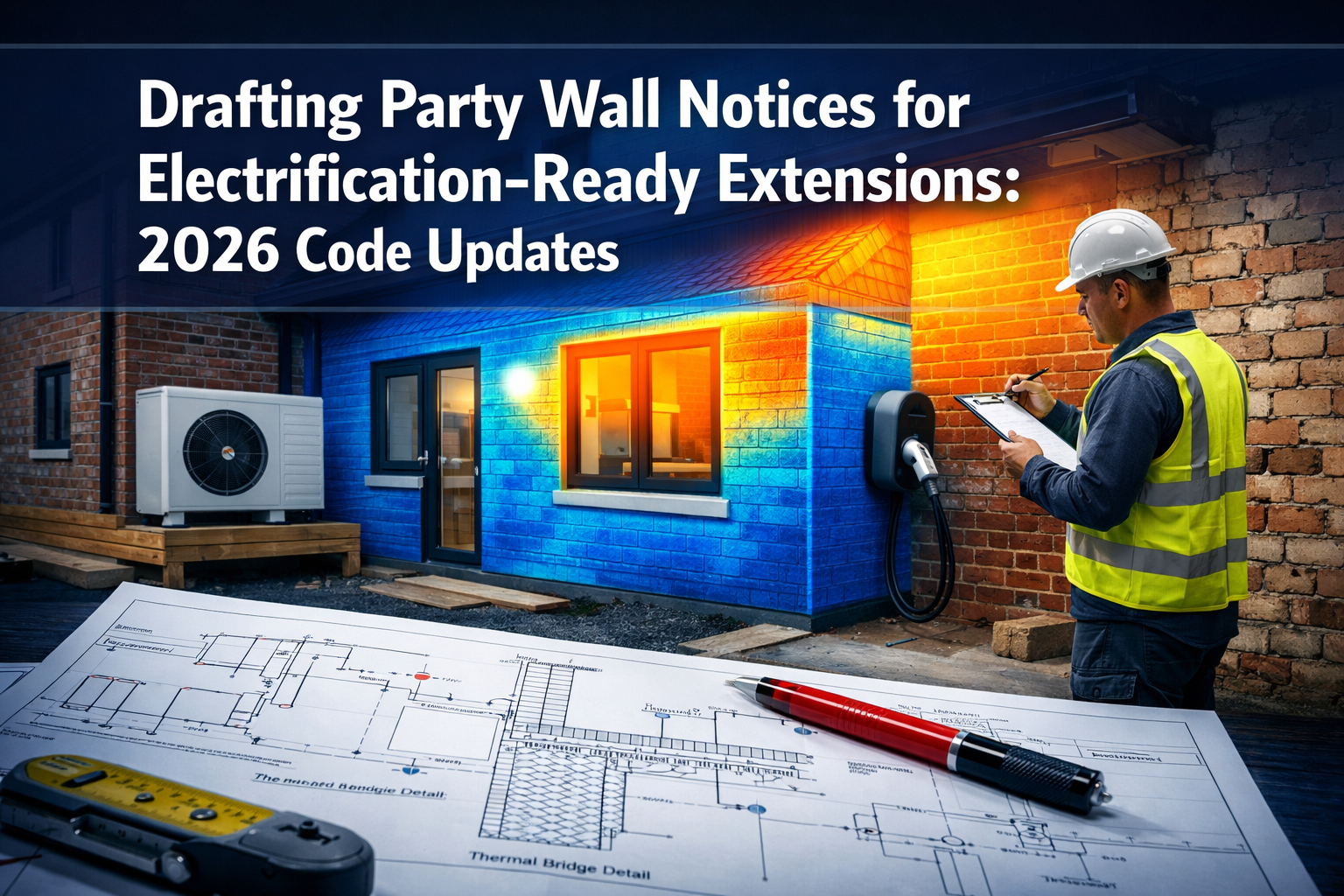
As the UK accelerates toward its net-zero targets, homeowners planning extensions in 2026 face a new reality: electrification is no longer optional. Heat pumps, EV charging infrastructure, and enhanced energy performance standards are transforming how we approach home renovations—and these changes have significant implications for party wall procedures. When your extension shares a wall with your neighbour's property, understanding how to draft party wall notices that account for electrification-ready designs has become essential for compliance and neighbour relations.
Drafting Party Wall Notices for Electrification-Ready Extensions: 2026 Code Updates and Surveyor Checklists represents a critical intersection of traditional party wall law and modern building regulations. This comprehensive guide explores how the latest energy standards impact shared wall construction, what surveyors must now include in their assessments, and how building owners can navigate these requirements smoothly.
Key Takeaways
- 🔌 2026 Building Regulations now mandate electrification-ready infrastructure in extensions, affecting party wall notice requirements and technical specifications
- 📋 Enhanced surveyor checklists must include airtightness testing, thermal bridging assessments, and acoustic isolation for heat pump installations near party walls
- 🏠 Heat pump and EV charging provisions require specific clauses in party wall agreements addressing structural loading, vibration isolation, and penetration details
- ⚖️ Compliance documentation linking party wall awards to Building Control approvals has become mandatory for electrification-ready extensions
- 🤝 Early neighbour engagement regarding electrification features reduces disputes and streamlines the party wall process
Understanding the 2026 Electrification Mandate for Extensions
The landscape of home extensions changed dramatically with the 2026 updates to Part L (Conservation of Fuel and Power) and Part F (Ventilation) of the Building Regulations. These amendments establish electrification-ready standards as baseline requirements rather than optional upgrades.
What "Electrification-Ready" Means in Practice
An electrification-ready extension must incorporate infrastructure for:
- Heat pump installation with appropriate electrical capacity (typically 32A dedicated circuit)
- EV charging capability with minimum 7kW provision or conduit for future installation
- Enhanced thermal performance exceeding previous U-value requirements by 15-20%
- Airtightness standards achieving ≤3 m³/(h·m²) at 50 Pa pressure differential
- Renewable energy integration points for solar PV or battery storage systems
When these features intersect with party walls, the complexity increases substantially. Heat pumps mounted near shared boundaries create acoustic considerations, while enhanced insulation affects thermal bridging at party wall junctions.
Why This Matters for Party Wall Procedures
Traditional party wall notices focused primarily on structural integrity and basic construction details. The 2026 requirements demand a more sophisticated approach that addresses:
Energy performance implications 🌡️
- Thermal bridging at party wall interfaces
- Continuous insulation strategies
- Airtightness membrane continuity across shared structures
Mechanical system integration ⚙️
- Heat pump mounting and vibration transmission
- Refrigerant pipework penetrations through party walls
- Acoustic isolation requirements for mechanical equipment
Electrical infrastructure ⚡
- High-capacity cable routing near party structures
- Consumer unit upgrades affecting shared services
- EV charging point positioning relative to boundaries
The Party Wall etc. Act 1996 doesn't explicitly address these modern considerations, creating a gap that surveyors and building owners must bridge through comprehensive notice drafting and award conditions.
Drafting Party Wall Notices for Electrification-Ready Extensions: Essential Components
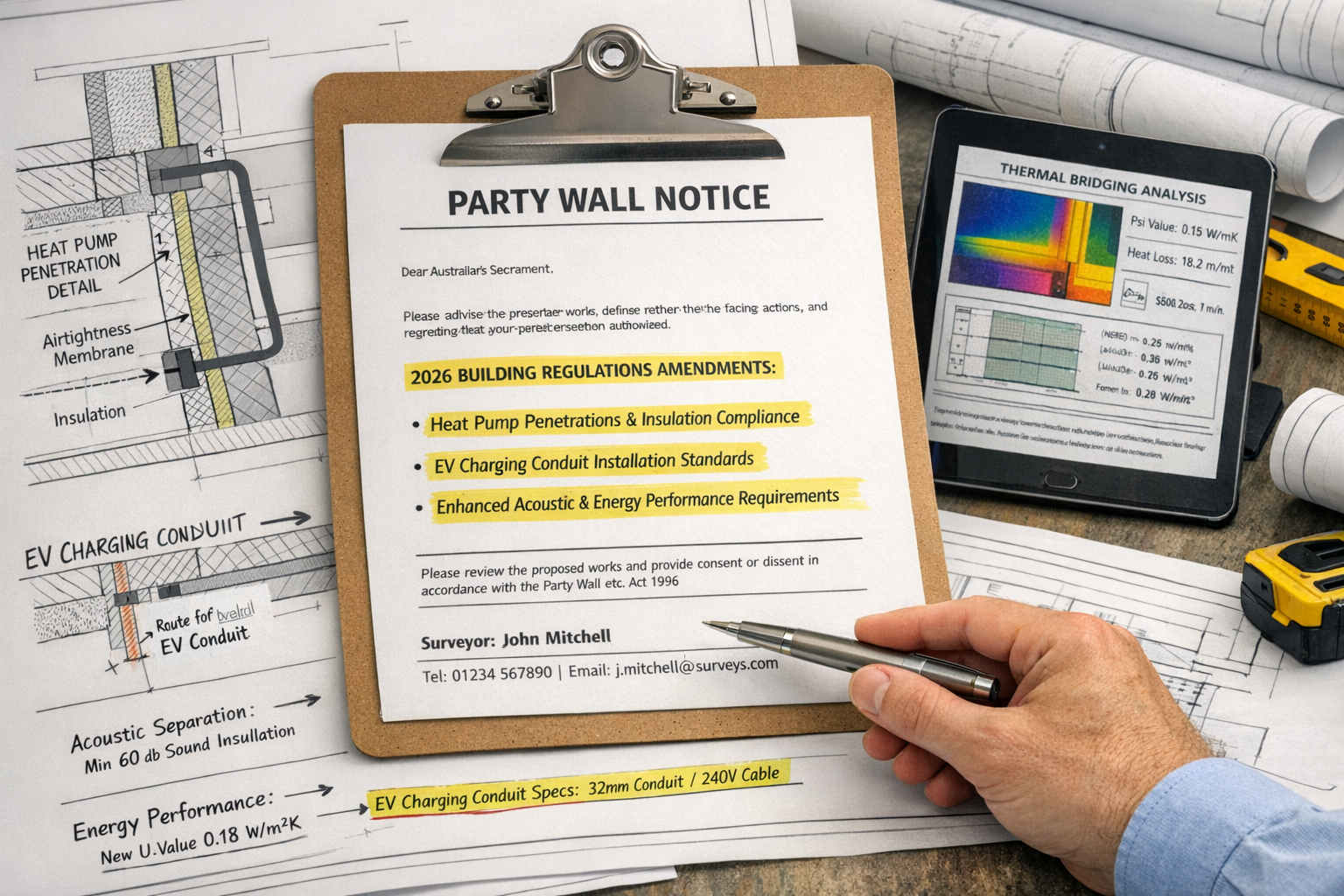
Creating effective party wall notices for electrification-ready work requires integrating traditional party wall requirements with modern energy performance specifications. The notice must provide sufficient detail for adjoining owners to understand both structural and operational implications.
Core Notice Elements Under 2026 Standards
When preparing a party structure notice for an electrification-ready extension, include these enhanced components:
1. Detailed Construction Specifications
Beyond standard dimensions and materials, specify:
| Component | Traditional Notice | 2026 Enhanced Notice |
|---|---|---|
| Wall insulation | "Cavity insulation to be installed" | "Continuous external insulation: 120mm PIR, λ=0.022 W/mK, achieving U-value ≤0.18 W/m²K with thermal bridge mitigation at party wall junction" |
| Airtightness | Not typically mentioned | "Airtightness membrane: 0.2mm AVCL with taped joints, continuity maintained at party wall interface, target ≤3 m³/(h·m²) @ 50Pa" |
| Mechanical systems | "Central heating to be extended" | "Air source heat pump: 8kW output, wall-mounted 1.2m from party boundary, vibration-isolated mounting, acoustic rating ≤42dB @ 1m" |
| Electrical provisions | Basic circuit information | "32A dedicated heat pump circuit, 7kW EV charging provision, upgraded consumer unit from 80A to 100A supply" |
2. Thermal Bridging Mitigation Clauses
Thermal bridges at party wall junctions can compromise the entire extension's energy performance. Your notice should specify:
- Junction detailing: Provide drawings showing insulation continuity at party wall interfaces
- Psi-value targets: State acceptable linear thermal transmittance values (typically ≤0.15 W/mK for party wall junctions)
- Verification methods: Commit to thermal imaging verification post-completion
- Remediation protocols: Establish procedures if thermal bridging exceeds acceptable limits
"The integration of enhanced thermal performance with party wall construction requires unprecedented attention to junction details. A poorly executed party wall junction can negate the energy benefits of an otherwise excellent extension." — Party Wall Surveying Best Practices, 2026
3. Acoustic and Vibration Considerations
Heat pumps and mechanical ventilation systems introduce operational impacts that must be addressed:
For heat pump installations near party walls:
- Mounting location relative to party boundary (minimum 1.0m recommended)
- Vibration isolation specifications (anti-vibration mounts with ≥85% isolation efficiency)
- Acoustic barriers or screening if unit is within 2.0m of party wall
- Operating schedule restrictions if applicable (though modern units rarely require this)
For penetrations through party structures:
- Refrigerant pipework sleeving and sealing details
- Acoustic isolation at penetration points
- Fire-stopping specifications compliant with Part B requirements
- Maintenance access provisions
4. Airtightness Continuity Statements
Achieving the 2026 airtightness standards requires careful coordination at party wall interfaces:
- Membrane specification: Type, thickness, and fire rating of airtightness barrier
- Junction treatment: How the membrane connects to existing party wall
- Penetration sealing: Protocol for maintaining airtightness around services
- Testing commitment: Agreement to conduct blower door testing and share results
Special Considerations for Different Extension Types
The type of extension significantly affects notice requirements:
Rear extensions 🏗️
- Typically involve new foundations adjacent to party walls
- May require underpinning or foundation reinforcement
- Heat pump positioning often affects adjoining owner's garden amenity
- Roof-mounted solar PV may cast shadows on neighbour's property
Side extensions 🏘️
- Often built directly against party boundaries
- Require careful coordination of damp-proof courses and insulation
- May necessitate removal of existing party fence wall
- EV charging points frequently positioned on side elevations
Loft conversions 🏠
- Affect party wall thermal performance at roof level
- May require party wall to be raised for headroom
- Ventilation and heat recovery systems often penetrate party structures
- Dormer construction can impact neighbour's light and privacy
For guidance on different types of party wall works, consider consulting with experienced professionals who understand both structural and energy performance requirements.
2026 Code Updates: What Changed and Why It Matters
The 2026 amendments to Building Regulations represent the most significant update to energy standards since 2021's Future Homes Standard consultation. Understanding these changes is essential for drafting compliant party wall notices.
Key Regulatory Changes Affecting Party Walls
Part L (Conservation of Fuel and Power) – 2026 Edition
The updated Part L introduces:
- Enhanced U-values: External walls must achieve ≤0.18 W/m²K (down from 0.26 W/m²K)
- Mandatory heat pump readiness: All new extensions must accommodate heat pump installation
- Thermal bridging limits: Psi-values at junctions capped at 0.15 W/mK for party wall interfaces
- Primary energy performance: 30% improvement over 2021 baseline
Part F (Ventilation) – 2026 Edition
Ventilation requirements now mandate:
- Mechanical ventilation with heat recovery (MVHR) for extensions exceeding 30m² floor area
- Airtightness testing mandatory for all extensions (previously only required for whole dwellings)
- Continuous ventilation rates increased to account for improved airtightness
- Filter specifications for air quality in urban environments
Part Q (Security) – Electrification Amendments
New provisions address:
- EV charging point security: Lockable connectors and tamper-proof installations
- External equipment protection: Heat pumps and associated infrastructure
- Cable routing security: Preventing unauthorized access to high-capacity electrical systems
How These Changes Impact Party Wall Agreements
The regulatory updates create several new obligations for party wall awards:
Expanded Scope of Works
Traditional party wall awards focused on structural matters. 2026 awards must now address:
- Energy performance verification – Committing to achieve specified U-values and airtightness
- Testing protocols – Agreeing to thermal imaging and blower door testing schedules
- Remediation rights – Establishing procedures if energy performance targets aren't met
- Long-term monitoring – Provisions for addressing thermal bridging discovered post-completion
Enhanced Technical Specifications
Awards must include detailed specifications for:
- Insulation materials: Type, thickness, thermal conductivity, fire rating
- Airtightness barriers: Material specification, installation methodology, junction details
- Mechanical systems: Equipment specifications, mounting details, acoustic performance
- Electrical infrastructure: Cable sizes, circuit protection, earthing arrangements
Coordination with Building Control
The 2026 regulations strengthen the link between party wall procedures and Building Control approval:
- Concurrent submissions: Party wall notices should reference Building Control application numbers
- Coordinated inspections: Building Control officers may request access via party wall provisions
- Compliance documentation: Party wall awards must demonstrate regulatory compliance
- Completion certificates: Building Control sign-off may be conditional on party wall compliance
This integration means that surveyors drafting notices and awards must possess substantial knowledge of Building Regulations—a significant departure from traditional practice.
Comprehensive Surveyor Checklists for Electrification-Ready Extensions
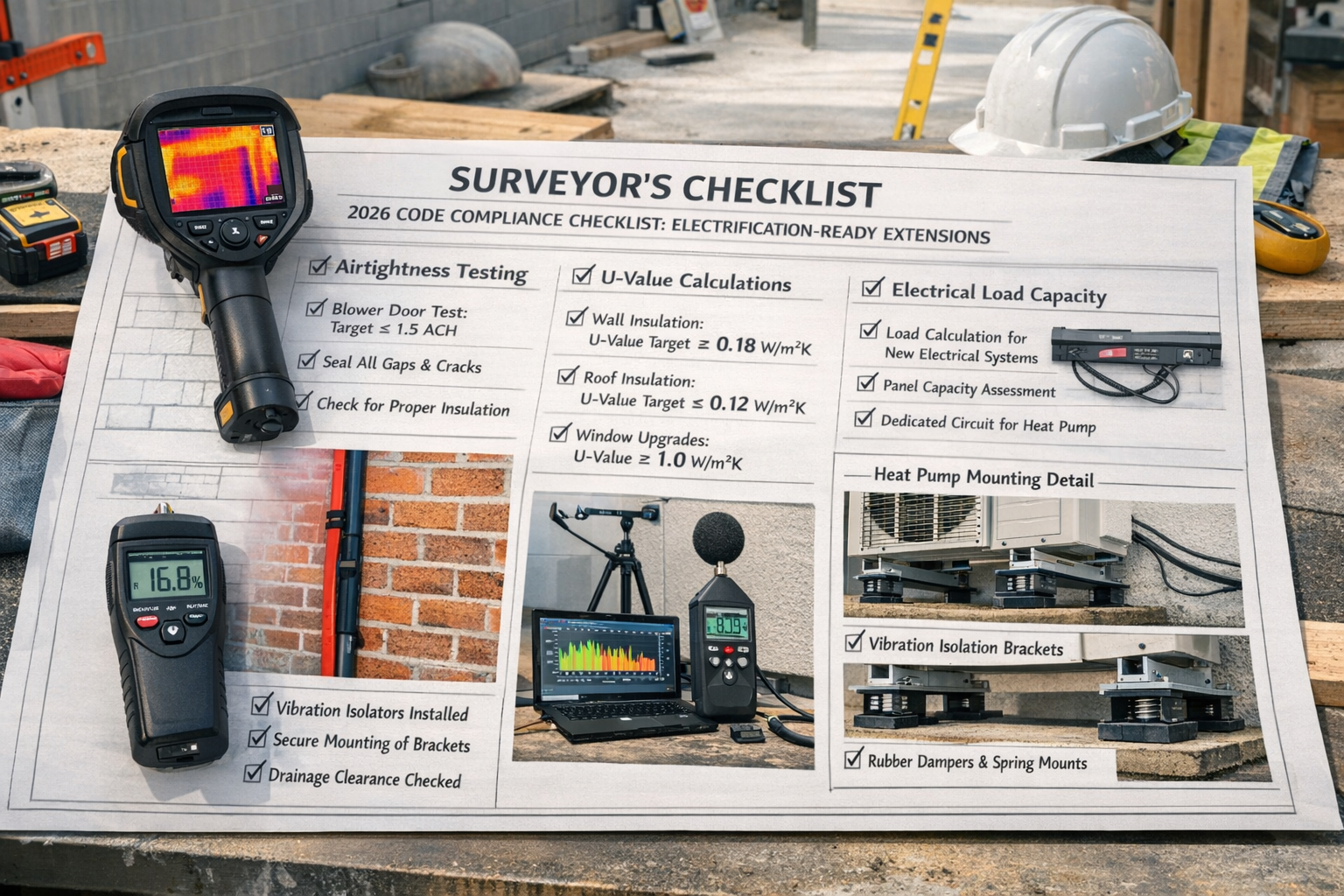
Professional surveyors must adapt their assessment methodologies to address electrification requirements. These enhanced checklists ensure nothing is overlooked when evaluating party wall implications of modern, energy-efficient extensions.
Pre-Notice Site Assessment Checklist
Before drafting notices, surveyors should evaluate:
Existing Conditions ✅
- Current party wall construction type and condition
- Existing insulation levels (if determinable)
- Current electrical service capacity and consumer unit rating
- Available space for heat pump installation relative to party boundary
- Existing thermal bridging at party wall junctions
- Current airtightness characteristics (if measurable)
- Acoustic baseline measurements at party wall
Electrification Infrastructure Assessment ✅
- Electrical supply capacity (verify with DNO if necessary)
- Available mounting locations for heat pumps (distance from party wall)
- EV charging point positioning options
- Solar PV potential and roof access across party structures
- Space for upgraded consumer units and distribution boards
- Routing options for high-capacity cables near party walls
Regulatory Compliance Verification ✅
- Confirm applicable 2026 Building Regulations requirements
- Identify any local planning conditions affecting electrification
- Check for conservation area or listed building restrictions
- Verify compliance with DNO connection requirements
- Confirm MCS certification requirements for heat pumps
- Review any covenant restrictions on external equipment
Notice Drafting Checklist
When preparing party wall notices for electrification-ready work:
Essential Technical Details 📋
- Complete construction specifications including all insulation layers
- U-value calculations for all elements interfacing with party structures
- Airtightness strategy with membrane specifications
- Thermal bridging mitigation details at party wall junctions
- Heat pump specifications (capacity, mounting, acoustic rating)
- EV charging infrastructure details
- Electrical upgrade specifications
- Ventilation system details (MVHR if applicable)
Drawings and Documentation 📐
- Scaled plans showing extension relative to party walls
- Cross-sections through party wall junctions showing insulation continuity
- Detail drawings of thermal bridge mitigation measures
- Heat pump mounting details with dimensions from party boundary
- Electrical schematic showing new circuits and upgraded infrastructure
- Airtightness membrane continuity details
- Service penetration details through party structures
Operational Impact Statements 🔊
- Predicted acoustic impact of heat pump operation
- Vibration assessment for mechanical equipment
- Visual impact statement for external equipment
- Maintenance access requirements
- Emergency shutdown procedures for heat pumps
- Long-term operational commitments
During-Works Inspection Checklist
Surveyors conducting inspections during construction should verify:
Foundation and Structural Stage 🏗️
- Foundation depths and proximity to party wall foundations
- Underpinning execution (if required)
- Damp-proof course installation and continuity
- Party wall protection measures during excavation
- Structural connections to party wall executed as specified
Thermal Envelope Stage 🌡️
- Insulation installed to specified thickness and continuity
- Thermal bridging details executed as designed
- Airtightness membrane installed with proper overlaps and taping
- Junction between new and existing party wall properly sealed
- Service penetrations properly sealed and insulated
- Window and door installation airtightness verified
Mechanical and Electrical Stage ⚡
- Heat pump mounted as specified with proper vibration isolation
- Refrigerant pipework properly insulated and sealed at penetrations
- Electrical circuits installed to specification
- Consumer unit upgrade completed and certified
- EV charging infrastructure installed (or provision made)
- MVHR system installed with proper ductwork sealing
Completion and Testing Stage ✓
- Airtightness test conducted and results documented
- Thermal imaging conducted to verify absence of thermal bridging
- Acoustic testing of heat pump operation
- Building Control final inspection completed
- All party wall conditions satisfied
- Completion documentation provided to adjoining owner
Post-Completion Verification Checklist
After works complete, surveyors should:
Performance Verification 📊
- Review airtightness test results (target: ≤3 m³/(h·m²) @ 50Pa)
- Analyze thermal imaging for thermal bridging issues
- Verify acoustic compliance of heat pump (≤42dB @ 1m)
- Confirm Building Control approval certificate issued
- Verify MCS certification for heat pump installation
- Review EPC rating achievement
Documentation and Handover 📄
- Compile comprehensive photographic record
- Prepare final party wall award incorporating as-built details
- Document any variations from original notice
- Provide maintenance guidance for electrification equipment
- Confirm warranty and guarantee documentation
- Establish monitoring protocol for first 12 months
This thorough approach ensures that electrification-ready extensions meet both party wall obligations and modern energy performance standards.
Practical Guidance for Building Owners and Surveyors
Successfully navigating the intersection of party wall procedures and electrification requirements demands practical strategies that benefit all parties involved.
Early Planning Strategies
Start conversations early ⏰
Begin discussing your electrification-ready extension with neighbours well before serving formal notices. Explain the benefits:
- Reduced energy costs and carbon emissions
- Enhanced property values for both properties
- Compliance with future-proofed building standards
- Potential for shared infrastructure (e.g., EV charging points)
Engage specialists appropriately 👥
Modern extensions require a coordinated team:
- Party wall surveyor with electrification knowledge
- Architect or designer familiar with 2026 Building Regulations
- Mechanical engineer for heat pump and ventilation design
- Electrical engineer for high-capacity infrastructure
- Energy assessor for thermal performance verification
Working with professionals who understand both party wall procedures and modern building standards streamlines the process significantly. If you're carrying out works, assembling the right team early prevents costly redesigns later.
Cost Management Considerations
Electrification-ready extensions typically cost 8-15% more than traditional construction, but strategic planning can minimize expenses:
Cost-Effective Approaches 💰
- Install infrastructure (conduits, upgraded electrical panels) even if not immediately using heat pumps
- Consider shared heat pump installations with neighbours where feasible
- Optimize insulation strategy to minimize thermal bridging remediation
- Conduct early airtightness testing to identify issues before finishes are applied
- Bundle party wall and Building Control inspections to reduce professional fees
For detailed guidance on managing expenses, review our tips on how to keep party wall costs down.
Common Pitfalls and How to Avoid Them
Pitfall #1: Inadequate Notice Detail ❌
Problem: Generic notices that don't specify electrification requirements lead to disputes when neighbours discover heat pumps or electrical upgrades weren't disclosed.
Solution: Use comprehensive notice templates that explicitly detail all electrification infrastructure, including equipment specifications, mounting locations, and operational characteristics.
Pitfall #2: Ignoring Thermal Bridging ❌
Problem: Failing to address party wall thermal bridging can compromise the entire extension's energy performance, potentially causing Building Control rejection.
Solution: Commission detailed thermal modeling of party wall junctions during design phase and include mitigation measures in party wall notices.
Pitfall #3: Inadequate Acoustic Consideration ❌
Problem: Heat pumps positioned too close to party walls create noise disputes post-completion, potentially requiring expensive relocation.
Solution: Conduct acoustic assessments during design, specify minimum distances from party boundaries (typically 1.0-1.5m), and include vibration isolation in specifications.
Pitfall #4: Disconnected Building Control and Party Wall Processes ❌
Problem: Proceeding with party wall agreements without coordinating with Building Control can lead to compliance issues discovered mid-construction.
Solution: Submit Building Control applications concurrently with party wall notices and cross-reference both processes in documentation.
Regional Considerations Across London
Different London areas present unique challenges for electrification-ready extensions:
Central London 🏙️
- Conservation area restrictions may limit external heat pump placement
- Limited space requires creative solutions for equipment positioning
- Higher property values justify premium solutions
- Noise considerations more critical in dense urban environments
- Find specialists familiar with these challenges through party wall surveyors in Central London
Suburban London 🏘️
- More space available for equipment positioning
- Greater flexibility in heat pump placement
- Potential for ground source heat pumps in larger gardens
- Lower noise sensitivity in less dense areas
- Access regional expertise via North London, East London, South London, or West London specialists
Template Clauses for 2026-Compliant Notices
Incorporate these model clauses into your party wall notices:
Thermal Performance Clause:
"The proposed extension shall achieve a maximum U-value of 0.18 W/m²K for external walls, with thermal bridging at the party wall junction not exceeding a Psi-value of 0.15 W/mK. Thermal imaging verification shall be conducted post-completion and results shared with the Adjoining Owner."
Airtightness Clause:
"The extension shall achieve airtightness of ≤3 m³/(h·m²) at 50 Pa pressure differential, verified by blower door testing conducted by an accredited tester. The airtightness membrane shall maintain continuity at the party wall interface using [specified material and methodology]."
Heat Pump Installation Clause:
"An air source heat pump of [X] kW output capacity shall be wall-mounted at minimum 1.2m from the party boundary, with vibration-isolated mounting achieving ≥85% isolation efficiency. The unit shall maintain acoustic output ≤42dB at 1m distance during normal operation. Installation shall comply with MCS standards and manufacturer specifications."
Remediation Rights Clause:
"Should thermal imaging or airtightness testing reveal deficiencies affecting the party wall or adjoining property, the Building Owner shall undertake remedial works within 30 days at their own expense, subject to agreement with the Adjoining Owner or determination by the appointed surveyor(s)."
Conclusion
Drafting Party Wall Notices for Electrification-Ready Extensions: 2026 Code Updates and Surveyor Checklists represents a fundamental evolution in party wall practice. The integration of heat pumps, EV charging infrastructure, and enhanced energy performance standards into shared wall construction demands unprecedented attention to technical detail and neighbour communication.
The key to success lies in understanding that party wall procedures and Building Regulations compliance are no longer separate processes—they're deeply interconnected aspects of modern construction. Surveyors must expand their expertise beyond structural matters to encompass thermal performance, airtightness, and mechanical systems integration. Building owners must recognize that comprehensive notices and transparent communication prevent disputes far more effectively than minimal disclosure.
Your Action Plan for 2026-Compliant Extensions
For Building Owners: 🏗️
- Engage a party wall surveyor familiar with 2026 electrification requirements early in your design process
- Commission thermal modeling of party wall junctions before finalizing designs
- Discuss your plans with neighbours informally before serving formal notices
- Ensure your design team coordinates party wall and Building Control submissions
- Budget for enhanced specifications including airtightness testing and thermal imaging
- Review our schedule of condition guidance to protect all parties' interests
For Adjoining Owners: 🏠
- Request detailed specifications when receiving notices about electrification-ready extensions
- Consider appointing your own surveyor if you have concerns about thermal or acoustic impacts
- Ask for commitments regarding testing and verification of energy performance
- Understand your rights regarding remediation if issues arise post-completion
- Explore whether shared electrification infrastructure might benefit your property
For Surveyors: 📋
- Invest in professional development covering 2026 Building Regulations and electrification technologies
- Develop comprehensive notice templates incorporating all electrification requirements
- Build relationships with mechanical and electrical engineers for complex projects
- Create detailed inspection protocols covering thermal performance and airtightness
- Stay current with evolving guidance from RICS and other professional bodies
The transition to electrification-ready construction presents challenges, but it also offers opportunities to create healthier, more efficient homes while maintaining positive neighbour relations. By approaching party wall procedures with the thoroughness and technical sophistication that modern building standards demand, we can successfully navigate this new landscape.
For personalized guidance on your specific project, consider consulting with experienced professionals who understand both the legal framework of party wall procedures and the technical requirements of 2026 Building Regulations. The investment in expert advice typically pays dividends through smoother approvals, reduced disputes, and successful project outcomes.
