


Basement extensions have become one of London's most sought-after home improvements, offering valuable living space without compromising garden areas or street aesthetics. However, the Essential Party Wall Notices for Basement Extensions Under 2026 Permitted Development Rules remain a critical legal requirement that many property owners overlook until complications arise. Understanding these notice requirements can mean the difference between a smooth construction process and costly legal disputes with neighbors.
In 2026, with basement extension costs ranging from £4,600 to £6,200 per square meter—a 3-4% increase from 2025—protecting your investment through proper legal compliance has never been more important. The intersection of permitted development rights, party wall legislation, and deep excavation requirements creates a complex regulatory landscape that demands careful navigation.
Key Takeaways 📋
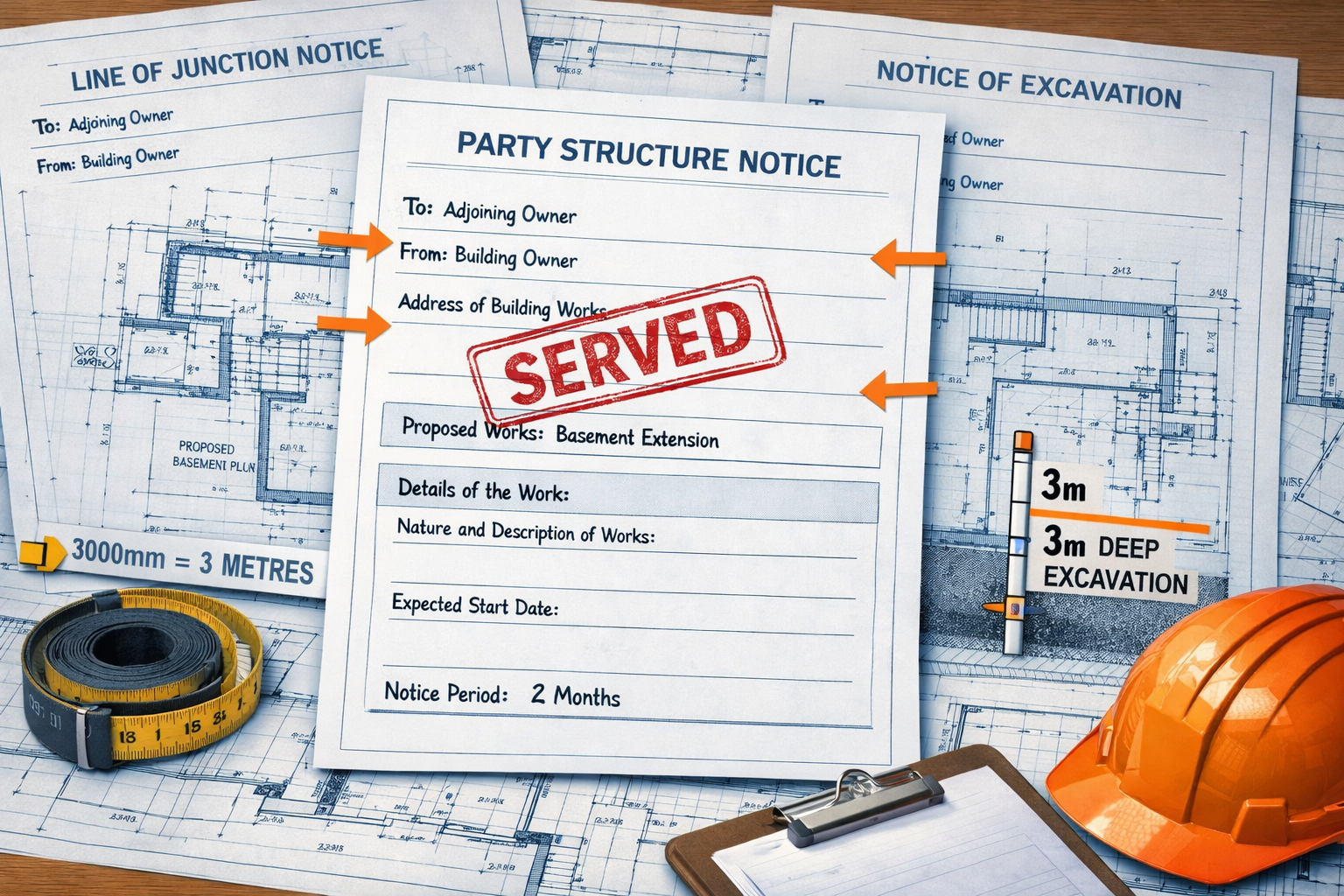
- Three main notice types apply to basement extensions: Party Structure Notice, Line of Junction Notice, and Notice of Adjacent Excavation, depending on excavation depth and proximity to boundaries
- The 3-meter and 6-meter rules determine when notices are required based on excavation depth relative to neighboring foundations
- Vibration monitoring conditions must be included in party wall awards for basement excavations to protect adjacent properties from structural damage
- Standard surveyor fees range from £750–£1,800 per neighbor, with the entire party wall process typically taking 2–4 months to complete
- Thermal compliance requirements now mandate U-values not exceeding 0.15 W/m²K for basement party wall work, verified through post-construction testing
Understanding Party Wall Notice Requirements for Basement Excavations
The Party Wall etc. Act 1996 establishes specific legal obligations when undertaking basement extensions that affect shared boundaries or involve excavation near neighboring properties. Unlike standard home improvements, basement work almost always triggers party wall requirements due to the depth of excavation and potential impact on adjacent foundations.
What Triggers Party Wall Notices for Basements?
Basement extensions typically engage the Party Wall Act through excavation provisions rather than direct work to party walls themselves. The Act distinguishes between different scenarios based on how deep you're digging and how close your excavation comes to neighboring properties.
The 3-Meter Rule applies when excavating within three meters of a neighbor's structure and digging deeper than their foundations. This is the most common scenario for basement extensions in terraced or semi-detached properties.
The 6-Meter Rule extends protection further, requiring notices when excavating within six meters of a neighbor's building if you're cutting a line at 45 degrees downward from the bottom of their foundations.
For comprehensive guidance on different notice types, review our detailed resource on party wall notices.
The Three Essential Notice Types
Understanding which notice to serve depends on your specific basement project configuration:
| Notice Type | When Required | Notice Period |
|---|---|---|
| Party Structure Notice | Work directly affecting existing party walls or structures | 2 months |
| Line of Junction Notice | Building new walls on boundary lines | 1 month |
| Notice of Adjacent Excavation | Excavating within 3m or 6m of neighboring foundations | 1 month |
Most basement extensions require a Notice of Adjacent Excavation as the primary document. However, if your basement involves underpinning or reinforcing an existing party wall, you'll also need a Party Structure Notice. Learn more about what a party structure notice entails and proper serving procedures.
Calculating Excavation Depths and Distances
Accurate measurement is crucial for compliance. Here's how to determine your notice requirements:
- Identify neighboring foundation depths: Request this information from neighbors or commission a trial pit investigation
- Measure horizontal distance: Calculate the distance from your proposed excavation to the nearest point of your neighbor's structure
- Apply the appropriate rule: Use the 3-meter rule if excavating within 3m, or the 6-meter rule for excavations between 3-6m away
- Document everything: Maintain detailed plans showing dimensions, depths, and calculations
💡 Pro Tip: Most Victorian and Edwardian London properties have foundation depths of approximately 1.0–1.5 meters. Modern properties typically have foundations 1.5–2.5 meters deep, depending on soil conditions.
Deep Excavation Protocols and Award Conditions for Vibration Monitoring
Basement extensions involve significant excavation work that can potentially destabilize neighboring properties through ground movement, vibration, and foundation disturbance. The 2026 regulatory framework emphasizes proactive monitoring and protection measures that must be formalized within party wall awards.
Mandatory Vibration Monitoring Requirements
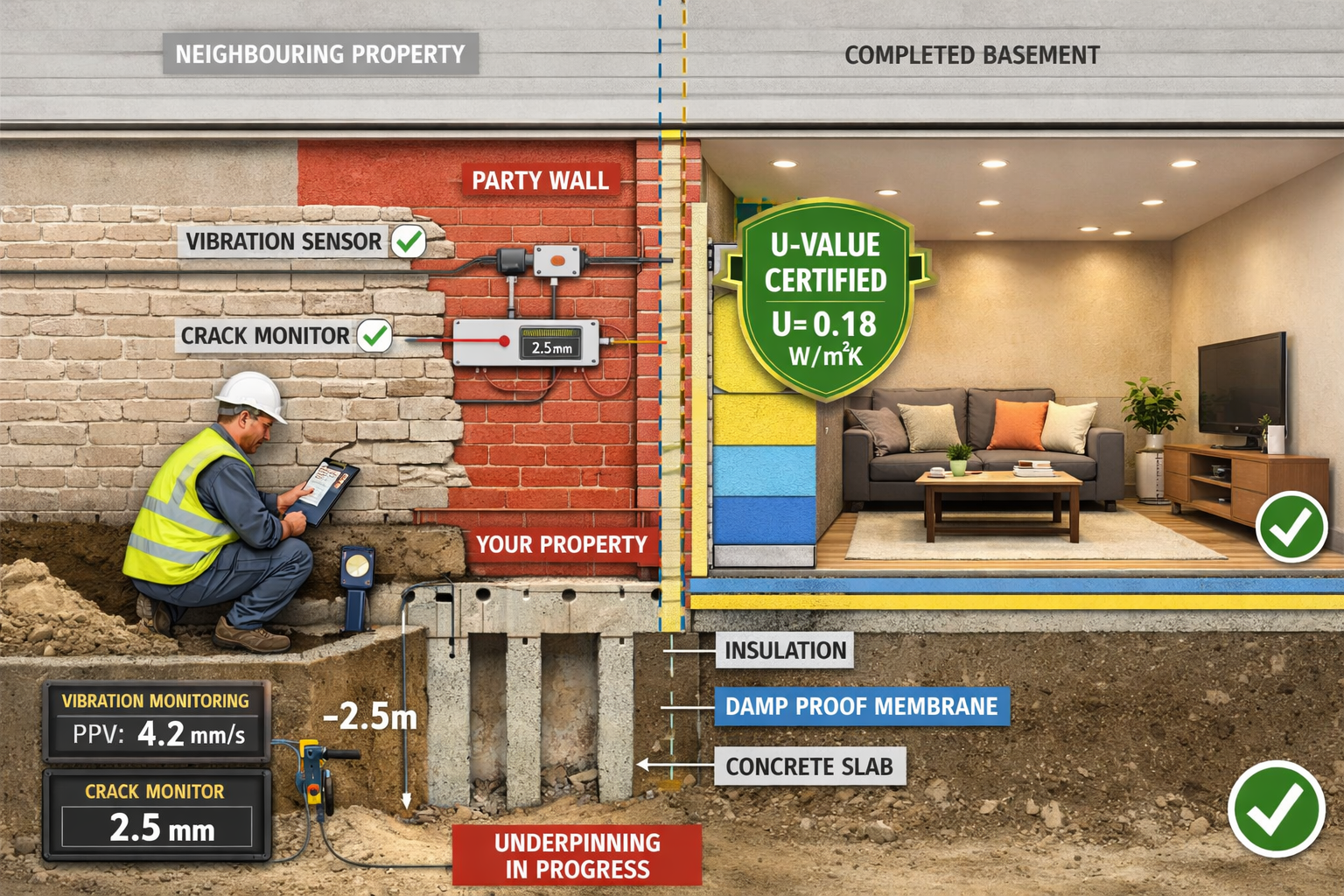
Party wall awards for basement excavations in 2026 routinely include specific conditions regarding vibration monitoring to protect adjacent properties. These requirements have become standard practice following several high-profile subsidence cases in London.
Key monitoring provisions include:
- Pre-construction baseline surveys: Detailed photographic and structural condition reports of neighboring properties before work commences
- Installation of monitoring equipment: Seismographs, crack monitors, and tilt sensors positioned at strategic points
- Threshold limits: Typically 5mm peak particle velocity (PPV) for residential structures, with work cessation triggers at 7mm PPV
- Regular reporting: Weekly monitoring reports submitted to appointed surveyors and neighboring owners
- Remedial action protocols: Predetermined procedures if monitoring indicates excessive movement
For detailed information on how these conditions are formalized, explore our guide on party wall awards.
Underpinning and Foundation Protection
When basement excavations extend below neighboring foundations, underpinning becomes necessary to maintain structural integrity. The party wall award must specify:
Technical specifications:
- Underpinning methodology (mass concrete, mini-piled, or beam and base)
- Excavation sequence and bay lengths (typically 1.0–1.5m sections)
- Concrete mix specifications and curing times
- Temporary support measures during excavation phases
Safety protocols:
- Maximum unsupported excavation depths
- Shoring and propping requirements
- Ground water management procedures
- Emergency response procedures for unexpected ground conditions
Thermal Performance Standards for Basement Party Walls
New for 2026, party wall work involving basement extensions must now meet enhanced thermal compliance requirements. Awards should specify that any new or altered party wall construction achieves thermal transmittance (U-value) not exceeding 0.15 W/m²K.
This requirement reflects updated building regulations focusing on energy efficiency and applies particularly to:
- New party walls constructed at the line of junction
- Existing party walls where insulation is added or modified
- Tanking systems that incorporate thermal barriers
Verification requirements:
- Post-construction thermal imaging surveys
- Certification from qualified building control inspectors
- Documentation of insulation materials and installation methods
Understanding the full scope of types of party wall works helps ensure all necessary conditions are included in your award.
Cost Implications and Fee Structures
The party wall process for basement extensions involves several cost components that building owners should budget for:
Surveyor fees (2026 rates):
- Building owner's surveyor: £1,200–£2,500 for basement projects
- Adjoining owner's surveyor: £750–£1,800 per neighbor
- Agreed surveyor (if appointed): £1,500–£3,000 total
Additional costs:
- Schedule of condition surveys: £300–£600 per property
- Monitoring equipment installation: £800–£1,500
- Ongoing monitoring services: £150–£300 per month during construction
For strategies to minimize expenses, consult our advice on how to keep party wall costs down.
"The party wall process for basement extensions typically adds 2–4 months to project timelines and £3,000–£8,000 to overall costs when multiple neighbors are involved. However, this investment prevents far more expensive disputes and legal challenges later."
Office-to-Residential Conversions and Basement Extension Synergies
The 2026 permitted development landscape has created unique opportunities where office-to-residential conversions intersect with basement extension projects, particularly in urban areas experiencing commercial property repurposing.
Permitted Development Rights for Basement Extensions
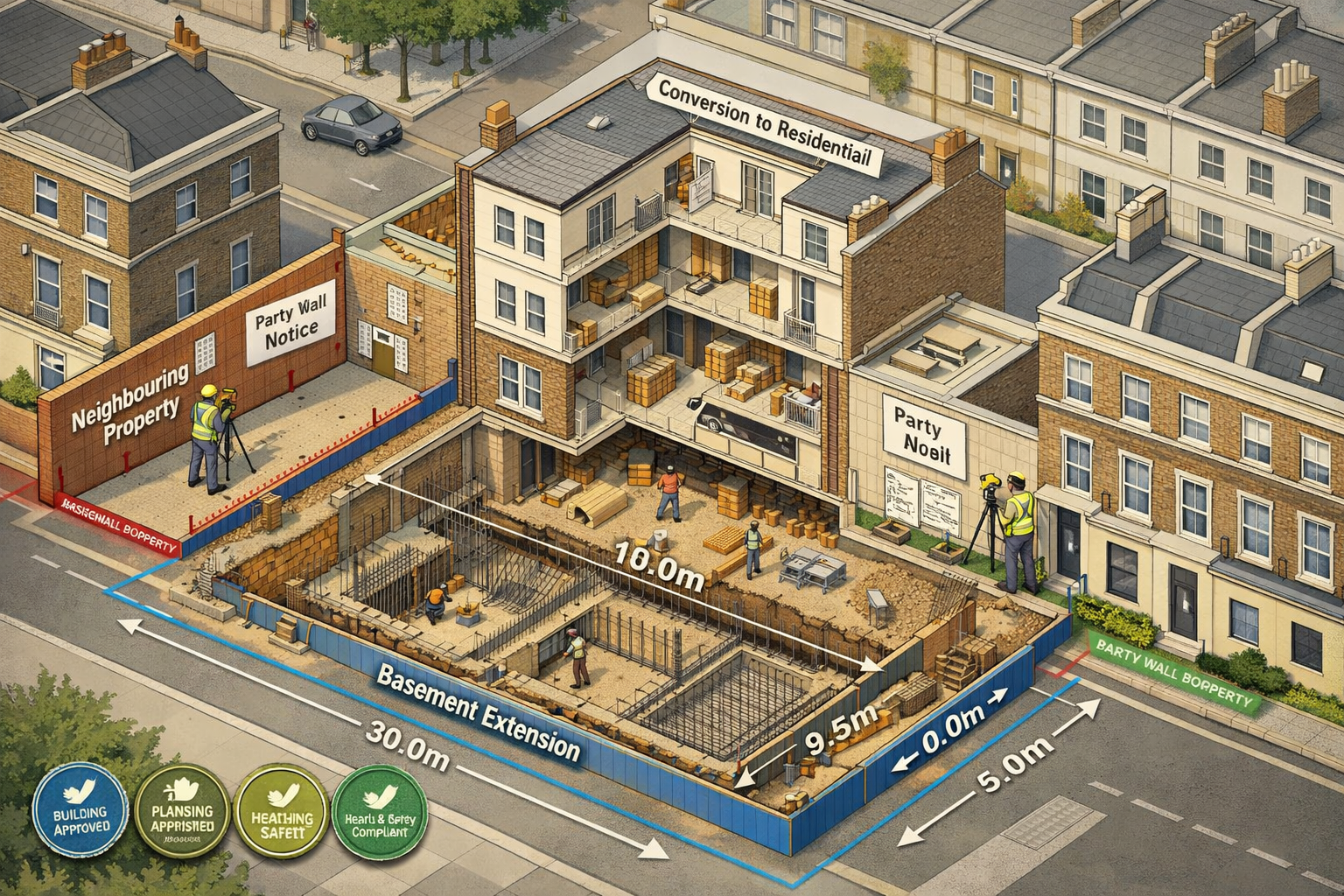
Understanding current permitted development rules is essential for planning basement projects efficiently. As of 2026, basement extensions generally do not benefit from permitted development rights and require full planning permission in most London boroughs.
Key planning considerations:
- Volume limits: Many boroughs restrict basement extensions to 50% of garden area or impose absolute volume caps
- Depth restrictions: Typical maximum depths of 3.0–3.5 meters below ground level
- Light well requirements: Minimum distances from boundaries for excavated light wells
- Flood risk assessments: Mandatory for properties in flood zones
However, the party wall process remains completely separate from planning permission. You must comply with the Party Wall Act regardless of whether planning permission is required or granted.
Office-to-Residential Conversion Scenarios
Recent permitted development expansions for office-to-residential conversions (Class MA) have created situations where basement work becomes part of larger conversion projects. These scenarios present unique party wall challenges:
Shared commercial buildings:
When converting office space to residential in multi-occupancy buildings, basement areas often require reconfiguration. This may involve:
- Creating separate residential storage areas in shared basements
- Installing new party walls to divide previously open basement spaces
- Modifying existing party structures for fire separation requirements
- Excavating additional basement depth for ceiling height compliance
Adjacent property considerations:
Office buildings being converted to residential often share party walls with existing residential properties, creating mixed-use scenarios where:
- Different construction standards apply to each side of the party wall
- Sound insulation requirements become more stringent
- Vibration tolerance levels differ significantly
- Notice timing must account for both commercial and residential occupancy patterns
For location-specific expertise in navigating these complex scenarios, consider consulting specialists such as a party wall surveyor in Central London or party wall surveyor in East London, depending on your project location.
Coordinating Multiple Regulatory Frameworks
Basement extensions within conversion projects must navigate overlapping regulatory requirements:
Building Regulations compliance:
- Structural stability calculations for increased loading
- Fire resistance standards for party walls (typically 60 minutes for residential)
- Ventilation and moisture control in below-ground spaces
- Means of escape considerations for basement habitable rooms
Party Wall Act compliance:
- Serving notices to all affected neighbors (both commercial and residential)
- Coordinating construction schedules with occupied adjacent properties
- Managing access requirements for condition surveys
- Addressing concerns from diverse stakeholder groups
Planning policy compliance:
- Demonstrating compliance with local basement SPDs (Supplementary Planning Documents)
- Providing structural method statements
- Submitting flood risk and drainage impact assessments
- Addressing heritage considerations in conservation areas
Timeline Coordination Strategies
Successful basement extension projects within conversion scenarios require careful timeline management:
Optimal sequencing:
- Months 1-2: Secure planning permission for conversion and basement extension
- Months 2-3: Serve party wall notices (running concurrently with planning)
- Months 3-5: Complete party wall agreement and award process
- Month 6: Commence construction with all approvals in place
Common pitfalls to avoid:
- ❌ Starting party wall process before planning permission is secured (may require re-serving if plans change)
- ❌ Assuming commercial neighbors won't engage with the party wall process
- ❌ Underestimating the time required for multiple-party negotiations
- ❌ Failing to coordinate building control approvals with party wall requirements
For comprehensive understanding of the party wall framework, review the Party Wall etc. Act 1996 provisions.
Dispute Resolution in Complex Projects
Basement extensions involving conversions or multiple parties face higher dispute risks. Understanding resolution mechanisms is crucial:
Common dispute triggers:
- Disagreement over excavation methodology
- Concerns about vibration impact on commercial equipment
- Disputes over working hours and access
- Cost allocation disagreements for shared monitoring
Resolution pathways:
- Appointment of agreed surveyor to mediate
- Third surveyor determination for unresolved surveyor disagreements
- County court proceedings as last resort (rare, expensive, time-consuming)
To understand your rights and responsibilities in these situations, review guidance on how to respond to party wall act notices.
Practical Steps for Serving Essential Party Wall Notices
Successfully navigating the party wall process for basement extensions requires methodical preparation and clear communication. Follow these practical steps to ensure compliance:
Step 1: Prepare Comprehensive Documentation
Before serving any notices, compile complete project documentation:
Required documents:
- Detailed architectural plans showing excavation depths and dimensions
- Structural engineer's calculations and methodology statements
- Cross-section drawings clearly indicating neighboring foundations
- Site location plan with property boundaries marked
- Specification of proposed underpinning or support works
Best practices:
- Use professional architectural drawings (hand-drawn sketches are insufficient)
- Include multiple cross-sections showing relationship to adjacent properties
- Clearly label all party walls, boundaries, and excavation zones
- Provide scale bars and dimension annotations
Step 2: Identify All Affected Neighbors
Basement excavations may affect more properties than initially apparent:
Properties requiring notices:
- Immediate adjoining properties sharing party walls
- Properties within 3 meters of excavation if digging deeper than their foundations
- Properties within 6 meters if the 45-degree rule applies
- Properties behind or diagonal to yours if excavation extends near their boundaries
Verification methods:
- Review Land Registry title plans
- Conduct site measurements
- Consult with your architect or surveyor
- Consider commissioning a boundary survey for complex layouts
Step 3: Serve Notices with Proper Timing
Timing is critical for legal compliance and project scheduling:
Notice periods:
- 2 months for Party Structure Notices (work to existing party structures)
- 1 month for Line of Junction Notices and Notices of Adjacent Excavation
Service methods:
- Hand delivery with signed acknowledgment (most reliable)
- Recorded delivery postal service (maintain proof of postage)
- Service to the property if owner cannot be located (with additional legal steps)
Critical timing considerations:
- Notices cannot be served before planning permission is secured (though this is advisable)
- The notice period doesn't begin until the notice is actually received
- Building owners should serve notices simultaneously to all affected neighbors
Step 4: Respond to Neighbor Reactions
Neighbors have three possible responses to party wall notices:
1. Consent (Rare but ideal):
If neighbors provide written consent, no award is necessary for that neighbor. However, it's still advisable to complete schedules of condition.
2. Dissent or no response:
If neighbors dissent or don't respond within 14 days, a "dispute" is deemed to exist, triggering the surveyor appointment process.
3. Counter-proposals:
Neighbors may consent with conditions. These must be negotiated and formalized in the award.
Managing neighbor concerns:
- Provide clear explanations of proposed work in plain language
- Offer to arrange pre-construction meetings with your surveyor present
- Address concerns about noise, disruption, and property protection proactively
- Emphasize the protective benefits of the party wall process for their property
For guidance on navigating these situations, see information on responding to party wall notices.
Step 5: Appoint Surveyors Appropriately
The surveyor appointment process determines how smoothly the party wall process proceeds:
Three appointment scenarios:
Option 1: Agreed Surveyor (Most cost-effective)
- Single surveyor acts for both parties
- Requires neighbor's agreement
- Reduces costs but neighbor may prefer independent representation
- Total fees: £1,500–£3,000
Option 2: Two Surveyors (Most common)
- Each party appoints their own surveyor
- Surveyors work together to prepare the award
- Building owner pays both surveyors' fees
- Total fees: £2,000–£4,500
Option 3: Third Surveyor (Dispute resolution)
- Appointed when the two surveyors cannot agree
- Makes binding determinations on disputed matters
- Additional fees: £1,000–£2,500
Surveyor selection criteria:
- RICS qualification and party wall specialization
- Local experience with basement projects
- Availability to meet project timelines
- Clear fee structures and terms of engagement
Step 6: Complete Schedules of Condition
Schedules of condition provide essential protection for both parties:
What's included:
- Comprehensive photographic survey of neighboring properties
- Written descriptions of existing defects, cracks, and conditions
- Measurements of existing cracks and movement
- External and internal coverage of affected areas
Why they're essential:
- Establishes baseline condition before work commences
- Protects building owners from false damage claims
- Protects neighbors by documenting pre-existing conditions
- Provides evidence for resolving post-construction disputes
Learn more about schedule of condition requirements and best practices.
Step 7: Finalize the Party Wall Award
The award is the legal document that authorizes your work and sets conditions:
Award contents:
- Description of authorized works
- Working hours and access provisions
- Vibration monitoring requirements
- Protection measures for neighboring properties
- Dispute resolution procedures
- Fee allocation and payment terms
Timeline expectations:
- Award preparation: 2–4 weeks after surveyor appointments
- Review and negotiation: 1–2 weeks
- Finalization and service: 1 week
- 14-day appeal period before work can commence
For detailed information about award contents and templates, review our party wall contract template guide.
Conclusion: Securing Successful Basement Extensions Through Proper Notice Compliance
The Essential Party Wall Notices for Basement Extensions Under 2026 Permitted Development Rules represent a critical legal framework that protects both building owners and their neighbors during complex excavation projects. With basement extension costs reaching £155,000–£310,000 for typical 20m² projects in London, ensuring proper party wall compliance from the outset protects these substantial investments from costly delays, disputes, and legal challenges.
Understanding which notice types apply to your specific project—whether Party Structure Notices for underpinning work, Line of Junction Notices for new boundary walls, or Notices of Adjacent Excavation for deep excavations—ensures you meet your legal obligations under the Party Wall etc. Act 1996. The 3-meter and 6-meter rules provide clear guidance on when notices are required, while vibration monitoring conditions and thermal compliance requirements protect all parties involved.
Your Next Steps 🎯
Immediate actions:
- Commission professional drawings showing excavation depths, neighboring foundations, and boundary relationships
- Calculate your notice requirements using the 3-meter and 6-meter rules with accurate measurements
- Identify all affected neighbors including properties that may not be immediately obvious
- Budget appropriately for surveyor fees (£2,000–£4,500 typically) and monitoring costs
- Serve notices with proper timing allowing 1-2 months for the process before your planned construction start date
Professional support:
Engaging qualified party wall surveyors early in your planning process ensures compliance, minimizes disputes, and protects your investment. Whether your project is in North London, South London, West London, or any other area, specialist surveyors provide invaluable expertise in navigating the complex intersection of party wall requirements, planning regulations, and building control standards.
The party wall process may seem daunting, but it provides essential protection for everyone involved in basement extension projects. By understanding the Essential Party Wall Notices for Basement Extensions Under 2026 Permitted Development Rules and following proper procedures, you can proceed with confidence, maintain positive neighbor relations, and create valuable additional living space that enhances your property for years to come.
Remember: the party wall process typically adds 2–4 months to project timelines and £3,000–£8,000 to overall costs, but this investment prevents far more expensive disputes, construction delays, and potential legal action. Start early, communicate clearly, and engage qualified professionals to ensure your basement extension project succeeds from foundation to completion.