

The healthcare industry is experiencing unprecedented growth in 2026, with non-hospital medical facilities projected to expand by 24% across urban centers. As clinics, diagnostic laboratories, and outpatient centers rush to establish themselves in densely populated areas, developers face a critical legal challenge: navigating Healthcare Construction Surge: Party Wall Agreements for Clinics and Labs in Densely Populated 2026 Sites. This surge in medical facility construction is transforming city skylines and creating complex scenarios where new healthcare buildings must share walls, foundations, and boundaries with existing structures.
The convergence of healthcare demand and limited urban space has made party wall agreements more than just a legal formality—they're now essential tools for protecting both building owners and their neighbors during construction. Whether converting a retail space into a medical clinic or constructing a state-of-the-art diagnostic laboratory between two existing buildings, understanding party wall procedures can mean the difference between a smooth project launch and costly legal disputes.
Key Takeaways
- 🏥 Non-hospital healthcare facilities are experiencing 24% net growth in 2026, driving increased demand for party wall agreements in urban retrofit and new construction projects
- ⚖️ Party wall agreements protect both building owners and neighbors by establishing clear rights, responsibilities, and procedures before construction begins on shared walls or boundaries
- 📋 Proper notice timelines are critical: building owners must serve party wall notices 14-28 days before work begins, depending on the type of construction planned
- 🤝 Building owners can choose between informal agreements or formal party wall awards, with awards providing stronger legal protection and dispute resolution mechanisms
- 💰 Understanding cost allocation, surveyor selection, and dispute resolution processes helps healthcare developers avoid delays and budget overruns in densely populated construction sites
Understanding the Healthcare Construction Boom in 2026
The 24% Growth Phenomenon
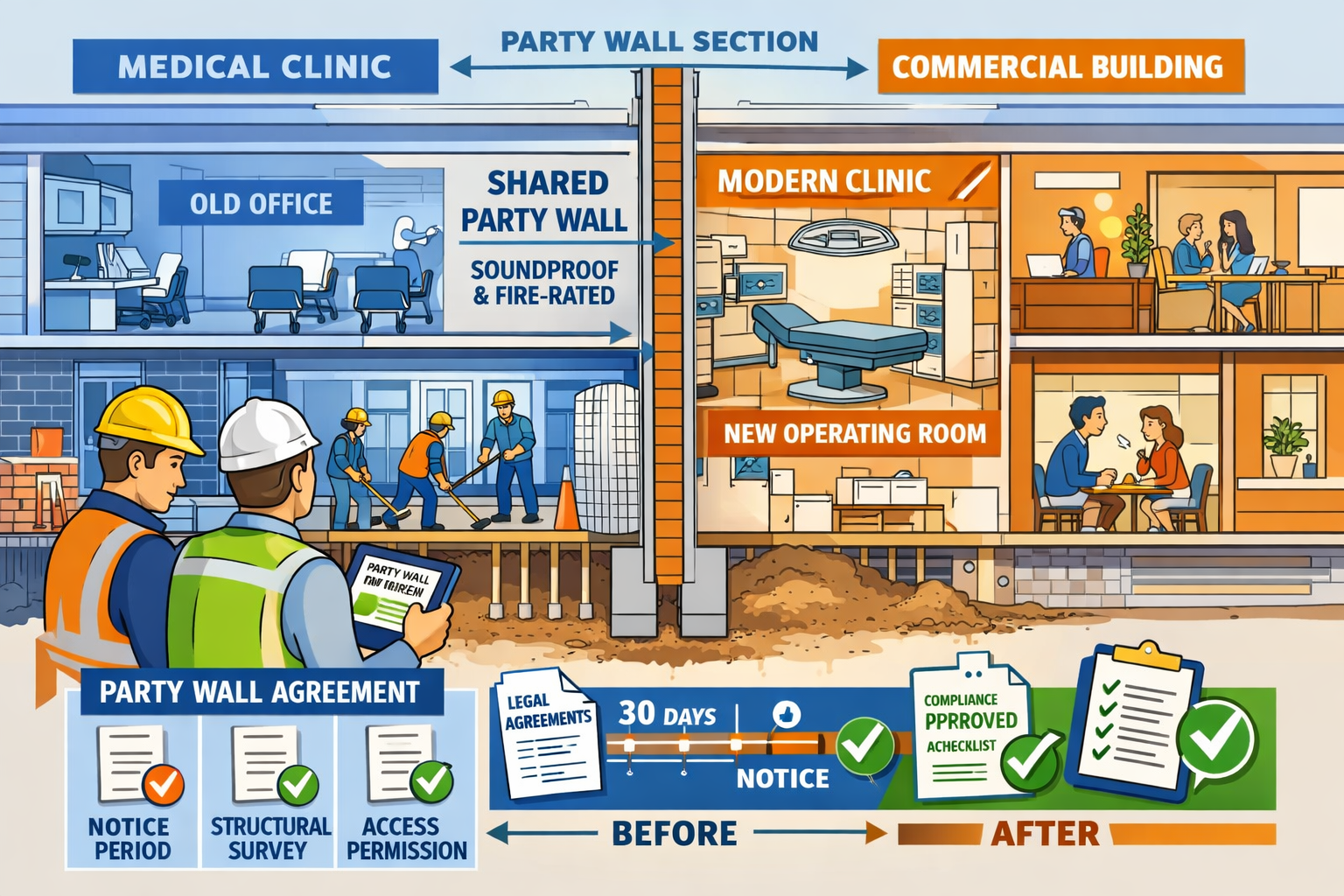
The healthcare construction sector has entered an extraordinary growth phase in 2026. Non-hospital facilities—including urgent care clinics, diagnostic imaging centers, medical laboratories, and specialty outpatient centers—are expanding at an unprecedented rate. This 24% net growth reflects several converging trends:
Demographic shifts toward aging populations requiring more accessible healthcare services have created demand for neighborhood-based medical facilities. Technological advances in diagnostic equipment now allow sophisticated testing to occur outside traditional hospital settings. Healthcare delivery models increasingly emphasize convenience and cost-effectiveness, pushing services into retail spaces and mixed-use developments.
Post-pandemic healthcare restructuring has accelerated the decentralization of medical services. Patients and providers alike now prefer smaller, specialized facilities located in residential and commercial districts rather than centralized hospital campuses.
Why Urban Retrofits Dominate
Healthcare developers in 2026 face a fundamental challenge: prime urban locations with adequate space are scarce. This scarcity has driven a massive wave of retrofit construction, where existing commercial buildings are converted into medical facilities. Former retail stores, office buildings, and even industrial spaces are being transformed into modern clinics and laboratories.
These retrofit projects almost always involve work on or near party walls—the shared structural elements between adjacent properties. Unlike greenfield suburban developments where buildings stand isolated, urban healthcare construction inherently requires coordination with neighboring property owners.
The density of 2026 urban environments means that:
- 🏢 Most available properties share at least one wall with an adjacent building
- 🔨 Foundation work often affects neighboring structures
- 📏 Excavation for medical equipment installations may extend beyond property boundaries
- 🚧 Construction activities create vibration, noise, and temporary structural stress affecting neighbors
Party Wall Agreements: Essential Framework for Healthcare Construction Surge
What Are Party Walls in Healthcare Construction Contexts?
A party wall is any wall, structure, or boundary that stands on the land of two or more owners and forms part of a building. In healthcare construction, party walls take several forms:
Type 1: Shared Structural Walls – The most common scenario involves a wall that separates two buildings but belongs to both properties. When converting a ground-floor retail space into a medical clinic, the walls separating the new clinic from adjacent businesses are typically party walls.
Type 2: Boundary Walls – Walls built entirely on one owner's land but used by both properties. These often appear in older urban developments where property lines run through building structures. Understanding the difference between party fence walls and boundary walls is crucial for healthcare developers.
Type 3: Party Structures – Floors, ceilings, and other structural elements shared between properties. When constructing a second-floor medical laboratory above existing commercial space, the floor/ceiling assembly becomes a party structure requiring agreement.
Why Healthcare Construction Surge Intensifies Party Wall Needs
Medical facilities present unique party wall challenges compared to standard commercial construction:
Vibration-Sensitive Equipment 🔬 – Diagnostic laboratories house precision instruments that cannot tolerate vibration from neighboring activities. Party wall agreements must address vibration control during and after construction.
Infection Control Requirements 🦠 – Healthcare facilities require sealed, cleanable surfaces and controlled air exchanges. Modifications to party walls must maintain infection control standards while respecting neighbors' rights.
Heavy Equipment Loads ⚖️ – MRI machines, CT scanners, and other medical equipment create extraordinary floor loads. When installing such equipment in retrofit buildings, party structures may require reinforcement affecting adjacent properties.
24/7 Operations ⏰ – Unlike typical retail or office spaces, many medical facilities operate around the clock. Party wall agreements should address noise transmission and access requirements for continuous operations.
Regulatory Compliance 📋 – Healthcare construction must satisfy building codes, health department regulations, and medical facility standards simultaneously. Party wall work must accommodate these overlapping requirements.
Legal Framework: Party Wall Agreements for Clinics and Labs in Densely Populated 2026 Sites
The Party Wall Etc. Act 1996 and Healthcare Construction
In England and Wales, the Party Wall etc. Act 1996 provides the legal framework governing construction work on party walls, boundary walls, and excavations near neighboring buildings. This legislation becomes particularly relevant during the Healthcare Construction Surge: Party Wall Agreements for Clinics and Labs in Densely Populated 2026 Sites.
The Act covers three main categories of work common in healthcare construction:
Section 1: New Party Walls – When building a new medical facility that will share a wall with an existing structure, or when building directly on a boundary line.
Section 2: Work to Existing Party Walls – The most common scenario in healthcare retrofits. This includes:
- Cutting into party walls to install new doorways or service penetrations
- Raising party walls to accommodate new HVAC systems
- Underpinning party walls to support heavy medical equipment
- Demolishing and rebuilding party walls to meet modern standards
- Installing damp-proof courses or insulation in party walls
Section 6: Excavation and Construction Near Boundaries – Critical for healthcare projects involving:
- Basement excavations for equipment rooms or storage
- Foundation work for equipment pads
- Underground utility installations serving medical facilities
Notice Requirements and Timelines
Building owners (those planning healthcare construction) must serve formal notices to adjoining owners (neighboring property owners) before beginning work. The party wall notice requirements establish specific timelines:
| Notice Type | Work Covered | Minimum Notice Period | Response Deadline |
|---|---|---|---|
| Party Structure Notice | Work to existing party walls | 2 months | 14 days |
| Line of Junction Notice | New walls on boundary lines | 1 month | 14 days |
| Notice of Adjacent Excavation | Excavation within 3-6 meters of neighbor | 1 month | 14 days |
Critical Timeline Considerations for Healthcare Projects:
Healthcare developers often work under tight deadlines to meet market demands or lease commitments. However, party wall procedures cannot be rushed. A typical timeline includes:
- Initial Survey and Planning (2-4 weeks) – Identify all party walls and adjoining owners
- Notice Preparation and Service (1 week) – Prepare detailed notices with construction specifications
- Neighbor Response Period (14 days minimum) – Adjoining owners review and respond
- Agreement or Award Process (2-8 weeks) – Negotiate agreements or appoint surveyors
- Pre-Construction Survey (1-2 weeks) – Document existing conditions
- Construction Commencement – Work can begin only after completing all procedures
For a healthcare project with multiple adjoining owners, the entire process typically requires 3-4 months minimum. Developers should factor this timeline into project schedules from the earliest planning stages.
Serving Party Wall Notices for Medical Facilities
Proper notice service is the foundation of successful party wall procedures. For healthcare construction projects, notices must include:
Essential Information:
- ✅ Building owner's name and contact details
- ✅ Adjoining owner's name and property address
- ✅ Detailed description of proposed works
- ✅ Date work will commence (must be after notice period expires)
- ✅ Technical drawings showing party wall involvement
- ✅ Specifications for structural alterations
Healthcare-Specific Details:
- Medical equipment locations and weights
- Vibration control measures
- Noise mitigation during construction
- Hours of construction activity
- Access requirements during and after construction
Understanding what is a party structure notice and how to serve it becomes particularly important for healthcare developers working in areas like Central London, North London, or other densely populated zones.
Agreement vs. Award: Critical Decision Points in Healthcare Construction Surge
The Informal Agreement Route
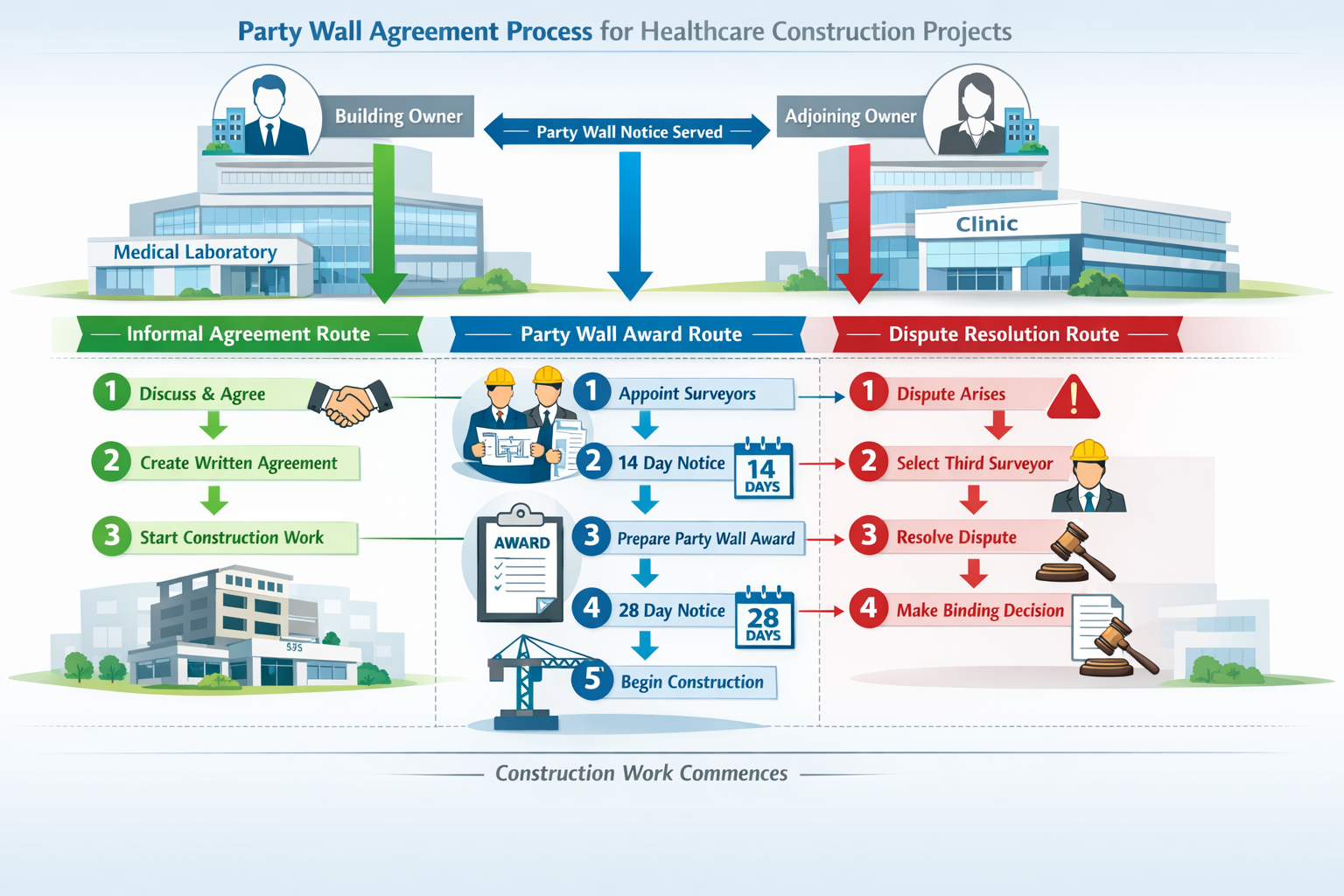
When adjoining owners consent to proposed healthcare construction work, building owners face a choice: proceed with an informal agreement or formalize the arrangement through a party wall award.
Informal agreements offer several advantages:
💰 Lower Initial Costs – No surveyor fees or formal documentation expenses
⚡ Faster Process – Work can commence immediately after agreement without surveyor appointments
🤝 Simpler Relationships – Maintains friendly neighbor relations through direct communication
However, informal agreements carry significant risks for healthcare construction projects:
⚠️ No Dispute Resolution Mechanism – If damage occurs or disputes arise, parties must resort to expensive litigation
⚠️ Unclear Rights and Obligations – Without formal documentation, responsibilities become ambiguous
⚠️ Future Complications – When properties change hands, new owners may dispute informal arrangements
⚠️ Insurance Complications – Construction insurance may not cover work performed under informal agreements
For healthcare developers investing hundreds of thousands or millions in facility construction, informal agreements rarely provide adequate protection. The benefits of having a party wall agreement with a surveyor far outweigh the modest cost savings.
The Party Wall Award Process
A party wall award is a formal legal document prepared by qualified surveyors that establishes rights, obligations, and procedures for party wall work. For healthcare construction projects, awards provide essential protections:
The Award Process:
Step 1: Surveyor Appointment – When an adjoining owner dissents (or fails to respond within 14 days), the party wall award process begins. Each party appoints a surveyor, or both parties agree to use a single "agreed surveyor."
Step 2: Initial Inspection – Surveyors inspect the party wall and adjacent properties, documenting existing conditions through photographs and detailed notes called a schedule of condition.
Step 3: Award Preparation – Surveyors draft the party wall award, which typically includes:
- Detailed description of permitted works
- Construction methods and specifications
- Working hours and access arrangements
- Protective measures required
- Cost allocation between parties
- Dispute resolution procedures
- Compensation provisions for damage
Step 4: Award Service – The completed award is served on both parties, who have 14 days to appeal to the county court.
Step 5: Construction Oversight – Surveyors monitor construction to ensure compliance with award terms.
Understanding Party Wall Awards for Healthcare Projects
For medical facility construction, party wall awards should address healthcare-specific considerations:
Equipment Installation Protocols 🏗️
- Maximum vibration levels during installation
- Structural reinforcement requirements
- Floor load distribution methods
- Equipment access routes through party structures
Operational Requirements 🔧
- Ongoing vibration limits from medical equipment
- Noise transmission standards
- Emergency access provisions
- Utility service routing through party walls
Infection Control Measures 🧼
- Dust containment during construction
- Wall sealing specifications
- Air barrier continuity
- Cleanable surface requirements
Long-Term Maintenance 🔨
- Responsibility for party wall repairs
- Access for future maintenance
- Modification approval processes
- Cost-sharing formulas
Healthcare developers can review sample party wall agreement templates to understand typical award structures, though medical facility projects often require customized provisions.
Surveyor Selection and Roles in Healthcare Construction Projects
Choosing the Right Party Wall Surveyor
The success of party wall procedures during the Healthcare Construction Surge: Party Wall Agreements for Clinics and Labs in Densely Populated 2026 Sites depends heavily on surveyor expertise. Healthcare construction requires surveyors with specialized knowledge:
Essential Qualifications:
- 📜 RICS (Royal Institution of Chartered Surveyors) membership
- 🏥 Experience with medical facility construction
- 🏗️ Understanding of healthcare building regulations
- ⚖️ Knowledge of medical equipment structural requirements
- 🤝 Strong negotiation and communication skills
Building Owner's Surveyor Responsibilities
The building owner's surveyor represents the healthcare developer's interests while maintaining professional impartiality. Key responsibilities include:
- Preparing detailed work specifications
- Coordinating with construction teams and architects
- Documenting pre-construction conditions
- Ensuring construction complies with award terms
- Addressing neighbor concerns promptly
- Managing cost allocation and payment procedures
Adjoining Owner's Surveyor Responsibilities
The adjoining owner's surveyor protects neighboring property owners' interests. Their duties include:
- Reviewing proposed work for potential impacts
- Negotiating protective measures and safeguards
- Monitoring construction for compliance
- Documenting any damage or deviations
- Ensuring fair compensation for impacts
- Representing adjoining owner's concerns
The Agreed Surveyor Option
When relationships are cooperative, parties may appoint a single agreed surveyor to act impartially for both sides. This approach offers:
- ✅ Lower overall costs (one surveyor fee instead of two)
- ✅ Simplified communication and coordination
- ✅ Faster award preparation
- ✅ Reduced administrative complexity
However, agreed surveyors must maintain strict impartiality, which can be challenging when healthcare construction involves complex technical issues or significant cost implications.
Cost Considerations and Fee Structures
Understanding party wall costs helps healthcare developers budget accurately. Typical expenses include:
Surveyor Fees:
- Building owner's surveyor: £800-£2,500 per award
- Adjoining owner's surveyor: £600-£2,000 per award
- Agreed surveyor: £1,200-£3,500 per award
- Complex healthcare projects: £3,000-£10,000+ total
Additional Costs:
- Schedule of condition photography: £300-£800
- Structural engineering consultations: £500-£2,000
- Specialist testing (vibration, noise): £400-£1,500
- Post-construction inspections: £300-£1,000
Important: Under the Party Wall Act, building owners typically pay all reasonable surveyor fees for both their own surveyor and the adjoining owner's surveyor. This cost allocation reflects the principle that those benefiting from construction should bear procedural costs.
Healthcare developers can learn how to keep party wall costs down through:
- Early engagement with neighbors
- Clear, detailed initial notices
- Proactive communication throughout the process
- Selecting experienced surveyors who work efficiently
- Addressing concerns before they escalate to disputes
Common Party Wall Issues in Healthcare Construction Surge: Clinics and Labs
Structural Concerns and Foundation Work
Healthcare facilities often require substantial structural modifications that impact party walls:
Heavy Equipment Foundations ⚖️
Medical imaging equipment like MRI machines and CT scanners can weigh 5-15 tons. Installing such equipment in retrofit buildings frequently requires:
- Foundation reinforcement extending below existing party walls
- Load transfer systems that may affect neighboring structures
- Vibration isolation requiring specialized foundation designs
- Floor strengthening involving party structure modifications
When foundation work extends within 3 meters of a neighboring building and goes deeper than that building's foundations, or within 6 meters and cuts a 45-degree plane from the neighbor's foundation base, party wall procedures become mandatory.
Underpinning Requirements 🏗️
Older urban buildings often have shallow foundations inadequate for modern medical facility loads. Underpinning—the process of strengthening and deepening foundations—commonly affects party walls. Healthcare construction underpinning must address:
- Temporary support of party walls during excavation
- Neighbor building stability during foundation work
- Vibration control to protect sensitive adjacent uses
- Access requirements for construction equipment
- Restoration of party wall integrity after foundation completion
Understanding the types of party wall works helps developers anticipate which procedures their healthcare project will require.
Noise, Vibration, and Disruption Management
Medical facility construction creates significant temporary disruption that party wall agreements must address:
Construction Phase Impacts:
🔨 Noise Levels – Demolition, concrete cutting, and equipment installation generate substantial noise affecting neighbors. Party wall awards should specify:
- Permitted construction hours
- Maximum noise levels at party walls
- Advance notice requirements for particularly disruptive work
- Compensation for business interruption if applicable
📳 Vibration Concerns – Pile driving, concrete breaking, and heavy equipment operation create vibration that can:
- Damage neighboring structures
- Disrupt vibration-sensitive businesses
- Cause cosmetic cracking in adjacent buildings
- Affect resident comfort and safety
Party wall awards should establish vibration monitoring protocols, maximum permissible levels, and remediation procedures if limits are exceeded.
Operational Phase Considerations:
Once the medical facility opens, ongoing operations may affect neighbors:
- HVAC systems running 24/7 creating noise transmission through party walls
- Emergency generator testing producing periodic loud noise
- Patient and staff traffic creating parking and access pressures
- Waste management (including medical waste) requiring special handling
Forward-thinking party wall awards address these long-term operational impacts, not just construction-phase concerns.
Access and Right of Entry Issues
Healthcare construction often requires temporary access to neighboring properties:
Why Access Becomes Necessary:
- 🚧 Scaffolding installation on narrow sites
- 🔧 Party wall repairs requiring access from both sides
- 📸 Condition surveys documenting pre-construction state
- 🔍 Construction monitoring and inspection
- 🛠️ Emergency repairs if unexpected issues arise
The Party Wall Act grants building owners right of entry to adjoining properties for party wall purposes, but this right comes with important limitations:
- 14 days' written notice must be provided (except emergencies)
- Access must occur at reasonable times (typically business hours)
- Minimal disruption to adjoining owner's use
- Compensation for any damage or significant inconvenience
For healthcare construction in densely populated areas like East London, West London, or South London, access coordination becomes particularly complex when multiple adjoining owners are involved.
Dispute Resolution During Healthcare Construction Surge
Common Sources of Party Wall Disputes
Despite best intentions, party wall disputes frequently arise during healthcare construction:
Pre-Construction Disputes:
❌ Notice Deficiencies – Incomplete or technically inadequate notices triggering adjoining owner concerns
❌ Work Scope Disagreements – Neighbors questioning whether proposed work is necessary or appropriate
❌ Surveyor Selection Conflicts – Disagreements over surveyor qualifications or independence
❌ Timeline Pressures – Building owners rushing procedures to meet project deadlines
Construction Phase Disputes:
❌ Damage Claims – Allegations that construction caused cracking, settlement, or other damage
❌ Award Non-Compliance – Construction methods deviating from agreed specifications
❌ Access Conflicts – Disputes over entry timing, frequency, or intrusiveness
❌ Noise and Disruption – Complaints about construction impacts exceeding agreed limits
Post-Construction Disputes:
❌ Incomplete Repairs – Disagreements over whether damage has been adequately remedied
❌ Cost Allocation – Conflicts over who pays for various aspects of party wall work
❌ Long-Term Impacts – Concerns about ongoing operational effects from the medical facility
The Third Surveyor and Dispute Resolution Process
When the building owner's surveyor and adjoining owner's surveyor cannot agree, the Party Wall Act provides a structured dispute resolution mechanism:
The Third Surveyor Appointment
If surveyors disagree on any matter, either surveyor may refer the dispute to a third surveyor—an independent expert who acts as arbitrator. The third surveyor:
- Reviews submissions from both appointed surveyors
- Inspects the properties and party wall work
- Makes binding determinations on disputed matters
- Issues decisions that have the same force as a party wall award
Third Surveyor Selection:
Ideally, the two appointed surveyors agree on a third surveyor before disputes arise. This agreement should be documented in the initial party wall award. If surveyors cannot agree on a third surveyor when a dispute occurs, either party may apply to the local authority to appoint one.
Dispute Resolution Timeline:
- Dispute Identification (immediate) – Surveyors recognize they cannot agree
- Third Surveyor Referral (within 10 days) – Either surveyor initiates the process
- Third Surveyor Appointment (1-4 weeks) – Selection by agreement or authority appointment
- Submissions and Evidence (2-4 weeks) – Both surveyors present their positions
- Third Surveyor Decision (2-6 weeks) – Determination issued
- Implementation (immediate) – Decision becomes binding
Cost Implications:
Third surveyor fees typically range from £1,500-£5,000 depending on dispute complexity. These costs are usually shared between the parties or allocated based on the third surveyor's determination of fault.
Appeals and Court Proceedings
Party wall awards and third surveyor decisions are legally binding, but parties retain limited appeal rights:
County Court Appeals:
Either party may appeal a party wall award to the county court within 14 days of service. Appeals are limited to:
- ✅ Procedural errors in award preparation
- ✅ Surveyor misconduct or bias
- ✅ Awards that exceed statutory authority
- ❌ Simple disagreement with surveyor judgment (not grounds for appeal)
Litigation Alternatives:
If party wall procedures fail to resolve disputes, parties may pursue:
- Injunctions to stop work that violates agreements or causes damage
- Damages claims for losses caused by party wall work
- Nuisance actions for ongoing operational impacts
- Specific performance to compel compliance with award terms
For healthcare developers, litigation represents the worst outcome—expensive, time-consuming, and potentially project-ending. Proper party wall procedures, experienced surveyors, and proactive communication prevent most disputes from reaching court.
Best Practices for Healthcare Construction Surge: Party Wall Agreements in 2026
Early Planning and Neighbor Engagement
Successful party wall management begins long before construction:
6-12 Months Before Construction:
🔍 Identify All Party Walls – Conduct thorough title searches and site surveys to identify every party wall, party structure, and boundary requiring notice
🗺️ Map Adjoining Owners – Determine all neighboring property owners who must receive notices, including those affected by excavation provisions
📊 Assess Construction Impacts – Work with architects and engineers to understand exactly how construction will affect party walls
💼 Budget for Party Wall Costs – Include surveyor fees, testing, monitoring, and potential remediation in project budgets
3-6 Months Before Construction:
👥 Informal Neighbor Meetings – Before serving formal notices, meet with neighbors to explain the healthcare project and address concerns
📋 Prepare Detailed Notices – Develop comprehensive party wall notices with technical drawings and specifications
🏗️ Select Building Owner's Surveyor – Appoint an experienced surveyor with healthcare construction expertise
📅 Develop Realistic Timeline – Create a project schedule that accommodates party wall procedures without rushing
1-3 Months Before Construction:
📬 Serve Party Wall Notices – Deliver notices with appropriate lead time for response periods
🤝 Facilitate Surveyor Appointments – Help adjoining owners understand their rights and surveyor selection options
📸 Conduct Pre-Construction Surveys – Document existing conditions thoroughly to prevent future disputes
✍️ Finalize Party Wall Awards – Ensure awards address all healthcare-specific requirements
Technical Specifications for Medical Facilities
Party wall awards for healthcare construction should include detailed technical specifications:
Structural Requirements:
- Maximum floor loading capacities for equipment areas
- Reinforcement methods for party structures supporting medical equipment
- Vibration isolation specifications for imaging equipment
- Foundation design requirements for heavy loads
- Structural monitoring during and after construction
Building Envelope Standards:
- Air barrier continuity across party walls
- Vapor barrier installation methods
- Insulation requirements for thermal and acoustic performance
- Fire-resistance ratings for party wall assemblies
- Infection control surface specifications
Mechanical and Electrical Considerations:
- Service penetration sealing methods
- HVAC system isolation from party structures
- Electrical system grounding and isolation
- Plumbing installation without party wall compromise
- Emergency power system routing
Operational Provisions:
- Noise transmission limits during facility operation
- Vibration standards for ongoing equipment use
- Maintenance access arrangements
- Future modification approval processes
- Emergency response protocols
Documentation and Record-Keeping
Comprehensive documentation protects all parties during the Healthcare Construction Surge: Party Wall Agreements for Clinics and Labs in Densely Populated 2026 Sites:
Essential Records:
📸 Photographic Evidence – Extensive pre-construction photographs of party walls and adjacent properties from multiple angles, with date stamps
📝 Written Correspondence – All notices, responses, surveyor communications, and agreements in organized files
📐 Technical Drawings – As-built drawings showing actual party wall construction details
🔬 Testing Reports – Vibration monitoring, noise measurements, structural testing results
💰 Financial Records – All invoices, payments, and cost allocations related to party wall work
Digital Documentation Systems:
Modern healthcare construction projects benefit from digital documentation platforms that:
- Store all party wall documents in searchable cloud repositories
- Provide timestamp verification for legal compliance
- Enable real-time sharing with surveyors, contractors, and neighbors
- Create automatic backup and version control
- Generate compliance reports for regulatory authorities
Regional Considerations for Party Wall Agreements in Densely Populated Sites
London and Major Urban Centers
The Healthcare Construction Surge: Party Wall Agreements for Clinics and Labs in Densely Populated 2026 Sites is most intense in major cities where space constraints force medical facilities into shared buildings.
London-Specific Challenges:
London's dense urban fabric creates unique party wall scenarios:
- 🏙️ Terraced Buildings – Continuous rows of connected structures where single healthcare projects may involve 4-6 adjoining owners
- 🏗️ Mixed-Use Developments – Medical facilities sharing buildings with residential, retail, and office uses
- 📜 Historic Structures – Listed buildings and conservation areas requiring special construction methods
- 💷 High Property Values – Elevated stakes for damage claims and compensation
Healthcare developers working in different London areas should engage local expertise:
- Central London party wall surveyors understand high-density commercial environments
- North London specialists handle mixed residential-commercial projects
- South London experts navigate diverse building types and ages
- East London professionals work with rapidly developing areas
- West London surveyors address high-value properties and conservation concerns
Regulatory Variations and Local Requirements
While the Party Wall etc. Act 1996 provides the statutory framework across England and Wales, local authorities may impose additional requirements:
Building Control Coordination:
Party wall awards must align with building control approvals. Healthcare construction requires:
- Change of use approvals when converting retail or office space to medical use
- Fire safety certifications for healthcare occupancies
- Accessibility compliance under building regulations
- Infection control approvals from health authorities
- Environmental health permits for medical waste and hazardous materials
Planning Permission Considerations:
Healthcare facility development may trigger planning requirements that interact with party wall procedures:
- Material alterations to building exteriors affecting party walls
- Noise impact assessments for 24/7 medical operations
- Parking and access modifications affecting shared boundaries
- Signage and wayfinding on party walls or boundaries
Health and Safety Regulations:
Construction on party walls must comply with CDM (Construction Design and Management) Regulations, particularly important for healthcare projects involving:
- Asbestos management in older buildings
- Lead paint abatement
- Dust and contamination control
- Worker safety during party wall work
- Public safety for occupied adjacent buildings
Case Studies: Healthcare Construction and Party Wall Agreements in 2026
Case Study 1: Urban Diagnostic Laboratory Conversion
Project: Conversion of 3,000 sq ft ground-floor retail space to diagnostic imaging center in dense urban area
Party Wall Challenges:
- Shared walls with active restaurant on one side and residential apartments on the other
- Installation of 8-ton MRI machine requiring foundation reinforcement
- 24/7 operation creating noise concerns for residential neighbors
- Limited construction access requiring scaffolding on neighbor's property
Party Wall Solutions:
- Served notices 3 months before planned construction start
- Appointed experienced agreed surveyor acceptable to all parties
- Conducted detailed vibration testing before and during construction
- Installed advanced vibration isolation system exceeding standard requirements
- Established construction hours (7am-6pm weekdays only) to minimize residential impact
- Provided temporary rent reduction to restaurant for construction disruption
- Created detailed schedule of condition with 200+ photographs
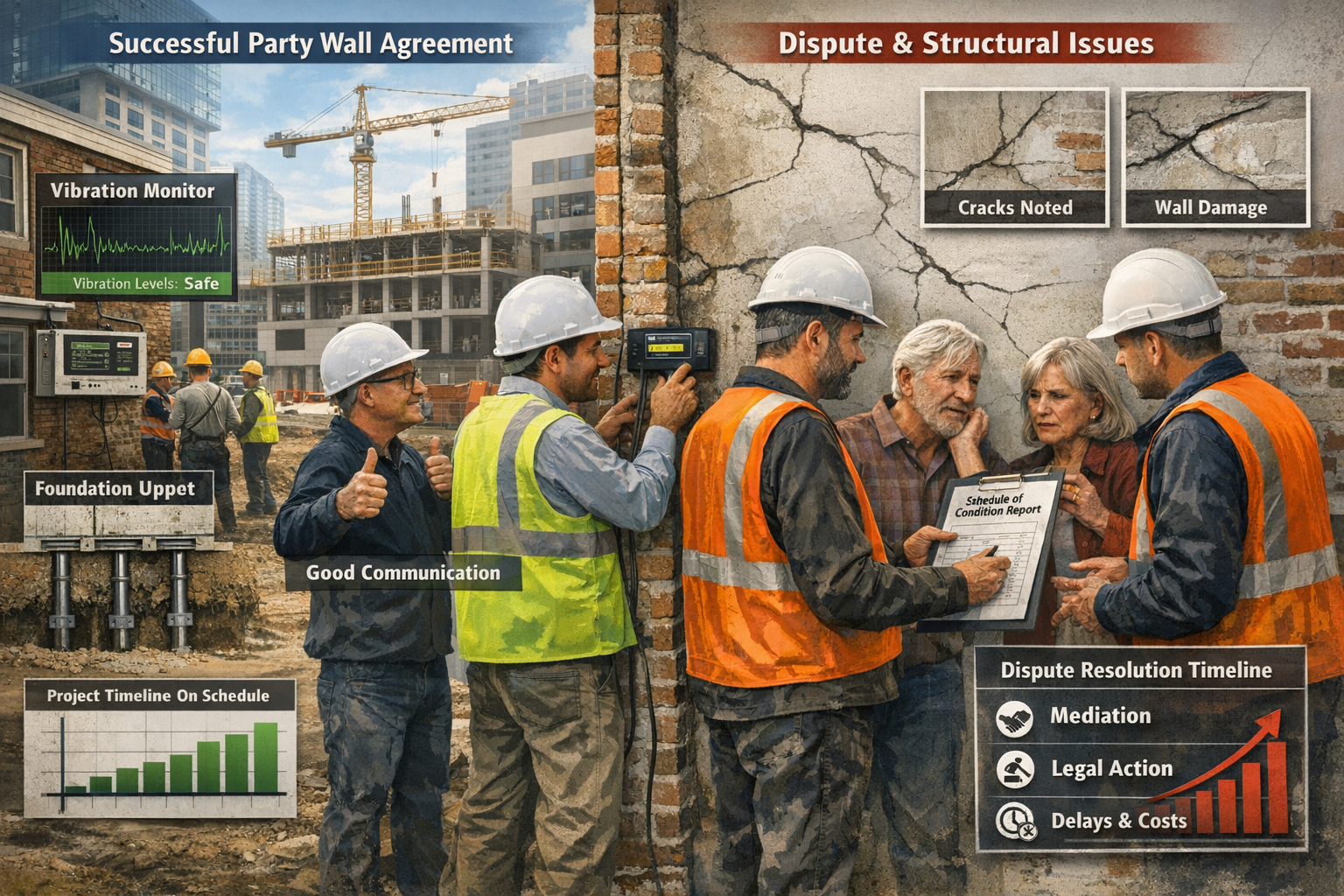
Outcome: Project completed on schedule with no disputes, minimal neighbor complaints, and successful operational launch
Key Lessons:
- Early engagement and generous timelines prevent rushed procedures
- Exceeding minimum requirements builds goodwill
- Compensation for business disruption prevents disputes
- Thorough documentation protects all parties
Case Study 2: Multi-Story Medical Clinic New Build
Project: New 4-story medical clinic constructed between two existing buildings in city center
Party Wall Challenges:
- Building on narrow lot with party walls on both sides
- Deep excavation for basement equipment room affecting both neighbors
- Structural connection to one neighbor's building for lateral support
- Construction access requiring use of neighbor's loading area
- Historic building on one side requiring special protection
Party Wall Solutions:
- Engaged structural engineer specializing in party wall construction early in design
- Served notices 4 months before construction with detailed engineering drawings
- Each neighbor appointed their own surveyor (three surveyors total)
- Implemented continuous vibration and settlement monitoring
- Installed temporary shoring protecting historic building
- Negotiated formal access agreement with loading area neighbor including compensation
- Created detailed construction sequencing plan minimizing neighbor impacts
- Established weekly communication meetings with all surveyors and neighbors
Outcome: Complex project completed successfully with minor third surveyor involvement on one technical issue, no litigation, and positive neighbor relationships
Key Lessons:
- Complex projects benefit from multiple surveyors representing each party's interests
- Specialized engineering expertise prevents problems before they occur
- Regular communication prevents small issues from becoming disputes
- Investment in protective measures pays dividends in smooth project execution
Case Study 3: Urgent Care Clinic Retrofit Dispute
Project: Conversion of former bank building to urgent care clinic
Party Wall Challenges:
- Building owner rushed party wall notices to meet lease commitment deadline
- Inadequate notice details led to adjoining owner dissent
- Construction began before party wall award finalized
- Vibration from demolition caused cracking in neighbor's property
- Dispute over whether damage was pre-existing or construction-caused
Party Wall Problems:
- Notices served with only 2 weeks before planned construction start
- No pre-construction schedule of condition prepared
- Building owner proceeded with demolition during notice period
- Adjoining owner's surveyor found multiple award violations
- Third surveyor required to resolve damage attribution dispute
Resolution:
- Construction halted for 6 weeks while party wall procedures completed properly
- Extensive remedial work required to repair neighbor's property
- Building owner paid all surveyor fees plus compensation for delay
- Project budget exceeded by £45,000 due to party wall issues
- Project opening delayed by 3 months
Key Lessons:
- Rushing party wall procedures creates expensive delays and disputes
- Pre-construction documentation is essential for damage attribution
- Starting work before completing procedures violates the Act and exposes building owners to liability
- Proper planning and timeline management prevent costly problems
Future Trends: Healthcare Construction and Party Wall Agreements Beyond 2026
Technological Innovations
The Healthcare Construction Surge: Party Wall Agreements for Clinics and Labs in Densely Populated 2026 Sites is driving technological innovations in party wall management:
Digital Monitoring Systems 📱
Advanced sensors now provide real-time monitoring of:
- Structural movement and settlement
- Vibration levels during construction
- Noise transmission through party walls
- Temperature and humidity affecting party structures
- Air quality and dust levels
These systems create automatic alerts when parameters exceed agreed thresholds, enabling immediate corrective action before damage occurs.
3D Documentation Technologies 🎥
Laser scanning and photogrammetry create detailed 3D models of existing conditions:
- Millimeter-accurate measurements of party walls
- Complete visual records of all surfaces
- Before-and-after comparisons showing any changes
- Virtual inspections without physical access
Building Information Modeling (BIM) 🏗️
Healthcare construction increasingly uses BIM for party wall management:
- Precise modeling of party wall locations and conditions
- Simulation of construction impacts on adjacent structures
- Coordination between architectural, structural, and MEP systems
- Clash detection preventing party wall conflicts
Blockchain Documentation 🔐
Emerging blockchain applications provide:
- Tamper-proof records of party wall notices and agreements
- Timestamp verification for legal compliance
- Distributed access for all parties and surveyors
- Permanent, searchable documentation
Regulatory Evolution
Party wall law continues evolving to address modern construction challenges:
Proposed Reforms:
Several reforms under discussion could affect healthcare construction:
- Electronic notice service – Formal recognition of email and digital notices
- Expedited procedures – Streamlined processes for low-risk work
- Standard specifications – Pre-approved methods for common healthcare construction scenarios
- Mandatory mediation – Required alternative dispute resolution before third surveyor involvement
- Enhanced penalties – Stronger enforcement for non-compliance
Healthcare-Specific Regulations:
As medical facility construction accelerates, specialized regulations may emerge:
- Infection control standards for party wall work in healthcare settings
- Vibration limits specific to medical equipment
- Noise transmission standards for 24/7 medical operations
- Emergency access provisions for healthcare facilities
- Patient privacy protections during construction
Sustainability and Party Walls
Healthcare construction in 2026 increasingly emphasizes sustainability, affecting party wall considerations:
Energy Efficiency Upgrades ♻️
Medical facility retrofits often include:
- Party wall insulation improvements
- Air sealing at party wall junctions
- Thermal bridge elimination
- High-performance window installations affecting party structures
These upgrades require party wall agreements addressing:
- Installation methods that don't compromise structural integrity
- Vapor barrier continuity across property boundaries
- Long-term maintenance responsibilities
- Energy performance verification
Green Building Certifications 🌱
LEED, BREEAM, and other certifications drive party wall innovations:
- Sustainable materials in party wall construction
- Construction waste reduction affecting party wall work methods
- Indoor air quality standards influencing party wall sealing
- Renewable energy systems requiring party structure modifications
Conclusion: Navigating Healthcare Construction Surge with Effective Party Wall Agreements
The 24% growth in non-hospital healthcare facilities during 2026 represents both tremendous opportunity and significant challenge for medical facility developers. As clinics, diagnostic laboratories, and specialty centers expand into densely populated urban areas, Healthcare Construction Surge: Party Wall Agreements for Clinics and Labs in Densely Populated 2026 Sites becomes not just a legal requirement but a critical success factor.
"Successful healthcare construction in urban environments requires equal attention to medical functionality and neighbor relations. Party wall agreements are the foundation of both."
Key Success Factors
Healthcare developers who successfully navigate party wall requirements share common practices:
✅ Early Planning – Begin party wall procedures 3-6 months before construction, not as an afterthought
✅ Professional Expertise – Engage qualified surveyors with healthcare construction experience
✅ Comprehensive Documentation – Create detailed records before, during, and after construction
✅ Proactive Communication – Maintain open dialogue with neighbors throughout the process
✅ Technical Excellence – Invest in proper engineering and construction methods that protect all parties
✅ Realistic Budgeting – Include adequate party wall costs in project financial planning
✅ Flexible Timelines – Build party wall procedures into project schedules with buffer time
Actionable Next Steps
For healthcare developers planning construction projects in densely populated 2026 sites:
Immediate Actions (This Week):
- 📋 Conduct title search – Identify all party walls and boundary conditions at your proposed site
- 🗺️ Map adjoining owners – Determine who must receive party wall notices
- 💼 Research qualified surveyors – Identify professionals with healthcare construction experience in your area
- 📊 Review project timeline – Ensure adequate time for party wall procedures
Short-Term Actions (This Month):
- 🏗️ Engage structural engineer – Assess party wall impacts of your proposed construction
- 👥 Schedule neighbor meetings – Begin informal discussions before serving formal notices
- 📝 Prepare notice documents – Draft detailed party wall notices with technical specifications
- 💰 Budget for party wall costs – Include surveyor fees, testing, and potential remediation
Medium-Term Actions (Next 3 Months):
- 📬 Serve party wall notices – Deliver formal notices with appropriate lead times
- 🤝 Appoint surveyors – Engage building owner's surveyor and facilitate neighbor surveyor selection
- 📸 Conduct condition surveys – Document existing conditions thoroughly
- ✍️ Finalize party wall awards – Complete formal agreements before construction begins
Long-Term Commitments:
- 🔍 Monitor construction compliance – Ensure work follows party wall award specifications
- 📊 Maintain documentation – Keep comprehensive records throughout construction
- 🔧 Address issues promptly – Respond immediately to neighbor concerns or surveyor findings
- ✅ Complete final inspections – Verify all party wall obligations fulfilled before project closeout
Final Thoughts
The Healthcare Construction Surge: Party Wall Agreements for Clinics and Labs in Densely Populated 2026 Sites represents a defining moment in urban medical facility development. Developers who master party wall procedures gain competitive advantage through:
- Faster project approvals with fewer delays and disputes
- Lower risk exposure through proper legal compliance
- Better neighbor relations supporting long-term operations
- Enhanced reputation as responsible developers
- Reduced costs from avoiding litigation and remediation
As the healthcare construction boom continues through 2026 and beyond, party wall expertise will increasingly separate successful projects from troubled ones. The investment in proper party wall procedures—though sometimes seeming burdensome in the short term—pays substantial dividends in project success, neighbor goodwill, and long-term facility operations.
By understanding notice requirements, choosing between agreements and awards wisely, engaging qualified surveyors, and maintaining comprehensive documentation, healthcare developers can navigate even the most complex party wall scenarios successfully. The future of urban healthcare delivery depends on these new facilities—and the party wall agreements that make their construction possible.
References
[1] ontario.ca – https://www.ontario.ca/laws/regulation/220246
[2] Critical Amendments To Ontario Construction Act Have Arrived – https://www.dlapiper.com/en-ca/insights/publications/2026/01/critical-amendments-to-ontario-construction-act-have-arrived
[3] Ontario S Construction Act Key 2026 Amendments And Practical Implications – https://oba.org/ontario-s-construction-act-key-2026-amendments-and-practical-implications/
[4] 2026 Amendments To The Em Construction Act Em – https://www.torkin.com/insights/publication/2026-amendments-to-the–em-construction-act–em
[5] Changes To Ontarios Construction Act Effective January 1 2026 – https://www.blg.com/en/insights/2026/01/changes-to-ontarios-construction-act-effective-january-1-2026
[6] Construction Act How The 2026 Updates Impact You And Your Contracts – https://oaa.on.ca/whats-on/news-and-insights/news-and-insights-detail/Construction-Act-How-the-2026-Updates-Impact-You-and-Your-Contracts
[7] Ontarios Construction Act Changes What You Need To Know In 2026 – https://www.mondaq.com/canada/arbitration-dispute-resolution/1745486/ontarios-construction-act-changes-what-you-need-to-know-in-2026