


The healthcare sector is experiencing unprecedented expansion in 2026, with hospitals, clinics, and ambulatory surgical centers racing to meet growing patient demand. However, as medical facilities expand into adjacent properties or construct additions that share walls with neighboring buildings, party wall agreements have become critical legal requirements that can make or break construction timelines. Healthcare Facility Expansions and Party Wall Agreements: Navigating 2026's Health Sector Growth requires understanding both the medical industry's unique construction needs and the complex legal framework governing shared property boundaries.
With the 2026 Health Care Extenders legislation extending funding for community health centers through December 31, 2026[1], and a three-year CMS phase-out driving migration from inpatient to outpatient facilities[3], healthcare organizations are pursuing aggressive expansion strategies. Yet many project managers discover too late that failing to properly serve party wall notices can delay construction by months and expose facilities to costly legal disputes.
Key Takeaways
- 🏥 Healthcare facility expansions in 2026 are driven by extended federal funding and the shift from inpatient to outpatient care models
- 📋 Party wall agreements are legally required when construction affects shared walls, boundaries, or foundations between adjacent properties
- ⏱️ Proper notice periods (typically 2 months for most works) must be served to adjoining owners before construction begins
- 💼 Professional surveyors help navigate complex healthcare construction scenarios and ensure compliance with the Party Wall Act
- ⚖️ Non-compliance risks include construction delays, legal injunctions, and damaged relationships with neighboring property owners
Understanding the 2026 Healthcare Expansion Landscape
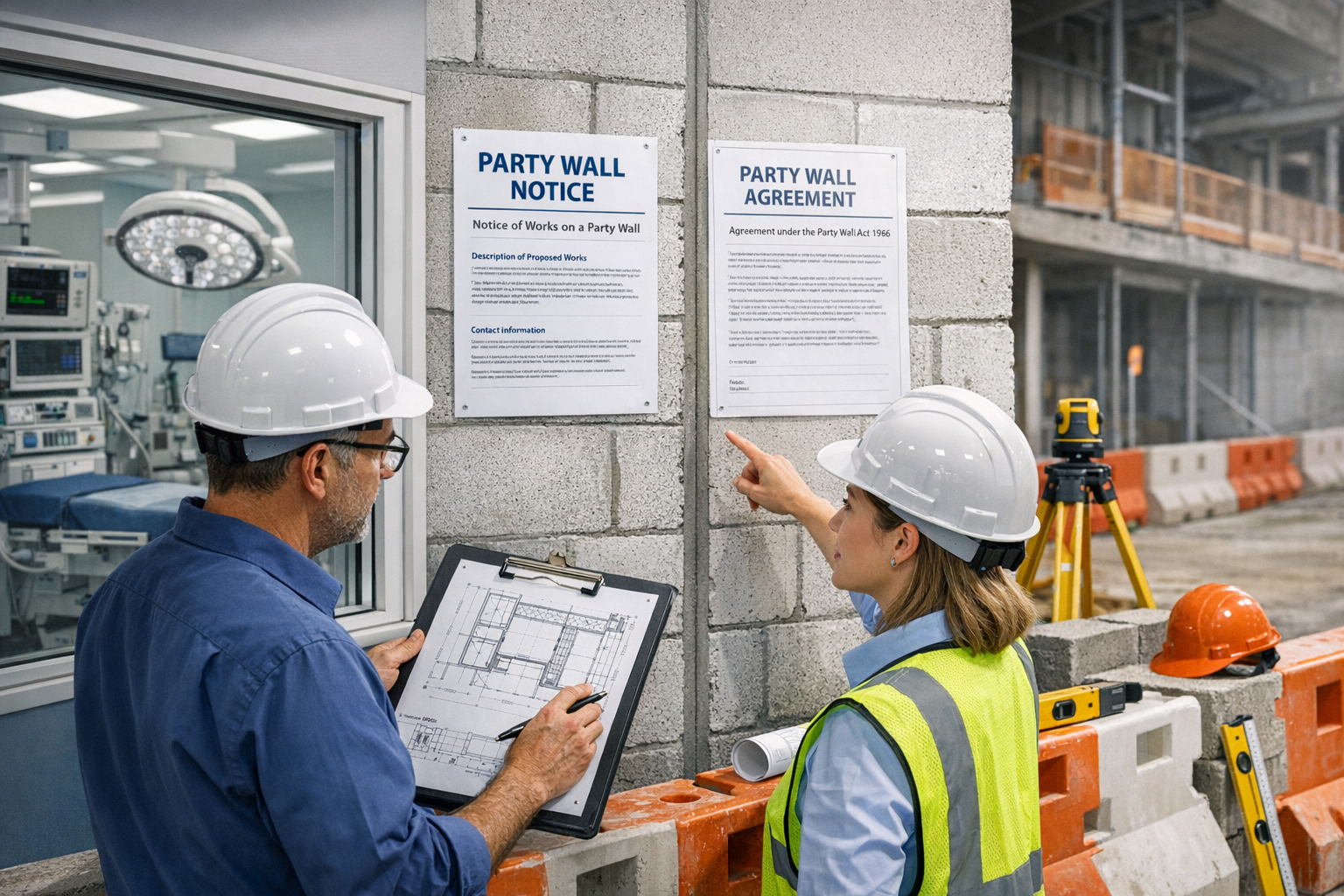
The healthcare real estate market in 2026 represents one of the strongest growth sectors across all commercial property types. Multiple factors are converging to drive this unprecedented expansion wave.
Federal Funding Extensions Fuel Growth
The 2026 Health Care Extenders legislation has created a favorable environment for facility-based services. Community health centers now have funding certainty through December 31, 2026, with prorated amounts extending into Q1 2027[1]. This financial stability enables long-term capital planning and construction projects that previously faced uncertain funding timelines.
Teaching health centers operating graduate medical education (GME) programs have also received payment authority extended through the end of 2026[1]. This supports infrastructure investments necessary for physician training facilities, including classroom spaces, simulation labs, and expanded clinical areas.
The Outpatient Migration Phenomenon
Perhaps the most significant driver of healthcare construction in 2026 is the CMS phase-out of the Inpatient Prospective Payment (IPO) list. This three-year transition is causing hospital systems to rapidly pursue joint venture partnerships and longer-term lease structures for Ambulatory Surgical Centers (ASCs)[3].
Advanced medical technology now enables procedures previously requiring inpatient stays to be safely performed in outpatient settings. This technological shift is fundamentally reshaping capital allocation strategies, with healthcare organizations investing heavily in:
- Ambulatory surgical centers for same-day procedures
- Diagnostic imaging facilities with advanced equipment
- Specialty clinics for focused care delivery
- Urgent care centers for immediate access
Real-World Expansion Examples
The Lompoc Health Village Center expansion in Vandenberg Village, California, exemplifies 2026's healthcare growth trajectory. The project converted a former credit union headquarters into a modern medical facility with:
Phase 1 specifications:
- Investment: $4.2 million
- Space: 7,500 square feet
- Features: 12 exam rooms, three nurse stations, six provider offices, diagnostic imaging
- Completion: October 2026[2]
Phase 2 planning:
- Investment: $3.8 million
- Space: Additional 7,500 square feet
- Services: 18 exam/treatment rooms, urogynecology, pediatrics[2]
The medical center has already signed four new physicians to begin service between March and November 2026, with each provider expected to serve 800-1,000 patients annually[2]. Foundation funding of approximately $1.4 million has been raised for the first phase[2].
Party Wall Requirements for Healthcare Construction Projects
When healthcare facilities expand, they frequently encounter party wall situations that trigger specific legal obligations. Understanding these requirements is essential for project managers overseeing hospital wings, clinic additions, or ASC developments.
What Constitutes a Party Wall in Healthcare Settings
A party wall is any wall or structure that stands on the boundary between two properties and is shared by both owners. In healthcare contexts, common scenarios include:
- Hospital additions sharing walls with adjacent medical office buildings
- Clinic expansions abutting neighboring commercial properties
- Multi-tenant medical complexes with shared structural walls
- ASC developments on properties with existing boundary walls
The Party Wall etc. Act 1996 governs these situations in England and Wales, establishing clear procedures for construction affecting shared structures.
Types of Notifiable Works in Medical Facility Construction
Healthcare expansion projects typically involve one or more of these types of party wall works:
| Work Type | Healthcare Examples | Notice Required |
|---|---|---|
| Building on the boundary line | New ASC wing constructed at property edge | Party Structure Notice |
| Works to existing party walls | Reinforcing shared walls for heavy medical equipment | Party Structure Notice |
| Excavation within 3-6 meters | Foundation work for multi-story hospital addition | Notice of Adjacent Excavation |
| Cutting into party walls | Installing HVAC systems through shared structures | Party Structure Notice |
Mandatory Notice Periods and Documentation
Healthcare construction teams must serve party wall notices well in advance of construction:
Standard notice periods:
- ⏰ Two months for party structure notices (most construction work)
- ⏰ One month for party fence wall notices
- ⏰ At least one month for excavation notices
These timelines are non-negotiable and cannot be shortened without written consent from adjoining owners. For healthcare projects with strict completion deadlines tied to physician recruitment or service delivery commitments, early notice service is critical.
The notice must include detailed information about the proposed works, including architectural drawings, structural specifications, and construction timelines. A free download sample party wall agreement template can help healthcare administrators understand required documentation.
When Professional Surveyors Become Essential
Healthcare construction presents unique complexities that often necessitate professional surveyor involvement:
✅ Vibration-sensitive equipment: Medical imaging devices, laboratory instruments, and surgical equipment in adjacent facilities require protection from construction vibration
✅ Infection control requirements: Healthcare settings demand specialized temporary barriers and contamination prevention measures during construction[5]
✅ 24/7 operational continuity: Unlike typical commercial properties, hospitals cannot cease operations during construction, requiring sophisticated scheduling and noise management
✅ Regulatory compliance layers: Healthcare facilities must maintain Joint Commission accreditation and state licensing throughout construction
Professional surveyors can navigate these challenges while ensuring compliance with party wall legislation. Many healthcare organizations work with specialists who understand both construction law and medical facility requirements.
Healthcare Facility Expansions and Party Wall Agreements: Step-by-Step Compliance Process
Successfully navigating party wall requirements for healthcare expansions requires a systematic approach that integrates legal compliance with project management.
Step 1: Early Identification and Assessment
Before architectural planning begins, healthcare administrators should:
- Conduct boundary surveys to identify all potential party wall situations
- Review property deeds to understand existing easements and rights
- Assess neighboring properties for sensitive uses (other medical facilities, residential buildings, laboratories)
- Engage preliminary surveyor consultation to understand likely requirements
This early assessment prevents costly design revisions later in the process.
Step 2: Serving Proper Party Wall Notices
Once construction plans are finalized, the building owner must serve appropriate notices. Understanding what party wall act notices are and how to respond helps healthcare project managers prepare complete documentation.
Notice must include:
- Detailed description of proposed works
- Architectural drawings and structural plans
- Proposed construction start date
- Contact information for the building owner
- Explanation of adjoining owner's rights
For complex healthcare projects, working with a party wall surveyor in Central London or other relevant locations ensures notices meet all legal requirements.
Step 3: Negotiating Party Wall Awards
If the adjoining owner consents to the works, construction can proceed with agreed-upon protections. However, if they dissent or fail to respond within 14 days, the party wall award process begins.
A party wall award is a legally binding document that:
- ✔️ Specifies exactly what work can be performed
- ✔️ Establishes construction methods and timing
- ✔️ Documents the condition of adjoining property before work begins
- ✔️ Sets out rights of access for inspections
- ✔️ Determines who pays surveyor fees
For healthcare projects, awards often include special provisions for:
- Noise restrictions during patient care hours
- Vibration monitoring near sensitive medical equipment
- Infection control protocols for shared HVAC systems
- Emergency access provisions if construction creates safety issues
Understanding party wall contract templates and awards helps healthcare administrators anticipate these requirements.
Step 4: Managing Construction with Compliance
Once the party wall award is in place, healthcare construction teams must:
Implement protective measures:
- Install temporary protective barriers (critical for healthcare settings)[5]
- Establish vibration monitoring systems
- Create dust containment protocols
- Schedule noisy work during agreed-upon hours
Maintain documentation:
- Photograph existing conditions regularly
- Keep detailed construction logs
- Document any deviations from approved plans
- Maintain communication records with adjoining owners
Coordinate surveyor inspections:
- Allow access for condition surveys
- Address concerns raised during inspections promptly
- Provide advance notice of critical construction phases
Step 5: Post-Construction Resolution
After construction completion, the process concludes with:
- Final condition survey comparing post-construction state to pre-construction documentation
- Resolution of any damage claims identified during construction
- Final payment of surveyor fees according to the award
- Formal closure documentation confirming all obligations met
Unique Challenges in Healthcare Facility Expansions and Party Wall Agreements: Navigating 2026's Health Sector Growth
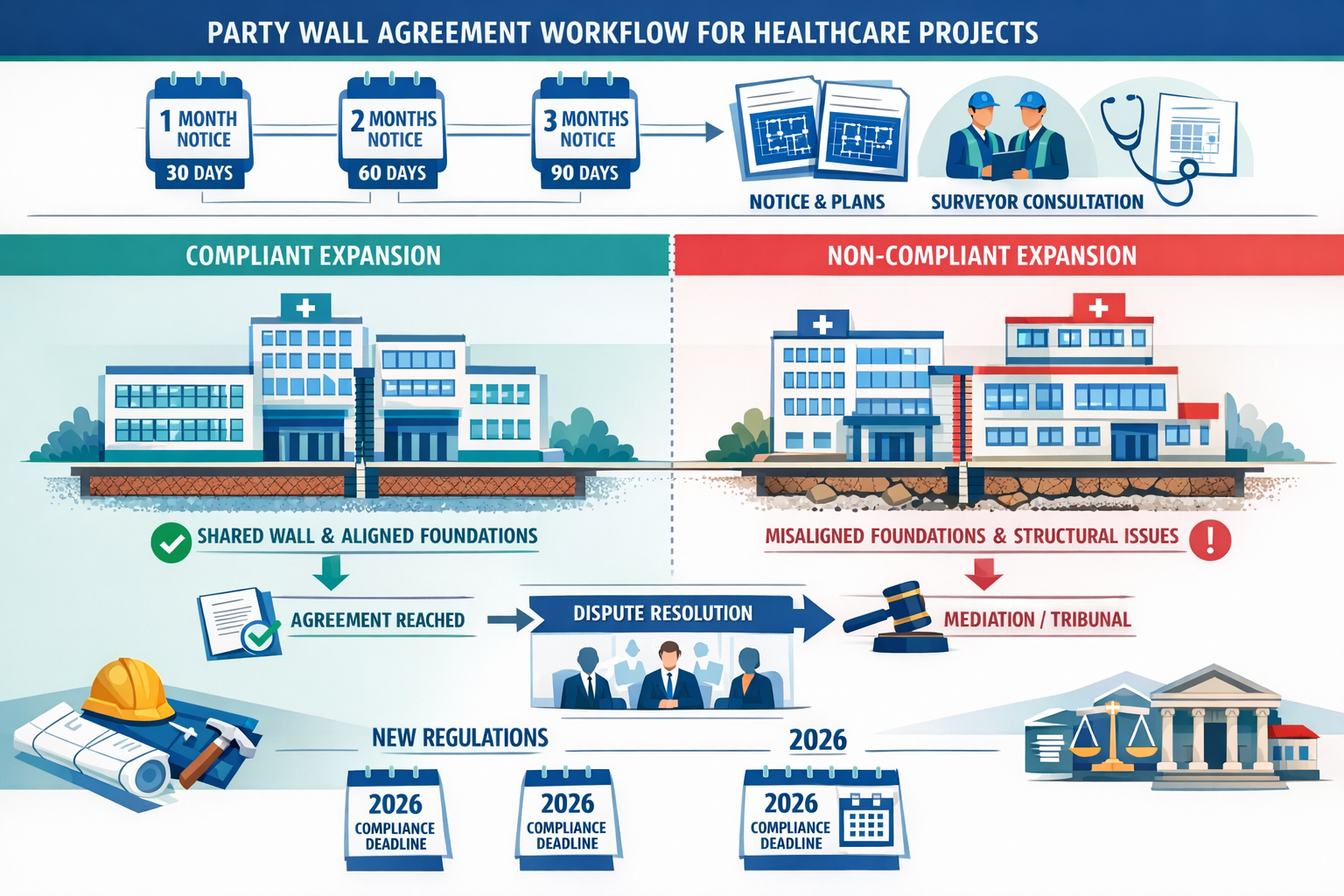
Healthcare construction introduces specialized considerations beyond typical commercial party wall situations.
Regulatory Compliance Layering
Healthcare facility expansions must satisfy multiple regulatory frameworks simultaneously:
Stark Law and Anti-Kickback Statute compliance now requires hospital systems to integrate compliance frameworks into real estate strategy from project inception[3]. Lease arrangements must demonstrate commercial reasonableness and fair market value (FMV) to avoid financial penalties and regulatory delays[3].
Stark Law violations pose strategic risks including:
- ⚠️ Delayed expansion plans
- ⚠️ Strained physician relationships
- ⚠️ Financial penalties
- ⚠️ Loss of Medicare/Medicaid participation
Party wall agreements must be structured to avoid any appearance of improper financial relationships when healthcare organizations share walls with physician-owned properties or joint ventures.
Infection Control During Construction
Healthcare facilities cannot simply close during construction. Infection control requirements demand specialized approaches:
- ICRA (Infection Control Risk Assessment) protocols for all construction
- Temporary wall systems that meet healthcare-grade containment standards[5]
- Negative air pressure zones to prevent contamination spread
- HEPA filtration in construction areas
- Dedicated construction access routes separate from patient areas
These requirements significantly impact costs of the party wall process for healthcare projects, as standard construction barriers are insufficient.
Equipment Sensitivity and Vibration Concerns
Modern medical facilities house vibration-sensitive equipment worth millions of dollars:
- MRI machines requiring extremely stable environments
- Laboratory equipment with precision tolerances
- Surgical robots with calibration requirements
- Diagnostic imaging devices
Party wall awards for healthcare projects must include:
📊 Baseline vibration monitoring before construction begins
📊 Continuous monitoring during foundation and structural work
📊 Immediate work stoppage protocols if thresholds are exceeded
📊 Equipment recalibration provisions if vibration impacts occur
24/7 Operational Requirements
Unlike office buildings or retail spaces, healthcare facilities never close. This creates unique party wall challenges:
Noise restrictions: Construction must often occur only during specific hours, extending project timelines and increasing costs
Emergency access: Party wall agreements must preserve emergency vehicle access and patient transport routes
Utility continuity: Shared utilities (water, power, HVAC) require redundant systems during construction to prevent service interruptions
Staff and patient safety: Construction zones must be completely isolated from patient care areas
Managing Disputes Without Disrupting Patient Care
When party wall disputes arise in healthcare settings, resolution becomes more urgent. A guide on what to do when your neighbour is carrying out works provides general guidance, but healthcare scenarios require expedited resolution.
Dispute resolution strategies:
- Early mediation: Engage neutral third parties before disputes escalate
- Expedited surveyor processes: Use surveyors experienced in healthcare timelines
- Temporary operational adjustments: Relocate sensitive equipment or services during critical construction phases
- Communication protocols: Establish regular updates with all stakeholders
Healthcare organizations should consider whether having a party wall agreement without a surveyor is appropriate for their situation, though most complex medical facility projects benefit from professional representation.
Cost Management and Timeline Planning
Healthcare construction budgets must account for party wall compliance costs from the earliest planning stages.
Typical Cost Components
Party wall surveyor fees:
- Building owner's surveyor: £1,500-£5,000+ depending on project complexity
- Adjoining owner's surveyor: Similar range (typically paid by building owner)
- Agreed surveyor (if used): £2,000-£7,000+
Additional healthcare-specific costs:
- Vibration monitoring equipment and services: £3,000-£15,000
- Healthcare-grade temporary barriers: 2-3x standard construction barriers[5]
- Extended project timelines due to restricted work hours: 15-30% schedule extension
- Specialized infection control measures: Variable based on facility type
Understanding how to keep party wall costs down helps healthcare administrators optimize budgets without compromising compliance.
Timeline Integration
Recommended timeline for healthcare expansion projects:
| Phase | Duration | Key Activities |
|---|---|---|
| Pre-planning | 2-3 months | Boundary surveys, preliminary surveyor consultation, regulatory review |
| Notice period | 2 months minimum | Serve party wall notices, await responses |
| Award negotiation | 1-2 months | Surveyor appointments, condition surveys, award drafting |
| Construction | Project-specific | Execute works per award terms, ongoing monitoring |
| Post-construction | 1 month | Final surveys, damage resolution, closeout |
For the Lompoc Health Village Center project with its October 2026 completion target[2], party wall compliance would need to begin no later than April 2026 to ensure adequate notice and award periods.
Best Practices for Healthcare Organizations
Healthcare administrators can optimize party wall compliance through strategic approaches:
🏆 Engage Specialists Early
Work with surveyors who understand both party wall legislation and healthcare construction requirements. Regional specialists like those offering party wall surveyor services in North London, West London, South London, or East London often have experience with local healthcare projects.
🏆 Integrate Compliance into Project Planning
Don't treat party wall compliance as an afterthought. Include it in:
- Initial feasibility studies
- Project budgets and timelines
- Architectural design parameters
- Stakeholder communication plans
🏆 Prioritize Neighbor Relations
Healthcare facilities are permanent community fixtures. Maintaining positive relationships with adjoining property owners serves long-term interests:
- Communicate proactively about construction plans
- Address concerns promptly and professionally
- Consider voluntary accommodations beyond minimum legal requirements
- Document all agreements in writing
🏆 Prepare Comprehensive Documentation
Healthcare projects face heightened scrutiny. Maintain meticulous records:
- Photographic and video documentation of existing conditions
- Detailed construction logs with timestamps
- All correspondence with adjoining owners and surveyors
- Monitoring data (vibration, noise, air quality)
- Incident reports and resolution actions
🏆 Plan for Contingencies
Build flexibility into healthcare expansion plans:
- Budget contingencies of 15-20% for party wall-related issues
- Schedule buffers for potential dispute resolution
- Alternative construction sequencing if access is restricted
- Temporary facility options if operations must relocate
Conclusion
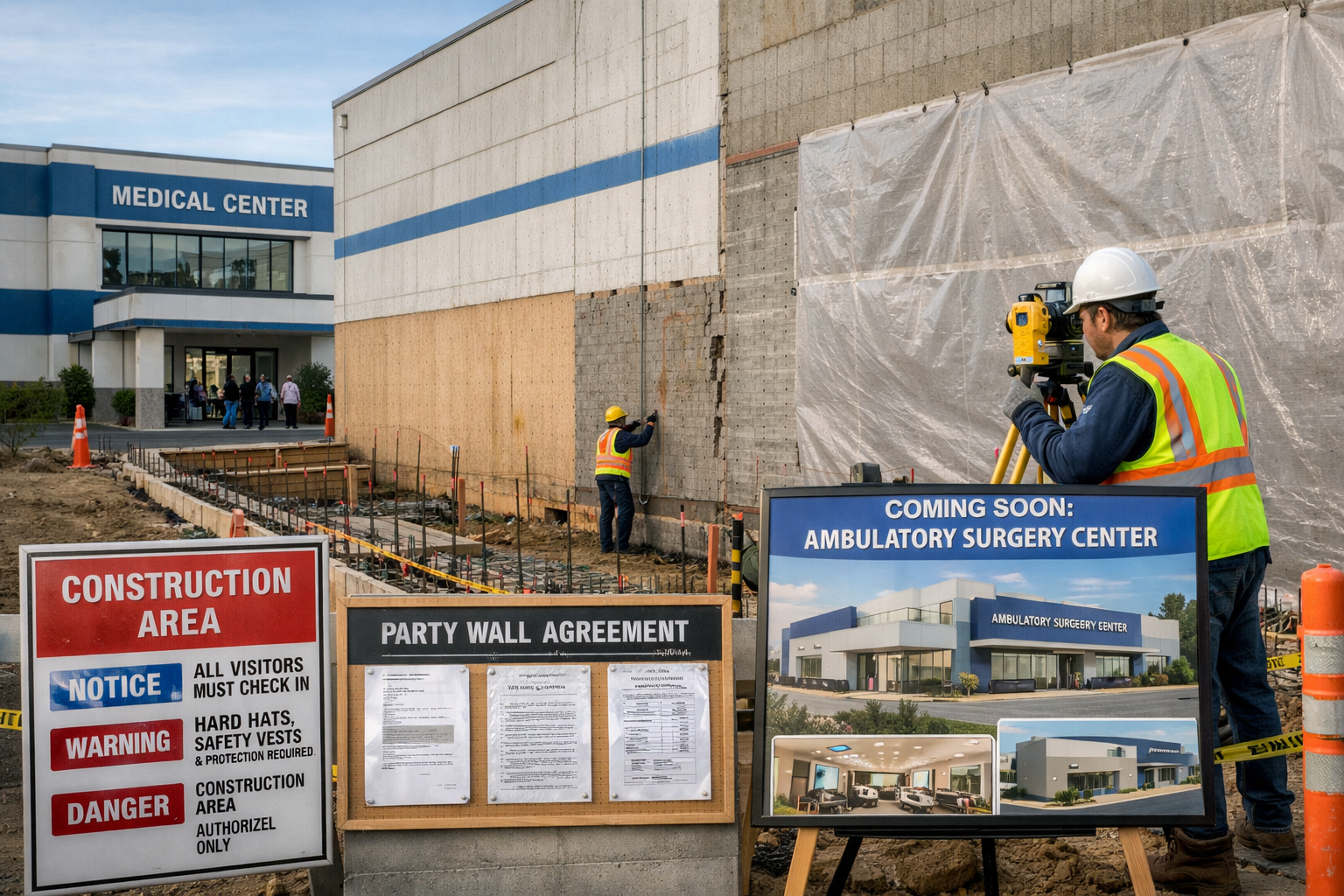
Healthcare Facility Expansions and Party Wall Agreements: Navigating 2026's Health Sector Growth requires healthcare organizations to master both the opportunities and obligations of this expansion era. With federal funding extensions creating favorable conditions[1] and the shift to outpatient care driving unprecedented construction[3], medical facilities across the country are pursuing ambitious growth strategies.
However, party wall compliance cannot be overlooked. The legal requirements established by the Party Wall etc. Act 1996 apply equally to healthcare construction, and the unique operational demands of medical facilities—infection control, vibration sensitivity, 24/7 operations—make compliance even more critical.
Actionable Next Steps
Healthcare administrators planning expansion projects should:
-
✅ Conduct immediate boundary assessments to identify potential party wall situations in current expansion plans
-
✅ Engage qualified party wall surveyors with healthcare construction experience during the feasibility phase
-
✅ Integrate party wall timelines into master project schedules, allowing minimum 2-month notice periods plus award negotiation time
-
✅ Budget appropriately for surveyor fees, specialized monitoring, and healthcare-grade temporary barriers
-
✅ Establish neighbor communication protocols to build positive relationships before construction begins
-
✅ Review regulatory compliance frameworks to ensure party wall agreements align with Stark Law and Anti-Kickback Statute requirements
-
✅ Develop contingency plans for potential disputes or construction delays
The healthcare expansion wave of 2026 presents tremendous opportunities to increase patient access, deploy advanced medical technologies, and strengthen community health infrastructure. By approaching party wall requirements strategically and proactively, healthcare organizations can execute their growth visions while maintaining legal compliance, protecting neighboring properties, and preserving the operational continuity essential to patient care.
The projects that will succeed are those that recognize party wall compliance not as a bureaucratic obstacle, but as a framework for responsible construction that protects all stakeholders—patients, neighbors, staff, and the broader community served by healthcare facilities.
References
[1] The 2026 Health Care Extenders Summary And Analysis – https://paragoninstitute.org/paragon-prognosis/the-2026-health-care-extenders-summary-and-analysis/
[2] Lompoc Valley Medical Center Breaks Out The Hammers To Mark Expansion – https://www.noozhawk.com/lompoc-valley-medical-center-breaks-out-the-hammers-to-mark-expansion/
[3] Healthcare Real Estate Strategy In 2026 Navigating Hospital Growth Outpatient Demand And Compliance Risk – https://lpc.com/insights-research/healthcare-real-estate-strategy-in-2026-navigating-hospital-growth-outpatient-demand-and-compliance-risk/
[5] Temporary Wall Systems The Gold Standard For 2026 Healthcare Renovations – https://www.hepacart.com/blog/temporary-wall-systems-the-gold-standard-for-2026-healthcare-renovations