


New guidance discussed at 2024 CPD (Continuing Professional Development) sessions for surveyors has sent ripples through the home improvement sector, prompting urgent questions from homeowners and professionals alike about how the Party Wall etc. Act 1996 now applies in practice. Basement extensions alone account for nearly 40% of all party wall disputes in urban areas, largely because of missed notice procedures and inadequate protective documentation [1]. Understanding how recent changes to the Party Wall Act impact current home extensions and basement projects is no longer optional — it is essential for anyone planning to build in 2026.
Key Takeaways
- New interpretations of the Party Wall etc. Act 1996, shaped by 2024 CPD guidance, are changing how surveyors and homeowners approach notice obligations for extensions and basement works.
- Basement projects trigger up to three separate notice types — Section 1, Section 2, and Section 6 — each with distinct timelines and legal consequences if missed.
- Failing to serve a Section 6 Adjacent Excavation Notice is one of the most common and costly mistakes in basement projects, even when no shared wall is touched.
- A formal Party Wall Award is mandatory for most terraced and semi-detached properties undertaking basement works; proceeding without one creates serious legal exposure.
- Selecting a surveyor with verified basement conversion experience is critical, as general party wall knowledge is often insufficient for these technically complex projects.
What the Party Wall etc. Act 1996 Actually Covers
Before examining how recent changes to the Party Wall Act impact current home extensions and basement projects, it is worth establishing what the Act does and does not cover. The Party Wall etc. Act 1996 governs works to shared walls, boundary structures, and excavations near neighbouring properties. It applies in England and Wales and creates a formal framework for notifying neighbours, resolving disputes, and documenting the condition of adjoining structures before work begins [8].
The Act covers three broad categories of work:
- Party wall works: Alterations to a wall shared with a neighbour, such as cutting in a beam or raising the height of a shared wall.
- New walls on or near the boundary: Construction of a new wall at or astride the boundary line between two properties.
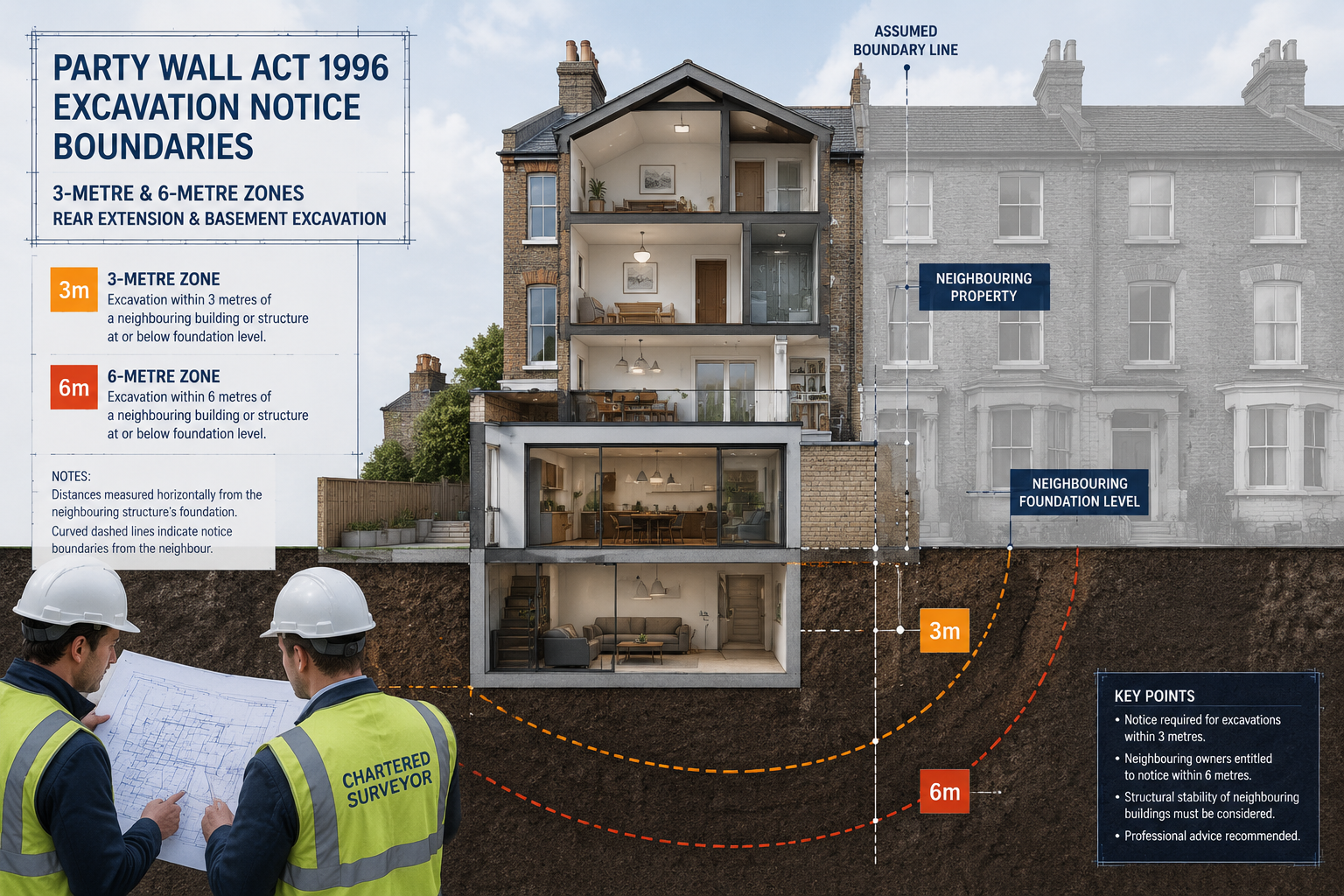
- Excavation near neighbouring structures: Digging within 3 or 6 metres of a neighbour's building, depending on depth.
For a clear explanation of how shared structures are legally defined, the Party Wall etc. Act 1996 overview provides a useful starting point. It is also worth understanding the distinction between different types of boundary structures, as explained in this guide on party fence walls and boundary walls.
How the 2024 CPD Guidance Has Shifted Practice
The 2024 CPD sessions for party wall surveyors did not introduce new legislation — the Act itself remains unchanged. What changed is the interpretation and application of existing rules, particularly around:
- Notice timelines: Surveyors are now applying stricter standards to what constitutes adequate notice for complex basement works, with greater scrutiny of whether notices were served in the correct sequence and with sufficient lead time.
- Schedule of condition requirements: There is growing professional consensus that a thorough pre-works condition survey is not merely best practice but a near-mandatory protective step, especially for excavation projects.
- Security for expenses: Adjoining owners are increasingly exercising their right under Section 12 of the Act to demand financial security before works begin, particularly on high-value projects in London.
These shifts in professional practice mean that homeowners and developers who relied on informal arrangements or minimal documentation in previous years face significantly higher scrutiny in 2026.
Notice Requirements: The Three Notices That Govern Extensions and Basement Works
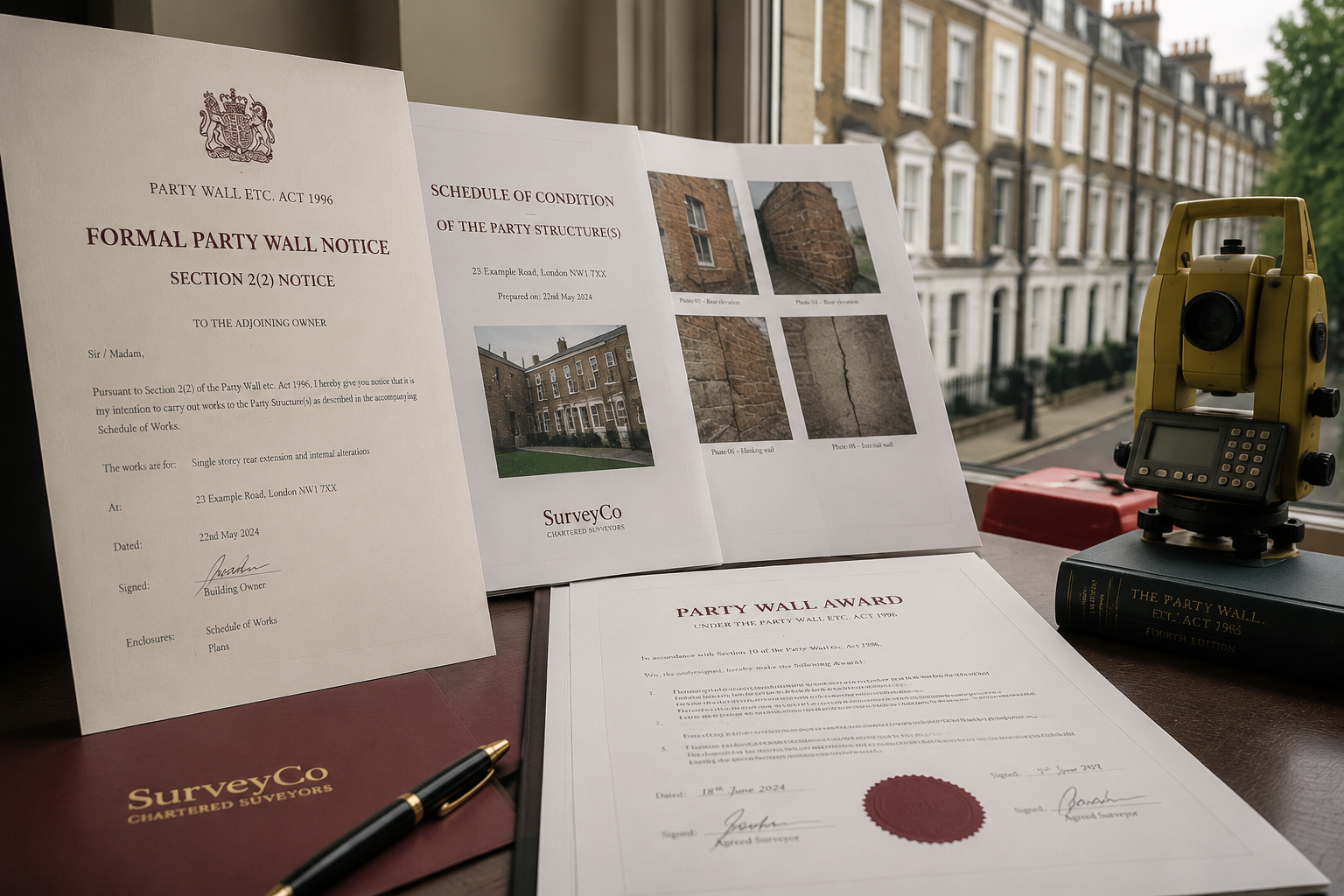
One of the most practical ways to understand how recent changes to the Party Wall Act impact current home extensions and basement projects is to examine the notice obligations in detail. Most residential projects trigger at least one of three formal notices, and basement conversions frequently require all three [2].
Section 1 Notice: Line of Junction Notice
A Section 1 Notice is required when a building owner intends to construct a new wall at or astride the boundary line between two properties. This applies to many rear extensions where the new structure sits close to or on the legal boundary. The notice must be served at least one month before the planned start date.
Section 2 Notice: Party Structure Notice
A Section 2 (Party Structure) Notice is required when work directly affects a shared wall or structure. Common triggers include:
- Cutting into a party wall to insert a steel beam (RSJ)
- Underpinning a shared wall
- Raising or extending a party wall
- Demolishing and rebuilding a party wall
This notice must be served at least two months before the planned start date. For detailed guidance on serving this type of notice correctly, see this resource on what a party structure notice is and how to serve it.
Section 6 Notice: Adjacent Excavation Notice
The Section 6 Notice is the most frequently overlooked requirement, and it is the one generating the most questions in the wake of 2024 CPD guidance. It is required when:
| Scenario | Notice Trigger |
|---|---|
| Excavating within 3 metres of a neighbour's building | Depth of excavation lower than neighbour's foundations |
| Excavating within 6 metres of a neighbour's building | Excavation intersects a 45-degree line drawn from the base of neighbour's foundation |
Many homeowners mistakenly assume that if they are not physically touching the shared wall, no notice is needed. This is incorrect and can lead to injunctions, costly delays, and legal liability [2]. The Section 6 Notice must be served at least one month before excavation begins.
Important: Basement projects in terraced or semi-detached London properties almost universally require a Section 6 Notice. The proximity of neighbouring foundations makes this a near-universal obligation, not an occasional one.
For a comprehensive breakdown of all notice types and how to respond to them, the party wall notices guide covers the process in full.
Basement Projects: The Most Complex Application of the Act
Basement conversions represent the most technically demanding category of work under the Party Wall etc. Act 1996. They involve deep excavation, sustained vibration, ground movement, and direct interference with the foundations of neighbouring properties [3]. In 2026, the combination of stricter professional standards and the 2024 CPD guidance means that the margin for error on these projects has narrowed considerably.
The London Clay Problem
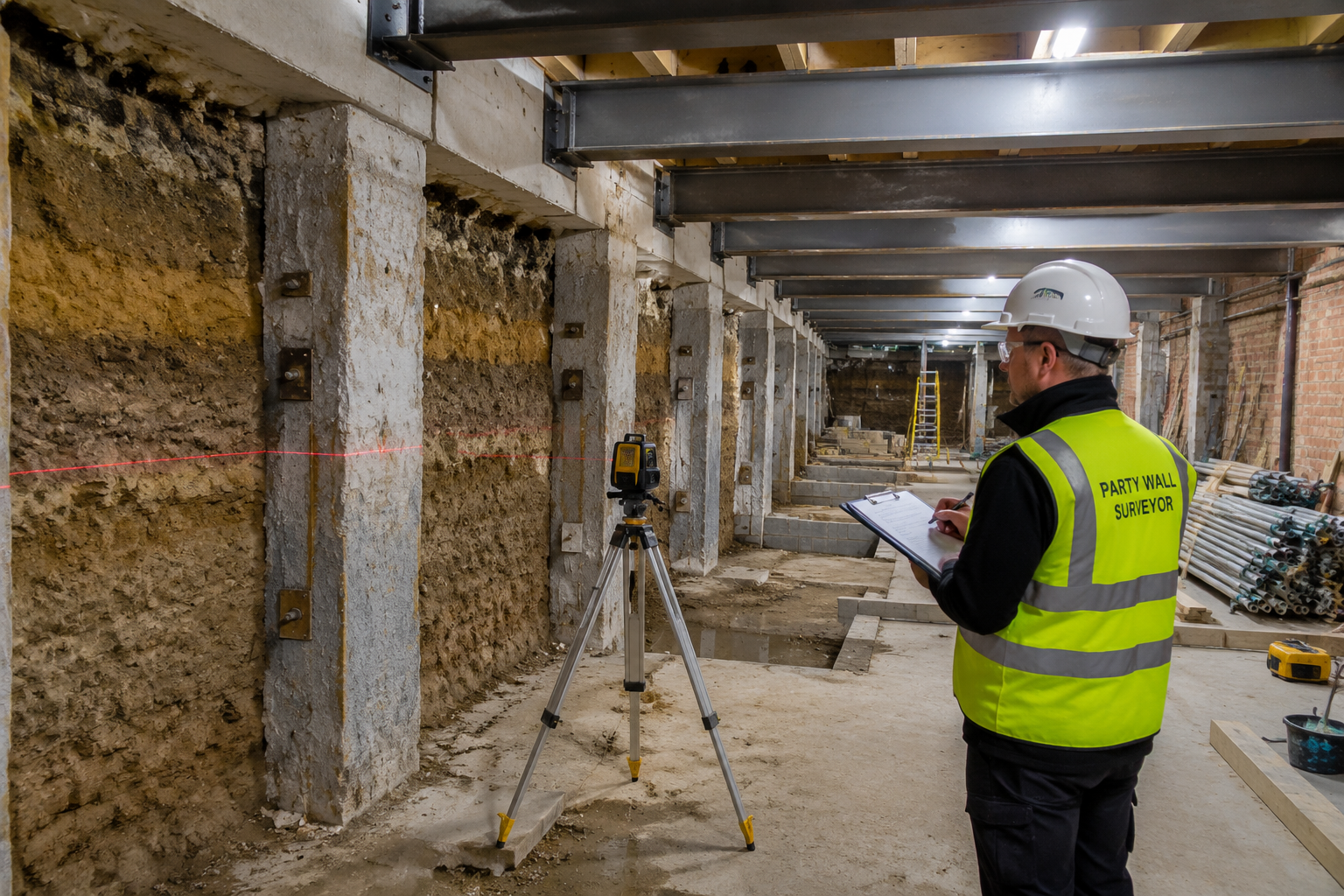
In large parts of London, particularly south and central areas, the subsoil is predominantly London Clay. This material is highly susceptible to shrinkage and swelling in response to moisture changes — a characteristic that is directly relevant to basement excavation. When deep underpinning is required in London Clay, the risk of differential settlement affecting neighbouring properties is significantly elevated [3].
This geological reality has practical consequences for the party wall process:
- Structural method statements are increasingly expected as part of the Party Wall Award documentation.
- Monitoring requirements — including crack gauges and settlement monitoring — are now more commonly specified by surveyors.
- Underpinning sequences must be clearly defined in the award to protect both the building owner and the adjoining owner.
Homeowners planning basement works in south or central London should engage a surveyor familiar with these specific conditions. Resources for finding qualified professionals are available through party wall surveyor services in South London and Central London.
Why a Party Wall Award Is Not Optional for Basement Works
For terraced or semi-detached properties undergoing basement works, a formal Party Wall Award is not a discretionary step — it is a legal necessity [3]. The Award is a binding document that:
- Sets out the rights and obligations of both the building owner and the adjoining owner
- Specifies the method and sequence of works
- Defines hours of working and access arrangements
- Records the pre-works condition of the adjoining property
- Establishes the process for resolving any damage claims
Proceeding without a Party Wall Award exposes the building owner to injunctions that can halt works entirely, as well as significant financial liability if damage occurs and there is no agreed baseline condition survey to reference. For more on what a Party Wall Award contains and how it is structured, see this guide on party wall awards.
Security for Expenses: A Growing Trend in 2026
Section 12 of the Act allows adjoining owners to request that the building owner provides financial security before works begin. This provision, historically used sparingly, is now being exercised more frequently — particularly on high-value London projects where the potential for damage is significant [3].
In practical terms, this means building owners may be required to place funds in escrow or provide a bond before a single spade enters the ground. Homeowners should factor this into their project budgets and timelines.
Home Extensions: Rear and Side Extensions Under the Act
Rear and side extensions are among the most common home improvement projects in the UK. While they are generally less complex than basement conversions, they still engage the Party Wall etc. Act in several important ways.
When a Rear Extension Triggers the Act
A rear extension triggers party wall obligations when it:
- Is built up to or astride the boundary with a neighbouring property
- Involves cutting into or building off an existing party wall
- Requires excavation within 3 or 6 metres of a neighbouring structure
Single-storey rear extensions that sit entirely within the building owner's land and do not involve any work to shared walls may not trigger the Act at all. However, the moment foundations are dug close to a boundary, Section 6 obligations come into play [4].
Loft Conversions and the Party Wall Act
Loft conversions frequently involve cutting into party walls to insert steel beams at roof level. This is a direct trigger for a Section 2 Party Structure Notice. The 2024 CPD guidance has reinforced that the notice must be served before any structural drawings are finalised, not simply before work begins, to allow the adjoining owner adequate time to appoint a surveyor and review the proposals [5].
Common Mistakes That Lead to Disputes
Based on current professional practice and the patterns emerging from 2024 guidance, the most frequent errors made by building owners include:
- Serving notice too late: The Act requires minimum notice periods; serving notice the week before work starts is not compliant.
- Serving notice on the wrong person: Notice must be served on all owners of the adjoining property, including any mortgagees in certain circumstances.
- Assuming consent where none exists: A neighbour's silence does not constitute consent; a formal dissent triggers the surveyor appointment process.
- Skipping the schedule of condition: Without a pre-works record of the neighbour's property, any subsequent damage claim becomes a dispute about what existed before.
A schedule of condition is a straightforward protective measure that benefits both parties and is strongly recommended regardless of the scale of the project.
Practical Steps for Homeowners in 2026
Understanding how recent changes to the Party Wall Act impact current home extensions and basement projects is one thing; acting on that understanding is another. The following steps reflect current best practice as shaped by the 2024 CPD guidance and the evolving expectations of the surveying profession.
Step 1: Determine which notices apply
Before engaging a contractor, establish whether the proposed works trigger Section 1, Section 2, Section 6, or a combination. An experienced party wall surveyor can advise on this at an early stage.
Step 2: Serve notices at the correct time
Allow for the full statutory notice periods — one month for Section 1 and Section 6, two months for Section 2. Factor in the possibility of dissent and the subsequent surveyor appointment process, which can add several weeks.
Step 3: Commission a schedule of condition
Before any work begins, a thorough photographic and written record of the neighbouring property's condition should be prepared and agreed. This protects the building owner from inflated damage claims and gives the adjoining owner confidence that their property is protected.
Step 4: Appoint a surveyor with relevant experience
General party wall knowledge is not sufficient for basement projects. Select a surveyor with verified experience in basement conversions, particularly if the project involves deep excavation or underpinning [3]. Those carrying out works can find relevant guidance through the building owners section of specialist surveyor resources.
Step 5: Budget for security for expenses
On basement projects in London, budget for the possibility that the adjoining owner will request financial security under Section 12. This is increasingly common and should not come as a surprise.
For those concerned about managing costs, practical advice on how to keep party wall costs down can help homeowners plan more effectively without cutting corners on compliance.
Conclusion
The Party Wall etc. Act 1996 has not been amended, but the way it is interpreted and applied in 2026 has shifted meaningfully. The 2024 CPD guidance has raised professional standards around notice timelines, schedule of condition requirements, and the use of Section 12 security for expenses — particularly for basement projects and complex home extensions. Homeowners who treat these obligations as administrative formalities risk injunctions, delays, and significant financial liability.
Actionable next steps for homeowners planning works in 2026:
- Consult a qualified party wall surveyor before finalising any design or appointing a contractor.
- Identify which of the three notice types apply to the proposed works and serve them with the correct lead times.
- Commission a schedule of condition as standard practice, not as an afterthought.
- For basement projects in London, engage a surveyor with specific basement conversion experience and prepare for the possibility of security for expenses requests.
- If a neighbour has already started works that may affect a shared structure, review the adjoining owners guidance to understand the available protections.
The Act exists to protect both building owners and their neighbours. Used correctly, it provides a clear, structured framework that allows ambitious home improvement projects to proceed with confidence and legal certainty.
References
[1] Avoiding Party Wall Disputes In Basement Extensions 2026 Notice Timelines And Protective Measures – https://partywallsurveyorlondon.uk/blogs/avoiding-party-wall-disputes-in-basement-extensions-2026-notice-timelines-and-protective-measures/?utm_source=openai
[2] Party Wall Notice Mistakes Basement Extensions London 2026 The Complete Guide To Avoiding Costly Disputes – https://partywallsurveyorlondon.uk/blogs/party-wall-notice-mistakes-basement-extensions-london-2026-the-complete-guide-to-avoiding-costly-disputes/?utm_source=openai
[3] Party Wall Surveying For Basement Conversions Navigating Deeper Excavations In Stabilising Southern Markets – https://www.canterburysurveyors.com/blog/party-wall-surveying-for-basement-conversions-navigating-deeper-excavations-in-stabilising-southern-markets/?utm_source=openai
[4] Knowledge Article Party Wall Act 3 Metre Rule – https://www.aylingassociates.com/knowledge-article-party-wall-act-3-metre-rule.html?utm_source=openai
[5] How The Party Wall Affects Loft Conversions And Home Extensions – https://www.drawandplan.com/new-blog/2025/3/21/how-the-party-wall-affects-loft-conversions-and-home-extensions?utm_source=openai
[8] The Party Wall Etc Act 1996 Explanatory Booklet – https://www.gov.uk/government/publications/preventing-and-resolving-disputes-in-relation-to-party-walls/the-party-wall-etc-act-1996-explanatory-booklet?adlt=strict&utm_source=openai