

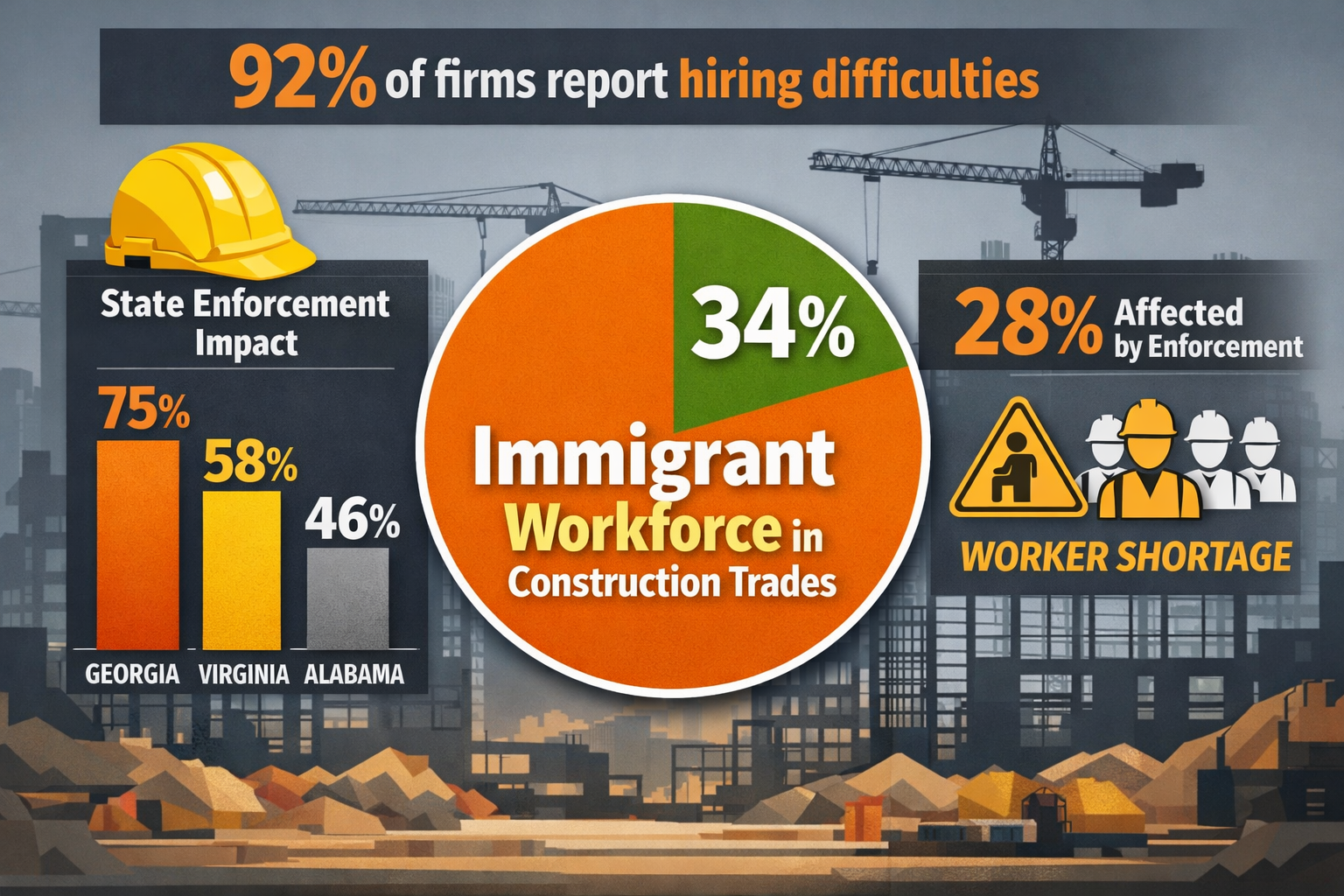
The construction industry faces an unprecedented crisis in 2026 as immigration enforcement activities collide with already strained workforce shortages, creating a perfect storm that is transforming how party wall disputes unfold across the United Kingdom and beyond. With one-third of construction firms reporting direct impacts from immigration enforcement and 92% struggling to hire workers[1], the ripple effects are reaching party wall surveyors who now navigate increasingly complex disputes fueled by project delays, cost overruns, and contractor reliability concerns. Immigration Enforcement and Construction Workforce Disruption: How Party Wall Disputes Are Escalating in 2026 represents more than a headline—it signals a fundamental shift in how neighboring property owners, contractors, and surveyors must approach construction projects involving shared walls.
The numbers tell a sobering story. 34% of construction trades workers are immigrants[2], with some specialized trades reaching as high as 61% immigrant workforce composition. When enforcement actions create what industry experts call a "chilling effect," workers avoid jobsites even when they remain legally in the country, and projects grind to a halt. For party wall matters, this translates to extended timelines, broken agreements, and neighbors locked in disputes that could have been avoided under normal circumstances.
Key Takeaways
- 92% of construction firms report difficulty hiring workers, with 45% directly attributing project delays to labor shortages caused by immigration enforcement impacts[1]
- 28% of construction companies have been affected by immigration enforcement activities in recent months, creating widespread disruption to construction timelines and party wall project schedules[1]
- Party wall disputes are escalating as contractors struggle to meet agreed-upon timelines, leading to increased neighbor conflicts, broken party wall agreements, and costly legal interventions
- Regional variations are significant, with states like Georgia seeing 75% of contractors affected while Idaho and Alaska report only 8-9% impact[1]
- Proactive party wall planning and flexible agreement structures are becoming essential to navigate workforce uncertainty and protect both building owners and adjoining owners
Understanding the Construction Workforce Crisis of 2026
The Scale of Immigration Enforcement Activities
The landscape of immigration enforcement transformed dramatically in early 2026 when ICE announced a 120% workforce increase, adding more than 12,000 officers and agents to enforcement operations[6]. This expansion followed high-profile enforcement actions in major construction markets including Portland, Los Angeles, and Chicago, with a particularly impactful September 2024 raid at a Georgia Hyundai plant that resulted in 475 worker arrests[2].
The construction industry, which has long relied on immigrant labor to fill critical workforce gaps, found itself at the epicenter of enforcement activities. Unlike other sectors, construction sites present visible, accessible locations where enforcement agencies can conduct operations with relative ease. The psychological impact has been profound: one-third of construction firms report workers avoiding jobsites specifically due to immigration enforcement concerns[10], even when those workers have legal authorization to work.
Regional Disparities in Workforce Impact
The effects of Immigration Enforcement and Construction Workforce Disruption: How Party Wall Disputes Are Escalating in 2026 vary dramatically by geography. Georgia contractors face the highest impact at 75%, followed by Virginia, Alabama, Nebraska, and South Carolina, where between 36% and 75% of firms report enforcement-related disruptions[1]. These states have seen construction timelines extend by weeks or months as contractors scramble to replace missing workers or complete projects with skeleton crews.
Conversely, Idaho and Alaska report the lowest impact at 8% and 9% respectively[1], suggesting that workforce composition, local enforcement priorities, and regional economic factors all play roles in determining how severely individual markets experience disruption.
| State/Region | % of Contractors Affected | Primary Impact |
|---|---|---|
| Georgia | 75% | Severe project delays |
| Virginia | 65-75% | Workforce shortages |
| Alabama | 60-70% | Timeline extensions |
| Nebraska | 50-60% | Cost increases |
| South Carolina | 36-50% | Moderate disruption |
| Idaho | 8% | Minimal impact |
| Alaska | 9% | Minimal impact |
The "Chilling Effect" on Construction Labor
Perhaps the most insidious aspect of the current enforcement environment is what economists and industry analysts call the "chilling effect." This phenomenon occurs when workers—including those with legal authorization to work—avoid construction sites due to perceived risk of enforcement actions. As one industry report notes, "The construction inflow of potential workers has been 'turned off,' with early estimates suggesting immigration to the U.S. has declined and potentially reversed"[2].
Undocumented workers are self-deporting or not showing up to work due to fear, even when they remain in the country[2]. This creates a paradoxical situation where labor exists but remains unavailable, leaving contractors unable to staff projects adequately. For party wall projects in North London and other high-density urban areas where construction activity remains robust, this workforce hesitancy translates directly into project delays that cascade into party wall disputes.
How Immigration Enforcement and Construction Workforce Disruption: How Party Wall Disputes Are Escalating in 2026
The Direct Connection Between Workforce Shortages and Party Wall Conflicts
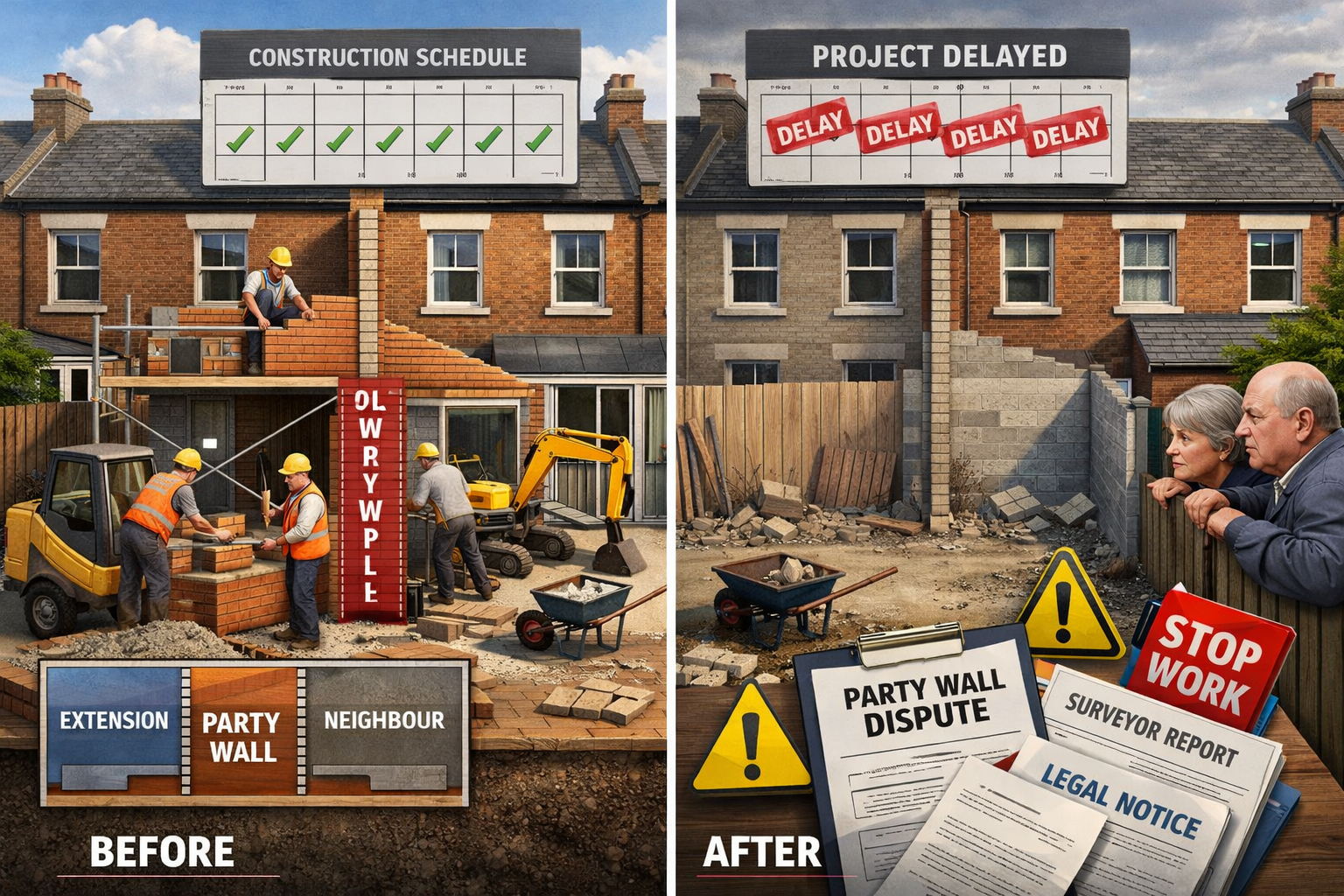
Party wall agreements operate on carefully negotiated timelines, access schedules, and completion dates. When contractors cannot maintain adequate workforce levels, these agreements crumble. Building owners who have served party wall notices and received consent from adjoining owners find themselves unable to fulfill the terms of their party wall awards.
The typical progression follows a predictable pattern:
- Initial Agreement: Building owner serves proper notice under the Party Wall Act, negotiates terms with adjoining owner
- Workforce Disruption: Contractor loses workers to enforcement fears or actual enforcement actions
- Timeline Extension: Project delays beyond agreed completion date
- Neighbor Frustration: Adjoining owner experiences prolonged disruption, noise, and inconvenience
- Dispute Escalation: Relationship deteriorates, leading to formal complaints and potential legal action
Party wall surveyors across South London, West London, and East London report a significant uptick in mid-project disputes where the original party wall agreement remains valid but the practical execution has become impossible due to workforce constraints.
Financial Pressures Amplifying Disputes
The financial dimension of Immigration Enforcement and Construction Workforce Disruption: How Party Wall Disputes Are Escalating in 2026 cannot be overstated. Construction loans in South Texas are down approximately 30% over the past year[5], reflecting how lenders view workforce disruption as a fundamental risk to project completion. This financing squeeze creates additional pressure on building owners who may have borrowed against tight timelines and budgets.
When projects extend beyond planned durations, several cost pressures emerge:
- Extended financing costs as construction loans remain outstanding longer than anticipated
- Increased labor costs as contractors compete for a shrinking pool of available workers
- Material cost escalation due to extended project timelines and inflation
- Additional surveyor fees for revised party wall awards and ongoing dispute resolution
- Potential compensation to adjoining owners for extended disruption periods
These financial pressures often transform what might have been minor disagreements into significant conflicts. Adjoining owners who initially consented to three months of construction disruption become far less accommodating when that timeline extends to six or nine months due to workforce unavailability.
Contractor Reliability and Party Wall Agreement Compliance
The traditional party wall process assumes contractor reliability and continuity. Building owners select contractors, those contractors provide timelines and methods of work, and party wall awards formalize these commitments. However, the current enforcement environment has introduced unprecedented uncertainty into contractor performance.
Some contractors have simply abandoned projects mid-stream when their workforce disappeared overnight following enforcement actions. Others continue working but at drastically reduced capacity, turning a six-week loft conversion into a six-month ordeal for neighboring properties. Understanding what party wall notices are and how to respond becomes more complex when the underlying assumptions about contractor capability no longer hold.
Party wall surveyors now face difficult questions:
- How should party wall awards account for workforce uncertainty?
- What contingency timelines are reasonable in the current environment?
- When does workforce disruption constitute a material breach of a party wall agreement?
- What remedies are available to adjoining owners facing indefinite project extensions?
The Broader Economic Context of Immigration Enforcement and Construction Workforce Disruption
Construction Industry Economic Impacts
The construction sector's economic contribution makes workforce disruption particularly consequential for broader economic health. A recent report from Los Angeles County revealed widespread economic impacts of federal immigration enforcement[9], with construction representing one of the hardest-hit sectors due to its high concentration of immigrant workers.
The economic ripple effects include:
- Delayed housing development exacerbating existing housing shortages
- Increased construction costs passed through to homebuyers and commercial tenants
- Reduced property tax revenue as projects stall or cancel
- Supply chain disruption as construction material suppliers face reduced demand
- Employment losses in construction-adjacent industries
For property owners engaged in party wall projects, these macro-economic factors translate into micro-level challenges. The contractor who seemed reliable during the bidding process may struggle to complete work as their subcontractor network collapses due to workforce losses.
Regional Construction Market Variations
The impact of Immigration Enforcement and Construction Workforce Disruption: How Party Wall Disputes Are Escalating in 2026 varies significantly by regional construction market characteristics. Urban areas with high concentrations of terraced housing and shared walls—common in Central London and similar dense urban environments—face particular challenges.
These markets typically feature:
- High volume of party wall projects due to dense housing stock
- Specialized trades with high immigrant workforce concentration
- Complex regulatory environments requiring experienced contractors
- Premium pricing that can absorb some cost increases but not indefinite delays
Suburban and rural markets face different dynamics, with fewer party wall issues but potentially greater vulnerability to workforce shortages in specialized trades like masonry, concrete work, and framing—all trades with significant immigrant workforce participation.
The Psychology of Neighbor Relations Under Stress
Beyond the legal and financial dimensions, Immigration Enforcement and Construction Workforce Disruption: How Party Wall Disputes Are Escalating in 2026 highlights the psychological strain that prolonged construction uncertainty places on neighbor relations. Party wall matters inherently involve close proximity, shared structures, and mutual dependencies that require goodwill and patience.
When construction timelines extend indefinitely due to workforce issues beyond the building owner's control, several psychological factors intensify disputes:
- Erosion of trust as promised completion dates pass without resolution
- Fatigue from prolonged disruption affecting quality of life and home enjoyment
- Resentment over perceived lack of control as adjoining owners feel powerless
- Anxiety about property damage when inexperienced replacement workers take over
- Financial stress for both parties as costs mount and property use remains restricted
Party wall surveyors increasingly find themselves serving as mediators and counselors as much as technical experts, helping neighbors navigate the emotional dimensions of extended construction disruption that neither party anticipated when the original party wall agreement was signed.
Practical Strategies for Navigating Party Wall Matters During Workforce Disruption
Enhanced Due Diligence for Building Owners
Building owners planning construction work in 2026 must approach party wall matters with enhanced due diligence that accounts for workforce uncertainty. Traditional contractor vetting focused on technical capability, pricing, and references. Today's environment demands additional scrutiny:
✅ Workforce Stability Assessment
- Request information about contractor's workforce composition and stability
- Understand backup plans if key workers become unavailable
- Verify subcontractor relationships and their workforce reliability
✅ Timeline Contingency Planning
- Build 30-50% timeline buffers into party wall agreements
- Establish milestone-based progress requirements rather than fixed completion dates
- Include provisions for timeline extensions due to workforce disruption
✅ Financial Protections
- Ensure adequate project financing to cover extended timelines
- Consider performance bonds or completion guarantees
- Budget for potential compensation to adjoining owners for extended disruption
✅ Communication Protocols
- Establish regular update schedules with adjoining owners
- Create transparent reporting on workforce challenges and mitigation efforts
- Maintain professional party wall surveyor involvement throughout project duration
Understanding how to keep party wall costs down remains important, but not at the expense of adequate contingency planning for workforce disruption scenarios.
Adjoining Owner Protections and Rights
Adjoining owners facing party wall projects in the current environment need enhanced protections beyond traditional party wall awards. When reviewing proposed work and party wall agreement templates, adjoining owners should insist on:
🛡️ Enhanced Timeline Provisions
- Maximum project duration clauses with specific remedies if exceeded
- Regular progress reporting requirements
- Right to independent verification of workforce-related delays
🛡️ Compensation Structures
- Graduated compensation for disruption extending beyond agreed timelines
- Coverage of costs for temporary relocation if disruption becomes excessive
- Reimbursement for independent surveyor review of extended timelines
🛡️ Quality Assurance Measures
- Right to approve replacement contractors if original contractor abandons project
- Enhanced schedule of condition documentation
- More frequent condition monitoring during extended project timelines
🛡️ Exit Provisions
- Circumstances under which work must cease if timelines become unreasonable
- Building owner obligations to restore property if project abandonment occurs
- Clear allocation of costs for incomplete work affecting party walls
Party Wall Surveyor Best Practices in 2026
Party wall surveyors must adapt their practices to address Immigration Enforcement and Construction Workforce Disruption: How Party Wall Disputes Are Escalating in 2026. Modern party wall awards should incorporate workforce uncertainty as a recognized risk factor:
📋 Award Drafting Enhancements:
- Include specific provisions addressing workforce disruption scenarios
- Establish clear communication protocols for delay notifications
- Create framework for timeline adjustments without requiring complete award revision
- Define objective criteria for distinguishing legitimate workforce challenges from contractor incompetence
📋 Ongoing Project Monitoring:
- Schedule periodic site visits to verify progress and workforce presence
- Maintain communication channels with both building and adjoining owners
- Document workforce-related challenges as they emerge
- Provide early warning when delays threaten to breach agreement terms
📋 Dispute Resolution Frameworks:
- Establish mediation processes before disputes escalate to formal legal action
- Create graduated response protocols for timeline extensions
- Maintain neutrality while acknowledging unprecedented industry challenges
- Document industry-wide workforce conditions to provide context for individual project delays
For those wondering about having a party wall agreement without a surveyor, the current environment strongly argues against this approach. Professional surveyor involvement provides essential protection when workforce uncertainty makes informal agreements particularly vulnerable to breakdown.
Industry Response and Adaptation Strategies
Construction Firm Compliance and Preparedness
Forward-thinking construction firms are implementing comprehensive compliance and preparedness strategies to navigate the enforcement environment while maintaining project capability. Industry guidance emphasizes rapid response preparedness[6] including:
🔧 Workforce Documentation:
- Enhanced I-9 verification processes
- Regular audits of subcontractor compliance
- Digital documentation systems for rapid verification during enforcement actions
🔧 Operational Continuity Planning:
- Cross-training workers to reduce dependency on specific individuals
- Maintaining relationships with multiple subcontractors for critical trades
- Geographic diversification of workforce sourcing where possible
🔧 Client Communication:
- Transparent disclosure of workforce challenges during bidding
- Regular updates on workforce stability throughout project duration
- Proactive timeline adjustment requests before delays become critical
🔧 Legal Preparedness:
- Relationships with immigration attorneys for rapid response to enforcement actions
- Understanding of rights and obligations during worksite enforcement visits
- Training for supervisors on appropriate responses to enforcement activities
Industry Association Advocacy
Construction industry associations have mobilized to address workforce challenges through advocacy and member support. The Associated General Contractors (AGC) survey revealing that 92% of firms struggle with hiring[1] has catalyzed industry-wide calls for comprehensive immigration reform that balances enforcement with economic necessity.
Industry advocacy focuses on:
- Temporary worker programs to provide legal pathways for construction labor
- Enforcement predictability to reduce the chilling effect on legal workers
- Industry-specific considerations in enforcement policy development
- Workforce development initiatives to expand domestic labor pool
For Architecture, Engineering, and Construction (AEC) firms, the challenges extend beyond labor to include immigration challenges affecting professional staff[7], creating workforce pressure at multiple skill levels.
Technology and Process Innovation
The workforce crisis is accelerating adoption of technology and process innovations that reduce labor dependency:
- Prefabrication and modular construction reducing onsite labor requirements
- Robotics and automation for repetitive tasks in masonry and concrete work
- Advanced project management software optimizing available workforce deployment
- Digital collaboration tools enabling remote expert consultation to supplement onsite crews
While these innovations cannot fully replace skilled construction labor, they provide partial mitigation of workforce shortages and may reduce timeline extensions for party wall projects.
Legal and Regulatory Considerations
Party Wall Act Application in Uncertain Times
The Party Wall etc. Act 1996 provides a robust framework for managing construction affecting shared walls, but it was drafted in an era of relatively stable construction workforce availability. The Act's provisions assume that building owners can reasonably control project timelines and methods of work—assumptions challenged by current workforce uncertainty.
Key legal questions emerging in 2026 include:
⚖️ Force Majeure and Party Wall Agreements:
Do workforce disruptions caused by immigration enforcement constitute force majeure events excusing timeline breaches? Courts have not yet definitively addressed this question in the party wall context, creating uncertainty for both building and adjoining owners.
⚖️ Reasonable Timeframes:
What constitutes a "reasonable" timeframe for party wall work when industry-wide workforce shortages extend typical project durations? Traditional expectations may require adjustment to reflect current realities.
⚖️ Building Owner Obligations:
To what extent must building owners go to maintain workforce and project continuity? Are they obligated to pay premium wages to attract workers, or can they cite market conditions as justification for delays?
⚖️ Adjoining Owner Remedies:
What remedies are available when workforce disruption extends projects beyond reasonable bounds? Can adjoining owners demand work cessation, seek damages, or require contractor replacement?
Enforcement Actions and Construction Site Rights
Construction firms must understand their rights and obligations when enforcement actions occur at worksites. Recent guidance on ICE enforcement rapid response preparedness[6] emphasizes:
- Administrative warrants vs. judicial warrants and the different access rights they convey
- Employer obligations to provide access versus rights to verify warrant validity
- Worker rights regardless of immigration status
- Documentation requirements and record preservation during enforcement actions
For party wall projects, enforcement actions create immediate challenges. Work stops, workers may not return, and project timelines become uncertain. Building owners should include enforcement action protocols in contracts with construction firms, specifying notification requirements and continuity plans.
Insurance and Liability Considerations
The intersection of workforce disruption and party wall disputes raises complex insurance and liability questions:
🔒 Professional Indemnity Insurance:
Party wall surveyors should verify that their professional indemnity coverage addresses disputes arising from workforce-related project delays, particularly if awards are challenged for failing to account for foreseeable workforce risks.
🔒 Contractor Liability Insurance:
Building owners should verify that contractor insurance policies remain valid if workforce composition changes significantly during project execution, and that coverage extends to delays caused by workforce disruption.
🔒 Project Completion Insurance:
Consideration of specialized insurance products that protect against project abandonment or excessive delays due to workforce unavailability may be warranted for significant party wall projects.
Future Outlook and Long-Term Implications

Structural Changes to Construction Labor Markets
Immigration Enforcement and Construction Workforce Disruption: How Party Wall Disputes Are Escalating in 2026 may represent not a temporary disruption but a fundamental restructuring of construction labor markets. Industry analysts suggest several potential long-term outcomes:
📊 Workforce Composition Shifts:
- Increased automation and prefabrication reducing labor intensity
- Higher wages attracting domestic workers to construction trades
- Formalization of previously informal labor arrangements
- Potential guest worker programs providing legal pathways for immigrant construction labor
📊 Project Cost and Timeline Adjustments:
- Permanent increase in construction costs reflecting labor scarcity
- Extended standard timelines becoming the new normal
- Greater project risk premiums in financing and insurance
- Reduced volume of small-scale residential construction projects
📊 Party Wall Practice Evolution:
- More sophisticated party wall awards addressing workforce uncertainty
- Increased surveyor involvement throughout project duration rather than just at initiation
- Enhanced dispute resolution mechanisms built into standard agreements
- Greater emphasis on contractor vetting and capability assessment
Regional Market Divergence
The geographic variation in enforcement impacts suggests potential divergence of regional construction markets. Areas with lower immigrant workforce concentration or less aggressive enforcement may see competitive advantages in construction capacity, potentially attracting development activity away from high-impact regions.
For party wall practitioners, this could mean:
- Market-specific practice adaptations reflecting local workforce conditions
- Regional variation in standard timeline assumptions for party wall awards
- Geographic arbitrage as developers shift activity to areas with more stable workforces
- Localized expertise requirements as surveyors need deep understanding of regional workforce dynamics
Policy and Reform Possibilities
The construction industry's economic importance and the visibility of workforce challenges may catalyze policy reforms addressing immigration and construction labor. Potential developments include:
- Industry-specific visa programs providing legal pathways for construction workers
- Enforcement modifications reducing the chilling effect on legal workers
- Workforce development initiatives expanding domestic construction labor pool
- Regulatory streamlining to reduce labor requirements for certain construction activities
Party wall practitioners should monitor policy developments, as reforms could significantly affect the workforce stability assumptions underlying party wall agreements and awards.
Conclusion: Navigating Party Wall Matters in an Era of Workforce Uncertainty
Immigration Enforcement and Construction Workforce Disruption: How Party Wall Disputes Are Escalating in 2026 represents a defining challenge for property owners, contractors, and party wall professionals. The convergence of aggressive enforcement, high immigrant workforce concentration in construction trades, and the chilling effect on worker availability has created unprecedented uncertainty in construction project execution.
For building owners, success requires enhanced due diligence, realistic timeline expectations, adequate contingency planning, and proactive communication with adjoining owners. The days of assuming contractor reliability and predictable project timelines have given way to a new reality requiring flexibility and preparedness.
For adjoining owners, protection demands insistence on enhanced party wall agreement provisions, clear remedies for timeline extensions, and professional surveyor involvement to navigate increasingly complex disputes. Understanding rights under types of party wall works becomes more critical when projects may extend far beyond initial expectations.
For party wall surveyors, professional excellence now requires incorporating workforce uncertainty into awards, maintaining active project involvement, facilitating communication between parties, and providing dispute resolution when workforce challenges strain neighbor relations. The technical aspects of party wall work remain important, but the human dimensions of managing expectations and mediating conflicts have become equally critical.
Actionable Next Steps
🎯 For Building Owners Planning Construction:
- Conduct enhanced contractor vetting focusing on workforce stability
- Build 30-50% timeline buffers into party wall agreements
- Establish transparent communication protocols with adjoining owners
- Ensure adequate project financing for potential timeline extensions
- Engage professional party wall surveyors early in planning process
🎯 For Adjoining Owners Receiving Party Wall Notices:
- Insist on realistic timelines with specific remedies for extensions
- Require regular progress reporting and workforce status updates
- Engage independent party wall surveyor to protect interests
- Document all agreements and communications thoroughly
- Understand rights and remedies available under party wall legislation
🎯 For Party Wall Surveyors:
- Update standard party wall award templates to address workforce uncertainty
- Establish ongoing project monitoring protocols
- Create dispute resolution frameworks for workforce-related delays
- Maintain awareness of regional workforce conditions and enforcement activities
- Provide clients with realistic expectations based on current industry conditions
🎯 For Construction Firms:
- Implement comprehensive workforce compliance and documentation systems
- Develop operational continuity plans for enforcement scenarios
- Communicate transparently with clients about workforce challenges
- Invest in workforce development and retention initiatives
- Explore technology and process innovations reducing labor dependency
The challenges of Immigration Enforcement and Construction Workforce Disruption: How Party Wall Disputes Are Escalating in 2026 are significant, but they are not insurmountable. With realistic expectations, proactive planning, professional guidance, and good-faith communication, property owners and their neighbors can successfully navigate party wall projects even in this uncertain environment.
Those seeking professional assistance should consult experienced party wall surveyors who understand the current workforce dynamics and can craft agreements that protect all parties while acknowledging industry realities. The costs of party wall processes may increase somewhat due to enhanced complexity, but this investment provides essential protection against far more costly disputes arising from workforce-related project failures.
The construction industry has weathered significant challenges throughout its history, and it will adapt to current workforce disruptions as well. Party wall practice will evolve alongside these adaptations, developing new approaches that maintain the essential protections for building and adjoining owners while accommodating the realities of a transformed labor market. By staying informed, planning proactively, and working collaboratively, all stakeholders can successfully manage party wall matters even as Immigration Enforcement and Construction Workforce Disruption: How Party Wall Disputes Are Escalating in 2026.
References
[1] Construction Workforce Shortages Are Leading Cause Project Delays Immigration Enforcement Affects – https://www.agc.org/news/2025/08/28/construction-workforce-shortages-are-leading-cause-project-delays-immigration-enforcement-affects
[2] constructiondive – https://www.constructiondive.com/news/how-immigration-enforcement-will-impact-construction-in-2026/809482/
[3] Immigration Enforcement In 2026 What 6395570 – https://www.jdsupra.com/legalnews/immigration-enforcement-in-2026-what-6395570/
[4] 2026 Immigration Enforcement Update Preparing For Ice Raids And Dhs Actions In The Construction Industry – https://www.fisherphillips.com/en/news-insights/2026-immigration-enforcement-update-preparing-for-ice-raids-and-dhs-actions-in-the-construction-industry.html
[5] Construction Site Ice Raids Hurting Economy And Building Industry – https://www.tpr.org/border-immigration/2026-02-04/construction-site-ice-raids-hurting-economy-and-building-industry
[6] Ice Enforcement Rapid Response Preparedness – https://www.kutakrock.com/newspublications/publications/2026/february/ice-enforcement-rapid-response-preparedness
[7] Immigration Challenges Aec Firms 2026 – https://zweiggroup.com/blogs/news/immigration-challenges-aec-firms-2026
[8] Pulse Poll Results Immigration Enforcement Impacts On Practice – https://www.asla.org/news-insights/land/pulse-poll-results-immigration-enforcement-impacts-on-practice
[9] New Report From La County Deo And Laedc Reveals Widespread Economic Impacts Of Federal Immigration Enforcement – https://lacounty.gov/2026/02/09/new-report-from-la-county-deo-and-laedc-reveals-widespread-economic-impacts-of-federal-immigration-enforcement/
[10] Construction – https://www.hubinternational.com/insights/outlook/2026/construction/