

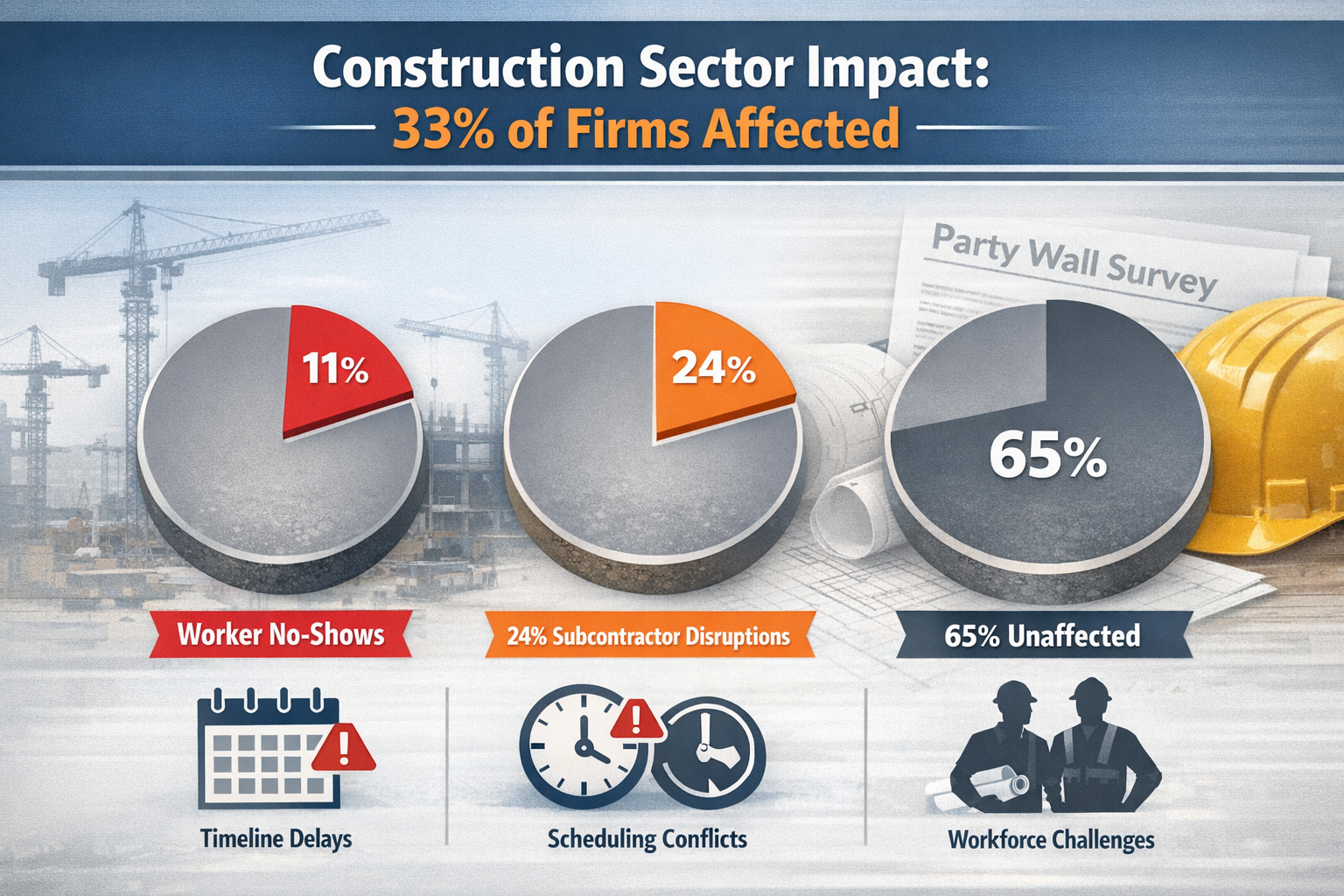
The construction industry across London and the broader United Kingdom faces unprecedented disruption in 2026, and the ripple effects are being felt in unexpected corners of the property sector. One-third of construction firms have been affected by immigration enforcement, with 11% reporting worker no-shows and 24% experiencing subcontractor disruptions [5]. For party wall surveyors navigating the complexities of the Party Wall etc. Act 1996, understanding the Immigration Enforcement Impact on Party Wall Surveys: Workforce Challenges and Timeline Management in 2026 has become essential to delivering effective service to building owners and adjoining owners alike.
Party wall surveyors operate at the intersection of construction, property law, and neighbor relations. When immigration enforcement actions disrupt the construction workforce, the consequences cascade through every stage of the party wall process—from initial inspections to the completion of building works. Delayed timelines, rescheduled appointments, and contractor unavailability now require surveyors to adopt new strategies for managing expectations and protecting all parties' interests.
Key Takeaways
- Construction workforce disruptions affect 33% of firms in 2026, with 11% experiencing worker no-shows and 24% facing subcontractor issues due to immigration enforcement actions
- Party wall survey timelines are extending beyond standard periods, requiring surveyors to build additional buffers into scheduling and party wall awards
- Proactive risk management strategies, including contractor vetting, contingency planning, and enhanced communication, are essential for surveyors navigating workforce uncertainties
- Economic impacts of enforcement extend beyond labor availability to affect project costs, insurance considerations, and dispute resolution timelines
- Professional adaptation requires surveyors to update their practices, documentation, and client advisement to address workforce volatility in 2026
Understanding the Construction Workforce Crisis in 2026
Immigration Enforcement and Economic Disruption
The construction sector's reliance on immigrant labor has made it particularly vulnerable to enforcement actions in 2026. Recent economic analysis reveals that one-third of construction firms have experienced direct impacts from immigration enforcement operations [5]. This disruption manifests in two primary ways:
- Worker no-shows (11% of firms): Construction workers failing to appear at job sites due to enforcement concerns or actual detention
- Subcontractor disruptions (24% of firms): Specialized contractors unable to fulfill commitments due to workforce depletion
The Immigration Enforcement Impact on Party Wall Surveys: Workforce Challenges and Timeline Management in 2026 extends beyond simple labor shortages. Party wall surveyors must now account for unpredictable workforce availability when scheduling inspections, coordinating with contractors, and establishing realistic timelines for building works completion.
Public Opinion and Policy Context
Understanding the broader political landscape helps surveyors anticipate future enforcement patterns. Recent polling data from early 2026 shows complex public attitudes toward immigration enforcement:
📊 Public Support Metrics:
- 61% of Americans support deportations of undocumented immigrants with criminal records [1]
- 54% support increased border security measures [2]
- 47% express concerns about enforcement tactics affecting communities [3]
- 52% worry about economic disruption from enforcement actions [4]
These statistics reflect the tension between enforcement priorities and economic stability concerns. For the construction industry—and by extension, party wall surveyors—this uncertainty creates planning challenges that require adaptive strategies.
Sector-Specific Vulnerabilities
The construction industry's unique characteristics make it especially susceptible to workforce disruption:
| Industry Factor | Impact on Party Wall Work | Surveyor Consideration |
|---|---|---|
| High immigrant workforce percentage | Reduced contractor availability | Longer lead times for scheduling |
| Subcontractor specialization | Specific trades unavailable | Alternative contractor networks needed |
| Project timeline sensitivity | Delays cascade through phases | Extended buffer periods required |
| Regulatory compliance requirements | Incomplete work creates liability | Enhanced monitoring protocols |
| Neighbor coordination needs | Rescheduling affects multiple parties | Improved communication strategies |
When carrying out works that require party wall procedures, building owners now face extended timelines that surveyors must factor into their planning and documentation.
Immigration Enforcement Impact on Party Wall Surveys: Timeline Complications and Scheduling Challenges
The Party Wall Process Timeline Under Normal Conditions
To understand how workforce disruptions affect party wall surveys, it's essential to review the standard process timeline:
Standard Party Wall Procedure:
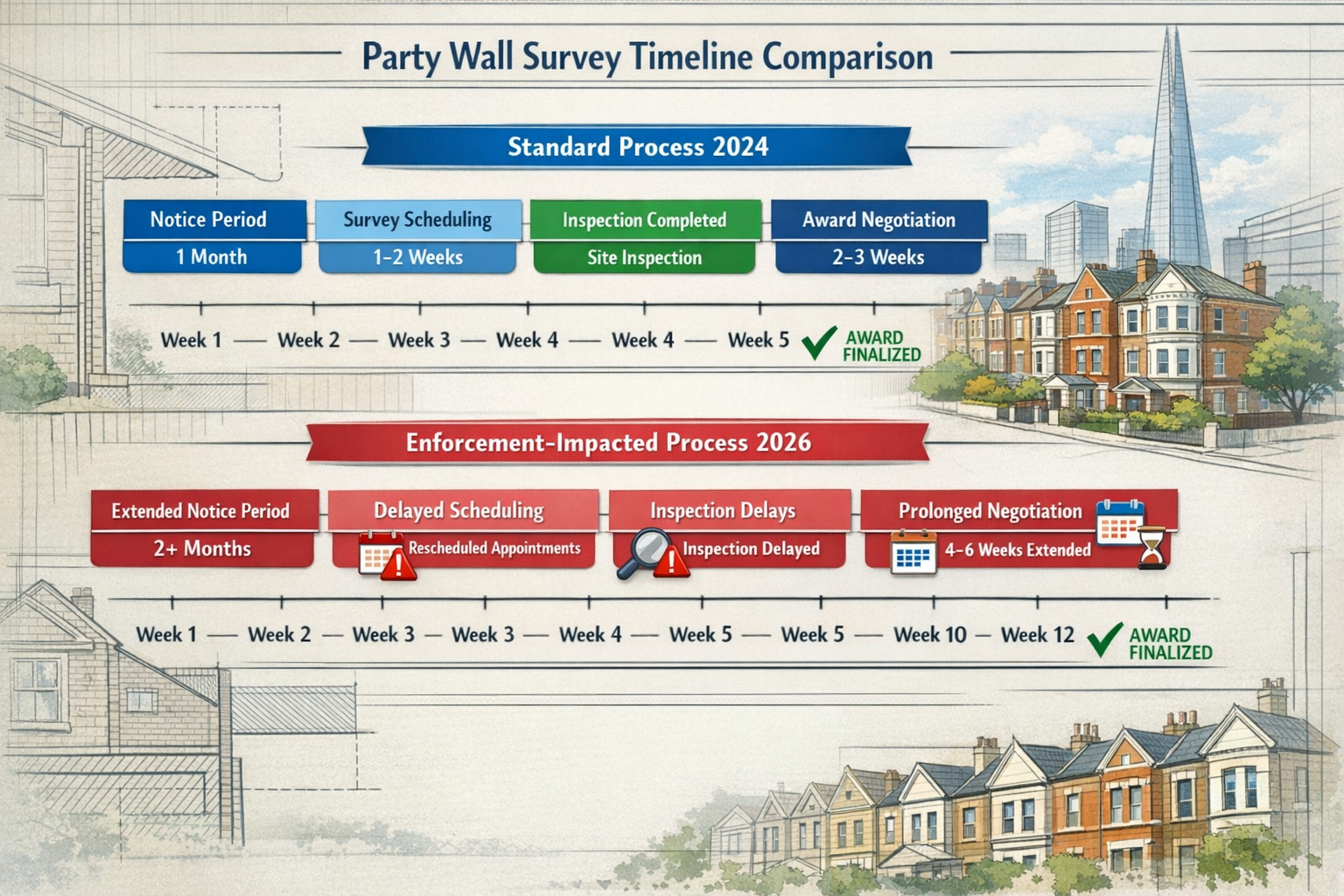
- Notice Period (1-2 months): Building owner serves party wall notices to adjoining owners
- Surveyor Appointment (2-4 weeks): Parties appoint surveyors or agree to use the same surveyor
- Initial Inspection (1-2 weeks): Surveyors conduct schedule of condition surveys
- Award Preparation (2-4 weeks): Surveyors draft and agree upon the party wall award
- Construction Phase (varies): Building works proceed according to award terms
- Final Inspection (1-2 weeks): Post-construction condition assessment
Under optimal conditions, the pre-construction party wall process typically spans 2-4 months from initial notice to commencement of works.
2026 Timeline Extensions Due to Workforce Disruptions
The Immigration Enforcement Impact on Party Wall Surveys: Workforce Challenges and Timeline Management in 2026 has fundamentally altered these timelines:
Extended Timeline Factors:
🔴 Inspection Scheduling Delays
- Contractors unavailable for preliminary meetings
- Building owner's representatives unable to attend scheduled inspections
- Specialist trades needed for technical assessments not available
- Result: Initial inspections extending from 1-2 weeks to 3-6 weeks
🔴 Award Negotiation Complications
- Uncertainty about contractor availability affects condition specifications
- Timeline provisions in awards require larger buffers
- Dispute resolution delayed when parties can't coordinate schedules
- Result: Award preparation extending from 2-4 weeks to 4-8 weeks
🔴 Construction Phase Interruptions
- Mid-project workforce changes requiring re-inspection
- Prolonged work periods affecting adjoining owners
- Increased likelihood of disputes requiring surveyor intervention
- Result: Construction timelines 25-40% longer than projected
Real-World Scheduling Challenges for Surveyors
Party wall surveyors across East London, North London, and other areas report specific challenges:
Case Study Example: Loft Conversion Project
A typical loft conversion requiring party wall procedures might have proceeded as follows in 2024:
- Week 1-8: Notice period and surveyor appointment
- Week 9-10: Schedule of condition inspection
- Week 11-14: Award preparation
- Week 15-26: Construction (12 weeks)
- Week 27: Final inspection
Same project in 2026 with workforce disruptions:
- Week 1-8: Notice period and surveyor appointment
- Week 9-14: Schedule of condition inspection (delayed 4 weeks due to contractor unavailability)
- Week 15-22: Award preparation (extended due to timeline uncertainty)
- Week 23-40: Construction (18 weeks—50% longer due to workforce interruptions)
- Week 41-42: Final inspection (delayed due to contractor scheduling)
This represents a 55% increase in total project duration, creating significant implications for all parties involved.
Impact on Different Types of Party Wall Works
The workforce challenges affect various types of party wall works differently:
Excavation and Foundation Works:
- Specialized groundwork contractors particularly affected
- Safety-critical timelines create additional pressure
- Delays in shoring work create cascading schedule impacts
Party Structure Alterations:
- Structural engineers and specialist contractors in high demand
- Limited availability extends inspection and approval timelines
- Mid-project modifications more difficult to coordinate
New Building on Boundary Line:
- Coordination with multiple trades becomes more complex
- Extended construction periods increase neighbor relations challenges
- Surveyors must anticipate longer dispute resolution periods
Workforce Challenges: Practical Implications for Party Wall Surveyors
Contractor Availability and Vetting Challenges
Party wall surveyors in 2026 face new responsibilities regarding contractor assessment and recommendation. The Immigration Enforcement Impact on Party Wall Surveys: Workforce Challenges and Timeline Management in 2026 requires surveyors to consider:
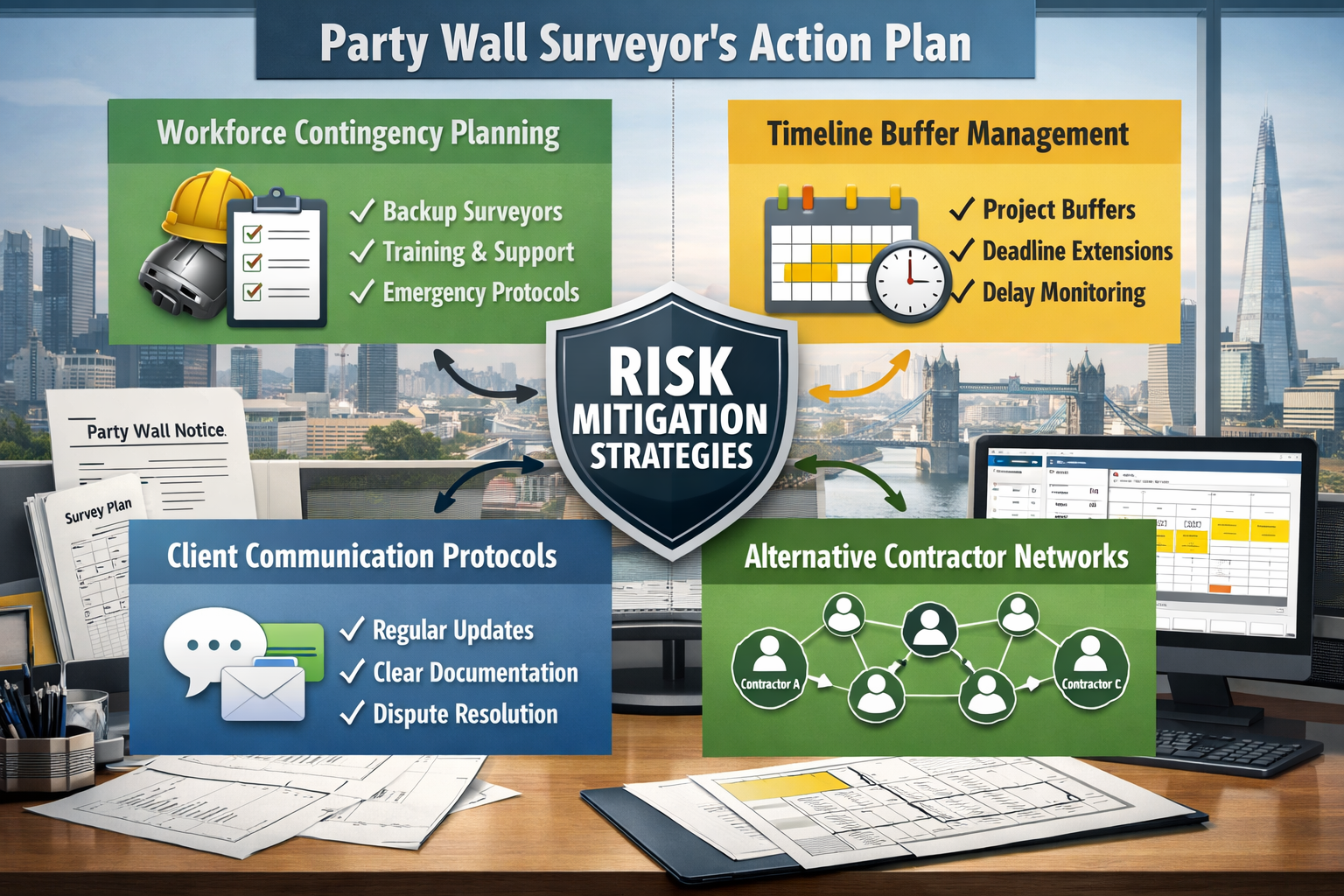
Enhanced Contractor Due Diligence:
✅ Workforce Stability Assessment
- Requesting information about contractor workforce composition
- Evaluating contractor's contingency plans for labor disruptions
- Assessing contractor's track record for completing projects on schedule in 2026
- Verifying contractor's compliance with employment regulations
✅ Alternative Contractor Networks
- Maintaining relationships with multiple contractors in each specialty
- Developing backup options for critical trades
- Creating pre-vetted contractor lists for rapid replacement if needed
- Coordinating with building owners about contractor selection criteria
✅ Timeline Realism
- Advising clients to add 30-50% buffer to standard construction timelines
- Building flexibility into party wall awards for schedule adjustments
- Setting realistic expectations with adjoining owners about project duration
- Documenting workforce-related delays to protect all parties
Managing Adjoining Owner Expectations
The extended timelines created by workforce disruptions significantly impact adjoining owners who must tolerate construction activities for longer periods. Surveyors must proactively manage these relationships:
Communication Strategies:
📢 Proactive Disclosure
- Informing adjoining owners about industry-wide workforce challenges
- Setting realistic expectations about project duration from the outset
- Explaining how workforce disruptions may affect the construction schedule
- Providing regular updates when delays occur
📢 Award Provisions
- Including specific clauses addressing workforce-related delays
- Establishing notification requirements when contractors change
- Creating mechanisms for timeline extensions without dispute
- Protecting adjoining owners' rights while acknowledging industry realities
📢 Dispute Prevention
- Documenting all workforce-related delays thoroughly
- Maintaining clear communication channels between all parties
- Addressing concerns promptly before they escalate to formal disputes
- Offering solutions when extended timelines create hardship
Insurance and Liability Considerations
Workforce disruptions create new liability exposures that party wall surveyors must address:
Risk Management Priorities:
⚠️ Professional Indemnity Insurance
- Ensuring coverage addresses workforce-related project delays
- Documenting surveyor's reasonable efforts to mitigate timeline impacts
- Maintaining detailed records of all advice provided regarding timelines
- Consulting with insurers about emerging risk factors
⚠️ Building Owner Protection
- Advising clients about increased project cost risks
- Recommending appropriate contingency budgets (typically 15-25% higher)
- Ensuring adequate contractor insurance coverage
- Documenting all workforce-related issues for potential claims
⚠️ Adjoining Owner Safeguards
- Ensuring party wall awards protect against prolonged construction impacts
- Addressing compensation mechanisms for extended disruption periods
- Maintaining inspection schedules despite contractor delays
- Preserving adjoining owners' rights to timely completion
Strategic Adaptations: Best Practices for Party Wall Surveyors in 2026
Revised Timeline Planning and Documentation
Successful party wall surveyors in 2026 have adapted their practices to address the Immigration Enforcement Impact on Party Wall Surveys: Workforce Challenges and Timeline Management in 2026:
Updated Timeline Templates:
| Project Phase | Pre-2026 Duration | 2026 Recommended Duration | Buffer Percentage |
|---|---|---|---|
| Notice Period | 1-2 months | 1-2 months | 0% (statutory) |
| Surveyor Appointment | 2-4 weeks | 3-6 weeks | 50% |
| Initial Inspection | 1-2 weeks | 3-6 weeks | 200% |
| Award Preparation | 2-4 weeks | 4-8 weeks | 100% |
| Construction (typical) | 8-16 weeks | 12-24 weeks | 50% |
| Final Inspection | 1-2 weeks | 2-4 weeks | 100% |
These extended timelines should be incorporated into all party wall documentation, client advisement, and party wall awards.
Enhanced Communication Protocols
Professional surveyors working across Central London, West London, South London, and surrounding areas have implemented enhanced communication strategies:
Multi-Party Communication Framework:
-
Initial Consultation Phase
- Discuss workforce challenges explicitly with building owners
- Explain potential timeline impacts during surveyor appointment
- Set realistic expectations about project duration and costs
- Provide written documentation of timeline assumptions
-
Award Preparation Phase
- Include workforce contingency clauses in party wall awards
- Establish clear notification requirements for contractor changes
- Create mechanisms for timeline adjustments without formal disputes
- Document assumptions about contractor availability
-
Construction Phase
- Implement weekly progress reporting to all parties
- Provide immediate notification of workforce-related delays
- Maintain detailed logs of all schedule changes and reasons
- Conduct regular check-ins with both building and adjoining owners
-
Dispute Resolution Phase
- Document all workforce-related factors contributing to disputes
- Present evidence of reasonable efforts to mitigate delays
- Engage third-party surveyors when workforce issues create conflicts
- Utilize alternative dispute resolution mechanisms efficiently
Leveraging Technology for Improved Management
Modern party wall surveyors are adopting technological solutions to manage workforce-related uncertainties:
Digital Tools and Platforms:
💻 Project Management Software
- Cloud-based scheduling platforms with real-time updates
- Automated notifications when timeline changes occur
- Shared access for building owners, adjoining owners, and contractors
- Historical data tracking for timeline accuracy improvement
💻 Virtual Inspection Capabilities
- Video conferencing for preliminary assessments when contractor unavailability delays site access
- Photographic documentation protocols for remote condition assessment
- Digital annotation tools for schedule of condition reports
- Secure cloud storage for all documentation
💻 Communication Platforms
- Dedicated project communication channels for all parties
- Automated update distribution when delays occur
- Document sharing platforms for party wall awards and notices
- Timeline visualization tools for client understanding
Financial Planning and Cost Management
Understanding the costs of party wall the process has become more complex in 2026 due to workforce uncertainties:
Cost Considerations for Building Owners:
💰 Direct Cost Increases
- Surveyor fees: 10-20% higher due to extended project management requirements
- Contractor costs: 15-30% higher due to labor scarcity and competition
- Extended timeline costs: Additional site security, insurance, and overhead
- Contingency requirements: 20-25% recommended vs. 10-15% pre-2026
💰 Indirect Cost Factors
- Delayed project completion affecting rental income or occupancy plans
- Extended financing costs due to longer construction periods
- Increased risk of cost escalation during prolonged projects
- Potential dispute resolution costs if workforce issues create conflicts
Cost Implications for Adjoining Owners:
💰 Surveyor Fee Considerations
- Increased time requirements for monitoring extended construction periods
- Additional inspections needed due to workforce changes
- Enhanced documentation requirements for prolonged projects
- Potential dispute resolution costs
Surveyors should provide clear guidance on how to keep party wall costs down while acknowledging the realities of workforce challenges in 2026.
Regulatory Compliance and Professional Standards
Party Wall etc. Act 1996 Interpretation
The Party Wall etc. Act 1996 does not explicitly address workforce disruptions, requiring surveyors to interpret statutory requirements in light of 2026 realities:
Statutory Obligations vs. Practical Realities:
⚖️ Notice Period Requirements
- Statutory notice periods remain unchanged regardless of workforce conditions
- Surveyors must ensure building owners comply with minimum notice requirements
- Extended timelines should be planned after statutory notice periods
- Party wall act notices must be served according to statutory timelines
⚖️ Award Preparation Obligations
- Surveyors must prepare awards "within reasonable time"
- 2026 workforce conditions affect what constitutes "reasonable"
- Awards should address workforce contingencies explicitly
- Documentation of delays protects surveyors from liability
⚖️ Work Completion Requirements
- Building owners remain obligated to complete works diligently
- Workforce disruptions may constitute legitimate delay reasons
- Surveyors should document workforce-related delays thoroughly
- Adjoining owners' rights must be balanced against industry realities
Professional Body Guidance
Professional surveying organizations have begun addressing workforce challenges in their guidance materials:
Emerging Best Practices:
📋 Documentation Standards
- Maintaining detailed records of all workforce-related communications
- Documenting contractor availability issues and mitigation efforts
- Recording all timeline adjustments and justifications
- Preserving evidence for potential dispute resolution
📋 Client Advisory Obligations
- Informing clients about industry-wide workforce challenges
- Providing realistic timeline estimates based on current conditions
- Advising on appropriate contingency planning
- Explaining cost implications of workforce uncertainties
📋 Dispute Resolution Protocols
- Distinguishing between avoidable and unavoidable delays
- Applying reasonable standards given 2026 workforce conditions
- Utilizing mediation and alternative dispute resolution
- Engaging third-party surveyors when workforce issues create conflicts
Case Studies: Real-World Applications
Case Study 1: Basement Excavation in East London
Project Overview:
- Semi-detached Victorian property requiring basement excavation
- Significant excavation within 3 meters of adjoining owner's foundation
- Complex structural engineering requirements
- Multiple specialized contractors needed
Workforce Challenges Encountered:
- Primary excavation contractor experienced 40% workforce reduction
- Structural engineering firm delayed site visits by 6 weeks
- Underpinning specialist unavailable for 8-week period
- Concrete supplier faced delivery delays due to driver shortages
Surveyor Response:
- Extended timeline provisions included in initial party wall award
- Weekly progress meetings with building owner and contractors
- Proactive communication with adjoining owner about delays
- Alternative contractor network activated for critical path items
- Documentation of all workforce-related delays maintained
Outcome:
- Project completed 14 weeks beyond original schedule
- No formal disputes arose due to proactive communication
- Additional surveyor fees: £1,800 for extended monitoring
- Total project cost increase: 22% above original estimate
- Adjoining owner relationship preserved through transparency
Lessons Learned:
- Early identification of workforce risks enables better planning
- Transparent communication prevents disputes
- Alternative contractor relationships provide critical backup
- Extended timeline buffers should be 50%+ for complex projects
Case Study 2: Loft Conversion Across Multiple Properties
Project Overview:
- Terraced property requiring party wall procedures with two adjoining owners
- Roof alterations affecting shared party walls
- Steel beam installation requiring structural work
- Coordination with multiple trades necessary
Workforce Challenges Encountered:
- Roofing contractor lost 3 key workers mid-project
- Steel fabricator delayed delivery by 5 weeks
- Plastering subcontractor unable to fulfill commitment
- Building control inspections delayed due to inspector shortages
Surveyor Response:
- Implemented phased inspection schedule to accommodate delays
- Coordinated with both adjoining owners on revised timelines
- Assisted building owner in sourcing replacement contractors
- Modified party wall award through supplemental agreement
- Enhanced documentation protocols for all changes
Outcome:
- Project timeline extended from 12 weeks to 19 weeks
- One adjoining owner required additional compensation for extended disruption
- Surveyor fees increased by 35% due to additional coordination
- Building owner's total costs increased by 18%
- Project completed successfully with preserved neighbor relationships
Lessons Learned:
- Multiple adjoining owners multiply communication requirements
- Supplemental agreements can address unforeseen workforce changes
- Compensation mechanisms should be built into initial awards
- Regular updates prevent surprise and reduce conflict
Future Outlook: Preparing for Continued Uncertainty
Industry Adaptation Strategies
The construction and surveying industries are developing long-term adaptations to workforce volatility:
Structural Changes:
🔧 Workforce Development Initiatives
- Increased investment in domestic workforce training
- Apprenticeship programs to reduce immigrant labor dependence
- Technology adoption to reduce labor intensity
- Productivity improvements through process optimization
🔧 Business Model Adjustments
- Contractors maintaining larger contingent workforce pools
- Increased use of prefabrication and off-site construction
- Strategic partnerships between contractors for workforce sharing
- Enhanced project management capabilities
🔧 Regulatory Advocacy
- Industry groups lobbying for workforce stability measures
- Professional bodies developing guidance for workforce challenges
- Collaboration with government on construction sector needs
- Standardized approaches to workforce-related delays
Surveyor Professional Development
Party wall surveyors must enhance their skills to navigate the Immigration Enforcement Impact on Party Wall Surveys: Workforce Challenges and Timeline Management in 2026:
Essential Competencies for 2026 and Beyond:
📚 Enhanced Project Management
- Advanced scheduling and timeline planning skills
- Risk assessment and mitigation expertise
- Multi-stakeholder communication proficiency
- Technology platform utilization capabilities
📚 Contractor Relationship Management
- Building extensive contractor networks across specialties
- Evaluating contractor stability and reliability
- Facilitating contractor replacement when necessary
- Understanding employment law and compliance issues
📚 Dispute Prevention and Resolution
- Proactive communication strategies
- Mediation and negotiation skills
- Documentation best practices
- Understanding of workforce-related delay justifications
📚 Client Advisory Excellence
- Setting realistic expectations about timelines and costs
- Explaining industry challenges in accessible terms
- Providing strategic guidance on project planning
- Balancing legal obligations with practical realities
Technology and Innovation
Emerging technologies offer solutions to workforce-related challenges:
Innovative Approaches:
🚀 Remote Inspection Technologies
- Drone-based condition surveys
- 3D scanning for detailed property documentation
- Virtual reality for remote site assessments
- AI-powered damage detection and analysis
🚀 Automated Documentation
- Template-based award generation with workforce contingency clauses
- Automated timeline tracking and notification systems
- Digital signature platforms for efficient agreement execution
- Cloud-based collaboration tools for all parties
🚀 Predictive Analytics
- Historical data analysis for timeline accuracy
- Workforce availability forecasting
- Risk modeling for project planning
- Cost estimation tools incorporating workforce factors
Conclusion: Navigating the New Normal in Party Wall Surveying
The Immigration Enforcement Impact on Party Wall Surveys: Workforce Challenges and Timeline Management in 2026 represents a fundamental shift in how party wall surveyors must approach their professional responsibilities. With one-third of construction firms experiencing workforce disruptions—including 11% facing worker no-shows and 24% dealing with subcontractor issues—the traditional timelines and assumptions that guided party wall practice no longer reflect reality [5].
Key Strategic Imperatives:
✅ Embrace Extended Timelines: Building 30-50% buffers into all project schedules is no longer conservative—it's realistic. Surveyors must update their timeline templates, client advisement, and party wall awards to reflect current workforce conditions.
✅ Prioritize Communication: Transparent, proactive communication with building owners, adjoining owners, and contractors prevents disputes and manages expectations effectively. Regular updates and detailed documentation protect all parties' interests.
✅ Develop Contingency Networks: Maintaining relationships with multiple contractors in each specialty provides critical backup when workforce disruptions occur. Alternative contractor networks are now essential professional infrastructure.
✅ Leverage Technology: Digital tools for project management, communication, and documentation improve efficiency and provide better service despite workforce challenges. Investment in technology platforms pays dividends in client satisfaction and risk management.
✅ Enhance Professional Skills: The modern party wall surveyor must be part project manager, part mediator, and part strategic advisor. Professional development in these areas separates successful practitioners from those struggling to adapt.
Actionable Next Steps for Party Wall Surveyors
Immediate Actions (Next 30 Days):
- Review and Update Templates: Revise all party wall award templates to include workforce contingency clauses and extended timeline provisions
- Assess Contractor Networks: Evaluate current contractor relationships and identify gaps requiring additional network development
- Implement Communication Protocols: Establish systematic communication procedures for all parties throughout the party wall process
- Update Client Advisory Materials: Revise all client-facing materials to address workforce challenges and set realistic expectations
Medium-Term Actions (Next 90 Days):
- Technology Adoption: Research and implement project management and communication platforms suitable for party wall work
- Professional Development: Pursue training in advanced project management, dispute resolution, and contractor relationship management
- Insurance Review: Consult with professional indemnity insurers about coverage for workforce-related delays and document retention requirements
- Industry Engagement: Join professional organizations and participate in discussions about workforce challenges and best practices
Long-Term Strategic Planning:
- Business Model Evolution: Consider how workforce volatility affects service delivery and pricing structures
- Specialization Opportunities: Identify niches where expertise in managing complex, delay-prone projects creates competitive advantage
- Thought Leadership: Share experiences and best practices with the professional community to advance industry standards
- Advocacy Participation: Engage with professional bodies on regulatory and policy issues affecting the construction workforce
The party wall surveying profession has weathered numerous challenges throughout its history, from economic recessions to regulatory changes. The workforce disruptions of 2026 represent another significant challenge requiring professional adaptation and innovation. Surveyors who embrace these changes, develop new competencies, and implement robust systems for managing workforce-related uncertainties will not only survive but thrive in this new environment.
For building owners planning construction projects, choosing the right party wall surveyor has never been more important. Look for professionals who demonstrate understanding of current workforce challenges, maintain extensive contractor networks, utilize modern project management tools, and communicate proactively throughout the process.
The Immigration Enforcement Impact on Party Wall Surveys: Workforce Challenges and Timeline Management in 2026 is not a temporary disruption but a fundamental shift requiring permanent adaptation. By understanding these challenges, implementing appropriate strategies, and maintaining professional excellence, party wall surveyors can continue to protect the interests of building owners and adjoining owners while facilitating successful construction projects despite workforce uncertainties.
References
[1] Press Release January 2026 – https://harvardharrispoll.com/press-release-january-2026/
[2] Poll Republicans Ice Immigration Deportations 00744668 – https://www.politico.com/news/2026/01/24/poll-republicans-ice-immigration-deportations-00744668
[3] What Independents Think Of Trumps Recent Immigration Actions According To New Ap Norc Poll – https://www.latimes.com/world-nation/story/2026-02-12/what-independents-think-of-trumps-recent-immigration-actions-according-to-new-ap-norc-poll
[4] The Actions Of Ice February 2026 – https://maristpoll.marist.edu/polls/the-actions-of-ice-february-2026/
[5] Laedcxdeo Economic Impacts Of Federal Immigration Enforcement – https://opportunity.lacounty.gov/wp-content/uploads/2026/02/LAEDCxDEO-Economic-Impacts-of-Federal-Immigration-Enforcement.pdf
[6] How Americans See Immigration Officers Behaviors And Civilian Actions – https://www.pewresearch.org/politics/2026/01/29/how-americans-see-immigration-officers-behaviors-and-civilian-actions/