
When three surveyors working on a complex party wall dispute in Central London discovered they couldn't share critical condition survey data without converting files multiple times, the resulting delays cost both parties an extra £4,000 and added six weeks to the award process. This scenario has become increasingly common in 2026 as construction projects grow more complex and multi-surveyor collaborations become the norm. Interoperability Standards for Party Wall Awards: Seamless Data Sharing in Multi-Surveyor 2026 Disputes represents a critical evolution in how professionals handle the technical and administrative challenges of cross-firm collaboration under the Party Wall etc. Act 1996.
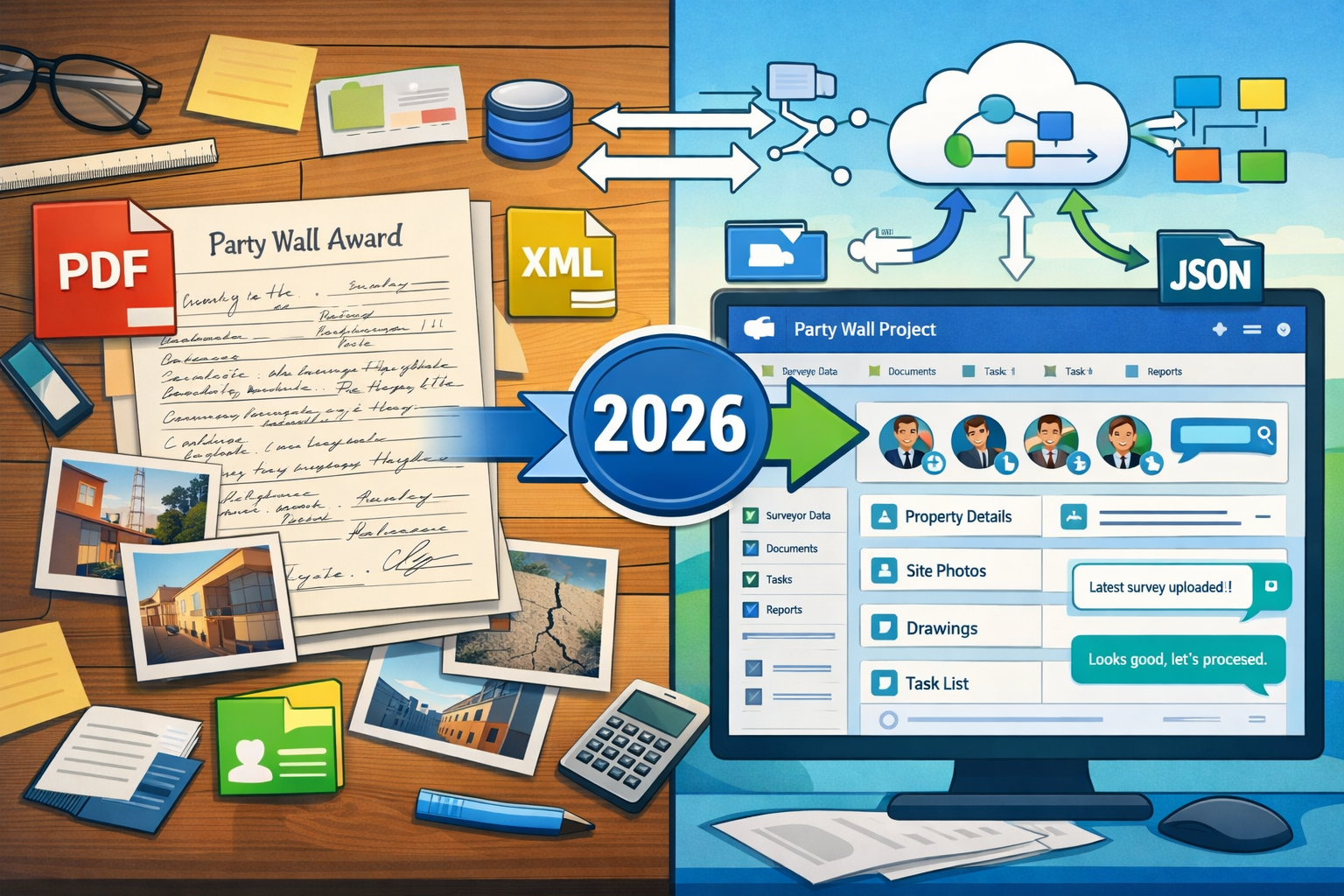
The construction industry's digital transformation has created a paradox: while individual surveyors have adopted sophisticated tools for condition surveys, photographic documentation, and award preparation, the lack of standardized data exchange protocols has created information silos that undermine efficiency. As building owners and adjoining owners increasingly appoint separate surveyors who must work together to produce a single party wall award, the absence of interoperability standards has emerged as a significant bottleneck in 2026.
Key Takeaways
- Format silos cost time and money: Incompatible data formats between surveyor firms can add 4-8 weeks to award timelines and increase costs by 15-25% in multi-surveyor disputes
- Common Data Environments (CDEs) enable collaboration: Cloud-based platforms with standardized data structures allow agreed surveyors to work simultaneously on award documentation with real-time synchronization
- Structured data standards improve accuracy: Adopting XML schemas, IFC formats, and standardized photographic metadata reduces transcription errors by up to 87% compared to traditional paper-based workflows
- Regulatory compliance drives adoption: The Party Wall etc. Act 1996 requirements for timely, accurate awards create legal incentives for firms to implement interoperable systems
- 2026 marks a tipping point: Industry surveys indicate 68% of London surveying firms now prioritize interoperability capabilities when selecting software platforms
The Current State of Data Sharing in Multi-Surveyor Party Wall Disputes
The traditional party wall award process involves multiple stakeholders: the building owner's surveyor, the adjoining owner's surveyor, and in many cases, an agreed surveyor or third surveyor appointed to resolve disputes. Each professional typically maintains their own documentation system, creating fragmented information workflows that complicate collaboration.
Common Challenges in 2026 Party Wall Data Exchange
Most party wall surveyors in London and across the UK face recurring obstacles when working with colleagues from other firms:
- Incompatible file formats: One surveyor uses proprietary software that exports schedules of condition as PDFs, while another requires editable spreadsheets with specific column structures
- Photographic evidence management: High-resolution condition photographs taken by different surveyors lack consistent metadata, making it difficult to organize, timestamp, and reference images in the final award
- Version control issues: When multiple surveyors contribute to draft awards via email attachments, tracking the "current" version becomes problematic
- Data duplication and transcription errors: Manual re-entry of measurements, descriptions, and technical specifications from one system to another introduces mistakes
- Timeline delays: The back-and-forth process of converting, reviewing, and reconciling data from different formats can extend award preparation from weeks to months
A building owner's surveyor working on a basement excavation project in West London recently reported spending 12 hours manually reformatting condition survey data received from the adjoining owner's surveyor before it could be integrated into the award document—time that could have been eliminated with proper interoperability standards.
The Cost of Non-Interoperable Systems
The financial and operational impacts of format silos extend beyond inconvenience:
| Impact Category | Average Cost/Delay | Source of Problem |
|---|---|---|
| Extended timeline | 4-8 additional weeks | File conversion and reconciliation |
| Increased professional fees | 15-25% cost increase | Additional surveyor hours for data management |
| Transcription errors | 3-7 errors per award | Manual re-entry of technical data |
| Dispute escalation | 18% higher third surveyor appointment rate | Miscommunication due to data inconsistencies |
| Legal challenges | £2,500-£8,000 in additional costs | Awards requiring revision due to data errors |
These challenges have intensified in 2026 as construction activity has rebounded and the complexity of types of party wall works has increased, particularly with infrastructure retrofits and sustainability upgrades [1].
Understanding Interoperability Standards for Party Wall Awards: Seamless Data Sharing in Multi-Surveyor 2026 Disputes
Interoperability in the context of party wall surveying refers to the ability of different software systems, data formats, and professional workflows to exchange and utilize information seamlessly. When properly implemented, interoperability standards enable surveyors from different firms to collaborate as if they were using a single, unified system.
Core Components of Party Wall Data Interoperability
Effective interoperability frameworks for party wall awards in 2026 incorporate several technical and procedural elements:
1. Standardized Data Schemas
A data schema defines the structure, format, and relationships of information elements within party wall documentation. Standardized schemas ensure that when one surveyor records a "pre-existing crack measurement," another surveyor's system understands exactly what that data point represents and how to display it.
Key schema elements for party wall awards include:
- Property identification fields: Consistent address formats, title numbers, and boundary descriptions
- Work classification taxonomies: Standardized categories aligned with the Party Wall etc. Act 1996 notice types
- Condition survey structures: Uniform templates for recording defects, measurements, and photographic references
- Timeline and milestone tracking: Standardized date formats and procedural step definitions
- Cost and fee documentation: Consistent formats for recording surveyor fees and work estimates
2. Common Data Environments (CDEs)
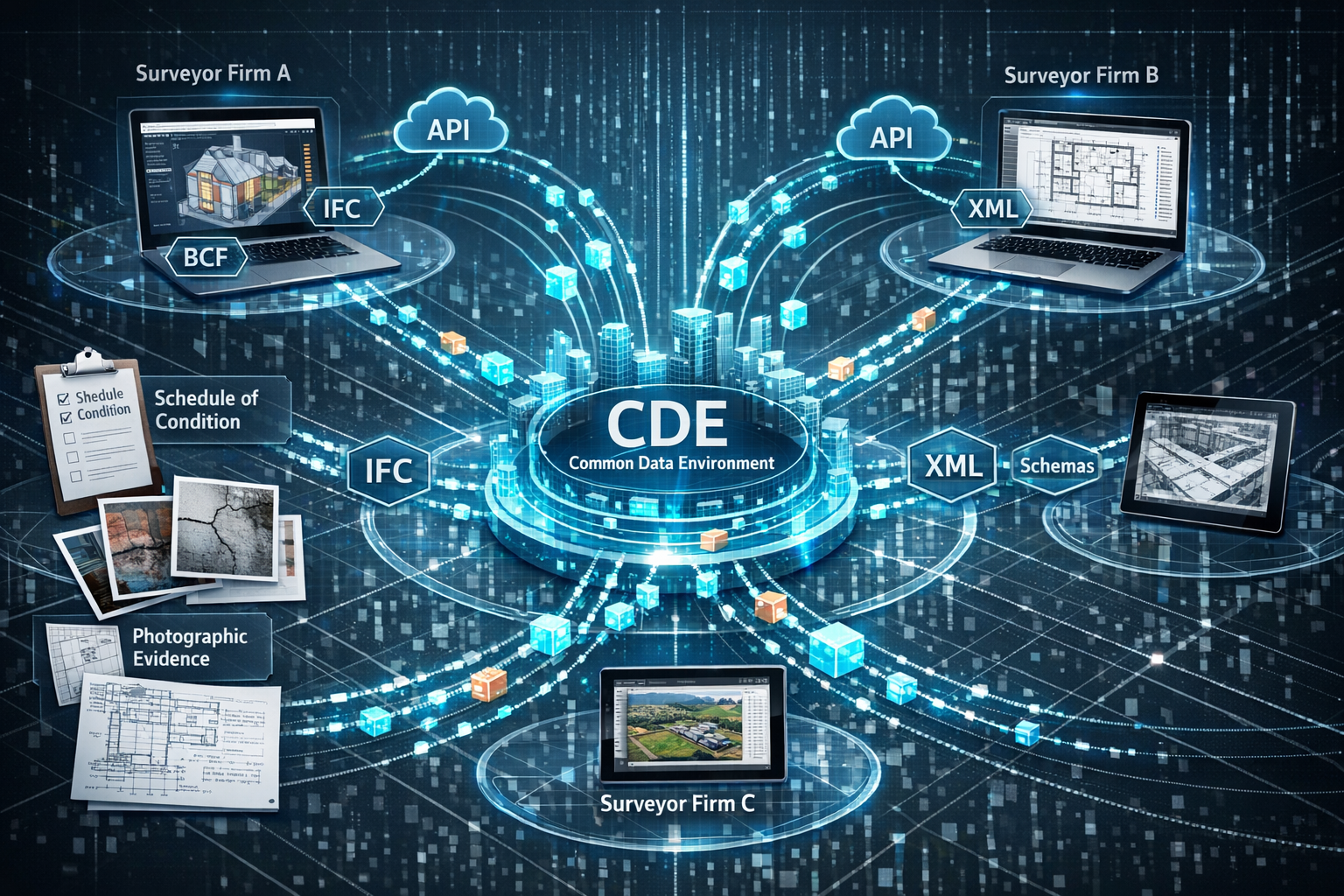
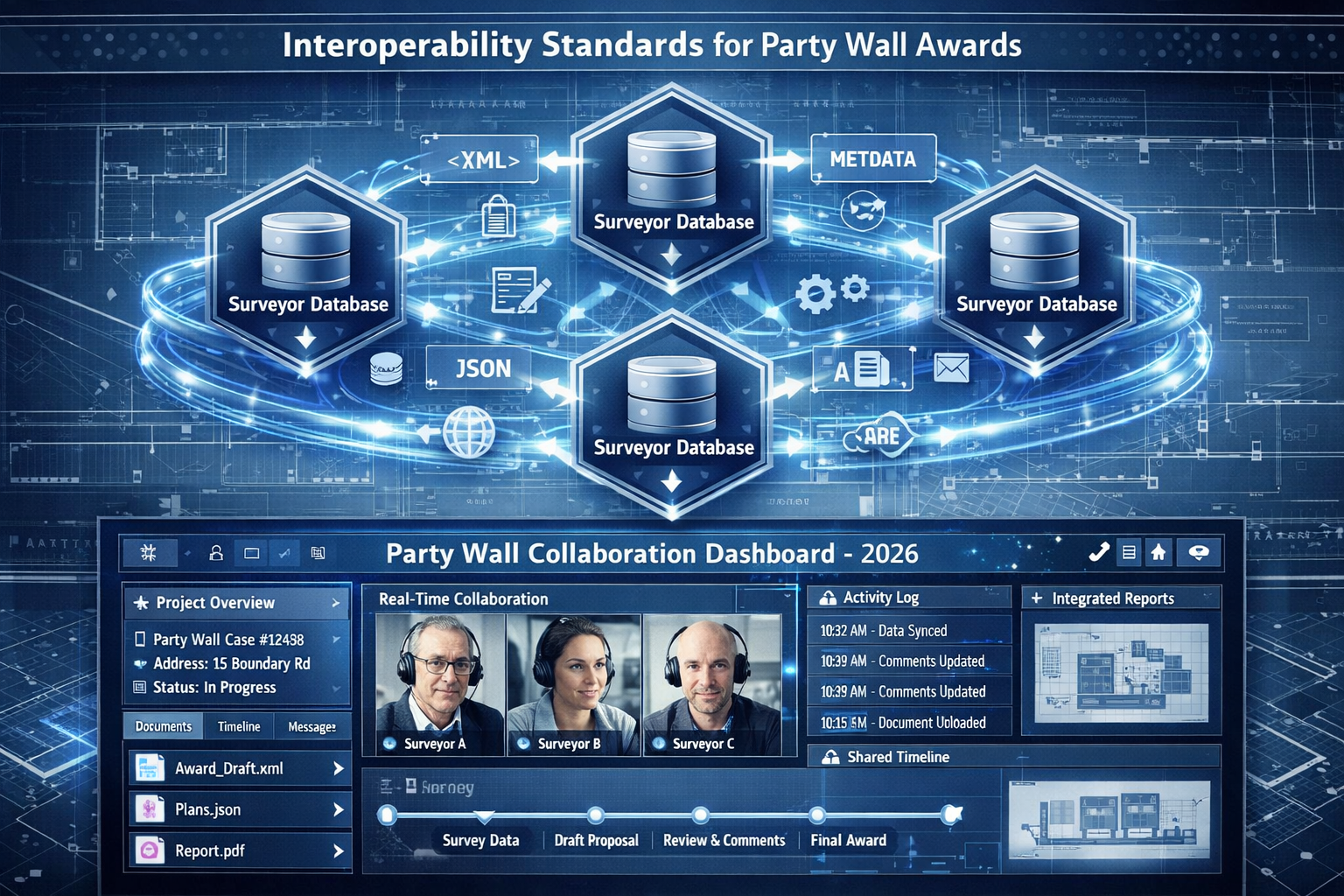
A Common Data Environment is a cloud-based platform that serves as a single source of truth for all project information. In party wall disputes, CDEs enable multiple surveyors to access, contribute to, and modify award documentation in real-time while maintaining version control and audit trails.
"The adoption of Common Data Environments has transformed how we handle complex party wall disputes involving multiple properties. What used to take three months of back-and-forth emails now happens in three weeks with complete transparency." — Senior Party Wall Surveyor, Central London Practice
CDEs designed for party wall work typically include:
- Centralized document repositories with role-based access controls
- Real-time collaboration tools allowing simultaneous editing with change tracking
- Automated notification systems alerting surveyors to updates and required actions
- Integrated communication channels replacing fragmented email threads
- Audit logs documenting all data access and modifications for compliance purposes
3. API-Based System Integration
Application Programming Interfaces (APIs) allow different software applications to communicate and exchange data programmatically. For party wall surveyors, APIs enable their preferred surveying software to connect with CDEs, document management systems, and colleagues' platforms without manual file conversion.
Modern party wall software platforms in 2026 increasingly offer:
- RESTful APIs for retrieving and submitting award data
- Webhook notifications triggering automated workflows when specific events occur
- OAuth authentication ensuring secure, authorized data access
- Batch data synchronization for efficient updates of large condition survey datasets
4. File Format Standards
While structured data exchange represents the ideal, practical interoperability also requires agreement on common file formats for documents, images, and technical drawings:
- PDF/A for long-term archival of finalized awards with embedded metadata
- XML for structured data exchange between different software systems
- IFC (Industry Foundation Classes) for building information modeling data relevant to structural works
- JPEG with EXIF metadata for photographic evidence with embedded timestamp, location, and camera information
- DWG/DXF for technical drawings and survey plans
Interoperability Standards for Party Wall Awards: Benefits for Multi-Surveyor Collaboration
When surveyors adopt interoperable systems and workflows, the advantages extend to all parties involved in the dispute resolution process:
For Building Owners:
- Faster award preparation reduces project delays
- Lower surveyor fees due to improved efficiency
- Greater transparency into the award development process
- Reduced risk of errors requiring award revisions
For Adjoining Owners:
- Better ability to review and verify condition survey data
- Confidence that their adjoining owner's surveyor has access to complete information
- Clearer communication about work schedules and protective measures
For Surveyors:
- Elimination of time-consuming file conversion tasks
- Reduced professional liability risk from transcription errors
- Enhanced reputation for modern, efficient practice
- Ability to handle more complex multi-party disputes effectively
For the Industry:
- Improved compliance with Party Wall etc. Act 1996 timelines
- Higher quality awards with comprehensive documentation
- Reduced dispute escalation to third surveyors
- Better data for industry benchmarking and best practice development
Implementing Interoperability Standards for Party Wall Awards: Seamless Data Sharing in Multi-Surveyor 2026 Disputes
The transition from traditional, siloed workflows to interoperable systems requires strategic planning and phased implementation. Surveying firms across London and the UK have developed practical approaches to adopting these standards in 2026.
Step 1: Assess Current Data Management Practices
Before implementing new systems, firms should conduct an honest evaluation of existing workflows:
Questions to answer:
- What software platforms do we currently use for condition surveys, photographic documentation, and award preparation?
- How do we currently exchange data with surveyors from other firms?
- What percentage of our time is spent on file conversion and data reconciliation?
- How many errors or disputes have arisen from data management issues in the past year?
- What are our clients' expectations regarding digital collaboration and transparency?
A party wall surveyor in North London might discover that 30% of their administrative time is spent reformatting data—time that could be redirected to higher-value professional activities with better systems.
Step 2: Select Interoperability-Ready Software Platforms
When evaluating party wall surveying software in 2026, prioritize platforms that demonstrate:
✅ Cloud-based architecture enabling remote access and real-time collaboration
✅ Open API availability for integration with other systems
✅ Support for standard file formats (PDF/A, XML, IFC)
✅ Built-in CDE functionality or certified integration with major CDE platforms
✅ Robust metadata management for photographic and documentary evidence
✅ Version control and audit logging for compliance and dispute resolution
✅ Mobile compatibility for on-site condition surveys with immediate data upload
✅ Template customization while maintaining standardized data structures
Step 3: Establish Firm-Level Data Standards
Even before industry-wide standards become universal, individual firms can implement internal protocols that facilitate external collaboration:
Documentation standards:
- Consistent naming conventions for files and folders
- Standardized templates for schedules of condition
- Uniform photographic documentation procedures (resolution, metadata, reference numbering)
- Clear version numbering systems for draft awards
Communication protocols:
- Preferred methods for sharing data with external surveyors
- Response time expectations for data requests
- Procedures for resolving data discrepancies
- Escalation paths for technical issues
Step 4: Negotiate Collaboration Protocols with Other Surveyors
When appointed to a multi-surveyor dispute, establish data sharing agreements early in the process:
Initial collaboration meeting agenda:
- Identify software platforms each surveyor uses
- Determine the most compatible data exchange method
- Select or establish a Common Data Environment for the project
- Define access permissions and responsibilities
- Agree on file naming conventions and organizational structure
- Set communication channels and response expectations
- Establish quality control procedures for data contributions
This proactive approach prevents the confusion and delays that arise when surveyors discover incompatibilities mid-process. Whether working on a party wall project in East London or elsewhere, these upfront conversations save significant time.
Step 5: Leverage Common Data Environments Effectively
For complex disputes involving multiple properties or extensive works, implementing a project-specific CDE provides the greatest benefits:
CDE setup best practices:
📁 Folder structure:
/Project_[Address]_Party_Wall_Award
  /01_Notices_and_Correspondence
  /02_Condition_Surveys
    /Building_Owner_Property
    /Adjoining_Owner_Property_1
    /Adjoining_Owner_Property_2
  /03_Photographic_Evidence
  /04_Technical_Drawings
  /05_Draft_Awards
  /06_Final_Award
  /07_Fee_Documentation
🔐 Access control:
- Building owner's surveyor: Read/write access to all folders
- Adjoining owner's surveyor: Read/write access to all folders
- Building owner: Read-only access to relevant sections
- Adjoining owner: Read-only access to relevant sections
- Third surveyor (if appointed): Full access to all folders
📊 Workflow automation:
- Automatic notifications when new condition survey data is uploaded
- Alerts when draft award sections are ready for review
- Scheduled reminders for response deadlines
- Automatic archival of superseded versions with retention of audit trail
Step 6: Train Staff and Build Competency
Technology adoption requires investment in human capital:
- Software training: Ensure all surveyors and support staff understand how to use interoperable platforms effectively
- Data management education: Teach best practices for metadata, file organization, and quality control
- Collaboration skills: Develop competencies in remote collaboration and digital communication
- Troubleshooting capabilities: Equip staff to resolve common technical issues without external support
Step 7: Monitor Performance and Refine Processes
Implement metrics to track the benefits of interoperability adoption:
Key performance indicators:
- Average time from appointment to award completion
- Percentage of awards requiring revision due to data errors
- Client satisfaction scores regarding communication and transparency
- Professional fee efficiency (hours spent per award)
- Frequency of disputes escalating to third surveyor appointment
Regular review of these metrics enables continuous improvement and demonstrates ROI to firm leadership and clients.
Industry Initiatives and Future Developments in 2026
The party wall surveying profession has recognized the urgency of addressing interoperability challenges. Several initiatives are shaping the landscape in 2026:
Professional Body Guidance
The Royal Institution of Chartered Surveyors (RICS) and the Faculty of Party Wall Surveyors (FPWS) have begun developing best practice guidance on digital collaboration and data standards. While formal standards remain in development, these organizations are encouraging members to adopt:
- Minimum metadata requirements for digital photographic evidence
- Recommended file formats for different document types
- Template structures for schedules of condition that facilitate data exchange
- Ethical guidelines for data security and client confidentiality in cloud-based systems
Software Vendor Collaboration
Major providers of party wall surveying software have established working groups to develop common API specifications and data exchange protocols. This industry-led standardization effort aims to ensure that surveyors can choose their preferred software while maintaining the ability to collaborate seamlessly with colleagues using different platforms.
Integration with Building Information Modeling (BIM)
As BIM adoption expands in the construction industry, party wall surveyors are exploring how to integrate award data with broader project information models. The IFC (Industry Foundation Classes) standard provides a framework for representing party wall conditions, proposed works, and protective measures within a 3D building model, enabling better coordination with architects, structural engineers, and contractors.
Regulatory Considerations
While the Party Wall etc. Act 1996 does not currently mandate specific data formats or digital processes, there is growing discussion about whether regulatory guidance should encourage or require digital-first approaches to improve compliance with statutory timelines and reduce disputes. Any such developments would likely emphasize technology-neutral standards that accommodate various software solutions rather than prescribing specific platforms.
Lessons from Other Industries
The party wall surveying profession can learn from interoperability initiatives in other sectors. Healthcare, for example, has made significant progress in standardizing data exchange through frameworks like FHIR (Fast Healthcare Interoperability Resources) and initiatives such as TEFCA (Trusted Exchange Framework and Common Agreement) [2][4]. While the technical requirements differ substantially, the principles of stakeholder collaboration, phased implementation, and balanced regulation provide valuable insights.
Similarly, the broader surveying and geospatial industries have embraced interoperability through standards like those discussed in 2026 land survey equipment developments [6], demonstrating the feasibility and benefits of cross-platform data exchange in technical professions.
Overcoming Barriers to Adoption
Despite the clear benefits, several obstacles slow the adoption of interoperability standards in party wall surveying:
🚧 Technical Challenges
Legacy systems: Many established firms have invested significantly in existing software and workflows, making migration costly and disruptive.
Solution: Prioritize platforms that offer migration tools and backward compatibility, allowing gradual transition rather than abrupt replacement.
Data security concerns: Cloud-based collaboration raises questions about confidentiality, data protection compliance (GDPR), and professional liability.
Solution: Select CDE providers with robust security certifications (ISO 27001, SOC 2), clear data processing agreements, and UK-based data storage options.
💰 Economic Barriers
Software costs: Interoperable platforms often require subscription fees, representing ongoing expenses rather than one-time purchases.
Solution: Calculate total cost of ownership including time savings, error reduction, and competitive advantage rather than focusing solely on license fees.
Training investment: Staff require time and resources to develop new competencies.
Solution: Leverage vendor training programs, online resources, and phased rollout to minimize disruption while building capabilities.
🤝 Cultural Resistance
Professional conservatism: Some surveyors prefer traditional methods and view digital transformation with skepticism.
Solution: Demonstrate benefits through pilot projects, share success stories from early adopters, and emphasize how technology enhances rather than replaces professional judgment.
Competitive concerns: Firms may hesitate to share process innovations that they view as competitive advantages.
Solution: Emphasize that standardized data exchange benefits the entire profession by improving client satisfaction and reducing disputes, ultimately expanding the market for all practitioners.
📋 Coordination Challenges
Lack of universal standards: Without mandated formats, surveyors must negotiate approaches on a project-by-project basis.
Solution: Professional bodies should accelerate development of recommended (even if not mandatory) standards to provide clear guidance and reduce negotiation overhead.
Multi-jurisdictional complexity: Surveyors working across England, Wales, and other jurisdictions encounter varying regulatory contexts.
Solution: Focus on core technical standards that remain consistent across jurisdictions while allowing flexibility for local procedural variations.
Practical Recommendations for Surveyors in 2026
For party wall surveyors seeking to improve their data sharing capabilities and prepare for the future of multi-surveyor collaboration:
For Individual Practitioners
- Audit your current tools: Evaluate whether your software supports modern data exchange formats and consider upgrades if necessary
- Develop digital competencies: Invest time in learning cloud collaboration tools, even if not all colleagues currently use them
- Standardize your own practices: Implement consistent file naming, metadata, and organizational systems that facilitate sharing
- Communicate capabilities to clients: Highlight your ability to collaborate efficiently in multi-surveyor disputes as a value proposition
- Stay informed: Follow professional body guidance and industry developments regarding emerging standards
For Surveying Firms
- Develop a digital transformation roadmap: Plan a phased approach to adopting interoperable systems over 12-24 months
- Invest in training: Ensure all staff have the skills to leverage modern collaboration platforms effectively
- Establish partnerships: Build relationships with other firms committed to interoperability to facilitate smoother collaboration
- Contribute to standards development: Participate in professional body working groups to shape emerging best practices
- Market your capabilities: Differentiate your firm by demonstrating sophisticated digital collaboration capabilities
For Building and Adjoining Owners
- Ask about digital capabilities: When appointing surveyors, inquire about their data management and collaboration approaches
- Request transparency: Seek access to project CDEs or regular digital updates on award progress
- Understand the costs of party wall processes: Recognize that efficient digital collaboration can reduce overall expenses
- Encourage collaboration: If appointing separate surveyors, emphasize your expectation that they will work together efficiently
- Review documentation carefully: Digital systems should enhance, not replace, thorough review of party wall contract templates and awards
Conclusion
Interoperability Standards for Party Wall Awards: Seamless Data Sharing in Multi-Surveyor 2026 Disputes represents more than a technical evolution—it embodies a fundamental shift in how the profession approaches collaboration, efficiency, and client service. As construction projects grow more complex and multi-surveyor appointments become increasingly common, the ability to exchange data seamlessly has transitioned from competitive advantage to professional necessity.
The format silos that currently plague many party wall disputes create unnecessary costs, delays, and risks for all parties involved. By adopting Common Data Environments, standardized data schemas, and interoperable software platforms, surveyors can eliminate these inefficiencies while improving accuracy, transparency, and compliance with the Party Wall etc. Act 1996.
The path forward requires coordinated action from multiple stakeholders: professional bodies must accelerate standards development, software vendors must prioritize interoperability in their platforms, individual surveyors must invest in digital competencies, and clients must recognize and reward firms that demonstrate sophisticated collaboration capabilities.
For surveyors working across London—whether in Central London, South London, or West London—the message is clear: the future of party wall practice is collaborative, digital, and interoperable. Those who embrace these changes in 2026 will be best positioned to serve clients effectively, resolve disputes efficiently, and thrive in an increasingly competitive professional landscape.
Next Steps
If you're a party wall surveyor:
- Evaluate your current software and identify interoperability gaps
- Connect with colleagues to discuss collaboration protocols for upcoming projects
- Explore CDE platforms suitable for party wall work
- Consider joining professional body working groups on digital standards
If you're planning construction work:
- Learn about party wall notices and when they're required
- When appointing surveyors, inquire about their digital collaboration capabilities
- Understand your role in facilitating efficient dispute resolution
- Review resources on how to keep party wall costs down
If you're an adjoining owner:
- Understand your rights and the party wall process
- Consider whether to appoint your own surveyor or agree to a single surveyor
- Ask your surveyor about how they'll access and verify condition survey data
- Ensure you receive regular updates throughout the award preparation process
The transition to fully interoperable party wall award systems will not happen overnight, but each step toward standardized data exchange brings measurable benefits. By acting now to adopt best practices and advocate for industry-wide standards, the party wall surveying profession can ensure it meets the challenges and opportunities of 2026 and beyond.
References
[1] Party Wall Surveys For Ev Infrastructure Retrofits Compliance Amid 2026 Net Zero Mandates And Neighbour Disputes – https://nottinghillsurveyors.com/blog/party-wall-surveys-for-ev-infrastructure-retrofits-compliance-amid-2026-net-zero-mandates-and-neighbour-disputes
[2] Ncqas 2026 Trends To Watch – https://www.ncqa.org/blog/ncqas-2026-trends-to-watch/
[4] Cms Onc Healthcare Regulations 2026 Interoperability Compliance – https://nirmitee.io/blog/cms-onc-healthcare-regulations-2026-interoperability-compliance/
[6] Navigating The 2026 Land Survey Equipment Boom Total Stations Gps And Laser Scanners Reviewed – https://nottinghillsurveyors.com/blog/navigating-the-2026-land-survey-equipment-boom-total-stations-gps-and-laser-scanners-reviewed