


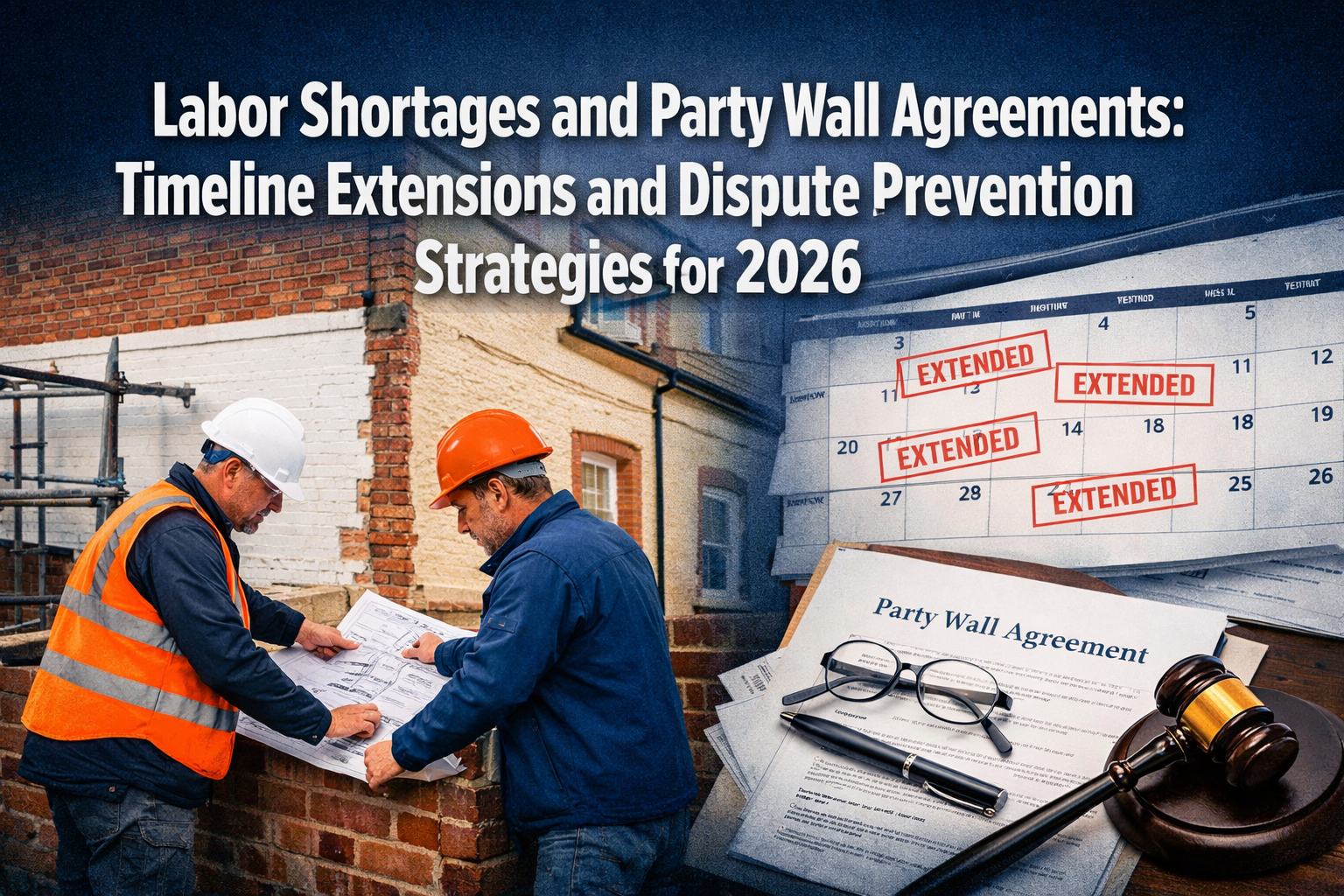
The construction industry in 2026 faces an unprecedented challenge that's reshaping how property owners and surveyors approach party wall agreements. With skilled labor shortages reaching critical levels across the United Kingdom, the traditional timelines for party wall works are no longer realistic. Labor Shortages and Party Wall Agreements: Timeline Extensions and Dispute Prevention Strategies for 2026 have become essential considerations for anyone planning construction work that affects shared walls or boundaries. The workforce crisis isn't just delaying projects—it's forcing a complete rethink of how we structure agreements, set expectations, and prevent disputes between neighbors.
Key Takeaways
- 🔧 Labor shortages in 2026 are extending party wall project timelines by 30-60 days beyond traditional estimates, requiring proactive planning and flexible agreements
- 📋 Contingency clauses in party wall awards are now essential to protect both building owners and adjoining owners from disputes caused by workforce delays
- ⏰ Standard notice periods remain unchanged (2 months for building works, 1 month for excavations), but work commencement and completion dates need buffer periods
- 🤝 Enhanced communication protocols between surveyors, contractors, and neighbors prevent misunderstandings when labor availability causes schedule shifts
- 💰 Cost implications of delays must be addressed upfront in party wall agreements to avoid financial disputes and maintain neighborly relations
Understanding the 2026 Labor Shortage Crisis
The construction sector in 2026 is experiencing what industry experts describe as a "perfect storm" of workforce challenges. Multiple factors have converged to create significant labor shortages that directly impact party wall projects.
The Scale of the Problem
Recent contractor surveys reveal alarming statistics about workforce availability:
- Skilled bricklayers are in critically short supply, with waiting lists extending 8-12 weeks in major urban areas
- Structural engineers face 40% increased demand compared to 2024 levels
- Party wall surveyors report 35% longer appointment scheduling times due to heightened demand [1]
These shortages don't just delay individual projects—they create a cascading effect throughout the entire construction timeline. When one trade is delayed, subsequent work phases must also shift, extending the overall project duration significantly.
Why This Matters for Party Wall Agreements
Traditional party wall agreements were drafted with the assumption that labor would be readily available once notices were served and awards issued. In 2026, this assumption no longer holds true. Building owners who serve proper party wall notices may find themselves unable to commence work on schedule, not due to legal delays, but because they simply cannot secure the necessary workforce.
This creates several problems:
For Building Owners:
- Increased holding costs while waiting for contractors
- Potential breach of timeline commitments in party wall awards
- Risk of disputes with neighbors expecting work to proceed as scheduled
For Adjoining Owners:
- Extended periods of uncertainty about when disruption will occur
- Difficulty planning their own schedules around neighbor's work
- Frustration leading to strained relationships and potential disputes
Timeline Extensions in Party Wall Agreements for 2026
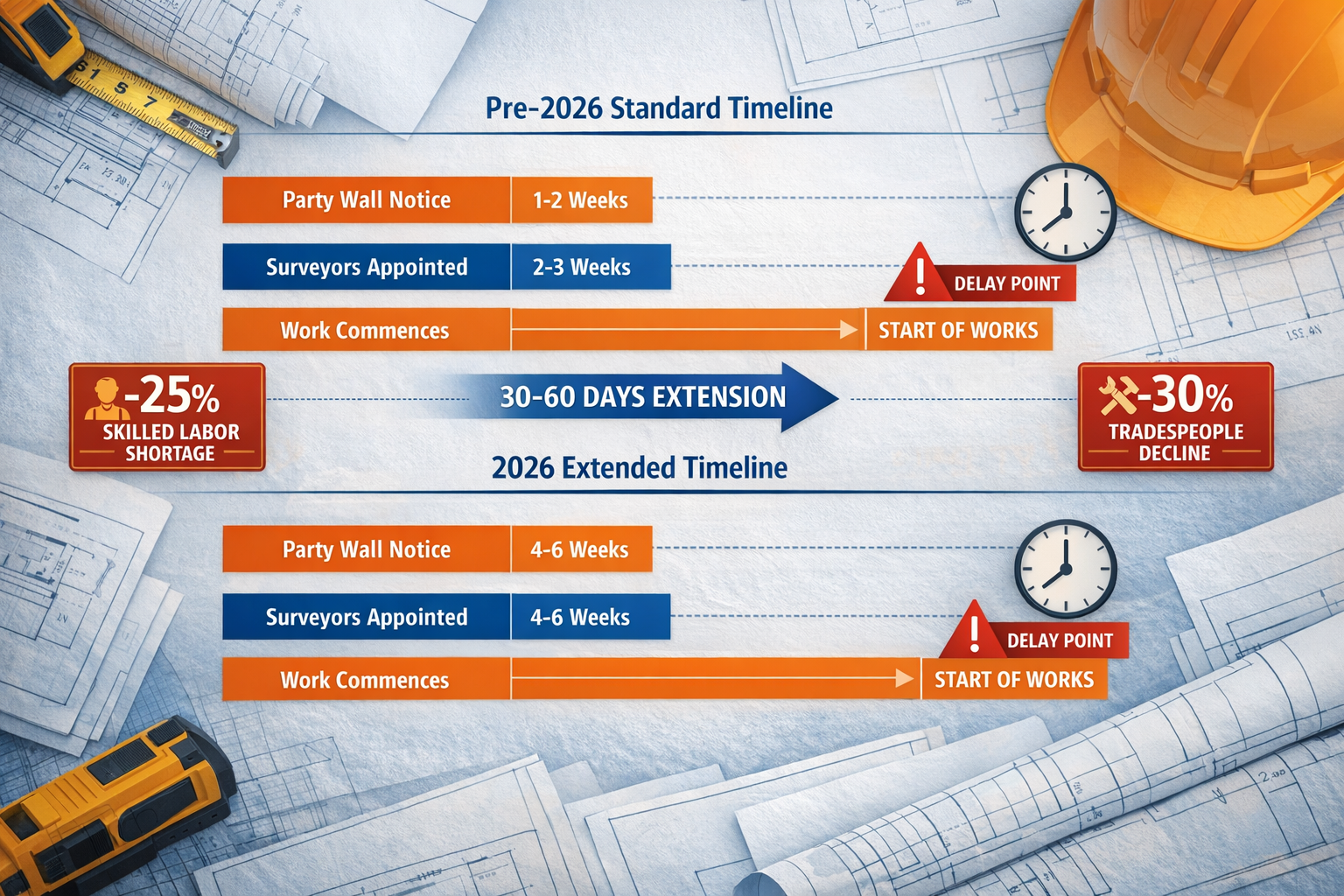
The standard party wall process follows well-established timelines under the Party Wall etc. Act 1996. However, 2026's labor realities require building these timelines with much greater flexibility.
Standard vs. Extended Timelines
| Phase | Standard Timeline | 2026 Recommended Timeline | Key Consideration |
|---|---|---|---|
| Notice Period | 2 months (building works) [2] | 2 months (unchanged) | Legal requirement remains fixed |
| Surveyor Appointment | 10-14 days | 21-28 days | Surveyor availability stretched |
| Award Preparation | 2-4 weeks | 4-6 weeks | More complex contingency planning |
| Contractor Procurement | 2-4 weeks | 6-10 weeks | Critical labor shortage impact |
| Work Commencement | As per award | Add 30-60 day buffer | Workforce availability variable |
| Project Completion | Project-specific | Add 20-30% to estimates | Ongoing labor disruptions |
Building Flexibility into Party Wall Awards
Modern party wall awards in 2026 must incorporate specific language that addresses labor shortage realities. Here are essential provisions to include:
1. Flexible Commencement Dates
Rather than specifying an exact start date, awards should establish a commencement window:
"Works shall commence no earlier than [date] and no later than [date + 90 days], with the Building Owner providing 14 days' written notice to the Adjoining Owner of the actual commencement date once contractor availability is confirmed."
This approach maintains legal compliance while acknowledging practical constraints.
2. Milestone-Based Scheduling
Instead of fixed calendar dates, structure the project around achievable milestones:
- Phase 1: Foundation and excavation work (upon contractor availability)
- Phase 2: Wall construction/alteration (within 30 days of Phase 1 completion)
- Phase 3: Finishing work (within 21 days of Phase 2 completion)
This method allows for labor-related delays between phases without invalidating the entire timeline.
3. Force Majeure Clauses for Labor Shortages
While traditionally reserved for extreme circumstances, 2026 agreements should explicitly include workforce unavailability as a recognized delay factor:
"The parties acknowledge that skilled labor shortages may impact project timelines. Delays of up to 60 days caused by documented inability to secure qualified contractors shall not constitute a breach of this Award, provided the Building Owner demonstrates reasonable efforts to procure labor and provides regular updates to the Adjoining Owner."
Understanding Different Types of Party Wall Works
Different types of party wall works face varying degrees of labor shortage impact. Understanding these differences helps set realistic expectations:
Most Affected Works:
- Loft conversions requiring steel beam installation [1]
- Structural alterations to load-bearing walls
- Foundation underpinning near party walls
Moderately Affected Works:
- Cutting into party walls for new openings
- Raising party wall height
- Damp-proofing party structures
Least Affected Works:
- Cosmetic repairs to party walls
- Minor boundary wall work
- Non-structural modifications
Dispute Prevention Strategies for Labor-Delayed Projects
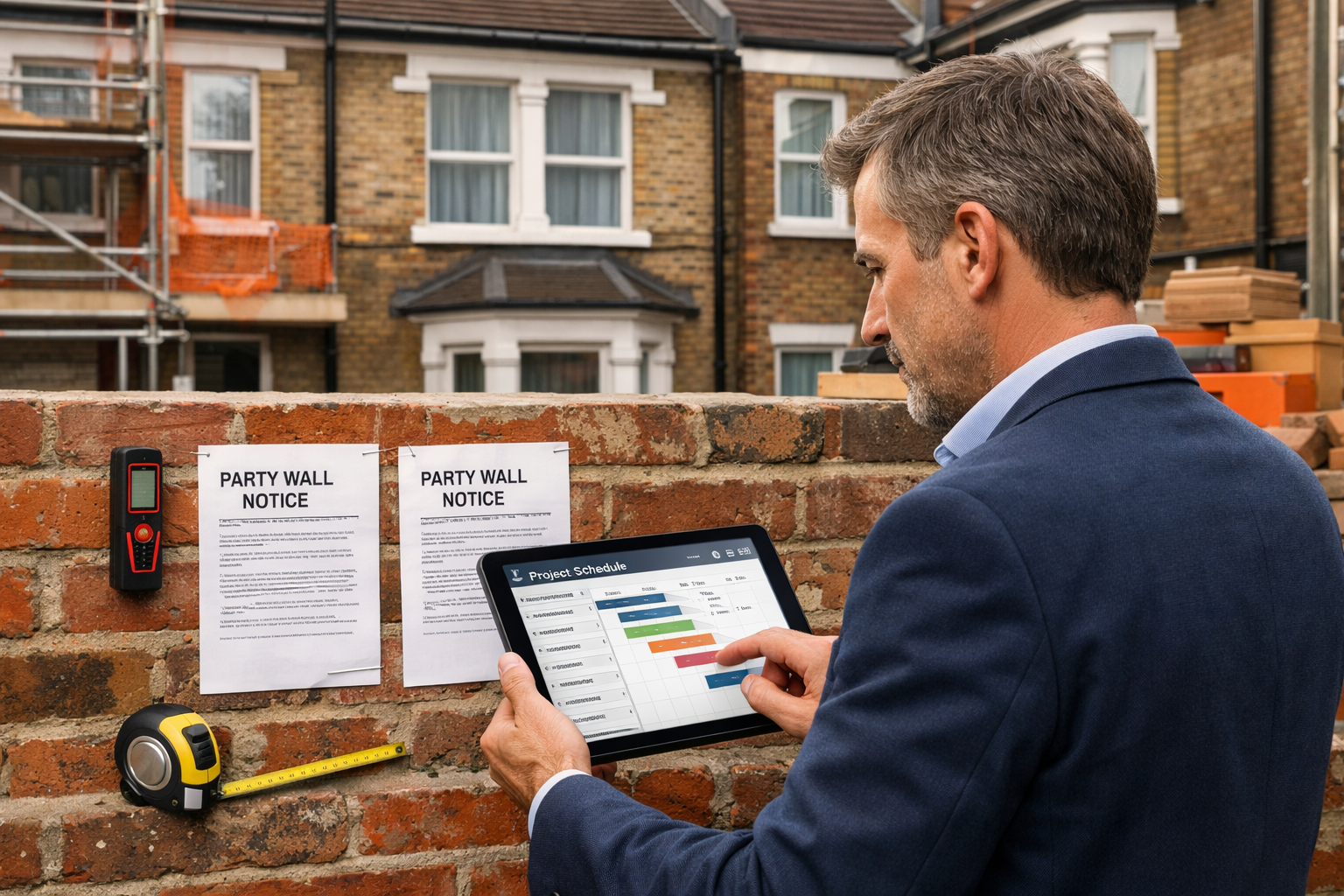
The most effective way to handle labor shortage impacts is preventing disputes before they arise. This requires proactive communication, realistic expectations, and well-crafted agreements.
Strategy 1: Enhanced Pre-Work Communication
Before serving party wall notices, building owners should have candid conversations with neighbors about current construction realities.
Key Discussion Points:
- ✅ Acknowledge industry-wide labor challenges upfront
- ✅ Share preliminary contractor availability information
- ✅ Explain that timelines may shift despite best planning efforts
- ✅ Establish preferred communication methods for updates
- ✅ Discuss potential accommodations for unavoidable delays
This transparency builds goodwill and reduces the shock factor when delays inevitably occur.
Strategy 2: Regular Progress Updates
Even when work hasn't commenced, maintaining communication prevents anxiety and speculation. Establish a monthly update protocol:
Update Content Should Include:
- Current contractor procurement status
- Revised timeline estimates based on latest information
- Any changes to project scope affecting the neighbor
- Anticipated next steps and decision points
- Contact information for questions or concerns
These updates can be brief emails or letters, but they demonstrate respect and consideration for the adjoining owner's situation.
Strategy 3: Contingency Cost Provisions
One of the most contentious aspects of delayed party wall projects involves costs. Who pays for extended surveyor involvement? What about additional inspections required due to timeline changes?
Recommended Cost Framework:
Building Owner Responsibility:
- Extended surveyor fees caused by labor delays
- Additional schedule of condition updates if work delays exceed 6 months
- Costs associated with re-serving notices if original timelines expire
Shared Responsibility:
- Dispute resolution costs if good faith efforts were made by both parties
- Mediation fees for timeline renegotiation
Adjoining Owner Responsibility:
- Costs arising from unreasonable objections to reasonable timeline extensions
- Surveyor fees for reviewing extension requests that are clearly documented
Strategy 4: Documented Contractor Procurement Efforts
To demonstrate good faith and justify timeline extensions, building owners should maintain comprehensive records:
📁 Essential Documentation:
- Quotes requested from contractors (with dates)
- Responses received and availability stated
- Evidence of contractor unavailability or extended booking periods
- Alternative contractor research and outreach
- Industry reports or data supporting labor shortage claims
This documentation becomes invaluable if disputes arise or if formal justification for delays is required under the party wall award.
Strategy 5: Professional Surveyor Involvement
Working with experienced party wall surveyors who understand 2026's labor challenges is more important than ever. Surveyors can:
- Draft awards with appropriate flexibility provisions
- Mediate timeline disputes between neighbors
- Provide independent assessment of whether delays are reasonable
- Recommend dispute resolution strategies before conflicts escalate
- Update awards when circumstances change significantly
Many property owners attempt to handle party wall matters without a surveyor to reduce costs, but in 2026's complex environment, professional guidance often prevents far more expensive disputes.
Regional Variations in Labor Shortage Impact
Labor shortages don't affect all areas equally. Understanding regional variations helps set appropriate expectations:
London and Southeast England
The capital and surrounding areas face the most acute shortages, with party wall surveyors in North London, South London, East London, and West London all reporting 6-10 week contractor lead times for party wall projects.
Recommended Timeline Buffer: Add 60-90 days to traditional estimates
Midlands and Northern England
Moderate shortages with more availability than London but still significantly constrained compared to pre-2024 levels.
Recommended Timeline Buffer: Add 30-45 days to traditional estimates
Scotland and Wales
Regional variations exist, with urban centers more affected than rural areas.
Recommended Timeline Buffer: Add 20-40 days depending on specific location
Cost Management During Extended Timelines
Extended project timelines inevitably increase costs. Understanding and planning for these increases prevents financial disputes.
Direct Cost Increases
Surveyor Fees:
- Extended monitoring periods
- Additional site visits due to delayed commencement
- Award amendments if timelines require formal updates
Learn more about keeping party wall costs down despite extended timelines.
Contractor Costs:
- Premium rates for securing available labor
- Potential price increases if quotes expire before work commences
- Mobilization costs if work must be scheduled in multiple phases
Indirect Cost Increases
Holding Costs:
- Extended mortgage payments on properties awaiting renovation
- Continued rent payments if work delays move-in dates
- Storage fees for materials or furniture
Opportunity Costs:
- Delayed property value increases from completed improvements
- Lost rental income if conversion projects are delayed
- Deferred benefits from completed work
Cost Protection Strategies
-
Fixed-Price Contracts with Extended Validity: Negotiate contractor agreements that lock in pricing for 90-120 days rather than standard 30-60 days
-
Phased Payment Structures: Align payment milestones with actual work completion rather than calendar dates
-
Transparent Cost Sharing: Clearly document in party wall awards which party bears costs for various delay scenarios
-
Insurance Considerations: Explore whether construction insurance policies cover labor shortage-related delays
Legal Considerations and Party Wall Act Compliance
Despite labor challenges, the Party Wall etc. Act 1996 requirements remain unchanged. Understanding how to maintain compliance while adapting to workforce realities is crucial.
Notice Period Requirements
The statutory notice periods are fixed by law [2]:
- 2 months for works to an existing party wall or building on a party line
- 1 month for excavation within 3 or 6 meters of a neighboring structure
These periods cannot be shortened regardless of labor availability. However, they can be extended by mutual agreement, which may be advisable in 2026 to allow more contractor procurement time.
Award Validity and Amendments
Party wall awards don't typically include expiration dates, but they do specify when work should commence. If labor shortages prevent commencement within reasonable timeframes:
Option 1: Award Amendment
- Surveyors can issue supplemental awards updating timelines
- Requires agreement from both parties or determination by surveyors
- Preserves original award terms while updating practical details
Option 2: New Notice Process
- If delays exceed 12 months, some surveyors recommend re-serving notices
- Ensures all parties have current information
- Allows for updated schedules of condition reflecting any property changes
Dispute Resolution Under Extended Timelines
When disputes arise from labor-related delays, the standard party wall dispute resolution process applies:
- Surveyor Mediation: Appointed surveyors attempt to resolve disagreements
- Third Surveyor Involvement: If agreement cannot be reached, the third surveyor makes binding determinations
- Appeal Process: Limited appeal rights to county court on specific grounds
Understanding the full costs of party wall processes including potential dispute resolution helps budget appropriately.
Practical Templates and Clauses for 2026 Agreements
To help property owners and surveyors adapt to current conditions, here are specific clauses and provisions to incorporate into party wall documentation.
Sample Commencement Flexibility Clause
"The Building Owner shall commence the Works described in this Award within a window beginning no earlier than [DATE] and ending no later than [DATE + 120 DAYS]. The Building Owner shall provide the Adjoining Owner with no less than 21 days' written notice of the actual commencement date. This extended commencement window acknowledges documented construction labor shortages in 2026 and shall not constitute grounds for dispute provided the Building Owner demonstrates reasonable efforts to secure qualified contractors."
Sample Labor Shortage Documentation Requirement
"In the event the Building Owner requires an extension beyond the commencement window specified in this Award due to contractor unavailability, the Building Owner shall provide the Adjoining Owner and appointed surveyors with: (a) evidence of no fewer than five contractor quotes requested; (b) documentation of contractor availability dates; (c) evidence of good faith efforts to secure alternative qualified contractors; and (d) a revised project timeline. Upon receipt of satisfactory documentation, the commencement window may be extended by up to an additional 60 days."
Sample Communication Protocol Clause
"The Building Owner agrees to provide the Adjoining Owner with written progress updates on the first business day of each calendar month until Works commence. Updates shall include contractor procurement status, anticipated commencement date, and any material changes to project scope or timeline. Failure to provide updates shall entitle the Adjoining Owner to request surveyor intervention to enforce communication requirements."
Sample Cost Allocation Clause
"The Building Owner shall bear all reasonable surveyor fees associated with timeline extensions caused by labor shortages, including but not limited to: award amendments, additional site visits, and extended monitoring periods. The Adjoining Owner shall bear surveyor fees associated with unreasonable objections to documented labor shortage delays. Disputed fee allocations shall be determined by the appointed surveyors or, if necessary, the third surveyor."
For additional guidance, review this sample party wall agreement template and adapt it for labor shortage considerations.
Case Study: Successful Timeline Extension Management
The Situation:
A homeowner in Central London planned a loft conversion requiring structural alterations to a party wall shared with a terraced neighbor. Party wall notices were served in January 2026 with an anticipated March commencement date.
The Challenge:
By February, it became clear that no structural engineers were available until May, and bricklayers were booked through June. The original timeline was impossible to meet.
The Solution:
The building owner's surveyor proactively:
- Documented the shortage: Collected evidence from seven contractors showing earliest availability dates
- Communicated immediately: Informed the adjoining owner in writing within 48 hours of confirming delays
- Proposed amended timeline: Suggested a June-August work window with specific milestone dates
- Offered accommodations: Proposed completing work during the neighbor's planned summer holiday to minimize disruption
- Updated the award: Issued a supplemental award incorporating the revised timeline and labor shortage provisions
The Outcome:
The adjoining owner appreciated the transparency and advance notice. Work commenced in June as revised, completed in August, and the relationship between neighbors remained positive throughout. The proactive approach prevented what could have been a contentious dispute.
Key Lessons:
- ✅ Early communication prevents disputes
- ✅ Documentation justifies necessary delays
- ✅ Professional surveyor involvement facilitates resolution
- ✅ Offering accommodations demonstrates good faith
Technology Solutions for Timeline Management
Several digital tools have emerged in 2026 to help manage extended party wall project timelines:
Project Management Platforms
Specialized construction project management software now includes party wall-specific features:
- Automated neighbor notifications when timeline milestones change
- Contractor availability tracking integrated with local labor market data
- Document repositories for storing labor shortage evidence and communications
- Timeline visualization tools showing original vs. revised schedules
Communication Apps
Dedicated apps facilitate ongoing dialogue between building owners, adjoining owners, and surveyors:
- Scheduled update reminders ensuring regular communication
- Photo and document sharing for progress documentation
- Milestone notifications alerting all parties to project phase completions
- Dispute escalation protocols when issues arise
Labor Market Intelligence
New data services provide real-time information about contractor availability:
- Regional labor shortage indices showing severity by trade and location
- Average wait time data for different types of construction professionals
- Price trend analysis helping budget for premium labor costs
- Contractor database access expanding the pool of potential service providers
Looking Ahead: Long-Term Strategies
While 2026's labor shortages create immediate challenges, forward-thinking property owners and professionals are implementing long-term strategies to mitigate future impacts.
Building Stronger Contractor Relationships
Rather than seeking the lowest bid for each project, savvy building owners are:
- Establishing ongoing relationships with reliable contractors
- Booking contractors 6-12 months in advance for planned projects
- Offering flexible scheduling that accommodates contractor availability
- Paying fair rates that reflect current market conditions
Advocating for Industry Solutions
Professional organizations and property owners are working together to address root causes:
- Supporting apprenticeship programs for construction trades
- Advocating for immigration policies that address skilled labor gaps
- Promoting construction careers to younger generations
- Investing in training and upskilling existing workforce
Adapting Project Planning
Property owners are rethinking how they approach renovation and construction:
- Earlier planning: Beginning party wall processes 6-12 months before desired work dates
- Flexible scheduling: Choosing project timing based on contractor availability rather than personal preference alone
- Phased approaches: Breaking large projects into smaller phases that can be scheduled around labor availability
- Alternative methods: Considering construction techniques that require less specialized labor
Conclusion
Labor Shortages and Party Wall Agreements: Timeline Extensions and Dispute Prevention Strategies for 2026 represent a fundamental shift in how property owners, neighbors, and surveyors must approach shared wall construction projects. The workforce crisis affecting the construction industry isn't a temporary inconvenience—it's a structural challenge requiring thoughtful adaptation of traditional party wall practices.
The key to successfully navigating 2026's labor landscape lies in three fundamental principles:
1. Transparency and Communication
Open, honest dialogue about labor challenges prevents misunderstandings and builds goodwill between neighbors. Regular updates and realistic expectations set the foundation for successful projects even when timelines extend.
2. Flexible but Structured Agreements
Party wall awards must balance legal requirements with practical realities. Incorporating contingency clauses, flexible commencement windows, and clear cost allocation provisions protects all parties while acknowledging workforce constraints.
3. Professional Guidance
Experienced party wall surveyors who understand current market conditions provide invaluable expertise in drafting appropriate agreements, mediating disputes, and ensuring compliance with the Party Wall etc. Act 1996 despite extended timelines.
Actionable Next Steps
For Building Owners Planning Party Wall Works:
- Start early: Begin the party wall process 3-6 months earlier than you would have in previous years
- Research contractor availability: Contact multiple contractors to understand realistic timelines before serving notices
- Engage professional surveyors: Work with experienced party wall surveyors who can draft flexible agreements
- Communicate proactively: Discuss labor challenges with neighbors before formal notices
- Document everything: Keep comprehensive records of contractor outreach and availability
- Budget for extensions: Add 20-30% to timeline and cost estimates to account for labor delays
For Adjoining Owners Receiving Party Wall Notices:
- Understand the context: Recognize that labor shortages affect all construction projects in 2026
- Appoint experienced surveyors: Ensure your interests are protected by knowledgeable professionals
- Request communication protocols: Ask for regular updates to be included in the party wall award
- Be reasonable about extensions: Documented labor shortages justify timeline flexibility
- Focus on protections: Ensure awards include provisions for quality work and property protection regardless of timeline
- Maintain dialogue: Keep communication channels open with your neighbor throughout the process
For Party Wall Surveyors:
- Update standard templates: Incorporate labor shortage provisions into award templates
- Educate clients: Help building and adjoining owners understand current market realities
- Build flexibility into awards: Create commencement windows and milestone-based scheduling
- Document market conditions: Maintain evidence of regional labor shortages to support timeline extensions
- Facilitate communication: Establish clear protocols for ongoing updates between parties
- Stay informed: Monitor construction industry trends and adjust recommendations accordingly
The construction labor shortage of 2026 presents significant challenges, but with proper planning, realistic expectations, and well-crafted party wall agreements, property owners can successfully complete their projects while maintaining positive relationships with neighbors. The strategies outlined in this guide provide a roadmap for navigating these challenges effectively, preventing disputes, and ensuring that party wall works proceed smoothly despite workforce constraints.
By embracing flexibility, maintaining transparency, and working with experienced professionals, the party wall process can adapt to current realities while continuing to protect the rights and interests of all parties involved. The labor shortage may extend timelines, but it doesn't have to derail projects or destroy neighborly relations.
References
[1] Party Wall Surveying Surge In 2026 Loft Conversions Navigating High Demand Compliance During Housing Uptick – https://nottinghillsurveyors.com/blog/party-wall-surveying-surge-in-2026-loft-conversions-navigating-high-demand-compliance-during-housing-uptick
[2] Party Wall Agreement – https://hoa.org.uk/advice/guides-for-homeowners/i-am-improving/party-wall-agreement/