


Roughly one in three UK construction disputes that reach the Third Surveyor stage involves a project where the party wall process was started too late [9]. That single statistic explains why last-minute party wall awards: risks, delays and how surveyors can rescue a project has become one of the most searched topics among building owners, contractors, and property professionals in 2026. When a planned start date collides with an incomplete statutory process, the consequences range from costly delays to injunctions, structural damage claims, and — in the most serious cases — unsafe works that put neighbouring properties at risk.
This article breaks down exactly why compressed party wall timelines are so dangerous, what goes wrong most often, and the practical steps an experienced surveyor can take to pull a project back from the brink.
Key Takeaways
- The Party Wall etc. Act 1996 sets minimum notice periods of one to two months; starting works without a valid award exposes building owners to injunctions and civil liability.
- A dispute is automatically "deemed" if an adjoining owner does not respond within 14 days of receiving a party wall notice, triggering a formal surveyor appointment process.
- Last-minute awards leave no margin to correct defective notices, flawed appointments, or missing schedule of condition surveys.
- Surveyors can use triage-based strategies — including tightly scoped initial awards and Third Surveyor escalation — to rescue projects where time is critically short.
- Labour shortages and the 2026 UK construction boom are extending award lead times, making early engagement more important than ever.
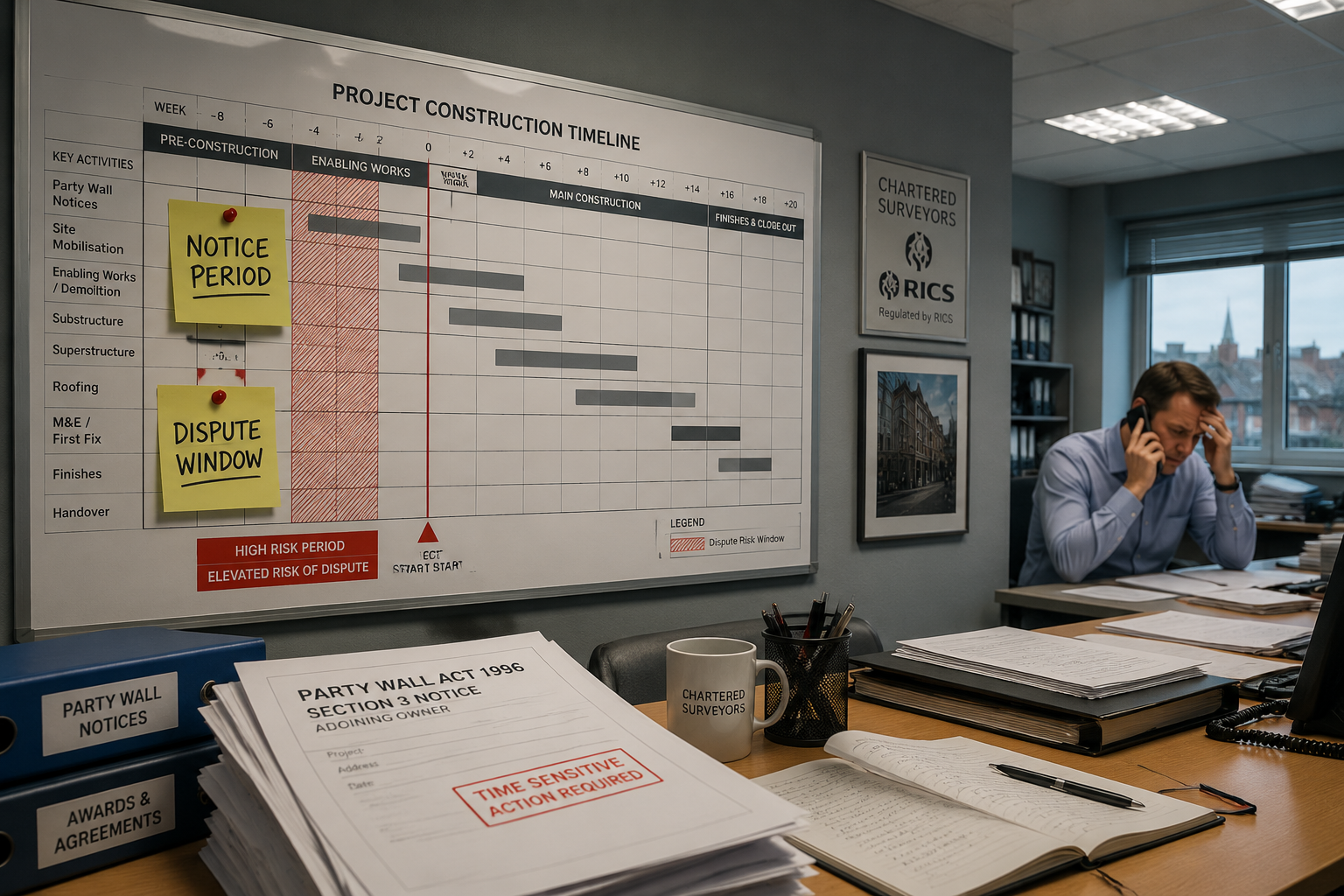
Why the Party Wall Process Is Structurally Incompatible with Last-Minute Planning
The Party Wall etc. Act 1996 was designed to protect both building owners and their neighbours. It was not designed for speed. Understanding its built-in timescales is the first step to grasping why last-minute party wall awards: risks, delays and how surveyors can rescue a project is such a pressing concern in modern construction.
Statutory Notice Periods Leave Almost No Room for Error
Under the Act, a building owner must serve a valid party wall notice before carrying out notifiable works. The minimum notice periods are:
| Type of Work | Minimum Notice Period |
|---|---|
| Line of junction works (new walls on or astride the boundary) | 1 month |
| Party structure works (alterations to an existing party wall) | 2 months |
| Excavation within 3 or 6 metres of a neighbouring structure | 1 month |
Once a notice is served, the adjoining owner has 14 days to respond. If they do not respond — or if they dissent — a dispute is "deemed" to have arisen, and both parties must appoint surveyors [3]. That appointment process, the preparation of a schedule of condition, and the drafting and agreement of the award itself can easily add another four to eight weeks on top of the notice period [6].
In practice, a building owner who serves notice just two months before their planned start date is already operating with almost no contingency. Any complication — a slow-responding neighbour, a disagreement over the scope of works, or a surveyor who is overloaded with cases — can push the award past the intended start date [4].
The "Deemed Dispute" Trap
Many building owners assume that silence from a neighbour is tacit consent. It is not. Under the Act, failure to respond within 14 days automatically creates a dispute. This is one of the most common triggers for last-minute crises [2]. A building owner who has been waiting hopefully for a consent letter suddenly discovers, days before their contractor is due on site, that they are now in a formal dispute and need to appoint a surveyor immediately.
The party wall award process then begins from scratch, and the clock is ticking loudly.
Defective Notices: A Hidden Time Bomb
Even when a notice is served on time, it can be invalid. Common defects include:
- Incorrect property description or missing owner details
- Wrong notice type served for the works being carried out
- Failure to identify all notifiable works accurately
- Serving notice on a tenant rather than the freehold owner
A defective notice does not start the statutory clock. If the defect is discovered late — perhaps when an adjoining owner's surveyor reviews the paperwork — the entire process may need to restart [10]. This is why surveyors consistently stress that understanding what a party structure notice requires and how to serve it correctly is not a formality but a critical project management task.
The Real Risks When Party Wall Awards Are Left Too Late
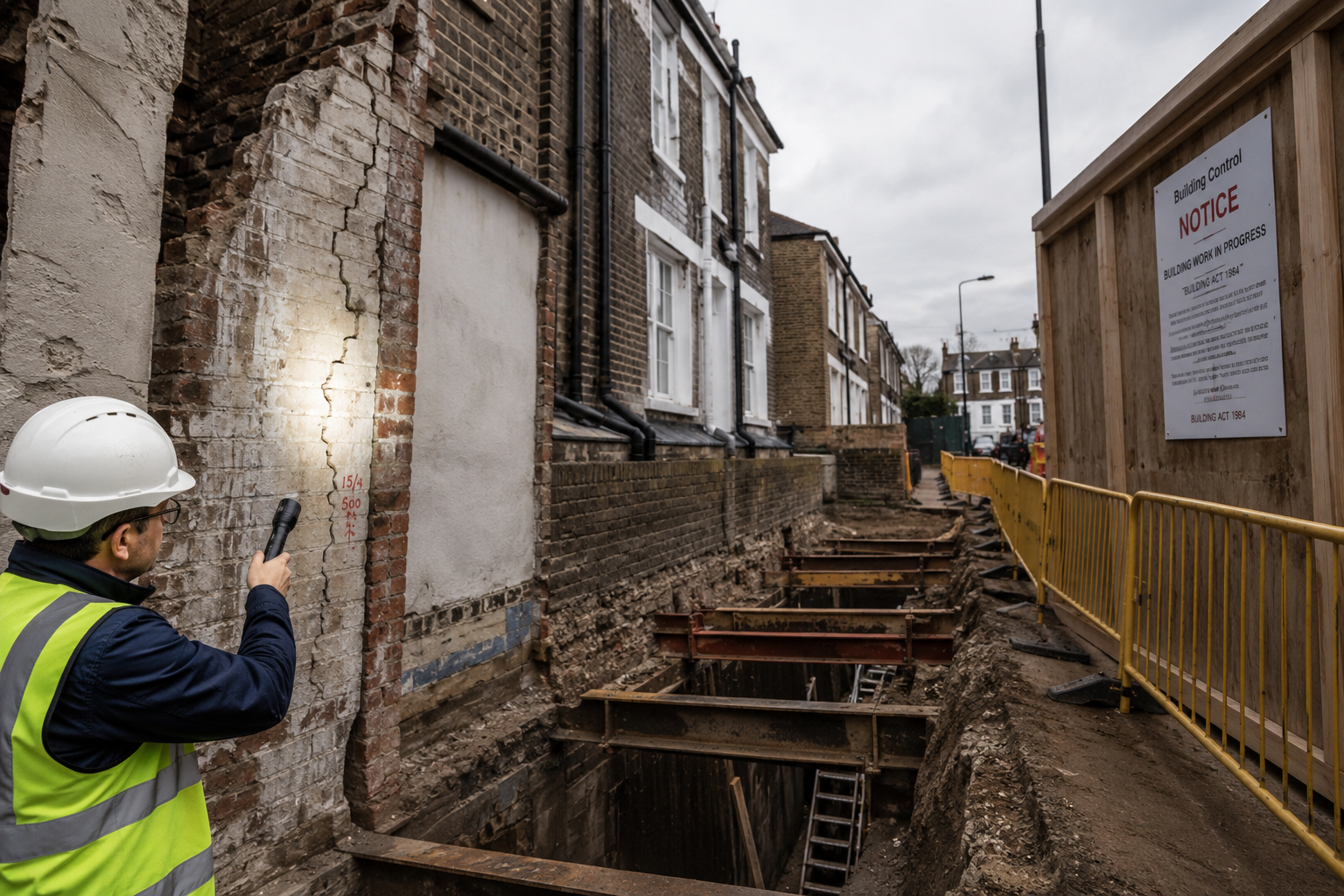
The risks associated with last-minute party wall awards: risks, delays and how surveyors can rescue a project are not theoretical. They fall into four distinct categories: legal, financial, structural, and reputational.
Legal Risk: Injunctions and Unlawful Works
Carrying out notifiable works without a valid award is unlawful. An adjoining owner can apply to the courts for an injunction to stop the works, and courts have consistently granted these applications where the statutory process has not been followed [1]. An injunction does not just pause the project — it can freeze a site for weeks or months while legal proceedings are resolved, with all associated contractor standing costs falling on the building owner.
"Rushing at the end of the party wall process does not save time — it creates the conditions for a much longer, more expensive stoppage later."
Beyond injunctions, building owners who proceed without an award lose the statutory protection the Act provides. They become exposed to common law claims for nuisance and negligence without the procedural safeguards that a properly made award would have given them [3].
Financial Risk: Costs That Spiral Quickly
A typical party wall award costs between £1,000 and £3,000 or more, depending on complexity [6]. When a project is delayed because the award is not in place, those costs multiply. Contractor standing time, extended plant hire, and prolonged professional fees can dwarf the original award cost many times over.
The 2026 UK construction boom has made this worse. Labour shortages mean that contractors who are stood down due to a party wall delay may not be available to return quickly, potentially pushing a project back by months rather than weeks [5]. Surveyors drafting awards in the current market are increasingly building explicit contingency provisions into their documents to account for these realities [4].
Structural Risk: When Speed Kills
Safety-critical works — deep excavations, underpinning, structural alterations to a shared wall — carry the highest risk when rushed. A safety report published by CROSS (Collaborative Reporting for Safer Structures) found that delay by a party wall surveyor, including the issuing of very late awards, can materially increase structural risk, particularly on excavation and alteration projects [9].
When an award is produced under time pressure, there is less opportunity to carry out a thorough schedule of condition survey of the adjoining property before works begin. Without this baseline record, disputes about pre-existing versus construction-caused damage become almost impossible to resolve fairly. Both the building owner and the adjoining owner are left exposed.
Works involving excavation near foundations are now subject to heightened scrutiny under the principles emerging from Awaab's Law, which has broadened attention to habitability and structural safety in residential properties [7]. A rushed award that fails to adequately address drainage, damp, or structural loading risks is not just procedurally weak — it may expose surveyors themselves to negligence claims.
Reputational Risk for Surveyors
Surveyors who allow themselves to be pressured into producing inadequate awards face professional consequences. The RICS requires members to act with competence and integrity. An award produced without adequate time for inspection, consultation, or proper scoping is unlikely to meet that standard, regardless of the commercial pressure applied [1].
How Surveyors Can Rescue a Last-Minute Party Wall Situation
When a building owner arrives at a surveyor's door with a contractor due on site in three weeks and no award in place, all is not necessarily lost. Experienced surveyors have developed a structured triage approach to managing last-minute party wall awards: risks, delays and how surveyors can rescue a project effectively.

Step 1: Rapid Validity Triage
The first task is to establish exactly what has and has not been done correctly. This means:
- Confirming whether valid notices have been served and when
- Checking that the correct notice type was used for each element of the works
- Verifying that all relevant adjoining owners have been identified and served
- Establishing whether any consent or dissent has been formally received
This triage step often reveals that the situation is less catastrophic than feared — or that a specific, fixable defect is the only obstacle. For building owners who want to understand the full scope of types of party wall works and which require formal notice, early clarity prevents the most common errors.
Step 2: Immediate Neighbour Engagement
In many last-minute cases, the adjoining owner has not actively dissented — they have simply not engaged. A surveyor who makes direct, professional contact with the neighbouring party can often move things forward significantly faster than the formal statutory process alone allows [2].
Where a neighbour is willing to consent in writing, the formal dispute process can be bypassed entirely, removing weeks from the timeline. Even where consent is not forthcoming, early engagement allows the adjoining owner's concerns to be identified and addressed in the award, reducing the risk of a challenge later.
Building owners who are unsure about their rights and obligations as an adjoining owner should be directed to clear, accessible information early in this process to reduce friction.
Step 3: Tightly Scoped Initial Awards
Where time is genuinely critical, surveyors can produce an initial award that covers only the works that must start immediately — typically groundworks or structural preparation — while reserving more complex or contentious issues for a supplementary award [6]. This approach:
- Allows critical path works to begin legally
- Reduces the drafting time required for the initial document
- Preserves the ability to address complex issues properly, without time pressure
- Gives both parties a clear framework while negotiations continue
This strategy requires careful scoping. An initial award that is too narrow may leave the building owner exposed on adjacent works; one that is too broad recreates the original time pressure problem. Surveyors with experience in drafting party wall awards understand where these boundaries lie.
Step 4: Third Surveyor Escalation Where Necessary
Where an appointed surveyor — whether acting for the building owner or the adjoining owner — is causing delay through inaction or unreasonable conduct, the Act provides a mechanism for escalation to a Third Surveyor. This is not a last resort; it is a statutory tool designed precisely for situations where the process has stalled [2].
The Third Surveyor can make a determination that is binding on both parties, cutting through obstruction and allowing the project to proceed. Surveyors who are familiar with this mechanism and willing to use it can rescue projects that would otherwise be lost to indefinite delay.
Step 5: Parallel Processing Where Possible
In some cases, certain preparatory works — those that do not directly affect the party wall or fall within the notifiable categories — can proceed while the award process is completed. A surveyor who understands the precise boundaries of the Act can identify these opportunities and advise the building owner accordingly, keeping the project moving without exposing anyone to legal risk.
Prevention Is Always Cheaper Than Rescue
The most effective way to manage last-minute party wall awards: risks, delays and how surveyors can rescue a project is to avoid the last-minute situation entirely. The following table summarises the recommended lead times for each stage of the process:
| Stage | Recommended Start Before Works |
|---|---|
| Identify notifiable works and adjoining owners | 4-5 months |
| Serve party wall notices | 3-4 months (allowing for 1-2 month notice periods) |
| Allow response period and appoint surveyors | 2-3 months |
| Complete schedule of condition and draft award | 6-8 weeks |
| Award agreed and signed | At least 2 weeks before start |
Building owners who are planning works in London should also factor in the additional complexity of urban environments, where multiple adjoining owners, shared infrastructure, and higher-density development create more opportunities for disputes. Specialist surveyors covering East London, North London, South London, West London, and Central London understand the specific challenges of their local markets, including the longer lead times now common in the 2026 construction environment [5].
For building owners who want to understand how to keep party wall costs down, the single most effective strategy is starting early. Every week of delay at the planning stage can translate into multiple weeks of delay — and significantly higher costs — at the construction stage.
Conclusion
Last-minute party wall awards are not simply an administrative inconvenience. They represent a genuine category of construction risk, with the potential to stop projects entirely, expose building owners to legal liability, and — in the most serious cases — compromise the structural safety of neighbouring properties.
The good news is that experienced surveyors have the tools, the statutory mechanisms, and the practical expertise to rescue many last-minute situations. Rapid triage, direct neighbour engagement, tightly scoped initial awards, and Third Surveyor escalation are all proven strategies that can get a stalled project moving again.
Actionable next steps for building owners:
- Start the party wall process as early as possible — ideally four to five months before the planned construction start date.
- Engage a qualified party wall surveyor at the planning stage, not after a problem has arisen.
- Ensure all notices are checked for validity before the response period begins.
- If a last-minute situation has already developed, contact a specialist surveyor immediately — the sooner triage begins, the more options remain available.
- Do not allow contractor pressure or sunk costs to push works forward without a valid award in place. The legal and financial consequences of proceeding unlawfully will always exceed the cost of a short delay.
The party wall process exists to protect everyone involved in a construction project. Treating it as a priority from day one — rather than a box to be ticked at the last moment — is the most reliable way to keep a project on time, on budget, and legally sound.
References
[1] Party Wall Issues – https://www.tatesurveyingservices.co.uk/advice/party-wall-issues/
[2] Party Wall Delay Tactics How Overcome Them Vince Rimmer 5qcte – https://www.linkedin.com/pulse/party-wall-delay-tactics-how-overcome-them-vince-rimmer-5qcte
[3] Party Wall Agreement – https://hoa.org.uk/advice/guides-for-homeowners/i-am-improving/party-wall-agreement/
[4] Drafting Party Wall Awards Under Labour Shortages Best Practices For Chartered Surveyors In 2026 – https://princesurveyors.co.uk/blog/drafting-party-wall-awards-under-labour-shortages-best-practices-for-chartered-surveyors-in-2026/
[5] Party Wall Surveys Amid 2026 Uk Construction Boom Handling High Demand Disputes In Tight Housing Markets – https://nottinghillsurveyors.com/blog/party-wall-surveys-amid-2026-uk-construction-boom-handling-high-demand-disputes-in-tight-housing-markets
[6] Managing Last Minute Party Wall Awards When You Need To Start Building Quickly – https://partywallsurveyorlondon.uk/blogs/managing-last-minute-party-wall-awards-when-you-need-to-start-building-quickly/
[7] Party Wall Awards For Structural Collapse Risks Safeguards Under Awaabs Law 2026 For Excavation And Demolition Works – https://manchestersurveyors.com/party-wall-awards-for-structural-collapse-risks-safeguards-under-awaabs-law-2026-for-excavation-and-demolition-works/
[9] Delay Party Wall Surveyor Adds Risk 1010 – https://www.cross-safety.org/us/safety-information/cross-safety-report/delay-party-wall-surveyor-adds-risk-1010
[10] What Is A Party Wall Notice – https://allwellpropertyservices.co.uk/blog/what-is-a-party-wall-notice
