
Nearly one in three homeowners who carry out internal structural works in England and Wales unknowingly breach the Party Wall etc. Act 1996 — not because they are building outward, but because they are building upward or inward. Loft conversions, chimney breast removal and the Party Wall Act: avoiding structural and legal pitfalls is a subject that catches thousands of property owners off guard every year. The assumption that "it's inside my own home" keeps many people from serving the notices the law requires — until a dispute, a damaged neighbour's wall, or a stalled property sale forces the issue.
This guide cuts through the confusion. It explains precisely which internal works trigger the Act, what notices must be served, what neighbours are entitled to, and how a properly drafted Party Wall Award protects everyone involved.
Key Takeaways
- 🏗️ Loft conversions and chimney breast removals frequently trigger the Party Wall etc. Act 1996, even when all work appears to be inside your own property.
- 📋 Serving the correct notice — and doing so at least two months before work starts — is a legal requirement, not a courtesy.
- 🔩 Steel beams (RSJs) inserted into or near a party wall are one of the most commonly overlooked triggers for the Act.
- 🏠 Neighbours have the right to appoint their own surveyor at the building owner's expense in many circumstances.
- ⚖️ A Party Wall Award sets out the conditions under which work may proceed and provides legal protection for both parties.
Why Internal Works Unexpectedly Trigger the Party Wall Act
Most homeowners associate the Party Wall etc. Act 1996 with extensions, new walls, or excavations close to a boundary. The reality is more nuanced. The Act covers a specific category of work defined by what is being done to a shared structure, not simply where the building site is located.
The Three Main Triggers for Loft and Chimney Works
| Type of Work | Party Wall Act Trigger | Notice Required |
|---|---|---|
| Loft conversion with new steel beam | Cutting into or bearing on the party wall | Party Structure Notice |
| Chimney breast removal (mid-terrace) | Removing part of a party structure | Party Structure Notice |
| New floor joists bearing on party wall | Inserting a beam into the party wall | Party Structure Notice |
| Chimney stack removal above the roof | Work to a shared chimney stack | Party Structure Notice |
| Excavation within 3m of neighbour's foundations | Underpinning or deepening foundations | Line of Junction / Section 6 Notice |
The Party Wall etc. Act 1996 defines a party wall as a wall that stands on the lands of two or more owners, or a wall that forms part of a building and stands on the boundary between two properties. A chimney breast in a mid-terrace house almost always forms part of that shared structure. Removing it — even entirely within what feels like "your" side — can alter the structural integrity of the shared wall and therefore falls squarely within the Act's scope.
💡 Pull Quote: "The Act is triggered by the nature of the work, not the location of the scaffolding. Working inside your own home does not automatically exempt you."
Chimney Breast Removal: The Hidden Structural Risk
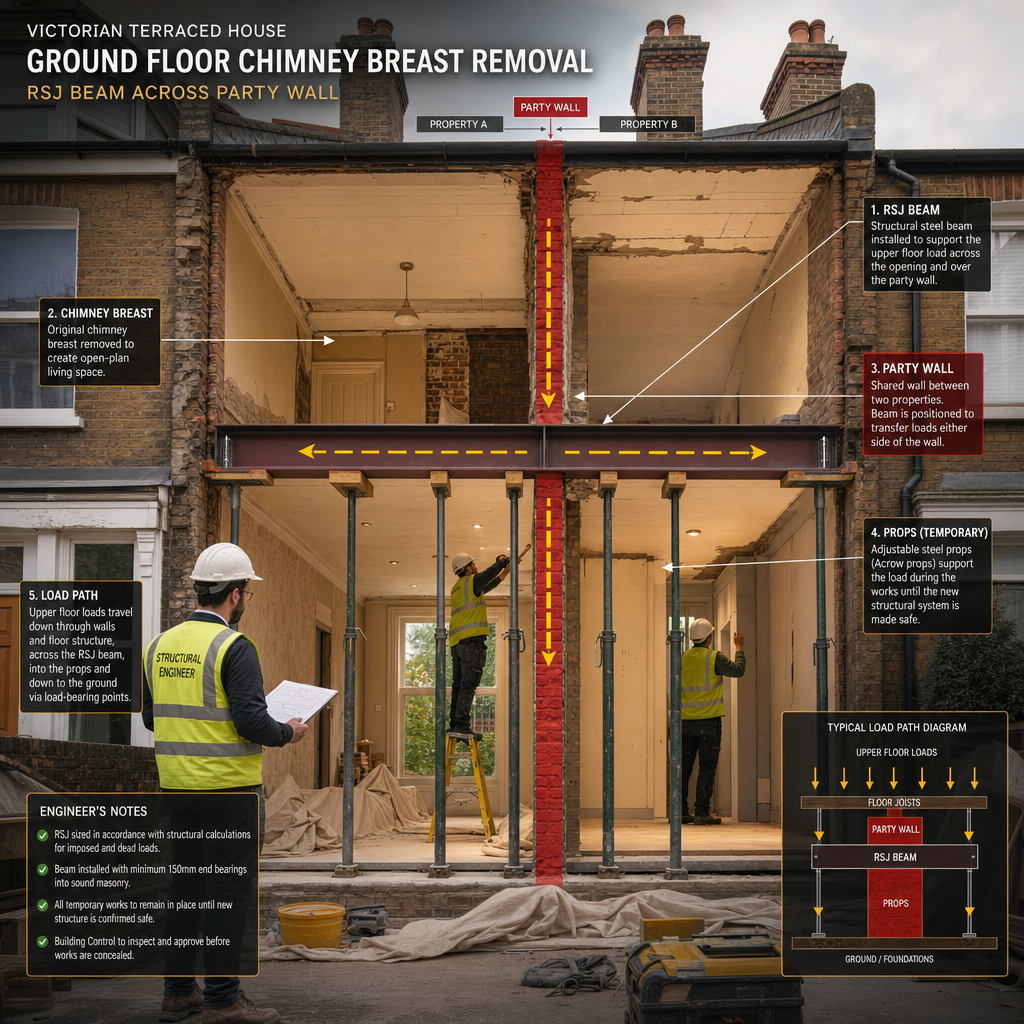
Removing a chimney breast is one of the most structurally complex domestic jobs a homeowner can undertake. In a Victorian or Edwardian terraced property — the most common housing stock in London and many other UK cities — the chimney breast is often integral to the party wall itself.
What Happens Structurally
When a chimney breast is removed on the ground or first floor, the chimney stack above it must be supported. This is typically achieved by installing a gallows bracket or a padstone and steel beam within the party wall. That beam bears on the party structure. Under Section 2 of the Party Wall etc. Act 1996, any work that involves:
- Cutting into a party wall
- Raising or underpinning a party wall
- Demolishing and rebuilding a party wall
- Inserting a damp proof course into a party wall
…requires a Party Structure Notice to be served on the adjoining owner at least two months before work commences.
The Risk of Proceeding Without Notice
Removing a chimney breast without the correct notice in place can:
- ❌ Invalidate your building insurance if damage occurs during works
- ❌ Expose you to a civil claim from your neighbour for damage to their property
- ❌ Cause a surveyor or solicitor to flag the issue during a future property sale
- ❌ Result in an injunction stopping all works until the legal process is followed
A retrospective Party Wall Award can be obtained after the fact, but it is significantly more expensive, more contentious, and provides far less protection than one agreed before work begins.
Loft Conversions and the Party Wall Act: Steel Beams, Joists, and Shared Structures
Loft conversions are among the most popular home improvements in the UK in 2026, adding an average of 20% to a property's value. Yet they are also among the most frequently mishandled when it comes to the Party Wall Act.
When Does a Loft Conversion Trigger the Act?
A loft conversion triggers the Act when it involves:
- Inserting steel beams (RSJs) into the party wall — Standard practice in most loft conversions, where the new floor structure bears on the shared wall.
- Raising the party wall — Some conversions require the wall to be built higher to accommodate the new floor level.
- Cutting pockets into the party wall — To seat the ends of new joists or beams.
- Work to a shared chimney stack — Removing, capping, or altering a chimney that sits on or straddles the party wall.
Understanding the types of party wall works that require formal notice is essential before any contractor breaks ground — or ceiling.
The Steel Beam Problem
The insertion of a steel RSJ into a party wall is the single most common trigger for the Act in loft conversion projects. Many builders and even some architects overlook this, assuming that because the beam sits within the building owner's floor structure, it does not engage the Act. This is incorrect.
Section 2(2)(f) of the Act specifically covers "cutting into a party structure for any purpose." Pocketing a beam end into a party wall — even just 100mm — is cutting into that structure. The notice obligation is clear.
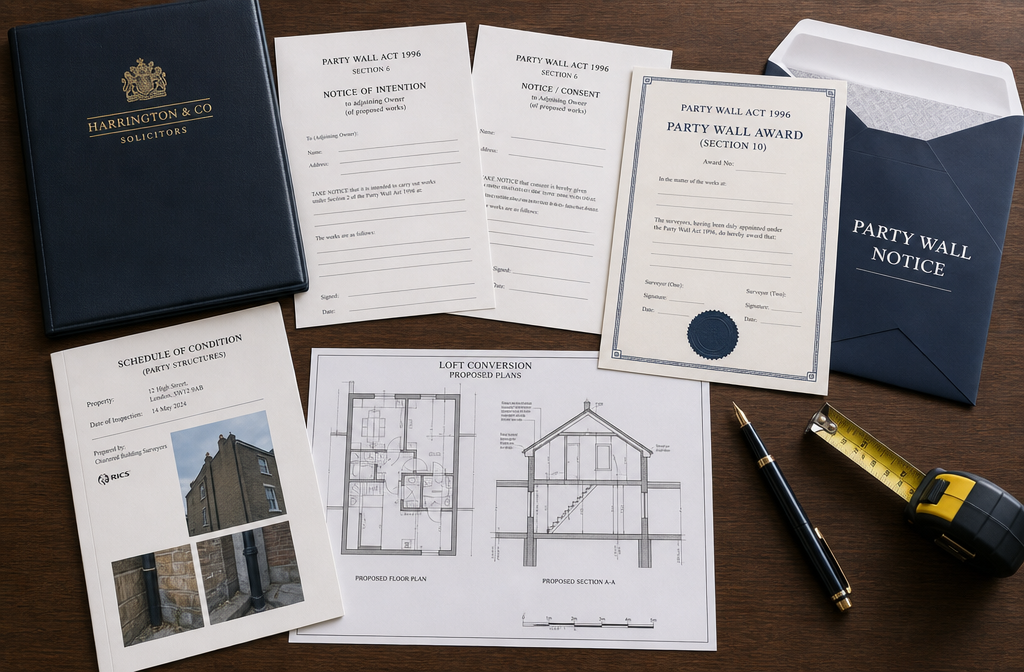
What the Party Structure Notice Must Include
A valid Party Wall notice for loft conversion or chimney breast works must state:
- The name and address of the building owner
- The nature and particulars of the proposed work
- The date on which the work is proposed to begin
- A statement that it is served under the Party Wall etc. Act 1996
Neighbours then have 14 days to respond. If they consent in writing, work can proceed. If they dissent — or fail to respond — a dispute is deemed to have arisen and surveyors must be appointed.
Neighbour Rights, Surveyor Appointments, and the Party Wall Award
Understanding the rights of the adjoining owner is just as important as understanding the obligations of the building owner. The Act is designed to be balanced, and neighbours have meaningful protections.
What Adjoining Owners Are Entitled To
- ✅ Receive proper written notice before any notifiable work begins
- ✅ Appoint their own surveyor — at the building owner's expense — if they dissent
- ✅ Receive a Schedule of Condition documenting the state of their property before works start
- ✅ Have a Party Wall Award setting out the conditions of work
- ✅ Claim compensation for any damage caused by the notifiable works
If you are a neighbour whose adjoining owner is carrying out a loft conversion or chimney breast removal, understanding your rights as an adjoining owner is the first step to protecting your property.
The Party Wall Award Explained
A Party Wall Award is a legally binding document produced by the appointed surveyor(s). For loft conversions and chimney breast removals, a typical Award will include:
| Award Condition | Purpose |
|---|---|
| Method of beam insertion | Specifies how and where the RSJ is to be seated |
| Working hours | Protects the neighbour from unreasonable disruption |
| Dust and noise mitigation | Sets out protective measures |
| Schedule of Condition | Baseline record of neighbour's property pre-works |
| Damage notification procedure | Defines how claims are to be handled |
| Right of access for inspection | Allows the surveyor to monitor compliance |
The Award also typically specifies temporary propping requirements — critical when a chimney breast is being removed, as the stack above must be supported throughout the works.
💡 Pull Quote: "A Party Wall Award is not a bureaucratic hurdle — it is a legal shield for both the building owner and their neighbour. Skipping it leaves both parties exposed."
Loft Conversions, Chimney Breast Removal and the Party Wall Act: A Practical Step-by-Step Guide
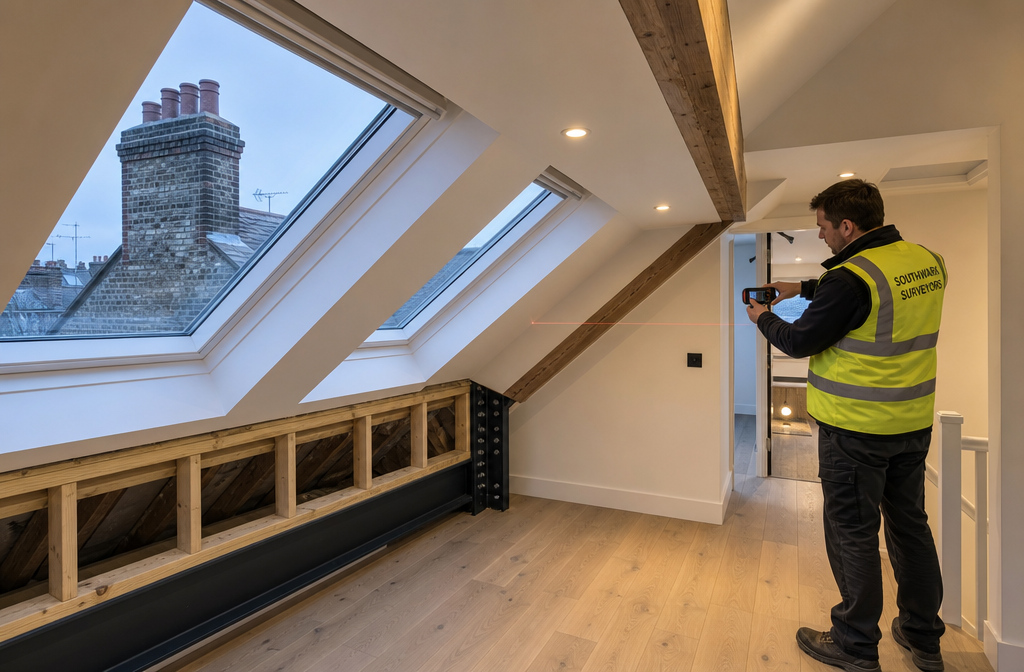
Navigating loft conversions, chimney breast removal and the Party Wall Act — and avoiding structural and legal pitfalls — is far more manageable when approached in the right sequence.
Step 1: Appoint a Structural Engineer Early
Before any planning or party wall process begins, commission a structural engineer to assess:
- Load paths through the existing chimney breast
- The specification of any new steel beams
- The impact on the party wall of new floor joists
This report informs both the building regulations application and the party wall notice.
Step 2: Identify All Notifiable Works
Work through the project with your architect or structural engineer to identify every element that touches or bears on the party wall. Be thorough — missed items discovered mid-build can halt the project.
Step 3: Serve the Correct Notices in Time
For most loft conversions and chimney breast removals, a Party Structure Notice under Section 2 of the Act is required, served at least two months before work starts. Understanding how Party Wall Act notices work and how to respond will help both building owners and neighbours navigate this stage confidently.
Step 4: Allow the Dispute Resolution Process to Run
If neighbours dissent or fail to respond within 14 days, surveyors are appointed. The process then typically takes four to eight weeks to produce an Award. Factor this into your project timeline — contractors cannot begin notifiable works until the Award is in place.
Step 5: Commission a Schedule of Condition
Before any work begins, a Schedule of Condition should be prepared. This photographic and written record of the neighbour's property — particularly walls, ceilings, and chimney breasts on their side — is the definitive reference point if any damage claim arises later.
Step 6: Comply with the Award Throughout Works
The Party Wall Award is a live document. Contractors must follow its conditions at all times. The appointed surveyor has the right to inspect the works, and any deviation from the Award's terms can result in enforcement action.
Common Mistakes to Avoid
Even well-intentioned homeowners and their builders make avoidable errors. The most frequent pitfalls in loft conversion and chimney breast projects include:
- 🚫 Assuming verbal agreement from a neighbour is sufficient — Only written consent under the Act provides legal protection
- 🚫 Starting work before the notice period expires — Even if the neighbour seems happy, the two-month notice period is a legal requirement
- 🚫 Using a single agreed surveyor without understanding the implications — While permitted under the Act, this arrangement requires careful consideration; see the guide on party wall agreements without a surveyor for context
- 🚫 Failing to notify all adjoining owners — In a mid-terrace property, both neighbours may need to be notified
- 🚫 Neglecting the chimney stack on the neighbour's side — Even if the breast is only removed on your side, the stack above is often shared
Costs and How to Keep Them Manageable
Party wall surveyor fees for loft conversions and chimney breast removals vary depending on complexity, location, and whether one or two surveyors are appointed. In London, fees typically range from £700 to £2,000 per surveyor for straightforward cases, rising for complex multi-neighbour projects.
The building owner generally pays the costs of the process, including the neighbour's surveyor's reasonable fees. However, there are ways to keep party wall costs down without compromising on legal compliance:
- Serve notices early to avoid rushed, premium-rate appointments
- Provide comprehensive structural drawings upfront to reduce surveyor query time
- Engage a single agreed surveyor where both parties are genuinely comfortable to do so
- Avoid starting work without an Award in place — remedial legal work is far more expensive
Conclusion: Act Early, Document Everything, and Get Expert Guidance
Loft conversions, chimney breast removal and the Party Wall Act: avoiding structural and legal pitfalls ultimately comes down to one principle — do not treat the legal process as an afterthought. The Party Wall etc. Act 1996 exists to protect both building owners and their neighbours from the very real structural risks that come with altering shared walls and structures.
Actionable Next Steps
- Before appointing a contractor, have a structural engineer and architect identify all notifiable works in your project.
- Serve Party Structure Notices at least two months before the planned start date — earlier if possible.
- Commission a Schedule of Condition to protect yourself against spurious damage claims.
- Engage a qualified party wall surveyor who has experience with loft conversions and chimney breast removals specifically.
- Keep all documentation — notices, consents, Awards, and correspondence — for the lifetime of your ownership of the property.
Whether carrying out works or receiving a notice from a neighbour, specialist guidance makes the process smoother and the outcome legally sound. For those in the capital, party wall surveyors covering all areas of London are available to advise from the earliest planning stages through to project completion.
The structural risks of chimney breast removal and loft conversion are manageable with the right engineering input. The legal risks are equally manageable — but only if the Party Wall Act process is followed correctly, from the very first notice.