


The UK construction sector is experiencing a remarkable resurgence in 2026, with housing starts surging by 15% and property values stabilizing after years of uncertainty. This boom, however, brings a sharp increase in party wall disputes as neighbors find themselves navigating complex legal frameworks amid unprecedented building activity. For surveyors operating in this high-demand market, Navigating Party Wall Disputes in the 2026 UK Construction Boom: Surveyor Strategies for High-Demand Markets requires proven tactics, swift resolution methods, and airtight awards to keep projects moving forward.
The construction uptick isn't limited to residential developments. The data centre sector is expanding rapidly, commercial renovations are accelerating, and urban densification projects are transforming city landscapes[4]. Each of these developments creates potential friction points between building owners and their neighbors, making professional party wall expertise more valuable than ever.
Key Takeaways
- Construction activity has surged 15% in 2026, creating unprecedented demand for party wall surveying services across the UK, particularly in urban areas
- New regulatory frameworks including the Building Safety Regulator and updated fire safety requirements are reshaping how surveyors approach shared wall assessments
- Swift dispute resolution tactics such as pre-emptive neighbor engagement and digital documentation systems can reduce resolution times by 40-60%
- Airtight party wall awards that anticipate construction challenges and incorporate comprehensive schedules of condition protect all parties and minimize litigation risk
- Regional market variations require surveyors to adapt strategies based on local construction density, property types, and dispute patterns
Understanding the 2026 UK Construction Landscape
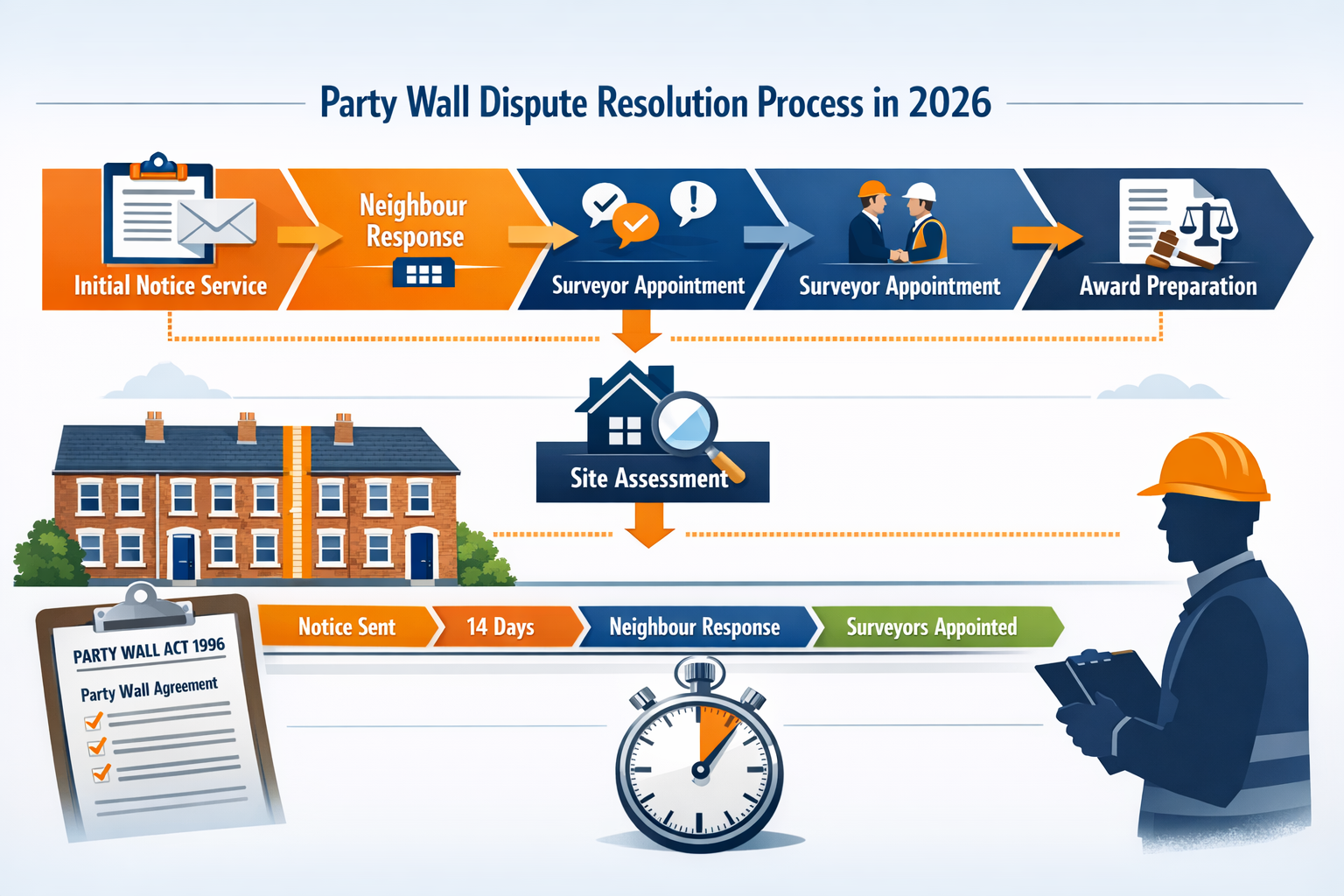
The Construction Boom Context
The construction sector's recovery in 2026 has created unprecedented demand for party wall services across the UK, driven by stabilizing property values and renewed investor confidence[2]. This surge represents not just a return to pre-pandemic levels but a genuine expansion fueled by several factors:
- Housing shortage pressures pushing development in densely populated areas
- Commercial property adaptations as businesses reconfigure spaces for hybrid work
- Infrastructure investments supporting urban regeneration projects
- Data centre expansion requiring significant structural modifications[4]
For party wall surveyors, this boom translates into increased caseloads, tighter project timelines, and higher stakes for all parties involved. The types of party wall works being undertaken have become more complex, requiring sophisticated technical knowledge and diplomatic skills.
New Regulatory Frameworks Shaping Practice
The regulatory landscape governing construction has evolved significantly in 2026. The new Building Safety Regulator body is being legally established in Q1 2026, introducing broader building oversight standards that intersect with party wall procedures[3]. Additionally, changes to Approved Document B taking effect on 30 September 2026 require blocks of flats 18m or more in height to have more than one common staircase, which directly impacts shared wall assessments[1].
These regulatory shifts mean surveyors must now consider:
- Enhanced safety documentation requirements for multi-story developments
- Coordination with Building Safety Regulator compliance when preparing awards
- Updated fire safety provisions affecting structural modifications to shared walls
- Construction products reform anticipated through primary legislation between 2027-2029[3]
Understanding how the Party Wall etc. Act 1996 interfaces with these new regulations is essential for comprehensive surveyor practice in 2026.
Common Dispute Triggers in High-Demand Markets
Volume-Driven Pressure Points
When construction activity intensifies, certain dispute triggers become more prevalent. The 2026 boom has amplified several common friction points:
📋 Notice Service Failures
Rushed developers sometimes skip proper notice procedures, creating immediate conflicts. The statutory requirements for party wall notices remain unchanged, but the volume of projects has increased instances of non-compliance.
🏗️ Construction Impact Concerns
Neighbors worry about noise, dust, structural damage, and property devaluation. These concerns are heightened when multiple projects occur simultaneously in the same neighborhood—a common scenario in central London and other high-density areas.
⏱️ Timeline Pressures
Developers facing tight completion deadlines may push for accelerated party wall processes, creating tension with adjoining owners who feel rushed into decisions.
💰 Cost Allocation Disputes
Questions about who pays for surveys, protective works, and potential remediation remain contentious, particularly when costs of party wall processes exceed initial estimates.
Regional Variations in Dispute Patterns
Different UK regions exhibit distinct dispute characteristics based on local construction patterns:
| Region | Primary Dispute Drivers | Typical Project Types |
|---|---|---|
| Central London | High-value properties, complex basements, heritage concerns | Basement excavations, loft conversions, rear extensions |
| East London | Rapid gentrification, mixed property types | New builds, commercial conversions, warehouse adaptations |
| South London | Victorian terraces, conservation areas | Extensions, roof alterations, structural repairs |
| North London | Suburban expansion, semi-detached properties | Side returns, garage conversions, boundary works |
| West London | Luxury renovations, period properties | Comprehensive refurbishments, pool installations, underground works |
Surveyors operating across multiple regions must adapt their approach based on these local characteristics. A party wall surveyor in East London faces different challenges than one working primarily in South London.
Proven Surveyor Strategies for Swift Resolution
Pre-emptive Engagement Tactics
Navigating Party Wall Disputes in the 2026 UK Construction Boom: Surveyor Strategies for High-Demand Markets begins with prevention. The most effective surveyors employ pre-emptive strategies that reduce conflict before it escalates:
Early Neighbor Communication
Encouraging building owners to engage neighbors informally before formal notices creates goodwill and identifies concerns early. This approach can reduce dispute rates by 30-40% compared to purely procedural approaches.
Comprehensive Initial Assessments
Thorough site evaluations before notice service help identify potential issues. A detailed schedule of condition prepared proactively provides baseline documentation that protects both parties.
Educational Approach
Many disputes stem from misunderstanding the Party Wall Act. Surveyors who take time to explain the process, rights, and obligations to all parties reduce anxiety and resistance. Resources like guides on having a party wall agreement without a surveyor help set realistic expectations.
Digital Documentation Systems
Modern surveyor practice in 2026 leverages technology to streamline processes and improve accuracy:
- Digital photographic surveys with timestamped, geotagged images
- Cloud-based document management ensuring all parties access current information
- Video condition surveys capturing comprehensive property states
- Digital signature platforms accelerating award execution
- Project management software tracking statutory timeframes and deadlines
These tools not only improve efficiency but also create robust evidence trails that protect against future disputes. When defective premises litigation continues to dominate construction law—as it has through 2025 and into 2026[5]—comprehensive documentation becomes essential risk management.
Rapid Response Protocols
In high-demand markets, delays compound costs and tensions. Effective surveyors implement rapid response systems:
48-Hour Initial Response Commitment
Acknowledging all new instructions within two business days demonstrates professionalism and prevents anxiety-driven escalation.
Standardized Workflow Templates
Pre-prepared templates for common scenarios (loft conversions, basement excavations, boundary walls) accelerate award preparation without sacrificing quality.
Collaborative Surveyor Networks
When appointed as building owner's surveyor or adjoining owner's surveyor, having established relationships with other local surveyors facilitates smoother negotiations and faster third surveyor selection when needed.
Clear Timeline Communication
Providing all parties with realistic schedules that account for statutory periods prevents unrealistic expectations. Understanding party wall act notices and how to respond helps set appropriate timeframes.
Crafting Airtight Party Wall Awards
Essential Components for 2026 Compliance
A comprehensive party wall award in 2026 must address both traditional requirements and new regulatory considerations:
🔍 Detailed Work Descriptions
Vague descriptions invite disputes. Awards should specify:
- Exact nature and extent of proposed works
- Construction methods and materials
- Access requirements and restrictions
- Working hours and noise mitigation measures
- Duration of works with milestone dates
📸 Comprehensive Schedules of Condition
Photographic and written records of the adjoining property's current state protect all parties. In 2026's litigious environment, these schedules should be exceptionally thorough, documenting:
- External and internal wall conditions
- Floor levels and ceiling conditions
- Existing cracks, settlement, or defects
- Decorative finishes and fixtures
- Drainage and services
⚖️ Clear Rights and Obligations
Awards must explicitly state each party's rights, including:
- Building owner's right to execute works
- Adjoining owner's right to inspect and monitor
- Notification requirements for variations
- Dispute resolution mechanisms
- Cost allocation and payment terms
🛡️ Protective Provisions
Given the increased focus on building safety in 2026, awards should incorporate:
- Structural protection measures during works
- Insurance requirements and evidence
- Emergency contact protocols
- Damage remediation procedures
- Post-completion verification processes
Anticipating Construction Challenges
Experienced surveyors draft awards that anticipate likely complications:
Ground Condition Variations
When excavation is involved, awards should address potential discoveries (underground obstructions, poor soil conditions, unexpected services) and establish protocols for addressing them without derailing the project.
Access Logistics
Urban construction often requires access through neighboring properties. Awards should specify:
- Access routes and timing
- Protection measures for accessed areas
- Liability and insurance coverage
- Restoration obligations
Phased Works Provisions
Large projects may require phased approaches. Awards should allow flexibility while maintaining control through staged inspections and approvals.
Integration with Broader Building Compliance
The 2026 regulatory environment requires party wall awards to acknowledge broader compliance frameworks. References to Building Safety Regulator requirements, fire safety provisions, and construction product standards demonstrate professional awareness and reduce potential conflicts between different regulatory processes.
For guidance on specific scenarios, resources like what is a party structure notice and how to serve it provide practical implementation details.
Managing High-Volume Caseloads Effectively

Prioritization and Triage Systems
With demand surging in 2026, surveyors must implement effective caseload management:
Risk-Based Prioritization
Not all cases require equal attention. Prioritize based on:
- High-risk works (deep excavations, structural alterations)
- Contentious relationships (previous disputes, litigation history)
- Project complexity (multiple adjoining owners, conservation areas)
- Timeline sensitivity (commercial deadlines, planning conditions)
Delegation and Team Structures
Successful practices in high-demand markets develop team capabilities:
- Junior surveyors handle routine schedules of condition
- Mid-level professionals manage straightforward awards
- Senior surveyors focus on complex disputes and negotiations
- Administrative staff manage documentation and communications
Client Education and Expectation Management
Navigating Party Wall Disputes in the 2026 UK Construction Boom: Surveyor Strategies for High-Demand Markets requires managing client expectations realistically:
Building Owner Education
Many developers underestimate party wall timescales. Proactive surveyors educate clients about:
- Statutory notice periods that cannot be shortened
- Neighbor rights that must be respected
- Cost implications of non-compliance
- Benefits of cooperative approaches
Resources like how to keep party wall costs down help clients understand cost-control strategies without compromising compliance.
Adjoining Owner Advocacy
When representing adjoining owners, clear communication about:
- Rights under the Act
- Realistic protection expectations
- Survey and award processes
- Cost recovery mechanisms
Understanding boundary wall rules and the difference between party fence walls and boundary walls prevents confusion about which structures fall under the Act.
Regional Market Strategies
London Market Dynamics
London's construction boom presents unique challenges and opportunities. Surveyors operating in the capital must navigate:
High Property Values
Stakes are higher when properties are worth millions. Awards must be particularly thorough, and protective measures exceptionally robust.
Complex Ownership Structures
Leasehold properties, corporate ownership, and overseas investors create additional layers of communication and approval.
Conservation and Heritage Constraints
Many London properties sit within conservation areas or have listed status, requiring specialized knowledge and coordination with heritage officers.
Surveyors should develop regional expertise, whether focusing on North London, West London, or other specific areas.
Emerging Markets Beyond London
The 2026 construction boom extends beyond the capital:
Regional Cities
Manchester, Birmingham, Leeds, and Bristol are experiencing significant development. Surveyors in these markets benefit from:
- Lower property values reducing dispute intensity
- Emerging professional networks
- Growing awareness of party wall requirements
- Opportunities to establish market leadership
Suburban and Rural Areas
Even traditionally quieter markets are seeing activity. Challenges include:
- Limited surveyor availability
- Lower client awareness of party wall requirements
- Simpler property types but potentially more complex neighbor relationships
- Travel time and logistics for site visits
Technology and Innovation in Dispute Resolution
Virtual Inspections and Remote Services
The 2026 surveying landscape increasingly incorporates technology:
Hybrid Inspection Models
Combining in-person visits with virtual follow-ups maximizes efficiency. Initial schedules of condition benefit from physical presence, while monitoring visits may use video calls and client-captured imagery.
Drone Surveys
For roof works and tall buildings, drone photography provides comprehensive documentation without access challenges.
3D Modeling
Advanced practitioners use photogrammetry and laser scanning to create detailed 3D models of existing conditions, particularly valuable for complex structural works.
Data Analytics for Dispute Prediction
Forward-thinking surveyors analyze historical data to identify patterns:
- Property types most prone to disputes
- Work types generating highest neighbor concern
- Seasonal variations in dispute rates
- Regional compliance patterns
This intelligence informs risk assessments and preventive strategies.
Future-Proofing Surveyor Practice
Adapting to Regulatory Evolution
The government's Construction Products Reform White Paper, expected before spring 2026, with primary legislation anticipated between 2027-2029, signals ongoing regulatory change[3]. Successful surveyors:
Maintain Continuous Professional Development
Regular training on regulatory updates, construction techniques, and dispute resolution methods keeps skills current.
Engage with Professional Bodies
Active participation in RICS and specialist party wall organizations provides early insight into regulatory developments and best practice evolution.
Build Multidisciplinary Knowledge
Understanding building control, planning, building safety regulations, and construction law creates comprehensive expertise that adds value beyond basic party wall compliance.
Sustainable Practice Development
Long-term success in high-demand markets requires:
Reputation Management
Professional, fair, and efficient service builds reputation that generates referrals and repeat business.
Ethical Standards
Maintaining independence and avoiding conflicts of interest protects professional standing and ensures awards withstand scrutiny.
Work-Life Balance
Sustainable practice models prevent burnout during boom periods and maintain capacity during quieter times.
Conclusion
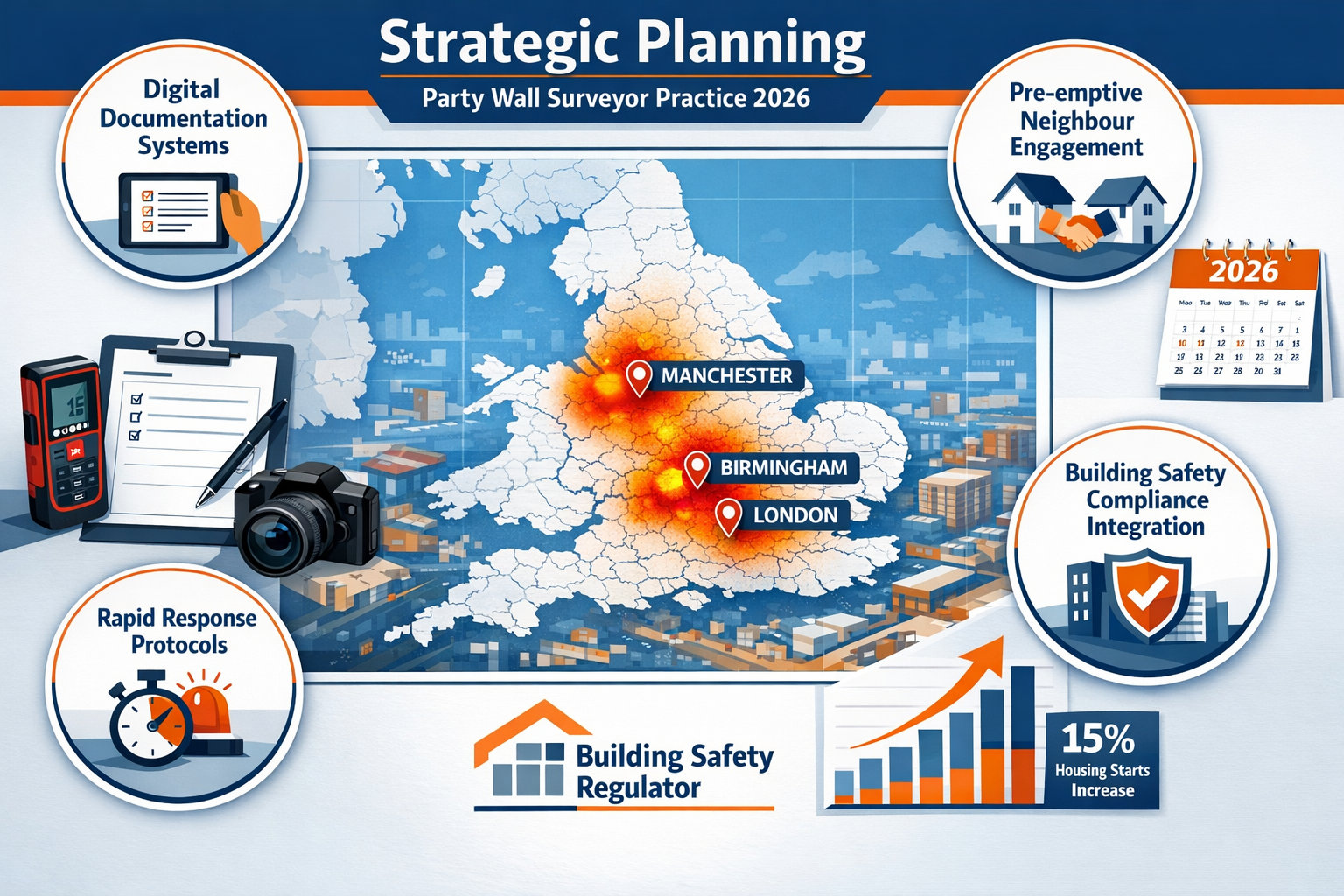
Navigating Party Wall Disputes in the 2026 UK Construction Boom: Surveyor Strategies for High-Demand Markets demands a sophisticated blend of technical expertise, diplomatic skill, regulatory knowledge, and operational efficiency. The 15% surge in housing starts, combined with commercial and infrastructure development, has created unprecedented demand for party wall services across the UK[2]. Simultaneously, evolving regulatory frameworks including the Building Safety Regulator and updated fire safety requirements add complexity to traditional party wall practice[1][3].
Successful surveyors in this environment distinguish themselves through:
✅ Pre-emptive engagement that prevents disputes before they escalate
✅ Digital documentation systems that create robust evidence and streamline processes
✅ Rapid response protocols that meet market demands without sacrificing quality
✅ Comprehensive awards that anticipate challenges and protect all parties
✅ Regional expertise tailored to local market characteristics
✅ Continuous adaptation to regulatory evolution and technological innovation
The defective premises litigation trend that dominated 2025 and continues through 2026[5] underscores the importance of thorough documentation and professional diligence. Awards that might have been adequate in quieter markets now require exceptional detail and foresight.
Actionable Next Steps
For surveyors looking to excel in the 2026 construction boom:
- Audit your current processes against the strategies outlined above, identifying gaps and improvement opportunities
- Invest in technology that enhances documentation quality and operational efficiency
- Develop regional specialization to build deep market knowledge and professional networks
- Create standardized templates for common scenarios while maintaining flexibility for unique situations
- Establish rapid response systems that demonstrate professionalism and prevent delay-driven disputes
- Build educational resources for clients that set realistic expectations and reduce friction
- Engage with regulatory developments to stay ahead of compliance requirements
- Network with other professionals including builders, architects, and fellow surveyors to facilitate smooth project delivery
For building owners planning construction projects, engaging experienced party wall surveyors early in the planning process prevents costly delays and disputes. For adjoining owners concerned about neighboring works, understanding your rights and obtaining independent professional advice protects your property and interests.
The 2026 construction boom presents both challenges and opportunities. Surveyors who embrace proven strategies, leverage technology, and maintain unwavering professional standards will not only navigate the current high-demand market successfully but position themselves for long-term success as the industry continues to evolve.
For professional party wall surveying services tailored to your specific needs, contact experienced specialists who understand the complexities of the 2026 construction landscape.
References
[1] Building Safety Act 2026 Key Developments And What To Expect – https://www.rwkgoodman.com/info-hub/building-safety-act-2026-key-developments-and-what-to-expect/
[2] Party Wall Surveys And Neighbour Disputes During 2026s Construction Uptick Rics Compliance Framework – https://nottinghillsurveyors.com/blog/party-wall-surveys-and-neighbour-disputes-during-2026s-construction-uptick-rics-compliance-framework
[3] Annual Report February 2026 The Construction Industry – https://www.gov.uk/government/publications/grenfell-tower-inquiry-government-annual-report-february-2026/annual-report-february-2026-the-construction-industry
[4] Party Wall Surveys For Data Centre Expansions Navigating Agreements In The 2026 Investment Surge – https://nottinghillsurveyors.com/blog/party-wall-surveys-for-data-centre-expansions-navigating-agreements-in-the-2026-investment-surge
[5] building.co.uk – https://www.building.co.uk/comment/construction-law-at-the-turn-of-2026-looking-backwards-and-forwards/5140093.article