


The construction landscape in 2026 has transformed dramatically. Trade tariffs and persistent supply chain disruptions are extending project timelines by months, creating unprecedented challenges for property owners and surveyors managing party wall procedures. When a basement excavation that once took three months now stretches to six or seven, how do you draft party wall notices that protect all parties while accounting for these uncertainties? Navigating Party Wall Notices Amid 2026 Tariffs and Material Delays: Surveyor Strategies has become essential knowledge for anyone planning construction work affecting shared boundaries.
The traditional party wall process, governed by the Party Wall etc. Act 1996, was designed for predictable construction schedules. Today's reality demands a more sophisticated approach. Surveyors must balance statutory requirements with the practical challenges of delayed material shipments, fluctuating costs, and extended construction periods—all while maintaining positive neighbour relations.
Key Takeaways
- 🏗️ Extended timelines: 2026 tariffs and supply chain issues are adding 4-6 months to typical construction projects, requiring party wall notices with built-in flexibility
- 💷 Cost implications: Party wall surveyor fees range from £900-£2,700 depending on project complexity, with the building owner responsible for all costs[1][4]
- 📋 Strategic notice timing: Serving notices earlier than the statutory minimum (2-12 months) provides essential buffer time for material delays
- 🤝 Neighbour communication: Transparent discussions about potential delays prevent disputes and strengthen party wall agreements
- ⚖️ Adaptive awards: Modern party wall awards must include contingency clauses addressing supply disruptions and timeline extensions
Understanding Party Wall Requirements in 2026's Economic Climate
The Party Wall etc. Act 1996 Fundamentals
The Party Wall etc. Act 1996 establishes the legal framework for construction work affecting shared walls, boundaries, and excavations near neighbouring properties. Property owners must serve formal party wall notices between 2 months and 1 year before commencing building work[1].
Three primary notice types exist:
- Party Structure Notice: For work directly to a shared wall
- Line of Junction Notice: For new walls on boundary lines
- 3/6 Metre Notice: For excavations within specified distances of neighbouring foundations
Each notice type triggers specific timeframes and procedural requirements. The adjoining owner has 14 days to consent or dissent, initiating the formal surveyor appointment process if agreement cannot be reached[7].
How 2026 Tariffs Impact Construction Timelines
The tariff landscape in 2026 has created significant ripple effects throughout the construction industry. Import duties on steel, timber, and specialized building materials have increased costs by 15-35% while simultaneously creating supply bottlenecks. What does this mean for party wall procedures?
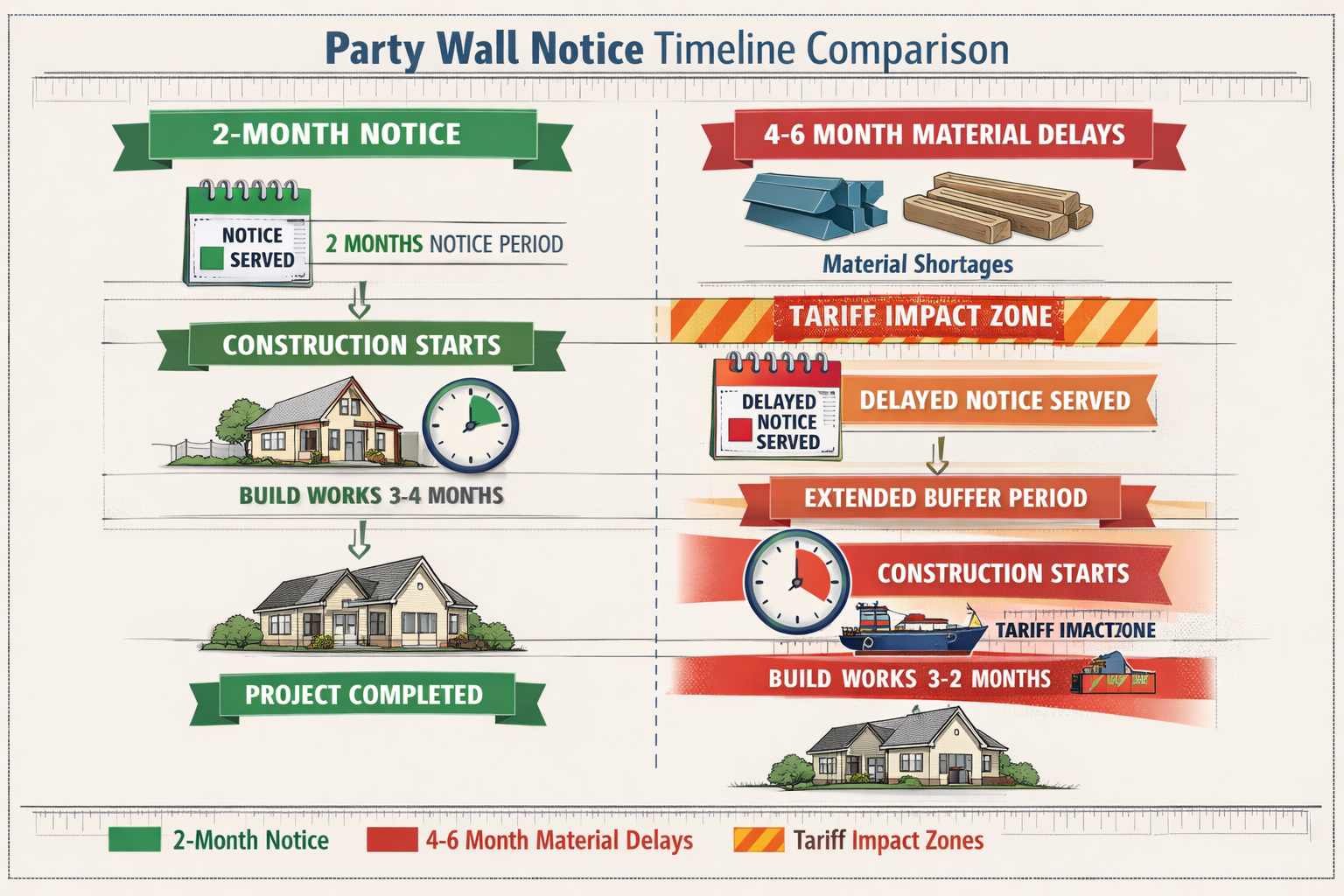
Material procurement delays now average 4-6 months for specialized items like structural steel beams, custom windows, and waterproofing systems. A loft conversion that previously required 3 months might now extend to 7-8 months. Basement excavations face even longer delays due to specialized underpinning materials and drainage systems.
These extensions create tension within the traditional party wall framework. Notices served at the statutory minimum 2-month period may become obsolete before work begins. Construction schedules outlined in party wall awards may bear little resemblance to actual timelines, creating confusion and potential disputes.
"The key challenge in 2026 is drafting party wall agreements that acknowledge economic uncertainty while providing sufficient protection for adjoining owners. Rigid timelines no longer serve anyone's interests." – Building Surveying Industry Insight[9]
Navigating Party Wall Notices Amid 2026 Tariffs and Material Delays: Core Surveyor Strategies
Strategy 1: Extended Notice Periods and Flexible Scheduling
Smart surveyors are now recommending notice periods significantly exceeding statutory minimums. Rather than serving a party structure notice 2 months before anticipated work, consider 6-9 months. This extended timeframe provides:
✅ Buffer time for material procurement delays
✅ Opportunity for multiple supplier quotes as tariff situations evolve
✅ Flexibility to adjust construction schedules without re-serving notices
✅ Goodwill with neighbours who appreciate advance warning
When drafting notices, include language acknowledging potential timeline adjustments: "Work is anticipated to commence in [month/year], subject to material availability and supply chain conditions." This transparency sets realistic expectations from the outset.
For those carrying out works, early engagement with surveyors allows comprehensive planning before formal notices are served. Understanding types of party wall works helps determine appropriate notice timing.
Strategy 2: Comprehensive Cost Projections with Tariff Contingencies
Party wall surveyor fees represent just one component of total project costs, but understanding these expenses helps with comprehensive budgeting. Standard surveyor costs in 2026 include[1][4]:
| Project Type | Single Surveyor Cost | Dual Surveyor Cost |
|---|---|---|
| Loft Conversion | £900-£1,200 | £1,800-£2,400 |
| Extension | £1,200-£1,500 | £2,400-£3,000 |
| Basement | £1,800-£2,700 | £3,600-£5,400 |
Hourly rates range from £90-£450, with typical rates at £150-£200 per hour[1][4]. The building owner planning the work pays all surveyor fees, including the adjoining owner's surveyor if appointed[1].
Beyond surveyor costs, modern party wall awards should address:
- Material cost escalation clauses: Acknowledging that tariff-affected materials may increase 10-30% during extended timelines
- Extended insurance requirements: Longer construction periods require extended coverage
- Interim inspection schedules: More frequent monitoring during prolonged projects
- Compensation mechanisms: Clear processes if delays cause genuine hardship to neighbours
Understanding how to keep party wall costs down becomes especially important when tariff pressures already strain budgets.
Strategy 3: Enhanced Communication Protocols
Navigating Party Wall Notices Amid 2026 Tariffs and Material Delays: Surveyor Strategies requires exceptional communication. The traditional approach of serving formal notices and proceeding through statutory procedures remains necessary, but insufficient in 2026's environment.
Pre-notice informal discussions have become invaluable. Before serving formal notices, building owners should:
- Explain the project in accessible terms to neighbours
- Acknowledge supply chain realities affecting timelines
- Demonstrate commitment to minimizing disruption
- Invite questions and address concerns proactively
This approach, while not legally required, dramatically improves outcomes. Research shows that projects with strong pre-notice communication experience 60% fewer disputes during construction[7].
Once formal procedures begin, regular updates maintain trust. Monthly progress reports to adjoining owners—even when progress is delayed—prevent the anxiety that breeds complaints. Digital communication tools make this easier than ever.
For neighbours receiving notices, understanding how to respond to party wall act notices ensures informed decision-making. Many choose to appoint an adjoining owner's surveyor for independent advice.
Strategy 4: Adaptive Party Wall Awards
The party wall award document serves as the binding agreement between parties. In 2026, these awards must evolve beyond static templates to address dynamic conditions.
Essential modern award components include:
📄 Flexible commencement clauses: "Work shall commence within 12 months of this award, with the specific start date subject to material availability and confirmed in writing 4 weeks prior to commencement."
📄 Supply chain acknowledgment: Explicit recognition that material delays may extend timelines, with notification requirements if delays exceed specified thresholds.
📄 Interim review provisions: Scheduled award reviews at 6-month intervals for projects extending beyond initial timelines, allowing adjustments to inspection schedules and working hours.
📄 Enhanced condition schedules: Detailed schedules of condition with photographic evidence become even more critical when construction periods extend, as memories fade and baseline conditions become disputed.
📄 Dispute resolution mechanisms: Clear escalation procedures if supply delays create genuine hardship, including mediation options before formal dispute procedures.
Working with experienced professionals, whether a building owner's surveyor or agreed surveyor, ensures awards address these contemporary challenges while maintaining legal compliance.
Regional Considerations Across London
Supply chain impacts vary across London's diverse construction markets. Areas experiencing high development activity face particular challenges:
West London: Premium developments in areas served by party wall surveyors in West London often involve specialized materials with longer lead times. Bespoke architectural elements face the most severe delays.
Central London: The Central London market sees complex basement excavations and luxury conversions. Limited site access compounds material delivery challenges, requiring even more sophisticated scheduling.
North, South, and East London: Residential extensions and loft conversions dominate in North, South, and East London areas. While generally less complex, these projects still face significant delays for standard materials like timber joists and roofing materials.
Local surveyor knowledge proves invaluable. Professionals familiar with regional supplier networks and typical delay patterns provide more accurate timeline projections.
Practical Implementation: A Step-by-Step Approach
Phase 1: Early Planning (6-12 Months Before Intended Start)
- Engage a surveyor early to assess party wall implications
- Obtain preliminary material quotes from multiple suppliers
- Research tariff impacts on specific materials needed
- Identify potential delays in procurement chains
- Draft realistic project timelines incorporating buffer periods
Phase 2: Pre-Notice Communication (4-6 Months Before)
- Approach neighbours informally to discuss planned work
- Explain potential timeline uncertainties honestly
- Share preliminary plans and answer questions
- Gauge neighbour concerns and address them proactively
- Document these discussions for reference
Phase 3: Formal Notice Service (3-6 Months Before)
- Serve appropriate party wall notices with extended timelines
- Include comprehensive project descriptions acknowledging supply uncertainties
- Provide surveyor contact information for questions
- Follow statutory requirements precisely while adding helpful context
- Maintain records of all service dates and methods
Phase 4: Award Negotiation (2-4 Months Before)
- Appoint surveyors (agreed surveyor or separate surveyors for each party)
- Conduct thorough inspections and prepare detailed schedules of condition
- Negotiate award terms incorporating flexibility clauses
- Agree monitoring schedules appropriate for extended timelines
- Finalize and serve awards on all parties
Phase 5: Construction and Monitoring (Duration of Works)
- Provide regular updates to neighbours and surveyors
- Document any material delays affecting timelines
- Conduct scheduled inspections as specified in the award
- Address concerns promptly when raised
- Complete final inspections and close out the party wall process
Common Pitfalls and How to Avoid Them
❌ Pitfall 1: Underestimating Timeline Extensions
Problem: Serving notices based on pre-2026 construction timelines leads to work commencing long after notices expire.
Solution: Add minimum 50% buffer to historical project durations when calculating notice timing. For a project that historically took 4 months, plan for 6-8 months and serve notices accordingly.
❌ Pitfall 2: Rigid Award Language
Problem: Awards with fixed commencement dates and inflexible schedules become obsolete when material delays occur.
Solution: Draft awards with conditional language and review mechanisms. Avoid absolute dates; use relative timeframes with notification requirements.
❌ Pitfall 3: Inadequate Neighbour Communication
Problem: Neighbours surprised by delays or changed schedules become hostile, leading to complaints and potential legal challenges.
Solution: Establish monthly communication protocols from the outset. Brief updates via email or letter maintain goodwill even when progress stalls.
❌ Pitfall 4: Ignoring Cost Escalation
Problem: Fixed-price quotes become invalid as tariffs affect material costs, creating budget crises mid-project.
Solution: Include cost escalation clauses in all contracts and party wall awards. Maintain contingency funds of 20-30% for tariff-affected materials.
❌ Pitfall 5: Insufficient Documentation
Problem: Extended timelines mean baseline conditions become disputed when memories fade.
Solution: Invest in comprehensive photographic and video schedules of condition. Update documentation if commencement delays significantly.
Alternative Approaches: Can You Avoid Formal Procedures?
Some property owners wonder about having a party wall agreement without a surveyor. While possible when neighbours fully consent, this approach carries significant risks—especially in 2026's uncertain environment.
Without professional surveyor involvement, parties lack:
- Expert assessment of potential damage risks
- Comprehensive schedules of condition for dispute resolution
- Professional monitoring during extended construction periods
- Impartial mediation if disagreements arise
Given the increased complexity of navigating material delays and timeline uncertainties, professional surveyor engagement provides valuable protection for both building and adjoining owners. The costs, while significant, pale compared to potential dispute resolution expenses or damage claims.
Understanding what is a party structure notice and how to serve it ensures proper compliance, while resources like free party wall agreement templates provide helpful starting points—though professional customization remains advisable.
Looking Ahead: Preparing for Continued Uncertainty

The tariff and supply chain challenges of 2026 may persist into 2027 and beyond. Surveyors and property owners must adapt to this "new normal" of extended timelines and material uncertainty.
Emerging best practices include:
🔄 Rolling timeline reviews: Quarterly reassessment of project schedules rather than fixed planning
🔄 Supplier diversification: Identifying multiple material sources to mitigate single-supplier delays
🔄 Modular approaches: Breaking large projects into phases that can proceed independently as materials become available
🔄 Enhanced digital tools: Using project management software to track material procurement and communicate status to all parties
🔄 Professional development: Surveyors pursuing specialized training in supply chain risk assessment and adaptive project management[9]
Industry conferences and professional development opportunities increasingly focus on these contemporary challenges, recognizing that traditional surveying expertise must expand to address economic and logistical complexities[9].
Conclusion
Navigating Party Wall Notices Amid 2026 Tariffs and Material Delays: Surveyor Strategies requires a fundamental shift from rigid, template-based approaches to flexible, communication-focused procedures. The core principles of the Party Wall etc. Act 1996 remain unchanged, but their application must evolve to address contemporary realities.
Key action steps for success:
- Plan early: Begin party wall procedures 6-12 months before intended construction, not the statutory minimum
- Communicate transparently: Engage neighbours before formal notices and maintain regular updates throughout
- Draft adaptive awards: Include flexibility clauses, review mechanisms, and supply chain acknowledgments
- Budget realistically: Account for surveyor fees (£900-£2,700 depending on complexity)[1][4] plus material cost escalations
- Engage professionals: Work with experienced surveyors who understand 2026's unique challenges
- Document comprehensively: Create detailed schedules of condition and maintain thorough project records
- Stay informed: Monitor tariff developments and supply chain conditions affecting your specific materials
The property owners and surveyors who thrive in 2026's challenging environment are those who view party wall procedures not as bureaucratic obstacles but as frameworks for building trust and managing uncertainty. By acknowledging delays upfront, building flexibility into agreements, and maintaining open communication, projects can proceed smoothly even amid supply chain disruptions.
For those beginning construction projects affecting shared boundaries, the time to act is now. Early engagement with qualified surveyors, transparent neighbour discussions, and carefully drafted notices and awards create the foundation for successful projects despite external challenges. The costs of professional surveyor involvement—whether for loft conversions, extensions, or basements—represent wise investments in project success and neighbour relations.
As 2026's economic landscape continues evolving, the principles outlined here will remain relevant: flexibility, communication, professional expertise, and realistic planning. These strategies transform party wall procedures from potential conflict points into collaborative frameworks that protect all parties while enabling necessary construction work to proceed.
References
[1] Party Wall Surveyor Cost – https://hoa.org.uk/advice/guides-for-homeowners/i-am-improving/party-wall-surveyor-cost/
[2] Party Wall Surveying – https://ramsdensmith.co.uk/services/party-wall-surveying/
[3] Party Walls – https://www.carterjonas.co.uk/building-surveying/party-walls
[4] Party Wall Agreement – https://hoa.org.uk/advice/guides-for-homeowners/i-am-improving/party-wall-agreement/
[5] Knowledge Article Party Wall Agreement – https://www.aylingassociates.com/knowledge-article-party-wall-agreement.html
[6] What Block Managers Really Need From Surveyors In 2026 Lessons From The Front Line – https://thebusinessgroup.co.uk/what-block-managers-really-need-from-surveyors-in-2026-lessons-from-the-front-line/
[7] How To Make The Party Wall Process Run Smoothly – https://urbanistarchitecture.co.uk/how-to-make-the-party-wall-process-run-smoothly/
[8] 2025 02 24 Your Rights Under The Party Wall Act – https://www.bangor.ac.uk/news/2025-02-24-your-rights-under-the-party-wall-act
[9] Rics Building Surveying Conference – https://www.rics.org/training-events/conferences/rics-building-surveying-conference