


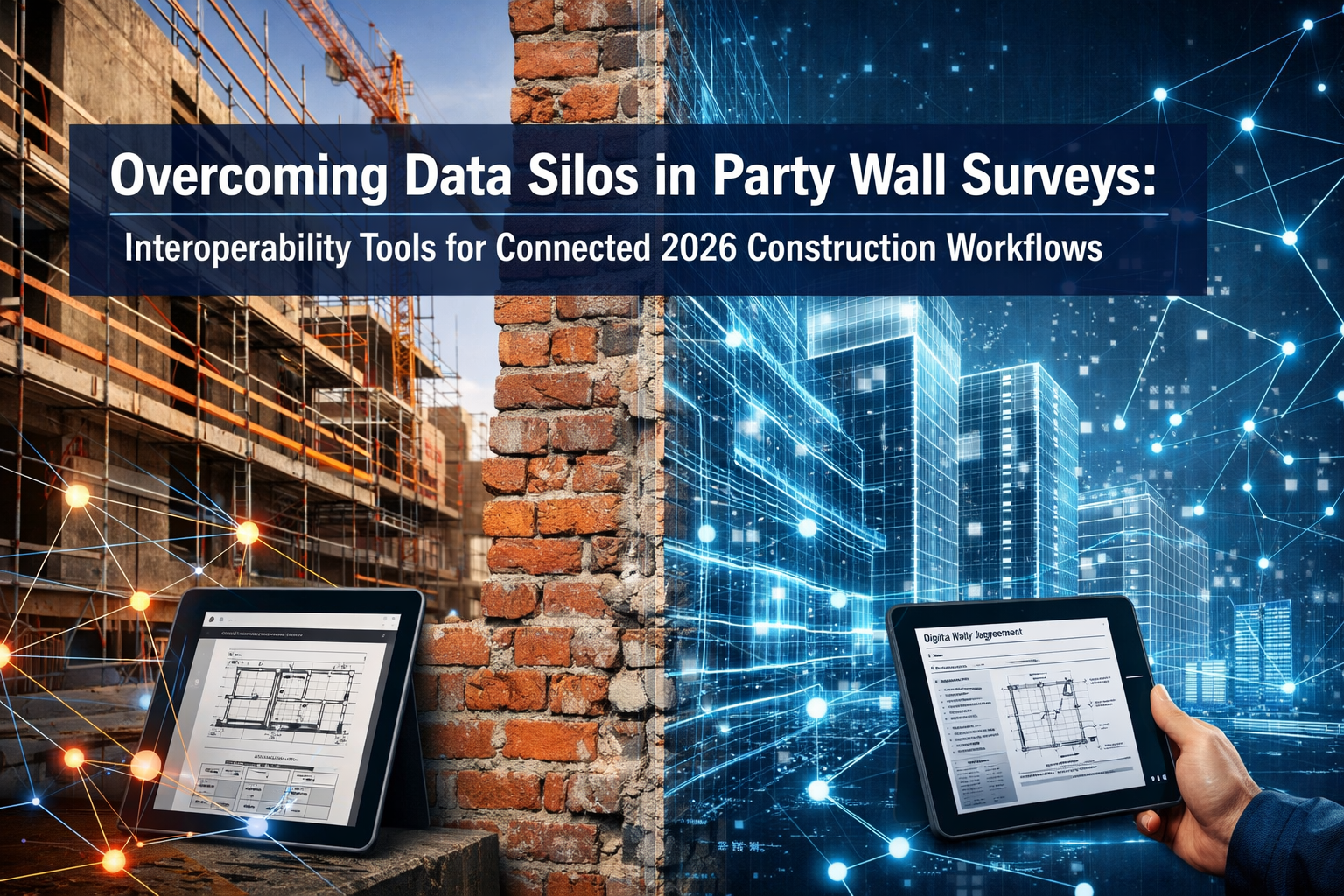
In 2026, construction projects face a critical challenge that costs time, money, and creates unnecessary friction between neighbors: fragmented data systems. When party wall surveys exist in isolation—trapped in separate software platforms, incompatible file formats, and disconnected communication channels—the entire construction workflow suffers. Overcoming Data Silos in Party Wall Surveys: Interoperability Tools for Connected 2026 Construction Workflows represents not just a technical upgrade, but a fundamental shift in how building professionals manage shared wall documentation, neighbor relations, and legal compliance.
The modern construction site operates with dozens of digital tools, yet party wall surveys often remain stuck in outdated processes. Surveyors use one system for documentation, contractors reference another for scheduling, and building owners struggle to access current information when they need it most. This fragmentation creates delays in serving party wall notices, complicates the party wall awards process, and increases project costs across the board.
Key Takeaways
- 🔗 Data silos in party wall surveys create costly delays, with disconnected systems preventing real-time information sharing between surveyors, contractors, and property owners
- 📊 Interoperability tools using standardized formats (IFC, BCF, API integrations) enable seamless data exchange across construction platforms in 2026
- 📱 Reality capture technology (3D scanning, photogrammetry) provides accurate shared wall documentation that integrates directly into BIM workflows
- ⚡ Connected workflows reduce party wall survey timelines by 40-60% through automated notifications, synchronized documentation, and collaborative platforms
- 🎯 Contractor priorities drive adoption: tools that save time, reduce rework, and provide audit trails gain fastest implementation across construction teams
Understanding the Data Silo Problem in Party Wall Surveys
What Are Data Silos in Construction?
Data silos occur when information becomes trapped within individual applications, departments, or workflows without the ability to flow freely to other systems that need it. In party wall surveys, these silos manifest in several damaging ways:
- Survey reports stored as static PDFs that cannot be searched or integrated
- Condition schedules documented in proprietary formats incompatible with project management software
- Communication records scattered across email, text messages, and paper files
- Historical survey data locked in legacy systems from previous projects
- Measurement data captured but not linked to building information models
The construction industry loses an estimated £1.2 billion annually in the UK alone due to poor data interoperability. For party wall surveys specifically, this fragmentation means surveyors often re-measure walls that were documented months earlier, building owners cannot quickly access party wall agreement templates when needed, and contractors work from outdated information.
The Real-World Impact on Construction Projects
Consider a typical London residential extension project in 2026. The building owner's surveyor conducts an initial assessment using specialized survey software. The adjoining owner's surveyor uses a different platform entirely. The contractor relies on project management tools that don't communicate with either survey system. The architect works in CAD software with no direct link to survey documentation.
The consequences cascade:
- ⏰ Survey findings must be manually re-entered into multiple systems
- 📄 Version control becomes impossible when documents exist in multiple locations
- 🔄 Updates to one system don't automatically reflect in others
- ⚠️ Critical information gets lost in translation between platforms
- 💰 Disputes arise when stakeholders reference different data versions
This fragmentation directly impacts party wall costs by extending timelines, requiring duplicate work, and creating opportunities for miscommunication that lead to formal disputes.

Why Traditional Party Wall Survey Methods Create Silos
Traditional party wall survey practices developed long before digital integration became possible. The Party Wall etc. Act 1996 established legal frameworks for surveys and agreements, but technology has evolved dramatically since then while survey practices have lagged behind.
Common silo-creating practices include:
| Traditional Method | Data Silo Created | Modern Alternative |
|---|---|---|
| Paper-based schedules of condition | Physical documents in filing cabinets | Cloud-based digital documentation with shared access |
| Email-only communication | Scattered conversation threads | Centralized project communication platforms |
| Standalone survey reports | Static PDFs without metadata | Structured data formats with searchable fields |
| Manual measurements | Non-digital records | Reality capture with exportable datasets |
| Individual surveyor databases | Proprietary systems with no export capability | Open-standard formats with API access |
The challenge intensifies when working across different London regions. A party wall surveyor in East London might use different tools than colleagues in West London, creating compatibility issues when surveyors need to collaborate or when property owners move projects between areas.
Interoperability Solutions for Connected Party Wall Workflows
Core Technologies Enabling Data Integration
Overcoming Data Silos in Party Wall Surveys: Interoperability Tools for Connected 2026 Construction Workflows relies on several foundational technologies that have matured significantly by 2026:
1. Industry Foundation Classes (IFC) for Party Walls
IFC provides an open, standardized data format that allows different software applications to exchange building information without data loss. For party wall surveys, IFC enables:
- Geometric data sharing: Exact wall dimensions, thickness, and spatial relationships
- Material specifications: Construction details, load-bearing capacity, and condition assessments
- Historical documentation: Previous survey findings embedded within the model
- Legal boundaries: Property lines and ownership information integrated with physical structure
When a surveyor captures party wall data in IFC format, contractors can import that information directly into their scheduling software, architects can reference it in design modifications, and building control can access it for compliance verification—all without manual data re-entry.
2. Building Information Modeling (BIM) Integration
BIM platforms in 2026 have evolved to accommodate party wall survey data as a native component of project models. This integration means:
✅ Survey findings become part of the living building model rather than separate documents
✅ Updates propagate automatically to all stakeholders with appropriate access
✅ Clash detection identifies conflicts between proposed works and party wall constraints
✅ Timeline integration links survey milestones with construction scheduling
For types of party wall works ranging from simple excavations to complex structural alterations, BIM integration ensures everyone works from the same accurate information.
3. Cloud-Based Collaboration Platforms
Modern cloud platforms designed for construction workflows provide the infrastructure for breaking down data silos. These systems offer:
- Real-time synchronization across devices and stakeholders
- Granular permission controls ensuring sensitive information reaches appropriate parties
- Audit trails documenting who accessed or modified data and when
- Mobile accessibility allowing surveyors to update information directly from site
- Integration APIs connecting specialized survey tools with general project management systems
4. Reality Capture and Digital Twins
3D laser scanning and photogrammetry have become standard tools for party wall documentation in 2026. These technologies create:
- Millimeter-accurate digital representations of existing conditions
- Point cloud data that integrates with BIM models
- Visual documentation with embedded measurements
- Baseline records for schedules of condition
- Comparative analysis capabilities for monitoring changes over time
The captured data exports in standardized formats (E57, LAS, RCP) that connect seamlessly with downstream construction applications, eliminating the traditional barrier between survey documentation and construction execution.

Practical Implementation: Tools and Workflows
Selecting Interoperable Survey Platforms
When choosing software for party wall surveys in 2026, construction professionals should prioritize platforms offering:
Essential interoperability features:
- 🔌 Open API access for custom integrations
- 📤 Multiple export formats including IFC, PDF, CSV, and XML
- ☁️ Cloud-native architecture for real-time collaboration
- 🔗 Pre-built integrations with major construction management platforms
- 📱 Cross-platform compatibility (desktop, tablet, mobile)
- 🔐 Secure data sharing with role-based access controls
- 📊 Structured data fields that map to industry standards
Leading platforms in 2026 have moved beyond simple digital versions of paper forms. They structure information in ways that other systems can automatically interpret and utilize.
Creating Connected Workflows for Party Wall Notices
The process of serving party wall notices demonstrates how interoperability transforms traditional workflows:
Traditional disconnected process:
- Surveyor prepares notice in word processor
- Notice printed and hand-delivered or posted
- Response received and filed separately
- Information manually transferred to project timeline
- Contractor informed through separate communication
Connected 2026 workflow:
- Surveyor generates notice within integrated platform
- System automatically populates data from BIM model and property records
- Digital delivery with read receipts and response tracking
- Responses captured in structured format and linked to project record
- Timeline automatically updates based on statutory periods
- All stakeholders receive notifications through their preferred systems
- Compliance documentation generated automatically
This connected approach reduces notice processing time from weeks to days while creating comprehensive audit trails that protect all parties.
Integrating Party Wall Awards with Construction Scheduling
Party wall awards contain critical information that should flow directly into construction planning. Interoperable systems enable:
- Condition precedents automatically added to project critical path
- Access requirements synchronized with site logistics planning
- Working hour restrictions integrated into contractor scheduling software
- Monitoring obligations triggering inspection reminders at appropriate intervals
- Payment terms linking to project accounting systems
When a surveyor finalizes an award in an interoperable platform, the relevant data elements automatically populate appropriate fields in the contractor's project management system, the building owner's compliance tracker, and the adjoining owner's monitoring dashboard—each seeing only the information relevant to their role.
Standards and Protocols Driving Interoperability
ISO 19650 and Information Management
The ISO 19650 series provides the framework for managing information throughout the construction lifecycle. For party wall surveys, compliance with these standards means:
- Common Data Environment (CDE) serving as single source of truth
- Information requirements clearly defined at project outset
- Structured naming conventions ensuring files are identifiable and retrievable
- Status codes indicating information maturity and approval levels
- Exchange Information Requirements (EIR) specifying data formats and delivery timing
When party wall surveyors align their practices with ISO 19650, their outputs integrate seamlessly with broader project information management protocols.
COBie for Handover and Operations
Construction Operations Building Information Exchange (COBie) standardizes the format for facility data handover. Party wall information structured in COBie format ensures:
- Future owners can access complete party wall history
- Facility managers understand maintenance obligations from awards
- Subsequent projects can reference previous survey findings
- Asset management systems incorporate party wall constraints
This long-term data accessibility prevents information loss that traditionally occurs during property transfers or when projects span multiple years.
Contractor Priorities and Adoption Drivers in 2026
What Contractors Actually Need from Party Wall Data
Understanding contractor priorities is essential for successful implementation of Overcoming Data Silos in Party Wall Surveys: Interoperability Tools for Connected 2026 Construction Workflows. Research from major UK construction firms reveals contractors prioritize:
Top 5 contractor requirements:
- 🎯 Actionable information at point of need: Quick access to relevant restrictions, access rights, and working conditions without searching through lengthy documents
- ⏱️ Time-saving automation: Elimination of manual data entry and re-keying of information across systems
- 📍 Spatial clarity: Visual representation of party wall locations, access points, and protection zones within site plans
- ✅ Compliance assurance: Clear indication of requirements met and outstanding obligations
- 💷 Cost predictability: Early visibility of party wall constraints that might impact scheduling or methodology
When party wall survey data meets these needs through interoperable delivery, contractor adoption accelerates dramatically. Conversely, systems that add administrative burden—even if technically sophisticated—face resistance.
Overcoming Resistance to New Systems
Change management remains the biggest barrier to implementing connected workflows, not technical capability. Successful adoption strategies in 2026 include:
Demonstrating Immediate Value
Rather than comprehensive system overhauls, leading firms implement interoperability in phases that deliver quick wins:
- Phase 1: Automated notice generation saving 2-3 hours per project
- Phase 2: Digital condition schedules accessible on mobile devices
- Phase 3: Integration with project scheduling for automatic updates
- Phase 4: Full BIM integration with reality capture workflows
Each phase demonstrates tangible benefits before requiring additional investment or learning.
Reducing Training Burden
Modern interoperable platforms prioritize intuitive interfaces that minimize training requirements. Features that support adoption include:
- Familiar user experiences modeled on consumer applications
- Contextual help and guided workflows
- Role-based interfaces showing only relevant functions
- Mobile-first design supporting on-site usage
- Voice input and AI-assisted data entry
When a party wall surveyor in North London can capture condition data through voice notes that automatically structure into the appropriate format, adoption barriers drop significantly.
Building on Existing Tools
Rather than replacing entire technology stacks, interoperability allows gradual evolution. A contractor might:
- Continue using familiar project management software
- Add a lightweight integration connecting to surveyor's platform
- Receive party wall data automatically within existing workflows
- Gradually adopt additional capabilities as comfort increases
This approach respects existing investments while delivering interoperability benefits.

Measuring ROI of Interoperable Party Wall Systems
Construction firms evaluating interoperability investments should track these metrics:
Quantifiable benefits:
| Metric | Traditional Approach | Interoperable System | Improvement |
|---|---|---|---|
| Time to process party wall notice | 8-12 days | 3-5 days | 60% reduction |
| Hours spent on data re-entry per project | 15-20 hours | 2-3 hours | 85% reduction |
| Party wall-related project delays | 2-4 weeks average | 3-5 days average | 75% reduction |
| Document version conflicts | 3-5 per project | <1 per project | 80% reduction |
| Cost of party wall administration | £2,500-£4,000 | £1,000-£1,500 | 60% reduction |
Beyond direct cost savings, interoperable systems reduce risk exposure through better documentation, faster dispute resolution, and improved neighbor relations—benefits that protect profit margins even when difficult to quantify precisely.
Best Practices for Implementing Connected Party Wall Workflows
Starting Small: Pilot Projects and Proof of Concept
Organizations new to interoperable party wall systems should begin with carefully selected pilot projects:
Ideal pilot project characteristics:
- ✅ Medium complexity with clear party wall requirements
- ✅ Willing stakeholders open to new approaches
- ✅ Timeline allowing for learning curve without critical pressure
- ✅ Mix of different types of party wall works to test system versatility
- ✅ Geographic location with good technical support access
A pilot in Central London might involve a residential extension with basement excavation—common enough to demonstrate typical workflows while complex enough to showcase interoperability benefits.
Establishing Data Standards Across Teams
Consistency is crucial for interoperability. Organizations should establish:
Naming Conventions
Standardized file and data naming ensures information remains identifiable across systems:
- Project codes that persist across all platforms
- Party wall document prefixes (e.g., PW-NOTICE, PW-AWARD, PW-SCHEDULE)
- Version numbering protocols
- Date formats (ISO 8601: YYYY-MM-DD)
Data Fields and Structures
Define required fields for party wall documentation:
- Property addresses in standardized format
- Owner and occupier information fields
- Work descriptions using consistent terminology
- Measurement units and precision standards
- Status indicators with clear definitions
When everyone uses the same structure, data flows seamlessly between systems without manual cleanup or reformatting.
Training and Change Management
Successful implementation requires investment in people, not just technology:
Effective training approaches:
- 🎓 Role-specific training: Surveyors need different skills than contractors or administrators
- 🎬 Video micro-lessons: Short, focused tutorials addressing specific tasks
- 👥 Peer mentoring: Experienced users supporting colleagues
- 📱 Just-in-time help: Contextual guidance within applications
- 🔄 Continuous learning: Regular updates as capabilities expand
Organizations should also address the cultural aspects of change. When keeping party wall costs down becomes easier through interoperable systems, highlighting these savings builds enthusiasm for adoption.
Security and Privacy Considerations
Connected systems require careful attention to data protection:
Essential security measures:
- 🔐 Encryption for data in transit and at rest
- 🔑 Multi-factor authentication for system access
- 👤 Role-based permissions limiting data access to appropriate parties
- 📋 Audit logging tracking all data access and modifications
- 🔄 Regular backups with tested recovery procedures
- ⚖️ GDPR compliance for personal information handling
Party wall surveys contain sensitive information about property ownership, structural conditions, and neighbor relationships. Interoperable systems must protect this data while enabling appropriate sharing.
Future Trends: The Evolution of Party Wall Survey Technology
Artificial Intelligence and Automated Analysis
AI capabilities in 2026 are transforming party wall surveys through:
- Automated condition assessment: Computer vision analyzing photos to identify defects and deterioration
- Predictive analytics: Forecasting potential issues based on historical data and current conditions
- Natural language processing: Converting surveyor voice notes into structured data automatically
- Smart document generation: AI drafting notices and awards from structured inputs with appropriate legal language
These technologies don't replace professional judgment but augment it, allowing surveyors to focus on complex decision-making while AI handles routine documentation.
Internet of Things (IoT) Monitoring
Connected sensors enable continuous party wall monitoring:
- Movement sensors detecting settlement or structural shifts
- Vibration monitors ensuring construction activities remain within agreed limits
- Environmental sensors tracking moisture, temperature, and other conditions
- Access logging recording when and where work occurs near party walls
This real-time data integrates with project management systems, automatically alerting relevant parties when parameters exceed thresholds defined in party wall awards.
Blockchain for Immutable Records
Distributed ledger technology provides tamper-proof documentation:
- Permanent record of notices served and responses received
- Timestamped evidence of condition assessments
- Immutable audit trail of all data modifications
- Smart contracts automatically executing award terms
While still emerging, blockchain applications show promise for reducing disputes by providing indisputable records of party wall processes.
Augmented Reality for On-Site Reference
AR applications overlay digital party wall information onto physical spaces:
- Contractors viewing access restrictions and protection zones through tablet cameras
- Surveyors comparing current conditions against baseline digital twins
- Building owners visualizing proposed works in relation to party walls
- Inspectors checking compliance against approved plans in real-time
This technology bridges the gap between digital documentation and physical construction, making interoperable data immediately useful at the point of work.
Conclusion: Building the Connected Construction Future
Overcoming Data Silos in Party Wall Surveys: Interoperability Tools for Connected 2026 Construction Workflows represents more than technological advancement—it's a fundamental reimagining of how construction professionals collaborate around shared walls and neighbor relationships. The fragmentation that characterized party wall surveys for decades is giving way to integrated systems where information flows seamlessly between surveyors, contractors, building owners, and adjoining owners.
The benefits extend across every stakeholder group. Surveyors spend less time on administrative tasks and more time applying professional expertise. Contractors access the information they need when they need it, reducing delays and rework. Building owners gain transparency into processes that previously seemed opaque and unpredictable. Adjoining owners receive better protection through comprehensive documentation and monitoring.
Actionable Next Steps
For organizations ready to embrace connected party wall workflows:
- Assess current state: Document existing systems, data flows, and pain points in your party wall processes
- Define requirements: Identify what information needs to flow between which systems for your specific projects
- Evaluate platforms: Test interoperable survey tools against your requirements with small pilot projects
- Establish standards: Create data conventions and protocols before widespread implementation
- Train teams: Invest in role-specific training that demonstrates value and builds confidence
- Measure results: Track time savings, cost reductions, and quality improvements to justify continued investment
- Iterate and improve: Use lessons from early projects to refine workflows and expand capabilities
The construction industry's digital transformation is well underway in 2026, and party wall surveys can no longer remain isolated from broader project workflows. Organizations that embrace interoperability gain competitive advantages through faster project delivery, reduced costs, and stronger neighbor relationships.
Whether you're carrying out works or responding to a neighbor's construction, connected systems make the party wall process more transparent, efficient, and equitable for everyone involved.
The future of construction is connected. The future of party wall surveys is integrated. The tools and technologies exist today to break down data silos and create workflows that serve all stakeholders better. The question is no longer whether to adopt interoperable systems, but how quickly your organization can implement them to capture the substantial benefits they deliver.