

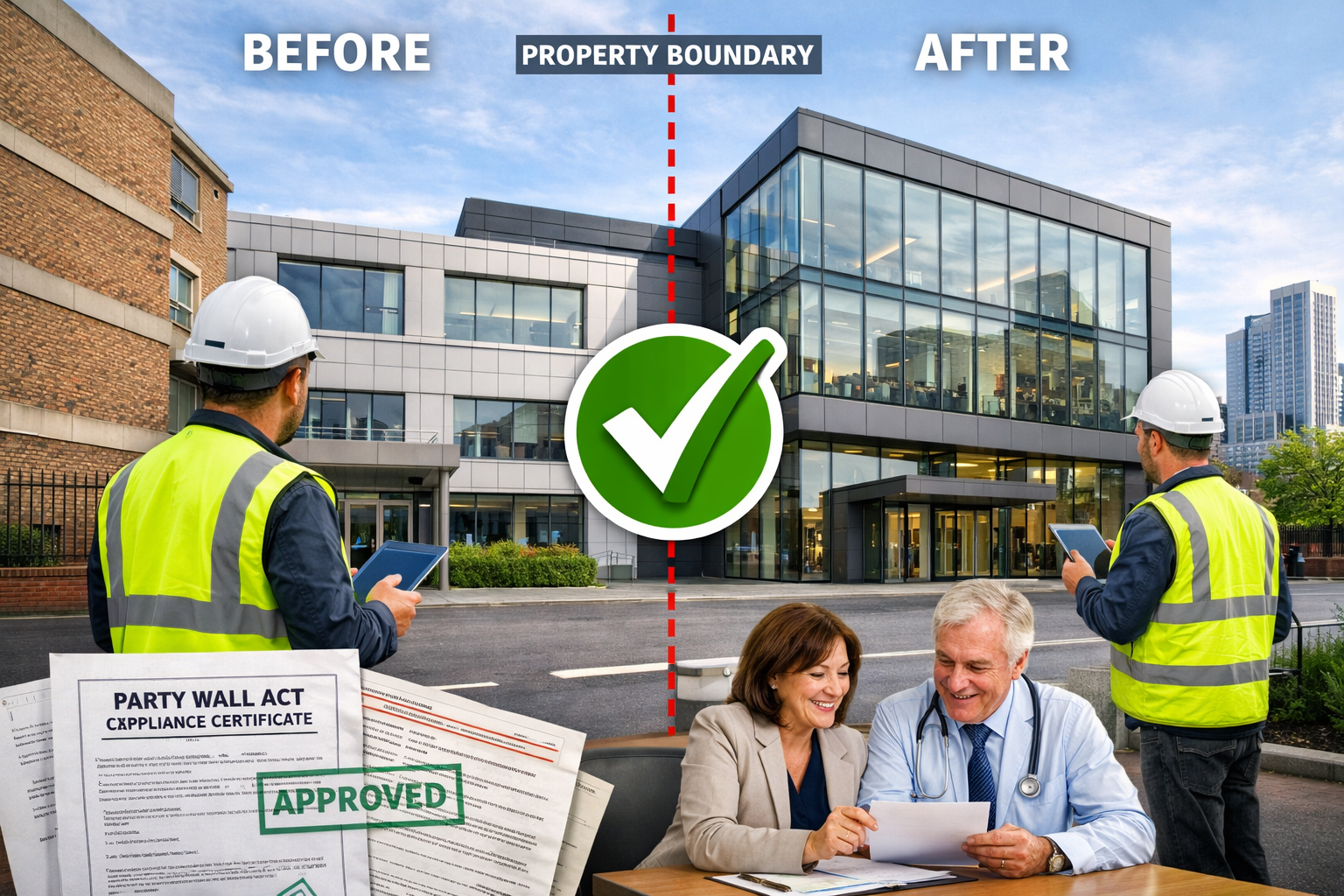
{"cover":"Professional landscape format (1536x1024) hero image featuring bold text overlay 'Party Wall Act Compliance for Healthcare Facility Expansions in 2026' in extra large 72pt white sans-serif font with dark shadow and semi-transparent navy overlay box, positioned in upper third center. Background shows modern healthcare clinic expansion construction site with shared boundary wall between medical facility and adjacent building, architectural blueprints visible, construction workers in hard hats, scaffolding, professional surveyor with equipment. Color scheme: medical blue, white, safety orange accents. High contrast, magazine cover quality, editorial architectural photography style, sharp focus on party wall structure.","content":["Landscape format (1536x1024) detailed illustration showing Party Wall Act notice documentation process for healthcare facilities, featuring three stacked legal documents labeled 'Party Structure Notice', 'Line of Junction Notice', and 'Excavation Notice' with medical facility floor plans visible in background, clipboard with checklist, calendar showing 2026 timeline with marked deadlines, professional surveyor's stamp, architectural cross-section drawing of clinic expansion showing shared wall, color-coded zones indicating notice requirements, clean professional aesthetic with medical blue and document white tones, infographic style with clear labels and arrows showing workflow.","Landscape format (1536x1024) professional architectural cross-section illustration of healthcare clinic expansion showing party wall compliance elements, detailed cutaway view of medical laboratory and diagnostic center addition, shared structural wall between properties clearly marked, foundation excavation depths labeled with measurements, steel beam insertions, damp-proof courses, temporary protective barriers, adjacent building protection measures, surveyor inspection points marked with checkmarks, construction phases numbered 1-4, technical drawing style with color-coded compliance zones in medical green and regulatory blue, annotations showing Party Wall Act requirements, scale ruler visible.","Landscape format (1536x1024) modern healthcare facility exterior showing completed clinic expansion project with visible party wall integration, contemporary medical center architecture with glass facades, professional surveyor in high-visibility vest conducting final inspection with tablet device, before-and-after split comparison showing original building and expanded wing, neighboring property boundary clearly marked, compliance certification documents in foreground, satisfied healthcare administrators reviewing completion paperwork, urban London setting, natural daylight, professional construction photography quality, success story aesthetic with checkmark overlay indicating successful Party Wall Act compliance."]}
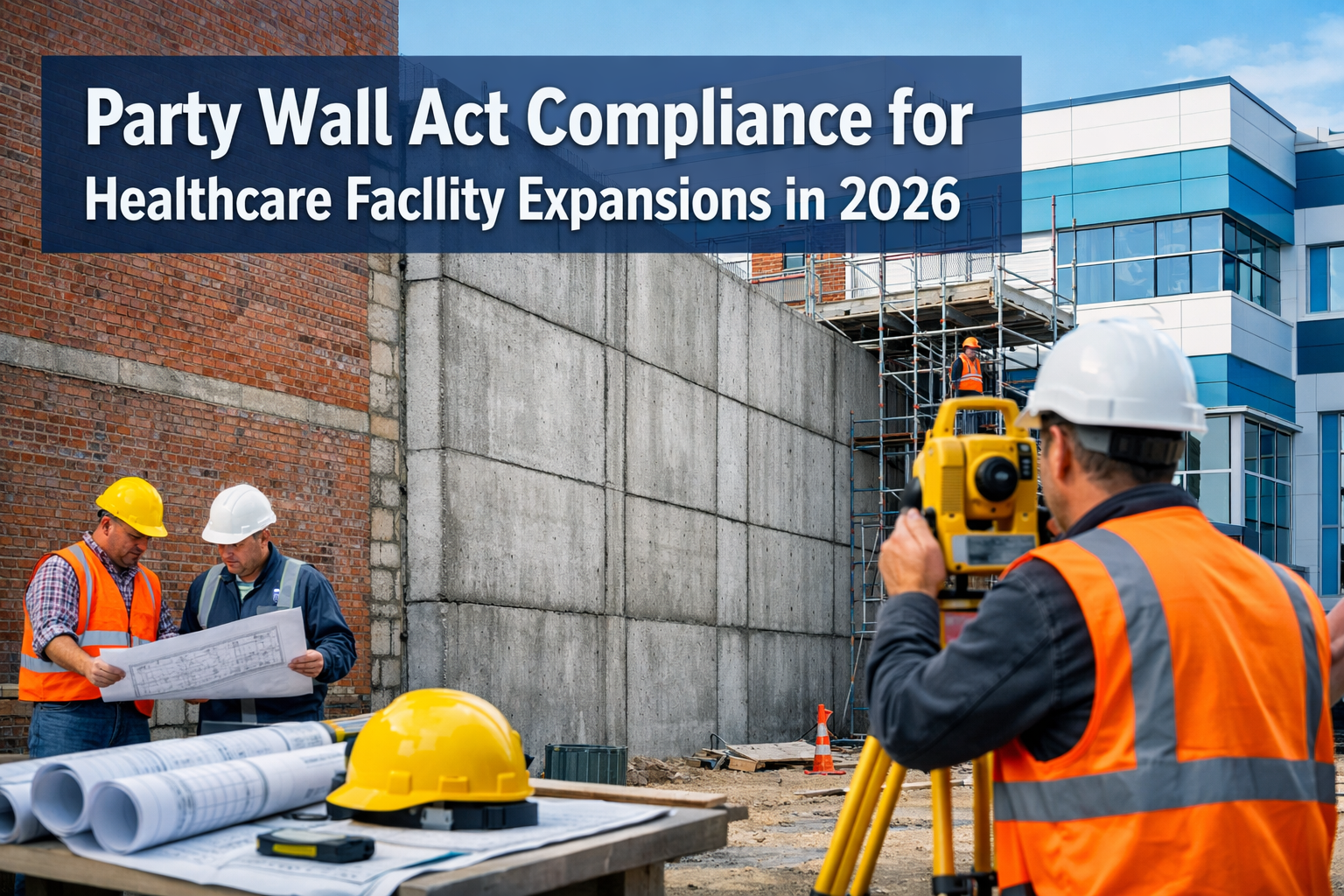
The healthcare sector is experiencing unprecedented growth in 2026, with non-hospital medical facilities showing a remarkable 24% net increase across the United Kingdom. As clinics, diagnostic laboratories, outpatient centers, and specialized medical facilities expand to meet rising patient demand, building owners face a critical legal requirement that can make or break their expansion timeline: Party Wall Act Compliance for Healthcare Facility Expansions in 2026. Understanding how to navigate party wall notices and agreements specifically tailored to medical construction projects has become essential for healthcare administrators, property developers, and facility managers seeking to avoid costly delays and legal disputes.
Healthcare real estate strategy in 2026 requires careful navigation of hospital growth, outpatient demand, and compliance risk [8]. When expansion plans involve shared walls, boundaries, or excavations near neighboring properties, the Party Wall etc. Act 1996 becomes a mandatory consideration that healthcare facility owners cannot afford to overlook.
Key Takeaways
- 🏥 Healthcare facilities expanding in 2026 must comply with the Party Wall etc. Act 1996 when construction affects shared walls or boundaries with neighboring properties
- 📋 Three types of notices govern different expansion scenarios: Party Structure Notices, Line of Junction Notices, and Excavation Notices—each with specific timelines
- ⏰ Notice periods range from two months to one year depending on the type of work, requiring early planning integration into project timelines
- 🔍 Professional party wall surveyors provide essential expertise in navigating healthcare-specific compliance challenges and protecting both building and adjoining owners
- 💰 Proper compliance prevents costly delays, legal disputes, and construction stoppages that could derail critical healthcare capacity expansion
Understanding the Party Wall Act Framework for Medical Facilities
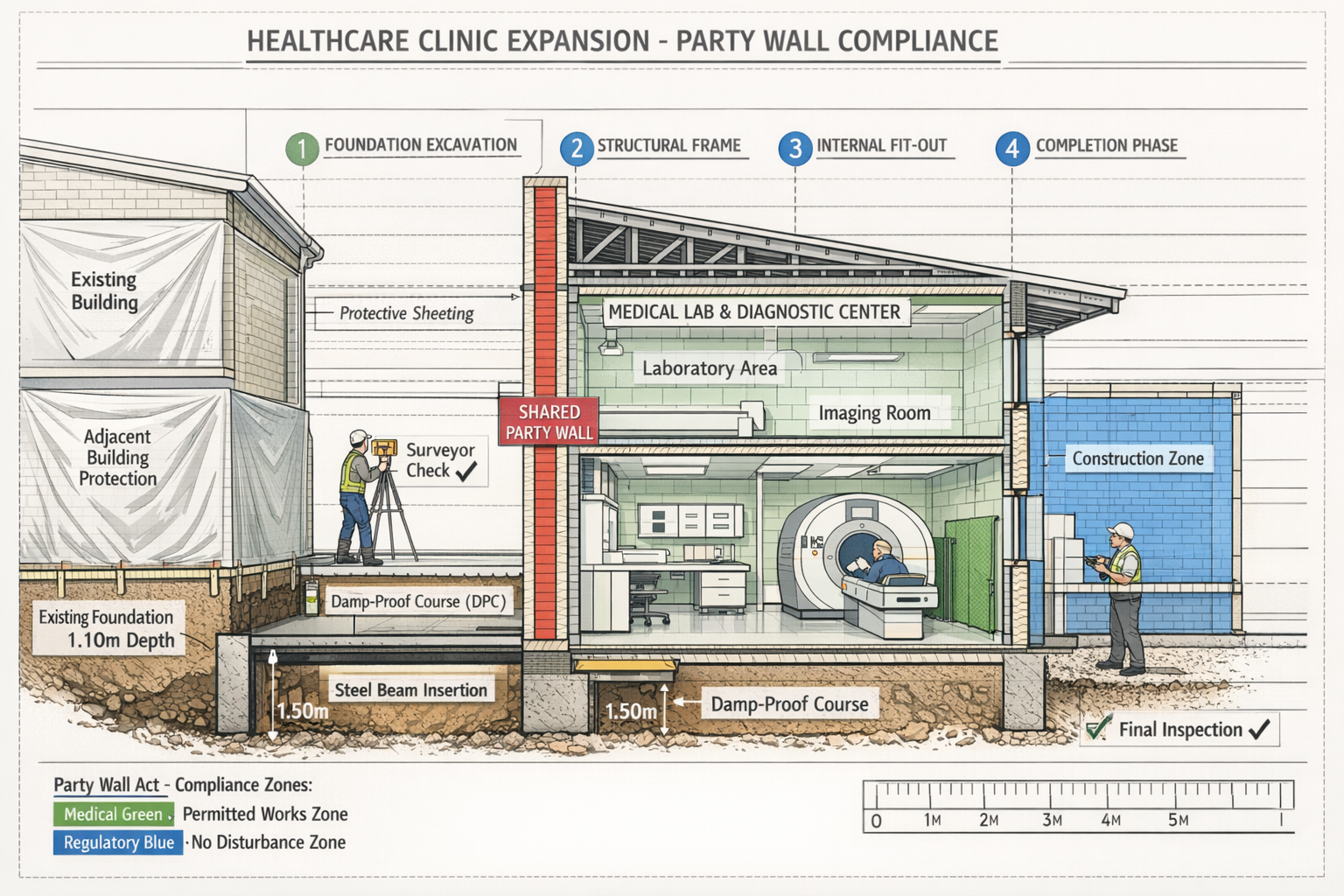
The Party Wall etc. Act 1996 provides the legal framework governing construction work on or near shared boundaries between properties in England and Wales. For healthcare facilities planning expansions, this legislation applies whenever construction activities affect party walls, party structures, or involve excavations near neighboring buildings.
What Qualifies as Party Wall Work in Healthcare Expansions?
Healthcare facility expansions typically trigger Party Wall Act requirements in several common scenarios:
Common Healthcare Expansion Scenarios:
- Adding new wings or extensions to existing clinics that share walls with adjacent properties
- Excavating foundations for multi-story medical office buildings near neighboring structures
- Installing specialized equipment requiring structural modifications to shared walls
- Creating new diagnostic imaging centers with radiation shielding that affects party structures
- Expanding laboratory facilities requiring reinforced flooring or structural alterations
- Building new patient parking structures involving excavations near boundary lines
The Act defines specific types of party wall works that healthcare developers must recognize during planning phases. A party wall is a shared wall standing on the boundary between two properties, while a party structure includes walls, floors, and partitions separating buildings in different ownership.
The Three Critical Notice Types for Healthcare Projects
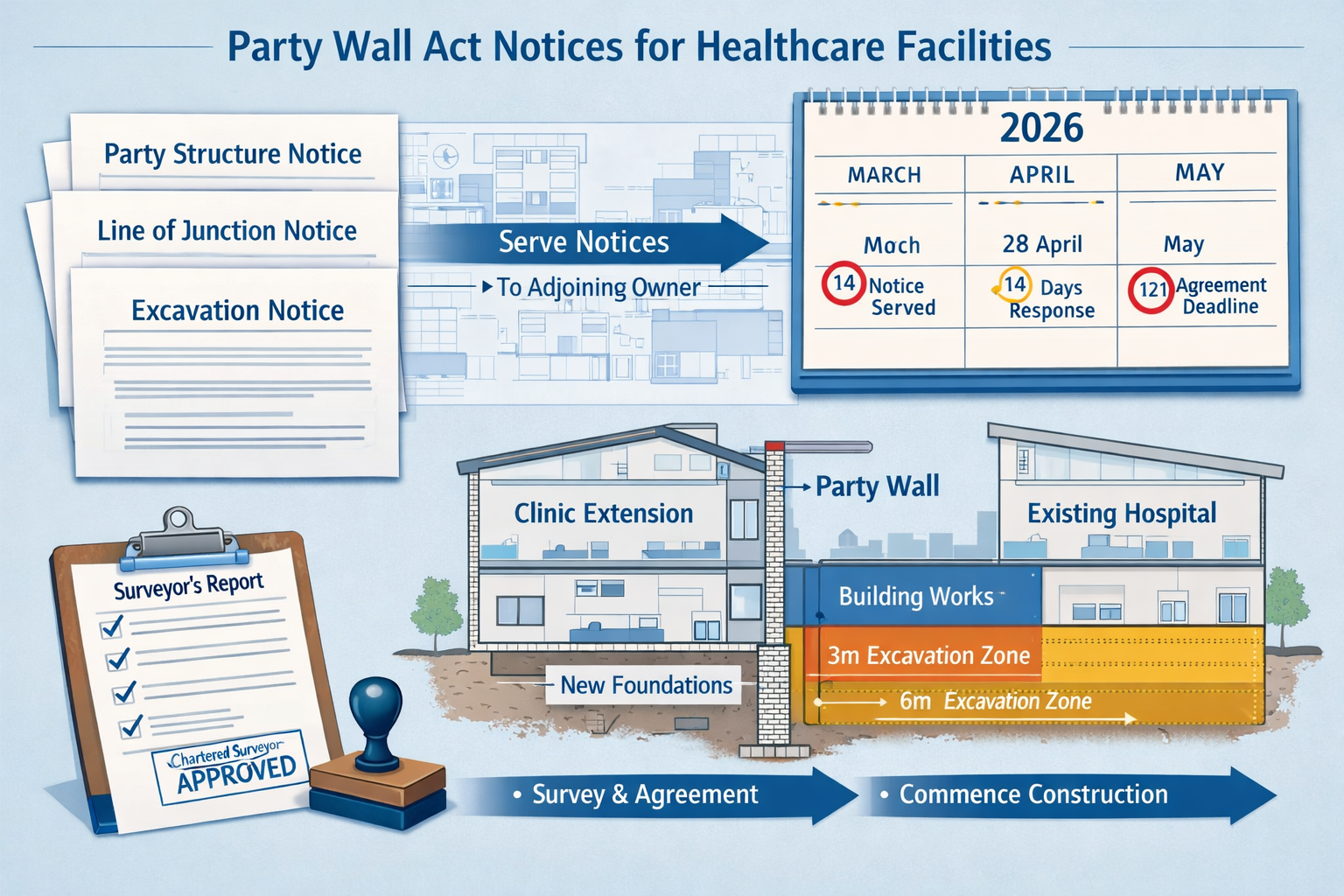
Understanding which notice applies to your healthcare expansion project is fundamental to Party Wall Act Compliance for Healthcare Facility Expansions in 2026. The Act establishes three distinct notice categories:
| Notice Type | When Required | Notice Period | Common Healthcare Applications |
|---|---|---|---|
| Party Structure Notice | Work directly to existing party walls/structures | 2 months | Structural modifications, beam insertions, raising walls |
| Line of Junction Notice | Building new walls on boundary lines | 1 month | New clinic wings, facility extensions |
| Excavation Notice | Digging within 3-6 meters of neighboring foundations | 1 month | Underground parking, basement laboratories |
For detailed guidance on serving these notices, healthcare facility managers should review comprehensive information on Party Wall Act notices and how to respond.
Healthcare-Specific Compliance Considerations in 2026
Medical facilities face unique challenges when pursuing Party Wall Act compliance. Healthcare construction projects often involve:
✅ Infection control requirements during construction that affect access arrangements
✅ 24/7 operational continuity necessitating carefully scheduled inspections
✅ Specialized structural needs for imaging equipment, surgical suites, and laboratory spaces
✅ Regulatory oversight from healthcare authorities alongside building control
✅ Patient safety protocols that must be maintained throughout construction
The Joint Commission standards have received significant updates affecting healthcare facility construction and expansion projects [5]. These regulatory requirements must be coordinated with Party Wall Act obligations to ensure comprehensive compliance.
"Healthcare facility expansions require meticulous coordination between medical operational requirements and legal construction obligations. Party Wall Act compliance isn't optional—it's a prerequisite for successful project delivery." — Healthcare Construction Compliance Expert
Navigating Party Wall Notices and Agreements for Medical Construction
Successfully managing Party Wall Act Compliance for Healthcare Facility Expansions in 2026 requires understanding the notice and agreement process from initial planning through construction completion. Healthcare facility owners must approach this systematically to avoid delays that could impact patient care capacity.
Step-by-Step Notice Process for Healthcare Expansions
Phase 1: Pre-Notice Planning (3-6 Months Before Construction)
Before serving formal notices, healthcare facility owners should:
- Conduct boundary surveys to identify all potentially affected neighboring properties
- Engage party wall surveyors with healthcare construction experience
- Review expansion plans with architects to identify all Party Wall Act triggers
- Prepare preliminary schedules of condition for adjacent properties
- Develop communication strategies for neighboring property owners
Phase 2: Serving Formal Notices (1-2 Months Before Construction)
The building owner (healthcare facility) must serve appropriate party wall notices containing:
- Detailed descriptions of proposed works
- Anticipated start dates
- Technical drawings and specifications
- Contact information for the building owner
- Information about adjoining owners' rights
Healthcare facilities can access sample party wall agreement templates to understand required documentation formats.
Phase 3: Adjoining Owner Response Period
After receiving notices, adjoining owners have 14 days to respond by either:
- Consenting to the proposed works (allowing construction to proceed)
- Dissenting or not responding (triggering the party wall award process)
- Requesting modifications to protect their property interests
The Party Wall Award Process for Healthcare Projects
When adjoining owners dissent or don't respond, the Act requires appointment of party wall surveyors to create a party wall award—a legally binding document governing the construction work. This process involves:
Surveyor Appointment Options:
- Agreed Surveyor: Both parties appoint one surveyor (most cost-effective)
- Two Surveyors: Each party appoints their own surveyor (who may appoint a third surveyor if needed)
- Three Surveyors: Each party appoints one, who jointly appoint a third surveyor
Healthcare facilities should work with experienced professionals who understand medical construction requirements. Those in the capital can find qualified party wall surveyors in Central London, South London, North London, East London, and West London.
Key Components of Party Wall Awards for Medical Facilities
A comprehensive party wall award for healthcare expansions typically includes:
📄 Detailed work descriptions with technical specifications
📄 Access arrangements that accommodate healthcare operations
📄 Construction methodologies protecting adjoining properties
📄 Monitoring protocols for vibration, noise, and structural movement
📄 Schedule of condition documenting pre-construction property states
📄 Dispute resolution procedures for addressing concerns during construction
📄 Cost allocation specifying who pays for various aspects
For guidance on award documentation, healthcare facility managers can review party wall contract templates and award guides.
Special Considerations for Healthcare Facility Operations
Medical facilities present unique operational challenges during party wall compliance processes:
Infection Control and Access Management
Healthcare construction in 2026 emphasizes temporary wall systems as the gold standard for renovations, providing critical infection control barriers during expansion projects [6]. Party wall agreements must specify:
- Designated access routes avoiding patient care areas
- Inspection scheduling coordinating with clinical operations
- Contamination prevention protocols for surveyors entering facilities
- Emergency access procedures for urgent structural concerns
Operational Continuity Requirements
Unlike standard commercial properties, healthcare facilities cannot simply close during construction. Party wall awards should address:
- Noise limitation periods during surgical hours or overnight patient care
- Vibration monitoring for sensitive diagnostic equipment
- Utility protection ensuring uninterrupted power, water, and medical gas systems
- Emergency evacuation routes maintained throughout construction
Regulatory Coordination
Healthcare facilities must coordinate Party Wall Act compliance with additional regulatory requirements, including healthcare plan compliance developments for 2026 [7] and information blocking enforcement regulations [3].
Cost Management and Timeline Optimization for Healthcare Party Wall Compliance
Understanding the financial and temporal implications of Party Wall Act Compliance for Healthcare Facility Expansions in 2026 enables healthcare administrators to budget accurately and schedule construction realistically. The costs and timelines associated with party wall procedures can significantly impact overall project feasibility.
Typical Costs for Healthcare Facility Party Wall Compliance
Party wall compliance involves several cost categories that healthcare facility owners should anticipate:
Direct Party Wall Costs:
| Cost Category | Typical Range (2026) | Who Pays |
|---|---|---|
| Building Owner's Surveyor Fees | £1,500 – £5,000 | Building Owner (Healthcare Facility) |
| Adjoining Owner's Surveyor Fees | £1,500 – £5,000 | Building Owner (Healthcare Facility) |
| Third Surveyor Fees (if required) | £2,000 – £4,000 | Building Owner (Healthcare Facility) |
| Schedule of Condition Preparation | £500 – £2,500 per property | Building Owner (Healthcare Facility) |
| Party Wall Award Documentation | Included in surveyor fees | Building Owner (Healthcare Facility) |
Important: Under the Party Wall etc. Act 1996, the building owner (healthcare facility undertaking expansion) typically bears all reasonable costs associated with the party wall process, including the adjoining owner's surveyor fees.
For strategies to minimize expenses, healthcare facility managers should review guidance on how to keep party wall costs down. Additional cost information is available through party wall process costs.
Timeline Planning for Healthcare Expansion Projects
Proper timeline planning prevents construction delays that could impact healthcare capacity expansion. The party wall compliance timeline typically follows this sequence:
Pre-Construction Timeline:
- Months 6-4 before construction: Engage party wall surveyor, conduct boundary analysis
- Month 4: Finalize expansion designs, identify all party wall triggers
- Month 3: Prepare and serve party wall notices (allowing for 1-2 month notice periods)
- Months 3-2: Adjoining owner response period, surveyor appointments
- Months 2-1: Schedule of condition preparation, party wall award drafting
- Month 1: Award finalization, pre-construction meetings
- Day 1: Construction commences with party wall compliance achieved
⚠️ Critical Planning Note: Healthcare facilities should integrate party wall timelines into overall project schedules during initial feasibility studies. Attempting to expedite party wall processes after construction contracts are signed creates unnecessary risk and potential delays.
Avoiding Common Compliance Pitfalls in Healthcare Projects
Healthcare facility expansions face specific compliance challenges that can derail projects if not properly addressed:
Pitfall #1: Delayed Notice Service
Many healthcare administrators underestimate notice period requirements. A Party Structure Notice requires two months' notice, meaning construction cannot legally commence before this period expires—regardless of construction contract deadlines.
Pitfall #2: Incomplete Adjoining Owner Identification
Healthcare facilities in dense urban areas may share boundaries with multiple properties, including:
- Adjacent medical practices or clinics
- Residential properties above or beside facilities
- Commercial tenants in mixed-use buildings
- Underground utilities or transportation infrastructure
Failing to identify and notify all affected parties can result in injunctions halting construction.
Pitfall #3: Inadequate Operational Coordination
Party wall agreements that don't account for 24/7 healthcare operations create conflicts when surveyors need access during patient care hours or when construction activities interfere with medical procedures.
Pitfall #4: Attempting to Proceed Without Professional Surveyors
While some property owners consider having a party wall agreement without a surveyor, healthcare facility expansions typically involve complex structural work that benefits from professional expertise. The specialized nature of medical construction—with unique loading requirements for imaging equipment, vibration-sensitive laboratories, and infection control considerations—makes professional surveyor involvement essential.
Integrating Party Wall Compliance with Healthcare Regulatory Requirements
Healthcare facility expansions in 2026 must navigate multiple compliance frameworks simultaneously. Party Wall Act requirements intersect with:
Healthcare-Specific Regulations:
- Joint Commission standards for facility design and construction [5]
- Provider-based department requirements under recent legislative updates [1]
- Healthcare compliance frameworks addressing operational and construction standards [2]
- State and local healthcare facility licensing requirements
Successful healthcare expansion projects coordinate party wall surveyors with:
- Healthcare facility design consultants
- Medical equipment planners
- Infection control specialists
- Clinical operations managers
- Regulatory compliance officers
This integrated approach ensures that party wall awards accommodate specialized healthcare requirements while protecting neighboring property owners' rights.
Best Practices for Healthcare Facility Building Owners
Healthcare organizations pursuing expansion projects should implement these best practices for Party Wall Act Compliance for Healthcare Facility Expansions in 2026:
✅ Engage party wall surveyors during feasibility studies, not after design completion
✅ Budget 2-4% of construction costs for party wall compliance expenses
✅ Add 3-4 months to project timelines for party wall processes
✅ Appoint surveyors with healthcare construction experience who understand medical facility operational requirements
✅ Communicate proactively with adjoining owners to build cooperative relationships
✅ Document everything thoroughly with photographs, correspondence, and technical records
✅ Coordinate party wall schedules with clinical operations calendars
✅ Review party wall awards with legal counsel before construction commencement
Healthcare facility building owners should work with building owners' surveyors who understand medical construction complexities and can draft awards that protect both expansion objectives and neighboring property interests.
Conclusion: Strategic Party Wall Compliance for Healthcare Growth
As the healthcare sector continues its remarkable expansion in 2026, with non-hospital facilities showing 24% net growth, Party Wall Act Compliance for Healthcare Facility Expansions in 2026 has become a critical success factor for medical facility development. The Party Wall etc. Act 1996 provides a balanced framework protecting both healthcare facilities pursuing necessary expansions and neighboring property owners affected by construction activities.
Healthcare administrators, facility managers, and property developers must recognize that party wall compliance is not an optional administrative task—it is a legal requirement that, when properly managed, facilitates smooth construction processes and prevents costly disputes. The key to successful compliance lies in early planning, professional expertise, and thorough documentation.
Actionable Next Steps for Healthcare Facility Expansions
For Healthcare Facilities Planning Expansions:
- Conduct preliminary boundary assessments during feasibility studies to identify potential party wall implications
- Engage qualified party wall surveyors with healthcare construction experience at the earliest planning stages
- Integrate party wall timelines into overall project schedules, allowing 3-4 months for compliance processes
- Budget appropriately for party wall costs, typically 2-4% of total construction expenses
- Communicate proactively with neighboring property owners to establish cooperative relationships
- Coordinate compliance frameworks by aligning party wall requirements with healthcare regulatory obligations
- Document comprehensively through schedules of condition, photographic records, and correspondence files
For Adjoining Owners Near Healthcare Expansions:
- Respond promptly to party wall notices within the 14-day statutory period
- Appoint qualified surveyors to protect your property interests through the award process
- Document existing conditions with photographs and written descriptions before construction begins
- Understand your rights under the Party Wall etc. Act 1996, including protection from construction damage
- Maintain communication with healthcare facility representatives and appointed surveyors
The healthcare real estate landscape in 2026 presents tremendous opportunities for facility expansion to meet growing patient demand [8]. By mastering party wall compliance requirements, healthcare organizations can pursue necessary growth while maintaining positive community relationships and legal compliance.
For healthcare facilities embarking on expansion projects, the investment in proper party wall compliance—both financial and temporal—represents a small fraction of overall project costs while providing essential legal protection and construction certainty. The alternative—proceeding without compliance or attempting to circumvent requirements—risks injunctions, construction stoppages, legal disputes, and damaged relationships with neighboring properties.
As healthcare continues evolving to meet 2026's challenges, facilities that integrate party wall compliance into strategic expansion planning will position themselves for successful growth, operational continuity, and regulatory adherence across all applicable frameworks.
References
[1] Consolidated Appropriations Act New Requirements For Provider Based Departments – https://www.nixonpeabody.com/insights/alerts/2026/02/13/consolidated-appropriations-act-new-requirements-for-provider-based-departments
[2] Healthcare Compliance In 2026 – https://signinapp.com/blog/healthcare-compliance-in-2026
[3] The Wait Is Over Information Blocking Enforcement Is Officially Here – https://www.hklaw.com/en/insights/publications/2026/02/the-wait-is-over-information-blocking-enforcement-is-officially-here
[5] Joint Commission Standards Receive Significant Updates – https://www.ashe.org/joint-commission-standards-receive-significant-updates
[6] Temporary Wall Systems The Gold Standard For 2026 Healthcare Renovations – https://www.hepacart.com/blog/temporary-wall-systems-the-gold-standard-for-2026-healthcare-renovations
[7] Navigating Health Plan Compliance Developments For 2026 – https://parrottbenefitgroup.com/navigating-health-plan-compliance-developments-for-2026/
[8] Healthcare Real Estate Strategy In 2026 Navigating Hospital Growth Outpatient Demand And Compliance Risk – https://lpc.com/insights-research/healthcare-real-estate-strategy-in-2026-navigating-hospital-growth-outpatient-demand-and-compliance-risk/