


The UK data centre boom is transforming brownfield sites across London and beyond, but one critical challenge catches many developers off guard: party wall compliance. As hyperscale facilities squeeze into urban locations alongside existing buildings, shared wall works have become a complex minefield of legal requirements, structural risks, and neighbour relations. With UK data usage set to double by 2026 and nearly 100 GW of new capacity planned globally through 2030[2][4], understanding the Party Wall Act Essentials for Shared Wall Works in UK Data Centre Builds: 2026 Surveyor Checklist has never been more crucial.
This comprehensive guide provides surveying professionals, developers, and project managers with the specialized knowledge needed to navigate party wall agreements for data centre construction—where traditional building regulations meet cutting-edge infrastructure demands.
Key Takeaways
- Data centre projects require specialized party wall approaches due to unique structural loads, vibration concerns, and 24/7 operational requirements that differ significantly from residential developments
- Vibration monitoring protocols are essential for protecting both existing structures and sensitive server equipment during excavation and construction phases
- Early engagement with adjoining owners reduces dispute risks in complex stakeholder environments typical of commercial data centre builds
- Integration with Building Safety Act 2022 requirements creates additional compliance layers for party wall surveyors working on hyperscale projects
- Brownfield site preference means more party wall scenarios as developers target greyfield locations over greenfield sites[1]
Understanding the Party Wall Act Framework for Data Centre Construction

What Makes Data Centre Party Wall Works Different? 🏗️
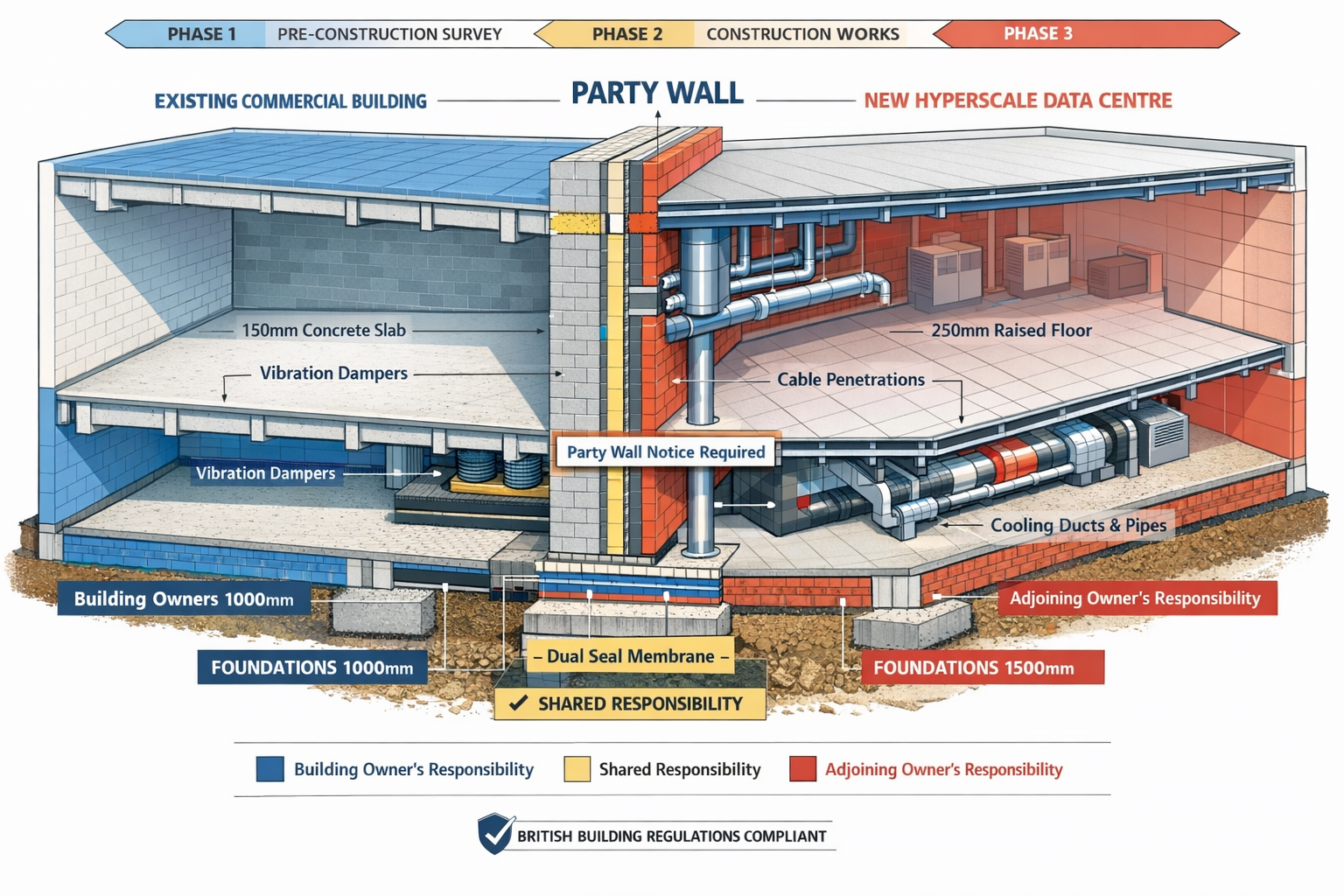
Data centre construction presents unique challenges under the Party Wall etc. Act 1996. Unlike residential extensions or loft conversions, these facilities involve:
Extraordinary structural loads from server racks, cooling equipment, and backup power systems that can exceed 2,000 kg per square meter—far beyond typical commercial building specifications.
Continuous vibration sources including HVAC systems, generators, and cooling towers that operate 24/7, creating long-term structural stress on shared walls.
Complex service penetrations through party walls for fiber optic cables, electrical conduits, and cooling pipes that must maintain fire safety integrity while supporting critical infrastructure.
The rapid expansion of UK data centre capacity means surveyors increasingly encounter scenarios where types of party wall works intersect with specialized technical requirements. Data centres are now designated as nationally significant infrastructure, elevating the importance of proper party wall procedures[2].
The Three Key Notice Types for Data Centre Builds
Understanding which notice applies to your data centre project is fundamental:
| Notice Type | Application to Data Centres | Typical Timeline |
|---|---|---|
| Party Structure Notice | Structural alterations to existing shared walls, underpinning adjacent to party walls, cutting into party walls for service penetrations | 2 months before work starts |
| Line of Junction Notice | New walls built on boundary lines, particularly for standalone data centre pods | 1 month before work starts |
| 3/6 Meter Notice | Excavations for deep foundations (common in hyperscale builds), basement construction for cooling systems | 1 month before work starts |
Most data centre projects trigger multiple notice types simultaneously. A typical hyperscale facility might require party structure notices for wall modifications, alongside 3/6 meter notices for foundation works extending below neighbouring properties.
For detailed guidance on serving these notices correctly, review our resource on party wall notices and how they apply to commercial construction scenarios.
Party Wall Act Essentials for Shared Wall Works: The 2026 Data Centre Surveyor Checklist
Pre-Construction Assessment Phase ✅
1. Comprehensive Site Boundary Analysis
Before serving any notices, surveyors must establish:
- Precise boundary locations using registered title plans and ground surveys
- Identification of all party walls, party fence walls, and structures within 3 or 6 meters of proposed excavations
- Ownership verification for complex commercial properties with multiple freeholders or leaseholders
- Rights of access for inspection and monitoring equipment installation
2. Stakeholder Mapping and Engagement Strategy
Data centre projects typically involve greater complexity with multiple stakeholders[2]. Create a detailed register including:
- Direct adjoining owners (commercial tenants, freeholders, leaseholders)
- Indirect stakeholders (utilities, transport authorities, conservation bodies)
- Special interest parties (listed building custodians, heritage organizations)
- Occupiers who may be affected by vibration or noise during construction
Early engagement reduces dispute risks significantly. Consider pre-notice informal discussions to explain the project scope and address concerns before formal party wall agreement procedures begin.
3. Initial Structural Condition Survey
Prepare comprehensive schedules of condition documenting:
- Photographic evidence of all elevations, internal walls, ceilings, and finishes
- Crack mapping with measurements and monitoring points
- Structural assessment identifying pre-existing defects or weaknesses
- Vibration baseline readings establishing normal background levels before construction
This documentation protects both building and adjoining owners from spurious damage claims while establishing clear evidence if genuine construction-related damage occurs.
Specialized Technical Considerations for Hyperscale Projects
4. Vibration Monitoring Protocols 📊
Data centre construction involves heavy machinery, piling operations, and excavation that can damage existing structures or disrupt operational facilities. Implement:
Continuous vibration monitoring using triaxial geophones mounted on party walls and critical structural elements, with real-time alerts when thresholds are exceeded.
Frequency analysis to identify resonance risks specific to the adjoining building's structural characteristics and the data centre's operational equipment.
Graduated response protocols defining immediate stop-work triggers, investigation procedures, and remediation requirements.
British Standard BS 7385 provides guidance on vibration limits, but data centre projects often require more stringent controls—particularly when construction occurs adjacent to operational server facilities where even minor vibrations can cause equipment failures.
5. Service Penetration Planning and Fire Safety
When data centres require cable or pipe penetrations through party walls:
- Maintain fire resistance ratings equivalent to the original wall construction (typically 60-120 minutes for commercial buildings)
- Use approved fire-stopping systems with third-party certification
- Document all penetrations in the party wall award with precise locations and specifications
- Coordinate with Building Control and fire safety consultants to ensure Building Safety Act 2022 compliance
The intersection of party wall requirements and building safety regulations creates additional complexity in 2026, as the new regulatory framework demands enhanced documentation and accountability.
6. Foundation and Underpinning Specifications
Hyperscale data centres often require substantial foundations to support equipment loads. When working near party walls:
- Specify underpinning methodology (mass concrete, mini-piling, or jet grouting) appropriate to ground conditions and adjacent structure sensitivity
- Define protection measures including temporary propping, movement monitoring, and contingency strengthening
- Establish settlement tolerances with clear trigger levels for remedial action
- Plan construction sequencing to minimize risk periods and allow monitoring between phases
Award Preparation and Dispute Resolution
7. Comprehensive Party Wall Award Drafting
A robust party wall award for data centre construction should include:
Detailed work descriptions referencing architectural and structural drawings, with specific attention to shared wall interfaces and service penetrations.
Access provisions covering both construction phase access and post-completion maintenance access for monitoring equipment or remedial works.
Time and manner restrictions addressing noise limitations, vibration controls, working hours, and phasing requirements that protect adjoining owners while allowing practical construction progress.
Cost allocation protocols clarifying who pays for what, particularly important when works provide mutual benefit or when not-for-profit rules apply under the Act.
8. Understanding Not-for-Profit Provisions
The Party Wall Act includes provisions preventing building owners from profiting at adjoining owners' expense. For data centre projects:
- When shared wall strengthening benefits both properties, costs may be apportioned
- If works are solely for the building owner's benefit, they bear full costs
- Enhanced structural capacity that could benefit the adjoining owner in future may justify cost sharing
- Surveyors must carefully analyze whether works fall under Section 11 (shared benefit) or Section 1 (building owner's benefit)
This becomes particularly relevant when data centre structural enhancements inadvertently strengthen party walls, potentially allowing adjoining owners to undertake their own future developments with reduced foundation costs.
9. Dispute Resolution Mechanisms
When disagreements arise, the Party Wall Act provides a structured framework:
- Surveyor appointment with the option for a single agreed surveyor or separate surveyors for each party
- Third surveyor selection to resolve deadlocks between party-appointed surveyors
- Award appeals to the County Court within 14 days of award service
- Alternative dispute resolution including mediation for complex commercial disputes
Given the high stakes and complexity of data centre projects, early dispute resolution prevents costly construction delays. Many experienced surveyors recommend appointing a third surveyor at the outset for hyperscale projects to expedite resolution if disagreements emerge.
Integration with Building Safety Standards and Modern Compliance
The Building Safety Act 2022 Intersection
The Building Safety Act 2022 has transformed compliance requirements for higher-risk buildings. While most data centres fall outside the "higher-risk building" definition (residential buildings over 18 meters), the Act's principles influence party wall practice:
Enhanced accountability with named duty holders and clear responsibility chains that parallel party wall surveyor obligations.
Golden thread documentation requiring comprehensive record-keeping throughout a building's lifecycle—complementing party wall schedules of condition and awards.
Competence requirements for all construction professionals, including party wall surveyors who must demonstrate appropriate qualifications and experience.
For data centre projects in mixed-use developments or conversions of residential buildings, direct Building Safety Act compliance may apply alongside party wall requirements, creating complex overlapping obligations.
2026 Best Practice Standards
Professional bodies including RICS (Royal Institution of Chartered Surveyors) have developed guidance specifically addressing party wall surveys for data centre expansions[3]. Current best practice includes:
Digital documentation using cloud-based platforms for schedules of condition, enabling timestamped photographic evidence and collaborative review by all parties.
BIM integration where Building Information Modeling allows precise visualization of party wall interfaces and service penetrations before construction begins.
Sustainability considerations addressing how party wall works can support environmental performance goals, particularly relevant given data centres' significant energy consumption.
Cyber security awareness recognizing that party wall documentation may contain sensitive information about data centre security measures requiring appropriate confidentiality protocols.
Regional Considerations Across UK Data Centre Hubs
London's Concentrated Development Challenges
London remains a primary data centre hub, with particular concentrations in specific areas. Surveyors working in the capital face unique challenges:
High property values mean even minor damage claims can be financially significant, elevating the importance of thorough condition surveys.
Complex ownership structures with multiple leaseholders, freeholders, and commercial tenants requiring extensive stakeholder management.
Heritage constraints when data centres occupy or adjoin listed buildings or conservation areas, adding planning and consent layers beyond party wall requirements.
Specialists offering services as a party wall surveyor in Central London, North London, South London, East London, and West London must navigate these regional nuances while maintaining consistent professional standards.
Brownfield and Greyfield Site Implications
The shift toward brownfield and greyfield development[1] creates specific party wall scenarios:
Existing structures on site may require demolition with party wall implications if they share walls with retained buildings.
Contaminated land remediation might necessitate excavations triggering 3/6 meter notice requirements.
Adaptive reuse of industrial buildings for data centres often involves structural modifications to existing party walls.
Utility infrastructure on brownfield sites may cross property boundaries, requiring careful coordination with party wall works.
This preference for previously developed land—driven by green belt protection policies—means virtually all major data centre projects in 2026 involve party wall considerations, unlike greenfield developments on isolated sites.
Cost Management and Financial Planning
Understanding Party Wall Costs for Data Centre Projects
Financial planning for party wall compliance should account for:
Surveyor fees which vary based on project complexity but typically range from £1,000-£5,000 for straightforward cases to £20,000+ for complex hyperscale developments with multiple adjoining owners.
Award preparation costs including technical assessments, structural calculations, and specialist reports (vibration analysis, fire engineering, etc.).
Monitoring and inspection throughout construction, with monthly or weekly site visits depending on work sensitivity.
Contingency for remedial works if construction causes damage requiring repair, despite careful planning and execution.
For strategies to minimize expenses without compromising compliance, review guidance on how to keep party wall costs down and understanding costs of party wall processes.
Who Pays What?
The Party Wall Act establishes clear principles:
Building owners pay for their own surveyor, the adjoining owner's surveyor (if appointed), and the agreed surveyor (if used).
Adjoining owners cannot be charged for reasonable costs of protecting their interests through the party wall process.
Dispute resolution costs are typically borne by the building owner unless the adjoining owner acts unreasonably.
This cost allocation recognizes that the building owner initiates the works and should bear the administrative burden of compliance. However, where works provide shared benefits, cost apportionment may apply.
Practical Implementation: From Notice to Completion
Timeline Planning for Data Centre Party Wall Compliance
Integrate party wall procedures into your project timeline:
Months -4 to -3: Conduct boundary surveys, identify all affected parties, prepare initial assessments and stakeholder engagement strategies.
Month -3: Serve party structure notices (2-month statutory period) and engage informally with adjoining owners to explain project scope.
Month -2: Serve line of junction and 3/6 meter notices (1-month statutory period), appoint surveyors if disputes arise or agreements aren't reached.
Month -1: Finalize party wall awards, complete schedules of condition, install monitoring equipment, and obtain all necessary consents.
Month 0: Construction commences with ongoing monitoring, regular communication with adjoining owners, and compliance with award conditions.
Post-completion: Final inspections, removal of monitoring equipment, resolution of any damage claims, and archiving of documentation for future reference.
This timeline assumes straightforward scenarios. Complex projects with multiple adjoining owners or contentious issues may require 6-12 months for complete party wall resolution before construction can legally commence.
Communication and Relationship Management 💬
Successful party wall compliance for data centre projects relies heavily on effective communication:
Transparency about project scope, timeline, potential impacts, and mitigation measures builds trust with adjoining owners.
Regular updates during construction keep stakeholders informed and prevent surprises that might trigger complaints or disputes.
Accessible contact points ensuring adjoining owners can quickly raise concerns or report issues for immediate investigation.
Professional courtesy recognizing that commercial neighbours may have their own operational pressures and scheduling constraints.
"The most successful data centre party wall projects are those where surveyors act as facilitators and problem-solvers, not just procedural gatekeepers. Early engagement, transparent communication, and creative solutions to legitimate concerns prevent disputes before they arise."
Conclusion: Mastering Party Wall Act Essentials for Shared Wall Works in UK Data Centre Builds

As the UK data centre sector continues its dramatic expansion in 2026, with capacity doubling and brownfield sites becoming the norm[1][2], party wall compliance has evolved from a procedural formality to a critical success factor for hyperscale projects. The Party Wall Act Essentials for Shared Wall Works in UK Data Centre Builds: 2026 Surveyor Checklist outlined in this guide provides the framework for navigating these complex requirements.
Key success factors include:
✅ Early assessment and stakeholder engagement to identify all party wall scenarios before project timelines are finalized
✅ Specialized technical protocols for vibration monitoring, service penetrations, and structural loading unique to data centre construction
✅ Integration with building safety standards ensuring compliance with both party wall requirements and broader regulatory frameworks
✅ Professional surveyor involvement with expertise in both traditional party wall practice and contemporary data centre construction challenges
✅ Comprehensive documentation creating defensible records that protect all parties and facilitate smooth project delivery
Next Steps for Building Owners and Surveyors
If you're planning a data centre development involving shared wall works:
- Conduct a preliminary party wall assessment at the earliest project stage, ideally during site selection and feasibility studies
- Engage qualified party wall surveyors with demonstrable experience in commercial and data centre projects
- Develop a stakeholder engagement strategy identifying all affected parties and planning early communication
- Budget appropriately for party wall compliance costs, monitoring, and potential contingencies
- Integrate party wall timelines into your critical path, recognizing that statutory notice periods are non-negotiable
For adjoining owners receiving party wall notices for data centre construction, understand your rights and obligations by reviewing resources on what to do when your neighbour is carrying out works and consider appointing an experienced adjoining owner's surveyor to protect your interests.
The convergence of rapid data centre expansion, brownfield development preference, and enhanced building safety requirements creates both challenges and opportunities for surveying professionals in 2026. Those who master the specialized knowledge required for data centre party wall compliance will find themselves at the forefront of one of the UK's most dynamic construction sectors.
References
[1] Data Centres In The Uk Challenges And Opportunities In Development – https://www.russell-cooke.co.uk/news-and-insights/news/data-centres-in-the-uk-challenges-and-opportunities-in-development
[2] Data Centres – https://www.brownejacobson.com/insights/2026-horizon-scanning-in-construction/data-centres
[3] Party Wall Surveys For Data Centre Expansions In The Uk Ai Boom Rics Guidance And Case Studies From 2026 Projects – https://nottinghillsurveyors.com/blog/party-wall-surveys-for-data-centre-expansions-in-the-uk-ai-boom-rics-guidance-and-case-studies-from-2026-projects
[4] Party Wall Surveys For Data Centre Expansions Navigating Agreements In The 2026 Investment Surge – https://nottinghillsurveyors.com/blog/party-wall-surveys-for-data-centre-expansions-navigating-agreements-in-the-2026-investment-surge
