

Nearly 40% of homeowners who begin renovation projects in England and Wales unnecessarily serve party wall notices for work that falls outside the Act's scope, creating delays and incurring avoidable surveyor fees. Understanding Party Wall Act Exemptions 2026: When Notices Aren't Required and How to Prove It can save property owners significant time, money, and neighbourly friction while ensuring full legal compliance.
The Party Wall etc. Act 1996 governs building work on or near shared walls and boundaries, but many assume every home improvement requires formal notification. In reality, numerous common projects—from painting internal walls to installing kitchen cabinets—fall completely outside the legislation's remit. Knowing precisely which works are exempt, and how to document this exemption status, empowers homeowners to proceed confidently without triggering the formal notice process.

Key Takeaways
- Minor interior works like plastering, painting, electrical installations, and drilling for shelving do not require party wall notices under the 2026 framework
- Shallow excavations beyond certain distances from neighbouring foundations are exempt, with specific measurement thresholds determining notice requirements
- Documentation and photographic evidence are essential for proving exemption status and protecting against future disputes
- Loft conversions without party wall involvement may proceed without notices if no structural work affects shared walls or boundaries
- Professional verification from surveyors can provide definitive confirmation of exemption status, offering peace of mind for borderline cases
Understanding Party Wall Act Exemptions 2026: The Legal Framework
The Party Wall etc. Act 1996 applies exclusively to England and Wales, establishing a framework for managing construction work that affects shared structures between properties. However, the legislation was never intended to cover every type of building work—only those activities that could potentially affect neighbouring properties through structural changes, excavations, or alterations to shared walls.[2]
What the Act Actually Covers
The Act specifically addresses three main categories of work:
- Work directly to an existing party wall or party structure (Section 2)
- Building a new wall at or astride the boundary line (Section 1)
- Excavating within specified distances of neighbouring buildings (Section 6)
Any work falling outside these three categories does not trigger the notice requirements, regardless of its scale or cost. This fundamental principle underlies all Party Wall Act exemptions in 2026.
The Geographic Limitation
Property owners in Scotland and Northern Ireland operate under entirely different legal frameworks. The Party Wall Act does not apply in these jurisdictions, meaning exemption considerations are irrelevant for properties located there.[2] This geographic specificity is crucial when purchasing property or planning work across different UK regions.
Minor Interior Works: The Most Common Exemptions
The majority of day-to-day home improvements fall completely outside the Party Wall Act's scope. Understanding these exemptions prevents unnecessary bureaucracy and expense.
Cosmetic and Non-Structural Modifications
Plastering and decorating represent the most frequent category of exempt work. Homeowners can freely:
- Apply new plaster or skim coats to internal walls (including party walls)
- Paint, wallpaper, or tile any interior surface
- Remove existing finishes down to the base wall surface
- Install decorative mouldings, coving, or skirting boards
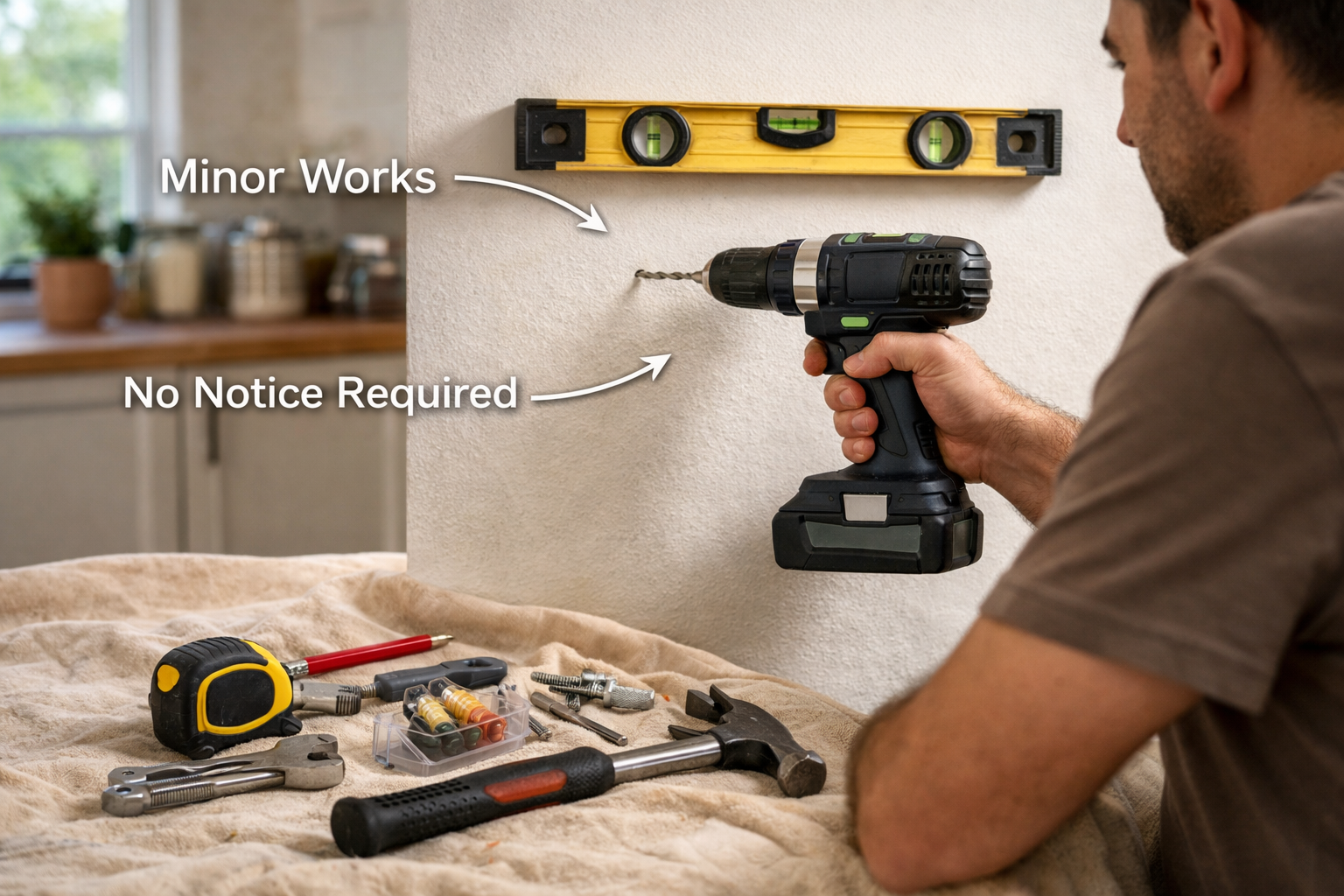
These activities do not require party wall notices because they involve no structural alteration or potential impact on the wall's load-bearing capacity.[2]
Electrical and Mechanical Installations
Electrical work within party walls is exempt provided it remains genuinely minor. Permitted activities include:
- ✅ Drilling small holes for electrical cables (typically under 20mm diameter)
- ✅ Installing socket outlets and light switches
- ✅ Running conduit through existing cavities
- ✅ Mounting electrical consumer units on party walls
Similarly, plumbing modifications that don't compromise structural integrity fall outside the Act's scope. Drilling for pipe runs, installing radiator brackets, and mounting bathroom fixtures all proceed without formal notification requirements.
Kitchen and Storage Installations
Homeowners frequently worry about types of party wall works when installing kitchens, but drilling for kitchen units and shelving is explicitly exempt.[2] This includes:
- Fixing wall cabinets to party walls
- Installing shelving brackets and support systems
- Mounting appliances like boilers or extractor fans
- Creating small penetrations for utility connections
The key distinction lies in the depth and purpose of any penetration. Shallow fixings that don't compromise the wall's structural function remain exempt, while deeper cutting or removal of significant wall sections may trigger notice requirements.
Case Study: 2026 Kitchen Renovation in Islington
A terraced house owner in Islington planned a complete kitchen refit involving removal of old units and installation of new cabinets on the party wall with their neighbour. Concerned about compliance, they consulted a surveyor who confirmed the work was entirely exempt under the Act. The drilling required for cabinet fixings (maximum 12mm diameter, 60mm depth) fell well below the threshold for structural concern. By documenting the work scope and obtaining written confirmation, the homeowner proceeded confidently without serving notices, saving approximately £800-1,200 in surveyor fees and avoiding a 14-day waiting period.
Excavation Exemptions: Understanding Distance and Depth Thresholds
Excavation work near neighbouring properties represents a more complex exemption category, with specific measurement criteria determining whether notices are required.
The Three-Meter Rule
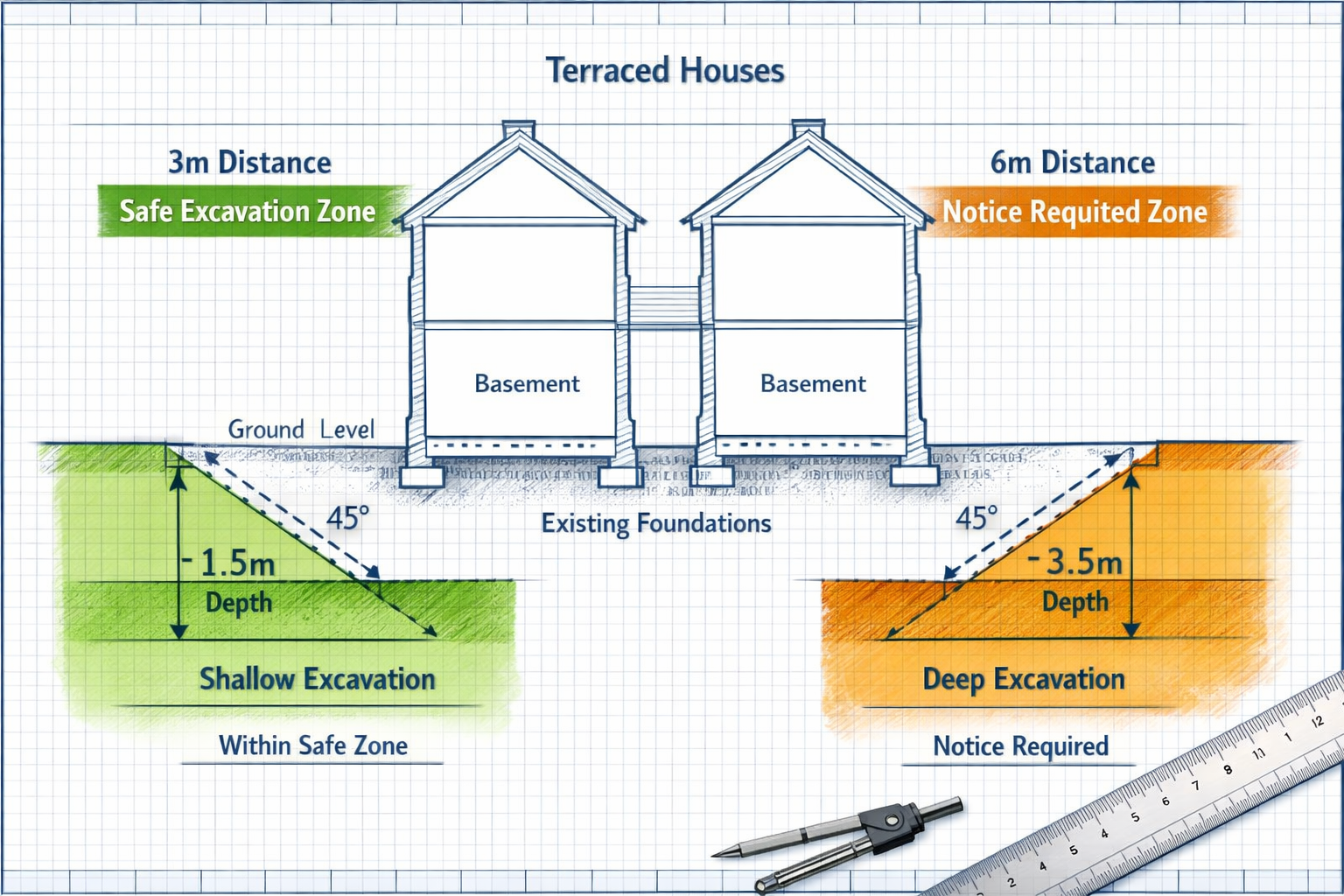
Under Section 6 of the Act, excavations are exempt when they satisfy distance and depth requirements relative to neighbouring foundations. The primary threshold states:
Excavations are exempt if:
- They occur more than 3 meters from any part of a neighbouring building's foundation, OR
- They are shallower than the neighbour's foundation level (even within 3 meters)
This provision allows most garden landscaping, shallow drainage work, and minor ground-level modifications to proceed without notification.
The Six-Meter Extended Zone
A secondary threshold applies to deeper excavations:
Excavations between 3-6 meters from neighbouring foundations require notice only if they extend to a depth that would intersect a 45-degree angle drawn downward from the bottom of the neighbour's foundation.
This geometric rule means that shallow excavations can occur closer to boundaries without triggering notice requirements, while deeper work must maintain greater distance.
Practical Application: 2026 Garden Extension Example
A homeowner in Richmond planned a single-story garden room requiring foundations 600mm deep. Their neighbour's existing house foundations sat at 900mm depth, located 4.2 meters from the proposed excavation.
Analysis:
- Distance: 4.2m (falls within the 3-6m zone)
- Proposed depth: 600mm
- Neighbour's foundation depth: 900mm
- 45-degree test: At 4.2m distance, the critical depth is approximately 3.3m
Result: The excavation was exempt because it remained shallower than both the neighbour's foundations and the 45-degree threshold. The homeowner documented the measurements with photographs and a simple site plan, providing clear evidence of exemption status.
Proving Excavation Exemptions
Documentation for excavation exemptions should include:
- Measured distances from property boundaries to excavation areas
- Depth specifications from ground level
- Foundation depth information for neighbouring properties (if available)
- Photographic evidence of existing ground conditions
- Site plans showing relative positions and measurements
Professional surveyors can provide definitive confirmation when measurements fall near threshold boundaries, offering protection against future disputes.
Loft Conversions and Extensions: When Notices Aren't Necessary
Loft conversions represent a frequent source of confusion regarding Party Wall Act requirements. The determining factor is whether the work involves structural modifications to party walls.
Exempt Loft Conversion Scenarios
A loft conversion may proceed without party wall notices when:
- No work occurs on party walls separating properties
- No new structural openings are created in shared walls
- No additional loading is transferred to party walls
- No roof structure modifications affect the neighbour's side
For example, a detached house loft conversion never requires party wall notices because no shared structures exist. Similarly, a semi-detached property conversion that involves only work to the external (non-party) walls and internal floor structure may be exempt.[2]
When Loft Conversions Do Require Notices
Conversely, notices become necessary when:
- Raising the party wall to accommodate increased head height
- Creating openings in party walls for access
- Installing steel beams that bear on party walls
- Removing chimney breasts that form part of the party structure
The distinction often requires professional assessment, particularly in terraced properties where roof structures may be interconnected.
Case Study: 2026 Semi-Detached Loft Conversion in Bristol
A semi-detached property owner planned a loft conversion involving dormer windows on the non-party side, new floor joists spanning between external walls, and a staircase installation. The party wall with the neighbour would remain completely untouched, with no structural modifications or additional loading.
A surveyor confirmed the work was exempt from party wall notice requirements. The homeowner documented this with:
- Architectural drawings showing no party wall involvement
- Structural engineer's calculations confirming load paths
- Written confirmation from the surveyor
- Photographic record of existing party wall condition
This documentation protected against potential future claims and allowed the project to proceed immediately without the standard notice period.
Boundary Walls and Fence Installations: Navigating the Grey Areas
Work involving boundary walls and fences creates frequent confusion about exemption status.
Fence Installations: Generally Exempt
Standard fence installations are typically exempt because:
- Fences are not "party fence walls" as defined by the Act
- They don't involve building "on the line of junction"
- No structural connection exists with neighbouring property
Homeowners can generally install or replace fences along boundaries without party wall notices, though planning permission and boundary ownership issues may still apply.
Party Fence Walls: When Notices Are Required
A party fence wall is specifically defined as a wall standing astride the boundary line, not belonging entirely to either property. Work to these structures—including repairs, heightening, or rebuilding—does require notices.
The key distinction: if the wall sits entirely within one property's land (even if located near the boundary), it's not a party fence wall, and modifications may be exempt from the Act (though other legal considerations about boundary disputes may apply).
Proving Exemption Status: Documentation Strategies for 2026
Establishing and maintaining evidence of exemption status protects property owners against future disputes and provides clear justification for proceeding without formal notices.
Essential Documentation Elements
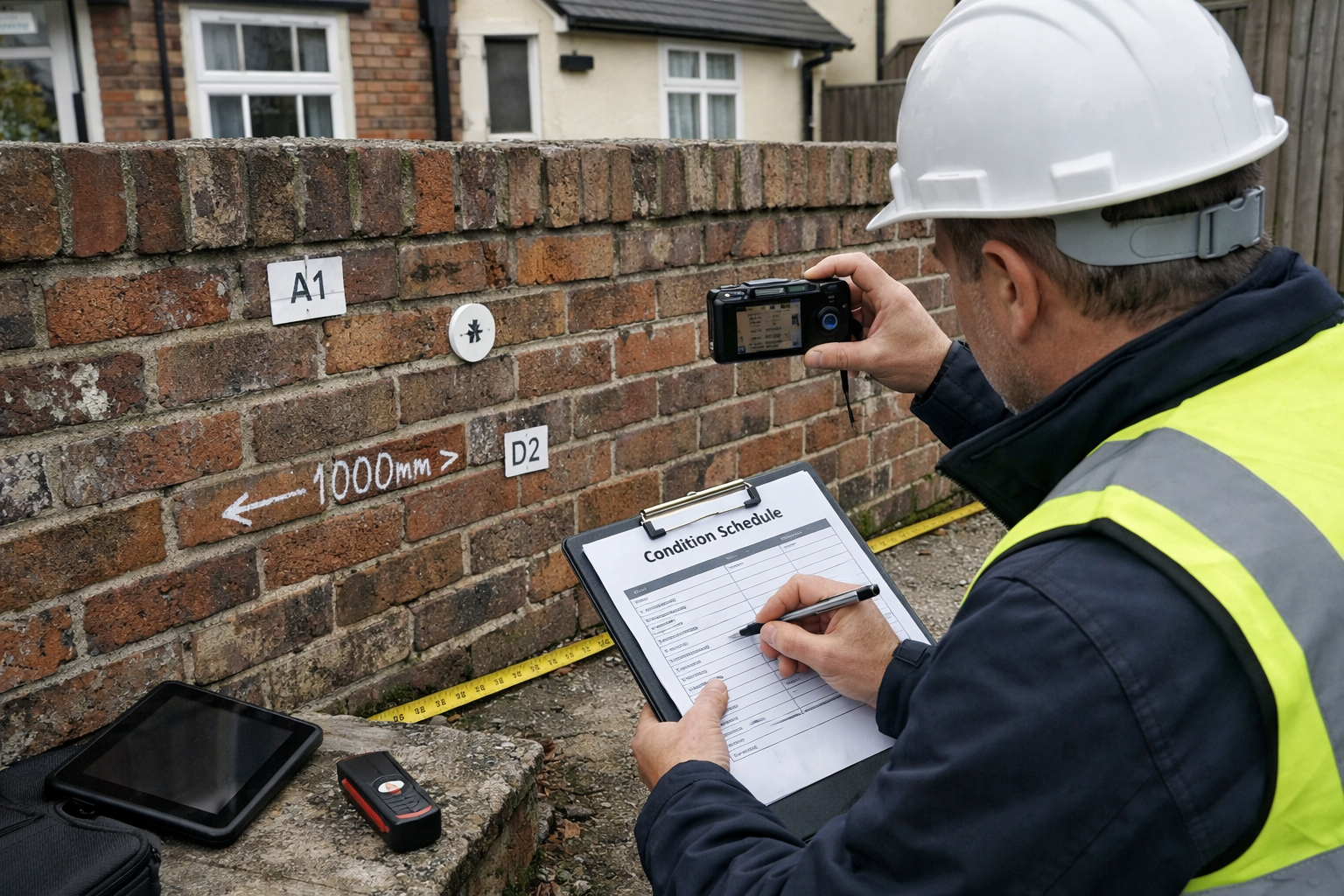
Comprehensive exemption documentation should include:
1. Detailed Work Specifications
- Written descriptions of all planned activities
- Materials specifications
- Depth and extent of any penetrations
- Structural calculations (where relevant)
2. Photographic Evidence
- Pre-work condition of all affected areas
- Measurements shown with tape measures in frame
- Multiple angles of party walls and boundaries
- Date-stamped images
3. Professional Assessments
- Written confirmation from surveyors
- Structural engineer opinions (for excavations)
- Architect's drawings showing party wall positions
4. Measurement Records
- Distances from boundaries
- Excavation depths
- Foundation levels (where ascertainable)
- Site plans with dimensions
The Role of Professional Verification
While not legally required for exempt work, obtaining professional confirmation from a qualified party wall surveyor offers significant advantages:
- Definitive assessment of exemption status
- Protection against neighbour challenges
- Clear documentation for future property sales
- Peace of mind for borderline cases
Surveyors can provide written opinions confirming exemption status, typically for fees significantly lower than full party wall awards processes. This investment often proves worthwhile for substantial projects or when neighbour relationships are sensitive.
2026 Best Practice: Pre-Work Neighbour Communication
Even when work is exempt, informal neighbour notification remains advisable. A simple letter or conversation explaining:
- The nature of planned work
- Why it falls outside the Act's scope
- Expected duration and working hours
- Contact information for questions
This proactive approach maintains positive relationships and often prevents misunderstandings that could escalate into disputes, even when no legal obligation exists.
Common Misconceptions About Party Wall Act Exemptions
Several persistent myths create unnecessary concern or, conversely, lead to non-compliance.
Myth 1: "All Building Work Requires Party Wall Notices"
Reality: Only work falling within the three specific categories defined by the Act requires notices. The majority of home improvements proceed without any party wall involvement.
Myth 2: "If It Touches a Party Wall, It Needs a Notice"
Reality: Touching or making surface-level modifications to party walls doesn't automatically trigger notice requirements. The work must involve structural alteration, cutting away, or significant penetration.
Myth 3: "Exemptions Apply Only to Very Minor Work"
Reality: Some substantial projects, including complete loft conversions or significant excavations, may be entirely exempt based on their relationship to party structures and neighbouring foundations.
Myth 4: "Neighbour Agreement Eliminates the Need for Notices"
Reality: While neighbour consent simplifies the process, it doesn't change whether work is legally notifiable. Conversely, exempt work remains exempt regardless of neighbour objections.
Myth 5: "The Act Applies Throughout the UK"
Reality: The Party Wall etc. Act 1996 applies only to England and Wales. Scotland and Northern Ireland have different legal frameworks.[2]
Special Circumstances: Damp Proofing, Underpinning, and Structural Repairs
Certain maintenance and repair works create specific exemption questions.
Damp Proof Course Installation
Inserting a damp proof course into a party wall requires formal party wall notice, even though it's maintenance rather than improvement.[2] This work involves cutting into the wall structure, creating potential stability concerns during the process.
The notice requirement applies regardless of whether:
- The work is essential maintenance
- Both properties would benefit
- The wall is already deteriorating
Underpinning and Foundation Repairs
Underpinning work almost always requires party wall notices because it involves:
- Excavation near or beneath neighbouring foundations
- Structural modifications to party walls
- Potential temporary instability during works
Exemptions are extremely rare for underpinning, even when work occurs entirely within one property's land.
Repointing and External Repairs
External repointing of party walls typically doesn't require notices if it involves only surface mortar replacement without cutting into the wall structure. However, extensive repairs involving brick replacement or structural stabilization may cross into notifiable territory.
Regional Considerations: Party Wall Exemptions Across London and England
While the Act applies uniformly across England and Wales, practical application varies by region based on property types and local building practices.
London-Specific Considerations
London's dense terraced housing creates unique scenarios where understanding exemptions becomes particularly valuable. Property owners in Central London, East London, West London, North London, and South London frequently encounter party wall issues due to:
- Terraced Victorian and Edwardian properties with shared walls
- Basement excavations in areas with high water tables
- Loft conversions in properties with interconnected roof structures
- Rear extensions in gardens with minimal separation
Understanding exemptions in these contexts helps property owners distinguish between work requiring formal processes and projects that can proceed immediately.
Rural and Suburban Applications
In areas with predominantly detached properties, party wall considerations arise less frequently, but exemptions remain relevant for:
- Boundary wall constructions
- Excavations near neighbouring buildings
- Semi-detached property modifications
Cost Implications: Financial Benefits of Confirming Exemptions
Understanding and properly documenting exemptions delivers tangible financial benefits.
Avoided Surveyor Fees
Full party wall procedures typically cost:
- £700-1,500 for straightforward cases with agreed surveyors
- £1,500-3,000+ for disputed cases requiring separate surveyors
- Additional costs for complex awards or multiple neighbouring properties
Confirming exemption status eliminates these expenses entirely, though modest fees for professional verification (£200-500) may still prove worthwhile.
For guidance on managing expenses, see our resource on how to keep party wall costs down.
Time Savings
The statutory notice periods create project delays:
- Minimum 14 days for most party wall notices
- One month for line of junction notices
- Additional time for surveyor appointments and award preparation
Exempt work proceeds immediately, avoiding these mandatory waiting periods.
Project Flexibility
Exempt work allows greater flexibility in:
- Scheduling contractors without notice period constraints
- Making design modifications without re-serving notices
- Responding quickly to discovered issues during construction
When to Seek Professional Guidance on Exemptions
While many exemptions are straightforward, certain scenarios warrant professional assessment.
Borderline Cases Requiring Expert Opinion
Consult a qualified party wall surveyor when:
- Measurements fall near threshold boundaries (e.g., excavations between 2.5-3.5m from neighbours)
- Work involves multiple elements, some potentially notifiable
- Structural implications are unclear from plans alone
- Neighbour relationships are already strained
- Property value is substantial, warranting professional protection
The Value of Pre-Work Consultations
Many surveyors offer initial consultations or exemption confirmation services at modest cost. These typically include:
- Review of proposed work specifications
- Site visit and measurements
- Written opinion on exemption status
- Documentation suitable for future reference
This investment often proves worthwhile compared to the cost and disruption of incorrectly assuming exemption or unnecessarily serving notices.
Finding Qualified Professionals
When selecting a surveyor for exemption assessment, prioritize:
- RICS (Royal Institution of Chartered Surveyors) membership
- Specific party wall expertise and experience
- Local knowledge of property types in your area
- Clear fee structures for consultation services
For those carrying out works or serving as building owners, professional guidance ensures compliance while maximizing efficiency.
Exemptions vs. Neighbour Agreements: Understanding the Difference
A critical distinction exists between work that's exempt and work that proceeds with neighbour consent.
Exempt Work: No Notice Required
Exempt work falls completely outside the Act's scope:
- No legal obligation to notify neighbours
- No formal consent required
- No surveyor appointments necessary
- No awards or written agreements needed
Proceeding with exempt work carries no legal risk under the Party Wall Act, though other legal frameworks (planning permission, building regulations, nuisance law) may still apply.
Notifiable Work with Consent: Simplified Process
Notifiable work that receives neighbour consent still requires:
- Formal written notice served correctly
- Neighbour's written consent within 14 days
- Compliance with any conditions the neighbour specifies
- Proper documentation of the agreement
While simpler than disputed cases, this remains a formal legal process distinct from exemption. For more details, see our guide on party wall agreements without a surveyor.
Why the Distinction Matters
Confusing these categories creates two potential problems:
- Treating exempt work as notifiable wastes time and money on unnecessary procedures
- Treating notifiable work as exempt creates legal liability and potential injunctions
Proper classification at the project's outset prevents both scenarios.
Future-Proofing: Maintaining Exemption Documentation
Proper record-keeping protects not only during the project but for years afterward.
Documentation Retention
Maintain comprehensive records including:
- All work specifications and plans
- Photographic evidence (pre, during, and post-work)
- Professional opinions or surveyor letters
- Contractor invoices and completion certificates
- Correspondence with neighbours
Store these documents:
- Digitally with cloud backup
- Physically with property deeds
- Accessibly for future reference
Value for Property Sales
When selling property, exemption documentation demonstrates:
- Proper legal compliance with building work
- No outstanding party wall disputes
- Professional approach to property modifications
- Clear history for buyer solicitors
This documentation often prevents transaction delays and buyer concerns about previous works.
Protection Against Future Claims
Comprehensive records protect against:
- Neighbour claims about work done years earlier
- Disputes with new neighbouring property owners
- Questions from mortgage lenders or insurers
- Legal challenges to property modifications
The investment in proper documentation during the project pays dividends throughout property ownership.
Conclusion
Understanding Party Wall Act Exemptions 2026: When Notices Aren't Required and How to Prove It empowers property owners to navigate building projects efficiently while maintaining full legal compliance. The majority of common home improvements—from interior decorating to shallow excavations—fall completely outside the Act's scope, eliminating the need for formal notices, surveyor appointments, and statutory waiting periods.
The key to confident compliance lies in accurate classification of proposed work against the Act's three specific categories, combined with thorough documentation of exemption status. Minor interior modifications, electrical installations, and kitchen fittings proceed freely without notification requirements. Excavations beyond specified distance thresholds and loft conversions without party wall involvement similarly avoid the formal process.
For borderline cases or substantial projects, professional verification from qualified surveyors provides definitive confirmation and valuable protection against future disputes. The modest cost of expert assessment often proves worthwhile compared to the expenses and delays of unnecessary formal procedures—or the legal risks of incorrectly assuming exemption.
Actionable Next Steps
- Review your planned work against the three Act categories to determine likely exemption status
- Measure and document all relevant distances, depths, and structural elements
- Photograph existing conditions comprehensively before starting any work
- Consider professional consultation for projects near threshold boundaries or involving complex structural elements
- Communicate informally with neighbours even when work is exempt, maintaining positive relationships
- Retain all documentation permanently with property records for future reference
For those requiring formal party wall processes, explore our resources on party wall notices, understanding what party wall notices are and how to respond, and guidance for neighbours carrying out works.
By combining legal knowledge with practical documentation strategies, property owners in 2026 can confidently distinguish between work requiring formal procedures and projects that proceed immediately under exemption provisions—saving time, money, and neighbourly goodwill while ensuring complete compliance with the Party Wall etc. Act 1996.
References
[1] Construction Look Ahead 2026 What You Need To Know Key Legislations And Updates – https://www.herrington-carmichael.com/construction-look-ahead-2026-what-you-need-to-know-key-legislations-and-updates/
[2] Party Wall Agreement – https://hoa.org.uk/advice/guides-for-homeowners/i-am-improving/party-wall-agreement/
[3] Amended Again Critical Changes To Rpapl %c2%a7 881 What New York Contractors And Construction Managers Need To Know – https://www.pecklaw.com/client_alerts/amended-again-critical-changes-to-rpapl-%C2%A7-881-what-new-york-contractors-and-construction-managers-need-to-know/
[4] Who Pays For A Party Wall Surveyor – https://partywalldiy.com/guides/who-pays-for-a-party-wall-surveyor
[5] Party Wall Act – https://southernbcp.co.uk/Homeowners/Party-Wall-Act
SEO Meta Title: Party Wall Act Exemptions 2026: When Notices Aren't Required