

Party Wall Agreed Surveyor: Your Complete Guide to Shared Appointments in 2025
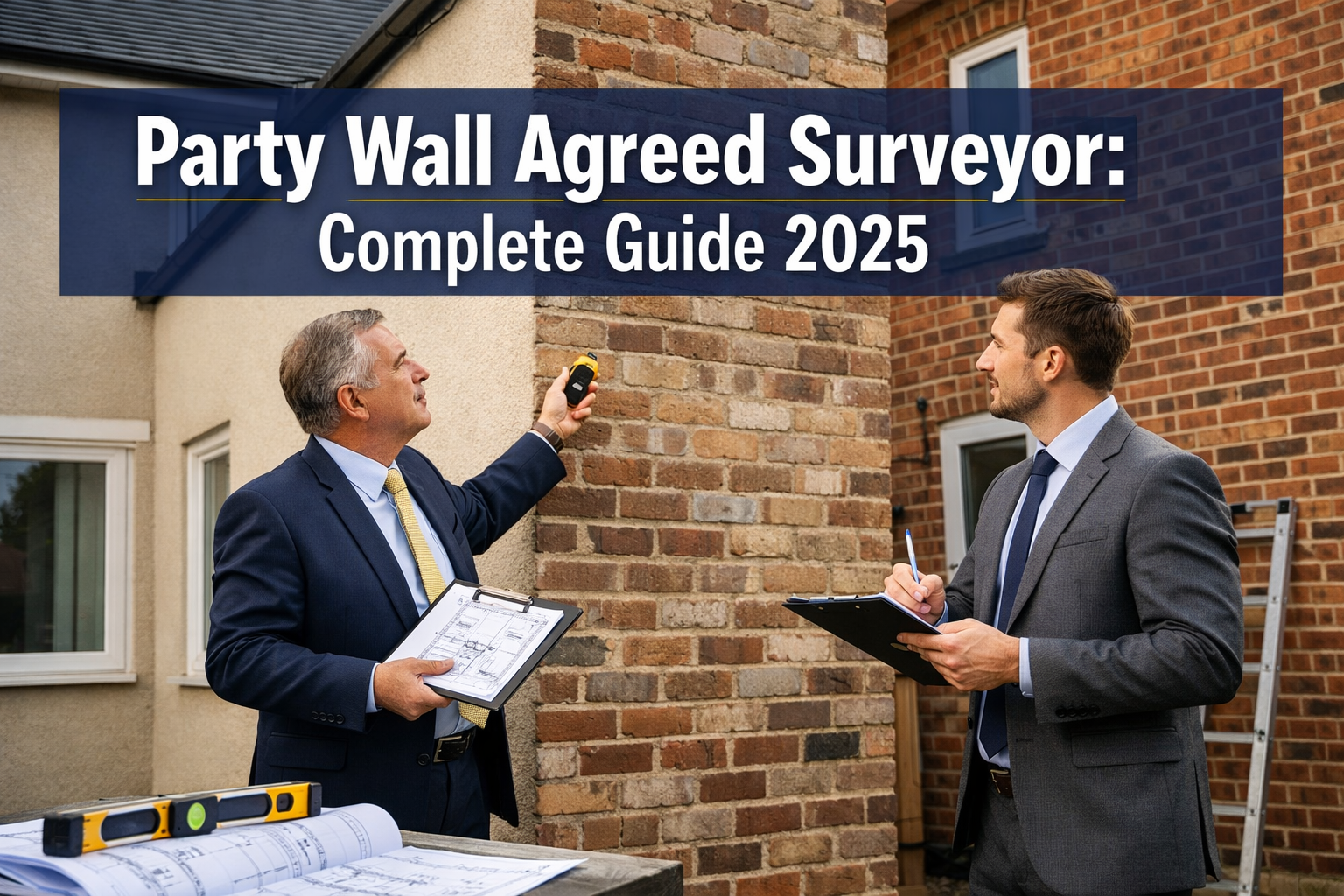
When neighbours on either side of a property boundary need to navigate construction work, the choice of who oversees the process can make or break the relationship. Instead of appointing separate surveyors—one for each party—there’s a streamlined alternative that can save time, money, and potential conflict: the party wall agreed surveyor. This professional acts as a single, impartial expert representing both the building owner and the adjoining owner, ensuring fairness while simplifying what can otherwise become a complicated legal process.
Understanding how a party wall agreed surveyor works, when this appointment makes sense, and what responsibilities they hold is essential for anyone planning building works near a shared boundary. Whether you’re extending your home, excavating foundations, or repairing a shared wall, making the right surveyor choice can transform a potentially contentious situation into a smooth, professional experience.
Key Takeaways
- ✅ A party wall agreed surveyor is a single professional appointed by mutual consent to represent both the building owner and adjoining owner, acting impartially throughout the party wall process
- 💰 Choosing an agreed surveyor typically reduces overall costs compared to appointing two separate surveyors, as you’re only paying for one professional’s time and expertise
- ⚖️ The agreed surveyor must maintain complete impartiality and cannot favour either party, ensuring fair treatment and balanced decisions in all party wall matters
- 📋 Both parties must formally consent to the agreed surveyor appointment in writing, and either party can withdraw consent and appoint their own surveyor at any time
- 🏗️ The agreed surveyor handles all aspects of the party wall process, from serving notices to preparing awards, conducting inspections, and resolving disputes between neighbours
What Is a Party Wall Agreed Surveyor?
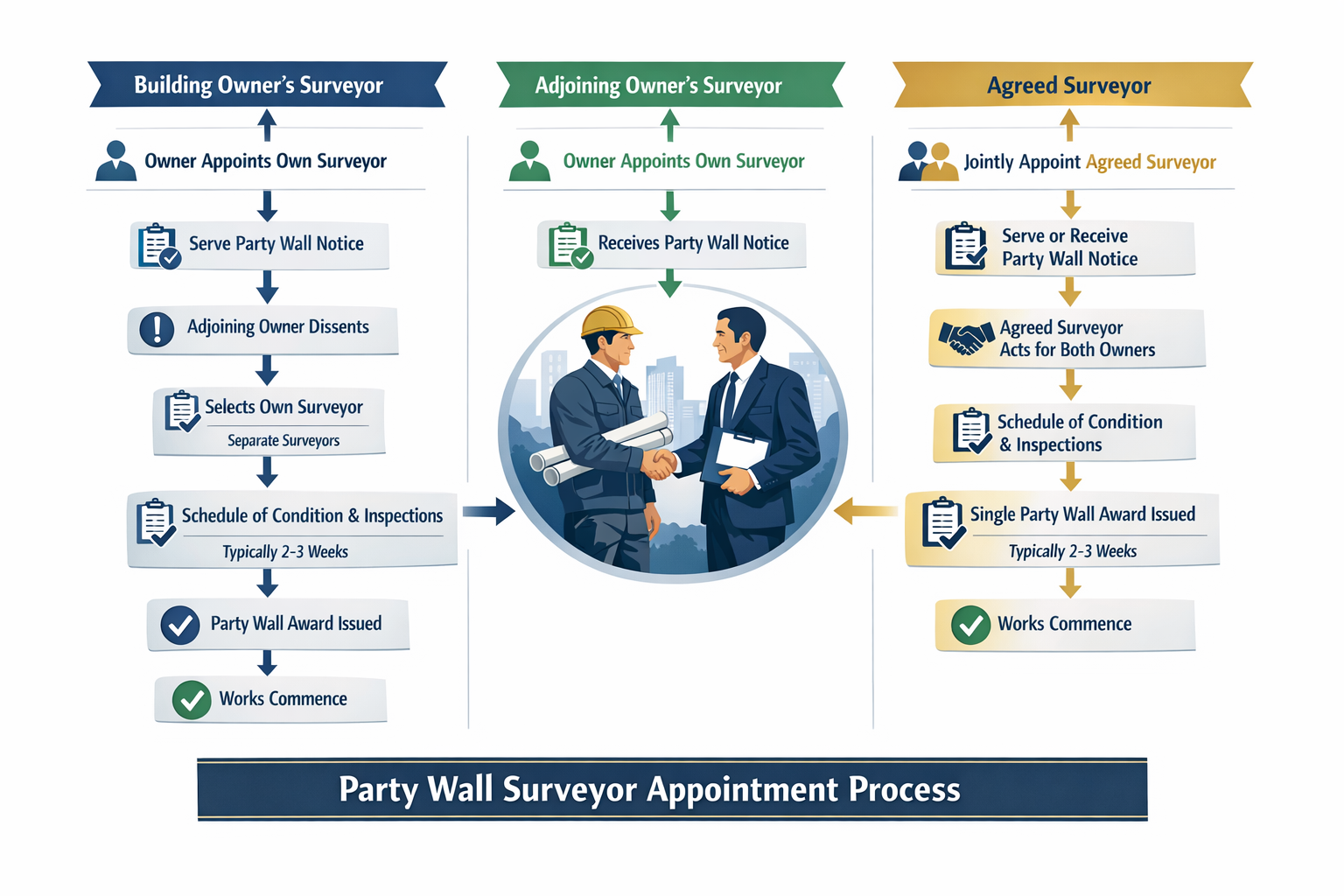
A party wall agreed surveyor is a qualified professional who both the building owner (the person carrying out works) and the adjoining owner (the neighbour) mutually agree to appoint under the Party Wall etc. Act 1996. Rather than each party selecting their own surveyor, they jointly select one impartial expert to oversee the entire party wall process.
This appointment represents a collaborative approach to managing party wall matters. The agreed surveyor acts as a neutral third party with a duty to be fair and reasonable to both sides. They cannot show bias toward either the building owner or the adjoining owner, despite the building owner typically being responsible for all fees.
The Legal Framework Behind Agreed Surveyors
The Party Wall etc. Act 1996 specifically provides for the appointment of an agreed surveyor as one of three possible surveyor appointment routes:
- Two surveyors (one appointed by each party) plus a third surveyor
- One agreed surveyor appointed by both parties
- One surveyor appointed by one party after the other party fails to respond
When both parties choose the agreed surveyor route, they’re opting for efficiency and cooperation. This choice must be documented in writing, with both parties formally confirming their consent to the appointment.
How an Agreed Surveyor Differs from Separate Appointments
The key distinction lies in representation and independence:
| Aspect | Agreed Surveyor | Separate Surveyors |
|---|---|---|
| Number of professionals | One surveyor for both parties | Two surveyors (one per party) |
| Representation | Impartial to both sides | Each represents their appointing party |
| Cost | Single fee (typically lower overall) | Two separate fees plus potential third surveyor |
| Decision-making | Makes decisions independently | Must reach agreement or involve third surveyor |
| Communication | Direct with both parties | Through respective surveyors |
| Timeline | Generally faster | Can be longer due to negotiations |
When you work with a professional party wall surveyor, understanding these differences helps you make an informed choice about the appointment structure that best suits your situation.
When Should You Appoint a Party Wall Agreed Surveyor?
Deciding whether to appoint an agreed surveyor depends on several factors, including the relationship between neighbours, the complexity of the proposed works, and the level of trust between parties.
Ideal Scenarios for Agreed Surveyor Appointments
✅ Amicable Neighbour Relations
When building owners and adjoining owners have a good working relationship and trust each other, appointing an agreed surveyor makes excellent sense. The cooperative nature of this arrangement reinforces positive neighbour dynamics and demonstrates mutual respect.
✅ Straightforward Building Projects
For relatively simple works—such as a single-storey rear extension, loft conversion with minimal party wall impact, or basic repairs to a shared wall—an agreed surveyor can efficiently handle the process without the complexity of multiple professionals.
✅ Cost-Conscious Projects
Property owners looking to keep party wall costs down often benefit from the agreed surveyor route. With only one professional to pay, the overall expense is typically 30-50% lower than appointing separate surveyors.
✅ Time-Sensitive Construction Schedules
When building works need to commence quickly, an agreed surveyor can expedite the process. Without the need for two surveyors to coordinate and reach consensus, decisions and awards can be prepared more rapidly.
Situations Where Separate Surveyors May Be Better
⚠️ Complex or High-Value Projects
Large-scale developments, basement excavations, or works involving significant structural changes may warrant separate surveyors. Each party benefits from dedicated representation when substantial risks or costs are involved.
⚠️ Existing Disputes or Tensions
If neighbours already have disagreements or the adjoining owner has concerns about the proposed works, separate surveyors provide independent advocacy for each party’s interests.
⚠️ Significant Power Imbalances
When one party has considerably more construction knowledge, financial resources, or legal understanding, separate surveyors help level the playing field and ensure fair treatment.
⚠️ Previous Party Wall Issues
If there’s a history of party wall problems, damage claims, or unresolved disputes from earlier works, the protection of separate representation may be prudent.
The Roles and Responsibilities of a Party Wall Agreed Surveyor
A party wall agreed surveyor carries substantial responsibilities, balancing the interests of both parties while ensuring compliance with the Party Wall etc. Act 1996. Their role encompasses technical, legal, and diplomatic dimensions.
Core Duties and Obligations
📋 Preparing and Serving Party Wall Notices
While technically the building owner’s responsibility to serve notices, the agreed surveyor often assists in preparing the correct party wall notices and ensuring they contain all required information. They verify that notices are served correctly and within appropriate timeframes.
🔍 Conducting Property Inspections
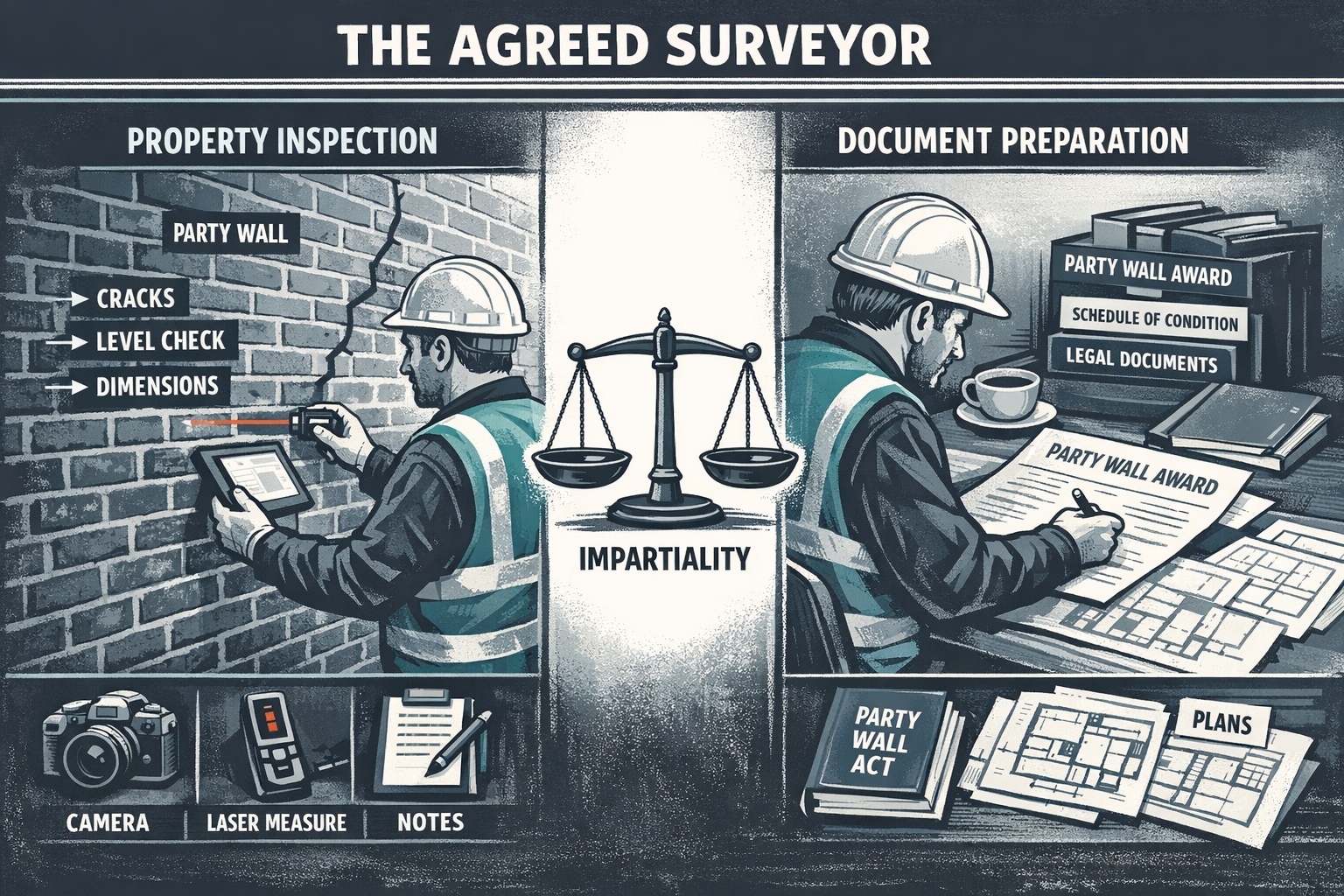
The agreed surveyor must inspect both properties to prepare a comprehensive schedule of condition. This detailed photographic and written record documents the pre-works state of the adjoining owner’s property, establishing a baseline for assessing any future damage claims.
📝 Drafting the Party Wall Award
The surveyor prepares the party wall award—the legal document that sets out:
- Details of the proposed works
- When and how works will be carried out
- Access requirements
- Working hours
- Special foundations (if applicable)
- Rights and responsibilities of both parties
- Dispute resolution procedures
⚖️ Maintaining Impartiality
Perhaps the most critical responsibility is remaining completely neutral. The agreed surveyor cannot favour either party, even though the building owner pays their fees. Every decision must be fair, reasonable, and based on the Act’s provisions and professional judgment.
🏗️ Monitoring Works Progress
During construction, the agreed surveyor may conduct site visits to ensure works proceed in accordance with the award. They verify that the building owner complies with agreed conditions and that the adjoining owner’s property remains protected.
🔧 Resolving Disputes
When disagreements arise during the works, the agreed surveyor acts as mediator and decision-maker. Their determinations are binding unless appealed to the county court within 14 days.
Professional Standards and Qualifications
A competent party wall agreed surveyor should possess:
- Professional membership in organizations such as the Royal Institution of Chartered Surveyors (RICS) or the Faculty of Party Wall Surveyors (FPWS)
- Comprehensive knowledge of the Party Wall etc. Act 1996 and related case law
- Technical expertise in building construction, structural engineering, and property assessment
- Insurance coverage including professional indemnity insurance
- Local experience understanding regional building practices and property types
When selecting an experienced party wall surveyor, verify their credentials and ask about their specific experience with similar projects in your area.
The Agreed Surveyor Appointment Process: Step-by-Step
Understanding how to properly appoint a party wall agreed surveyor ensures the process begins correctly and avoids potential complications later.
Step 1: Serving the Initial Party Wall Notice
The building owner must first serve the appropriate party wall notice on the adjoining owner. This notice describes the proposed works and triggers the party wall process. The type of notice depends on the work:
- Party Structure Notice for works directly to a party wall
- Party Wall Notice for new walls built on or astride the boundary
- Notice of Adjacent Excavation for digging within 3 or 6 metres of a neighbouring structure
For guidance on what party wall notices are and how to respond, refer to detailed resources that explain each notice type.
Step 2: The Adjoining Owner’s Response
After receiving the notice, the adjoining owner has 14 days to respond in one of two ways:
✅ Consent to the works (ending the party wall process)
📋 Dissent or request a party wall award (triggering surveyor appointments)
If the adjoining owner doesn’t respond within 14 days, they’re deemed to have dissented, and the surveyor appointment process automatically begins.
Step 3: Mutual Agreement on a Single Surveyor
For an agreed surveyor appointment, both parties must actively consent to appointing the same professional. This typically involves:
- Initial discussion between neighbours about using an agreed surveyor
- Identifying potential surveyors through recommendations or research
- Obtaining quotes and discussing the surveyor’s approach
- Formal written consent from both parties to the appointment
The agreed surveyor should provide a clear fee proposal and explain their impartial role before appointment.
Step 4: Formal Appointment Documentation
Once both parties agree, the appointment should be documented in writing. The agreed surveyor typically sends a letter of engagement to both parties outlining:
- The scope of their appointment
- Their fee structure and payment terms
- The timeline for completing the award
- Their duties under the Act
- Confirmation of their impartiality
Both parties should sign and return this engagement letter, creating a clear contractual relationship.
Step 5: The Right to Withdraw Consent
⚠️ Important: Either party can withdraw their consent to the agreed surveyor appointment at any time and appoint their own surveyor instead. This right exists throughout the process, even after the agreed surveyor has begun work.
If one party withdraws consent, the process transitions to the two-surveyor model, with each party appointing their own professional. The two surveyors then work together to produce the award or, if they cannot agree, appoint a third surveyor to resolve differences.
Costs and Fees: What to Expect When Appointing an Agreed Surveyor
Understanding the financial implications of appointing a party wall agreed surveyor helps both parties budget appropriately and avoid surprises.
Typical Fee Structures
Party wall surveyors generally charge using one of these models:
💷 Fixed Fees
Many surveyors offer fixed-fee packages for straightforward projects. These typically range from:
- Simple works (single-storey extension, basic wall repairs): £700-£1,200
- Moderate complexity (two-storey extension, loft conversion): £1,200-£2,000
- Complex projects (basement excavation, multiple party walls): £2,000-£4,000+
⏰ Hourly Rates
For unpredictable or complex situations, surveyors may charge hourly rates, typically £100-£250 per hour depending on experience and location. This approach provides flexibility but can make total costs harder to predict.
📊 Percentage-Based Fees
Rarely, surveyors charge a percentage of the construction value, though this is less common for party wall work specifically.
Who Pays the Agreed Surveyor’s Fees?
Under the Party Wall etc. Act 1996, the building owner is responsible for all reasonable surveyor fees, including:
- The agreed surveyor’s fees
- The cost of preparing the party wall award
- Inspection and monitoring costs
- Any additional work required during construction
This applies even though the agreed surveyor represents both parties equally. The building owner initiates the works and therefore bears the associated costs.
For detailed information about costs of the party wall process, including what’s considered “reasonable,” consult specialist resources.
Cost Comparison: Agreed vs. Separate Surveyors
| Scenario | Agreed Surveyor | Separate Surveyors |
|---|---|---|
| Simple extension | £700-£1,200 | £1,400-£2,400 |
| Moderate project | £1,200-£2,000 | £2,400-£4,000 |
| Complex works | £2,000-£4,000 | £4,000-£8,000+ |
| Third surveyor | Not applicable | Additional £1,000-£3,000 |
💡 Cost-saving tip: The agreed surveyor route typically saves 30-50% compared to appointing separate surveyors, making it an attractive option for cost-conscious building owners.
Additional Costs to Consider
Beyond the surveyor’s basic fees, budget for:
- Schedule of condition photography: £200-£500 (often included)
- Additional inspections: £100-£300 per visit if issues arise
- Award amendments: £150-£500 if changes to works require award updates
- Dispute resolution time: Hourly charges if significant disagreements emerge
Benefits of Choosing a Party Wall Agreed Surveyor
The agreed surveyor route offers several compelling advantages when circumstances are appropriate.
🎯 Streamlined Decision-Making
With only one professional making determinations, the process moves more quickly. There’s no need for two surveyors to exchange correspondence, negotiate terms, or reach consensus. The agreed surveyor can make decisions promptly and issue the award without delays.
💰 Significant Cost Savings
As illustrated earlier, appointing a single agreed surveyor substantially reduces overall costs. Building owners benefit from lower fees while adjoining owners receive the same level of protection and professional service.
🤝 Preserving Neighbour Relations
The collaborative nature of appointing an agreed surveyor sends a positive message about cooperation and trust. This approach can strengthen neighbour relationships rather than creating an adversarial dynamic that separate surveyors might inadvertently encourage.
📞 Simplified Communication
Both parties communicate directly with the same professional, reducing the potential for miscommunication or “lost in translation” issues that can occur when information passes between multiple surveyors.
⚖️ Consistent Interpretation
A single surveyor applies consistent standards and interpretations throughout the process. There’s no risk of conflicting professional opinions or differing approaches to the Act’s requirements.
🏆 Professional Accountability
The agreed surveyor bears sole responsibility for the award’s accuracy and fairness. This concentrated accountability often results in meticulous attention to detail and balanced decision-making.
Potential Drawbacks and Limitations
While the agreed surveyor route offers many benefits, it’s important to understand potential limitations.
⚠️ Perceived Bias Concerns
Even though agreed surveyors must remain impartial, adjoining owners sometimes worry about bias toward the building owner who pays the fees. This perception can create unease, even when unfounded.
Mitigation: Choose a surveyor with a strong reputation for impartiality and clear communication with both parties.
🔍 Limited Advocacy
Unlike separate surveyors who actively advocate for their appointing party’s interests, an agreed surveyor cannot champion either side. Adjoining owners who want strong representation may feel underserved.
Consideration: For complex or high-risk projects, the advocacy provided by separate surveyors may justify the additional cost.
🚫 Withdrawal Complications
If one party withdraws consent mid-process, it creates disruption and potential additional costs. Work already completed by the agreed surveyor may need to be reviewed or duplicated by newly appointed surveyors.
Protection: Clear initial communication about commitment to the agreed surveyor process helps minimize this risk.
📉 Inappropriate for Contentious Situations
When significant disagreements already exist, an agreed surveyor may struggle to satisfy both parties. The neutral position that normally provides value becomes a liability when strong advocacy is needed.
Alternative: In contentious situations, separate surveyors with a third surveyor available for dispute resolution may be more appropriate.
How to Select the Right Party Wall Agreed Surveyor
Choosing the right professional is crucial for a smooth party wall process. Both parties should be involved in the selection to ensure mutual confidence.
Essential Qualifications to Look For
✅ Professional Accreditation
- RICS (Royal Institution of Chartered Surveyors) membership
- FPWS (Faculty of Party Wall Surveyors) membership
- Relevant building surveying qualifications
✅ Specific Party Wall Experience
- Minimum 5+ years of party wall work
- Experience with similar project types
- Knowledge of local building practices
✅ Professional Indemnity Insurance
- Minimum £1 million coverage
- Current policy with reputable insurer
- Coverage specific to party wall work
✅ Local Knowledge
- Familiarity with your area’s property types
- Understanding of regional construction methods
- Established relationships with local builders and contractors
Questions to Ask Potential Surveyors
Before appointing an agreed surveyor, both parties should ask:
- How many party wall matters have you handled in the past year?
- What percentage of your work involves agreed surveyor appointments?
- Can you provide references from both building owners and adjoining owners?
- What is your typical timeline from appointment to award issuance?
- How do you ensure impartiality when the building owner pays your fees?
- What is your approach to communication with both parties?
- How do you handle disagreements between the parties?
- What are your fees, and what exactly do they include?
- Are you available for site visits during the construction phase?
- What is your policy if one party withdraws consent to your appointment?
Red Flags to Avoid
🚩 Lack of specific party wall experience (general building surveyors without party wall specialization)
🚩 Unwillingness to communicate with both parties equally
🚩 Vague or unclear fee structures
🚩 No professional indemnity insurance
🚩 Pressure to make quick decisions without proper consideration
🚩 Reluctance to provide references or credentials
🚩 Limited availability for inspections or communication
When searching for qualified professionals, explore party wall surveyors across different London locations to find experienced practitioners in your area.
The Party Wall Award: What an Agreed Surveyor Delivers
The culmination of the agreed surveyor’s work is the party wall award—a legally binding document that governs how the works proceed.
Key Components of a Comprehensive Award
A properly prepared party wall award includes:
📋 Detailed Description of Works
- Specific construction activities covered
- Drawings and specifications referenced
- Structural elements affected
- Methods and materials to be used
📅 Timeframes and Scheduling
- Permitted working hours (typically 8am-6pm weekdays)
- Duration of works
- Notice periods for commencement
- Restrictions on weekend or holiday working
🔑 Access Provisions
- Rights of access to adjoining property
- Notice requirements for access
- Scope of permitted access
- Restoration obligations after access
🏗️ Protective Measures
- Required protections for adjoining property
- Temporary support requirements
- Dust and noise mitigation measures
- Security arrangements
📸 Schedule of Condition
- Comprehensive photographic record
- Written descriptions of existing conditions
- Identification of pre-existing defects
- Baseline for assessing future damage claims
💷 Cost Provisions
- Confirmation of building owner’s fee responsibility
- Provisions for additional inspection costs
- Damage compensation procedures
- Dispute resolution mechanisms
⚖️ Rights and Obligations
- Each party’s specific rights under the award
- Obligations to comply with award terms
- Consequences of non-compliance
- Appeal rights and procedures
Timeline for Award Preparation
A typical timeline for agreed surveyor appointments:
| Stage | Timeframe |
|---|---|
| Initial appointment | Week 1 |
| Property inspections | Weeks 1-2 |
| Schedule of condition preparation | Weeks 2-3 |
| Draft award preparation | Weeks 3-4 |
| Review and finalization | Weeks 4-5 |
| Award service | Week 5 |
| Appeal period | Weeks 6-7 |
| Works can commence | Week 8+ |
⏱️ Note: Complex projects may require longer timelines, while straightforward matters can sometimes be completed more quickly.
For those interested in understanding award documents better, reviewing a party wall contract template and award guide provides valuable insights.
Common Scenarios and Case Studies
Real-world examples illustrate how party wall agreed surveyors handle different situations.
Case Study 1: Single-Storey Rear Extension
Situation: A homeowner in South London planned a 4-metre single-storey rear extension that would be built up to the boundary with their neighbour’s property.
Approach: Both neighbours had a friendly relationship and agreed to appoint a single agreed surveyor. The surveyor:
- Conducted inspections of both properties
- Prepared a detailed schedule of condition
- Issued an award within 4 weeks
- Conducted mid-construction and post-completion inspections
Outcome: Works proceeded smoothly with no disputes. Total surveyor costs: £950 (compared to estimated £1,800-£2,200 for separate surveyors).
Key Learning: For straightforward projects with cooperative neighbours, the agreed surveyor route delivers efficiency and cost savings.
Case Study 2: Loft Conversion with Party Wall Works
Situation: A terraced house owner in North London planned a loft conversion requiring steel beams to be inserted into both party walls.
Approach: Initially, both neighbours agreed to an agreed surveyor. However, one adjoining owner became concerned about potential structural issues and withdrew consent, appointing their own surveyor.
Outcome: The process transitioned to two surveyors who worked together to produce the award. The withdrawal caused a 3-week delay and increased costs by approximately £1,200.
Key Learning: Ensure all parties are fully committed to the agreed surveyor approach before proceeding, especially for works involving structural changes.
Case Study 3: Basement Excavation
Situation: A property owner in Central London planned a full basement excavation within 3 metres of neighbouring foundations.
Approach: Given the complexity and risk, both parties initially considered separate surveyors but ultimately agreed on a highly experienced agreed surveyor with basement expertise.
Outcome: The agreed surveyor prepared a comprehensive award with detailed protective measures, conducted weekly inspections during excavation, and successfully managed minor concerns that arose. Total costs: £3,200 (compared to estimated £6,000+ for separate surveyors plus potential third surveyor).
Key Learning: Even for complex works, an agreed surveyor can be effective if both parties choose a highly qualified professional with specific relevant experience.
Frequently Asked Questions About Party Wall Agreed Surveyors
Can I suggest my own surveyor to be the agreed surveyor?
Yes, you can suggest a surveyor, but the adjoining owner must genuinely consent to the appointment. The surveyor cannot be considered “agreed” unless both parties freely choose them. Pressure or coercion invalidates the agreement.
What happens if I’m unhappy with the agreed surveyor’s decisions?
You have two options:
- Withdraw consent and appoint your own surveyor (the process then becomes a two-surveyor matter)
- Appeal to the county court within 14 days of receiving the award (though this is expensive and rarely successful)
Does the agreed surveyor need to visit both properties?
Yes, absolutely. The agreed surveyor must inspect both the building owner’s and adjoining owner’s properties to prepare an accurate schedule of condition and understand the works’ potential impact.
How long does the agreed surveyor appointment last?
The appointment typically lasts from initial engagement through completion of works and final inspection. For most projects, this spans 3-12 months depending on construction duration.
Can the agreed surveyor charge extra fees during the project?
Yes, if additional work beyond the original scope becomes necessary (such as extra inspections due to complications or award amendments due to design changes), the surveyor can charge additional reasonable fees. These remain the building owner’s responsibility.
What if the agreed surveyor makes a mistake in the award?
Professional surveyors carry professional indemnity insurance to cover errors. If a genuine mistake occurs, it should be corrected. Significant errors might give grounds for appeal or, in extreme cases, professional negligence claims.
Is it better to have an agreed surveyor or separate surveyors?
Neither option is universally “better”—the right choice depends on:
- Your relationship with your neighbour
- Project complexity and risk
- Budget considerations
- Desired level of individual representation
- Timeline pressures
For more detailed guidance on party wall matters, explore the comprehensive FAQ section covering various scenarios.
Tips for a Smooth Process with Your Agreed Surveyor
Maximize the benefits of your agreed surveyor appointment with these practical strategies.
✅ For Building Owners
Communicate Early and Openly
Discuss your plans with neighbours before serving formal notices. Early conversation builds trust and increases the likelihood of agreed surveyor acceptance.
Choose Quality Over Cost
While agreed surveyors save money compared to separate appointments, don’t select the cheapest option. Experience and professionalism matter more than minor fee differences.
Provide Complete Information
Give your agreed surveyor comprehensive details about your project, including drawings, specifications, and construction methods. Complete information enables better awards.
Respect the Process
Don’t pressure the surveyor for quick decisions or favourable treatment. Their impartiality protects you from future disputes and appeals.
Budget for Contingencies
Set aside 10-15% extra beyond the quoted surveyor fees for potential additional inspections or complications.
✅ For Adjoining Owners
Engage Actively
Don’t assume the agreed surveyor will automatically protect your interests without your input. Communicate concerns clearly and promptly.
Review Documents Carefully
Read the draft award thoroughly and ask questions about anything unclear. The agreed surveyor should explain all provisions.
Document Everything
Keep copies of all correspondence, notices, and the schedule of condition. These protect you if disputes arise later.
Consider Independent Advice
For complex or high-value works, consider obtaining independent legal or technical advice before consenting to an agreed surveyor, even if you ultimately proceed with that route.
Know Your Rights
Understand that you can withdraw consent and appoint your own surveyor at any time if you become uncomfortable with the process.
✅ For Both Parties
Maintain Professional Communication
Keep all interactions with the agreed surveyor professional and factual. Emotional appeals or personal attacks undermine the process.
Respond Promptly
Answer the surveyor’s questions and requests quickly to avoid delays. Most timeline extensions result from slow party responses, not surveyor delays.
Trust the Expertise
Remember that you’ve appointed a qualified professional. While you should ask questions and raise concerns, also respect their technical judgment.
Focus on Long-Term Neighbour Relations
The party wall process is temporary; your neighbour relationship is permanent. Approach the process with courtesy and reasonableness.
Alternative Options: When Not to Use an Agreed Surveyor
Understanding alternatives helps you make informed decisions about the best approach for your situation.
The Two-Surveyor Route
When an agreed surveyor isn’t appropriate, each party appoints their own surveyor:
Building Owner’s Surveyor
- Represents the building owner’s interests
- Prepares notices and documentation
- Advocates for reasonable project needs
- Negotiates award terms with the adjoining owner’s surveyor
Learn more about the building owner’s surveyor role and responsibilities.
Adjoining Owner’s Surveyor
- Represents the adjoining owner’s interests
- Reviews proposed works for potential impacts
- Ensures adequate protections in the award
- Monitors works to protect the adjoining property
Explore the adjoining owner’s surveyor function for detailed information.
The Third Surveyor
When two surveyors cannot agree on award terms, they appoint a third surveyor to resolve differences. This professional:
- Reviews both surveyors’ positions
- Makes binding determinations on disputed matters
- Issues the final award or specific decisions
- Charges additional fees (building owner’s responsibility)
Proceeding Without Surveyors
In rare cases where works are truly minor and neighbours fully trust each other, they might consider having a party wall agreement without a surveyor. However, this approach carries significant risks:
⚠️ No professional schedule of condition (difficult to prove pre-existing conditions)
⚠️ No formal award (unclear rights and obligations)
⚠️ No expert oversight (technical issues may be missed)
⚠️ Potential future disputes (no clear framework for resolution)
For most projects, professional surveyor involvement provides essential protection that far outweighs the cost.
Understanding Your Rights and Responsibilities
Both building owners and adjoining owners have specific rights and obligations throughout the party wall process.
Building Owner Rights
✅ Right to carry out necessary works described in the Act
✅ Right to appoint a surveyor (or agree to an agreed surveyor)
✅ Right to reasonable access to adjoining property as specified in the award
✅ Right to expect timely responses from the adjoining owner and their surveyor
Building Owner Responsibilities
📋 Serve proper notices with correct information and timing
💷 Pay all reasonable surveyor fees including the agreed surveyor’s costs
🏗️ Comply with award terms including working hours, methods, and protections
🔧 Make good any damage caused by the works
📞 Provide reasonable notice of work commencement and access requirements
For comprehensive guidance, review resources for building owners carrying out works.
Adjoining Owner Rights
✅ Right to receive proper notice of proposed works
✅ Right to appoint a surveyor (or agree to an agreed surveyor)
✅ Right to a schedule of condition documenting pre-works property state
✅ Right to compensation for any damage caused by the works
✅ Right to appeal the award to county court within 14 days
Adjoining Owner Responsibilities
📋 Respond to notices within 14 days (or be deemed to have dissented)
🔑 Provide reasonable access as specified in the award
🤝 Cooperate with inspections and schedule of condition preparation
📞 Communicate concerns promptly to the agreed surveyor
Additional information is available for neighbours whose property adjoins planned works.
Regional Considerations Across London
Party wall practices can vary slightly across different London areas, though the Act applies uniformly.
Property Type Variations
Central London
- Higher proportion of listed buildings and conservation areas
- More complex basement excavations
- Premium property values increase stakes
- Party wall surveyors in Central London often specialize in heritage properties
East London
- Mix of Victorian terraces and new developments
- Increasing gentrification creating diverse neighbour dynamics
- East London party wall surveyors handle varied property types
North London
- Many semi-detached and terraced properties
- Active development and extension market
- North London specialists familiar with local construction methods
South London
- Diverse property stock from Victorian to modern
- Growing extension and conversion activity
- South London party wall surveyors experienced with boundary complexities
West London
- High-value properties with complex works
- Basement excavations particularly common
- West London experts handle premium projects
Local Building Practices
Understanding regional construction methods helps agreed surveyors prepare appropriate awards:
- Victorian terraced houses have specific party wall construction types
- Post-war properties may have different structural systems
- Modern developments often have clearer boundary definitions
- Listed buildings require additional sensitivity and expertise
Conclusion: Making the Right Choice for Your Party Wall Matter
Choosing a party wall agreed surveyor represents a collaborative, cost-effective approach to managing building works that affect shared boundaries. When both neighbours trust each other and the proposed works are relatively straightforward, this route offers significant advantages: reduced costs, faster timelines, simplified communication, and preserved neighbour relations.
However, the agreed surveyor appointment isn’t universally appropriate. Complex projects, existing tensions, or situations requiring strong individual advocacy may benefit from separate surveyor appointments despite the higher cost.
Key Decision Factors
When deciding whether to appoint an agreed surveyor, consider:
🤝 Relationship quality with your neighbour
🏗️ Project complexity and risk level
💰 Budget constraints and cost priorities
⏱️ Timeline requirements for your works
⚖️ Need for individual advocacy versus neutral oversight
Next Steps
If you’re a building owner planning works:
- Research your obligations under the Party Wall etc. Act 1996
- Discuss plans with neighbours early in the design process
- Identify qualified surveyors with relevant experience
- Obtain quotes from potential agreed surveyors
- Serve proper notices with correct timing and information
- Engage professionally throughout the process
If you’re an adjoining owner who has received a notice:
- Understand your rights under the Act
- Review the proposed works carefully
- Consider whether an agreed surveyor suits your situation
- Obtain independent advice if you have concerns
- Respond within 14 days to avoid deemed dissent
- Communicate openly with your neighbour and surveyor
For both parties:
The party wall process exists to protect everyone’s interests while enabling necessary building works. Whether you choose an agreed surveyor or separate appointments, professional oversight ensures fair treatment, proper documentation, and clear procedures for resolving any issues that arise.
Ready to begin your party wall journey? Contact experienced party wall professionals who can guide you through the process, answer your specific questions, and help you make the right surveyor appointment decision for your unique circumstances.
Remember: the small investment in proper party wall procedures protects both your property and your neighbour relations for years to come. Choose wisely, communicate clearly, and approach the process with professionalism and good faith.