


Nearly one in three residential disputes arising from neighbour construction in England and Wales involves damage that started underground — cracked drains, settled foundations, or destabilised footings — yet most homeowners only think about the Party Wall etc. Act 1996 in relation to the walls they can see. The reality is that Party Wall Agreements for Shared Drains, Foundations, and Underpinning: What the Act Covers Below Ground is one of the most legally consequential — and most misunderstood — areas of property law in 2026. Get it wrong, and the consequences range from costly disputes to structural claims running into tens of thousands of pounds.
This guide explains exactly when the Act applies to subterranean works, which notices are required, what a Party Wall Award must contain to protect both parties, and how shared drains and special foundations are treated under current law.
Key Takeaways 📋
- The Party Wall etc. Act 1996 covers below-ground works through Section 6, which triggers notice obligations for excavations within 3m or 6m of a neighbouring structure.
- Underpinning, piling, and deep strip foundations almost always require a formal Party Wall Award — not just a consent letter.
- Shared drains and drainage trenches can trigger Section 6 even though drains are not expressly listed as "party structures."
- Special foundations (reinforced concrete) cannot be placed under a neighbour's land without their express written consent.
- A Schedule of Condition is now standard practice before any below-ground work begins, protecting both building owner and neighbour from disputed claims.
Understanding the Party Wall etc. Act 1996 and Its Below-Ground Reach
Most people associate party wall legislation with walls, fences, and loft conversions. In fact, the Party Wall etc. Act 1996 contains three distinct sections that between them cover almost everything a builder or homeowner might do near a shared boundary — including what happens metres below the surface.
The Three Key Sections
| Section | What It Covers | Typical Trigger |
|---|---|---|
| Section 1 | New walls on or at the boundary line | Building a new party wall or fence wall |
| Section 2 | Works to an existing party structure | Underpinning, raising, cutting into a shared wall |
| Section 6 | Excavations near neighbouring structures | Extensions, basements, drainage, new foundations |
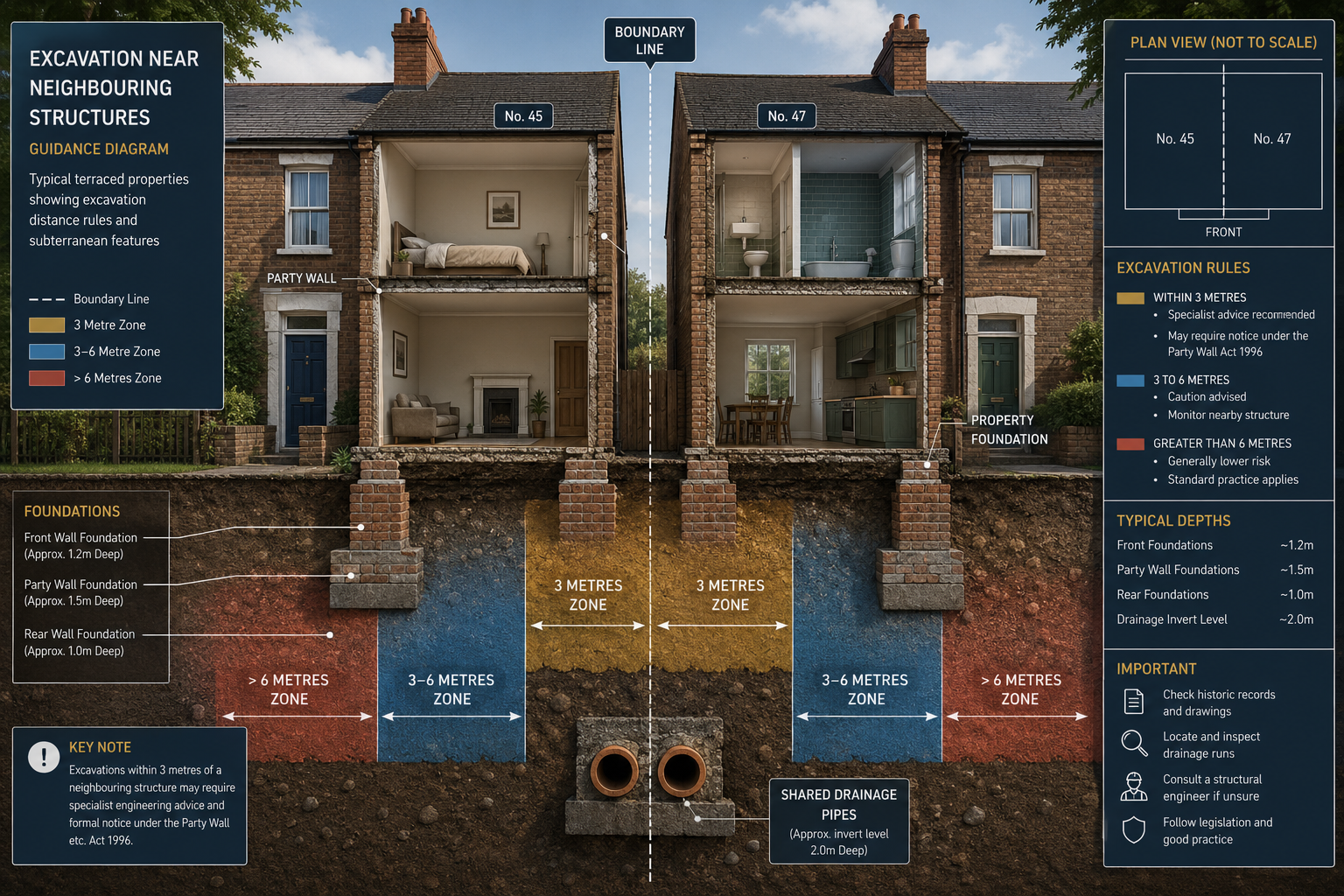
For below-ground works, Section 2 and Section 6 are the critical provisions. Section 2 applies when the party wall itself is being altered — for example, when underpinning is carried out on the shared wall's foundations. Section 6 applies whenever excavation work is carried out close enough to a neighbour's structure to risk affecting their foundations, even if the wall itself is untouched [5].
Why "Below Ground" Matters More Than Most Realise
Victorian and Edwardian terraced houses — which make up a huge proportion of London's housing stock — were typically built on shallow brick footings, sometimes as little as 450mm deep. Modern excavations for rear extensions, basement conversions, or even replacement drainage can easily go deeper than these footings, threatening the stability of the entire neighbouring structure [7].
💡 Pull Quote: "Even a drainage trench for a new soil pipe can be deep enough to undermine a Victorian garden wall's foundations — and that makes it notifiable under Section 6."
This is why the Act's below-ground provisions exist: to ensure that any excavation work near a neighbour's property is notified in advance, properly supervised, and carried out in a way that protects both parties [3].
Section 6 Explained: The 3-Metre and 6-Metre Excavation Rules
Section 6 is the engine of Party Wall Agreements for Shared Drains, Foundations, and Underpinning: What the Act Covers Below Ground. It sets out two distinct geometric tests that determine whether a notice must be served before excavation begins.
The 3-Metre Rule (Section 6(1))
If you plan to excavate within 3 metres of a neighbouring building or structure, and your excavation will go deeper than the bottom of that neighbour's foundations, you must serve a Section 6 notice at least one month before work starts [5].
This catches:
- ✅ Rear extension footings close to a shared boundary wall
- ✅ New drainage trenches running alongside a neighbour's house
- ✅ Basement dig-outs adjacent to a semi-detached neighbour
- ✅ Retaining walls for sloped gardens
The 6-Metre Rule (Section 6(2))
If you plan to excavate within 6 metres of a neighbouring structure, and your excavation would cut through a line drawn at 45 degrees downward from the bottom of that neighbour's foundations, you must also serve notice [3].
This wider rule catches deeper excavations — such as piled foundations or basement construction — that may not be immediately adjacent to the neighbour but are deep enough to affect the load-bearing soil beneath their footings.
Notice Periods and What Happens Next
- Section 6 notice period: At least 1 month before work begins
- Neighbour's response window: 14 days to consent or dissent
- If no response: A dispute is automatically deemed to have arisen
- Next step: Both parties must appoint surveyors to produce a Party Wall Award
For comparison, works under Section 2 (such as underpinning a party wall) require two months' notice [4]. Understanding this distinction matters — serving the wrong notice, or serving it too late, can halt a project entirely.
For a detailed overview of how notices work and how to respond to them, see this guide on Party Wall Act notices and how to respond.
Underpinning, Special Foundations, and Shared Drains: The Detail
Underpinning Under the Act
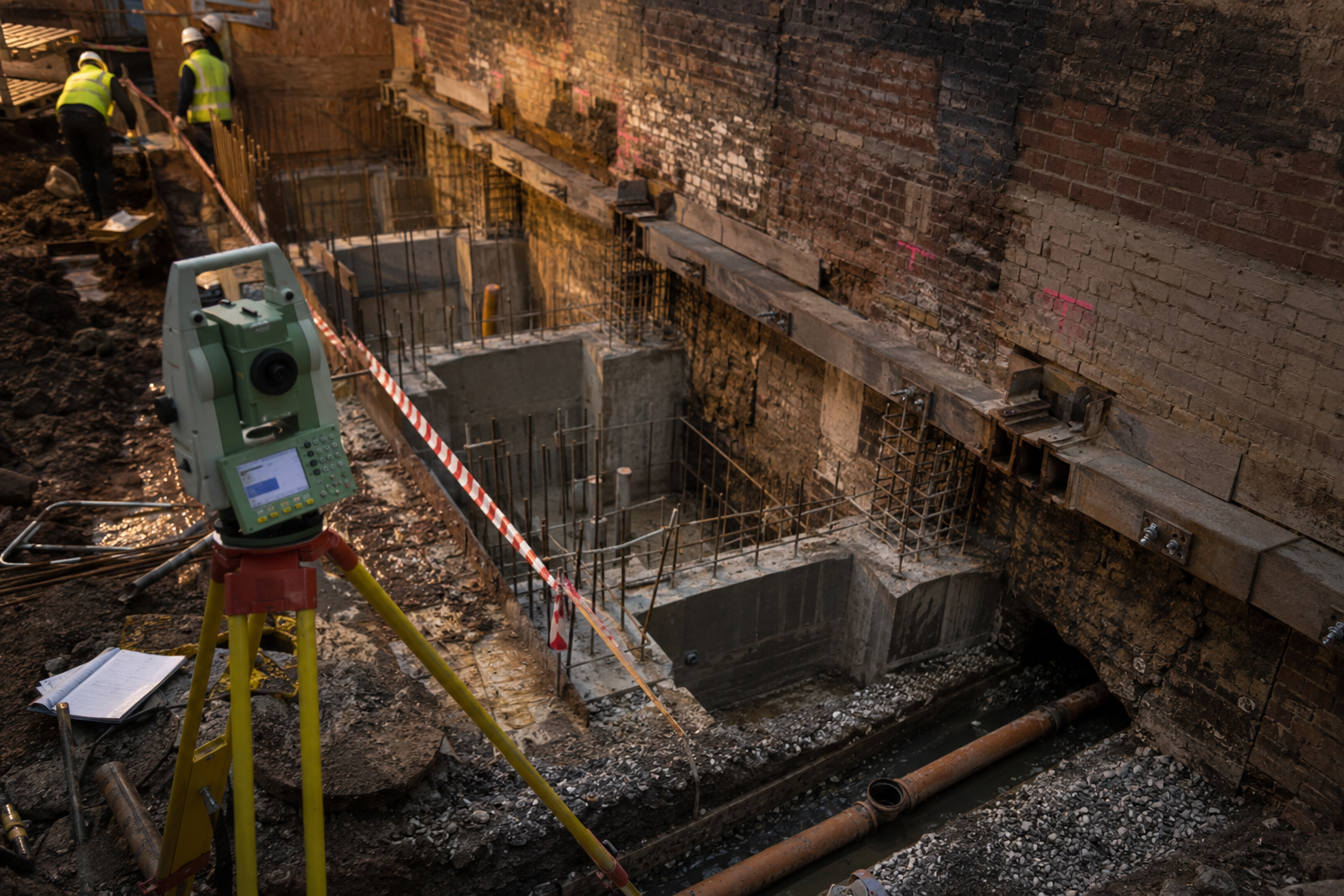
Underpinning — the process of strengthening or deepening existing foundations — is one of the most high-risk below-ground operations in residential construction. It is treated as a major notifiable work under Section 2 of the Act when carried out on or in connection with a party wall, and under Section 6 when it involves excavation near a neighbour's structure [5].
Common underpinning scenarios that require notice:
- Mass concrete underpinning of a shared party wall
- Installing piles adjacent to or beneath a shared boundary
- Deep strip foundations for a new extension within 3m of the neighbour
- Drilling through a party wall for a damp proof course
In almost every underpinning case, a formal Party Wall Award will be required rather than a simple letter of consent. This is because the risk of movement, cracking, and subsidence is significant enough that insurers and surveyors will not rely on informal agreements [6].
⚠️ Important: If underpinning is carried out without proper notice and an Award, the building owner loses the statutory protections the Act provides — including the right to access the neighbour's land and the framework for resolving damage claims.
Special Foundations: The Strictest Rule in the Act
Special foundations are defined under the Act as foundations that use reinforced concrete incorporating metal bars or rods — in other words, anything beyond plain mass concrete. Reinforced rafts, piled-raft foundations, and reinforced strip footings all fall into this category.
Under Section 7(4), a building owner who wishes to place special foundations beneath a neighbour's land must:
- Serve formal notice specifying the intended foundation type
- Obtain the express written consent of the adjoining owner
- If consent is refused, use an alternative foundation design [2]
This rule exists because special foundations can permanently affect a neighbour's ability to develop their own land in the future. If the neighbour dissents, the surveyor will typically require the building owner to use mass concrete underpinning instead — a more expensive but legally compliant alternative [2].
Shared Drains and Below-Ground Services
The Act does not list drains as "party structures" in the way it defines party walls. However, drainage trenches and sewer connections regularly trigger Section 6 because they involve deep, localised excavations close to a neighbour's building or boundary [9].
When drainage work becomes notifiable:
| Scenario | Likely Section Triggered |
|---|---|
| New soil pipe trench within 3m of neighbour's wall | Section 6(1) |
| Sewer connection trench crossing 45° line within 6m | Section 6(2) |
| Diverting a shared drain under a party wall | Section 2 + Section 6 |
| CCTV survey revealing shared drain under boundary | May require Award before any works |
Where historic or shared drains run under a boundary or beneath a building, surveyors in 2026 increasingly recommend treating any associated excavation as notifiable Section 6 work, with a full schedule of condition to document existing drain condition before works begin [9].
For homeowners unsure whether their project triggers these rules, the types of party wall works page provides a useful overview of what falls within the Act's scope.
What a Party Wall Award Must Contain for Below-Ground Works
When a neighbour dissents — or fails to respond within 14 days — a Party Wall Award (also called a Party Wall Agreement in common usage) must be prepared by the appointed surveyor or surveyors. For below-ground works, this document needs to go well beyond a standard above-ground Award in its level of technical detail.
For more on the structure and content of Awards, see this guide on Party Wall Awards.
Essential Provisions for Below-Ground Awards
1. Method Statement for Excavation
The Award should specify how the excavation will be carried out — sequence of bays for underpinning, maximum excavation depths at each stage, temporary propping requirements, and any dewatering measures.
2. Foundation Specification
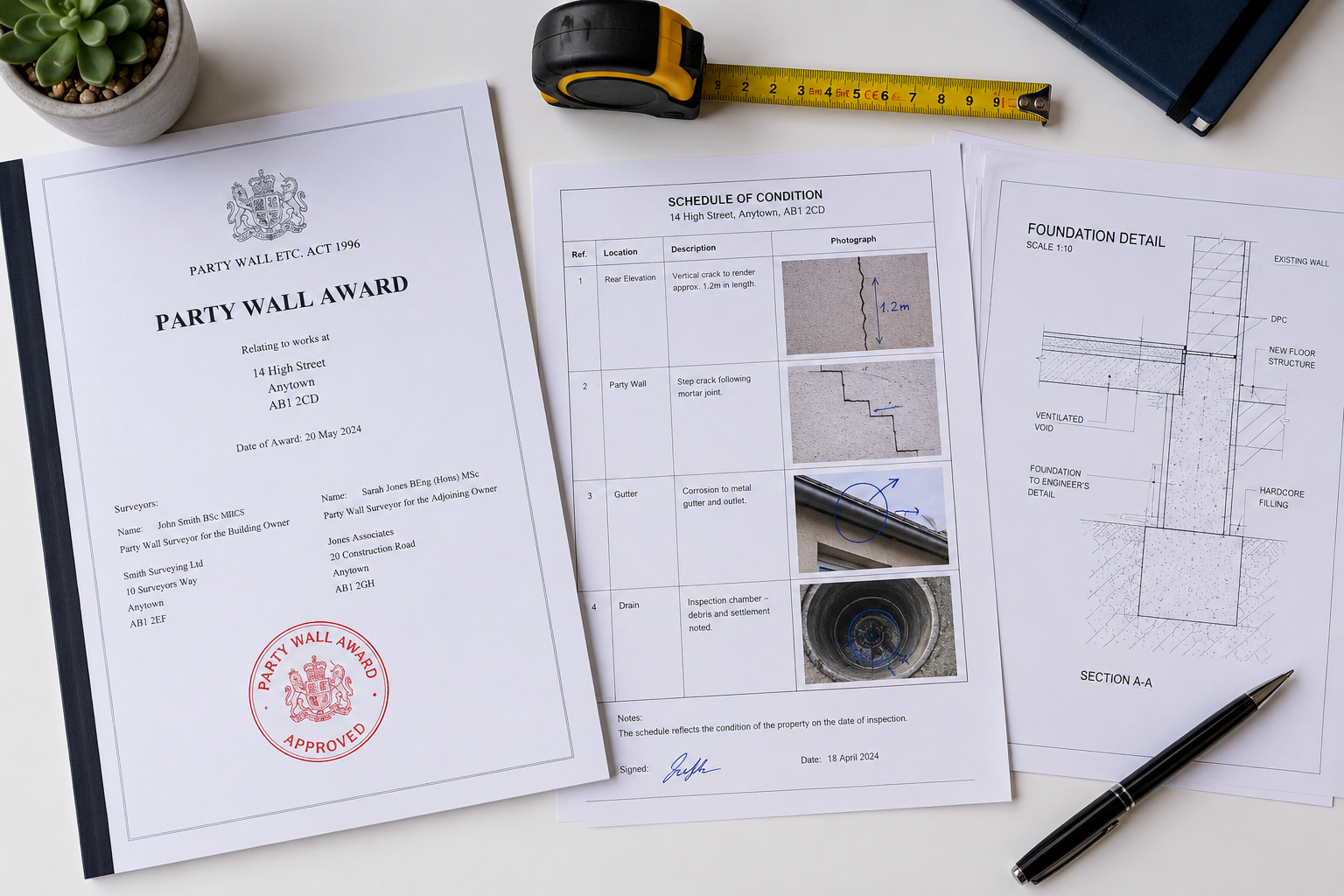
The type of foundation, its depth, and its proximity to the boundary must be clearly stated. For special foundations, the written consent (or the alternative design) must be recorded.
3. Drainage Protection Measures
Where drainage trenches are involved, the Award should specify how existing drains will be protected, whether CCTV surveys are required before and after, and what reinstatement is required.
4. Monitoring Requirements
For underpinning or deep excavations, the Award typically requires crack monitoring on the neighbour's property throughout the works, with agreed trigger levels that would halt construction if movement exceeds safe limits.
5. Schedule of Condition
This is now standard practice. A photographic and written record of the neighbour's property — including existing cracks, drain condition, and structural state — is prepared before works begin. This is the primary tool for resolving any post-works damage claims [1].
6. Access Rights
The Award should confirm the building owner's right to access the adjoining owner's land where necessary for underpinning or drain works, and specify notice requirements for that access.
💡 Pull Quote: "A well-drafted Party Wall Award for underpinning is not a bureaucratic formality — it is the legal framework that protects both neighbours if something goes wrong underground."
Costs, Risk Management, and Practical Steps in 2026
What Does Below-Ground Party Wall Work Cost?
For straightforward residential projects, surveyor fees for a Section 6 Award typically fall in the £1,000–£2,000 plus VAT range where one Award is needed [4]. However, costs can escalate significantly for:
- London basement conversions (two surveyors, complex Awards)
- Piling works close to multiple neighbours
- Disputed shared drain situations requiring CCTV evidence
- Projects where the neighbour appoints their own surveyor (whose fees the building owner pays under the Act)
For a realistic picture of what to budget, see this overview of party wall costs and the process, and for practical ways to reduce expenditure, the guide on how to keep party wall costs down is worth reading before appointing a surveyor.
The Growing Risk of "Minor" Below-Ground Works
Industry practice in 2026 has become notably more cautious about classifying below-ground works as "minor." Surveyors now routinely advise serving notice where any excavation could reasonably go deeper than a neighbour's shallow foundations — even for small residential extensions and replacement drains [6][7].
Why the caution?
- Many older properties have very shallow brick or stone footings (as little as 300–450mm)
- Claims for subsidence and drain damage are increasingly litigated
- Insurers scrutinise whether proper party wall procedures were followed before meeting claims
- Without a Schedule of Condition, it is almost impossible to prove what damage pre-existed the works [1]
Loft Conversions and Combined Projects
Even projects that appear entirely above ground can trigger below-ground party wall obligations. A loft conversion combined with a rear extension, new stair core, or structural alterations requiring new foundations or drainage within 3m of a neighbour will engage both Section 2 and Section 6, requiring separate notices for each element [1].
If you are a building owner planning works, the building owners' section explains your obligations clearly. If you are an adjoining owner whose neighbour is carrying out works, the adjoining owners' section sets out your rights.
Party Wall Agreements for Shared Drains, Foundations, and Underpinning: Avoiding the Most Common Mistakes
Understanding Party Wall Agreements for Shared Drains, Foundations, and Underpinning: What the Act Covers Below Ground also means knowing where things typically go wrong.
❌ Common Mistakes to Avoid
- Assuming verbal consent is enough — It is not. For Section 6 works and special foundations, written consent within the statutory framework is required.
- Serving notice too late — One month (Section 6) or two months (Section 2) before work starts is the legal minimum. Late notice can delay a project by weeks.
- Skipping the Schedule of Condition — Without this document, any pre-existing damage to the neighbour's property may be attributed to your works.
- Using reinforced foundations without checking — Placing special foundations under a neighbour's land without their written consent is a direct breach of the Act.
- Ignoring shared drains — Assuming drainage works are outside the Act's scope is a mistake that regularly leads to disputes and claims.
Conclusion: Actionable Next Steps for Below-Ground Party Wall Works
The Party Wall etc. Act 1996 reaches well below the surface — and in 2026, the industry's approach to subterranean works is more rigorous than ever. Whether planning an extension, a basement conversion, underpinning, or a drainage diversion, the steps below will keep a project legally protected and neighbour relationships intact.
✅ Actionable Next Steps
- Map your excavation zone early. Before design is finalised, check whether any excavation falls within 3m or 6m of a neighbouring structure and how deep their foundations are likely to be.
- Serve the correct notice at the right time. Section 6 notices require one month's notice; Section 2 notices require two months. Serve both if both apply.
- Commission a Schedule of Condition before breaking ground. This single document can save thousands of pounds in disputed damage claims.
- Check your foundation type. If reinforced concrete is planned near the boundary, confirm whether it constitutes "special foundations" and obtain written consent before proceeding.
- Appoint a qualified party wall surveyor. For any below-ground work involving underpinning, piling, or shared drains, professional advice is not optional — it is essential.
- Review the Award carefully. Ensure it contains a method statement, monitoring requirements, drainage protection measures, and clear access rights before works begin.
For expert guidance on any of these steps, the Party Wall Surveyor London team covers all London boroughs and can advise on both building owner and adjoining owner obligations.
References
[1] Party Wall Agreement – https://hoa.org.uk/advice/guides-for-homeowners/i-am-improving/party-wall-agreement/
[2] Party Wall Special Foundations What You Need Know Anstey Horne Tfeie – https://www.linkedin.com/pulse/party-wall-special-foundations-what-you-need-know-anstey-horne-tfeie
[3] Party Wall Section 6 – https://www.houricanassociates.com/party-wall-news/party-wall-section-6/
[4] Party Wall Agreements – https://www.homebuilding.co.uk/advice/party-wall-agreements
[5] Section1 2 6 – https://faulknersurveyors.co.uk/section1-2-6/
[6] Do I Need A Party Wall Agreement – https://collier-stevens.co.uk/advice-hub/party-wall/do-i-need-a-party-wall-agreement/
[7] Party Wall Act 3 Metre Rule – https://hardingsurveyors.co.uk/party-wall-matters/party-wall-act-3-metre-rule
[9] What Is A Party Wall Survey – https://expressdrainagesurveys.co.uk/news/what-is-a-party-wall-survey/
